How Much Does It Cost to Develop an App in 2026? A Detailed Guide
Table of Contents
Subscribe To Our Newsletter
If you’re planning to launch an app in 2026, you’re probably asking the same question every founder, product head, and business owner asks first: how much does it cost to develop a mobile app in 2026 and what exactly are you paying for?
The truth is: there’s no single number that fits every app. The cost to develop a mobile app in 2026 depends on what you’re building (feature depth), how you’re building it (platform + architecture), and who’s building it (team location + seniority + process maturity). A simple app can cost a fraction of what a highly integrated, AI-enabled, enterprise-grade product costs.
This guide breaks down realistic ranges, explains the app development cost breakdown, and helps you do smarter app development budget planning without guessing or getting surprised mid-build.
Quick Answer: Typical App Development Cost in 2026 (Realistic Ranges)
Here’s a practical snapshot of mobile app development pricing 2026 based on complexity. These ranges assume professional development (not a DIY builder) and include core product build, UI/UX, backend, and QA.
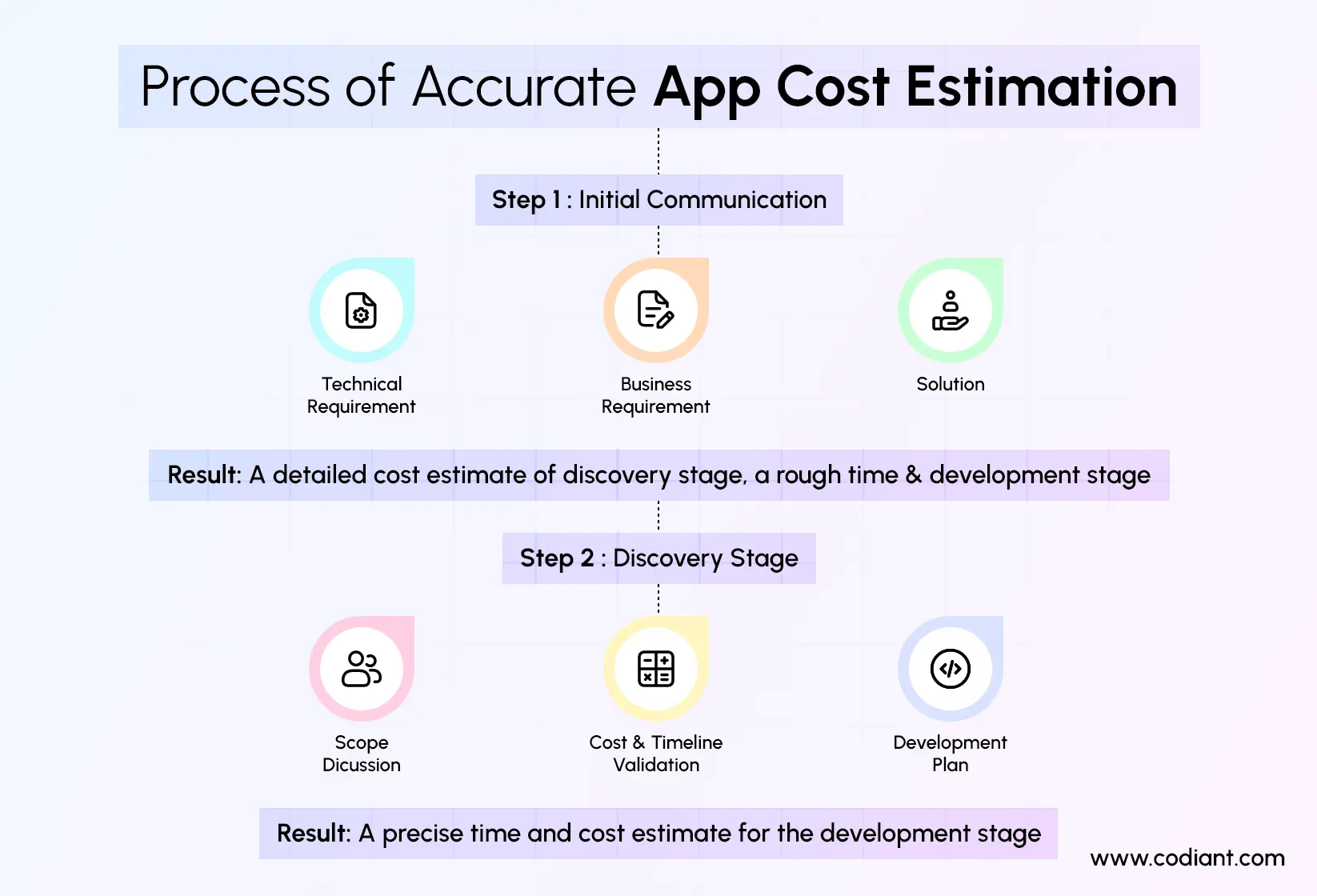
Estimated cost ranges (USD)
- Simple app (basic UI, limited screens, no heavy backend): $15,000 – $50,000
- Medium complexity app (user accounts, payments, APIs, admin panel): $50,000 – $150,000
- Complex app (real-time features, advanced integrations, scalable backend): $150,000 – $400,000+
- Enterprise/AI-heavy app (security, compliance, big data, AI workflows): $300,000 – $1M+
So yes app development cost 2026 can start in the tens of thousands, but it can also scale into six or seven figures when the product scope is large.
Cost by App Type: What You Build Changes Everything
Different app categories come with very different technical, security, and scalability requirements. This is why custom app development cost 2026 can vary dramatically depending on the type of product you’re building.
Estimated App Development Cost by App Type (2026)
| App Type | Typical Features Included | Estimated Development Cost (USD) |
| Basic Utility App | Simple UI, limited screens, local data storage, minimal backend | $15,000 – $60,000 |
| Marketplace App | Buyer & seller roles, payments, listings, ratings, admin panel | $80,000 – $300,000+ |
| On-Demand Service App | Booking flows, real-time tracking, dispatch logic, notifications | $100,000 – $350,000+ |
| Social App | User profiles, feeds, chat, content moderation, media handling | $150,000 – $500,000+ |
| Fintech App | KYC, secure payments, compliance, audit logs, fraud prevention | $200,000 – $1,000,000+ |
| Healthcare App | Secure data handling, audit trails, role-based access, compliance | $200,000 – $1,000,000+ |
| AI-Powered App | AI models, data pipelines, personalization, automation workflows | $200,000 – $1,000,000+ |
Why Costs Increase for Certain App Types?
Apps in fintech, healthcare, and AI categories require advanced security, compliance readiness, scalable infrastructure, and custom workflows. These requirements significantly raise the cost to develop a mobile app compared to simpler consumer utilities.
Before You Budget Blindly
Get clarity on features, platforms, and costs so your app investment aligns with real business outcomes.
iOS vs Android vs Cross-Platform: Which Costs More in 2026?
Choosing between iOS, Android, or cross-platform development is one of the biggest cost decisions you’ll make when planning an app in 2026. This choice doesn’t just affect your initial app development cost it also shapes your long-term maintenance budget, scalability, time-to-market, and feature flexibility.
Cost Comparison Table: iOS vs Android vs Cross-Platform (2026)
| Approach | Codebases | Initial Cost Range (USD) | Time to Market | Maintenance Cost | Best For |
| Native iOS only | 1 | $30K – $150K | Medium | Medium | iOS-focused audiences, premium UX |
| Native Android only | 1 | $30K – $150K | Medium | Medium | Android-heavy markets |
| Native iOS + Android | 2 | $120K – $300K+ | Slowest | High | Performance-critical, enterprise apps |
| Cross-platform (Flutter / RN) | 1 | $50K – $250K | Fast | Lower | MVPs, SaaS, marketplaces |
| Single platform MVP first | 1 | $25K – $80K | Fastest | Low initially | Budget-conscious validation |
Let’s break down each option in detail, including when it makes sense, what it costs, and what trade-offs to expect.
Option A: Native iOS + Native Android Development
Native development means building two separate applications, each optimized specifically for its platform one for iOS and one for Android.
Why native apps cost more
With native development:
- You maintain two codebases
- You often need two specialized developer skill sets
- Features must be built, tested, and maintained twice
- OS updates and bug fixes happen independently
However, this approach delivers the highest level of performance and platform fidelity.
Pros of native iOS + Android apps
- Best-in-class performance and responsiveness
- Superior UI polish aligned with platform guidelines
- Full access to device-level features (camera, sensors, Bluetooth, background tasks)
- Better support for complex animations, AR/VR, and heavy real-time processing
- Ideal for apps with demanding UX or hardware integration needs
Cons of native iOS + Android apps
- Higher upfront development cost
- Longer development timelines
- Increased long-term maintenance expenses
- Separate QA cycles and releases
Typical cost impact in 2026
Native development usually costs 1.6x to 2.2x more than building for a single platform, depending on app complexity.
Approximate cost ranges (USD):
- Medium-complexity native iOS app: $60,000 – $150,000
- Medium-complexity native Android app: $60,000 – $150,000
- Combined native iOS + Android build: $120,000 – $300,000+
This is why iOS and Android app development cost is often the first strategic decision founders and enterprises must make.
Option B: Cross-Platform Development (Flutter / React Native)
Cross-platform development uses a single shared codebase to deploy apps on both iOS and Android. In 2026, this approach has matured significantly and is now widely used for MVPs, SaaS apps, marketplaces, and internal enterprise tools. So, is it cheaper to build a cross-platform app?
In most cases, yes because teams write core logic once, reduce duplicated effort, and streamline testing and maintenance, making it a cost-efficient choice for businesses aiming to launch faster without sacrificing quality.
Why cross-platform apps cost less
With cross-platform development:
- Core logic is written once and reused
- UI components are largely shared
- Fewer developers are required
- QA and release cycles are faster
This leads to lower development and maintenance costs especially for feature-rich but non-hardware-intensive apps.
Pros of cross-platform apps
- One codebase for iOS and Android
- Faster development and launch timelines
- 20–40% cost savings compared to fully native builds
- Easier long-term maintenance and updates
- Strong performance for most business and consumer apps
Cons of cross-platform apps
- Edge-case limitations for very platform-specific features
- Advanced native capabilities may still require custom native modules
- Slightly less flexibility for extreme UI or hardware-heavy use cases
Typical cost impact in 2026
For many apps, cross-platform development offers the best balance between cost, speed, and quality.
Approximate cost ranges (USD):
- Simple cross-platform app: $25,000 – $60,000
- Medium-complexity cross-platform app: $50,000 – $120,000
- Complex cross-platform app: $120,000 – $250,000
For start-ups and scaling businesses, this option often defines modern mobile app development pricing 2026.
Option C: Start with One Platform (iOS or Android First)
If budget or timelines are tight, launching on a single platform first is a smart MVP strategy. This approach allows teams to validate demand before committing to a full multi-platform investment.
When single-platform development makes sense
- Your target audience is heavily skewed toward iOS or Android
- You need to launch quickly to test traction
- You want to validate product-market fit before scaling
- Your app relies on early user feedback to refine features
Pros of starting with one platform
- Lowest initial development cost
- Faster time to market
- Focused UX and feature refinement
- Easier pivoting based on real user behavior
Cons of starting with one platform
- Limited reach initially
- Second platform still requires additional investment later
- Some rework may be needed if architecture wasn’t planned for expansion
Typical cost impact in 2026
Starting with iOS or Android allows focused development and faster go-to-market. It helps optimize resources while testing user demand early.
Approximate cost ranges (USD):
- Single-platform MVP (iOS or Android): $25,000 – $80,000
- Later expansion to second platform: +50–70% of original build cost
This phased approach is common in strong app development budget planning strategies.
Which Option Is Best in 2026?
There’s no universal winner but there is a best-fit choice based on your goals:
- Choose native iOS + Android if performance, polish, and device-level control are mission-critical.
- Choose cross-platform if you want faster launches and lower costs without sacrificing quality.
- Choose single-platform first if you’re validating an idea or operating under tight budget constraints.
App Development Cost by Team Size and Location
Beyond technology choices and app complexity, who builds your app and where they are located plays a major role in overall development cost. Hourly rates vary significantly across regions due to differences in labor markets, operating expenses, technical maturity, and demand for skilled engineers.
In 2026, many businesses balance cost efficiency with expertise by choosing distributed or hybrid development teams. Below is a realistic overview of average hourly app development rates by region, helping you estimate costs more accurately during early-stage app development budget planning.
Average Hourly App Development Rates by Region (2026)
| Region | Typical Hourly Rate (USD) | Cost Perspective |
| North America | $30 – $120 | Premium pricing with high seniority and strong product expertise |
| Latin America (East & Central) | $20 – $50 | Cost-effective nearshore option with growing talent pools |
| Western & Northern Europe | $30 – $70 | Strong engineering standards with moderate-to-high pricing |
| South, Central & Eastern Europe | $30 – $60 | Popular outsourcing region balancing quality and affordability |
| Middle East | $40 – $70 | High-quality talent with regional domain expertise |
| Africa | $25 – $40 | Emerging tech markets with competitive pricing |
| Eastern Asia | $20 – $60 | Large talent base supporting both startups and enterprises |
| Southeast Asia | $20 – $50 | Budget-friendly region suited for MVPs and scale builds |
| Oceania / Australia | $40 – $70 | High-quality development with premium operational costs |
How Team Size Impacts Total App Development Cost
Location determines hourly rates, but team size determines velocity and timeline. A small team may reduce monthly burn but extend delivery time, while a larger team increases upfront cost but accelerates time to market.
Typical team structures include:
- Small team (3–4 members): Best for MVPs and validation builds.
- Mid-size team (5–8 members): Suitable for feature-rich apps and platform builds.
- Large team (10+ members): Required for enterprise-grade, high-scale applications.
Cost Estimation Based on App Features, Functionalities, and API Integrations
App features and functionalities are the primary drivers of development cost. While it’s tempting to pack your product with advanced capabilities, the smartest approach in 2026 is to prioritize essential features first the ones your app cannot function without.
Instead of building everything from scratch, many teams reduce development time and cost by integrating reliable third-party APIs for common functionalities like authentication, chat, payments, and notifications. This ensures faster launches while maintaining performance and scalability.
Below is an approximate cost overview of commonly used app features, including AI-powered solution capabilities, categorized by complexity and implementation approach.
Estimated Development Cost by App Features (2026)
| Feature | Key Functionalities | Avg. Development Cost (USD) |
| User Authentication | Email/phone signup, social login, password recovery, logout | $500 – $5,000+ |
| User Profile Management | Profile details, preferences, profile photo updates | $3,000 – $8,000+ |
| In-App Chat & Calling | User-to-user messaging, voice calls, end-to-end encryption | From scratch: $3,000 – $20,000+ API-based: $500 – $10,000+ |
| Push Notifications | Alerts, reminders, transactional and promotional notifications | $500 – $5,000+ |
| Admin Panel (Basic) | User management, content moderation, query handling | $1,500 – $8,000+ |
| Payment Gateway Integration | Secure payments, refunds, transaction handling | $1,500 – $7,000+ |
| Maps & Location Services | Live location access, route mapping, destination pinning | $1,500 – $7,000+ |
| AI Chatbot / Virtual Assistant | Automated user support, FAQs, contextual responses | $3,000 – $15,000+ |
| AI Recommendations | Personalized content, product or service suggestions | $5,000 – $25,000+ |
| AI Search & Smart Filters | Natural language search, intent-based filtering | $4,000 – $20,000+ |
| AI Analytics & Insights | User behavior analysis, predictive insights, reporting | $6,000 – $30,000+ |
Key Cost Insight
Feature pricing is never fixed. The final cost depends on:
- Number of features included
- Custom logic and workflows
- Third-party API usage and licensing
- Security, performance, and scalability requirements
The more complex and interconnected your features are, the higher your overall app development cost will be. That’s why focusing on must-have features first is critical for controlling budgets and achieving faster time to market.
Relatable reading: How to Choose the Right AI Solutions for Your Existing App
App Development Cost Breakdown (What You’re Actually Paying For)
When people ask about app development cost 2026, they often expect a single number. In reality, app development is a layered process made up of multiple workstreams each contributing directly to the final cost, quality, and scalability of the product.
Understanding this app development cost breakdown helps you make better decisions, avoid hidden expenses, and plan a realistic budget from day one. Below are the core building blocks that account for nearly every professional mobile app project in 2026.
1. Product Discovery and Planning (5–15% of Total Budget)
Product discovery is the foundation of your entire app. This phase determines what gets built, why it’s built, and how it should evolve over time. While it may seem optional to some teams, skipping discovery often leads to costly rework later.
What this phase includes:
- Stakeholder and requirements workshops to align business goals
- User journey mapping to understand real user behavior
- Feature prioritization to define MVP vs future releases
- Technical feasibility analysis and architecture planning
- Risk identification and dependency mapping
- Sprint planning, delivery milestones, and roadmap creation
Why it impacts cost:
Clear planning reduces scope creep, prevents unnecessary features, and minimizes development backtracking. Teams that invest properly in discovery often save 20–30% of total development costs by avoiding mid-project changes.
In short, discovery doesn’t add cost it protects your app development budget planning.
2. UI/UX Design (10–25% of Total Budget)
Design is not just about how the app looks it’s about how users experience it. In 2026, users expect fast, intuitive, and visually polished apps, regardless of industry.
What this phase includes:
- Low-fidelity wireframes to structure screens and flows
- Clickable prototypes to validate navigation and interactions
- Visual design systems (colors, typography, components)
- Mobile UI screens for iOS and Android
- Responsive and adaptive layouts where required
- UX writing, including button labels, onboarding text, and error messages
Why design costs vary:
Design cost increases with:
- Number of screens and user flows
- Multiple user roles (users, admins, vendors, etc.)
- Custom animations or branded interactions
- Iteration cycles based on feedback or testing
A stronger design phase often leads to higher user adoption and lower churn making it a strategic investment, not just a visual one.
3. Frontend App Development (25–45% of Total Budget)
Frontend development is where the design comes to life. This is the actual mobile application users interact with on their devices.
What this phase includes:
- Implementing UI designs into functional app screens
- Navigation logic and state management
- Handling device-level permissions (camera, microphone, GPS, storage)
- Offline and low-network behavior handling
- Performance tuning for speed and responsiveness
- Platform-specific adaptations for iOS and Android
- Preparing the app for App Store and Play Store guidelines
Why this is a major cost component:
Frontend work is highly dependent on:
- Platform choice (iOS, Android, or both)
- Native vs cross-platform frameworks
- Feature complexity (real-time updates, animations, media handling)
This is where iOS and Android app development cost can differ significantly, especially if both platforms are built natively with separate codebases.
4. Backend Development (15–35% of Total Budget)
If the frontend is the visible part of your app, the backend development is the engine running behind it. Any app that stores data, manages users, syncs content, or integrates with other systems requires a robust backend.
What this phase includes:
- API development to connect mobile apps with servers
- Database design and data modeling
- User authentication and authorization systems
- Role-based access control
- Admin dashboard logic and management tools
- Business rules and workflow automation
- Integration with third-party services (payments, maps, CRM, analytics)
What drives backend cost higher:
- Multiple user roles and permissions
- Real-time data syncing
- High scalability or multi-tenant architecture
- Complex workflows and business rules
- Security and data compliance requirements
As apps evolve from simple tools into full platforms, backend scope becomes one of the most significant contributors to custom app development cost 2026.
5. QA Testing and Performance Optimization (10–20% of Total Budget)
Quality assurance is no longer a final checklist it’s an ongoing process throughout development. In 2026, users expect apps to work flawlessly across devices, OS versions, and network conditions.
What this phase includes:
- Manual testing for usability and functional accuracy
- Automated testing for repeated scenarios and regressions
- Cross-device and cross-OS testing
- Performance and load testing
- Security testing for data-sensitive apps
- Bug tracking, fixing, and verification cycles
Why QA affects cost:
Testing effort grows with:
- Number of features and screens
- Supported devices and OS versions
- Frequency of releases
- Security and compliance needs
Well-tested apps reduce post-launch failures, negative reviews, and costly hotfixes making QA a critical part of the mobile app development cost guide.
6. DevOps, Deployment, and Release (5–15% of Total Budget)
This phase ensures your app can be reliably built, deployed, and maintained after launch. Modern app development relies heavily on automation and cloud infrastructure.
What this phase includes:
- CI/CD pipeline setup for automated builds and deployments
- Cloud infrastructure configuration
- Environment setup (development, staging, production)
- Monitoring, logging, and alerting systems
- App Store and Play Store submission support
- Release management and versioning
Why DevOps matters in 2026:
Teams now integrate DevOps early to:
- Speed up releases
- Reduce deployment errors
- Support frequent updates and scaling
- Improve long-term maintainability
Ignoring DevOps upfront often leads to slower releases and higher operational costs later.
Why Understanding This Breakdown Matters?
When you understand what you’re actually paying for, app development pricing stops feeling arbitrary. Each phase directly impacts performance, scalability, user experience, and long-term cost of ownership.
For accurate app development budget planning, it’s not enough to ask how much does it cost to build an app you need to know where that money goes and why each part matters.
What Factors Influence App Development Cost?
App development cost depends on a mix of technical choices, feature complexity, and execution strategy. In 2026, the most important cost-influencing factors include:
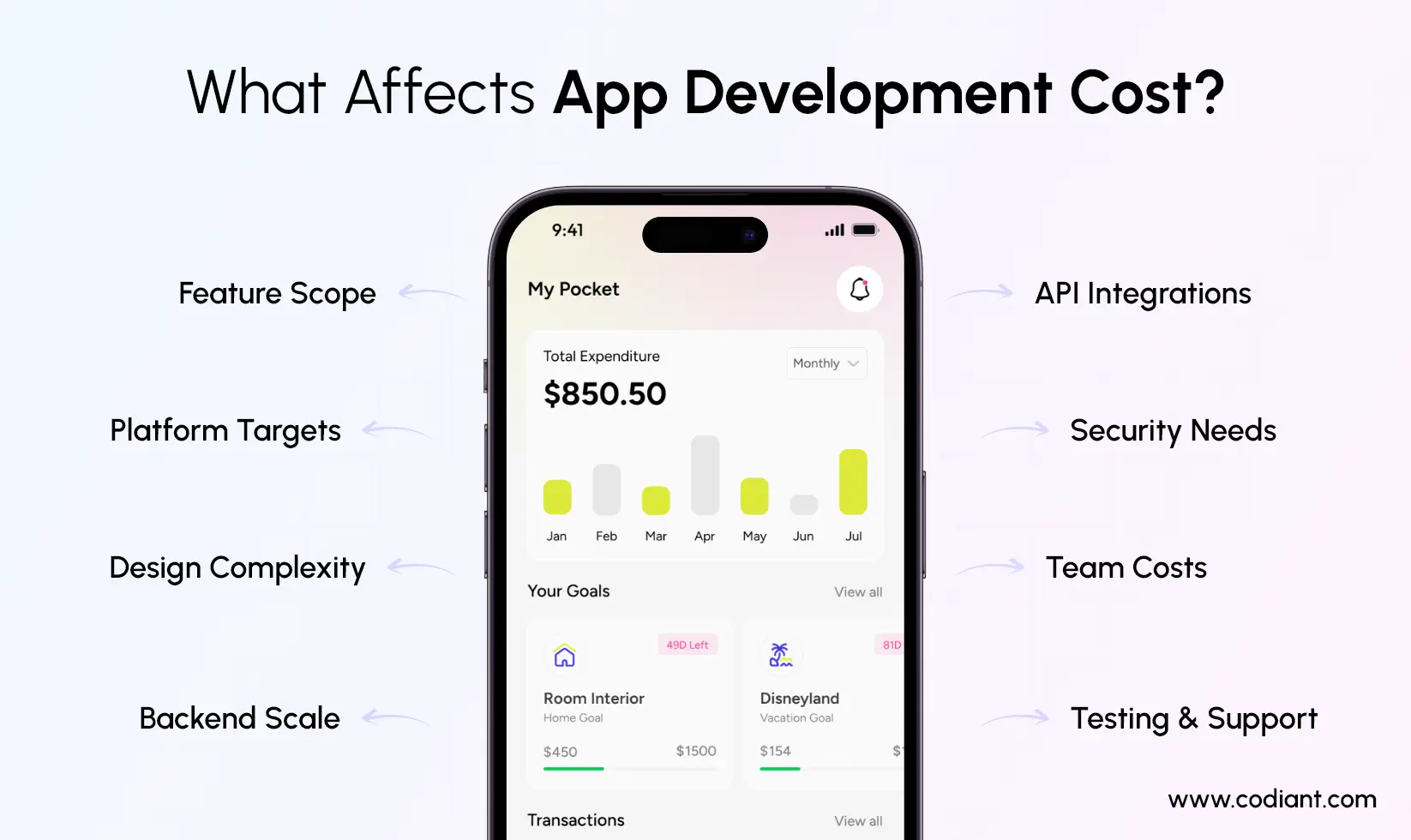
- App complexity & features: More features, user roles, and workflows directly increase development and testing effort.
- Platform selection: Building for iOS, Android, or both impacts cost, with cross-platform reducing overall effort.
- UI/UX design level: Custom designs, animations, and branded experiences cost more than standard layouts.
- Backend & scalability needs: User accounts, real-time data, integrations, and future scalability add to development scope.
- Third-party APIs & integrations: Payments, maps, chat, analytics, and AI services influence both build and recurring costs.
- Security & compliance requirements: Apps handling sensitive data require advanced security measures and testing.
- Team size & location: Developer rates vary by region, experience, and team structure.
- Testing, maintenance & updates: Ongoing QA, OS updates, and performance improvements must be budgeted beyond launch.
Still Unsure What Your App Will Really Cost?
Talk through your app idea with experts and uncover realistic costs before you commit time or money.
How Long Does App Development Take in 2026?
One of the most common questions businesses ask right after how much does it cost to build an app is how long app development actually takes. In 2026, development timelines are faster than they were a few years ago, but they still vary widely based on scope, technology choices, and execution quality.
There is no one-size-fits-all timeline. App development is a multi-phase process, and the total duration depends on what you’re building, how complex it is, and how prepared you are before development starts.
Average App Development Timelines in 2026
Here’s a realistic breakdown of how long different types of apps take to build in 2026:
| App Complexity | Typical Timeline |
| Simple app (basic features, minimal backend) | 2–3 months |
| Medium-complexity app (user accounts, payments, APIs) | 3–6 months |
| Complex app (real-time features, integrations, scalability) | 6–9 months |
| Enterprise or AI-driven app | 9–12+ months |
These timelines assume a professional development team using modern frameworks, agile delivery, and continuous testing.
Phase-by-Phase Development Timeline
Understanding where time is spent helps set realistic expectations and avoid delays.
- Discovery & Planning (2–4 weeks)
This phase includes requirements gathering, user flow mapping, feature prioritization, and technical architecture planning. Strong discovery reduces rework later and shortens overall delivery time. - UI/UX Design (3–6 weeks)
Design teams create wireframes, clickable prototypes, and final UI screens. Apps with advanced UX, animations, or branding typically spend more time here. - Development (8–24 weeks)
This is the longest phase and includes frontend development, backend logic, API integrations, and platform-specific work. Timelines vary based on:
- Number of features
- Platform choice (iOS, Android, or cross-platform)
- Real-time or AI-driven functionality
- Testing & Quality Assurance (3–6 weeks)
QA runs in parallel with development but intensifies toward the end. This includes functional testing, device testing, security checks, and performance optimization. - Deployment & Launch (1–2 weeks)
Final preparation includes app store submissions, production configuration, and release approvals. App Store review timelines can also impact launch dates.
What Can Speed Up or Slow Down App Development?
Several factors directly influence how fast an app can be built in 2026:
Faster timelines when:
- Requirements are clearly defined early
- MVP scope is well-controlled
- Cross-platform frameworks are used
- APIs and third-party services are leveraged
- Stakeholders provide quick feedback
Longer timelines when:
- Features keep expanding mid-project
- Multiple user roles and workflows exist
- Heavy compliance or security requirements apply
- AI models require training and tuning
- Native iOS and Android apps are built separately
Cost of Hiring a Dedicated Mobile App Development Team
With the dedicated or hourly hiring model, businesses assemble a focused team that works exclusively on their app. This model offers greater cost transparency, flexibility, and control, allowing you to scale resources, pause development, or adjust scope as the product evolves making it ideal for custom and long-term app builds.
Below is an overview of the key roles typically required in a dedicated mobile app development team and their average hourly hiring costs in 2026.
Dedicated Mobile App Team: Roles & Hourly Costs (2026)
| Role | Key Responsibilities | Average Hourly Cost (USD) |
| Project Manager | Owns delivery, timelines, milestones, and cross-team coordination | $40 – $150+ |
| Business Analyst | Gathers requirements, documents scope, manages changes, validates solutions | $25 – $100+ |
| Software Architect | Defines system architecture, ensures scalability and technical standards | $25 – $150+ |
| UI/UX Designer | Designs user flows, wireframes, visual interfaces, and interaction patterns | $25 – $100+ |
| Mobile App Developer | Builds iOS, Android, or cross-platform applications and core features | $25 – $150+ |
| Backend Developer | Develops APIs, server logic, and database integrations | $30 – $100+ |
| QA Engineer | Tests functionality, performance, and stability using manual and automated methods | $20 – $100+ |
Why Companies Choose the Dedicated Hiring Model in 2026
- Clear visibility into development costs
- Ability to scale the team up or down as needed
- Faster iteration cycles and continuous development
- Better alignment with long-term product roadmaps
The Real Cost Drivers: Factors Affecting App Development Cost in 2026
If you want a reliable estimate, focus on the real variables these are the biggest factors affecting app development cost:
1. Feature complexity
Not all features are equal. For example:
- Simple: onboarding screens, static content, basic forms
- Medium: login, profiles, payments, push notifications
- Complex: real-time chat, live tracking, video calls, ML pipelines
2. Number of user roles
A single-user app is cheaper than a system with:
- Customer app
- Provider app
- Admin panel
- Super-admin controls
More roles = more screens + more logic + more QA.
3. Integrations (APIs + third-party tools)
Costs go up when you integrate:
- Payment gateways
- Maps and location services
- CRM or ERP systems
- Analytics and marketing automation
- Identity providers (SSO)
Each integration requires development + testing + ongoing maintenance.
4. Backend architecture and scalability
If you expect 5,000 users, you can build differently than if you expect 5 million.
Cost rises with:
- Multi-tenant design
- Load balancing and caching
- Event-driven systems
- Real-time data syncing
- Database optimization
5. Security and compliance requirements
If your app handles sensitive data (health, finance, kids, identity), you’ll need:
- Encryption at rest and in transit
- Secure session management
- Audit logs
- Role-based access control
- Pen testing and compliance alignment
This can significantly increase the cost to develop a mobile app, but it also reduces real business risk.
6. UI polish and animations
A clean standard UI costs less than a highly branded, motion-heavy experience.
In 2026, users compare your app to the best apps they use daily so “good enough UI” often isn’t good enough anymore.
7. Team composition and location
Rates vary widely based on:
- Region (US/UK/EU vs Eastern Europe vs India/Southeast Asia)
- Seniority mix (junior vs senior-led)
- Process maturity (ad-hoc vs robust delivery)
Cost Examples: What Different Budgets Can Realistically Build
This section helps you map budget to outcome.
1. Budget: $25K – $50K
Best for:
- Single-platform MVP
- Simple app with limited backend
- Basic UI, limited integrations
Avoid:
- Real-time features
- Too many roles
- Heavy admin systems
2. Budget: $50K – $150K
Best for:
- Cross-platform MVP for iOS + Android
- Payments + user accounts
- Admin panel (basic)
- Good UI/UX foundation
This range often fits the “serious MVP” most start-ups need.
3. Budget: $150K – $400K
Best for:
- Complex workflows
- Scalable backend foundation
- Multiple integrations
- Real-time modules (chat, tracking)
- Strong QA + release pipeline
4. Budget: $400K – $1M+
Best for:
- Enterprise-grade platform
- Compliance, audit trails, advanced security
- AI personalization or automation pipelines
- Multi-region scalability
- High availability + performance engineering
Hidden Costs People Forget (But Should Budget For)
A strong mobile app development cost guide must include ongoing costs. Your app isn’t “done” when it launches.
1. Maintenance and upgrades
Plan 15–25% of the build cost per year for:
- OS updates
- Bug fixes
- Performance improvements
- Library upgrades
2. Cloud and infrastructure
Costs vary based on usage:
- Hosting + database
- Storage (images, video)
- CDN
- Logs and monitoring
Small MVPs may spend low hundreds/month; high-scale products can spend thousands/month or more.
3. Third-party services
Common tools with recurring fees:
- SMS/OTP verification
- Email sending
- Push notification tooling
- Analytics and event tracking
- Customer support chat
4. App store accounts, legal, and compliance
You may also need:
- Privacy policy and terms
- Cookie tracking disclosures (if you have web)
- Compliance reviews for regulated industries
How to Estimate Your App Cost in 2026 (A Simple, Practical Framework)
If you’re trying to estimate app development cost 2026 without a detailed technical specification, this step-by-step framework helps you arrive at a realistic budget range early before engaging developers or requesting formal proposals.
Rather than guessing a number, this approach breaks cost estimation into clear, decision-driven steps that directly influence scope, effort, and pricing.
Step 1: Define Your Version-1 Scope (MVP)
Start by outlining what your app must do on day one to deliver value. This helps avoid overbuilding and keeps early costs under control.
Focus on:
- Core user flow: The primary action users come to your app for
- 8–12 must-have features: Essential functionality without which the app cannot operate
- 3–5 “nice-to-have later” features: Enhancements that can be scheduled post-launch
A clearly defined MVP is one of the most effective ways to manage custom app development cost in 2026.
Step 2: Choose Your Platform Strategy
Next, decide how and where your app will be launched. Platform selection has a direct and significant impact on both development time and budget.
Choose one:
- iOS only
- Android only
- Cross-platform (single codebase for both)
- Fully native for both iOS and Android
This decision heavily influences iOS and Android app development cost, as native builds require separate development and maintenance efforts.
Step 3: Identify User Roles and Access Levels
Determine how many different user types your app will support.
Ask:
- Is the app designed only for end users?
- Do you need an admin panel?
- Are there additional roles like vendors, service providers, or managers?
Each new role adds screens, logic, permissions, and testing incrementally increasing overall development cost.
Step 4: List Required Integrations
Third-party integrations often save time but still add complexity.
Common integrations include:
- Payment gateways
- Maps and location services
- CRM or ERP systems
- Analytics and marketing tools
Even two or three integrations can noticeably impact scope, timeline, and mobile app development pricing 2026, so it’s important to account for them early.
Step 5: Define Your Quality and UX Expectations
Finally, decide the level of visual and experiential polish your app requires.
Typical quality levels include:
- Basic functional UI: Minimal design, focused on usability
- Strong brand UI: Custom design aligned with brand identity
- Premium UI with animations: High-fidelity visuals, motion design, and micro-interactions
Higher UI expectations require more design time, frontend effort, and testing raising overall app development cost.
Read more: Top 15 Mobile App Development Companies in USA in 2026
App Development Budget Planning: How to Spend Smarter
If you want to control costs without lowering product quality, these practical strategies work well in 2026:
- Start small, then grow: Build only the core features needed to launch. Add advanced features after users start using the app.
- Focus on features that matter: Prioritize features that help you attract users, keep them engaged, or generate revenue. Delay everything else.
- Use cross-platform development when suitable: You don’t always need separate apps for iOS and Android. One shared build often saves time and money.
- Plan before you build: Clear planning early helps avoid changes, delays, and extra costs later.
- Build for growth, not complexity: Design the app so it can scale over time, without adding unnecessary systems too early.
How Codiant Can Help You Plan and Control App Development Cost?
Codiant helps businesses estimate, plan, and optimize app development cost in 2026 using a structured, engineering-led approach that removes uncertainty from early decision-making. We focus on clarity first so budgets are realistic, controlled, and aligned with business outcomes.
Our approach includes:
- Detailed product discovery to define the right MVP scope and avoid overbuilding
- Platform strategy guidance (native, cross-platform, or phased rollout) based on ROI and scalability
- Feature prioritization that separates must-haves from future enhancements
- Transparent pricing models with clear cost visibility at every stage
- Senior-led architecture planning to reduce rework and long-term maintenance costs
- Scalable delivery frameworks that support faster launches and future growth
With Codiant, you don’t just get an estimate you get a cost-controlled development roadmap designed to deliver value quickly, scale smoothly, and maintain quality without budget surprises.
Final Thoughts: Treat Cost as a Strategy, Not a Guess
If you came here looking for one fixed number, here’s the better takeaway: the app development cost breakdown is predictable when the scope is clear, the priorities are sharp, and the build approach matches the product stage.
In 2026, the real winners aren’t the teams that build the cheapest app they’re the teams that build the right version first, launch faster, learn from users, and scale with confidence.
If you want, share your app idea (industry + key features + platforms), and I’ll map it into a realistic estimate using this same app development budget planning framework.
Thinking About Building an App?
Let’s break down your idea, priorities, and budget to see what’s practical and what’s not.
The Author

Frequently Asked Questions
The total cost depends on app complexity, number of features, platform choice (iOS, Android, or cross-platform), backend requirements, third-party integrations, UI/UX expectations, and the development team’s location and expertise.
Higher complexity means more screens, workflows, integrations, security layers, and testing efforts. Simple apps cost less, while feature-rich, real-time, or AI-powered apps significantly increase development time and budget.
Post-launch costs include app maintenance, cloud hosting, third-party API subscriptions, OS updates, performance optimization, security patches, and feature enhancements typically 15–25% of the initial build cost annually.
Yes. Costs can be optimized by building a focused MVP, using cross-platform frameworks where suitable, prioritizing must-have features, leveraging proven APIs, and investing in upfront discovery to avoid rework later.
Businesses should define MVP scope, select a platform strategy, identify user roles and integrations, set UX quality expectations, and then map these decisions to effort-based cost ranges for accurate budget planning.
In 2026, the average cost of iOS vs Android app development is largely comparable, typically ranging between $30,000 and $150,000 per platform. Costs vary based on app complexity, device fragmentation on Android, platform-specific design standards, and required integrations. Building for both platforms increases total development and long-term maintenance costs significantly.
Featured Blogs
Read our thoughts and insights on the latest tech and business trends

Top 15 Mobile App Development Companies in USA in 2026
- January 8, 2026
- Mobile App Development
In a Nutshell: The USA is home to some of the world’s most reliable mobile app development companies, serving startups to Fortune-level enterprises. Top mobile app developers in the USA offer end-to-end services, from product... Read more

How AI Reduces Patient Wait Times by 50% in UAE Hospitals
- January 6, 2026
- Artificial Intelligence Healthcare
In a Nutshell AI helps UAE hospitals reduce patient wait times by up to 50% using smart triage, predictive scheduling, and automated patient flow management. Emergency departments benefit from faster severity scoring, load balancing, and... Read more
Integrating NLP Into Your Existing App: From Text Analytics to Conversational Interfaces
- December 29, 2025
- Artificial Intelligence Mobile App Development
Natural Language Processing has moved from a niche capability to an essential part of modern software, and 2025 has clearly shown its impact. Businesses are no longer rebuilding entire systems to keep up with user... Read more