How to Hire a Dedicated Development Team? All You Need to Know.
Table of Contents
Subscribe To Our Newsletter

Summarize with AI
Not enough time? get the key points instantly.
In 2026, agility, speed, and tech expertise aren’t just advantages—they’re business survival tools. That’s exactly why companies, from lean startups to billion-dollar enterprises, are increasingly turning to dedicated development teams instead of expanding their in-house IT departments.
The logic is straightforward! Technology doesn’t wait, and hiring delays can cost you more than just time. With a dedicated development team, you gain instant access to specialized skills, 24/7 productivity, and the flexibility to scale your projects up or down as needed without getting entangled in recruitment overhead or long-term HR liabilities.
Let’s say you’re a startup in the U.S. pushing hard to launch your MVP. Or a SaaS brand expanding rapidly. Or maybe a legacy enterprise seeking modernization. A dedicated software development team equips you with precisely what you need including speed, expertise, and control—without inflating your payroll.
Did You Know?
Over 60% of global companies outsourced software development last year to cut costs and access global tech talent, and that trend is only intensifying in 2026. If you’re considering custom software development, understanding how to hire dedicated software developers could be the most strategic move you make this year.
What Is a Dedicated Development Team?
A dedicated development team is an external group of tech professionals hired exclusively for your project. They are not like freelancers who juggle clients or in-house employees who serve broader roles, dedicated developers work solely on your software initiatives. As your business expands globally, setting up a virtual office, building a reliable remote development team can support your growing needs.
This software development dedicated team model is ideal when you need technical consistency, long-term commitment, and custom solutions.
Comparison Breakdown:
| Model | Ownership | Engagement | Control | Best For |
| In-House | Full-time | High Cost | High | Long-term product lifecycle |
| Freelancers | Contract-based | Low Cost | Low | Short, niche-based tasks |
| Dedicated Team | Full-time/Project-based | Mid Cost | High | MVPs, Scaling, Innovation Projects |
Power Tip – Many US-based companies choose to hire remote development teams from India, Eastern Europe, and Latin America to balance cost and quality.
When Should You Hire a Dedicated Team?
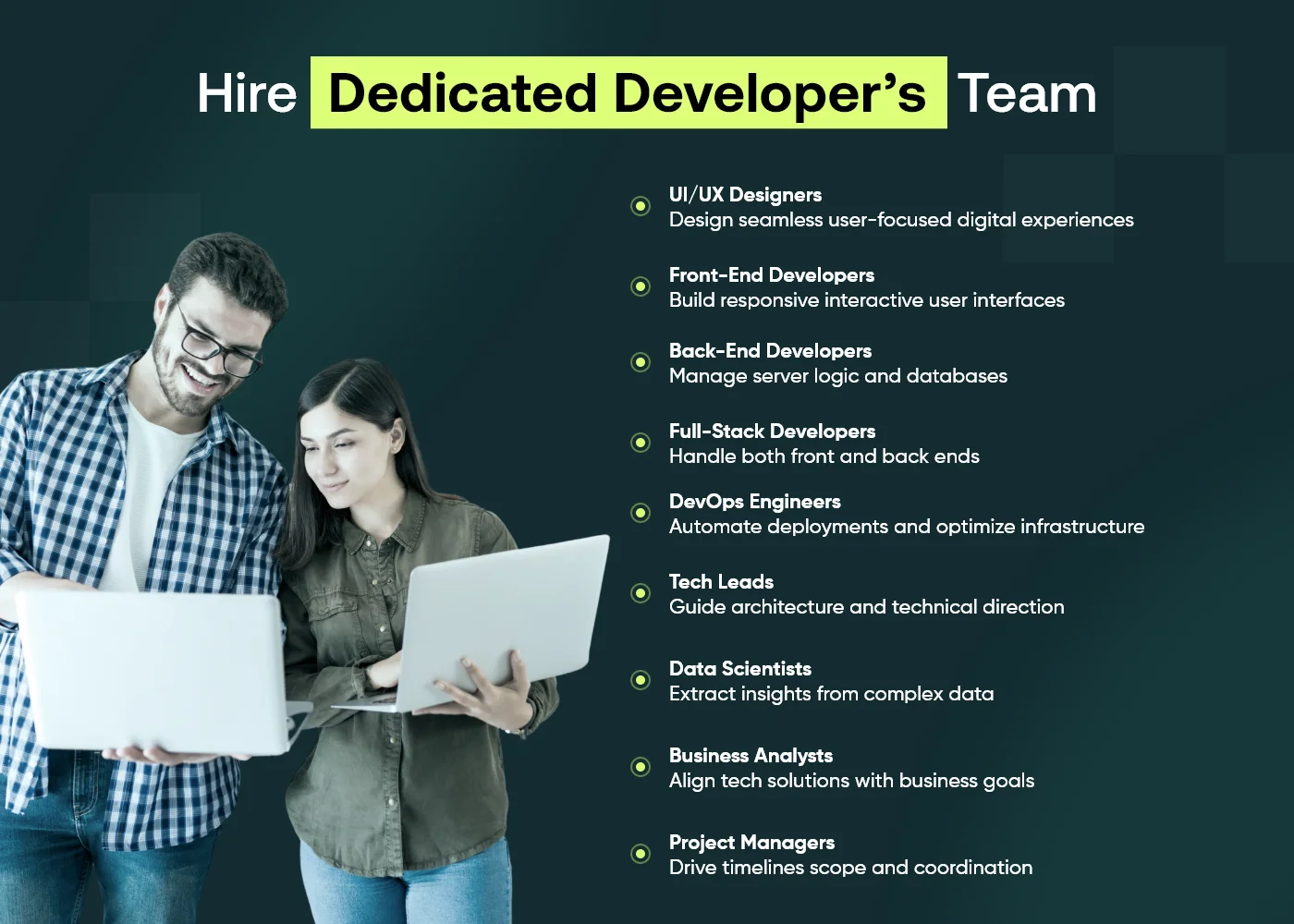
There’s no one-size-fits-all answer. But there are signs that you’re ready to hire a dedicated team. Startups especially benefit when they hire full-stack developers or dedicated specific developer for startup needs. As in, they get a cost-effective, scalable solution without the HR burden.
Ideal Scenarios:
- Long-Term Development Projects – Products with multiple feature rollouts or iterative updates.
- Startup MVP Launches – You need fast, expert delivery for validation.
- Scaling Phase – Internal teams can’t keep up with new development demands.
- Limited In-House Expertise – Lack of specific tech skills like AI/ML, Flutter, or Laravel.
- Offshore Expansion – Planning to tap into global markets and time zones.
Chasing Speed? Scaling Fast? Lacking Niche Skills?
Trust Codiant’s dedicated development team for these challenges. We push every limit of growth and build smart solution for you.
Dedicated Team vs Outsourcing vs In-House- What’s Better?
Choosing the right development model isn’t just an operational decision it directly impacts your speed, costs, product quality & long-term scalability. And in 2026, where timelines are tighter and competition is faster, picking the wrong model can slow you down before you even begin.
| Model | Control | Cost | Flexibility | Speed to Start | Management Effort |
| In-House | High | High | Low | Slow | High |
| Outsourcing | Low | Low–Medium | Low | Fast | Low |
| Dedicated Team | High | Medium | High | Fast | Medium |
Let’s break down the three most common approaches so you can clearly understand which one fits your business stage and goals.
In-House Development Team
An in-house team consists of full-time employees working within your organization. You hire, train & manage them directly.
Best for-
Long-term product development, companies with stable budgets & businesses building core proprietary technology.
Advantages-
- Full control over processes, priorities & team culture
- Deep alignment with your business vision and product goals
- Strong collaboration due to shared environment and availability
Challenges-
- High hiring and operational costs (salaries, infrastructure, benefits)
- Longer time to build a complete team
- Difficult to scale quickly for short-term or evolving needs
In simple terms- In-house works well when you’re building a long-term product and can afford time and cost investment.
Traditional Outsourcing
Outsourcing involves handing over a project (or part of it) to an external agency or vendor. They handle execution, often with minimal day-to-day involvement from your side.
Best for-
Short-term projects, clearly defined tasks, or when you need quick execution without managing a team.
Advantages-
- Lower upfront costs compared to in-house hiring
- Faster project kickoff
- Minimal management overhead
Challenges-
- Limited control over team and processes
- Communication gaps can slow progress
- Less flexibility if requirements change mid-project
In simple terms- Outsourcing is ideal when your scope is fixed and you don’t need deep involvement in development.
Dedicated Development Team
A dedicated development team is a group of professionals who work exclusively on your project, but are managed remotely usually through an external partner.
Best for-
Startups, scaling businesses, MVP development & long-term projects that need flexibility and speed.
Advantages-
- High control with direct access to the team
- Faster scaling compared to in-house hiring
- Cost-effective compared to building a full internal team
- Flexible team structure based on evolving needs
Challenges-
- Requires structured communication and management
- Choosing the right partner is critical
In simple terms- A dedicated team gives you the control of in-house with the flexibility and cost-efficiency of outsourcing.
Key Benefits of Hiring a Dedicated Software Development Team
Here’s what makes a dedicated software team the most strategic hiring decision:
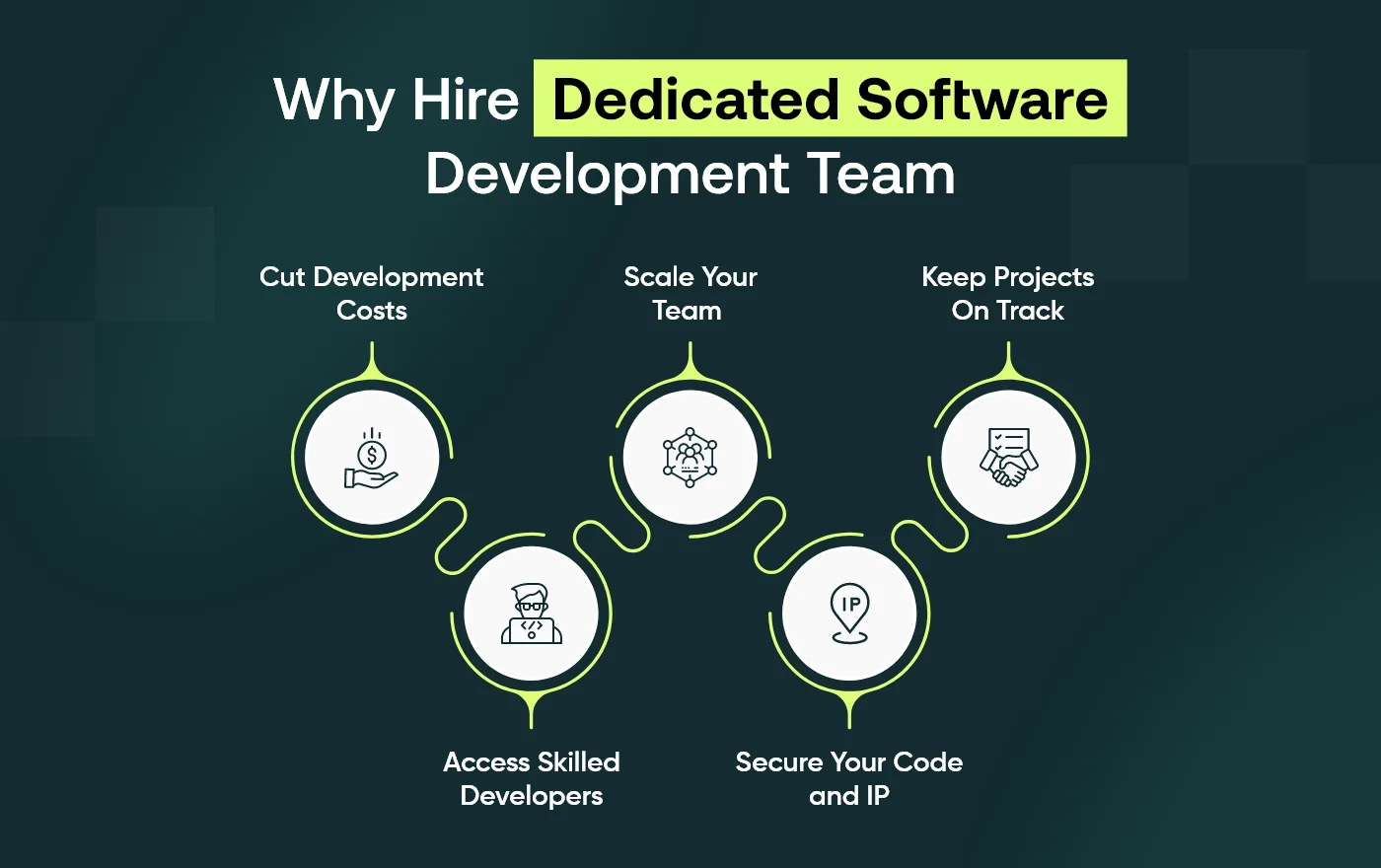
1. Cost-Efficiency
Hiring full-time staff is expensive. By opting to hire dedicated programmers, you save up to 60% in operational and HR costs, especially when working with offshore teams.
2. Scalability & Flexibility
You can scale up or down based on your project phase. Need a designer today and a QA expert tomorrow? No problem.
3. Focused Project Execution
A dedicated team of developers is immersed in your project goals—boosting productivity and shortening delivery cycles.
4. Global Talent Pool Access
Why limit your search to one zip code? Offshore markets like India, Ukraine, and Poland offer top-tier skills at lower costs.
5. IP Security & Reliability
Partnering with a reputed vendor ensures contracts that protect your intellectual property, especially in custom software development.
What Skills Should You Look for in a Dedicated Development Team?
Hiring a dedicated development team isn’t just about filling roles it’s about building a unit that can think, execute & scale with your product. The right team doesn’t just write code; it understands your business goals, adapts to change & delivers consistently under real-world constraints.
So, before you sign a contract, here’s what you should actually evaluate-
1. Strong Technical Expertise (Aligned With Your Stack)
Start with the fundamentals does the team have hands-on experience in the technologies your product requires?
Look for-
- Frontend- React, Angular, Vue
- Backend- Node.js, Python, .NET
- Mobile- Flutter, React Native, Swift
- Cloud & DevOps- AWS, Azure, Docker, Kubernetes
But don’t stop at tools.
What really matters is how well they’ve used these technologies in real projects. Ask for case studies, GitHub repositories, or live products they’ve worked on.
2. Product Thinking (Not Just Task Execution)
A good developer builds features.
A great developer questions them.
Your dedicated team should-
- Understand user journeys
- Suggest improvements proactively
- Think beyond “what to build” and focus on “why it matters”
This becomes especially important in MVP development, where every feature decision impacts time-to-market and budget.
3. Clear Communication & Collaboration Skills
Even the most technically sound team can fail if communication breaks down.
Look for teams that-
- Provide regular updates without being asked
- Can explain technical concepts in simple terms
- Are comfortable working across time zones
A simple test- If they can’t clearly explain their approach during early discussions, they won’t during development either.
4. Experience With Agile Development
In 2026, rigid development processes don’t work.
Your team should be comfortable with-
- Sprint planning
- Daily stand-ups
- Iterative releases
- Continuous feedback loops
This ensures your product evolves quickly based on real feedback instead of waiting months for a final version.
5. Problem-Solving Ability (Not Just Coding Skills)
Real-world development is messy. Things break, requirements change & unexpected challenges appear.
Your team should-
- Debug efficiently
- Handle edge cases
- Adapt to shifting priorities
Ask them how they handled a failed deployment or major bug. Their answer will tell you more than any resume.
6. Understanding of Modern Development Practices
Today’s high-performing teams don’t just code they follow structured engineering practices.
Look for experience in-
- CI/CD pipelines
- Version control (Git workflows)
- Automated testing
- Code reviews
These practices directly impact product quality, speed & long-term scalability.
7. UI/UX Awareness
Even backend-heavy products need user-friendly interfaces.
A strong dedicated team should-
- Understand basic UX principles
- Collaborate effectively with designers
- Build intuitive and responsive interfaces
Because in the end, users don’t see your code they experience your product.
8. Accountability and Ownership Mindset
This is often overlooked but it’s a deal-breaker.
You don’t want a team that just “completes tasks.”
You want a team that owns outcomes.
Signs of ownership-
- They take responsibility for delays or issues
- They suggest better alternatives instead of blindly following instructions
- They care about the final product quality
9. Experience Working with Global Clients
If you’re hiring offshore or remote teams, global exposure matters.
Look for teams that-
- Have worked with US, UK, or international clients
- Understand different work cultures
- Can manage time zone overlaps effectively
This reduces friction and improves collaboration from day one.
10. Ability to Scale with Your Needs
Your requirements today won’t be the same in 6 months.
A good dedicated team should-
- Scale up (add developers quickly)
- Scale down (optimize cost when needed)
- Support long-term product evolution
This flexibility is one of the biggest advantages of the dedicated team model make sure your partner can actually deliver on it.
The right dedicated development team isn’t just technically strong it’s aligned with your vision, communicates clearly & takes ownership of your product like it’s their own.
Step-by-Step Guide to Hiring a Dedicated Development Team
Here’s how to hire dedicated software development team experts the right way:
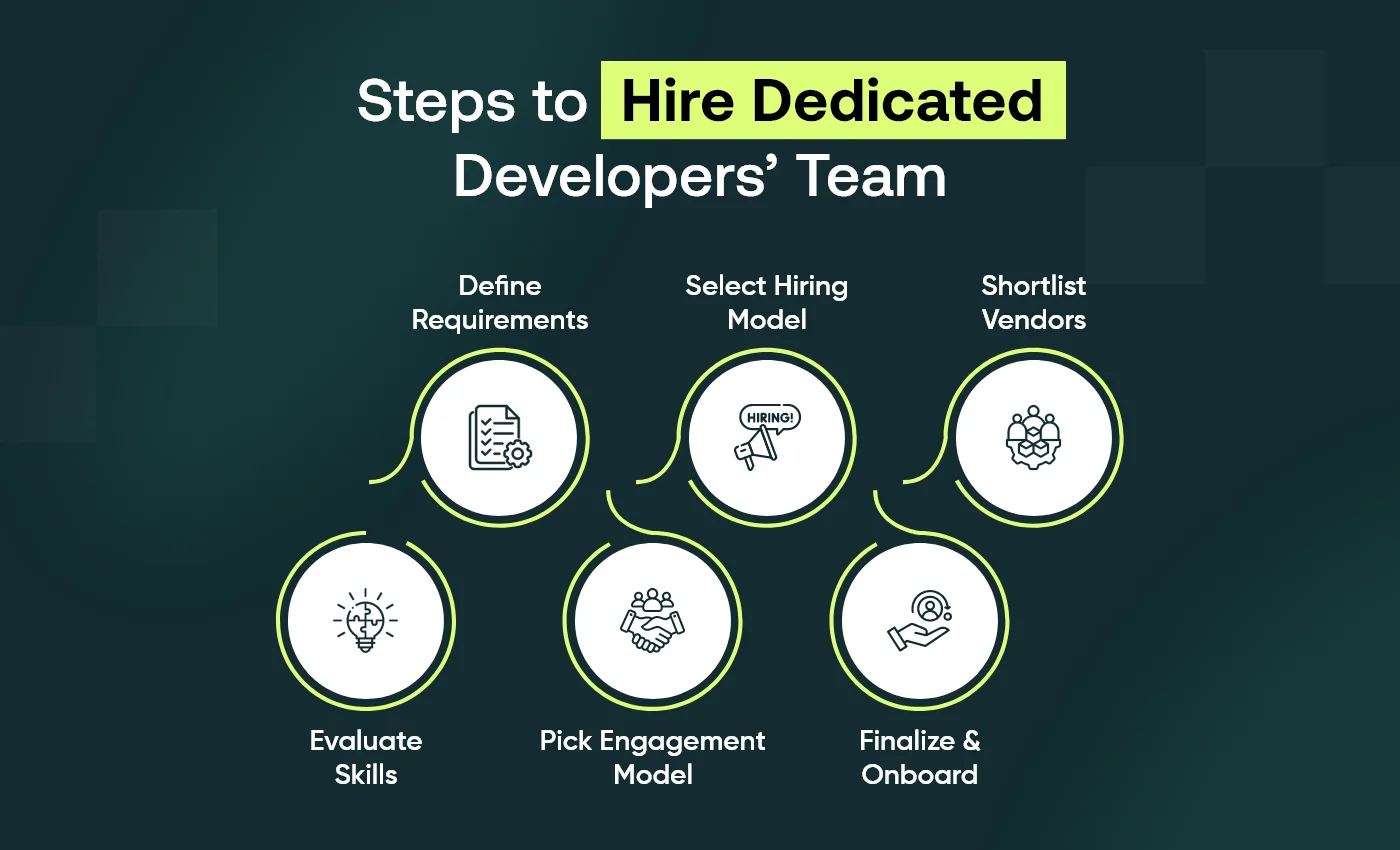
1. Define Your Technical Requirements
Clarifying your technical needs beforehand helps you reduce friction later on, or further issues during the development.
- What platforms are you building for (web, mobile, cross-platform)?
- What tech stack is required (React, Python, Node.js)?
- What roles do you need (Frontend, Backend, DevOps, UI/UX)?
2. Choose a Hiring Model
You need to choose the perfect hiring model before you hire a dedicated team of developers for your project. Preferably, 72% of startups outsource software development team efforts to offshore locations to scale affordably.
- Onshore – High-cost, real-time sync (e.g., USA)
- Nearshore – Mid-cost, overlapping hours (e.g., Mexico)
- Offshore – Low-cost, skilled talent (e.g., India)
Read More: How Much Does It Cost to Develop an AI System in Dubai?
3. Research & Shortlist Vendors
Look for agencies offering MVP development services in USA or your target market. These are platforms to explore –
- Clutch
- LinkedIn & GitHub portfolios
- Tech blogs or product showcases
4. Evaluate Technical and Communication Skills
This is the super most important part during hiring developers’ team. You must hire the tech expert with required technical and communication skills.
- Conduct code assessments & pair programming
- Assess soft skills and time zone compatibility
- Prioritize transparency and accountability
5. Decide Engagement Model
Select the engagement model to hire dedicated developers that aligns with your custom software development phases.
| Model | Ideal For | Billing |
| Fixed Price | Well-defined scope | Per milestone |
| Time & Material | Evolving scope | Hourly/daily rate |
| Dedicated Resource | Long-term projects | Monthly retainer |
6. Legal Contracts & Onboarding
- Sign NDAs and define IP rights
- Finalize KPIs and sprint deliverables
- Integrate them into your agile tools (Jira, Slack, Trello)
Read More: How to Integrate AI in Recruitment and Cut Hiring Time by 70%
Impact of AI on Software Development Teams in 2026
By 2026, AI has become a co-pilot embedded across the entire software development lifecycle not just autocompleting code, but reshaping team structures and workflows.
- Code generation has shifted junior workloads significantly. Developers spend less time writing boilerplate and more time directing AI toward the right problem making intent-setting and system design the premium skills.
- Code review is faster but more demanding. AI catches syntax errors and security issues instantly, pushing human reviewers to focus on architectural soundness and business logic.
- Planning has become data-driven. AI tools parse past sprints, estimate complexity & flag risk, making PMs more effective while retaining human judgment for stakeholder alignment.
- On-call is less grueling. AI triages alerts, narrows root causes & drafts incident summaries reducing burnout while allowing teams to safely manage more complex systems.
The net result- smaller, more senior-weighted teams operating at greater scale.
Cost of Hiring a Dedicated Software Team in 2026
When you decide to hire a dedicated development team, one of the first things that comes to mind is the cost. Let’s break it down clearly.
Key Factors Affecting Cost of Hiring Dedicated Software Developers:
1. Location of the Team
- USA – $80 – $150/hr
- Western Europe – $60 – $100/hr
- Eastern Europe – $40 – $70/hr
- India/Philippines – $20 – $45/hr
2. Skillset & Experience
- Junior Developers – Cheaper, but limited experience
- Senior Developers/Architects – Higher rates, faster delivery
3. Project Complexity
- A simple MVP can cost $10K–$30K
- A full-scale product with AI integration may range from $80K–$250K+
4. Engagement Duration
- Long-term contracts often get discounted pricing
If you’re looking to hire developers for startup needs, consider starting with a smaller offshore dedicated development team to keep costs low and scale gradually. According to Deloitte, 59% of businesses outsource primarily to reduce or control costs.
Build Smarter, Spend Better!
Don’t let budget uncertainty hold you back. We’ll match you with top-tier dedicated developers tailored to your project—fast.
1. Transparent pricing with no hidden costs.
2. MVP to full-scale product—built your way.
3. Offshore or onshore teams ready to start in 24–72 hours.
Ways to Manage a Remote Dedicated Team
Managing a remote software development dedicated team doesn’t have to be chaotic. Here’s how to lead with clarity:
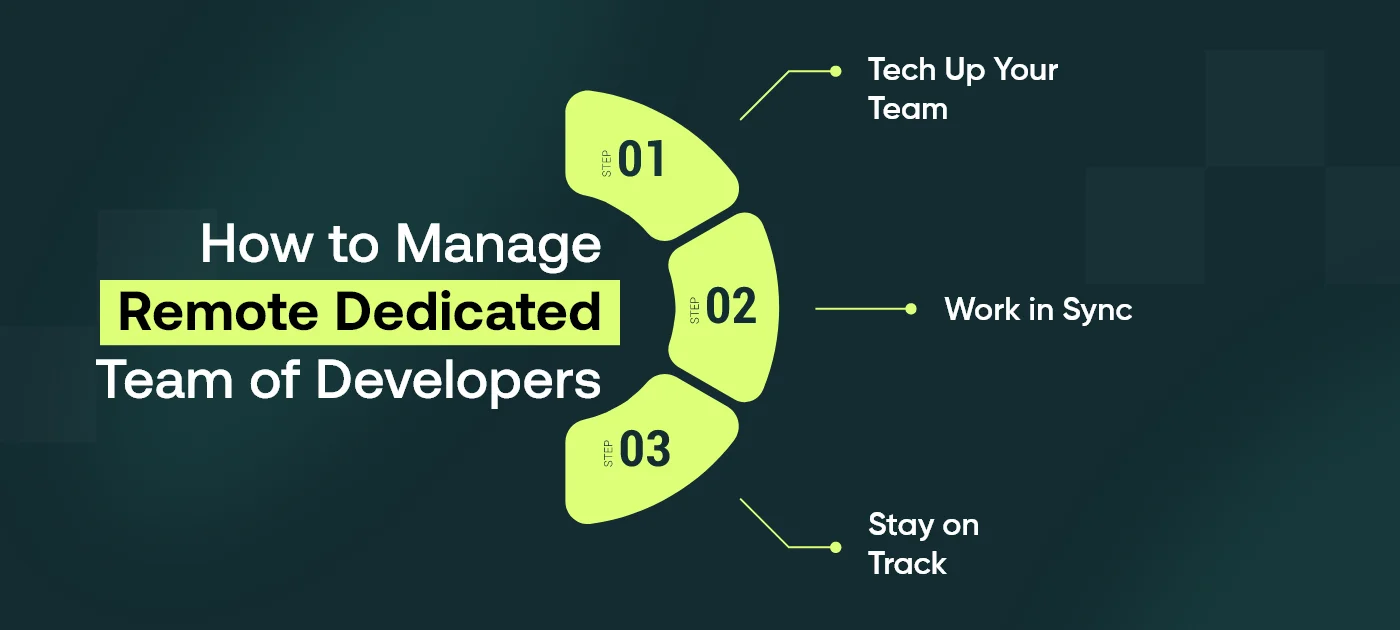
1. Use the Right Tools
- Slack – Real-time communication
- Jira/Trello – Task tracking and sprint planning
- Zoom/Google Meet – Weekly standups and demos
- Hubstaff/Time Doctor – Productivity tracking
2. Align Time Zones
Use a 2–3 hour overlap window daily for real-time interactions. Tools like World Time Buddy help with scheduling.
3. Track Performance
- Set KPIs – Sprint velocity, code quality, bug rate
- Use burndown charts to visualize progress
- Hold retrospectives to improve delivery cycles
Bonus Tip – Weekly 1-on-1s keep communication open and build trust with dedicated developers.
Best Tools for Managing Dedicated Development Teams
Here are the essential tools every dedicated development team needs to stay aligned, productive & deliver high-quality software consistently across projects.
| Category | Purpose | Top Tools | Why It Matters |
| Communication & Collaboration | Enables real-time discussions, meetings & team alignment | Slack, Microsoft Teams, Zoom | Ensures clear communication, reduces delays & keeps distributed teams aligned across time zones |
| Project Management & Task Tracking | Tracks tasks, sprints, deadlines & progress | Jira, Trello, Asana | Provides visibility into workflows, assigns accountability & ensures timely delivery of tasks |
| Code Collaboration & Version Control | Manages code changes, collaboration & repositories | GitHub, GitLab, Bitbucket | Maintains code quality, avoids conflicts & allows multiple developers to work seamlessly |
| Documentation & Knowledge Sharing | Stores project information, processes & documentation | Notion, Confluence, Google Workspace | Reduces repeated queries, supports async work & keeps knowledge centralized |
| Time Tracking & Productivity | Monitors work hours, productivity & performance | Hubstaff, Time Doctor, Clockify | Builds transparency, tracks efficiency & helps optimize team output |
| DevOps & Automation | Automates deployment, scaling & infrastructure management | Jenkins, Docker, Kubernetes | Speeds up development cycles, improves reliability & enables scalable deployments |
Common Mistakes to Avoid When Hiring Dedicated Developers
Hiring the wrong way can cost time, money, and momentum. You should know the do’s and don’ts of outsourcing software development projects.
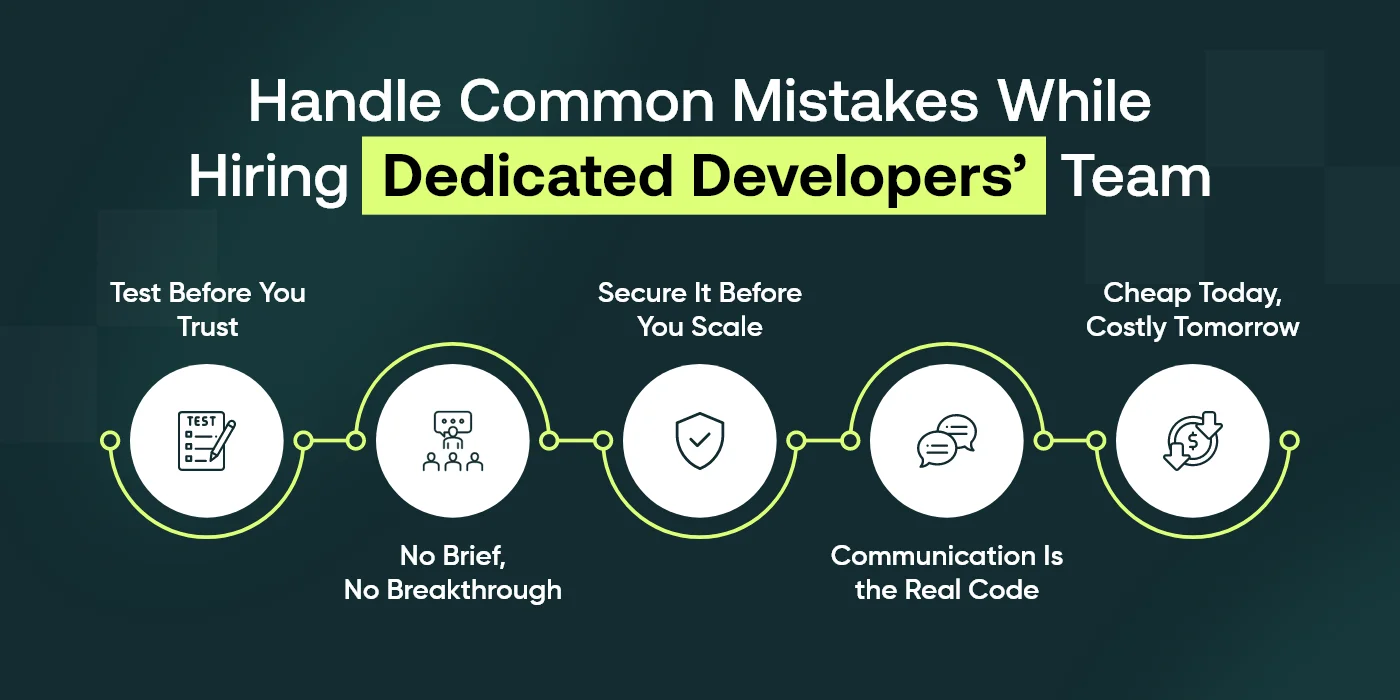
Have a look at the common mistakes to avoid:
1. Skipping Technical Screening
Don’t assume every developer with a nice-looking resume is the right fit. Before you hire dedicated developers, run a thorough technical screening. Look at their portfolio, review real code samples, and assign small problem-solving tests.
This step is crucial if you’re forming a dedicated software development team for long-term projects like MVP development services in the USA. The right vetting ensures you’re hiring people who not only understand your tech stack but can deliver on time without cutting corners.
2. Unclear Requirements
Imprecision kills momentum. If you’re not clear about your goals, timeline, and scope, even the best dedicated development team services can struggle to deliver. When you hire a development team, always start with a detailed project brief. You must define core features, user flows, and key deadlines.
This reduces the chances of scope creep and misalignment. Remember, a custom software development project succeeds when both sides know exactly what success looks like—right from day one.
3. No Legal Agreements
Working with a dedicated software team—especially offshore—without clear legal agreements is a disaster waiting to happen. Before onboarding, sign NDAs to protect your data and include IP ownership terms in the contract.
Also, ensure the SLA (Service Level Agreement) defines deliverables, timelines, and penalties for delays. When you hire a dedicated software development team, having these legal foundations protects your business and gives your partnership the structure it needs to thrive.
4. Poor Communication Practices
Bad communication is one of the top reasons custom software projects fail. If updates are irregular or feedback is lost in translation, delays are inevitable. When you hire dedicated developers or form an offshore dedicated development team, set clear communication protocols—weekly calls, daily stand-ups, shared dashboards.
Using tools like Slack, Jira, or Trello keeps everyone aligned. A successful dedicated development team feels like an extension of your in-house staff—not a disconnected third party.
5. Choosing Cost Over Quality
It’s tempting to go for the cheapest option when you hire dedicated programmers. But in software development, you get what you pay for. A low-cost team may lead to poorly written code, buggy releases, and higher maintenance costs.
When you hire dedicated web developers or any kind of dedicated AI developers, focus on experience, reliability, and cultural fit—not just hourly rates. Investing in a high-quality dedicated development team pays off in smoother delivery, fewer headaches, and a product that scales with your business.
How to Choose the Right Dedicated Development Partner
Choosing the right development partner directly impacts project success, delivery speed & long-term scalability of your software initiatives and business growth.
| Factor | What to Evaluate | How It Affects Your Project |
| Technical Expertise | Experience in your required tech stack (AI, React, Node.js, etc.) | Ensures the team can build scalable, high-quality solutions without delays or rework |
| Industry Experience | Past projects in your domain (SaaS, healthcare, fintech, etc.) | Helps them understand your business challenges and reduce onboarding time |
| Communication & Transparency | Response time, clarity, reporting structure | Strong communication prevents misunderstandings and keeps projects on track |
| Development Process | Agile methodology, sprint planning, delivery cycles | Structured processes ensure predictable timelines and consistent output |
| Portfolio & Case Studies | Real-world projects, measurable results | Validates credibility and proves their ability to deliver results |
| Scalability & Flexibility | Ability to scale team size based on project needs | Helps you grow without hiring delays or operational friction |
| Security & Compliance | NDAs, IP protection, data security practices | Protects your business, product & sensitive information |
| Post-Development Support | Maintenance, updates, long-term support | Ensures your product evolves without disruption after launch |
The best dedicated development partner doesn’t just write code they act as a strategic extension of your team, aligned with your product vision, timelines & growth goals.
Final Thoughts
If you’re a startup building an MVP, an enterprise launching a new SaaS product, or an SMB going digital—then yes, a dedicated software development team is likely your best option.
It gives you –
- The agility of freelancers for development.
- The focus of in-house teams to work on time.
- The cost advantages of outsourcing app development.
Your development doesn’t have to be limited by geography or budget. With the right strategy, you can hire dedicated programmers, designers, QA experts, and project managers who are fully aligned with your goals. Take the next step, explore vetted dedicated development team services and start building with confidence.
The Author

Frequently Asked Questions
Look for an experienced firm with a proven track record of delivering successful projects on schedule and within budget. Thoroughly vet their portfolio, talk to past clients and evaluate team dynamics before committing. The right dedicated partners will collaborate transparently and adapt freely to evolving needs.
Building a dedicated software team from scratch typically requires 2-4 weeks depending on complexity and availability. With well-defined requirements, reputable outsourcing specialists can sometimes fill needs more rapidly using standby talent.
Unquestionably. Outsourcing full-time roles saves immensely on salaries and benefits while attracting expertise beyond typical budgets. It enables startups to prototype and scale at low fixed cost.
Constant attention, elastic scaling, accelerated delivery and access to skills anywhere. For fledgling companies, growing ventures and protracted undertakings, dedicated developers deliver focus and talent on demand.
Regular check-ins, status reports and project management tools like Slack keep aligned globally. With judicious leadership, offshore outsourcing need not compromise control or collaboration.
Understanding requirements, budgeting costs realistically and validating qualifications heavily influence success. Safeguard intellectual property too through signed non-disclosure agreements.
Featured Blogs
Read our thoughts and insights on the latest tech and business trends

How Much Does It Cost to Build an MVP in 2026? A Complete Pricing Guide
- September 10, 2026
- Digital Transformation
MVP development cost typically ranges from $5,000 for a basic web-based product to $150,000 or more for a complex, cross-platform solution. A custom MVP with user accounts, a backend, essential integrations and a polished interface... Read more

How Much Does It Cost to Hire a Dedicated AI/LLM Developer in 2026?
- September 8, 2026
- Artificial Intelligence Staff Augmentation
Hiring a dedicated AI or large language model (LLM) developer typically costs $35–$60 per hour for general AI engineering and $50–$200 per hour for specialised machine learning work, with enterprise pricing rising for advanced RAG,... Read more

HIPAA-Compliant App Development in 2026: How to Build Securely and Avoid Preventable Fines
- September 4, 2026
- Mobile App Development
HIPAA-compliant app development in 2026 requires six foundations: complete ePHI mapping, documented risk analysis, role-based access, encryption, signed business associate agreements, and continuous security monitoring. This matters most to healthcare CTOs, product leaders, and compliance... Read more