Ultimate Guide to Telemedicine App Development in USA 2026
Table of Contents
Subscribe To Our Newsletter
Summarize with AI
Not enough time? get the key points instantly.
Telemedicine app development is the process of designing and building HIPAA-compliant software platforms that connect patients with licensed healthcare providers through secure video, chat, and AI-powered tools without requiring an in-person visit.
As healthcare organisations, clinics, and startups continue investing in virtual care solutions, understanding the broader market landscape becomes increasingly important. The US telehealth market is projected to reach $286.22 billion by 2030, reflecting continued demand for accessible virtual care, remote consultations, and digitally connected healthcare services.
However, market growth alone does not guarantee product success. A telemedicine platform must align technology with real clinical workflows, regulatory responsibilities, provider operations, and patient expectations.
This practical alignment becomes especially clear during real-world development. Ms. Rashmi Kasliwal COO at Codiant, shared that after contributing to more than 80 telemedicine application projects, she has observed that the strongest platforms are not necessarily those with the most features. They are the ones that clearly define the care workflow, address compliance during architecture planning, and make the experience practical for both patients and providers.
In a Nutshell
- Telemedicine app development combines virtual care workflows, clinical operations, security, compliance, and interoperability.
- Core features typically include consultations, scheduling, messaging, documentation, payments, and administrative controls.
- HIPAA compliance requires administrative, physical, and technical safeguards rather than one standard checklist.
- EHR integration commonly uses HL7 FHIR, but implementation varies by system and healthcare provider.
- Provider licensing requirements generally depend on the state where the patient receives care.
- Telemedicine platforms may support video, audio, asynchronous messaging, or remote patient monitoring.
- A focused MVP may require five to seven months, while enterprise platforms take longer.
- Development costs depend on product scope, integrations, user roles, security, and deployment requirements.
What Is a Telemedicine App?
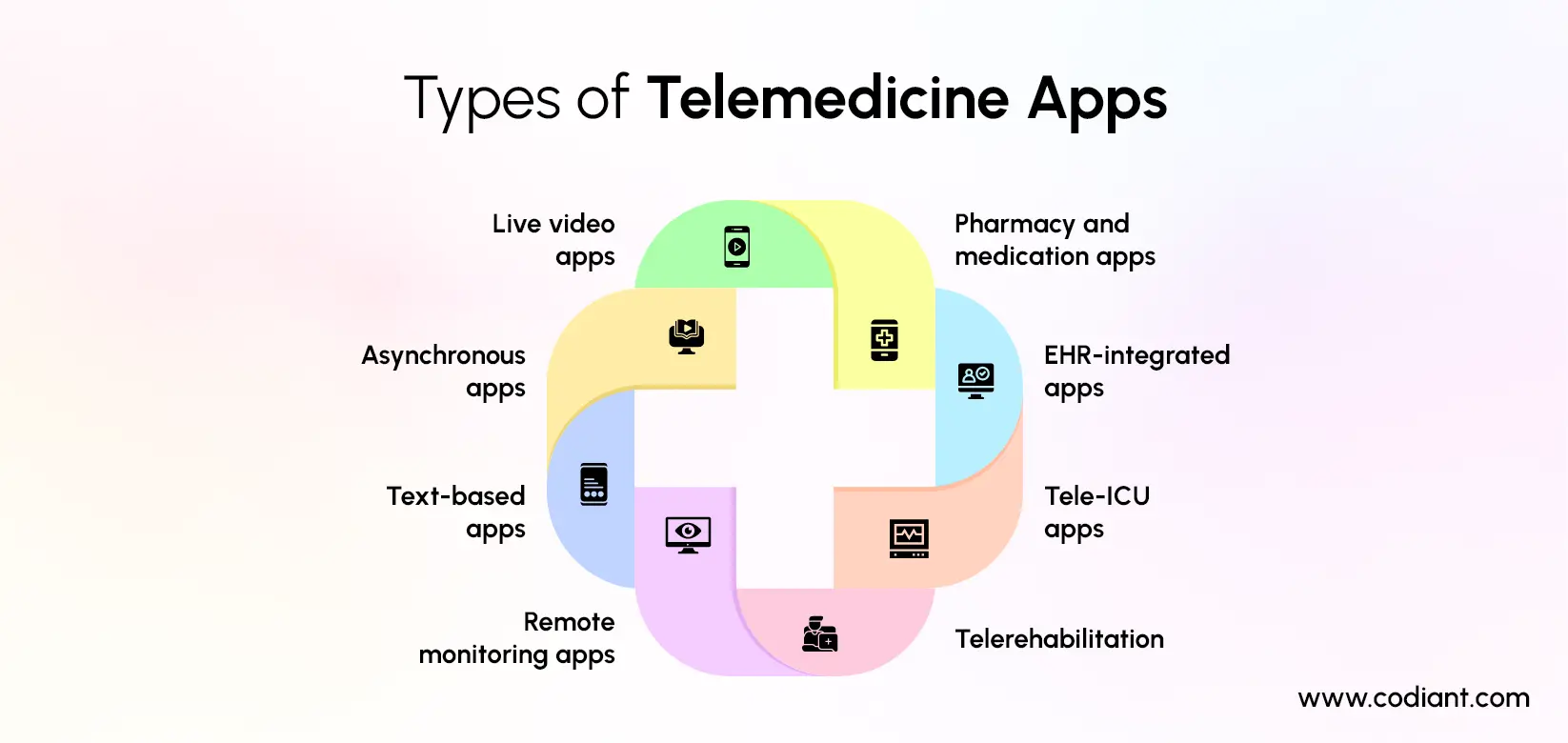
A telemedicine app is a digital healthcare product that enables patients and healthcare professionals to deliver or receive eligible services remotely. Depending on its purpose, the platform may support video consultations, secure messaging, appointment scheduling, patient intake, prescriptions, payments, clinical documentation, and health-record integration.
Telemedicine is one area of healthcare software development, alongside patient portals, EHR systems, remote patient monitoring solutions, medical billing platforms, and clinical management software. These systems often work together to support connected care across patient, provider, and administrative workflows.
Telemedicine applications can serve different care models, including:
- Primary and urgent care
- Mental and behavioural healthcare
- Chronic-condition management
- Post-discharge monitoring
- Dermatology and other image-based specialties
- Remote patient monitoring
- Specialist consultations
- Employer-sponsored virtual care
- Hospital and clinic outreach programmes
The correct feature set depends on the clinical workflow. A mental-health platform, for example, may prioritise recurring appointments, video reliability, consent, and clinician notes. A remote-monitoring platform may instead prioritise device data, alerts, dashboards, and escalation protocols.
Turn Your Telemedicine Vision into a Scalable Healthcare Platform Today
Build secure virtual care experiences with features, integrations, and workflows tailored to your healthcare goals.
Why Is Telemedicine Growing So Fast in the USA?
Telemedicine is growing in the USA because it solves three structural problems in American healthcare simultaneously: access gaps, cost inefficiencies, and provider shortages. Patients in rural areas, elderly populations with mobility limitations, and working adults who cannot take time off for in-person visits all benefit directly from virtual care.
Mobile access has made virtual care easier to use in everyday healthcare. Patients can schedule consultations, receive reminders, communicate with care teams, access reports, and manage follow-ups from one device. These wider benefits of mobile apps for healthcare providers also help hospitals and clinics improve patient engagement and extend care beyond their physical locations.
Several structural forces are driving this acceleration in 2025 and 2026:
- FDA digital health frameworks have simplified the regulatory pathway for telehealth software products
- AI-powered diagnostic tools embedded in telehealth platforms are reducing misdiagnosis rates
- Employer-sponsored telehealth benefits have expanded to over 80% of large US companies (SHRM, 2024)
- The US may face a shortage of 86,000 doctors by 2036, increasing the need for virtual care.
The Access Gap Driving Virtual Care
As of March 31, 2026, the United States had 8,789 designated primary-care shortage areas covering approximately 101.7 million people. HRSA estimated that 17,306 additional practitioners would be required to remove these shortage designations.
How to Build a Telemedicine App in the USA: Step-by-Step
Building a telemedicine app in the USA requires seven sequential phases: discovery and compliance planning, product design, backend infrastructure setup, frontend and mobile development, third-party integrations, security testing, and regulatory-compliant launch. Skipping the compliance phase at the start is the most expensive mistake healthcare startups make.
- Discovery & HIPAA Compliance Planning (Weeks 1–4): Define product scope, identify PHI flows, select HIPAA-eligible infrastructure, and document your technical safeguards plan before writing a single line of code.
- UI/UX Design (Weeks 3–8): Design patient and provider interfaces with accessibility (WCAG 2.1 AA) compliance. Test prototypes with actual patients and clinicians before development begins.
- Backend Architecture & Infrastructure (Weeks 5–16): Build on AWS GovCloud, Azure, or Google Cloud’s HIPAA-eligible services. Set up encrypted databases, audit logging, and identity management.
- Core Feature Development (Weeks 8–20): Build video consultation, scheduling, messaging, patient records, and payment processing. Implement end-to-end encryption at every data layer. (Features described below)
- EHR & Third-Party Integration (Weeks 14–24): Connect to EHR systems via HL7 FHIR, integrate payment and insurance billing tools, and configure lab and pharmacy workflows as required.
- Security Testing & Compliance Audit (Weeks 22–28): Conduct penetration testing, vulnerability scanning, and a formal HIPAA risk assessment. Remediate all critical and high findings before launch.
- Launch & Post-Launch Optimization (Weeks 26–30+): Submit to Apple App Store and Google Play (healthcare apps require additional documentation). Monitor performance, user feedback, and compliance posture continuously.
What Features Should a Telemedicine App Include?
A production-ready telemedicine app must include secure video consultations, patient registration and identity verification, prescription management, appointment scheduling, and HIPAA-compliant data storage as its foundational feature set. Optional advanced features expand functionality for specific care verticals.
Core Features (MVP-Must Have)
- Secure HD video and audio consultations (WebRTC-based)
- Patient onboarding, registration, and identity verification
- Appointment booking and calendar management
- In-app messaging and secure chat
- Electronic prescriptions (e-Prescribing)
- Payment gateway integration (insurance billing + self-pay)
- Medical records upload and document sharing
- HIPAA-compliant cloud storage and data encryption
- Push notifications and appointment reminders
- Provider dashboard and availability management
Recommended reading: Medical Claims Processing: A Complete Guide
Advanced Features (Scale-Up Platform)
- EHR/EMR Software integration (Healthray, Epic, Cerner, Allscripts)
- AI symptom checker and triage engine
- Remote Patient Monitoring (RPM) with IoT device support
- Multi-specialty care routing
- Insurance eligibility verification (real-time)
- Multilingual support for diverse patient populations
- Wearable device data integration (Apple Health, Google Fit)
- Analytics dashboard for healthcare administrators
As telemedicine platforms mature, AI can support more than symptom checking. A closer look at how AI agents are transforming healthcare shows their potential to coordinate appointments, triage requests, monitor patient inputs, automate follow-ups, assist with documentation, and move information across EHRs, patient applications, and administrative systems while keeping clinicians in control.
Teledocto: A White-Label Telemedicine Platform Example By Codiant
Teledocto is a white-label telemedicine platform developed by Codiant for healthcare providers seeking to launch or expand digitally delivered care services.
The platform brings several core telemedicine workflows into one configurable environment, including:
- Online appointment scheduling
- Video consultations and conferencing
- Real-time patient-provider messaging
- Store-and-forward medical data sharing
- Prescription, report, file, and screen sharing
- Integrated billing and payment workflows
- Customizable remote patient monitoring
- Practice-management and EHR integration
- Custom branding for healthcare organisations
Rather than building every foundational module independently, healthcare organisations can use Teledocto as a configurable starting point and adapt its branding, features, integrations, and workflows to their operating model.
This type of white-label approach may be suitable for clinics, hospital networks, virtual-care startups, and specialty-care providers that need greater customization than a standard off-the-shelf consultation tool.
Explore the Teledocto white-label telemedicine platform.
How Much Does It Cost to Develop a Telemedicine App in the USA?
The cost of telemedicine app development in the USA ranges from $40,000 for a basic MVP to $300,000 or more for an enterprise-grade, multi-specialty platform with EHR integration, AI features, and custom infrastructure. The primary cost drivers are feature scope, compliance requirements, integration complexity, and the development team model chosen.
Telemedicine App Development Cost Breakdown
| Component | Estimated Cost Range | Notes |
| Discovery & Architecture | $5,000 – $15,000 | Technical planning, compliance review |
| UI/UX Design | $8,000 – $25,000 | Patient + provider app interfaces |
| Core App Development | $30,000 – $120,000 | Video, scheduling, messaging, auth |
| HIPAA Compliance & Security | $10,000 – $30,000 | Encryption, audit logs, BAAs |
| EHR Integration | $15,000 – $50,000 | Epic, Cerner, HL7 FHIR APIs |
| Payment & Insurance Billing | $8,000 – $20,000 | Stripe, Waystar, RCM tools |
| QA & Testing | $8,000 – $20,000 | Security, load, functional testing |
| Cloud Infrastructure (Year 1) | $5,000 – $24,000 | AWS/Azure HIPAA-eligible setup |
| Post-Launch Maintenance | $2,000 – $8,000/mo | Ongoing updates and support |
Cost by Team Model
| Team Model | Avg. Hourly Rate | MVP Cost Estimate | Best For |
| US-based agency | $150 – $250/hr | $120,000 – $300,000+ | Regulated enterprise platforms |
| Nearshore (Latin America) | $60 – $100/hr | $60,000 – $150,000 | Mid-market startups |
| Offshore (India/Eastern Europe) | $30 – $60/hr | $40,000 – $100,000 | Early-stage MVPs |
| In-house team | Salary-based | $200,000+ (Year 1) | Long-term product investment |
How Long Does Telemedicine App Development Take?
A basic telemedicine app MVP takes 4 to 6 months to develop. A full-featured, HIPAA-compliant platform with EHR integration typically requires 9 to 18 months from discovery to launch. The timeline depends on team size, feature complexity, third-party integration requirements, and regulatory review processes.
Typical Development Timeline
| Phase | Duration | Key Deliverables |
| Discovery & Planning | 3 – 4 weeks | Architecture, compliance plan, wireframes |
| UI/UX Design | 4 – 6 weeks | Patient + provider design system |
| Backend Development | 8 – 14 weeks | APIs, database, HIPAA infrastructure |
| Frontend Development | 8 – 12 weeks | iOS, Android, and/or web app |
| EHR & Third-Party Integration | 4 – 8 weeks | Epic, Cerner, payment, labs |
| QA & Security Testing | 4 – 6 weeks | Penetration testing, functional QA |
| Deployment & Launch | 2 – 3 weeks | App store submission, production launch |
What Technologies Are Used to Build Telemedicine Apps?
Modern telemedicine apps are built using WebRTC for real-time video communication, HL7 FHIR APIs for EHR integration, HIPAA-eligible cloud infrastructure (AWS, Azure, or Google Cloud), and React Native or Flutter for cross-platform mobile development. The technology stack is selected based on scalability, compliance, and integration requirements.
Core Technology Stack for Telemedicine Apps
| Layer | Technology Options | Purpose |
| Video Infrastructure | WebRTC, Twilio Video, Vonage (TokBox) | Real-time secure consultations |
| Backend | Node.js, Python (Django), Java Spring Boot | APIs, logic, data management |
| Frontend Web | React.js, Vue.js | Provider portals, admin dashboards |
| Mobile Apps | React Native, Flutter, Swift (iOS), Kotlin (Android) | Patient and provider mobile apps |
| Database | PostgreSQL, MongoDB, Amazon RDS | HIPAA-eligible data storage |
| Cloud | AWS (GovCloud), Microsoft Azure, Google Cloud HIPAA | HIPAA-eligible infrastructure |
| EHR Integration | HL7 FHIR, Epic API, Cerner Open Platform | Patient record interoperability |
| AI/ML | Python, TensorFlow, AWS SageMaker | Symptom checkers, triage, analytics |
| Authentication | OAuth 2.0, Auth0, AWS Cognito + MFA | Secure identity management |
| Messaging | Twilio, Sendbird (HIPAA BAA available) | Secure in-app communication |
Modernize Healthcare Delivery with a Purpose-Built Telemedicine Solution for Growth
Connect patients and providers through secure workflows designed for accessible, efficient, and coordinated virtual care.
What Are the HIPAA Requirements for Telemedicine Apps?
A HIPAA-compliant telemedicine app must implement three specific safeguard categories: administrative safeguards (policies and workforce training), physical safeguards (hardware and device controls), and technical safeguards (encryption, access controls, and audit logs). Non-compliance can result in fines from $137 to $2,067,813 per violation category (HHS, 2024 adjusted figures).
Core HIPAA Technical Requirements for Telemedicine
- End-to-end encryption (AES-256 minimum) for all data in transit and at rest
- Unique user identification and role-based access controls (RBAC)
- Automatic session timeout and multi-factor authentication (MFA)
- Audit logs for all PHI (Protected Health Information) access
- Business Associate Agreements (BAAs) with all third-party vendors
- Secure messaging channels & standard SMS is not HIPAA-compliant
- Breach notification procedures (within 60 days of discovery)
- Data backup and disaster recovery protocols
How Can Telemedicine Apps Ensure Patient Data Security?
Telemedicine apps ensure patient data security through a layered approach: end-to-end encryption for all communications, zero-trust access architecture, regular third-party penetration testing, HIPAA-compliant cloud storage, and signed Business Associate Agreements (BAAs) with every vendor that touches Protected Health Information (PHI).
Security Best Practices Checklist
- AES-256 encryption for all data at rest; TLS 1.3 for data in transit
- Multi-factor authentication (MFA) for all provider and admin accounts
- Role-based access control & clinical staff cannot access billing data and vice versa
- Annual HIPAA risk assessments and penetration testing (required under the Security Rule)
- Signed BAAs with AWS/Azure, video SDK providers, and analytics platforms
- Automatic session timeouts (15 minutes maximum for inactive clinical sessions)
- Comprehensive audit logs retained for 6 years per HIPAA requirements
- Incident response plan with defined breach notification under 60-day window
Data Security Reality Check
IBM’s 2025 research found that the average cost of a data breach in the United States reached $10.22 million, the highest among the countries studied. Healthcare remained the most expensive industry for breaches globally, with an average cost of $7.42 million per incident.
Also Read: How to Build HIPAA-Compliant AI Voice Agents for Healthcare
Can Telemedicine Apps Integrate with EHR Systems?
Yes. Telemedicine apps can and should integrate with Electronic Health Record (EHR) systems using HL7 FHIR (Fast Healthcare Interoperability Resources) APIs, which became the US federal standard under the 21st Century Cures Act. Epic, Cerner (Oracle Health), and Allscripts all offer certified FHIR R4 APIs for third-party integration.
EHR Integration Capabilities
- Read and write patient demographics, allergies, and problem lists
- Retrieve and document clinical notes from telehealth visits
- Pull medication lists and reconcile e-prescriptions
- Access lab results and diagnostic imaging orders
- Sync appointment data bidirectionally between telehealth and EHR scheduling
- Submit billing codes and clinical documentation post-visit
What Are the Biggest Challenges in Telehealth App Development?
The most significant challenges in telehealth app development are achieving and maintaining HIPAA compliance, integrating with fragmented EHR systems, ensuring real-time video quality across varying network conditions, navigating state-by-state medical licensing requirements, and building patient trust in a digital care environment.
Challenge-by-Challenge Breakdown
| Challenge | Specific Issue | Recommended Approach |
| HIPAA Compliance | Compliance covers 400+ technical and administrative requirements | Engage a HIPAA consultant during architecture design, not post-development |
| EHR Integration | Each EHR has proprietary APIs and data formats | Use HL7 FHIR R4 and middleware like Redox or Mirth Connect |
| Medical Licensing | Providers must be licensed in each state where the patient is located | Use the IMLC (Interstate Medical Licensure Compact) for multi-state coverage |
| Video Quality | Network variability causes poor consultation experience | Implement adaptive bitrate streaming; fallback to audio-only below threshold |
| Patient Trust | 37% of patients cite privacy concerns as a barrier (Pew Research, 2024) | Transparent privacy policies; clear BAA disclosures during onboarding |
| Reimbursement Rules | State parity laws and payer policies vary significantly | Engage a healthcare billing specialist; use real-time eligibility verification |
Another challenge is the documentation workload created during virtual consultations. Clinicians must capture patient details accurately without allowing note-taking to interrupt the conversation.
To address this problem, Codiant developed Scribeflo, an AI-powered medical scribe that converts clinical conversations into structured SOAP notes for clinician review. It shows how AI can support documentation while allowing healthcare professionals to stay focused on the patient.
What Monetization Models Work for Telemedicine Platforms?
The most successful telemedicine platforms in the USA use subscription-based models for B2B (employer and health plan) clients, combined with fee-per-consultation pricing for direct-to-consumer users. Hybrid models, which combine subscription access with per-visit charges for specialist care, and this shows the highest revenue retention.
Telemedicine Monetization Models Compared
| Model | How It Works | Best For | Example |
| Per-Consultation Fee | Patient pays per visit ($25–$150 typical) | Direct-to-consumer urgent care | PlushCare, MDLive |
| Subscription (B2C) | Monthly/annual patient membership fee | Mental health, chronic care | Cerebral, Hims & Hers |
| B2B / Employer Contract | Per-member-per-month (PMPM) fee to employers | Large-scale deployment | Teladoc, Doctor on Demand |
| Health Plan Integration | Reimbursement via insurance billing (CPT codes) | Clinical-grade platforms | Amwell, Included Health |
| Freemium + Upsell | Free basic access, paid specialist tiers | Platform marketplaces | Amazon Clinic, Zocdoc |
| White-Label Licensing | Technology licensed to hospitals/health systems | B2B SaaS model | Doxy.me, Zoom for Healthcare |
How to Choose a Telemedicine App Development Company in the USA
Choose a telemedicine app development company with proven healthcare experience, knowledge of HIPAA requirements, EHR integration capabilities, strong security practices, and experience building patient and provider workflows. The company should also offer transparent planning, testing, deployment, and post-launch support.
Evaluate potential development companies based on the following criteria:
- Experience developing telemedicine or healthcare applications
- Understanding of HIPAA safeguards and protected health information
- Experience with HL7 FHIR and EHR or EMR integrations
- Knowledge of secure video, messaging, and authentication systems
- Ability to design accessible patient and provider interfaces
- Healthcare-focused quality assurance and security testing
- Clear project timelines, cost estimates, and communication processes
- Ongoing maintenance, monitoring, and compliance support
Organisations that need a detailed evaluation framework can follow this guide on how to hire a healthcare software development company. It explains how to assess technical expertise, healthcare experience, security practices, engagement models, and potential vendor risks.
After defining these requirements, organisations can review established healthcare software development companies in the USA and compare them based on their portfolios, healthcare capabilities, integration experience, team structure, and project suitability.
Why Healthcare Organizations Choose Codiant for Custom Telemedicine App Development?
Building a successful telemedicine platform requires more than adding video consultations to an app. Healthcare organization need software that aligns with clinical workflows, protects patient data, integrates with existing healthcare systems, and scales as patient demand grows. That’s where Codiant helps.
As a healthcare software development company, Codiant builds custom telemedicine applications for healthcare providers across the USA, including hospitals, multi-specialty clinics, dental practices, behavioral health providers, diagnostic centers, home healthcare agencies, and digital health startups. Every solution is designed around the organization’s unique care model rather than forcing teams to adapt to generic software.
How Codiant Helps Healthcare Businesses?
Whether you’re launching a new virtual care platform or modernizing an existing healthcare ecosystem, Codiant provides end-to-end telemedicine development services, including:
- Custom telemedicine web and mobile application development
- HIPAA-compliant architecture with security built into every layer
- HL7 FHIR, EHR, EMR, laboratory, pharmacy, and billing integrations
- Secure video consultations, appointment scheduling, e-prescriptions, and patient portals
- AI-powered capabilities such as clinical documentation, intelligent triage, virtual assistants, and workflow automation
- Ongoing maintenance, feature enhancements, compliance updates, and technical support after launch
Built for Every Healthcare Provider
Codiant develops telemedicine solutions tailored to different healthcare environments, including:
- Hospitals and health systems
- Primary care and specialty clinics
- Dental clinics and oral healthcare providers
- Mental and behavioral health practices
- Telehealth startups
- Home healthcare agencies
- Diagnostic and imaging centers
- Rehabilitation and physiotherapy clinics
- Wellness and preventive care providers
Rather than delivering one-size-fits-all software, Codiant works closely with healthcare organizations to understand their patient journeys, provider workflows, compliance obligations, and long-term business goals. This collaborative approach helps create secure, scalable telemedicine platforms that improve care delivery, streamline operations, and support sustainable digital transformation.
Conclusion: Building for the Future of American Healthcare
The telemedicine market in the USA continues to grow in 2026. The most successful platforms will not be the ones built at the lowest cost or in the shortest time. They will be the ones that make compliance, patient experience, and quality of care a priority from the beginning.
Whether you are a startup building an MVP, a healthcare organisation reaching more patients, or an investor exploring the market, the key requirements remain the same. The platform must protect patient data, connect with healthcare systems, and support better patient care.
Telemedicine app development is not only about building software. It is about using technology to deliver healthcare in a safer, simpler, and more accessible way.
Plan Your Telemedicine Product with Greater Clarity and Confidence Today
Discuss features, compliance needs, integrations, timelines, and development priorities with experienced healthcare technology specialists today.
The Author

Frequently Asked Questions
Telemedicine apps commonly use WebRTC or video APIs such as Twilio for virtual consultations, React Native or Flutter for mobile development, and Node.js, Python, or Java for backend services. They may also use HIPAA-eligible cloud services, OAuth-based authentication, multi-factor authentication, and HL7 FHIR APIs for health-record integration.
Telemedicine apps can protect patient data through encryption, role-based access controls, multi-factor authentication, audit logging, secure backups, and regular security testing. Healthcare organisations must also sign Business Associate Agreements with vendors that handle protected health information and maintain documented risk-management and breach-response procedures.
Telemedicine apps can integrate with EHR systems such as Epic, Oracle Health, athenahealth, and Veradigm through supported APIs and interoperability standards such as HL7 FHIR. Integration can enable the exchange of patient demographics, appointments, clinical notes, medications, and lab results, although the available data and implementation process vary by EHR environment.
The biggest challenges include maintaining HIPAA compliance, connecting with fragmented EHR systems, managing state-specific provider requirements, and delivering reliable video across different network conditions. Development teams must also address accessibility, patient adoption, clinical documentation, reimbursement workflows, and third-party vendor risks.
Telemedicine platforms commonly use per-consultation fees, patient subscriptions, employer contracts, health-plan partnerships, insurance reimbursement, or white-label licensing. The right model depends on the target users, care specialty, payer relationships, visit frequency, and whether the platform serves consumers or healthcare organisations.
Telemedicine app development in the USA is commonly estimated to cost between $40,000 and $300,000 or more, depending on features, integrations, compliance scope, platforms, and team structure. A focused MVP may fall near the lower end, while an enterprise platform with EHR connectivity, insurance workflows, remote monitoring, or AI capabilities can require a substantially larger budget. Actual pricing should be based on a defined product scope and technical assessment.
A focused telemedicine MVP commonly takes four to six months to design, develop, test, and launch. A more complex platform with EHR integration, multiple user roles, insurance workflows, AI features, or multi-state operations may require nine to eighteen months. The final timeline depends on integration access, compliance preparation, testing requirements, and approval processes.
Featured Blogs
Read our thoughts and insights on the latest tech and business trends

AI Developer Engagement Models Explained: How to Choose the Right AI Team
- August 27, 2026
- Artificial Intelligence
AI developer engagement model means deciding how external AI specialists will be assigned, managed, paid and held accountable. The main options are dedicated AI developers, AI team augmentation, time-and-material delivery, fixed-price projects and end-to-end AI... Read more

Enterprise Mobile App Development: How It Can Accelerate Your Business Growth
- August 21, 2026
- Mobile App Development
Enterprise mobile app development can accelerate growth by improving three measurable areas: workflow speed, access to business systems, and customer or employee service delivery. This matters to mid-market and enterprise leaders managing distributed teams, manual... Read more

React vs Angular vs Vue: Which Should You Choose in 2026?
- August 14, 2026
- Technology
For most web products in 2026, choose React for ecosystem flexibility and broad hiring reach, Angular for standardised enterprise architecture and complex workflows, and Vue for simpler adoption and faster team onboarding. For CTOs, product... Read more