What is AI-Powered Learning Platforms and How Much Do They Cost to Build in 2026?
Table of Contents
Subscribe To Our Newsletter
Summarize with AI
Not enough time? get the key points instantly.
Key Takeaways
- AI-powered learning platforms personalize education using machine learning, natural language processing, predictive analytics, and generative AI.
- The most common use cases include AI tutors, adaptive learning paths, automated grading, dropout prediction, language learning, employee training, and compliance learning.
- Unlike standard LMS platforms, AI learning systems adapt in real time to each learner’s pace, gaps, and engagement patterns reducing course drop-off rates by 20–50%.
- Building an AI learning platform takes 3–8 months depending on feature complexity, an MVP with adaptive quizzing and progress tracking can be ready in 10–14 weeks.
- Building an AI learning platform can cost anywhere from $15,000 to $300,000+, depending on AI complexity, integrations, live video, mobile apps, security, and scalability.
AI-powered learning platforms are education technology systems that use artificial intelligence to personalize lessons, automate feedback, track learner progress, and improve learning outcomes at scale. This matter because schools, universities, EdTech companies, and corporate training teams are under pressure to deliver more personalized education without increasing manual teaching effort.
AI-driven learning is also expanding beyond traditional classrooms into professional coaching and workforce development. For example, Codiant developed GeniusMesh, an AI-driven coaching platform, that uses multi-source feedback from peers, managers, and employees to generate performance summaries, personalized development plans, and measurable progress insights. Built using a LangGraph-based multi-agent architecture, the platform demonstrates how AI can transform fragmented performance reviews into structured, continuous, and data-backed employee learning journeys.
What are AI-Powered Learning Platforms?
An AI-powered learning platform is an education technology system that goes beyond delivering static courses. It uses algorithms to continuously analyze how a student is learning what they know, where they’re struggling, and how they prefer to absorb information and then adjusts the experience in real time.
Unlike traditional learning management systems (LMS) that serve the same content to everyone in the same order, adaptive learning platforms treat every learner as an individual. They create personalized paths, flag knowledge gaps before they become problems, and deliver the right content at the right time.
The core technology stack powering these platforms typically includes:
- Machine learning (ML) – to identify patterns in student behavior and predict future performance
- Natural language processing (NLP) – to power conversational AI tutors, essay grading, and language learning tools
- Predictive analytics – to identify at-risk students before they fall critically behind
- Generative AI – helps create personalized explanations, quizzes, summaries, practice questions, and learning content based on each learner’s progress.
Build Smarter Learning Platforms That Adapt to Every Learner
Turn your eLearning idea into an AI-powered platform built for personalization, scale, and measurable outcomes.
How is AI Used in Education?
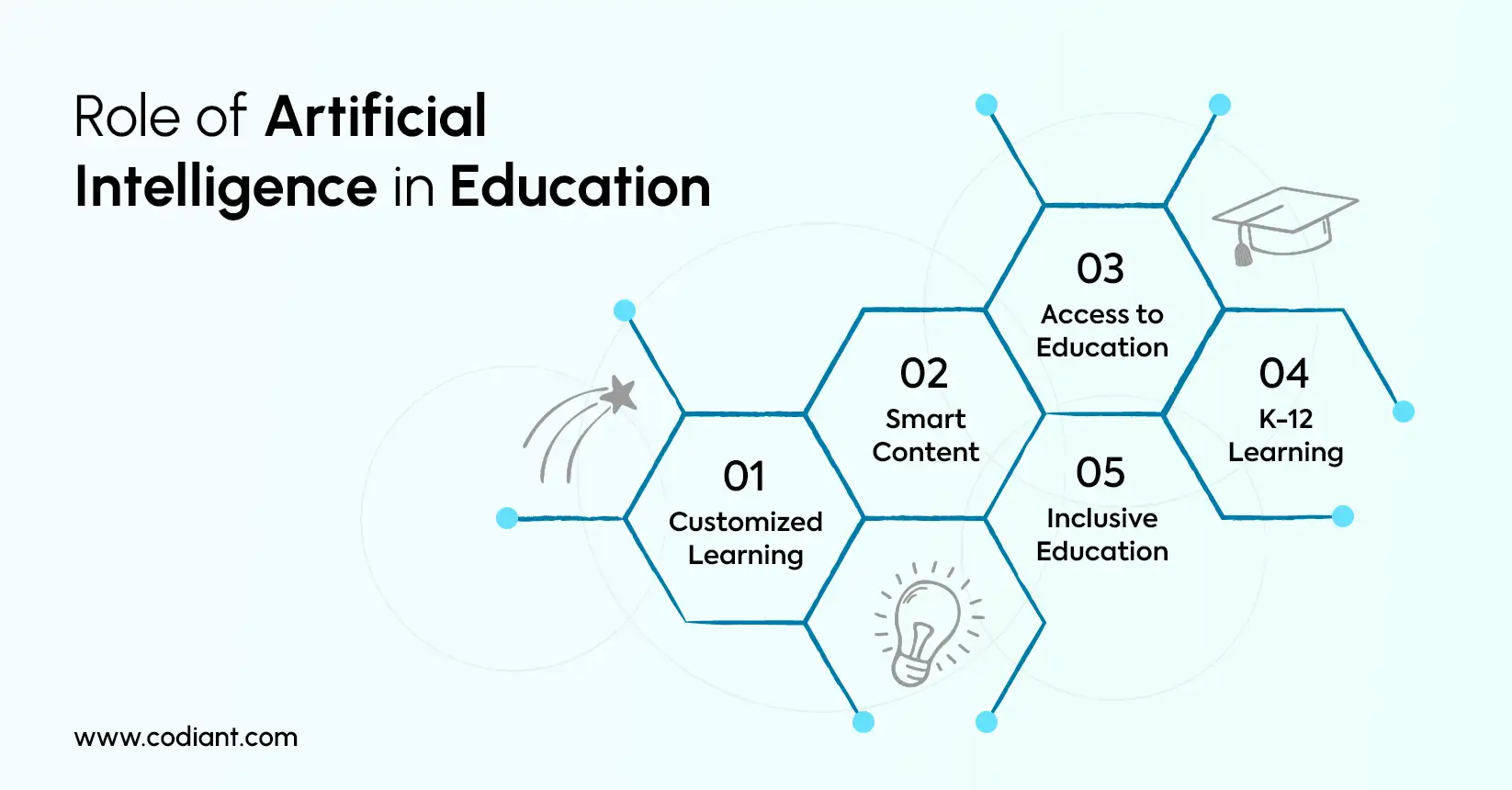
AI is used in education to personalize learning paths, power virtual tutors, automate grading, predict student risk, support language learning, generate learning content, and reduce administrative work for educators. These use cases are now visible across K–12 schools, higher education, online learning platforms, corporate training, and professional certification programs.
In classrooms, AI can help teachers identify learning gaps faster. In universities, AI can support course guidance, writing assistance, research workflows, and student engagement. In corporate training, AI can recommend role-based learning paths, track skill gaps, and automate compliance training.
The most common uses of AI in education include:
- Personalized course recommendations
- Adaptive quizzes and practice exercises
- AI tutoring and guided explanations
- Automated grading and feedback
- Essay review and writing support
- Dropout and performance risk prediction
- Multilingual learning support
- Skill gap analysis for employees
- Learning analytics dashboards for educators
- AI-generated summaries, flashcards, and practice tests
For EdTech startups, universities, and training businesses, AI-powered learning platforms are now becoming a core part of modern education and eLearning solutions, especially where personalization, learner analytics, and scalable digital training matter.
How Do AI Learning Platforms Work?
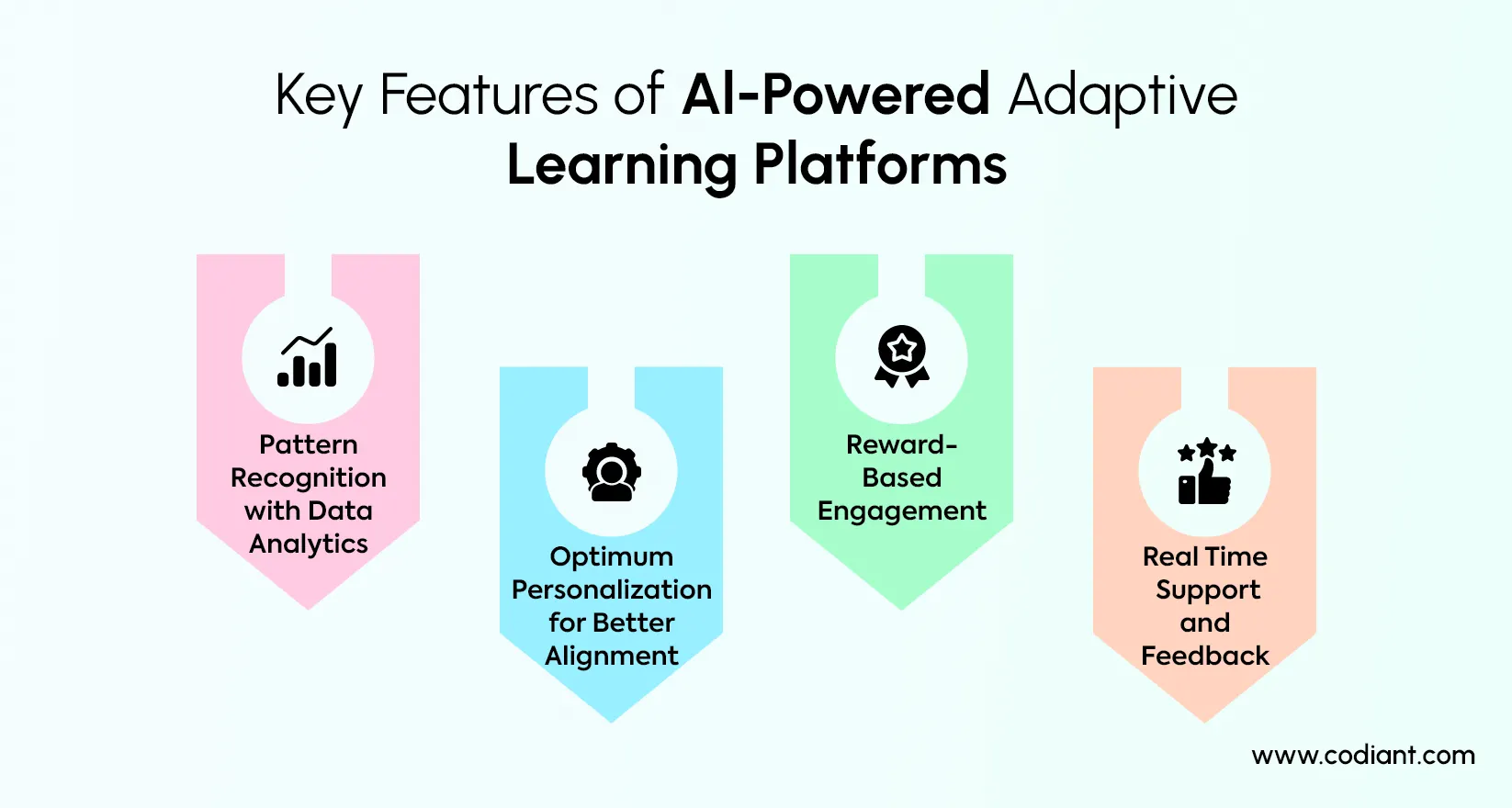
AI learning platforms work through a continuous feedback loop where learner activity is collected, analyzed, and used to personalize the next learning step. Every click, quiz attempt, video pause, wrong answer, skipped lesson, and completed assignment can help the system understand how the learner is progressing.
A typical AI learning platform works in six stages:
- Data collection
The platform tracks learning behavior such as time spent on lessons, answers submitted, videos watched, exercises skipped, quiz scores, and course completion patterns. - Learner profiling
Machine learning models build a dynamic learner profile based on strengths, weaknesses, preferred content format, learning pace, performance history, and engagement level. - Content adaptation
The platform adjusts the next lesson, quiz, hint, or recommendation based on the learner’s profile. For example, a student struggling with algebra may receive extra practice before moving to advanced equations. - Real-time feedback
Instead of showing only “right” or “wrong,” AI can explain why an answer is incorrect, offer hints, and guide the learner toward the right concept. - Progress reporting
Educators, mentors, or administrators receive dashboards that show individual progress, class-wide trends, weak topics, engagement levels, and risk alerts. - Model improvement
As more learners use the platform, the system can improve recommendations, refine feedback, and identify stronger learning patterns over time.
This is why AI-powered learning platforms are now seen as strong digital product development examples. They combine user behavior data, intelligent automation, content delivery, and personalized recommendations into one connected learning experience.
Based on Codiant’s e-learning marketplace experience with platforms like OpenOffice, the strongest foundation for future AI personalization is not only the AI model. It is the quality of learning data captured from user roles, mentor categories, session history, learner interests, bookings, course interactions, and feedback loops. Without clean learner behavior data, even advanced AI features can produce weak recommendations.
Did You Know?
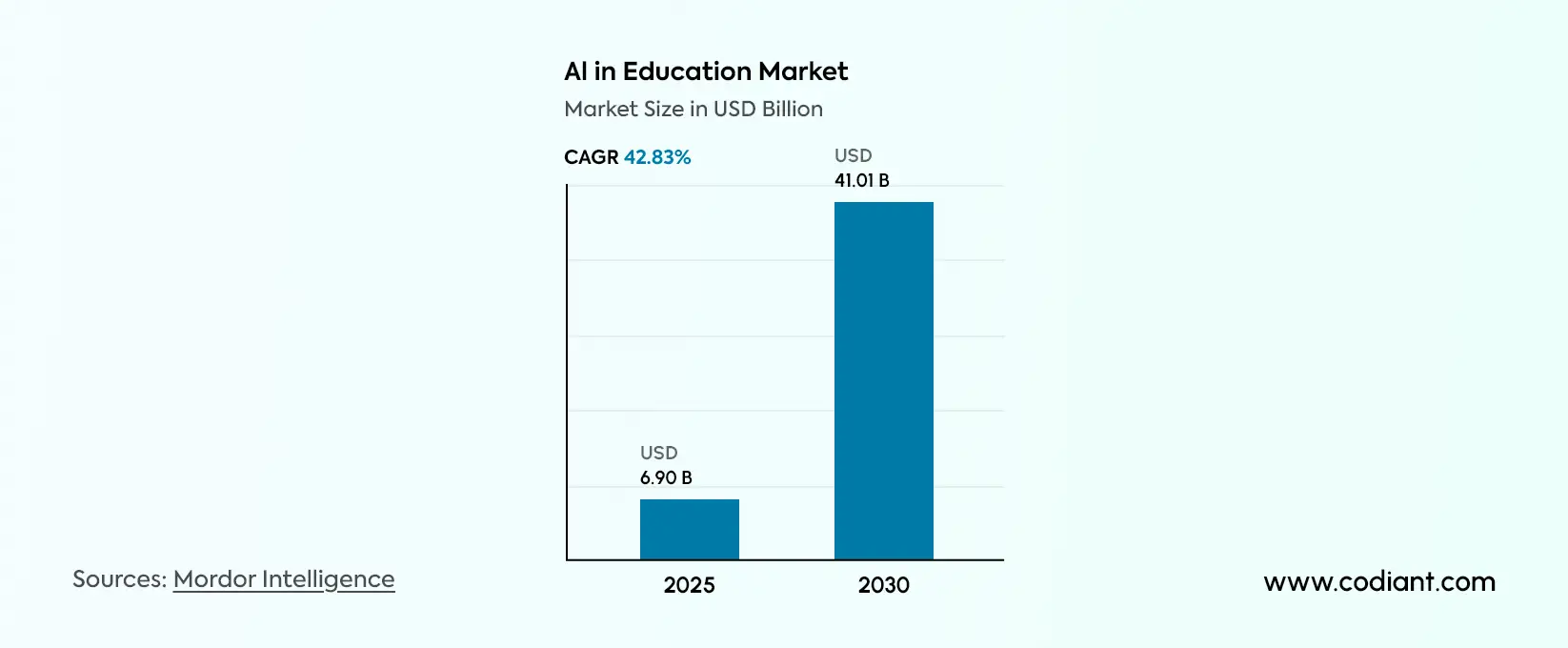
Over 60% of U.S. school districts had integrated AI-enabled tools specifically within their special education programs. Driven by the demand for adaptive learning, the global AI in education sector is now expanding at a massive 42.8% to 45% CAGR through 2030, with corporate training emerging as the fastest-growing end-user segment.
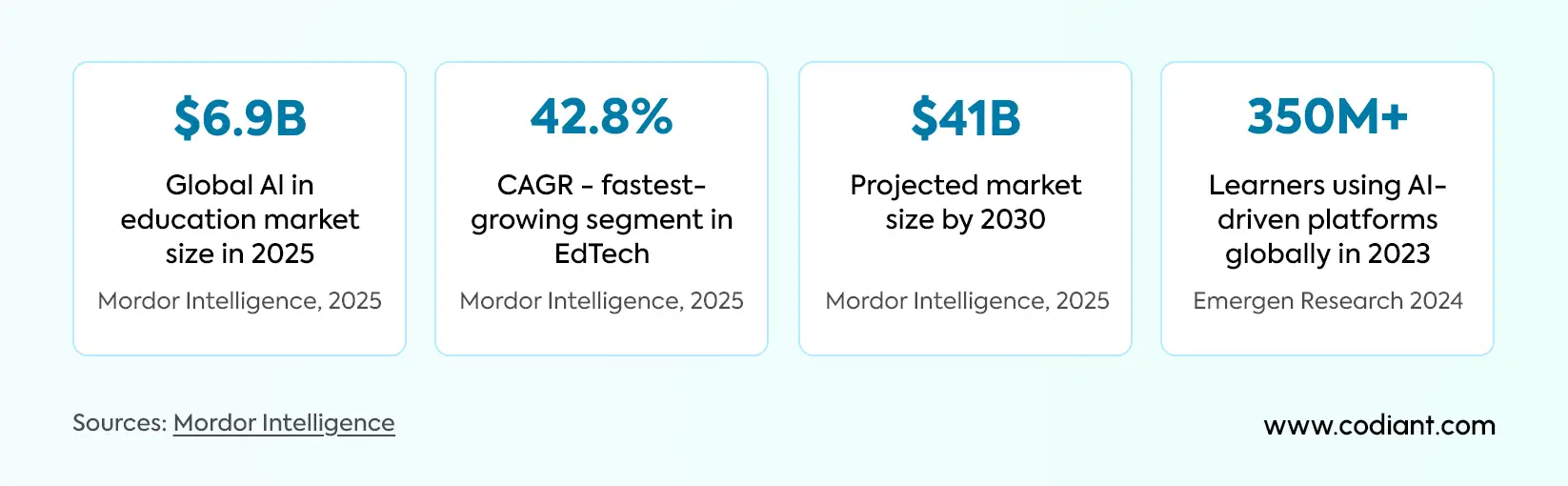
Sources: Mordor Intelligence
What Are the Main Use Cases of AI-Powered Learning Platforms?
The main use cases of AI-powered learning platforms include adaptive learning, AI tutoring, automated grading, personalized content recommendations, skill gap analysis, predictive learner analytics, language learning, and employee training. These use cases help education providers and businesses deliver more personalized learning without increasing manual teaching effort.
1. K–12 education
AI helps K–12 schools support adaptive math, reading practice, homework assistance, automated grading, and early identification of learning gaps. Teachers can use AI-generated insights to understand which students need intervention and which topics need reteaching.
Examples include:
- Adaptive reading and math platforms
- AI homework support
- Personalized practice worksheets
- Early warning systems for struggling students
- Special education support tools
- Teacher dashboards for class performance
2. Higher education
AI helps universities improve academic support, student retention, writing feedback, course recommendations, research assistance, and virtual simulations. Higher education institutions also use AI to support administrative workflows and student success programs.
Examples include:
- AI academic advisors
- Predictive dropout alerts
- Automated writing support
- Virtual labs and simulations
- AI-powered study assistants
- Plagiarism and originality checks
3. Corporate training
AI helps companies deliver role-based onboarding, compliance training, leadership development, sales coaching, and workforce upskilling. Instead of assigning the same training to every employee, AI solutions can recommend learning paths based on job roles, skill levels, performance data, and business goals.
Examples include:
- Employee onboarding
- Compliance training automation
- Skill gap analysis
- Sales enablement training
- Leadership learning paths
- Personalized employee development plans
4. Language learning
AI helps language learners practice pronunciation, grammar, vocabulary, listening, writing, and real-world conversation. Conversational AI tutors can simulate practical scenarios and provide instant explanations.
Examples include:
- AI conversation practice
- Pronunciation scoring
- Grammar correction
- Spaced repetition
- Personalized vocabulary review
- Multilingual learning support
5. Healthcare training
AI helps healthcare organizations train medical students, nurses, doctors, and administrative staff using simulations, compliance modules, decision-making scenarios, and patient communication practice.
Examples include:
- Medical simulations
- Clinical decision-making practice
- Patient communication training
- Continuing medical education
- Certification tracking
- Healthcare compliance learning
6. Vocational and skills training
AI helps learners practice job-ready skills through simulations, micro-learning, safety modules, and performance-based assessments.
Examples include:
- Trade skill simulations
- Safety compliance training
- Equipment handling modules
- Manufacturing process learning
- AR/VR practice environments
- On-the-job micro-learning
How Much Does It Cost to Build an AI-Powered Learning Platform?
The cost to build an AI-powered learning platform usually ranges from $15,000 to $300,000+, depending on platform complexity, AI features, user roles, integrations, live video, mobile apps, and scalability needs.
A basic MVP with course upload, user login, quizzes, progress tracking, and payment integration may cost $15,000 to $40,000. A full-scale enterprise AI learning platform with adaptive learning, AI tutors, live video, advanced analytics, LMS integrations, and custom AI models can cost $200,000 to $300,000+.
Cost by platform tier
| Platform Tier | Estimated Cost (USD) | Timeline | What’s included |
| Basic MVP | $15,000 – $40,000 | 2–4 months | User registration, course upload, basic progress tracking, simple quiz engine, payment integration |
| Mid-Level Platform | $40,000 – $100,000 | 4–7 months | Everything in Basic + live video sessions, AI content recommendations, discussion forums, instructor dashboard, mobile app |
| Advanced AI Platform | $100,000 – $200,000 | 7–12 months | Everything in Mid + adaptive learning engine, NLP-powered chatbot tutor, predictive analytics, automated grading, multi-language support, gamification |
| Enterprise / Full Scale | $200,000 – $300,000+ | 12–18+ months | Everything in Advanced + AR/VR learning environments, white-label options, deep LMS integrations, multi-tenant architecture, compliance tooling, custom AI model training |
Cost breakdown by development component
| Component | Estimated Cost (USD) | Notes |
| UI/UX Design | $5,000 – $25,000 | Wireframes, prototypes, visual design for web + mobile |
| Frontend Development | $10,000 – $40,000 | Web app (React/Vue), responsive layouts, interactive course player |
| Backend & API Development | $15,000 – $50,000 | Server logic, database, user management, content APIs |
| Mobile App (iOS + Android) | $20,000 – $60,000 | Native or cross-platform (React Native / Flutter) |
| AI & ML Features | $20,000 – $80,000 | Adaptive learning engine, NLP tutor, recommendation system, predictive analytics |
| Live Video Infrastructure | $10,000 – $30,000 | WebRTC integration, recording, streaming, session management |
| Payment Integration | $3,000 – $10,000 | Stripe / PayPal / regional gateways, subscription billing, payouts |
| Admin Dashboard & Analytics | $8,000 – $25,000 | Instructor controls, learner progress reports, platform analytics |
| QA Testing & Security | $5,000 – $20,000 | Functional, performance, and security testing; GDPR/data compliance |
| Deployment & DevOps | $3,000 – $15,000 | Cloud infrastructure (AWS/Azure/GCP), CI/CD pipeline setup |
| Ongoing Maintenance (annual) | $10,000 – $40,000/yr | Bug fixes, security patches, feature updates, AI model retraining |
What Factors Affect AI Learning Platform Development Cost?
The main factors that affect AI learning platform development cost are AI complexity, platform type, user roles, integrations, scalability, security, content management, live video, and mobile app requirements. The more intelligent and connected the platform needs to be, the higher the cost and development timeline.
- AI complexity: A simple recommendation engine costs less than a custom adaptive learning model that analyzes learner performance, generates feedback, and predicts future outcomes.
- Platform type: A course delivery app costs less than an e-learning marketplace with instructors, mentors, bookings, reviews, live sessions, subscriptions, and payouts.
- User roles: Learners, teachers, mentors, admins, institutions, parents, and enterprise managers may each need different dashboards and workflows.
- Integrations: LMS integrations, HR systems, SSO, CRM platforms, payment gateways, video tools, analytics tools, and content libraries increase cost.
- Scalability requirements: A platform for 1,000 learners needs a different architecture than a platform built for 1 million learners.
- Security and compliance: Education platforms handle learner data, payment data, academic records, and sometimes children’s data. Privacy, access control, data protection, and compliance can increase development effort.
- Mobile app requirements: Building only a web platform costs less than developing a web platform plus iOS and Android apps.
- Content and assessment logic: Advanced course builders, question banks, certificates, rubrics, adaptive assessments, and AI-generated practice modules add complexity.
Which Industries Use AI-Based Training Platforms?
AI-based training platforms are used in healthcare, corporate training, education, manufacturing, finance, retail, technology, and government. These industries use AI training systems to personalize learning, automate assessments, track employee progress, improve compliance training, and support continuous workforce upskilling.
| Industry | How AI-Based Training Platforms Are Used |
| Healthcare | Medical training, compliance learning, clinical skill assessments, certification tracking |
| Corporate & Enterprise | Employee onboarding, leadership training, sales enablement, workforce upskilling |
| Education & EdTech | Adaptive learning, personalized course recommendations, student performance tracking |
| Manufacturing | Safety training, equipment handling, quality control, process training |
| Financial Services | Compliance training, fraud awareness, product training, certification programs |
| Retail & E-commerce | Product training, customer service coaching, sales training |
| Technology | Software training, cybersecurity awareness, cloud and AI skill development |
| Government | Policy training, workforce development, public service training |
Industries adopt AI-based training platforms because they make learning more personalized, measurable, and scalable. Instead of giving every learner the same course, AI can recommend content based on role, skill level, performance gaps, learning history, and business goals.
This makes AI training platforms useful for organizations that need faster onboarding, better compliance, continuous skill development, and data-driven learning outcomes.
Which Companies are Leading AI in Education?
The companies leading AI in education include Khan Academy, Duolingo, Pearson, Microsoft, Google, and Squirrel AI. These companies use AI for tutoring, adaptive learning, learning content generation, study support, workplace skilling, and personalized education experiences.
1. Khan Academy: Khanmigo
Khan Academy’s Khanmigo is an AI-powered tutor and teaching assistant designed to guide learners instead of simply giving answers. Its approach is especially relevant for education because it encourages students to think through a problem with support.
Khanmigo shows how AI tutors can improve learning when they are built around guidance, safety, and educational design rather than answer generation alone.
2. Duolingo: AI-powered language learning
Duolingo uses AI to support lesson personalization, language practice, and content development. Duolingo Max introduced GPT-4-powered features such as Explain My Answer and Roleplay, helping learners understand mistakes and practice real-world conversations.
Duolingo’s AI strategy shows how generative AI solutions can make language learning more interactive, conversational, and scalable when paired with strong curriculum design.
3. Pearson: AI-powered study support
Pearson has added AI-powered study tools into its digital learning products to provide individualized support, practice, and feedback within assigned course materials. This reduces the need for students to leave the learning environment to search for help elsewhere.
Pearson’s approach shows how AI can strengthen higher education by connecting content, practice, and feedback inside one study experience.
4. Microsoft: AI skilling and workplace learning
Microsoft has invested heavily in AI skilling initiatives and workplace learning through tools like Microsoft 365, LinkedIn Learning, Viva Learning, and Copilot-related training programs. Its AI skilling initiatives focus on preparing students, workers, and organizations for AI-enabled work.
This shows how AI learning platforms are not limited to schools. They are also becoming central to workforce development and enterprise training.
5. Google: AI in education tools
Google supports education through Google Classroom, Google for Education, and AI-powered learning features across its ecosystem. Its education tools are widely used by schools and institutions to manage assignments, collaboration, content delivery, and classroom workflows.
Google’s role in education shows how AI can be integrated into tools learners and educators already use every day.
6. Squirrel AI: Adaptive learning at scale
Squirrel AI is known for adaptive learning systems that break subjects into granular knowledge points and personalize practice based on learner performance. Its platform has been used across thousands of learning centers and is often discussed as a large-scale example of AI-based adaptive tutoring.
Squirrel AI demonstrates how detailed learner mapping can help platforms recommend the next best learning activity with more precision.
Transform Online Education with AI That Personalizes Every Step
Create intelligent eLearning platforms that support learners, educators, trainers, and growing EdTech businesses.
Key Benefits of AI in eLearning
The main benefits of AI in eLearning are personalization, instant feedback, early intervention, reduced administrative workload, 24/7 support, multilingual accessibility, data-driven curriculum design, and cost-efficient scale. These benefits matter because digital learners often need flexible, guided, and measurable support.
- Personalization at scale
AI allows every learner to follow a different path based on their progress, skill gaps, interests, and pace. - Instant feedback
Learners do not need to wait days for responses. AI can provide immediate explanations, hints, and next-step guidance. - Early intervention
Predictive analytics can identify learners who are likely to fall behind, helping teachers or trainers intervene earlier. - Reduced administrative burden
AI can support grading, reporting, scheduling, content generation, and progress tracking, giving educators more time for teaching. - 24/7 learning support
AI tutors and assistants can support learners outside classroom hours, including evenings, weekends, and self-paced study sessions. - Multilingual accessibility
NLP-powered platforms can support learners in multiple languages, making education more accessible across regions and learner groups. - Data-driven curriculum improvement
Educators can see which lessons, questions, or formats are causing difficulty and improve course design based on real learner data. - Cost efficiency at scale
AI can support thousands or millions of learners without requiring the same proportional increase in teaching or support staff.
Is AI Learning Effective for Students?
AI learning can be effective for students when it is designed to guide learning, personalize practice, and support teachers rather than replace human instruction. The effectiveness depends on the quality of the content, the learning design, the accuracy of the AI model, and the level of educator oversight.
AI works well when it helps students:
- Understand why an answer is wrong
- Practice at the right difficulty level
- Review weak topics more often
- Receive instant feedback
- Learn in their preferred format
- Stay engaged through interactive exercises
- Access help outside fixed classroom hours
However, AI learning is not automatically effective just because AI is present. Poorly designed AI systems can give shallow explanations, recommend irrelevant content, create inaccurate answers, or reduce critical thinking if learners use them only to get final answers.
The best AI-powered learning platforms use guided discovery, structured feedback, and human oversight. They help learners think better, not just finish faster.
Did You Know?
A 2026 global campus report found that 95% of students and educators actively use generative AI on campus, with over 90% of academic researchers integrating it into their professional workflows. However, formal institutional governance continues to lag severely, only about 19% to 20% of universities worldwide have enacted formal AI policies, a gap that widens even further across underfunded public K–12 school districts.
Source: Engageli
How Duolingo Used AI to Build a Billion-Dollar Learning Platform?
Duolingo is a strong example of how AI can make digital learning more personalized, interactive, and scalable. The platform uses AI to support lesson personalization, answer explanations, conversation practice, and learner engagement.
With Duolingo Max, the company introduced two GPT-4-powered features: Explain My Answer and Roleplay. Explain My Answer helps learners understand why an answer is right or wrong, while Roleplay lets users practice real-world conversations in a safe, guided environment.
Key takeaway: Duolingo shows that AI in education works best when it improves practice, feedback, personalization, and engagement. For EdTech businesses, AI should not be added as a trend. It should solve a real learning problem and make the user experience more useful.
The Future of AI in Education
We are still early in what AI will do to education. The platforms of 2025 are impressive, but the trajectory over the next five to ten years points to something far more transformative.
1. Emotionally aware AI tutors
Researchers are building systems that detect frustration, confusion, or disengagement through behavioral signals pauses, error patterns, typing speed and adjust the emotional tone of their responses accordingly. The goal is an AI that doesn’t just know what you’re learning, but how you’re feeling while you’re learning it.
2. Immersive AR and VR learning environments
AI-powered VR platforms are beginning to simulate chemistry labs, historical events, and surgical procedures. Medical students practice a procedure dozens of times before touching a real patient. History students walk through events rather than reading about them.
3. Lifelong learning portfolios
Future platforms will maintain a continuous, verified record of everything a person has learned across schools, employers, and self-directed study creating a portable learning identity that follows individuals through their career, updating in real time as new skills are acquired.
4. Generative AI content that writes itself
Deep Learning and Generative AI is projected to grow at a 48.3% CAGR within the AI education sector through 2030. Course content will generate dynamically tailored not just to the student’s level, but to their interests, learning history, and the latest developments in the subject matter.
Can AI Replace Teachers in Classrooms?
No and the research consensus is clear on this. The National Education Association has noted that education is fundamentally a human endeavor requiring empathy, mentorship, and social connection that AI cannot replicate. What AI will do is handle the routine, giving teachers more time for the deeply human parts of teaching.
The Bottom Line
AI-powered learning platforms are not a future technology they are here, working, and already inside the classrooms and training rooms of millions of people worldwide. The opportunity isn’t just in building better technology. It’s in using that technology to close the access gap giving every learner, regardless of background or budget, the kind of thoughtful, personalized guidance that used to be a privilege. That’s not just a good business opportunity. That’s one of the most meaningful problems AI can help solve.
Design Future-Ready eLearning Experiences Powered by Intelligent AI
Develop scalable learning platforms that personalize education, automate workflows, and support measurable growth.
The Author

Frequently Asked Questions
AI-powered learning platforms are education systems that use AI to personalize lessons, automate feedback, track progress, and recommend learning content. They use technologies such as machine learning, natural language processing, predictive analytics, generative AI, and recommendation engines.
AI is transforming education by making personalized learning easier to deliver at scale. It helps educators automate repetitive tasks, identify struggling learners earlier, provide instant feedback, generate learning resources, and support students beyond fixed classroom hours.
The main benefits of AI in eLearning include personalized learning paths, instant feedback, adaptive assessments, early intervention, 24/7 tutoring support, multilingual accessibility, reduced administrative work, and data-driven curriculum improvement.
Yes, AI can personalize student learning by analyzing performance, learning pace, topic mastery, engagement, and preferences. Based on this data, the platform can adjust content difficulty, recommend resources, generate practice questions, and provide targeted feedback.
An AI-powered learning platform can cost between $15,000 and $300,000+. A basic MVP may cost $15,000 to $40,000, while an enterprise platform with adaptive AI, live video, analytics, LMS integrations, and mobile apps may cost $200,000 to $300,000+.
AI learning can be effective when it is designed around guided practice, accurate feedback, strong learning content, and educator oversight. It works best when it helps learners understand concepts, practice weak areas, and receive personalized support without replacing human teaching.
AI-based training platforms are used in healthcare, education, corporate training, manufacturing, finance, retail, technology, and government. These industries use AI for onboarding, compliance, certification, skill development, safety training, and continuous workforce learning.
The future of AI in education includes adaptive tutors, immersive simulations, AI-generated learning content, lifelong learning records, and human-AI teaching workflows. AI will support teachers and trainers, but human judgment, empathy, and mentorship will remain central to education.
Featured Blogs
Read our thoughts and insights on the latest tech and business trends
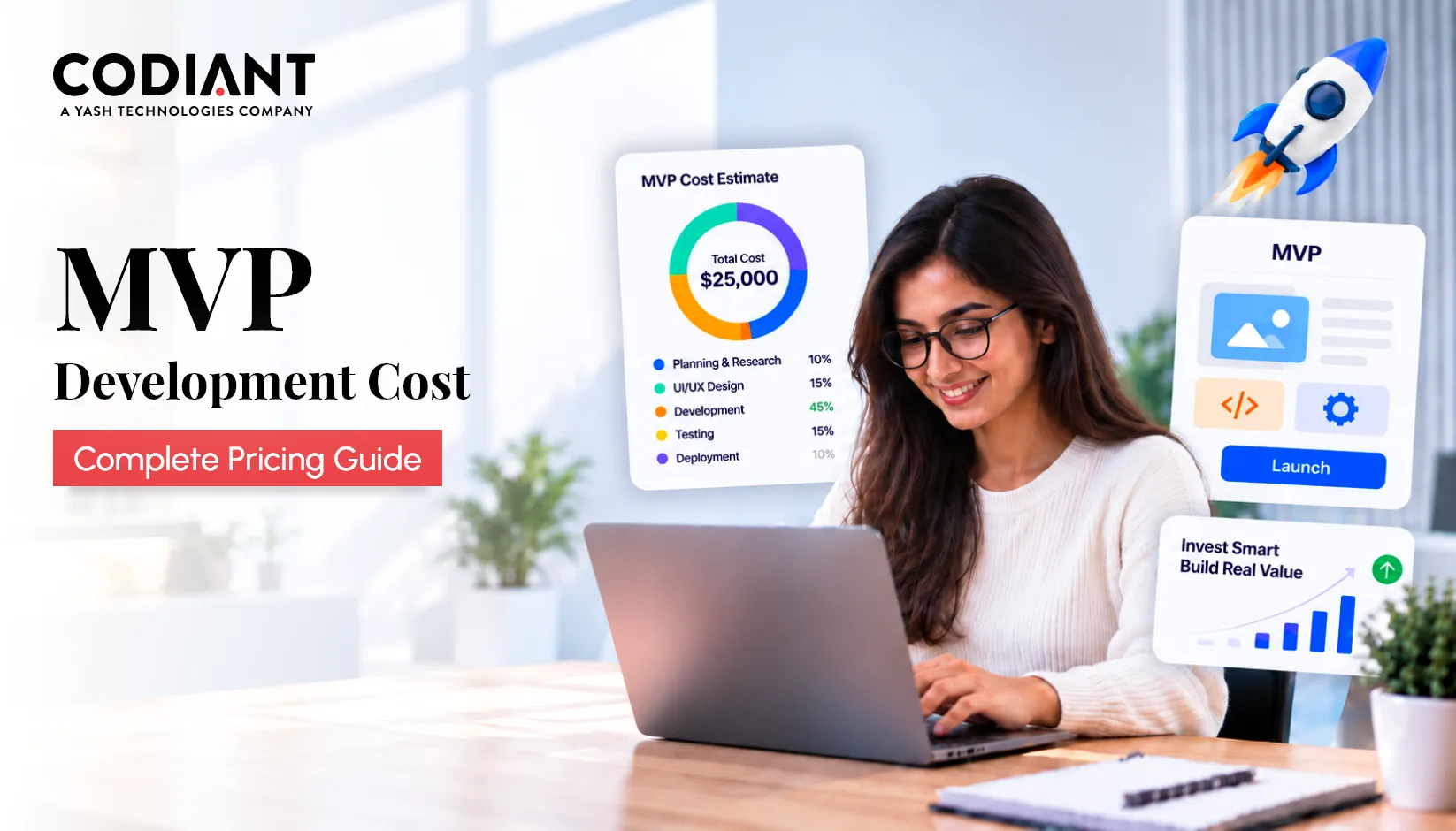
How Much Does It Cost to Build an MVP in 2026? A Complete Pricing Guide
- September 10, 2026
- Digital Transformation
MVP development cost typically ranges from $5,000 for a basic web-based product to $150,000 or more for a complex, cross-platform solution. A custom MVP with user accounts, a backend, essential integrations and a polished interface... Read more
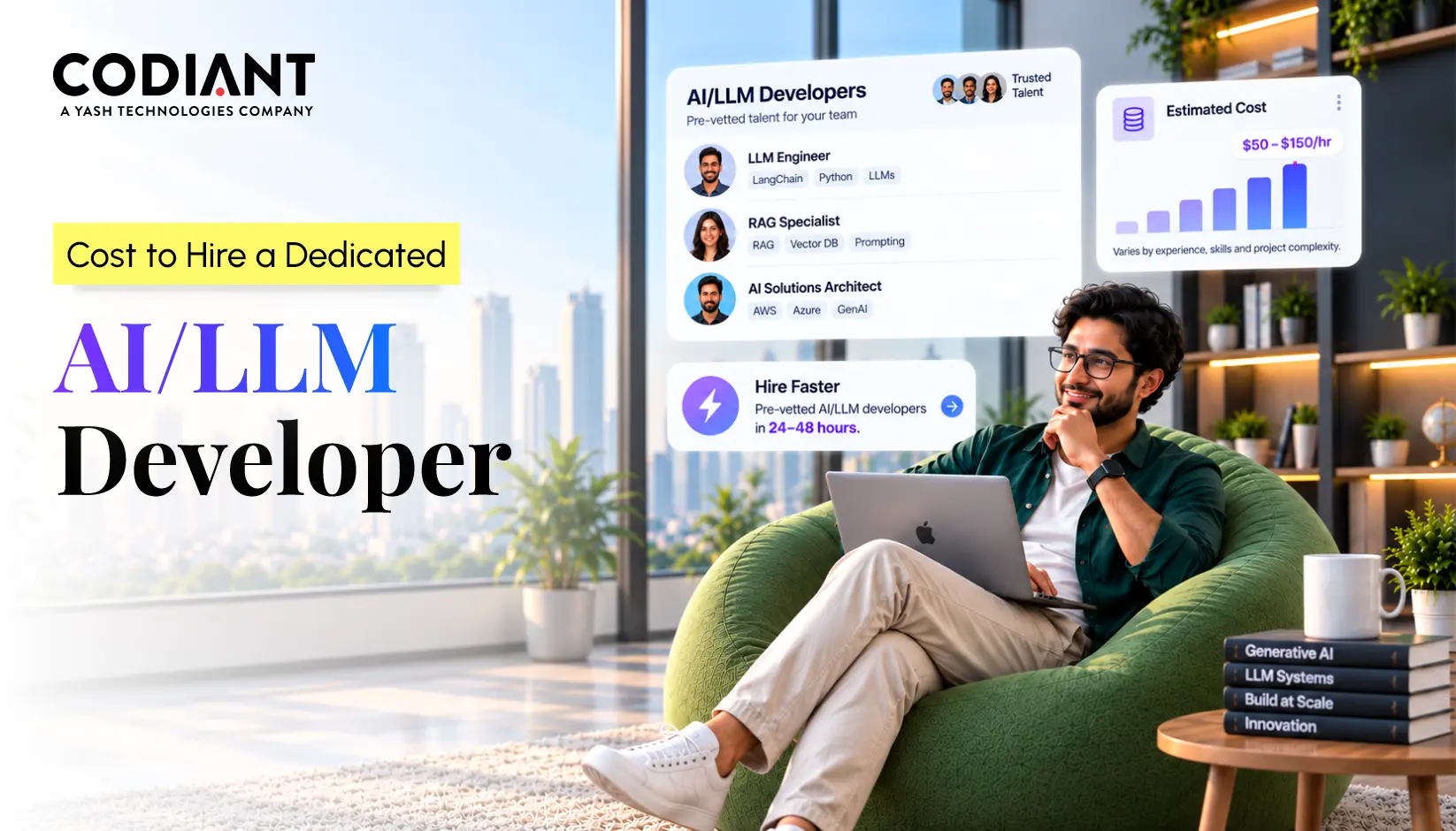
How Much Does It Cost to Hire a Dedicated AI/LLM Developer in 2026?
- September 8, 2026
- Artificial Intelligence Staff Augmentation
Hiring a dedicated AI or large language model (LLM) developer typically costs $35–$60 per hour for general AI engineering and $50–$200 per hour for specialised machine learning work, with enterprise pricing rising for advanced RAG,... Read more

HIPAA-Compliant App Development in 2026: How to Build Securely and Avoid Preventable Fines
- September 4, 2026
- Mobile App Development
HIPAA-compliant app development in 2026 requires six foundations: complete ePHI mapping, documented risk analysis, role-based access, encryption, signed business associate agreements, and continuous security monitoring. This matters most to healthcare CTOs, product leaders, and compliance... Read more