How to Create an AI Strategy for Your Business?
Table of Contents
Subscribe To Our Newsletter
Summarize with AI
Not enough time? get the key points instantly.
To create an AI strategy for your business, define the business outcomes AI should improve, assess your readiness across data, technology and talent, prioritize high-value use cases, establish governance and integration requirements, and set measurable KPIs. These steps create a practical roadmap for moving AI initiatives from initial pilots to scalable business solutions.
A successful AI strategy does not begin with selecting a model, tool or platform. It begins with identifying a specific business problem, understanding the workflow and data behind it, and deciding how success will be measured.
Deloitte’s State of AI in the Enterprise 2026 found that 66% of surveyed organizations had achieved productivity or efficiency improvements from AI, while only 20% reported revenue growth.
Anuradha Badone, Content Strategist covering AI and digital product development at Codiant, shares a similar observation from shaping content strategies for more than 150 AI and digital product projects: businesses often begin by asking which AI tool they should use, when the better starting point is the business problem, the workflow behind it, the available data and the result the company wants to measure. The technology should come only after those questions are clear.
Without this direction, AI initiatives can remain isolated pilots, create uncontrolled costs, introduce data and compliance risks, or fail to gain employee adoption. A well-designed AI strategy provides a repeatable framework for moving from opportunity assessment to responsible implementation and measurable return.
How to Build an AI Strategy
- Define the business outcome before choosing an AI model or platform.
- Assess readiness across data, technology, talent, governance and leadership.
- Identify repetitive, data-rich processes where AI can create measurable value.
- Prioritize use cases by impact, feasibility, risk and strategic alignment.
- Begin with focused pilots that have reliable data and clear ownership.
- Design integrations, security and human-review workflows before deployment.
- Establish AI governance covering privacy, accountability and model monitoring.
- Measure model performance, user adoption, cost savings and revenue impact.
- Scale an AI initiative only after its operational value is validated.
- Review the strategy regularly as business needs and AI capabilities change.
What Is an AI Strategy?
An AI strategy is an organization-wide plan that explains why, where, and how artificial intelligence, including AI video generator solutions, will be used to improve productivity and drive innovation. It connects AI investments with business priorities and establishes the capabilities required to implement AI responsibly at scale.
A complete strategy answers seven questions:
- Which business outcomes should AI improve?
- Which use cases should be prioritized?
- Is the organization ready to implement them?
- What data and technology will be required?
- Who will own AI-related decisions and risks?
- How will employees adopt the new systems?
- How will financial and operational value be measured?
An AI strategy is broader than an AI project plan. A project plan covers the implementation of one solution. A strategy establishes the priorities, standards and operating model for multiple initiatives across the organization.
Turn Your AI Ambitions into a Measurable Business Roadmap Today
Identify high-impact use cases, readiness gaps, and priorities with expert AI strategy guidance for growth.
Why Do Businesses Need an AI Strategy?
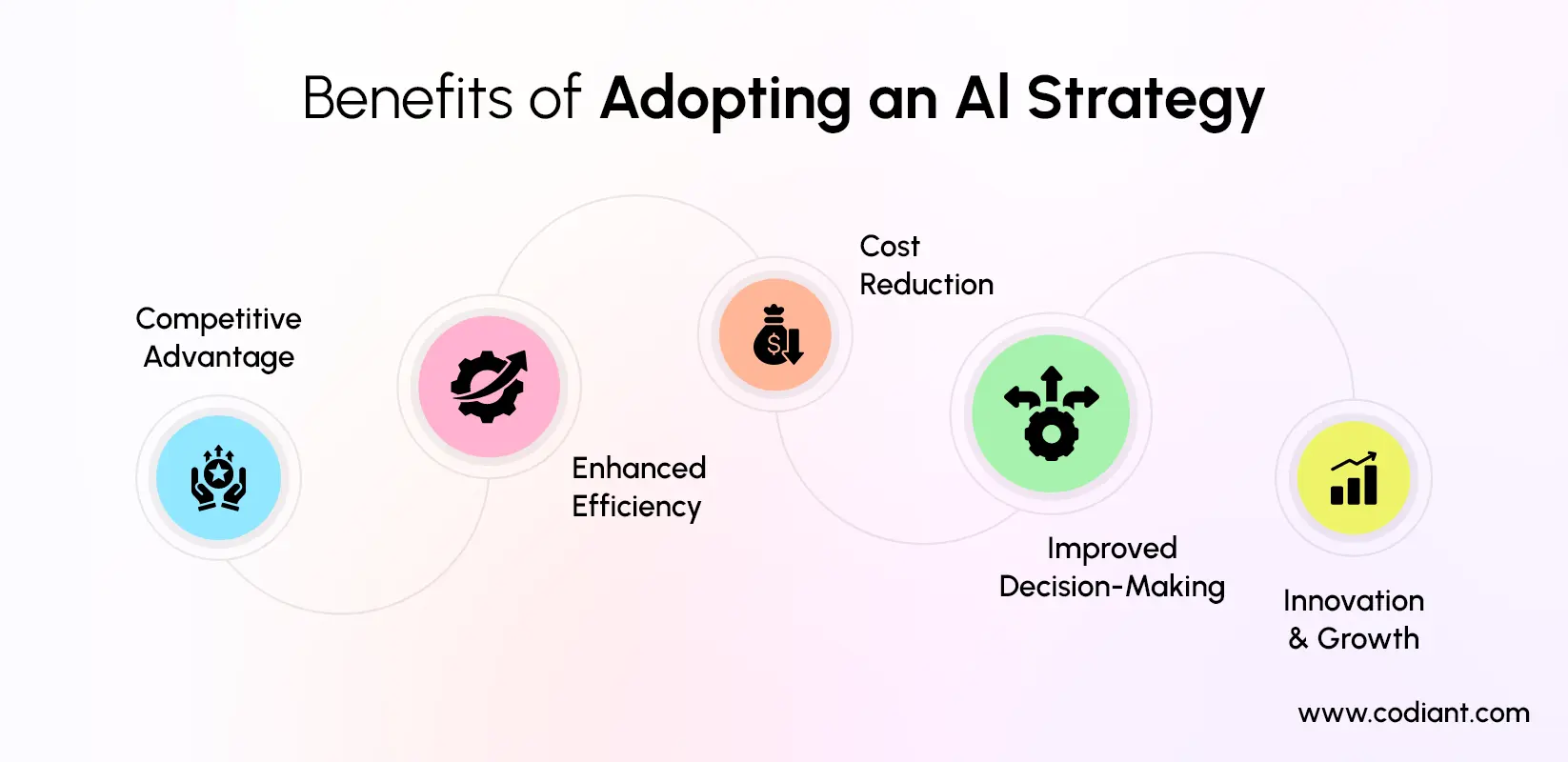
Businesses need an AI strategy to ensure AI investments solve valuable problems, use appropriate data, operate within defined safeguards and produce measurable results.
The difference between businesses that succeed with AI and those that struggle almost always comes down to planning, not technology. The tools are available to everyone. The strategy is not.
Here is what happens when businesses skip the strategy phase:
- Teams build disconnected AI pilots that never scale
- Data is collected without the infrastructure to use it
- Employees resist AI adoption because no one explained the purpose
- Security and compliance risks go unaddressed until they become incidents
- Leadership loses confidence and pulls funding before results materialize
💡 Did You Know?
McKinsey’s The State of AI in 2025 report found that 88% of organizations regularly use AI in at least one business function, but only about one-third have started scaling it across the enterprise. Although 39% report some EBIT impact, most say AI contributes less than 5% of total EBIT.
The data suggests that simply adopting AI is not enough. Meaningful returns depend on scaling successful use cases, redesigning workflows, strengthening governance, and aligning AI investments with measurable business outcomes.
A strong AI transformation strategy ensures your investments are targeted, your teams are prepared, and your results are measurable. It is not a one-time document. It is an operating framework.
What Should an AI Strategy Include?
A complete AI strategy should include business objectives, readiness assessment, use-case priorities, data and technology requirements, governance, talent planning and a measurement framework.
| Component | What It Covers |
| Business objective alignment | Maps AI initiatives to specific revenue, efficiency, or experience goals |
| AI readiness assessment | Evaluates data maturity, talent gaps, and technology infrastructure |
| Use case prioritization | Ranks AI opportunities by impact, feasibility, and strategic fit |
| Data and technology roadmap | Defines data pipelines, platforms, and integration requirements |
| Governance and risk framework | Addresses ethics, compliance, security, and model accountability |
| Talent and change management plan | Covers hiring, training, and organizational adoption |
| Measurement and ROI framework | Specifies KPIs, baselines, and evaluation timelines |
Each component answers a specific question your organization must resolve before committing resources to AI at scale. Skipping any one of them creates a gap that will surface during implementation.
How Do Businesses Identify AI Opportunities?
Businesses identify AI opportunities by examining repetitive, data-rich, decision-heavy or experience-sensitive processes and evaluating whether AI can improve their cost, speed, quality or reliability.
A cross-functional opportunity workshop can bring together leaders from operations, technology, finance, customer service, legal, security and relevant business units. The objective is not to produce the longest possible list of ideas. It is to identify a focused group of problems worth evaluating.
A structured framework for identifying high-ROI AI opportunities can help teams compare potential use cases based on value, feasibility, data readiness and implementation risk.
The Four-Lens AI Opportunity Filter
Use four lenses to evaluate each possible use case.
- Repetition lens: Is the activity performed frequently enough for automation to produce meaningful cumulative savings?
- Data lens: Is sufficient, relevant and accessible data available to support the task?
- Decision lens: Does the process involve classification, prediction, pattern recognition or recommendations that AI could improve?
- Experience lens: Could AI materially improve the experience of a customer, employee, supplier or partner?
A use case that performs well across three or four lenses may deserve detailed assessment. A weak score does not always mean the idea should be abandoned. It may indicate that data, process or governance foundations need to be improved first.
Where AI Typically Creates the Most Value?
Potential opportunities frequently appear in:
- Customer service: request classification, agent assistance and self-service
- Sales: lead prioritization, call analysis and proposal support
- Marketing: audience segmentation, personalization and content operations
- Finance: document extraction, anomaly detection and forecasting
- Operations: demand forecasting, scheduling and quality monitoring
- Human resources: knowledge support, onboarding and workforce planning
- Product teams: feedback analysis, testing support and feature discovery
- IT operations: incident classification, knowledge retrieval and code assistance
The best starting point is not necessarily the department with the most possible use cases. It is the area with a valuable problem, reliable data, clear ownership and measurable performance.
Identifying AI Opportunities in Property Management
While planning Occupy360, Codiant examined how property teams managed tenant requests, maintenance tasks, lease records, payments and portfolio reporting. The analysis revealed repetitive work, fragmented data and delays caused by manual coordination.
These findings highlighted several potential AI and automation opportunities:
- Automatically categorizing and routing maintenance requests
- Prioritizing urgent tenant issues
- Detecting overdue rent or lease-renewal risks
- Assigning technicians based on workload and availability
- Generating portfolio-level operational insights
Occupy360 first addressed the underlying problem by centralizing tenant, maintenance, financial and portfolio workflows within one platform. This created the structured data and standardized processes needed for more advanced automation.
Strategic takeaway: Businesses should identify AI opportunities by first locating repetitive workflows, disconnected data and recurring decision bottlenecks. AI becomes more practical once the underlying process and data are structured.
How to Create an AI Strategy for Your Business? (6-Step Framework)
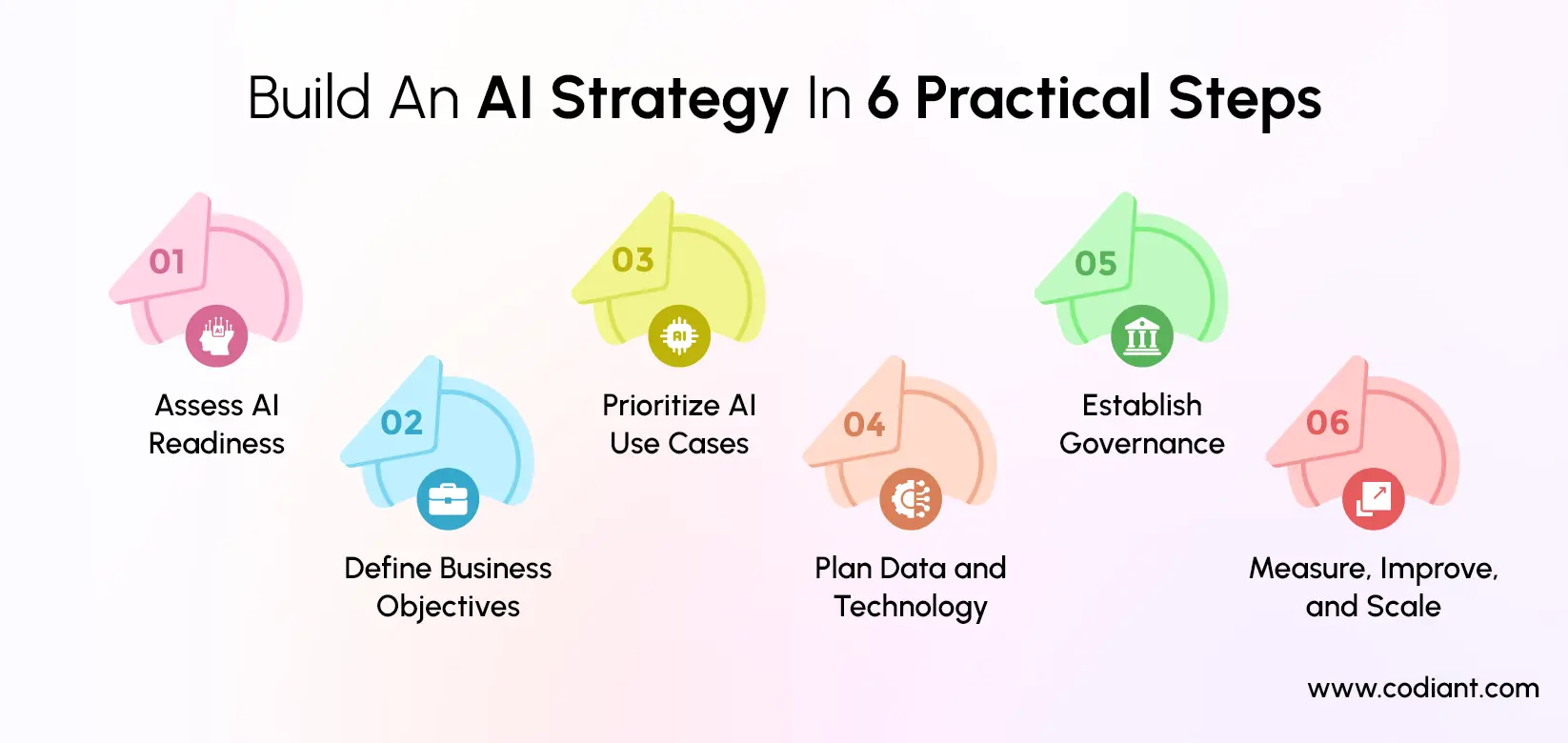
Step 1: Conduct an AI Readiness Assessment
An AI readiness assessment determines whether the organization has the data, technology, skills, governance and operational support needed to implement its proposed use cases.
Assess the organization across the following areas.
Data readiness
Evaluate:
- Data volume and relevance
- Accuracy, completeness and consistency
- Ownership and access rights
- Availability of labelled or historical examples
- Privacy and retention restrictions
- Data silos and integration barriers
Having large quantities of data does not automatically make an organization AI-ready. The data must be relevant to the specific outcome the system is expected to produce.
Technology readiness
Assess whether existing systems can support:
- Secure APIs and integrations
- Cloud or on-premises deployment
- Data pipelines and storage
- Identity and access controls
- Monitoring and logging
- Model or vendor integration
- Scalability and performance requirements
Talent readiness
Determine whether the organization has access to:
- AI or machine-learning engineers
- Data engineers
- Product managers
- Domain specialists
- Security and compliance expertise
- Quality-assurance professionals
- Change-management leadership
Not every company needs to employ every role internally. The strategy should define which capabilities will be built in-house, purchased through platforms or obtained from external specialists.
Governance readiness
Review whether the organization already has:
- Data governance policies
- Information-security standards
- Vendor assessment processes
- Privacy and legal review
- Model validation responsibilities
- Incident-management procedures
- Human-oversight rules
The output of this step should be a readiness scorecard showing current strengths, material gaps, required actions and accountable owners.
Step 2: Define AI Objectives Tied to Business Goals
Every AI initiative should connect to a measurable business outcome. Objectives should describe the result the organization wants, not merely the technology it plans to deploy.
| Technology-First Objective | Business-Aligned Objective |
| Implement a machine-learning model | Reduce preventable customer churn |
| Deploy a website chatbot | Resolve more routine support requests without escalation |
| Use NLP for document processing | Reduce invoice-processing time and manual data entry |
| Build a recommendation engine | Improve relevant product discovery and average order value |
| Introduce an AI assistant | Reduce time employees spend searching internal information |
A strong objective should define:
- The affected business process
- The current performance baseline
- The desired improvement
- The measurement period
- The accountable business owner
- Important quality or risk constraints
For example:
Reduce the average time required to classify and route support tickets from 12 minutes to four minutes within six months, while maintaining the existing quality-assurance threshold.
This objective is measurable and allows technical performance to be evaluated alongside the operational result.
Step 3: Build an AI Use-Case Roadmap
An AI use-case roadmap ranks opportunities by business impact, implementation feasibility, data readiness, risk and strategic relevance.
A practical scoring model can include:
| Criterion | Example Evaluation Question |
| Business impact | Could this materially affect revenue, cost, time, quality or risk? |
| Data readiness | Is suitable data available, accessible and legally usable? |
| Technical feasibility | Can current models and systems support the requirement? |
| Time to value | How quickly could a meaningful result be demonstrated? |
| Adoption complexity | How much workflow and behavioural change is required? |
| Risk | Could errors create legal, safety, financial or reputational harm? |
| Strategic fit | Does the use case support a current organizational priority? |
Group use cases into four categories:
Quick wins
High-value use cases with strong data readiness and manageable implementation requirements. These can create early evidence and organizational confidence.
Strategic initiatives
High-value but more complex opportunities requiring significant integration, governance, workflow redesign or data preparation.
Supporting improvements
Lower-impact opportunities that are relatively easy to implement but should not displace more valuable work.
Deprioritized initiatives
Use cases with limited value, weak data, high risk or disproportionate complexity.
The first roadmap should remain focused. It may include a small number of pilots and one carefully phased strategic initiative rather than a long list of simultaneous projects.
Step 4: Design the Data and Technology Architecture
The data and technology architecture defines how information will be prepared, how AI capabilities will be delivered and how outputs will connect to existing business systems.
Google Cloud’s guidance on building a data strategy for the AI era recommends beginning with business and AI priorities, assessing current organizational capabilities and then developing the data foundations required to support the intended outcomes.
The architecture plan should cover four areas.
1. Data inventory
Catalog:
- Relevant data sources
- Data owners
- Formats and locations
- Quality constraints
- Access permissions
- Retention requirements
- Sensitive-data classifications
2. Data pipeline design
Define how data will be:
- Collected
- Validated
- Cleaned
- Transformed
- Stored
- Retrieved
- Monitored
- Updated
3. Platform and model selection
The appropriate approach depends on whether the business needs prediction, content generation or autonomous workflow execution. Understanding the differences between traditional AI, generative AI and agentic AI helps teams select capabilities that match the intended business outcome.
Evaluate whether the use case requires:
- A commercial AI API
- A managed cloud AI platform
- An open-source model
- Retrieval-augmented generation
- Fine-tuning
- A custom predictive model
- A rules-based system combined with AI
The most advanced model is not always the most appropriate option. Selection should consider accuracy, latency, cost, privacy, explainability, integration effort and vendor dependence.
4. Integration planning
Map how the AI system will exchange information with:
- CRM platforms
- ERP systems
- Document repositories
- Support tools
- Data warehouses
- Identity systems
- Operational dashboards
- Human-review queues
The architecture should also define fallback behaviour. Teams need to know what happens when a model is unavailable, produces a low-confidence answer or encounters an unsupported request.
Moving from architecture planning to production may require capabilities across data preparation, model development, system integration, deployment and ongoing performance monitoring. These areas are typically covered within end-to-end AI development services.
Step 5: Establish AI Governance and Change Management
AI governance defines how decisions are made, risks are managed and responsibility is assigned throughout the AI lifecycle.
A practical governance framework should include:
AI ownership
Specify:
- Executive sponsor
- Business-process owner
- Technical owner
- Data owner
- Risk and compliance reviewers
- Final decision authority
Acceptable-use policy
Define:
- Approved AI tools
- Permitted data types
- Prohibited uses
- Confidential-information rules
- Requirements for employee disclosure
- Vendor review procedures
Human oversight
Identify which outputs:
- Can be automated
- Require sample-based review
- Require approval before execution
- Must never be delegated entirely to AI
Higher-risk decisions involving employment, credit, healthcare, legal rights, safety or access to essential services generally require stronger review and documentation.
Model and output monitoring
Track:
- Accuracy and task success
- Error patterns
- Unsupported responses
- Bias or uneven performance
- Data and model drift
- Latency and availability
- Security incidents
- User overrides
Incident response
Document what happens when the system:
- Produces harmful or inaccurate output
- Reveals sensitive information
- Behaves outside its intended scope
- Is manipulated or compromised
- Causes an operational disruption
Change management
AI adoption also requires communication, training and workflow redesign. Employees should understand:
- Why the system is being introduced
- Which tasks it supports
- What it cannot do reliably
- How outputs should be reviewed
- How to report failures
How their responsibilities will change
McKinsey’s 2025 global AI survey identifies six organizational dimensions associated with capturing value from AI: strategy, talent, operating model, technology, data, and adoption and scaling.
Step 6: Define How AI Success Will Be Measured
AI success should be measured using technical performance, operational adoption and business impact. The measurement plan must be defined before deployment so results can be compared against a valid baseline.
For every use case, establish:
Baseline metric
How does the process perform without AI?
Examples:
- Average handling time
- Conversion rate
- Error rate
- Cost per transaction
- Forecast accuracy
- Customer satisfaction
- Employee hours required
Target metric
What improvement should the initiative deliver, and by when?
Leading indicators
Which early measures indicate whether adoption and performance are moving in the right direction?
Examples:
- Active users
- Task-completion rate
- Acceptance of recommendations
- Escalation frequency
- Human override rate
- Time spent per workflow
Model-health metrics
Depending on the system, monitor:
- Accuracy
- Precision
- Recall
- False-positive rate
- False-negative rate
- Groundedness
- Retrieval quality
- Latency
- Drift
- Availability
Business-impact metrics
Connect the initiative to:
- Revenue growth
- Cost reduction
- Time savings
- Error reduction
- Risk reduction
- Customer retention
- Employee productivity
- Service quality
For efficiency-focused initiatives, teams should also examine the specific ways AI can reduce operational costs through workflow automation, fewer manual errors, improved resource use and faster process completion.
How Do You Calculate AI ROI?
AI ROI compares the financial benefit created by an AI initiative with its total cost.
AI ROI = [(Total financial benefit − Total AI cost) ÷ Total AI cost] × 100
For example, suppose an AI workflow generates $180,000 in annual savings and costs $120,000 during the same measurement period:
AI ROI = [($180,000 − $120,000) ÷ $120,000] × 100 = 50%
This means the net benefit is equal to 50% of the amount invested.
Total AI cost may include:
- Strategy and discovery
- Data preparation
- Software licences and API usage
- Model development or configuration
- Application engineering
- System integration
- Security and compliance
- Employee training
- Cloud infrastructure
- Monitoring and maintenance
- Human-review operations
Benefits should be supported by observed results rather than estimates wherever possible. Time savings should only be converted into monetary value when the organization can explain how the released capacity creates a financial benefit.
Create an AI Roadmap Built Around Real Business Priorities
Align technology, data, governance, and investment decisions with measurable goals and scalable implementation plans.
What Are the Risks of Implementing AI Without a Strategy?
Implementing AI without a clear strategy can expose businesses to wasted investment, security failures, compliance problems, low employee adoption, and capabilities that fail to address valuable business needs. By adopting AI security solutions for enterprises, organizations can strengthen data protection, manage AI-related risks, support compliance, and align AI initiatives with long-term business objectives.
| Risk | What It Looks Like | How Strategy Reduces It |
| Wasted investment | Pilots never scale or paid tools remain unused | Prioritized use cases and defined success criteria |
| Data exposure | Sensitive information is entered into unapproved systems | Data classification and acceptable-use controls |
| Compliance failure | AI use conflicts with privacy or sector requirements | Legal and risk assessment before deployment |
| Unreliable outputs | Employees act on incorrect or unsupported responses | Testing, human oversight and monitoring |
| Employee resistance | Teams avoid or work around the system | Communication, training and workflow design |
| Vendor dependency | A critical workflow depends on one provider | Architecture planning and exit provisions |
| Unmeasured value | Leadership cannot determine whether AI is working | Baselines, KPIs and evaluation timelines |
The objective of strategy is not to eliminate every risk. It is to make risks visible, assign ownership and determine which controls are proportionate to each use case.
Real-World AI Strategy Examples: What Leading Companies Are Doing
Successful AI strategies connect AI with clear business problems, existing data and everyday workflows.
Walmart: Integrating AI into Retail Operations
In 2025, Walmart introduced AI-powered tools for 1.5 million U.S. store associates. Its task-management system reduced shift-planning time from 90 minutes to 30 minutes, helping managers assign work more efficiently. (Walmart, 2025)
Strategic lesson: AI creates greater value when it improves a specific workflow and delivers a measurable operational result.
Siemens: Building AI Around Industrial Expertise
In January 2026, Siemens and NVIDIA expanded their partnership to develop an Industrial AI Operating System connecting AI across engineering, manufacturing, operations and supply chains. (Siemens, 2026)
Strategic lesson: Businesses should prioritize AI opportunities that strengthen their existing expertise and solve important industry-specific problems.
Should Companies Hire AI Consultants to Create a Strategy?
Companies should consider hiring AI strategy consultants when they lack internal AI expertise, need an independent assessment of their readiness, or are making a large strategic investment and want to reduce execution risk.
AI business consulting adds the most value in three specific scenarios:
- You are building your first enterprise AI strategy and do not have experienced AI leadership internally
- You have attempted AI adoption before and need an objective diagnosis of why previous initiatives did not scale
- You are evaluating a significant technology investment (a new data platform, a custom model build, or an AI product acquisition) and need rigorous due diligence
What to look for in an AI strategy consulting partner:
- Documented experience with AI implementations in your industry that drive AI productivity, not just AI awareness.
- A discovery process that starts with your business problems, not with technology recommendations.
- Deliverables that include a prioritized roadmap, a governance framework, and a measurement plan, not just a report.
- Transparency about model limitations, data requirements, and realistic timelines.
Businesses that are still evaluating their readiness, possible use cases or implementation direction can begin with a free AI consultation before committing to a larger strategy or development engagement.
AI Strategy Template
Use the following template to structure initial planning.
| Area | Question to Answer | Deliverable |
| Business objective | What measurable outcome should AI improve? | Objective and baseline |
| Process | Which workflow or decision is affected? | Current-state process map |
| Readiness | What data, systems and skills are available? | Readiness assessment |
| Use case | Why is AI appropriate for this problem? | Use-case definition |
| Value | What is the expected financial or operational benefit? | Business case |
| Risk | What could go wrong and who could be affected? | Risk assessment |
| Architecture | How will data, models and systems connect? | Solution architecture |
| Governance | Who approves, monitors and reviews the system? | Ownership framework |
| Adoption | How will employees use the system? | Change plan |
| Measurement | How will success be evaluated? | KPI and ROI scorecard |
Be cautious of any AI consulting engagement that leads with a specific tool or platform recommendation before completing a thorough needs assessment. The technology should follow the strategy, not define it.
The Most Important Rule for Building an AI Strategy
Do not build an AI strategy around what AI can do. Build it around what your business needs to accomplish.
The most successful AI strategies share one trait: they start with a clear business problem and work backwards to the technology, not the other way around. The companies generating real returns from AI are not the ones with the most advanced models. They are the ones with the clearest alignment between AI investments and business outcomes.
Your AI innovation strategy does not need to be perfect before you start. It needs to be directionally correct, measurable, and flexible enough to adapt as your capabilities grow and the technology evolves.
Start with your readiness assessment. Define two or three high-impact objectives. Build your first pilot around a use case that has strong data, clear ROI, and visible business sponsorship. Measure everything from day one.
That is how sustainable AI transformation starts.
Make Your Business Ready for Responsible AI Adoption Today
Assess data, infrastructure, skills, and governance before investing in complex AI tools or platforms.
The Author

Frequently Asked Questions
The first steps are assessing AI readiness and defining business outcomes. Review data quality, technology infrastructure, internal skills, governance requirements, and process gaps before selecting tools or use cases. For example, a customer service AI initiative should begin with a measurable goal such as reducing ticket-routing time or improving first-response accuracy.
Businesses assess AI readiness by evaluating data, technology, talent, governance, and organizational support. The assessment should identify whether relevant data is accessible, current systems can support integration, and teams can operate and monitor AI responsibly. The final output should be a gap analysis that shows what must be improved before priority use cases move into development.
Customer service, sales, marketing, finance, operations, human resources, and IT can all benefit from AI initiatives. The best starting department is the one with a high-value problem, reliable data, clear process ownership, and measurable performance. For example, finance teams may begin with invoice processing, while customer service teams may prioritize request classification or agent assistance.
Organizations measure AI success by tracking model performance, user adoption, operational improvement, and business impact. Relevant metrics may include accuracy, response time, cost reduction, error rates, employee productivity, customer satisfaction, or revenue contribution. Each initiative should have a baseline and target established before deployment so results can be evaluated objectively.
Companies should consider AI consultants when they lack internal AI leadership, need an independent readiness assessment, or are planning a major AI investment. A qualified consultant should deliver a prioritized use-case roadmap, governance framework, architecture recommendations, and measurement plan. Avoid partners that recommend a specific platform before evaluating business goals, data constraints, and implementation risks.
Featured Blogs
Read our thoughts and insights on the latest tech and business trends
How Much Does It Cost to Build an MVP in 2026? A Complete Pricing Guide
- September 10, 2026
- Digital Transformation
MVP development cost typically ranges from $5,000 for a basic web-based product to $150,000 or more for a complex, cross-platform solution. A custom MVP with user accounts, a backend, essential integrations and a polished interface... Read more
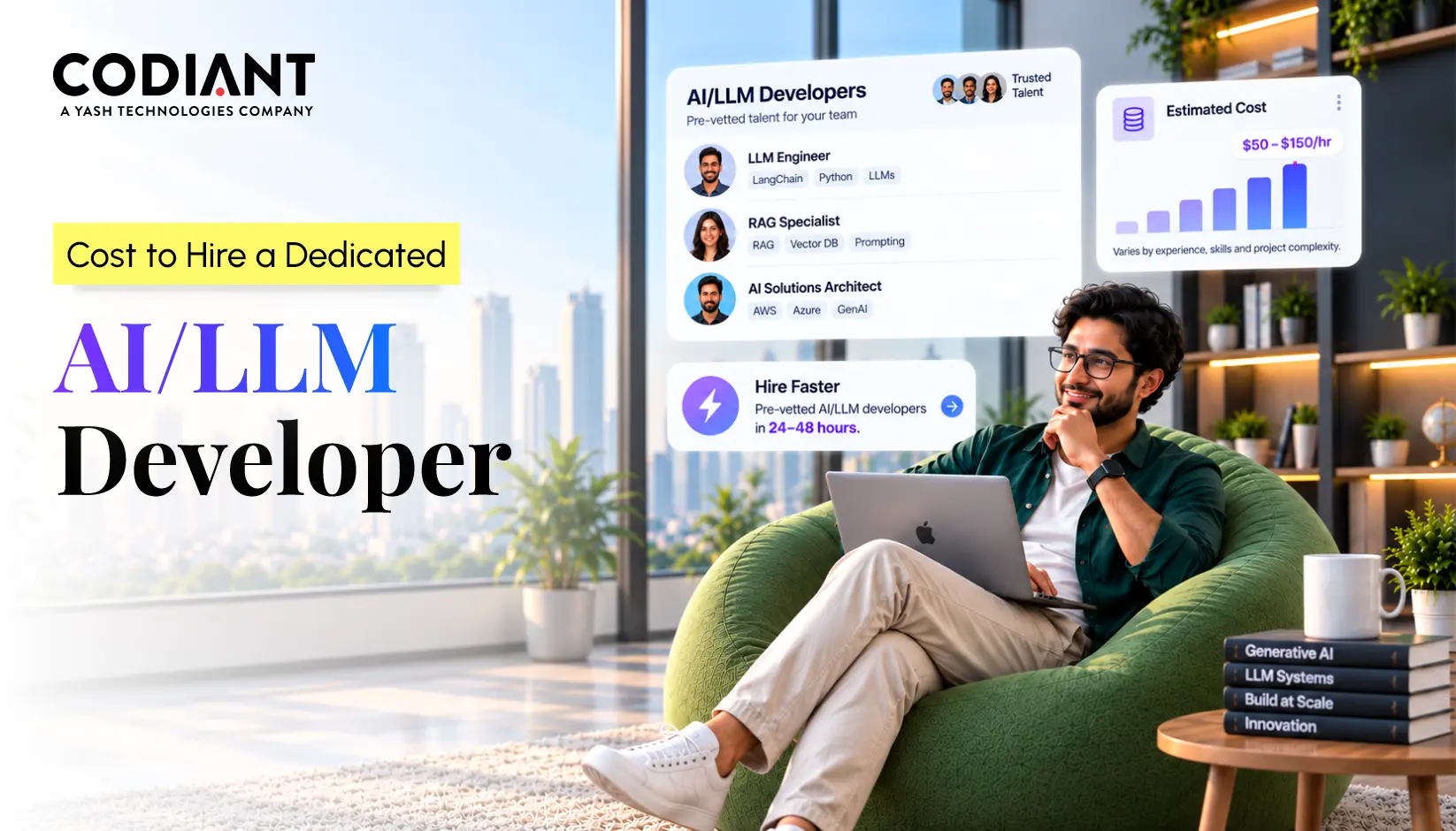
How Much Does It Cost to Hire a Dedicated AI/LLM Developer in 2026?
- September 8, 2026
- Artificial Intelligence Staff Augmentation
Hiring a dedicated AI or large language model (LLM) developer typically costs $35–$60 per hour for general AI engineering and $50–$200 per hour for specialised machine learning work, with enterprise pricing rising for advanced RAG,... Read more

HIPAA-Compliant App Development in 2026: How to Build Securely and Avoid Preventable Fines
- September 4, 2026
- Mobile App Development
HIPAA-compliant app development in 2026 requires six foundations: complete ePHI mapping, documented risk analysis, role-based access, encryption, signed business associate agreements, and continuous security monitoring. This matters most to healthcare CTOs, product leaders, and compliance... Read more