How to Hire the Right Healthcare Software Development Company – Complete Guide
Table of Contents
Subscribe To Our Newsletter
In a Nutshell
- Choosing the right healthcare software partner ensures long-term success outcomes.
- Healthcare software requires domain expertise, compliance knowledge and technical capabilities.
- Always prioritize HIPAA compliant software development for secure patient data.
- Evaluate company experience in real healthcare projects before making decisions.
- Healthcare app development cost depends on features, complexity and integrations.
- Outsourcing healthcare software development helps reduce costs without compromising quality.
- Essential features include security, scheduling, teleconsultation and data management systems.
- Avoid companies lacking healthcare experience, compliance knowledge or structured processes.
- AI integration enhances healthcare software with automation, insights and predictions.
- A reliable partner ensures scalable, secure and future-ready healthcare solutions.
Healthcare is no longer just about hospitals, doctors and physical infrastructure. It’s becoming deeply digital. From telemedicine platforms to AI-powered diagnostics, software is now at the center of modern healthcare delivery.
But here’s the challenge.
Building healthcare software isn’t like building a typical mobile app. The stakes are higher. The regulations are stricter. And the margin for error is almost zero.
That’s why choosing the right healthcare software development company becomes one of the most critical decisions for your business.
Pick the right partner and you accelerate innovation, improve patient outcomes and stay compliant. Pick the wrong one and you risk delays, security issues and regulatory violations.
This guide breaks down everything you need to know before you hire healthcare app developers or partner with a medical software development company.
Why Healthcare Software Development Requires Specialized Expertise?
It deals with sensitive patient data, integrates with complex systems, and must comply with strict regulations like HIPAA. This means your development partner needs more than just technical skills. They need domain understanding.
A reliable healthcare IT solutions company understands clinical workflows, patient journeys, and compliance frameworks. They know how electronic health records (EHR), telemedicine systems & diagnostic platforms work in real-world scenarios.
Without this expertise, even well-built software can fail in practical use.
Build Healthcare Software That Actually Works in Real Environments
Turn your healthcare idea into a secure, scalable, compliant solution.
Types of Healthcare Software You Can Build
Before you start evaluating vendors, it helps to understand what kind of software you actually need.
Healthcare solutions vary widely depending on use cases.
- Telemedicine platforms for remote consultations
- Electronic Medical Records (EMR/EHR) systems
- Hospital management systems
- Patient engagement apps
- AI-based diagnostic tools
- Health tracking and wearable integrations
A strong medical software development company will not just build what you ask. They’ll guide you on what you actually need based on your goals.
Key Factors to Consider Before Hiring a Healthcare Software Development Company
This is where most businesses make mistakes. They focus only on cost or timelines.
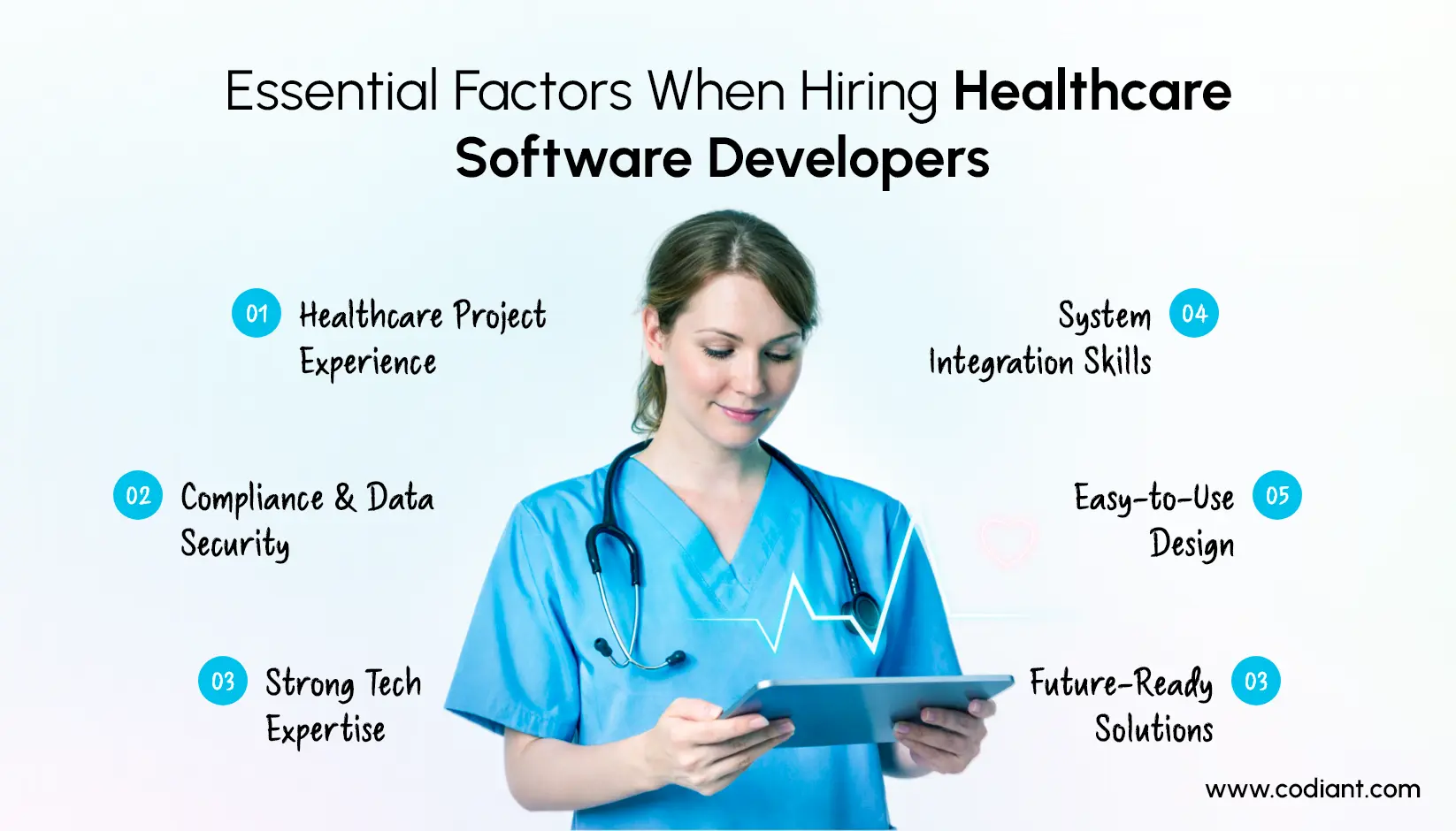
But hiring the right partner requires a deeper evaluation.
1. Domain Expertise in Healthcare
Not every development company understands healthcare.
Look for teams that have worked on real healthcare projects. Experience with EMR systems, telehealth platforms, or clinical workflows is a strong signal.
When a company understands healthcare, they don’t just code. They anticipate challenges.
2. Compliance and Security Capabilities
Healthcare software must comply with strict regulations.
One of the most important is HIPAA. If your app handles patient data in the US, HIPAA compliant software development is mandatory.
This includes-
- Secure data storage
- Encrypted communication
- Access control systems
- Audit trails
If a company cannot clearly explain how they handle compliance, that’s a red flag.
3. Technical Expertise and Tech Stack
Healthcare applications require robust and scalable architecture.
The company you hire should have expertise in-
- Cloud platforms like AWS or Azure
- Secure APIs and integrations
- AI solutions and data analytics (if needed)
- Mobile and web development frameworks
The right custom healthcare software solutions provider will recommend technologies based on your scalability and security needs, not trends.
4. Integration Capabilities
Healthcare systems don’t operate in isolation.
Your software may need to integrate with-
- EHR systems
- Insurance platforms
- Laboratory systems
- IoT devices and wearables
A capable healthcare software development services provider ensures seamless integration without disrupting existing workflows.
5. UI/UX Designed for Healthcare Users
Healthcare software is used by doctors, nurses, administrators & patients.
Each of them has different needs.
A good development partner focuses on usability. They design interfaces that reduce cognitive load and make workflows faster, not more complicated.
6. Scalability and Future Readiness
Healthcare technology evolves quickly.
Your software should be built to scale as your business grows.
Whether it’s adding AI features, expanding to new regions, or handling more users, your system should be ready for the future.
Read more: Top 10 Healthcare Software Development Companies in the USA for 2026
Understanding HIPAA Compliance in Healthcare Software
Let’s simplify this.
HIPAA is not just a checkbox. It’s a framework to protect patient data.
In practical terms, it ensures that sensitive health information is-
- Stored securely
- Shared only with authorized users
- Protected from breaches
When companies talk about HIPAA compliant software development, they refer to building systems that follow these strict guidelines.
This includes encryption, secure authentication, and regular security audits.
If your healthcare software handles patient data, compliance is not optional. It’s foundational.
How Much Does Healthcare App Development Cost?
This is one of the first questions every business asks before starting a healthcare project.
And the honest answer is still the same- it depends.
But let’s break it down properly so you can actually estimate your budget with clarity.
Healthcare App Development Cost Breakdown (Snapshot)
Here’s a realistic cost snapshot based on current market trends:
| App Type | Estimated Cost | Timeline | Best For |
| Basic Healthcare App | $20,000 – $50,000 | 2–4 months | Appointment booking, simple patient portals |
| Mid-Level Healthcare Solution | $50,000 – $150,000 | 4–8 months | Telemedicine apps, EHR integrations, dashboards |
| Advanced Healthcare Platform | $150,000 – $300,000+ | 8–12+ months | AI-powered apps, remote monitoring, multi-system integrations |
The healthcare app development cost is not a fixed number because healthcare apps vary widely in complexity, compliance needs, and integrations. A simple appointment booking app is very different from a full-scale telemedicine or AI-powered diagnostic platform.
What Factors Influence Healthcare App Development Cost?
Several key variables directly impact your total investment:
- Features and Complexity: The more advanced your app, the higher the cost. Basic features like login and scheduling are affordable, but adding AI, real-time video consultations, or analytics increases development effort significantly.
- Platform (Web, Mobile, or Both): Building for a single platform (iOS or Android) costs less. Cross-platform or web + mobile solutions require more development time and resources.
- Integrations Required: Healthcare apps often need to integrate with third-party systems like EHR/EMR platforms, payment gateways, lab systems, or wearable devices. Each integration adds complexity and cost.
- Compliance Requirements: If your app handles patient data, HIPAA compliant software development becomes mandatory. This includes encryption, secure storage, audit logs & strict access control systems, all of which increase development effort.
- UI/UX Design Complexity: Healthcare apps require intuitive and error-free interfaces for doctors, patients, and staff. Designing for multiple user roles adds to the cost.
- Development Team Location: Hiring developers in the US or Europe is significantly more expensive compared to outsourcing to countries like India. This is why many businesses explore healthcare software outsourcing to optimize costs.
Feature-Based Cost Impact (Quick View)
To give you a more practical perspective, here’s how specific features affect your budget:
| Feature | Cost Impact |
| User login & profiles | Low |
| Appointment scheduling | Low to Medium |
| Video consultation | Medium |
| EHR/EMR integration | Medium to High |
| AI-based diagnostics | High |
| Real-time data sync | High |
| Wearable/IoT integration | High |
| Advanced analytics dashboard | Medium to High |
Cost Optimization Through Outsourcing
If you’re working with a limited budget, outsourcing is often the smartest move.
By choosing to hire healthcare app developers from experienced offshore teams, you can-
- Reduce development costs by 40–60%
- Access pre-built healthcare expertise
- Speed up time-to-market
- Avoid long hiring cycles
Many global businesses partner with a reliable healthcare software development company in India to balance cost and quality effectively.
In-House vs Outsourcing- What’s the Better Choice?
Building an in-house team gives you control, but it comes with high costs and long hiring cycles.
On the other hand, outsourcing allows you to-
- Access specialized talent instantly
- Reduce operational costs
- Speed up development timelines
That’s why many companies choose to hire healthcare developers externally instead of building full internal teams.
The key is to choose the right partner who works as an extension of your business, not just a vendor.
Cut Development Costs Without Compromising Quality or Compliance
Hire expert healthcare developers and accelerate your product development journey.
What Features Should Healthcare Software Include?
The features depend on your use case, but some essentials remain constant.
A well-built healthcare platform typically includes:
- Secure user authentication
- Patient data management
- Appointment scheduling
- Teleconsultation capabilities
- Data analytics and reporting
- Integration with external systems
Advanced platforms may also include:
- AI-based recommendations
- Remote monitoring
- Voice-enabled documentation
- Predictive analytics
The right healthcare software development company will help you prioritize features based on your goals instead of overloading the system.
Red Flags to Avoid When Hiring a Healthcare Development Partner
Sometimes knowing what to avoid is just as important.
Watch out for-
- No healthcare portfolio
- Lack of compliance knowledge
- Unrealistically low pricing
- Poor communication processes
- No clear development roadmap
A reliable healthcare IT solutions company will be transparent, structured & proactive in communication.
Questions You Should Ask Before Hiring
Before finalizing a partner, ask these questions-
- What healthcare projects have you worked on?
- How do you ensure data security and compliance?
- What is your development process?
- How do you handle scalability?
- What post-launch support do you offer?
The answers will reveal more than any sales pitch.
How to Choose the Best Healthcare Software Development Company?
There’s no single “best” company.
The right choice depends on your requirements.
But the best partners share common traits-
- Strong healthcare domain experience
- Proven track record
- Clear understanding of compliance
- Scalable development approach
- Transparent communication
Instead of looking for the biggest name, focus on the right fit.
The Role of AI in Modern Healthcare Software
AI is transforming healthcare faster than expected.
From automated documentation to predictive diagnostics, AI is making systems smarter and more efficient.
Modern custom healthcare software solutions often include-
- AI-powered chatbots
- Clinical decision support systems
- Automated data analysis
- Personalized treatment recommendations
If you’re building a future-ready platform, integrating AI is no longer optional. It’s a competitive advantage.
Development Timeline- How Long Does It Take?
Timelines vary depending on complexity.
- Basic apps- 2–4 months
- Medium platforms- 4–8 months
- Advanced systems- 8–12+ months
The timeline also depends on integrations, compliance requirements, and feature sets.
A professional medical software development company will provide a realistic roadmap instead of overpromising speed.
Technologies Used in Healthcare Software Development
Healthcare software relies on a mix of technologies.
Common ones include-
- Frontend– React, Angular
- Backend– Node.js, Python, .NET
- Databases– PostgreSQL, MongoDB
- Cloud– AWS, Azure, Google Cloud
- AI/ML– TensorFlow, PyTorch
The choice of technology should align with your scalability, security & performance needs.
How Codiant Can Help You Build the Right Healthcare Software?
Choosing the right partner is what turns a healthcare idea into a scalable, compliant product. Codiant helps businesses build secure, high-performance healthcare solutions tailored to real-world clinical needs.
With deep expertise in healthcare software development services, the team ensures every solution is built with compliance, usability & scalability at its core.
- Proven experience in custom healthcare software solutions across telemedicine, EMR, and patient platforms
- Strong focus on HIPAA compliant software development and data security
- Dedicated teams to hire healthcare app developers based on your project needs
- Flexible engagement models for cost-effective healthcare software outsourcing
From idea to deployment, Codiant works as your long-term technology partner.
Related reading: How AI Agents Transform the Healthcare Sector?
Final Thoughts
Healthcare is evolving fast. Software is no longer just a support system. It’s becoming the backbone of patient care and operational efficiency. Choosing the right healthcare software development company is not just a technical decision. It’s a strategic one.
The right partner will help you build secure, scalable & compliant solutions that actually work in real-world healthcare environments. Take your time. Ask the right questions. Evaluate beyond pricing.
Because in healthcare, the impact of your software goes far beyond business. It directly affects lives.
Planning to Launch Your Healthcare App?
Validate your idea and build a future-ready healthcare platform efficiently.
The Author

Frequently Asked Questions
Healthcare software development involves creating digital solutions like telemedicine apps, EMR systems & patient platforms designed specifically for healthcare providers and patients.
HIPAA compliance ensures that patient data is securely stored and shared, protecting sensitive information from breaches and unauthorized access.
Depending on complexity, it can take anywhere from 2 months for basic apps to over 12 months for advanced, integrated healthcare platforms.
Healthcare apps use technologies like React Native, Node.js, Python, cloud platforms, and AI frameworks to ensure scalability, security & performance.
Yes. AI can be integrated for diagnostics, automation, patient engagement, and predictive analytics, making healthcare systems more efficient and intelligent.
Featured Blogs
Read our thoughts and insights on the latest tech and business trends
AI Tools vs Custom AI Development- Which One Fits Your Business Model?
- April 6, 2026
- Artificial Intelligence
In a Nutshell AI tools offer quick setup but limited flexibility for businesses. Custom AI solutions adapt deeply to unique workflows and requirements. AI SaaS tools reduce upfront costs but increase long-term expenses. Custom AI... Read more
Mobile App Personalization Using AI- Benefits, Use Cases & Implementation
- March 31, 2026
- Artificial Intelligence
In a Nutshell: AI helps mobile apps understand users and personalize experiences effectively. Apps learn from user behavior, improving recommendations over time automatically. Personalized content increases engagement, making users spend more time inside. AI driven... Read more
Top 15 Logistics App Development Companies in 2026
- March 27, 2026
- Mobile App Development
In a Nutshell Logistics apps enable real-time shipment tracking, improving transparency and operational efficiency across supply chains. Businesses partner with logistics app development companies to build scalable digital transportation platforms. AI-powered logistics systems optimize route... Read more