How Long Does It Take to Develop an App in 2026?
Table of Contents
Subscribe To Our Newsletter
In a Nutshell
- App development timelines depend more on scope clarity than technology speed.
- Simple apps take 2–4 months; complex platforms often require 9–12+ months.
- MVPs typically launch within 6–16 weeks when features remain tightly controlled.
- Cross-platform development shortens timelines but does not eliminate platform-specific work.
- AI features often add weeks, while AI-assisted development saves limited time.
- Integrations, compliance, and QA depth are major drivers of delivery timelines.
- Faster launches come from disciplined planning, not rushing development execution.
If you’ve ever asked, “How long does it take to develop an app?”, you’ve probably received the most frustrating answer in tech: it depends. And yes it still depends in 2026.
But the difference now is that we can estimate timelines far more accurately when we break app development into phases, define complexity clearly, and account for modern realities like AI-assisted engineering, privacy compliance, multi-device QA, and app store review cycles.
In this guide, you’ll get a practical, planning-friendly view of app development duration in 2026 what happens in each phase, how long each step usually takes, and the exact factors affecting app development time that cause projects to finish early… or drift for months.
You’ll also see how the question “how long does it take to build an app with AI?” changes the timeline (spoiler: AI speeds up specific work, but it doesn’t magically remove product decisions, QA, integrations, or approvals).
The 2026 Baseline: Typical App Development Timeline by Complexity
The time required to develop a mobile app in 2026 is shaped less by technology limits and more by product scope and execution discipline.
Most modern guides cluster mobile app development time into “simple, mid-size, complex.”
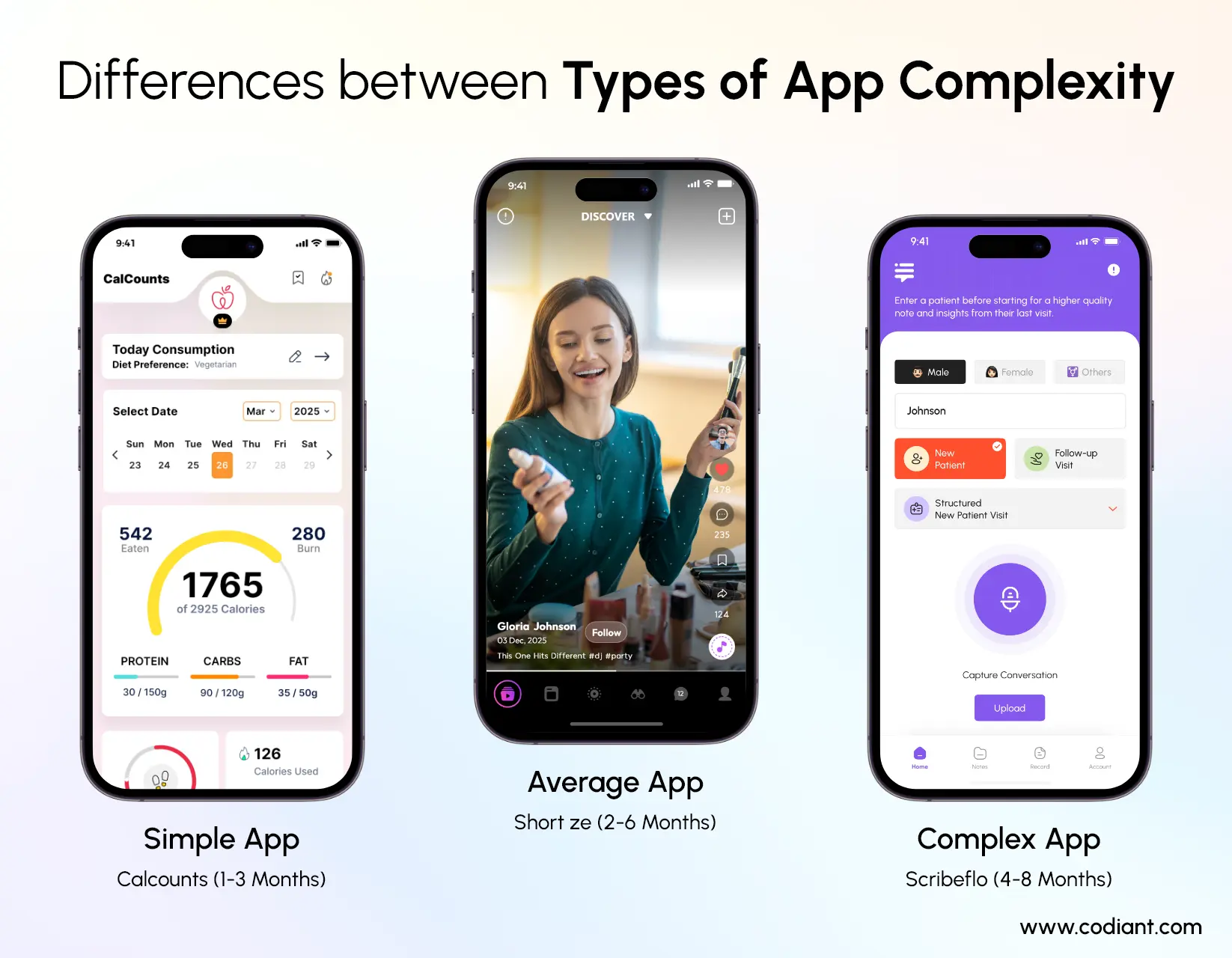
The ranges vary slightly by source, but the pattern is consistent:
- Simple apps: usually take 2–4 months.
- Medium-complexity apps: usually take 4–8 months.
- Complex or enterprise apps: usually take 9–12+ months.
A clean “2026 reality check” (typical ranges)
| Complexity level | Typical build scope | Estimated time to build a mobile app |
| Simple | Basic flows, minimal integrations, limited roles | ~8–16 weeks (2–4 months) |
| Mid-size | Multiple features + integrations + admin + analytics | ~4–8 months |
| Complex | Real-time systems, heavy integrations, high compliance, multi-role enterprise workflows | ~9–12+ months |
For MVPs, most app development projects typically take between 6 and 16 weeks, depending on feature scope and required integrations.
Not Sure Where Your App Fits? Let’s Map It Together
Get a clear app timeline estimate tailored to your features, platforms, AI scope, and growth goals.
What “Developing an App” Really Includes in 2026?
Before answering how long it takes to build an app, we need to define what “done” actually means.
In 2026, an app is not just screens + login + a database. A typical production-grade release often includes:
- Product discovery (what you’re building, for whom, and why)
- UI/UX design (flows, prototypes, design system)
- Frontend development (mobile + sometimes web admin)
- Backend + APIs (auth, data models, integrations)
- Third-party services (payments, maps, analytics, notifications)
- QA (manual + automation + device testing)
- Security + privacy (especially if health/fintech/children data is involved)
- App Store / Play Store deployment + compliance steps
- Post-launch monitoring, hotfixes, iteration
That’s why “a simple app” can still take months. Even a lean MVP typically needs a complete workflow from idea → build → test → launch.
App Development Process Timeline: The 6 Phases and How Long Each Takes
A useful way to estimate how long does app development take is to map the timeline to phases. A commonly used breakdown includes planning, design, development, testing, deployment, and post-launch iteration.
Quick Snapshot: App Development Timeline in 2026
A structured, phase-wise view of app development reveals realistic timelines, dependencies, and delivery expectations in 2026.
| Phase | Duration | Primary Focus | Key Activities |
| Phase 1: Discovery & Planning | 2–4 weeks | Scope & alignment | Requirements workshops, user personas, key user flows, MVP vs V1 decisions, tech stack selection, risk assessment |
| Phase 2: UX Flows & UI Design | 2–6 weeks | Usability & visual clarity | Wireframes, clickable prototypes, design system, edge cases, developer handoff |
| Phase 3: Backend & Core Infrastructure | 2–8 weeks (overlaps) | System foundation | Authentication, APIs, database models, integrations, logging, analytics |
| Phase 4: Mobile App Development | 6–20+ weeks | Feature implementation | Frontend screens, API integration, offline logic, real-time features, performance tuning |
| Phase 5: QA & Release Preparation | 3–6+ weeks | Stability & compliance | Manual testing, regression fixes, security checks, performance validation, store readiness |
| Phase 6: Launch & Post-Launch Iteration | 2–6 weeks (ongoing) | Optimization & growth | Store submission, monitoring, hot fixes, analytics tuning, user feedback iteration |
Here’s a practical 2026 version of the app development process timeline with realistic time bands.
Phase 1: Discovery & Planning (2–4 weeks)
Goal: Align everyone on scope, priorities, and success metrics.
What happens here
- Requirement workshops, user personas, key flows
- MVP vs V1 feature decisions
- Tech architecture decisions (native vs cross-platform, backend approach)
- Risk planning (data privacy, integrations, timeline constraints)
Why this phase affects the whole schedule
If discovery is weak, development becomes a “moving target,” and your timeline stretches no matter how good the developers are.
Phase 2: UX Flows & UI Design (2–6 weeks)
Goal: Finalize how the app works (UX) and how it looks (UI) before heavy build.
What happens here
- Wireframes → clickable prototype
- Design system (colors, typography, components)
- Edge-case screens (empty states, error states, permission prompts)
- Handoff docs for developers
Design often overlaps with early backend setup to save time.
Phase 3: Backend & Core Infrastructure (2–8 weeks, overlaps with Phase 4)
Goal: Build the foundation: auth, APIs, database, admin roles, integrations.
Typical tasks
- Authentication + authorization (role-based access)
- Database models + API endpoints
- Integration setup (payments, maps, CRM, push notifications)
- Logging, monitoring, analytics events
Backend complexity is a major driver of app development duration especially if your product relies on third-party systems.
Phase 4: Mobile App Development (6–20+ weeks)
This is where most time goes.
What happens here
- Frontend screens + state management
- API integration + caching
- Offline support (if needed)
- Media uploads, real-time chat, location services
- Performance tuning
This phase expands quickly with features like:
- Real-time chat, video calls, streaming
- Complex filters/search
- Multi-language support
- Advanced animations + accessibility
Phase 5: QA, Security Review, and Release Prep (3–6+ weeks)
Most teams underestimate QA. In 2026, the testing matrix is bigger: more devices, more OS versions, more edge cases.
A typical testing phase can be several weeks and includes manual and automation QA, bug fixes, regression testing, security checks, and performance validation.
Phase 6: Store Submission + Post-Launch Iteration (2–6 weeks ongoing)
Even after “launch,” a real app needs:
- Production monitoring
- Crash fixes + hot patches
- Feedback-driven improvements
- App Store optimization (ASO), analytics tuning
How Long Does It Take to Develop Different Types of Apps in 2026?
Different app categories demand different levels of engineering effort, compliance, scalability, and QA. This table maps realistic mobile app development time in 2026 based on app type, feature depth, and technical complexity.
| App Type | Typical Features Included | Estimated App Development Timeline (2026) |
| Simple Utility App | Login, basic UI screens, static or form-based data, limited backend logic | 8–12 weeks |
| Content-Based App (Media, Blogs, News) | CMS integration, content feeds, search, bookmarks, push notifications, analytics | 10–16 weeks |
| Business / Productivity App | Dashboards, role-based access, workflow automation, third-party APIs, admin panel | 14–24 weeks |
| On-Demand Service App | User + provider apps, real-time tracking, bookings, payments, notifications, admin | 20–32 weeks |
| Ecommerce / Marketplace App | Product listings, cart, checkout, payments, order tracking, vendor/admin dashboards | 24–36 weeks |
| Social Networking App | Feeds, profiles, media uploads, likes/comments, chat, moderation, scalability | 28–40 weeks |
| Dating App | User profiles, matchmaking logic, swipes, chat, moderation, privacy controls | 26–38 weeks |
| Gaming App (Casual / Multiplayer) | Game mechanics, animations, leaderboards, in-app purchases, backend sync | 30–52+ weeks |
| eLearning App | Courses, video streaming, quizzes, progress tracking, certificates, admin panel | 20–34 weeks |
| Fitness / Wellness App | Activity tracking, plans, subscriptions, wearables integration, dashboards | 22–36 weeks |
| Healthcare / Telemedicine App | Secure auth, video calls, encrypted data, compliance, reporting, audit logs | 32–48+ weeks |
| Fintech App | Secure transactions, KYC, wallets, payment gateways, compliance, fraud detection | 34–52+ weeks |
| AI-Powered App (API-Based AI) | AI chat, recommendations, OCR, prompt tuning, fallback logic, monitoring | 20–30 weeks |
| AI-Driven App (Custom Models) | Data pipelines, model training, evaluation loops, AI infra, security | 32–52+ weeks |
| Enterprise-Grade Platform | Multi-tenant architecture, complex roles, ERP/CRM integrations, analytics | 40–60+ weeks |
iOS App Development Timeline vs Android App Development Time (2026 View)
You’ll often hear: “iOS is faster; Android takes longer.” In 2026, that’s sometimes true, mainly due to Android’s wider device fragmentation and broader testing requirements. Supporting multiple manufacturers, screen sizes, and OS versions can extend QA and optimization cycles on Android.
iOS App Development Timeline
- Simple app: 8–12 weeks
- Mid-complex app: 4–6 months
- Complex app: 8–10 months
iOS development can be smoother when your audience uses a narrower range of Apple devices and OS versions, allowing faster testing and more predictable releases.
Android timelines often stretch when apps must support multiple device brands, older OS versions, and varied hardware configurations, increasing testing and performance-tuning effort.
Android App Development Time
- Simple app: 10–14 weeks
- Mid-complex app: 5–7 months
- Complex app: 9–12+ months
That said, your overall timeline is rarely decided by iOS vs Android development alone. Scope definition, third-party integrations, security requirements, and QA depth usually have a bigger impact than the platform choice itself.
Cross-Platform App Development Timeline (Flutter/React Native) in 2026
Cross-platform app development is generally faster in 2026 when building for both iOS and Android, as frameworks like Flutter and React Native allow 70–90% code reuse across platforms.
This reduces duplicated development effort and shortens overall delivery timelines. However, time is still required for platform-specific optimizations and native bridging where needed, especially for performance-critical features.
Cross-Platform App Development Timeline
- Simple MVP: 10–14 weeks
- Mid-complex app: 4–6 months
- Complex app: 7–9 months
Cross-platform development is especially effective for MVPs and feature-rich consumer apps where speed-to-market matters. However, additional time may be required for:
- Platform-specific edge cases
- Performance tuning on older Android devices
- Plugin limitations and native module development
If your app relies heavily on native capabilities such as BLE, advanced camera pipelines, real-time media processing, or AR, separate native builds may be more predictable despite longer total timelines.
In short, a cross-platform app development timeline is usually shorter overall, but it is not half the time of building two native apps. The real savings come from shared logic, faster iteration, and unified maintenance not from skipping complexity entirely.
How Long Does It Take to Build an App with AI in 2026?
This is one of the most common questions in 2026 and the answer depends on how AI is used in your app.
AI impacts timelines in two clear ways:
- AI is part of the product (user-facing features like chat, recommendations, OCR, voice).
- AI is used behind the scenes to help the development team build faster.
Let’s break both down with clear timelines.
1. When AI Is Part of the App (User-Facing AI Features)
If your app includes AI features such as chatbots, personalization, image recognition, voice input, or smart recommendations, development usually takes longer than a non-AI app with the same number of screens.
That’s because AI adds complexity under the hood, not on the UI.
Why AI features add time?
AI-based apps require extra work for:
- Preparing and structuring data (even with ready-made models)
- Integrating AI services (LLM APIs, embeddings, vector databases)
- Handling safety, moderation, and privacy requirements
- Testing outputs, prompts, and edge cases
- Optimizing performance, latency, and ongoing AI costs
Practical AI feature timelines (2026)
- Using ready AI APIs (ChatGPT, vision APIs, speech-to-text, recommendations):
Add 2–6 weeks to the overall app development timeline - Custom AI logic or model fine-tuning (domain-specific AI, heavy personalization):
Add 6–16+ weeks, depending on data quality and complexity
Example: A mid-size app that normally takes 5 months can easily become a 6–7-month project once AI features are added.
2. When AI Is Used to Build the App Faster (Developer Productivity)
In 2026, most development teams use AI tools to speed up engineering work. These tools don’t replace developers but they reduce manual effort.
Where AI saves time?
AI tools help teams move faster by:
- Generating boilerplate code and basic logic
- Writing unit tests and test cases
- Drafting API documentation and release notes
- Assisting with refactoring and bug fixing
- Speeding up debugging and error analysis
Where AI does NOT reduce timelines?
AI tools do not eliminate time spent on:
- Product decisions and feature prioritization
- UX and usability trade-offs
- Third-party integrations and vendor limits
- QA, device testing, and app store readiness
- Security, privacy, and compliance reviews
Realistic impact on timelines
- AI-assisted app development can reduce coding time by 10–30%
- Overall project timelines usually shrink by 1–4 weeks, not months
This time saving often gets absorbed by better quality, more testing, or additional features rather than dramatically shorter delivery dates.
So, What’s the Real Timeline for an AI App in 2026?
Here’s a simple, realistic view:
| App Type | Typical Timeline |
| Non-AI MVP app | 3–4 months |
| AI-powered MVP (using AI APIs) | 4–5 months |
| Mid-size AI app | 6–8 months |
| Complex AI-driven platform | 9–12+ months |
Key takeaway: AI can make apps smarter but it doesn’t magically make them instant. In many cases, AI adds weeks, while AI-powered development tools save weeks, balancing each other out.
Planning an AI App in 2026
See how features, data, and integrations translate into real development time, not assumptions.
What Factors Affect App Development Timelines?
If you want accurate estimates, focus on the drivers below. These are the most common factors affecting app development time in 2026:
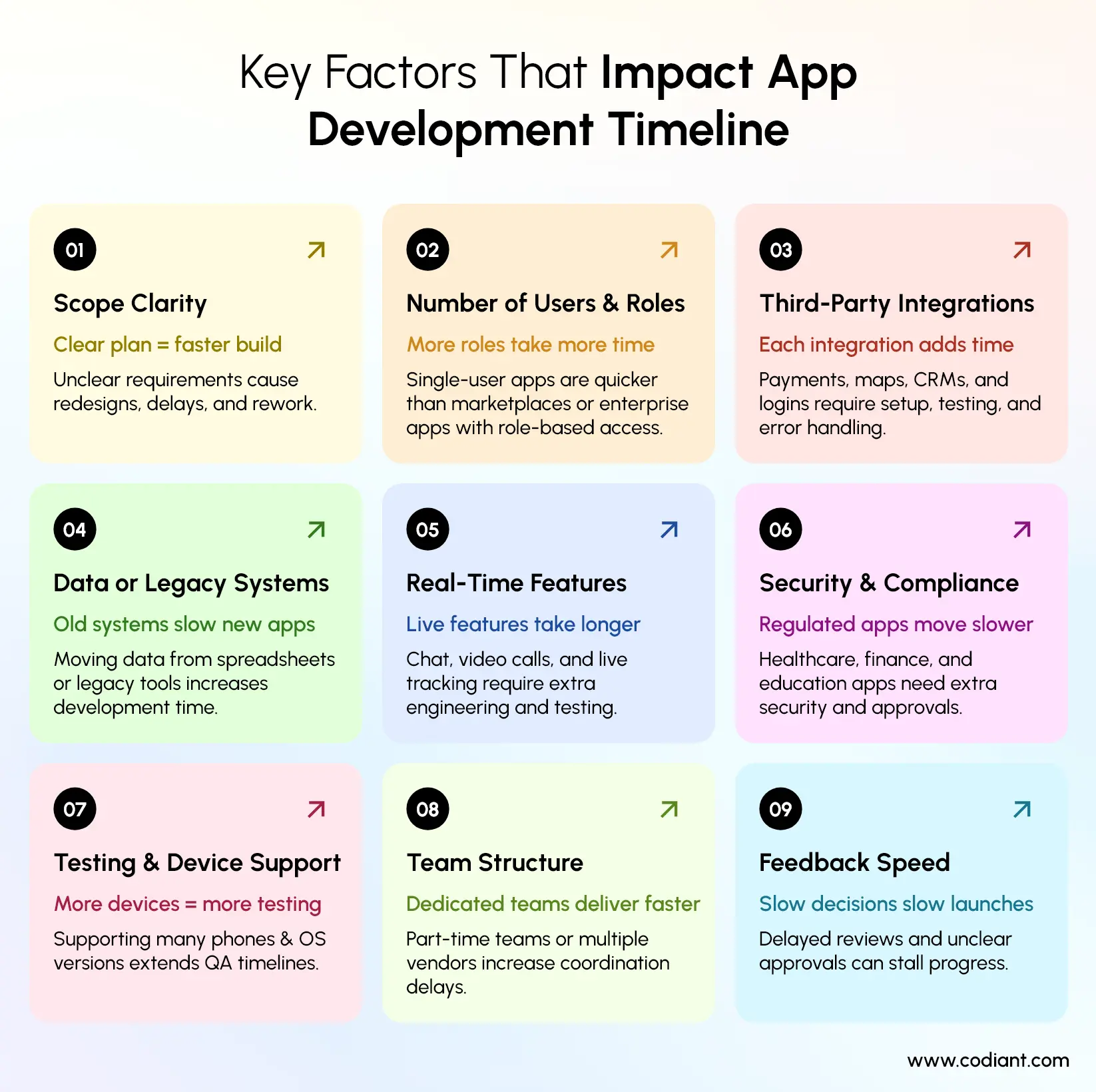
1. Scope clarity (the #1 predictor)
- Clear MVP: faster
- “We’ll decide later”: slower
Indecision creates rework, and rework is the silent timeline killer.
2. Number of user roles
Single-user app vs multi-role marketplace vs enterprise role-based permissions can change your timeline dramatically.
3. Integrations (payments, maps, CRM, ERP, identity providers)
Every integration adds:
- Vendor onboarding time
- API constraints
- Testing complexity
- Failure handling
4. Data migration or legacy system dependency
If you’re moving data from spreadsheets, older tools, or another platform add time.
5. Real-time features (chat, calling, live tracking)
Real-time often adds weeks because it adds:
- State synchronization
- Latency/performance tuning
- More QA surface area
6. Security + compliance requirements
Healthcare, finance, insurance, edtech for minors these introduce extra review, encryption requirements, logging, and audits.
7. QA expectations and device coverage
The more devices/OS versions you support, the more testing time you need especially on Android.
8. Team setup and delivery model
- Dedicated cross-functional team: faster
- Part-time, rotating team: slower
- Multiple vendors: coordination overhead increases
9. Feedback loop speed
Slow approvals, unclear ownership, and delayed feedback can erase the gains from AI tooling and fast developers something also echoed in modern dev productivity discussions.
A Detailed Timeline Breakdown You Can Copy into Your Project Plan
To make the app development timeline easier to understand, it helps to look at it phase by phase instead of thinking in months. In 2026, most apps move through a structured yet flexible process where planning, design, development, and testing often overlap.
The snapshot below shows a realistic MVP-to-V1 app development timeline, highlighting how long each phase typically takes and what gets done at every stage.
This format helps founders, product managers, and business teams quickly visualize the journey from idea to launch without technical complexity.
| Phase | Timeframe | What Happens in This Phase |
| Discovery & Planning | Weeks 1–2 | App goals are finalized, user journeys are defined, MVP features are locked, and a clear technical roadmap is created. |
| UX/UI Design & Technical Setup | Weeks 2–5 | Wireframes and clickable designs are created, the visual style is finalized, and the basic backend structure is prepared. |
| App Development (Sprints) | Weeks 4–12 | Core features are built in stages starting with onboarding, then main functionality, followed by integrations and final polish. |
| Testing & Quality Assurance | Weeks 10–14 | The app is tested across devices, bugs are fixed, security is reviewed, and app store requirements are checked. |
| Launch & Stabilization | Weeks 14–16 | The app is released gradually, performance is monitored, crashes are fixed, and user feedback is collected for improvements. |
How to Shorten App Development Duration Without Cutting Quality?
In 2026, faster app delivery is rarely about working longer hours or adding more developers. Teams that ship quickly do so because they remove friction from decision-making, limit unnecessary scope, and rely on repeatable systems instead of reinventing basics.
App development timelines can be shortened, but only when speed comes from clarity and structure not shortcuts that create rework later.
1. Define the MVP as a product outcome, not a checklist
The fastest projects begin with a sharp definition of value. Instead of listing features, successful teams define what the app must achieve in its first release validation, early revenue, or user adoption. Anything that does not directly support that outcome is deferred. This approach keeps the app development process timeline focused and prevents early bloat.
2. Limit user roles in the first release
Each additional role introduces more screens, logic paths, permissions, and testing effort. Reducing roles in V1 dramatically cuts complexity. Many admin and internal workflows can be simplified or handled manually at first, helping control mobile application development time without affecting the core user experience.
3. Build on proven components instead of custom logic
Modern app teams no longer build standard functionality from scratch. Authentication, payments, analytics, and UI components are best handled using stable, widely adopted tools. This is also where AI-assisted development adds real value by accelerating repetitive work while maintaining consistency and reliability. Using proven building blocks is one of the most effective ways to shorten app development duration safely.
4. Run design, backend, and mobile work in parallel
Sequential execution slows delivery. While UX flows are being finalized, backend teams can scaffold APIs, and mobile developers can begin screen implementation with mocked data. When dependencies are clearly defined, this parallel approach reduces idle time and keeps the time to build a mobile app predictable.
5. Introduce testing early, not just before launch
Quality slows projects only when testing is delayed. Early automation such as basic smoke tests and API checks catches issues before they spread across features. This reduces late-stage fixes and avoids extending the release timeline due to preventable bugs.
6. Enforce scope control through sprint boundaries
Most timeline overruns come from unplanned additions mid-build. A simple discipline works well: new ideas are scheduled for the next release unless they replace an existing feature. Clear sprint boundaries protect momentum and keep the app development process timeline intact.
Final Take: A Smart 2026 Way to Estimate Your App Timeline
If you want a reliable estimate for app development timeline 2026, don’t start with a generic “3–6 months” promise. Start with:
- MVP scope lock
- Platform decision (iOS/Android/cross-platform)
- Integration list
- Compliance + QA expectations
- Team capacity and feedback speed
Once those are clear, most projects can be estimated within a tight range and delivered without timeline surprises.
Build Faster, Smarter Apps with Codiant in 2026
App development timelines in 2026 are no longer defined by guesswork. They are shaped by strategy, technology choices, and the experience of the team you work with. At Codiant, we help businesses move from concept to launch with clarity, precision, and speed, without compromising on quality or scalability.
Our approach goes beyond writing code. We start by understanding your business goals, user expectations, and market dynamics, then map the right architecture, features, and tech stack to keep development efficient and future-ready. Whether it is a lean MVP, a complex enterprise platform, or an AI-powered application, our teams are equipped to deliver predictable timelines and measurable outcomes.
With deep expertise in AI-driven app development, cloud-native architectures, automation, and modern frameworks, we help you avoid delays, reduce rework, and accelerate time-to-market. More importantly, we build apps that are designed to evolve so your product stays relevant long after launch.
If you are planning to build an app in 2026 and want realistic timelines, transparent execution, and a technology partner you can trust, Codiant is ready to help. Share your idea with us, and let’s turn it into a high-performing digital product faster and smarter.
App Timelines Don’t Fail. Assumptions Do.
Validate scope, complexity, and delivery timelines with engineers who ship production apps.
The Author

Frequently Asked Questions
A standard app development timeline includes discovery and planning, UX/UI design, backend and frontend development, testing and quality assurance, deployment, and post-launch optimization. While these stages often overlap to save time, skipping or rushing any phase typically leads to rework, bugs, or launch delays later in the process.
App complexity directly determines development duration. Simple apps with limited features and integrations can be built quickly, while complex apps with multiple user roles, real-time functionality, AI features, or compliance requirements require significantly more time for development, testing, and validation. More complexity increases both build time and coordination effort.
The fastest way to launch an app in 2026 is to define a strict MVP scope, use cross-platform development where appropriate, rely on proven third-party services, and maintain fast feedback cycles. AI-assisted development tools can accelerate coding and testing, but clear decision-making and scope control matter more than tools alone.
Accurate app timeline estimates are based on feature breakdowns, platform selection, integration requirements, and risk assessment, not assumptions. Experienced teams estimate timelines by mapping features to development phases, accounting for QA and deployment time, and adding buffers for unknowns like third-party dependencies or review delays.
The most common causes of delays include unclear requirements, frequent scope changes, slow feedback or approvals, underestimated integrations, inadequate testing time, and dependency on external APIs or vendors. Poor early planning often creates cascading delays that surface late in the development cycle.
In 2026, most MVP apps take 6 to 16 weeks to build, depending on feature scope, platforms, and integrations. An MVP focuses on core functionality rather than completeness, allowing teams to validate ideas faster while keeping the app development timeline and costs under control.
Featured Blogs
Read our thoughts and insights on the latest tech and business trends

How Canadian Enterprises Are Using AI Development to Cut Operational Costs in 2026
- March 12, 2026
- Artificial Intelligence
In a Nutshell Canadian enterprises are using AI to control rising operational costs. Automation replaces repetitive manual processes across departments. Most companies start with small AI pilots before scaling. Implementation can take weeks for automation,... Read more

List of Top AI Agent Development Companies in the USA (2026 Guide)
- March 5, 2026
- AI Agent
In a Nutshell AI agents are the next evolution of automation, going beyond chatbots to perform real business tasks. They can understand intent, connect with tools, and execute multi-step workflows across teams. Businesses are increasingly... Read more

Hire Custom Software Developers in UAE for Secure and Scalable Enterprise Solutions
- February 27, 2026
- Digital Transformation Staff Augmentation
In a Nutshell UAE enterprises are shifting toward custom software because off-the-shelf tools fail to meet complex workflows and regional compliance needs. Custom enterprise software includes ERP modernization, automation systems, secure portals, analytics dashboards, and... Read more