Build In-House vs Hire a Development Agency: Real Cost Comparison
Table of Contents
Subscribe To Our Newsletter
Summarize with AI
Not enough time? get the key points instantly.
In a Nutshell
- In-house development offers control but comes with higher costs.
- Outsourcing reduces operational burden and speeds up delivery timelines.
- Hiring developers internally requires long-term financial commitments and management efforts.
- Development agencies provide flexibility with scalable team structures.
- Hidden costs make in-house development more expensive than expected.
- Outsourcing improves time-to-market and reduces hiring delays significantly.
- Startups benefit more from outsourcing due to limited resources.
- Hybrid models combine the best of both approaches effectively.
- Cost comparison should include time, scalability and efficiency factors.
- The right choice depends on business goals, budget and growth stage.
Every business that plans to build software eventually faces the same decision.
Should you build an internal team or hire a development agency?
At first glance, hiring in-house seems like the more controlled, long-term option. On the other hand, outsourcing to an agency promises speed, flexibility and lower upfront investment.
But when you look deeper, this decision isn’t just about preference it’s about cost, scalability, speed and long-term impact.
And this is where things get interesting.
Because the real difference between in-house vs outsourcing development isn’t always obvious at the start. Many businesses underestimate hidden costs, timelines and operational complexity.
In this blog, we’ll break down the real custom software development cost comparison, uncover hidden expenses and help you decide what works best for your business model.
Understanding The Two Models First
Before jumping into cost comparison, it’s important to understand how these models actually work.
In-House Development Model
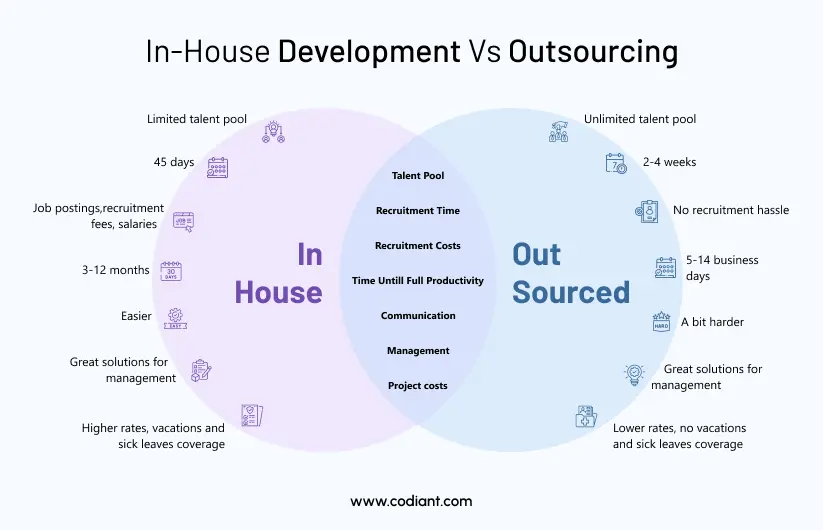
In-house development means building your own team of developers, designers, testers and project managers within your organization.
You hire them, train them, manage them and retain them.
This model gives you full control over your product, team and processes, but it also comes with significant long-term commitments.
Development Agency (Outsourcing Model)
When you hire a development agency, you partner with an external team that already has the expertise, infrastructure, and processes in place, whether for web applications or specialized embedded software development.
Instead of building everything from scratch, you leverage an experienced team that can start immediately.
This is why many businesses today prefer outsourcing vs in-house development, especially when speed and cost optimization matter.
Stop Overspending on Development Choose the Right Model Today
Avoid hidden costs and delays by selecting the right development approach for your business goals and growth plans.
Real Cost Breakdown: In-House Vs Development Agency
Let’s move beyond theory and look at what businesses actually spend. Because the biggest mistake in development team cost comparison is assuming salaries are the only cost.
In reality, salaries are just 40–50% of total ownership cost. The rest comes from infrastructure, hiring delays, management overhead, and productivity gaps.
Cost of Building An In-House Development Team (Detailed Breakdown)
Let’s assume you’re building a basic product team:
- 2 Developers
- 1 UI/UX Designer
- 1 QA Engineer
- 1 Project Manager
Annual Cost Breakdown (In-House Team – US/Europe)
| Cost Component | Monthly Cost (USD) | Annual Cost (USD) |
| Developers (2 × $10,000–$18,000) | $20,000 – $36,000 | $240,000 – $432,000 |
| UI/UX Designer | $6,000 – $10,000 | $72,000 – $120,000 |
| QA Engineer | $5,000 – $8,000 | $60,000 – $96,000 |
| Project Manager | $8,000 – $12,000 | $96,000 – $144,000 |
| Total Salaries | $39,000 – $66,000 | $468,000 – $792,000 |
This is what most companies calculate.
But this is only the starting point.
Additional Operational Costs (Often Ignored)
| Cost Component | Monthly Cost (USD) | Annual Cost (USD) |
| Recruitment (one-time spread monthly) | $3,000 – $8,000 | $36,000 – $96,000 |
| Office Space & Utilities | $5,000 – $12,000 | $60,000 – $144,000 |
| Hardware (laptops, devices amortized) | $1,500 – $3,000 | $18,000 – $36,000 |
| Software Licenses & Tools | $2,000 – $5,000 | $24,000 – $60,000 |
| Cloud Infrastructure | $3,000 – $10,000 | $36,000 – $120,000 |
| Employee Benefits (20–30% of salary) | $8,000 – $18,000 | $96,000 – $216,000 |
Hidden Cost Impact (Real Business Reality)
| Hidden Factor | Estimated Cost Impact |
| Hiring Delay (2–6 months lost time) | $50,000 – $150,000 opportunity cost |
| Attrition & Rehiring | 20–30% of annual salary per employee |
| Productivity Ramp-Up | 1–3 months reduced efficiency |
| Management Overhead | 10–15% of total team cost |
Total Real Cost of In-House Team
| Category | Annual Cost (USD) |
| Salaries | $468,000 – $792,000 |
| Operations & Infrastructure | $270,000 – $456,000 |
| Hidden & Indirect Costs | $100,000 – $300,000 |
| Total Real Cost | $838,000 – $1.5M+ per year |
This is why agency vs internal team cost often surprises businesses.
Cost of Hiring A Development Agency (Detailed Breakdown)
Now let’s compare this with outsourcing. Instead of fixed salaries, you pay for output, expertise, and delivery.
Typical Agency Pricing Models
| Model | Cost Range (USD) |
| Hourly Rate | $25 – $150/hour |
| Dedicated Team | $15,000 – $60,000/month |
| Project-Based (MVP) | $30,000 – $150,000 total |
Monthly Cost Snapshot (Equivalent Team via Agency)
| Role Equivalent | Monthly Cost (USD) |
| Developers (2) | $12,000 – $30,000 |
| UI/UX Designer | $3,000 – $8,000 |
| QA Engineer | $2,500 – $6,000 |
| Project Manager | Included / $3,000 – $7,000 |
| Total Monthly Cost | $20,000 – $50,000 |
Annual Cost (Agency Model)
| Category | Annual Cost (USD) |
| Development Team Cost | $240,000 – $600,000 |
| Infrastructure | Included |
| Recruitment | $0 |
| Tools & Licenses | Included |
| Management | Included |
| Total Cost | $240,000 – $600,000 per year |
Cost Advantage Summary
| Factor | In-House | Agency |
| Total Annual Cost | $838K – $1.5M+ | $240K – $600K |
| Cost Flexibility | Low | High |
| Setup Time | 2–6 months | Immediate |
| Infrastructure Cost | High | Included |
| Hiring Cost | High | Zero |
Real Insight- Cost Difference That Actually Matters
When you compare build vs outsource software, the difference is not small.
Businesses typically save:
- 40%–70% on total development cost
- 2–4 months in hiring time
- Significant operational overhead
But more importantly-
You convert fixed cost into variable cost
Which is critical for:
- Startups
- Scaling businesses
- MVP development
What Most Businesses Miss in Cost Comparison?
Here’s the part most blogs don’t talk about.
The real cost isn’t just money.
It’s:
- Time lost in hiring
- Delays in product launch
- Missed market opportunities
Because launching 3 months late can cost more than saving $100K.
That’s why IT outsourcing vs in-house is not just a cost decision.
It’s a speed + efficiency decision.
Build Faster Without Hiring Headaches or Long-Term Commitments
Launch your product quickly with expert developers without worrying about recruitment, training, and ongoing team management overhead costs.
Why In-House Development Feels More Expensive Over Time?
At the start, hiring internally might seem like an investment.
But over time, costs compound.
- Salaries increase
- Team expansion becomes necessary
- Retention becomes a challenge
- Technology upgrades are ongoing
And suddenly, your build vs outsource software decision starts looking different.
This is where businesses realize that hiring developers vs outsourcing isn’t just about cost it’s about sustainability.
Pros And Cons of Outsourcing Vs In-House Development
Choosing between in-house and outsourcing models requires understanding key trade-offs across cost, control, scalability, speed & long-term business impact.
| Category | In-House Development | Development Agency (Outsourcing) |
| Control | Full ownership and control | Limited direct control |
| Alignment | Strong cultural alignment | External team alignment required |
| Communication | Direct and faster internally | Depends on coordination setup |
| Expertise | Limited to hired skillset | Access to diverse specialists |
| Cost | High fixed and long-term | Flexible and cost-efficient |
| Hiring Speed | Slow (2–6 months) | Immediate availability |
| Scalability | Difficult to scale quickly | Easy to scale on demand |
| Execution Speed | Slower due to setup time | Faster delivery timelines |
| Dependency | Fully internal | Reliant on external partner |
| Long-Term Fit | Ideal for core products | Ideal for projects and scaling |
Related reading: How Much Does It Cost to Hire a Dedicated Developer in 2026?
When Should You Hire A Development Agency?
This is where most businesses start to gain real clarity.
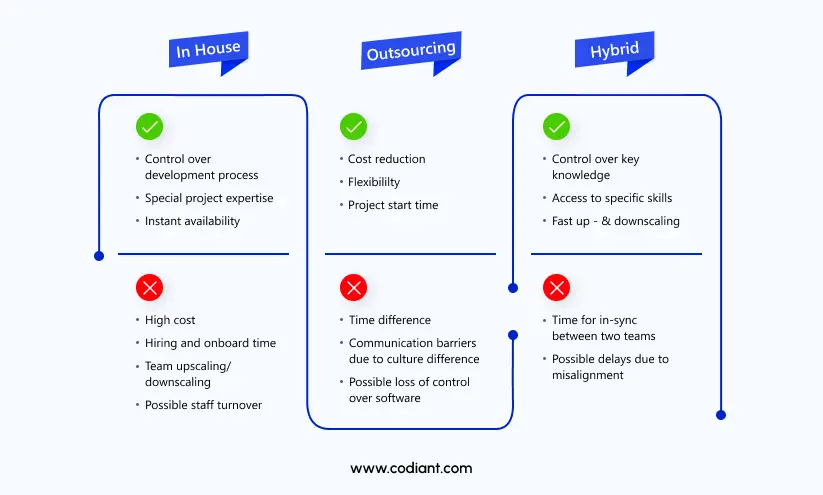
Choosing between hire development agency vs in-house team often comes down to how fast you need to move and how much operational complexity you’re willing to take on. In many cases, companies don’t struggle with the idea of building software they struggle with how to execute it efficiently.
Hiring a development agency makes the most sense when speed, flexibility & cost optimization are critical to your business outcomes.
Hiring an agency makes sense when:
- You need to launch quickly
Speed is often the biggest competitive advantage. Agencies already have teams, processes, and tools in place, allowing you to skip months of hiring and start building immediately. - You don’t want long-term hiring commitments
Building an in-house team means salaries, benefits & long-term obligations. Agencies allow you to pay for what you need, when you need it, without ongoing overhead. - You need access to diverse expertise
Modern software development requires multiple skill sets frontend, backend, DevOps, AI development solutions, QA. Agencies bring cross-functional expertise that’s difficult and expensive to build internally. - You want to reduce development costs
When comparing agency vs internal team cost, outsourcing often reduces hidden expenses like recruitment, infrastructure & employee retention.
Startups, in particular, benefit the most from this model.
Because in early stages, speed matters more than ownership. The ability to validate an idea quickly and enter the market often outweighs the need to build everything internally.
When In-House Development Makes More Sense?
While outsourcing is efficient, it’s not always the right fit for every scenario.
There are situations where investing in an internal team aligns better with long-term business goals especially when the product becomes central to your company’s identity and operations.
Building internally becomes a strategic decision when control, continuity, and deep product understanding are non-negotiable.
There are situations where building internally is the better option:
- You’re building a long-term core product
If your software is your business (not just a support tool), having an internal team ensures continuous ownership, faster iteration cycles & deeper product alignment. - You need full control over intellectual property
For companies working with sensitive data, proprietary algorithms, or regulated environments, maintaining everything in-house provides tighter control and security. - You have the budget for long-term investment
In-house teams require sustained financial commitment. If your organization is financially stable and focused on long-term product evolution, this model can be justified. - You require deep internal integration
Products that are tightly connected with internal systems, workflows, or legacy infrastructure often benefit from an in-house team that understands the ecosystem deeply.
In these cases, the higher cost of software development hiring cost becomes an investment rather than an expense.
Which Model Is Best For Startups?
For most startups, the answer becomes clearer when you look at their reality.
Startups don’t just build products they validate ideas, pivot quickly & operate under constant pressure to deliver results with limited resources. This makes the choice between outsourcing vs in-house development less about preference and more about survival.
Startups typically operate with:
- Limited budgets
Hiring a full in-house team early can drain capital quickly, especially when product-market fit is still uncertain. - Aggressive timelines
Speed is critical. Delays in development can mean missed opportunities, delayed funding, or losing first-mover advantage. - Uncertain product-market fit
Early-stage products often evolve rapidly. Outsourcing provides the flexibility to adapt without being locked into fixed team structures.
This is why, in most cases, build vs outsource software decisions lean toward outsourcing during the initial stages.
It allows startups to move fast, test ideas & iterate without heavy financial commitments.
Once the product stabilizes and begins to scale, many startups gradually transition to a hybrid approach bringing critical roles in-house while continuing to leverage external expertise for speed and scalability.
Hybrid Model: The Smart Middle Ground
Not every decision has to be binary.
In fact, many modern businesses are moving away from choosing strictly between IT outsourcing vs in-house and instead combining both models strategically.
The hybrid approach offers the flexibility of outsourcing with the control of an internal team making it one of the most practical and scalable solutions today.
Many businesses structure their teams in a way that balances ownership and execution:
- Core team stays in-house
Strategic roles such as product managers, architects & key developers remain internal to maintain vision, direction & decision-making control. - External agencies handle execution or scaling
Agencies are brought in for development, feature expansion, specialized tasks, or scaling efforts when demand increases.
This approach allows businesses to:
- Maintain control over critical components
- Scale resources without hiring delays
- Optimize overall development team cost comparison
- Reduce risk while increasing delivery speed
And in many real-world scenarios, this becomes the most practical solution especially for growing companies that need both stability and flexibility at the same time.
How To Calculate Development Cost Accurately?
If you’re planning your budget, here’s how you should think about it.
Instead of asking “How much will it cost?”, ask-
- What is the project scope?
- How complex is the product?
- What skills are required?
- How long will development take?
- What is the cost of delays?
A realistic software development cost comparison always includes:
- Direct costs (salary or agency fees)
- Indirect costs (time, delays, management)
- Opportunity costs (lost market time)
Is Outsourcing Actually Cheaper?
Here’s the truth.
Outsourcing is not always “cheap.”
But it is often more cost-efficient.
Because:
- You avoid long-term commitments
- You reduce hiring delays
- You get faster results
In many cases, businesses save 30%–60% of development costs by outsourcing to experienced agencies.
How Codiant Can Help You Build Smarter, Faster, Cost-Efficient Software?
Choosing between in-house vs outsourcing development becomes easier when you have the right partner guiding your decisions and execution strategy.
At Codiant, we help businesses:
- Build scalable software without heavy upfront hiring investments
- Access experienced developers, designers & AI specialists instantly
- Reduce development costs while maintaining enterprise-grade quality
- Accelerate time-to-market with structured development workflows
Whether you want to outsource completely or build a hybrid model, we align with your business goals and help you scale efficiently without operational complexity.
Read more: How to Hire AI Developers in 2026: A Complete Step-by-Step Guide
Conclusion
Choosing between in-house vs outsourcing development ultimately comes down to your business priorities, budget, and growth stage. While in-house teams offer control and long-term alignment, they come with higher costs and slower scaling.
On the other hand, hiring a development agency brings speed, flexibility, and cost efficiency without operational complexity. The smartest approach is not always choosing one over the other, but understanding when each model fits best. Evaluate your goals, timeline, and resources carefully. Because in the end, the right decision isn’t about cost alone it’s about building software that delivers value, faster and smarter.
Scale Your Product Without Scaling Your Internal Team Costs
Access skilled developers on demand and grow your product efficiently without increasing operational expenses or long-term hiring risks.
The Author

Frequently Asked Questions
In-house development refers to building and managing your own internal team of developers and engineers who work exclusively on your projects.
A development agency is an external team of experts that provides software development services on a project, hourly, or dedicated team basis.
Outsourcing is generally more scalable because you can quickly adjust team size based on project needs without hiring delays.
You should consider salaries or agency fees, infrastructure, tools, timelines & hidden costs like delays and management overhead.
Yes, many businesses use a hybrid approach where core strategy remains in-house and execution is outsourced for flexibility and efficiency.
Featured Blogs
Read our thoughts and insights on the latest tech and business trends
How Much Does It Cost to Build an MVP in 2026? A Complete Pricing Guide
- September 10, 2026
- Digital Transformation
MVP development cost typically ranges from $5,000 for a basic web-based product to $150,000 or more for a complex, cross-platform solution. A custom MVP with user accounts, a backend, essential integrations and a polished interface... Read more

How Much Does It Cost to Hire a Dedicated AI/LLM Developer in 2026?
- September 8, 2026
- Artificial Intelligence Staff Augmentation
Hiring a dedicated AI or large language model (LLM) developer typically costs $35–$60 per hour for general AI engineering and $50–$200 per hour for specialised machine learning work, with enterprise pricing rising for advanced RAG,... Read more

HIPAA-Compliant App Development in 2026: How to Build Securely and Avoid Preventable Fines
- September 4, 2026
- Mobile App Development
HIPAA-compliant app development in 2026 requires six foundations: complete ePHI mapping, documented risk analysis, role-based access, encryption, signed business associate agreements, and continuous security monitoring. This matters most to healthcare CTOs, product leaders, and compliance... Read more