How to Hire Dedicated Flutter Developers for Cross-Platform App Development
Table of Contents
Subscribe To Our Newsletter
Summarize with AI
Not enough time? get the key points instantly.
Today, businesses require apps that work seamlessly on iOS, Android, web and Desktop without developing separate products for each platform. Flutter helps you to build cross-platform apps with a single shared codebase. Supported by Google, it is widely adopted by firms seeking speedy updates, uniform designs and tighter cost controls.
However, it is not just enough to know that Flutter is beneficial; hiring the right flutter developers require more than that. You have to read about their skills, work experience, cost, hiring options, and the ability to build scalable apps.
This blog will guide you through the hiring process of dedicated flutter developers, what to check before hiring, how much it costs and consult which engagement model fits your business best.
Why Businesses Are Choosing Flutter for Cross-Platform App Development?
For many businesses, the biggest mobile app challenge is not only building an app. It is building it for multiple platforms without doubling the cost, timeline & maintenance effort.
That is where Flutter stands out.
Flutter allows developers to create Android and iOS apps from one shared codebase. The same technology can also support web, desktop, and embedded platforms depending on the product roadmap. For startups, this means faster market entry.
For enterprises, it means more consistent user experiences across platforms. For growing businesses, it means easier maintenance because the team does not need to manage completely separate native codebases for every small feature update.
This is one of the biggest reasons companies look for dedicated Flutter developers for hire. A dedicated developer or team can stay focused on your product, understand your business logic deeply, and keep improving the app after launch.
Flutter’s Market Dominance
46% of software developers globally chose Flutter in 2025, making it the most widely used cross-platform framework.
28% of all new apps launched on the iOS App Store today use Flutter.
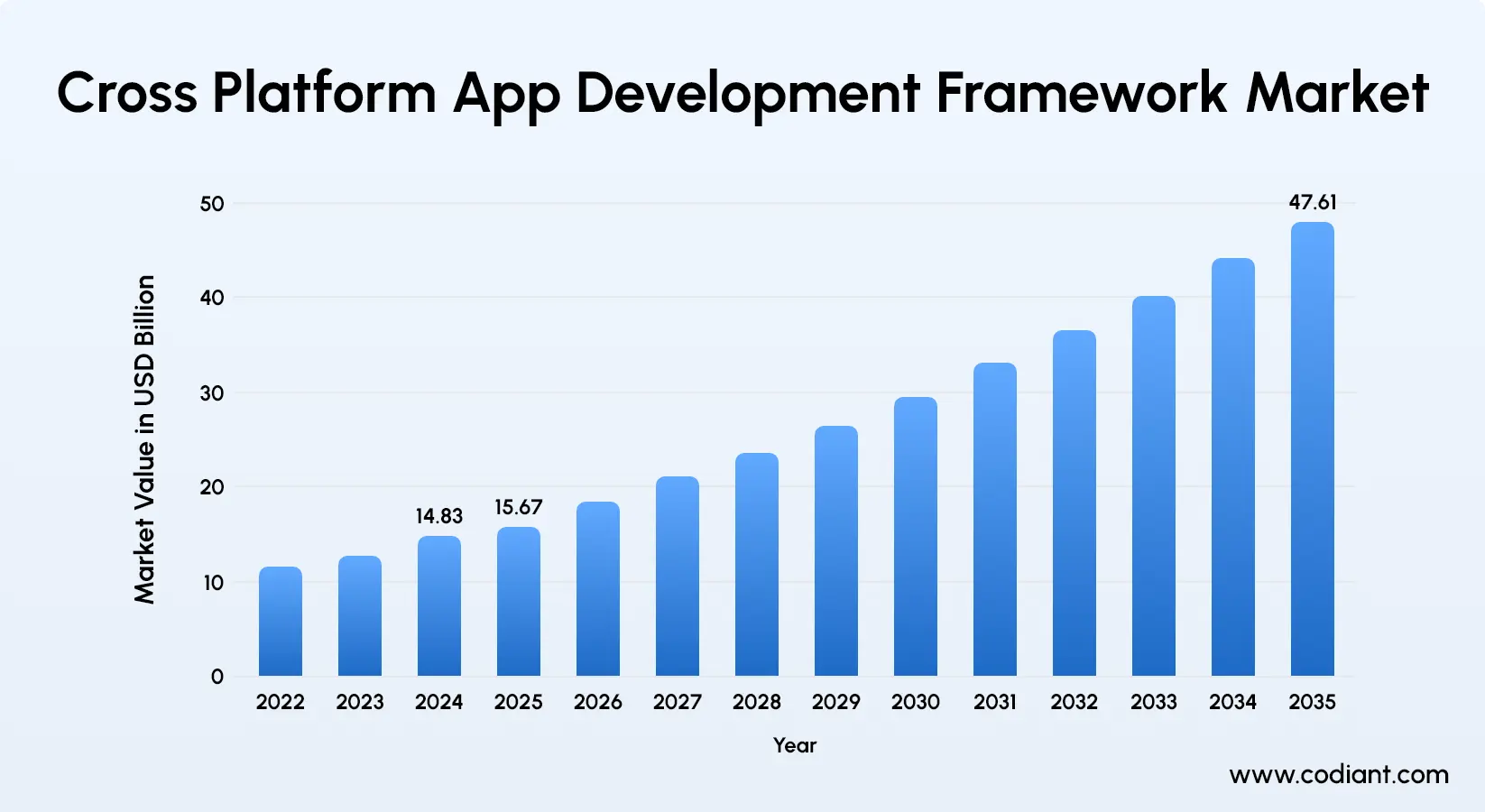
The cross-platform app development market is projected to grow from $47.61 billion in 2035 at a 20% CAGR through 2033.
Flutter apps generated approximately $283 million in net revenue in Q4 2024 alone.
Flutter is also useful when your app needs a polished UI. Its widget-based system helps developers create consistent designs, animations, transitions, and branded experiences across platforms. Unlike some cross-platform app development approaches that rely heavily on native components, Flutter gives developers more control over how the interface looks and behaves.
Google’s official Flutter mobile page says Flutter helps teams build for iOS and Android at the same time “without sacrificing features, quality, or performance.” That matters because users do not care what framework powers the app. They only care if it feels fast, clean, and reliable.
Build Cross-Platform Apps Without Doubling Development Effort
Hire Flutter experts to launch faster across Android, iOS, web, and desktop.
Step-by-Step Process to Hire Dedicated Flutter Developers
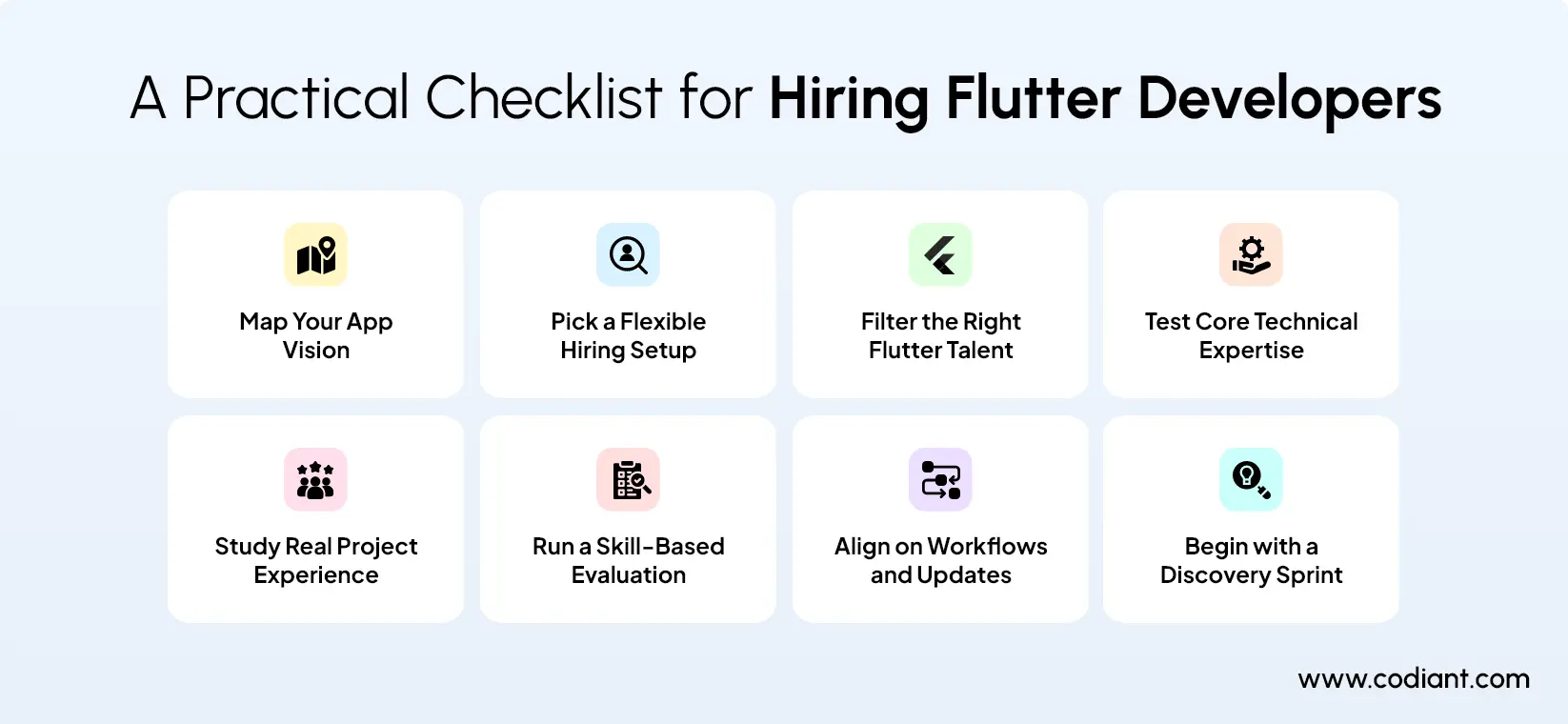
Hiring becomes easier when you follow a structured process.
Step 1- Define Your App Scope
Start with the basics. What kind of app are you building? Who will use it? What problem will it solve? Which platforms do you need first- Android, iOS, web, or all?
Create a simple feature list. Divide features into must-have, good-to-have & future features. This helps developers estimate effort more accurately.
Step 2- Decide the Hiring Model
Choose whether you need a freelancer, dedicated developer, full Flutter team, or outsourcing partner.
If your app is small, one developer may be enough. If your app is business-critical, you may need a complete team.
💡 Did You Know?
As of 2025, Flutter has surpassed 2.8 million monthly active developers worldwide, with over 600,000 Flutter-based apps released across Android, iOS, Windows, and other platforms. It also ranks among the top 10 most popular open-source projects on GitHub and has consistently outperformed React Native in Google Trends for five consecutive years.
Step 3- Shortlist Candidates or Companies
Look at portfolios, client reviews, industry experience, app store links, case studies & technical capabilities. If you want Flutter app developers USA, you may focus on local flutter app development companies or US-facing teams. If cost flexibility matters, offshore teams may be better.
Step 4- Check Technical Skills
Ask about Dart, Flutter widgets, state management, APIs, architecture, software testing, performance, deployment, and security.
A good developer should explain technical decisions in simple business terms.
Step 5- Review Past Work
Do not only look at screenshots. Ask for live app links, performance examples, app complexity, feature details & their role in the project.
Step 6- Conduct a Practical Assessment
Give a small task or technical discussion. You can ask them to review a sample app flow, suggest architecture, or explain how they would build a feature.
Step 7- Discuss Communication and Workflow
Ask how they manage sprints, reporting, calls, documentation, version control, task tracking & QA.
This is especially important for Flutter development outsourcing. Good communication reduces delays and misunderstandings.
Step 8- Start with a Trial or Discovery Phase
Before committing to a large project, start with a discovery phase, prototype, audit, or small sprint. This helps both sides test collaboration.
Questions to Ask Before Hiring Flutter Developers
Here are practical questions that can help you choose better:
- Have you built apps similar to our product?
- Which state management approach do you recommend and why?
- How do you structure large Flutter projects?
- How do you optimize Flutter app performance?
- How do you handle API failures and offline scenarios?
- How do you test Flutter apps?
- Can you support App Store and Play Store deployment?
- How do you manage code reviews?
- How do you handle security for user data?
- What happens after launch?
- Can your team scale if our product grows?
These questions help you understand whether the developer is task-focused or product-focused.
Read More: Top 10 Flutter App Development Tools
How Much Does It Cost to Hire Flutter Developers?
The cost to hire Flutter developers depends on experience level, location, project scope, hiring model, and team size.
Flutter Developer Cost by Experience Level
This table helps you compare developer levels, hourly rates, and best-fit project needs.
| Developer Type | Estimated Hourly Cost | Best Suitable For | What They Usually Handle |
| Junior Flutter Developer | $15–$30/hour | small fixes, UI updates, simple app screens | Basic Flutter screens, bug fixes, layout changes, support tasks |
| Mid-Level Flutter Developer | $30–$60/hour | MVPs, growing apps, feature development | API integration, state management, app flows, testing support |
| Senior Flutter Developer | $60–$100+/hour | Complex apps, enterprise products, scaling needs | Architecture, performance optimization, complex integrations, team guidance |
| Dedicated Flutter Team | $4,000–$20,000+/month | Full-cycle app development | Flutter development, UI/UX, backend, QA, DevOps, project management |
Flutter Developer Cost by Location
This table shows how hiring costs change across different regions and outsourcing markets.
| Hiring Location | Estimated Hourly Cost | Best for | Cost Advantage |
| USA | $80–$150+/hour | Local collaboration, enterprise consulting, premium builds | Higher cost, easier timezone alignment for US clients |
| UK / Western Europe | $70–$130/hour | Enterprise apps, regulated industries, product consulting | Strong expertise, higher development budget |
| Eastern Europe | $40–$80/hour | SaaS apps, startups, long-term product teams | Good technical talent at moderate cost |
| India | $18–$39/hour | Offshore Flutter development, MVPs, scalable app teams | Cost-effective hiring with strong mobile development talent |
| Southeast Asia | $25–$50/hour | MVPs, support projects, mid-size apps | Affordable rates with flexible team options |
Flutter App Development Cost by Project Type
This table gives a clearer cost view based on app size, features & complexity.
| App Type | Estimated Development Cost | Typical Features Included | Estimated Timeline |
| Basic Flutter App | $10,000–$25,000 | Login, profile, static pages, basic admin, simple APIs | 8–12 weeks |
| MVP Flutter App | $25,000–$50,000 | User flows, dashboards, payment gateway, push notifications, APIs | 3–4 months |
| Mid-Level Business App | $50,000–$100,000 | Real-time features, third-party integrations, analytics, custom UI | 4–6 months |
| Enterprise Flutter App | $100,000–$250,000+ | Advanced security, complex workflows, role-based access, scalable backend | 6+ months |
| On-Demand / Marketplace App | $70,000–$180,000+ | User app, provider app, admin panel, payments, tracking, notifications | 5–8 months |
In simple terms, the cost to hire Flutter developers can start from around $18–$39/hour in India, while developers in the USA may charge $80–$150+/hour. For full mobile app development, businesses usually spend anywhere between $10,000 and $250,000+, depending on features, complexity, and team size.
Why Hire Flutter Developers Instead of Native Developers?
There are some apps that are better suited for native development. If you are building a gaming app, device-based app or product that requires platform specific depth native development might be more appropriate.
But for most business apps, Flutter combines speed, cost savings, design uniformity and ease of maintenance better than others.
Native development typically necessitates different Android and iOS teams for businesses. That comes with maintaining 2 codebases, 2 timelines, 2 testing processes and 2 maintenance cycles.
With Flutter, a single team can create apps for both Android and iOS from the same codebase. Of course, you still need to do some platform-specific changes, but Flutter helps you in not repeating yourself a lot and writing less code.
Flutter is a strong choice for:
- eCommerce apps
- Healthcare appointment apps
- Food delivery apps
- Fitness apps
- Real estate apps
- Fintech dashboards
- Travel booking apps
- SaaS mobile apps
- Field service apps
- Education apps
- Social and community apps
- Internal enterprise tools
This is why businesses searching for Flutter developers for mobile app development are often looking for faster go-to-market without losing quality.
Flutter also supports visually rich apps. Its rendering engine helps maintain UI consistency across devices, which is useful when brand experience matters.
How Long Does It Take to Build a Flutter App?
A Flutter app timeline depends on app complexity, feature depth, backend requirements, integrations, testing needs & deployment scope.
| Flutter App Type | Estimated Timeline | What It Usually Includes | Best Suitable For |
| Basic Flutter App | 8–12 weeks | Login, profile, static pages, simple forms, basic APIs, content screens, basic admin support | Informational apps, internal tools, simple business apps |
| MVP Flutter App | 3–4 months | Core user flows, custom UI, payment integration, push notifications, dashboard, backend integration, app store setup | Startups, early-stage products, pilot launches |
| Medium-Complexity Flutter App | 3–5 months | Multiple user roles, real-time updates, third-party integrations, analytics, custom admin panel, advanced UI flows | eCommerce apps, booking apps, SaaS apps, service apps |
| Complex Flutter App | 6–9 months | Custom backend, real-time chat, live tracking, advanced dashboards, offline mode, complex workflows, strong security | Fintech, logistics, healthcare, marketplace, enterprise apps |
| Enterprise Flutter App | 9+ months | Scalable architecture, compliance needs, role-based access, multi-system integrations, performance testing, ongoing releases | Large businesses, regulated industries, multi-location operations |
Flutter can reduce development time because developers do not need to build two separate apps from scratch for Android and iOS. Still, planning, UI/UX design, backend development, API integration, testing, app store submission, and post-launch support must be included in the timeline.
The goal should not be to build the fastest app. The goal should be to build a stable, scalable, and user-friendly app people can trust.
What Does a Dedicated Flutter Developer Actually Do?
A dedicated Flutter developer is not just someone who writes app screens in Dart. A good developer helps turn your product idea into a usable, scalable, and maintainable application.
Their work usually includes:
- Understanding app requirements, user journeys & technical scope
- Building cross-platform mobile app interfaces using Flutter
- Writing clean Dart code with proper architecture
- Connecting the app with APIs, databases, payment gateways, maps, chats, notifications & third-party services
- Optimizing app performance for smooth loading, scrolling, animations & transitions
- Testing the app across Android and iOS devices
- Fixing bugs, improving stability & supporting version updates
- Preparing builds for App Store and Google Play submission
- Maintaining the app after launch
When you hire Flutter developers for cross-platform apps, you are not only hiring coding support. You are hiring execution capability. The right developer can spot technical risks early, recommend better architecture and reduce avoidable rework.
For example, a basic MVP may only need one Flutter developer, one backend developer, and one UI/UX designer. But a complex fintech, healthcare, logistics, or marketplace app may need a complete team that includes Flutter developers, backend engineers, QA testers, DevOps support, project managers and solution architects.
That is why many companies prefer working with a Flutter development company instead of hiring isolated freelancers. A company can bring a complete team, defined process, quality checks & long-term support.
Did You Know?
Flutter is not just a mobile app framework anymore. Google describes Flutter as an open-source framework for building natively compiled, multi-platform applications from a single codebase across mobile, web, desktop, and embedded experiences.
A Real-World Scenario: How Flutter Helped Cut MVP Effort
A retail startup came to Codiant with one clear concern: they wanted to launch on Android and iOS, but the MVP budget could not support two separate native teams.
Their first version needed:
| MVP Requirement | What the App Needed |
| Platforms | Android and iOS |
| Core Screens | Home, product listing, product detail, cart, checkout, order tracking |
| Key Features | Search, filters, push notifications, loyalty points, payment flow |
| Admin Support | Product updates, order status changes, customer details |
| Launch Goal | Release the MVP quickly, test demand, and improve based on real users |
After reviewing the scope, Codiant suggested Flutter because it allowed one team to build both apps from a shared codebase.
| Development Approach | Expected Impact |
| Separate Native Apps | 2 teams, 2 codebases, 2 testing cycles, higher MVP cost |
| Flutter App Development | 1 shared codebase, 1 coordinated team, faster updates, lower duplicate effort |
This helped the startup keep the MVP practical instead of overbuilding from day one. The team could focus on the features that mattered most: browsing products, placing orders, tracking deliveries, and bringing users back through offers.
After launch, the same Flutter base made it easier to add:
- Referral rewards
- Personalized product sections
- Seasonal offer banners
- Improved search filters
- Loyalty-based notifications
So instead of rebuilding separate features for Android and iOS, the startup could improve the app faster from one shared development setup.
Read More: Why Flutter Is the Best Framework for Cross-Platform App
When Should You Hire Dedicated Flutter Developers?
You should consider hiring dedicated Flutter developers when your app needs continuous development, frequent feature releases, or long-term maintenance.
Freelancers can be useful for small fixes, quick prototypes, or short-term UI work. But if your app is a serious business product, a dedicated model usually works better.
Dedicated Flutter developers are a strong fit when:
- You are building a new app from scratch
- You want Android and iOS apps with a shared codebase
- You already have a backend or web platform and need a mobile app
- You want to modernize an old native app
- You need faster MVP development
- You want to reduce separate Android and iOS development costs
- You need a long-term app team without hiring in-house
- You want to scale features after launch
- You need developers who work closely with your internal team
This is especially helpful for startups and growing businesses. You can start with a lean Flutter team, launch the first version, collect user feedback & then scale the team as your product grows.
For enterprises, dedicated Flutter developers can support internal business apps, employee tools, customer portals, booking platforms, commerce apps, dashboards, and field service apps. Flutter is already used by businesses of different sizes, and the official Flutter showcase highlights apps from Google and many production use cases.
Turn Your App Idea into a Scalable Flutter Product
Work with dedicated Flutter developers who build smooth, secure, future-ready mobile apps.
Key Skills to Check Before Hiring Flutter Developers
The easiest mistake businesses make is hiring a Flutter developer only by checking years of experience. Experience matters, but skill depth matters more.
A strong Flutter developer should have both technical and product-level thinking.
1. Strong Dart Programming Skills
Flutter apps are written in Dart, so Dart knowledge is the foundation. The developer should understand syntax, asynchronous programming, null safety, streams, futures, extensions, mixins & error handling.
Ask them how they manage async API calls, handle app states & structure reusable code. Their answers will quickly show whether they only know basic Flutter UI or can build production-grade apps.
2. Flutter UI and Widget Expertise
Flutter uses widgets for almost everything. A skilled developer should know how to build responsive layouts, custom widgets, animations, navigation flows, forms, lists, image handling, themes & reusable components.
This is especially important if your app has a custom design system. Poor widget structure can make the app difficult to maintain later.
3. State Management Knowledge
State management is one of the most important skills in Flutter development. Developers should know tools like Provider, Riverpod, Bloc, GetX, or MobX, depending on the project.
There is no single best choice for every app. A good developer should explain why they prefer one approach for your product. For example, a simple MVP app development may not need complex architecture, but a large enterprise app may need stricter state management.
4. API and Backend Integration
Most apps need backend communication. Your developer should know REST APIs, GraphQL, authentication, token management, JSON parsing, error handling, caching & secure data flow.
If your app includes payments, chat, maps, analytics, booking, CRM, or ERP integrations, the developer should be comfortable working with third-party SDKs and API documentation.
5. App Architecture
Good architecture keeps your app clean as it grows. Look for developers who understand layered architecture, clean architecture, MVVM, feature-based folder structure, dependency injection & separation of concerns.
This may sound technical, but the business value is simple- clean architecture makes the app easier to update, test, and scale.
6. Performance Optimization
Flutter apps are performant by design, but poor coding practices can still create jank, slow rendering, memory leaks & heavy load times. Flutter’s official performance documentation explains that release builds are pre-compiled to native instructions, while debug mode behaves differently and may show performance issues that do not reflect production behavior.
Good developers know how to use performance profiling, reduce unnecessary widget rebuilds, optimize images, manage lists efficiently & test app behavior on real devices.
7. Testing and Debugging
A professional Flutter developer should know unit testing, widget testing, integration testing, debugging tools, crash reporting, and QA collaboration.
Testing is not optional if your app handles payments, healthcare data, business workflows, bookings, logistics, or user accounts.
8. Deployment Knowledge
Publishing apps is a separate skill. Flutter developers should understand Android builds, iOS builds, signing certificates, provisioning profiles, Play Store requirements, App Store review guidelines, versioning & release management.
A developer who can build but cannot support deployment may slow down your launch.
Engagement Models for Hiring Flutter Developers
One of the most important decisions in your hiring process is the engagement model. Each has trade-offs depending on your project’s scope and your internal team’s capabilities.
- Fixed-Price Model works well for clearly scoped projects with defined deliverables. Once you and the development partner agree on scope, the cost is locked. It removes billing uncertainty but leaves little room for changes during development.
- Time & Material Model is ideal for projects that are likely to evolve which is most real-world projects. You pay for actual hours worked and can adjust scope as you learn more about your users and business needs. This model requires good communication but gives maximum flexibility.
- Dedicated Team Model is perhaps the most popular for businesses seeking long-term Flutter development outsourcing. You hire a team or a single developer who works exclusively on your project, typically on a monthly retainer. This model blends the cost-effectiveness of outsourcing with the focus of an in-house hire. Rates for this model generally range from $30–$70/hour from reputable agencies.
- Staff Augmentation lets you extend your existing team with specialized Flutter talent. If you have a product team but lack Flutter expertise, augmenting with dedicated Flutter developers for hire ensures you get the skills without the overhead of a full agency engagement.
Can Flutter Apps Scale for Large Businesses?
Yes, Flutter apps can scale for large businesses when they are planned and built correctly.
Scalability depends less on Flutter alone and more on architecture, backend infrastructure, code quality, testing, DevOps, security, and product planning.
Flutter is already used in production by major businesses. The official Flutter showcase highlights that businesses of all sizes use Flutter in production, including Google products like Google Pay, Google Ads, Google Classroom, Google Cloud & more.
For enterprise applications, developers should focus on:
- Modular architecture
- Secure authentication
- Role-based access
- API reliability
- Offline support where needed
- Performance monitoring
- Automated testing
- CI/CD pipelines
- Analytics and crash reporting
- Scalable backend systems
How Codiant Can Help You Hire Dedicated Flutter Developers
Codiant can help businesses build cross-platform apps with dedicated Flutter developers who work around real product goals, not just assigned tickets. From discovery to deployment, our team supports planning, UI/UX design, Flutter development, backend integration, testing & post-launch improvements.
With Codiant, you can:
- Hire dedicated Flutter developers based on your project needs
- Build Android and iOS apps using a shared Flutter codebase
- Create MVPs, enterprise apps, eCommerce apps, healthcare apps, and on-demand platforms
- Extend your existing team with skilled Flutter talent
- Get support from designers, QA engineers, backend developers & project managers
- Choose flexible engagement models for short-term or long-term development
Our approach focuses on clean code, smooth performance, scalable architecture & simple collaboration so your app can move from idea to launch with fewer roadblocks.
Read more: Top 10 Flutter App Development Companies in the USA for 2026
Conclusion
Hiring Flutter developers is not just a technical decision. It is a business decision that affects cost, speed, user experience, scalability, and long-term maintenance.
Flutter is a strong choice for companies that want cross-platform apps without creating separate Android and iOS codebases. But the success of your app depends on the people building it. The right Flutter developers should understand Dart, UI development, APIs, performance, architecture, testing, deployment & business goals.
Before hiring, define your scope clearly, choose the right engagement model, review past work, test technical skills & discuss communication. If your app is simple, a freelancer may work. If your app is business-critical, a dedicated developer or Flutter development company is usually a safer choice.
When done right, Flutter can help you launch faster, maintain easier, and scale smarter.
Need Skilled Flutter Developers for Faster App Launch?
Choose flexible Flutter hiring models built around your timeline, budget, and goals.
The Author

Frequently Asked Questions
Consider their Dart knowledge, Flutter experience, state management skills, API integration ability, architecture understanding, testing approach, deployment experience, communication style & past project quality.
A simple Flutter app may take 8–12 weeks, while a medium or complex app may take 3–6 months or more depending on features, backend, integrations & testing needs.
Yes. Flutter apps can scale for large businesses when built with strong architecture, secure APIs, performance monitoring, testing, modular code & scalable backend infrastructure.
Common models include dedicated developers, fixed-cost projects, time and material, offshore development teams & staff augmentation.
They optimize widget rebuilds, app startup time, images, API handling, memory usage, animations, caching, build size & test performance using profiling tools and real devices.
Featured Blogs
Read our thoughts and insights on the latest tech and business trends
AI Chatbot Use Cases: How Businesses Automate Support, Sales, and Operations
- June 16, 2026
- Artificial Intelligence
AI chatbots help businesses automate customer support, qualify leads, process transactions, schedule tasks, and streamline internal operations. This helps in reducing response times, cutting operational costs, and enabling 24/7 service without proportional headcount growth. Businesses... Read more

What is AI-Powered Learning Platforms and How Much Do They Cost to Build in 2026?
- June 12, 2026
- Education & eLearning
Key Takeaways AI-powered learning platforms personalize education using machine learning, natural language processing, predictive analytics, and generative AI. The most common use cases include AI tutors, adaptive learning paths, automated grading, dropout prediction, language learning,... Read more
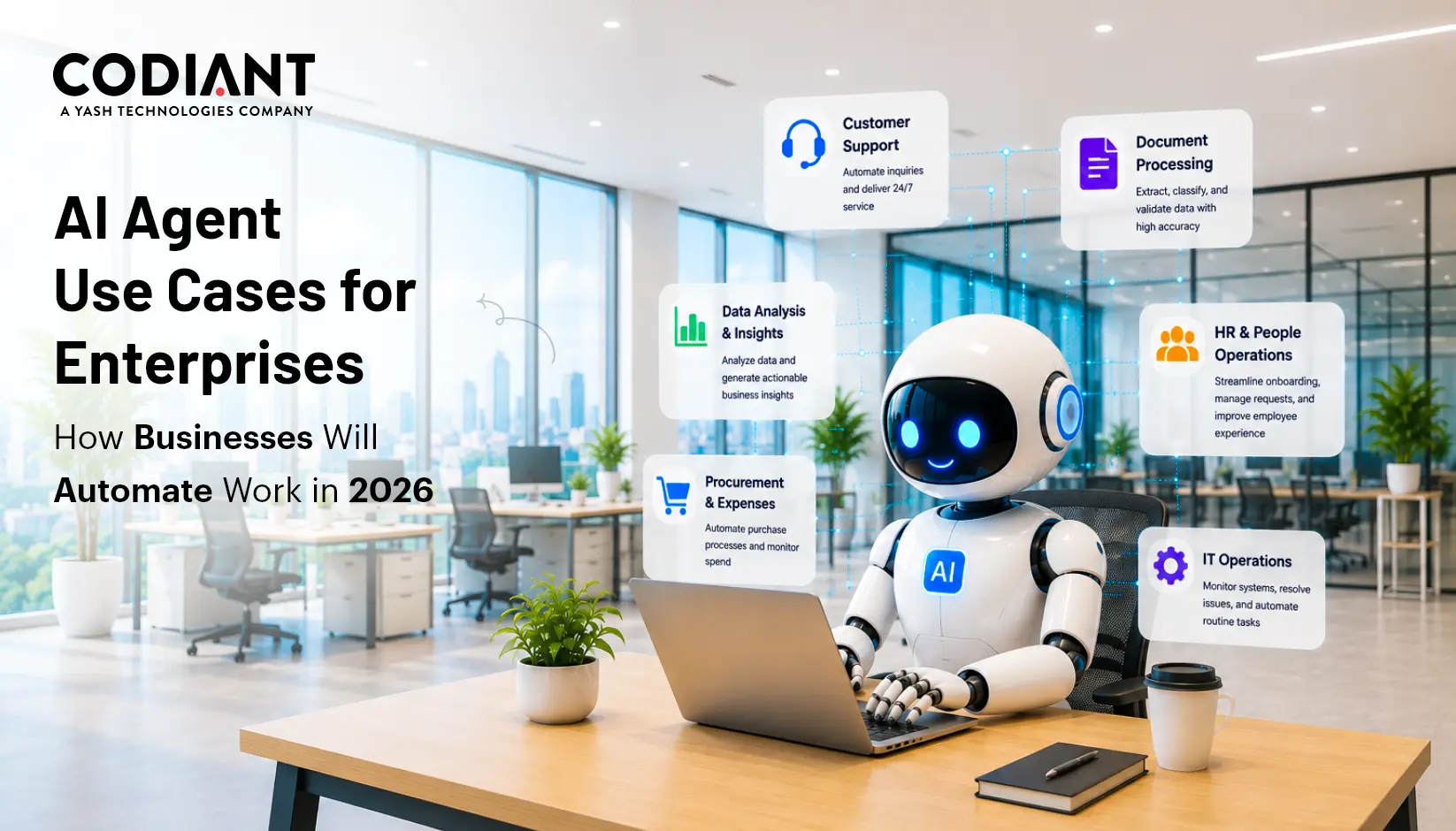
What Business Problems Can AI Agents Solve for Enterprises in 2026?
- June 9, 2026
- AI Agent
AI agents solve enterprise business problems by automating multi-step workflows across customer support, finance, HR, IT, sales, supply chain, legal and marketing. In 2026, the most practical use cases include reducing support backlogs, processing invoices,... Read more