AI Developer Engagement Models Explained: How to Choose the Right AI Team
Table of Contents
Subscribe To Our Newsletter
Summarize with AI
Not enough time? get the key points instantly.
AI developer engagement model means deciding how external AI specialists will be assigned, managed, paid and held accountable. The main options are dedicated AI developers, AI team augmentation, time-and-material delivery, fixed-price projects and end-to-end AI project outsourcing. The right choice depends on scope certainty, internal technical leadership, project duration and how much delivery responsibility an external partner should own.
This decision matters because AI development extends beyond model selection or coding. A production system may require discovery, data preparation, application engineering, integration, evaluation, deployment, monitoring and governance.
At Codiant, experience across 100+ AI projects shows that the right engagement model is determined less by company size and more by scope certainty, internal technical ownership, required expertise and post-launch responsibility. This comparison breaks down dedicated AI developers, team augmentation, time-and-material, fixed-price, hybrid and end-to-end outsourcing models, using Codiant’s delivery experience to clarify where each model fits, how costs are structured and who remains accountable throughout the AI lifecycle.
In a Nutshell
- Five primary AI engagement models cover dedicated developers, team augmentation, time and material, fixed-price delivery and end-to-end outsourcing.
- Scope certainty and internal technical ownership are the two most important criteria when selecting an AI development model.
- Use a two-stage budget decision: approve discovery first, then confirm development and production costs after validating data, integrations and evaluation requirements.
- The biggest mistake is forcing a fixed-price contract before data quality, technical dependencies and measurable acceptance criteria have been assessed.
- Codiant has delivered 100+ AI projects supporting clients from feasibility assessment and engineering through deployment, monitoring and ongoing optimisation.
- The World Economic Forum found 63% of employers viewed skills gaps as a transformation barrier.
What Are the Different AI Developer Engagement Models?
The most common AI developer engagement models are dedicated developers, team augmentation, time and material, fixed-price delivery and end-to-end outsourcing. They differ mainly in who controls the backlog, manages the team, handles scope changes and carries delivery risk.
| Engagement model | Best suited to | Client control | Commercial structure | Main limitation |
| Dedicated AI developers | Long-term product development | High | Monthly, full-time or part-time | Needs a consistent backlog and client direction |
| AI team augmentation | Filling skills or capacity gaps | High | Time-based or monthly | Client coordinates overall delivery |
| Time and material | Evolving scope and experimentation | Shared or high | Actual effort at agreed rates | Final cost is not fixed initially |
| Fixed-price project | Defined deliverables and acceptance criteria | Moderate | Milestone or project fee | Changes may require re-estimation |
| End-to-end AI outsourcing | One accountable delivery partner | Outcome-level governance | Milestone, retainer or blended | Requires strong vendor governance |
Choose an AI Engagement Model That Fits Your Delivery Needs
Codiant helps define scope, ownership, costs, and delivery responsibilities before hiring starts.
1. Dedicated AI Developers
Dedicated AI developers are external specialists assigned to one client for an agreed capacity. They typically work inside the client’s roadmap, sprint process and engineering standards. This model suits companies that need continuity across releases, retained product knowledge and control over changing priorities.
A complex product may require more than one AI engineer. The dedicated unit can include data engineering, machine learning, backend development, cloud or MLOps, quality assurance and technical leadership, depending on the actual delivery scope.
When businesses hire dedicated developers through this model, the specialists usually work as an extension of the internal team rather than as a separately managed vendor team.
2. AI Team Augmentation
AI team augmentation adds external specialists to a client-led team. The engineers collaborate with internal product managers, architects, developers and domain experts rather than operating as a separate outsourced project.
It works when the client can lead delivery but needs a capability such as:
- Retrieval-augmented generation
- LLM evaluation
- Computer vision
- Model deployment
- Data engineering
- AI security
- MLOps and monitoring
It is less suitable when nobody inside the business can define priorities, review technical decisions or resolve dependencies.
3. Time-and-Material Delivery
Under time and material, the business pays for agreed roles and actual effort. It is practical for feasibility studies, proofs of concept, data exploration and products where technical choices may change after testing.
The work should still have sprint goals, rate cards, approval limits, reporting processes and stage gates. Flexibility should not become an undefined or continuously expanding project.
Time and material can also be combined with a budget ceiling. The client and AI development partner can review progress at agreed intervals before authorising the next stage of work.
4. Fixed-Price Project Delivery
A fixed-price project assigns a defined scope, budget, schedule and set of acceptance criteria to the delivery partner. It fits contained AI features where the data sources, workflows, interfaces and expected outputs are understood.
Fixed price becomes unreliable when model quality depends on untested data or integrations are undocumented. In that situation, a paid discovery phase followed by a fixed implementation may offer stronger commercial control than fixing the entire project too early.
The agreement must also define what happens when assumptions prove incorrect. Without a change-control process, a fixed price can create disputes over whether new work is part of the original scope.
5. End-to-end AI Project Outsourcing
End-to-end AI project outsourcing gives an AI development partnership responsibility for delivery across discovery, data work, engineering, integrations, deployment, evaluation and support.
Businesses that need one partner across discovery, data preparation, model development, system integration and ongoing optimisation may be better suited to full-cycle AI development services
It also suits businesses that lack an internal AI delivery function or want one accountable partner. The client must still own business objectives, data-access decisions, risk tolerance and final acceptance.
Outsourcing execution should not mean outsourcing governance. Business leaders remain responsible for deciding where AI can be used, what level of risk is acceptable and whether the delivered system meets organisational requirements.
Which Engagement Model is Best for AI Projects?
There is no single best engagement model for all AI projects. The right model matches scope certainty, duration, internal leadership, required skills, delivery risk and the desired level of control.
| Project condition | Better starting model |
| The outcome is known, but the technical path is uncertain | Time and material or discovery |
| An internal team lacks AI specialists | AI team augmentation |
| The roadmap will continue for six months or longer | Dedicated AI developers |
| Scope and acceptance criteria are stable | Fixed-price project |
| One partner should own the full lifecycle | End-to-end AI outsourcing |
| Discovery is uncertain but implementation may become defined | Hybrid model |
AI projects are iterative because data, model behaviour and production conditions can change. Google notes that machine learning systems need data validation, model-quality evaluation and monitoring in addition to conventional software testing. AWS recommends applying lifecycle practices from business framing through monitoring rather than waiting until deployment.
Fixed-price delivery is predictable only when dependencies and acceptance criteria are predictable. A dedicated team is effective only when the business can maintain a meaningful backlog and make timely decisions.
For enterprise AI development, a blended model may be necessary. Internal teams can retain governance and architecture ownership while augmented specialists or managed delivery teams handle defined technical workstreams.
Should Businesses Hire Dedicated AI Developers or Project-based Teams?
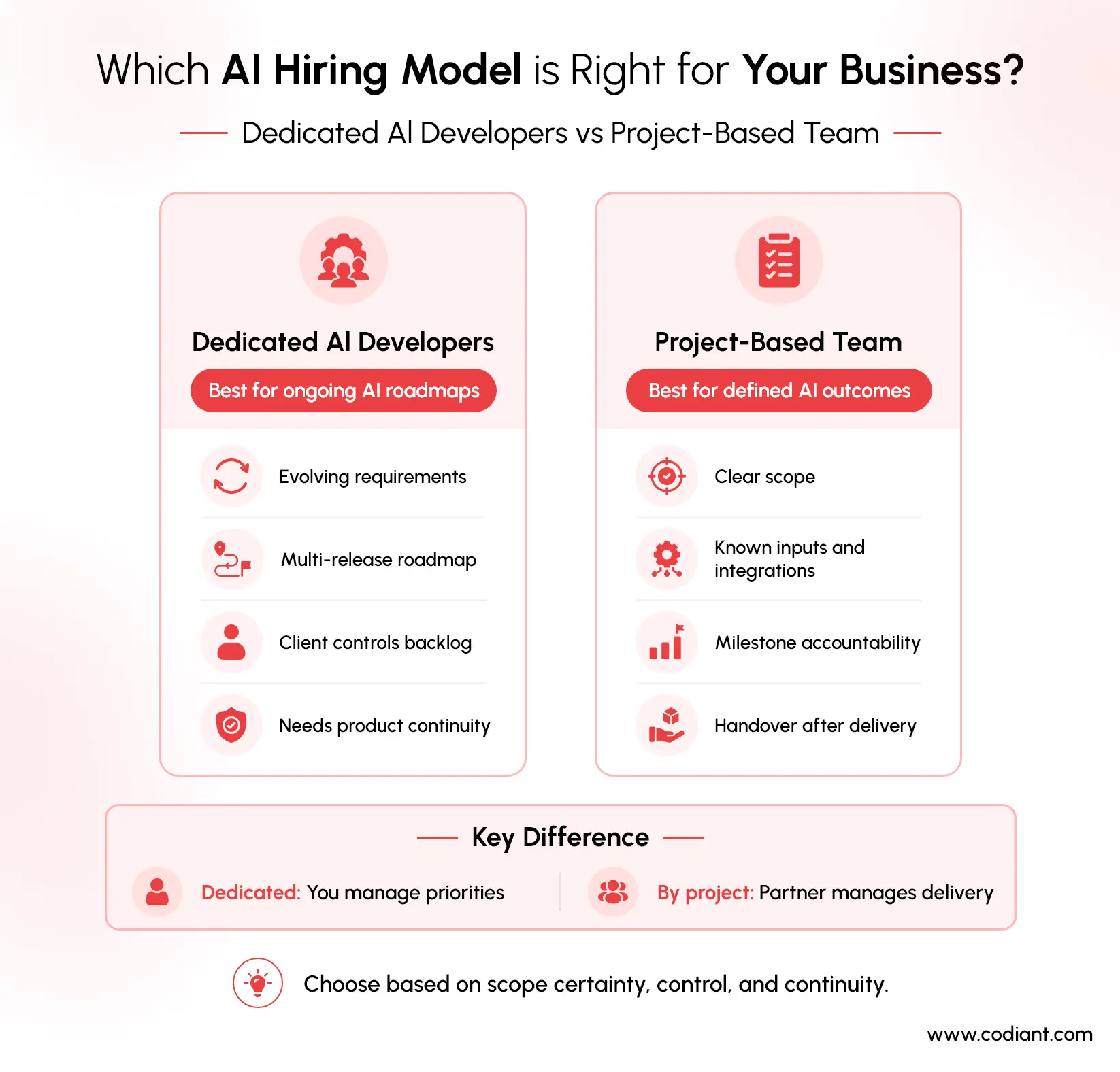
Businesses should hire dedicated AI developers when they need continuous capacity, direct backlog control and retained product knowledge. They should use a project-based team when the outcome is clearly defined and the external partner should own delivery against agreed milestones.
Dedicated developers are generally better when:
- Requirements will change as the product develops.
- The roadmap spans multiple releases.
- Internal leaders want to control priorities.
- The team needs continuing knowledge of proprietary systems.
- The company expects to add or change features regularly.
A project-based team is more appropriate when:
- The required output is contained and documented.
- Inputs, workflows and integrations are known.
- Acceptance tests can be agreed before implementation.
- The client wants milestone-based accountability.
- The work can be handed over after delivery.
The key distinction is management responsibility. With dedicated developers, the client usually controls the backlog and daily priorities. With project outsourcing, the partner typically manages staffing, work allocation and execution within the contracted scope.
Once the engagement model is selected, businesses need a structured process to hire AI developers based on the required skills, technical screening, project complexity, trial performance and onboarding expectations.
A dedicated model does not remove the need for measurable outcomes. The agreement should still define sprint objectives, technical standards, reporting expectations and performance indicators.
Codiant’s Project Insight: Why AI Products Need Multidisciplinary Delivery
HireGroww, an AI-powered recruitment platform developed by Codiant, required more than isolated AI model development. The product brought together candidate matching, automated video interviews, AI-based scoring, recruiter workflows and application engineering within one connected platform.
This type of AI product may require AI engineers, backend and frontend developers, cloud specialists, quality assurance professionals, UI/UX designers and product leadership. It demonstrates why businesses should select an engagement model according to the complete delivery scope rather than hiring one AI developer for a multidisciplinary product.
The correct model depends on who owns the roadmap, manages the specialists, approves changes and remains responsible after deployment.
Get a Clear AI Project Estimate Built on Defined Assumptions
Validate data, integrations, timelines, and exclusions before committing your development budget confidently.
What is Team Augmentation in AI Development?
AI team augmentation is a staffing model in which external AI professionals join an existing client-led team for a defined period or capacity. The client retains product ownership and delivery control, while the provider supplies missing expertise.
For example, a SaaS company may add an LLM engineer and an evaluation specialist for a RAG feature. A manufacturer may add a computer-vision specialist for inspection, while an enterprise may need an MLOps engineer to build deployment and monitoring pipelines.
Before onboarding augmented specialists, both sides should define:
- The capability gap being filled
- Expected deliverables
- Product and technical decision rights
- Working hours and communication overlap
- Data and system-access permissions
- Code review and documentation requirements
- Security and confidentiality obligations
- Performance measurement
- Replacement and exit procedures
AI team augmentation works best when the client has an accountable product owner or technical lead. Without that role, individual specialists may complete assigned tasks without moving a coherent product outcome forward.
The provider should also clarify whether supporting roles are included. Hiring an AI engineer does not automatically include data engineering, cloud architecture, interface development, quality assurance or project management.
Research Insight: Why Companies Are Rethinking AI Staffing
Deloitte’s State of AI in the Enterprise 2026 found that insufficient workforce skills were the largest reported barrier to integrating AI into business workflows. Among surveyed leaders, 36% were assessing talent requirements and hiring specialised professionals for AI initiatives, while 19% were changing the balance between full-time, contract and gig workers. These findings support the use of dedicated developers and AI team augmentation when internal teams have product knowledge but lack specialist engineering, data or MLOps capabilities.
How Do AI Engagement Models Affect Project Costs?
AI engagement models affect costs by changing billing, management responsibility, scope flexibility and who carries the financial risk of change. They do not eliminate the underlying costs of data, engineering, infrastructure, evaluation, security and ongoing operations.
A practical calculation is:
Total AI project cost = team effort + data work + model or API usage + application engineering + cloud infrastructure + integrations + security and compliance + testing and evaluation + monitoring and support.
Dedicated and augmented teams usually create recurring monthly or time-based costs. Fixed-price projects convert a defined scope into a milestone or total project fee. End-to-end outsourcing may combine discovery fees, delivery milestones and post-launch support.
An AI estimate may include:
- Product discovery and AI feasibility assessment
- Data collection, cleaning and labelling
- Model, framework or API selection
- Retrieval and knowledge-base development
- Application and backend engineering
- Third-party and enterprise-system integrations
- Cloud infrastructure and deployment
- Security, privacy and compliance controls
- Functional, quality, safety and performance evaluation
- Monitoring and ongoing optimisation
A credible estimate should also identify exclusions. These may include purchased datasets, third-party API consumption, cloud usage, external security audits, specialist labelling vendors, hardware, major change requests and support beyond the agreed period.
Every estimate should state its assumptions about:
- Available and permitted data
- Expected user and transaction volumes
- Target deployment environments
- Required model-quality thresholds
- Number and complexity of integrations
- Client response and approval times
- Security and regulatory responsibilities
- Final acceptance criteria
Without a defined scope and documented assumptions, an accurate AI project cost cannot be confirmed.
The lowest hourly rate does not necessarily create the lowest total cost. A lower-cost resource who needs extensive supervision or lacks deployment experience can increase rework and internal management effort. Cost comparisons should therefore use the same roles, scope, assumptions and responsibilities.
How Do Businesses Choose the Right AI Developer Engagement Model?
Businesses should evaluate the work before comparing vendors or rates.
1. Define the Business Outcome
Identify the workflow, user group, decision or task the AI system should improve. Before staffing the project, determine whether the requirement can be addressed through an existing product or requires custom AI development rather than an off-the-shelf AI tool. This decision changes the skills, delivery timeline and engagement structure the project requires.
“Build an AI chatbot” is too broad. A useful objective should specify who will use it, what information it can access, what actions it may perform and how success will be measured.
2. Assess Scope Certainty
Separate confirmed requirements from assumptions. Stable inputs, outputs, and interfaces can support fixed-price delivery. Experimental use cases should normally begin through discovery or time and material.
3. Map Internal Ownership
Identify who will own:
- Product decisions
- Technical architecture
- Data access
- Security reviews
- User acceptance
- Production operations
Existing internal leadership can support augmentation or dedicated developers. Limited internal delivery capacity may require managed outsourcing.
4. Map the Required Skills
AI development services may need data engineering, machine learning, retrieval engineering, backend development, frontend development, cloud, quality assurance, security and domain expertise.
For agent-based use cases, evaluating an AI agent development company should also include its architecture, integration capability, security practices, evaluation process and post-deployment support.
Google’s and AWS’s lifecycle guidance shows why production AI requires capabilities across data, deployment and monitoring, not only model development.
5. Define How Change Will be Handled
Agree on the process for:
- New requirements
- Failed experiments
- Unavailable data
- Additional integrations
- Model substitutions
- Changed quality thresholds
This decision determines whether a fixed, variable or hybrid commercial model is appropriate.
6. Set Governance Before Delivery
Define decision rights, reporting, evaluation thresholds, human review, data handling and risk escalation.
NIST’s voluntary AI Risk Management Framework organises AI risk work around four functions: Govern, Map, Measure and Manage. These functions provide a useful structure for assigning responsibilities between the client and the AI development partner.
Once the engagement model and evaluation criteria are clear, US buyers can compare AI development companies in the USA against the same scope, governance expectations, delivery experience and post-launch responsibilities rather than comparing headline rates alone.
When is a Hybrid AI Development Model the Better Choice?
A hybrid model is useful when one project contains work with different levels of certainty.
The business can use time and material for discovery, data assessment and experiments, then move a stable implementation into fixed-price delivery. It can also retain one or two dedicated AI developers for continuous product improvement while outsourcing a specialist workstream such as data engineering, security testing or MLOps.
For example, an enterprise knowledge assistant may begin with a short feasibility phase to test document quality, retrieval methods and model options. Once the architecture and evaluation baseline are accepted, the application and integrations may be delivered against defined milestones. After launch, a smaller dedicated team can monitor quality, update the knowledge base and improve workflows.
The advantage is commercial alignment: uncertain work remains flexible, while predictable work receives stronger budget and milestone controls.
The limitation is governance complexity. Each workstream must have a clear owner, change process, acceptance method and handover point.
What Are the Risks of Choosing the Wrong AI Engagement Model?
The wrong engagement model can create unnecessary costs, delays, and accountability gaps.
Fixing a price before data or integrations are assessed may lead to restrictive assumptions, repeated change requests or reduced scope. Hiring dedicated AI developers without a prioritised roadmap can leave costly capacity underused. Using team augmentation without an internal technical lead can produce fragmented execution because no party owns the complete outcome.
End-to-end outsourcing can also fail when the client does not assign business owners, provide data access or make timely decisions. The vendor may control delivery, but it cannot independently define the organisation’s risk tolerance, acceptance criteria or operational responsibilities.
Before signing an agreement, answer three questions:
- Who makes product and technical decisions?
- Who absorbs the cost of change?
- Who owns performance after deployment?
When any answer is unclear, the engagement structure is not ready.
What Should an AI Development Agreement Include?
An AI development agreement should define scope, roles, deliverables, dependencies, acceptance criteria, change control, billing, intellectual property, confidentiality, security, data rights, and termination conditions.
AI-specific provisions should address:
- Approved data sources and permitted data use
- Ownership of code, prompts and configurations
- Ownership of fine-tuned models and evaluation datasets
- Third-party model and API dependencies
- Quality, safety, latency and performance thresholds
- Human oversight and escalation requirements
- Logging, monitoring and incident response
- Model or prompt updates after launch
- Knowledge transfer and documentation
- Retraining and decommissioning responsibilities
The agreement should also distinguish deliverables from desired business results. A vendor can commit to building and testing an agreed system, but business outcomes may also depend on user adoption, data quality, operating processes and decisions outside the vendor’s control.
Conclusion
AI developer engagement models determine more than billing. They determine who controls priorities, manages delivery, funds uncertainty and remains responsible after launch.
Hire AI developers through dedicated or augmented models when internal leadership and an ongoing roadmap already exist. Use AI project outsourcing when the partner should own execution across a defined outcome. Choose time and material for uncertain work, fixed price for stable scope and a hybrid model when requirements change across discovery, implementation and operations.
The right AI staffing solution makes scope, responsibility, risk, cost and governance visible before development begins.
Build Your AI Team Around Ownership, Skills, Scale, and Governance
Codiant provides dedicated developers, augmentation, and end-to-end delivery for evolving AI programmes.
The Author

Frequently Asked Questions
The most common models are dedicated AI developers, team augmentation, time and material, fixed-price delivery and end-to-end AI outsourcing. Hybrid arrangements combine models when discovery, implementation and production support need different levels of flexibility and ownership.
Businesses should compare scope certainty, project duration, internal leadership, specialist skills, budget controls and the delivery ownership expected from the partner. The model should also explain how changes, unsuccessful experiments, security reviews and post-launch support will be managed.
Startups often use time-and-material discovery followed by a small dedicated or fixed-scope team. Enterprises frequently combine internal ownership, AI team augmentation and managed workstreams. The best choice depends on delivery maturity and governance needs, not company size alone.
Yes. A project can move from discovery to fixed delivery, augmentation to a dedicated team, or project delivery to managed support. Contracts should define knowledge transfer, documentation, ownership, notice periods and handover responsibilities before the transition.
Companies should evaluate technical expertise, data and integration experience, domain understanding, security practices, evaluation methods, communication, commercial transparency and post-launch support. They should also confirm who owns the code, data assets, model configurations and production responsibility.
Featured Blogs
Read our thoughts and insights on the latest tech and business trends

Enterprise Mobile App Development: How It Can Accelerate Your Business Growth
- August 21, 2026
- Mobile App Development
Enterprise mobile app development can accelerate growth by improving three measurable areas: workflow speed, access to business systems, and customer or employee service delivery. This matters to mid-market and enterprise leaders managing distributed teams, manual... Read more
React vs Angular vs Vue: Which Should You Choose in 2026?
- August 14, 2026
- Technology
For most web products in 2026, choose React for ecosystem flexibility and broad hiring reach, Angular for standardised enterprise architecture and complex workflows, and Vue for simpler adoption and faster team onboarding. For CTOs, product... Read more
AI Agents vs RPA: What’s the Difference and When Should You Use Each?
- August 12, 2026
- Artificial Intelligence
AI agents and Robotic Process Automation (RPA) differ in three main areas: how they make decisions, the data they can process, and how they respond when a workflow change. RPA follows predefined rules to complete... Read more