How to Choose the Right AI Agent Development Company in 2026?
Table of Contents
Subscribe To Our Newsletter
Summarize with AI
Not enough time? get the key points instantly.
Choosing the right AI agent development company requires evaluating more than technical skills or access to the latest AI models. It requires a partner who can take an AI agent from prototype to production-ready deployment. At Codiant, where we’ve built and deployed AI agents across logistics, fintech, and healthcare enterprises, the same pattern surfaces consistently: buyers struggle to distinguish vendors who can create impressive demos from those who can deliver secure, integrated, scalable systems.
Gartner forecasts that 40% of enterprise applications will include task-specific AI agents by the end of 2026, compared with less than 5% in 2025. However, rapid adoption does not guarantee business value.
Businesses therefore need a development partner that understands their workflows, connects AI agents with existing systems, protects sensitive data, establishes measurable performance criteria, and supports continuous improvement after deployment.
A capable partner does not simply connect a large language model to an interface. It develops an AI agent that can retrieve verified business information, use approved tools, follow operational rules, complete defined tasks, and transfer high-risk decisions to human reviewers.
Through conversations with businesses exploring AI implementation, Vivek Singh- Vice President – Strategic Growth & Partnerships at Codiant, has observed that many buyers struggle to distinguish between vendors that can create an impressive AI demonstration and those equipped to deliver a secure, integrated, production-ready system. Questions around unclear project scope, integration feasibility, data security, ongoing model costs, measurable ROI, and post-launch ownership frequently arise before development begins.
Key Takeaways
- Evaluate AI agent companies across 5 areas: architecture, integrations, security, evaluation, and governance.
- Request at least 2–3 production case studies, live demonstrations, client references, and technical documentation.
- Choose a partner that designs custom AI agents around your workflows, systems, permissions, and measurable business goals.
- Compare development, infrastructure, monitoring, maintenance, and model-usage costs to calculate total ownership cost.
- Codiant combines AI agent development expertise with workflow automation, system integration, security controls, and post-launch optimization.
What is an AI Agent?
An AI agent is a software system that uses artificial intelligence to pursue a defined goal, make decisions, access tools or information, and complete tasks on behalf of a user. Depending on its design, an agent may use reasoning, planning, memory, business data, APIs, and workflow logic to determine what action to take next.
An AI agent differs from a basic chatbot because it may be able to act rather than only respond. For example, an AI virtual agent could retrieve an order, verify its status, update a helpdesk ticket, notify the appropriate team, and send a response to the customer.
However, the term AI agent covers many solution types. It may refer to:
- Customer service agents
- Employee copilots
- Recruitment agents
- Sales qualification agents
- Knowledge-management assistants
- Finance and document-processing agents
- Voice-based intelligent virtual agents
- Multi-agent workflow systems
- Browser or process-automation agents
This variation is why businesses should begin with a clearly defined process and outcome rather than selecting a vendor based only on its use of terms such as “agentic AI” or “autonomous AI.”
Browser agents are a more specialised category designed to navigate websites, interact with web interfaces, and complete multi-step online tasks.
This AI browser agent development guide explains how these systems work, where they are useful, and what businesses should consider before building one.
Did You Know?
In PwC India’s September 2025 agentic AI readiness survey, 95% of participating organizations had started their agentic AI journey, but only 14% had moved beyond early validation into pilot expansion or enterprise-wide implementation. This gap shows why businesses should evaluate whether a development company can move an AI agent from prototype to secure production deployment, not merely create a working demonstration.
Source: PwC
Build an AI Agent That Delivers Real Business Value Today
Turn complex workflows into secure, scalable, intelligent automation built around your goals.
How to Choose the Right AI Agent Development Company?
Choose an AI agent development company by evaluating its relevant experience, solution architecture, integration capability, security practices, delivery process, testing approach, pricing transparency, and post-deployment support. The right company should also demonstrate that it understands the business process the agent is expected to improve.
A structured selection process generally includes five steps:
- Define the business problem and expected result.
- Create a shortlist using relevant experience and technical capability.
- Review case studies, demonstrations, architecture examples, and references.
- Compare proposals using consistent evaluation criteria.
- Validate the preferred vendor through a discovery phase or limited prototype.
Businesses creating an initial vendor shortlist may also compare the experience, service focus, and capabilities of established AI agent development companies in the USA before moving to technical evaluation and proposal review.
Do not choose a company solely because it works with a well-known model provider. The underlying model is only one component of an enterprise agent. Production systems may also require retrieval pipelines, orchestration, business rules, APIs, identity controls, monitoring, evaluation, cloud services, and human-approval workflows.
Google Cloud’s agent architecture guidance similarly treats agent development as an iterative architectural process that requires selecting appropriate components for the application and workload rather than relying on one universal design.
How Does Your AI Development Partner Affect the Security and Reliability of Your AI Agent?
The development partner affects the security, reliability, scalability, maintainability, and operational value of the final AI solution. Two companies can use the same foundation model and still produce significantly different outcomes because of differences in system architecture, data preparation, workflow design, integration quality, testing, and governance.
As AI agents transform business operations across customer service, knowledge work, decision support, and workflow automation, implementation quality becomes as important as the underlying model.
1. Architecture affects reliability
An AI agent should be designed around the task it performs.
A customer-support agent, for example, may need to:
- Recognize the customer’s intent
- Retrieve relevant product information
- Access an authenticated customer record
- Apply business policies
- Use approved tools
- Escalate restricted cases
- Record the interaction
- Generate a clear response
Each capability introduces architectural decisions. The development team must determine what information the agent can access, which actions it may perform, what validation is required, and when control must pass to a person.
2. Integrations determine operational value
An isolated AI assistant may answer questions, but an integrated agent can potentially complete work.
Common connections include:
- Customer relationship management systems
- Enterprise resource planning software
- Helpdesk platforms
- Document repositories
- Internal knowledge bases
- Communication tools
- Payment and order-management systems
- Business databases
- Custom applications
- Third-party APIs
Integration quality influences data accuracy, workflow continuity, security, and the range of tasks the agent can complete.
3. Security must be designed from the beginning
AI agents may access confidential documents, customer data, financial information, employee records, or operational systems. Security controls therefore need to be incorporated into the agent’s architecture and permissions before deployment.
The OWASP Top 10 for LLM Applications identifies AI-specific risks across the application lifecycle, including prompt injection, sensitive-information disclosure, improper output handling and excessive agency.
A qualified development partner should be able to explain how it addresses these risks through controls such as:
- Authentication
- Role-based authorization
- Least-privilege tool access
- Input and output validation
- Data encryption
- Audit logging
- Action restrictions
- Human approval
- Testing against adversarial inputs
- Incident-response procedures
4. AI agents require ongoing evaluation
Deployment is not the end of an AI agent project. Business information changes, integrations evolve, users discover unexpected workflows, and model behavior may vary across inputs.
Ongoing work can include:
- Response-quality evaluation
- Task-completion measurement
- Prompt refinement
- Retrieval-quality improvement
- Knowledge-base updates
- Cost monitoring
- Latency optimization
- Security testing
- Workflow adjustments
- Model or provider changes
The right partner should define how these responsibilities will be handled after launch.
62% of Organizations Are Exploring or Scaling AI Agents
McKinsey’s 2025 global AI survey found that 23% of respondents said their organizations were scaling an agentic AI system, while another 39% were experimenting with AI agents. However, no more than 10% reported scaling agents in any individual business function.
The data suggests that market interest is high, but production-level adoption remains limited. Businesses should therefore assess a vendor’s ability to integrate, govern, evaluate, and scale AI agents across real workflows rather than relying on prototype experience alone.
Source: McKinsey & Company, The State of AI: Global Survey 2025, November 2025.
What Services Does an AI Agent Development Company Provide?
An AI agent development company typically provides business discovery, feasibility assessment, solution architecture, AI engineering, data and retrieval development, application development, integrations, deployment, testing, security, monitoring, and ongoing optimization.
The exact service scope varies by company, so businesses should confirm which activities are included in the proposal.
Understanding how AI agents are built can also help buyers evaluate whether a vendor’s proposal covers the complete journey from use-case discovery and architecture to testing, deployment, and optimization.
1. Business discovery and AI strategy
The company should first determine whether an AI agent is appropriate for the proposed process.
This stage may include:
- Mapping the current workflow
- Identifying repetitive or high-friction tasks
- Understanding user roles
- Defining acceptable autonomy
- Listing required systems and data
- Identifying compliance constraints
- Establishing baseline performance
- Defining success metrics
For example, “build a recruitment agent” is too broad for accurate planning. A stronger scope would specify whether the agent will parse resumes, rank applicants, create interview questions, communicate with candidates, schedule interviews, or update an applicant-tracking system.
Also read: How to Create an AI Strategy for Your Business
2. Product discovery and AI feasibility assessment
A feasibility assessment evaluates whether the use case can be delivered safely and economically using the available data, systems, models, integrations, and infrastructure.
It should examine:
- Data availability and quality
- Process consistency
- API accessibility
- Model capability
- Accuracy requirements
- Security restrictions
- Human-review needs
- Expected usage
- Cost sensitivity
- Technical dependencies
The outcome should be a recommendation, a risk assessment, an initial architecture, and a phased implementation plan.
3. Data collection, cleaning, and labelling
Some AI agent projects depend on business documents, product records, historical conversations, policies, transaction data, or manually labelled examples.
A development team may need to:
- Identify approved data sources
- Remove duplicates
- Correct formatting problems
- Apply metadata
- Restrict confidential information
- Divide documents into retrievable units
- Create evaluation datasets
- Label examples for classification or testing
Data work should be estimated separately because its effort cannot be confirmed until the available information has been reviewed.
4. Model or API selection
The vendor should select models based on the application’s requirements rather than using the same model for every project.
Evaluation criteria may include:
- Reasoning capability
- Response quality
- Latency
- Context capacity
- Tool-calling support
- Multilingual performance
- Deployment options
- Data-processing terms
- Availability by region
- Usage cost
- Vendor dependency
The company should also explain whether the proposed system uses a commercial model API, an open-weight model, a privately hosted model, or a combination of models.
5. Retrieval and knowledge-base development
Retrieval-Augmented Generation, commonly called RAG, allows an AI application to retrieve relevant information from approved sources before producing an answer.
A development company may design:
- Document ingestion pipelines
- Chunking and metadata rules
- Embedding workflows
- Vector or hybrid search
- Access-aware retrieval
- Source citation
- Ranking and reranking
- Knowledge-base update procedures
- Retrieval evaluation
RAG can improve access to business-specific information, but it does not automatically eliminate incorrect answers. Retrieval quality, source quality, prompt design, model behaviour, and evaluation all affect the final result.
6. Application engineering
The agent also requires a usable software application or interface.
Application engineering can include:
- Web or mobile interfaces
- Administrative dashboards
- User management
- Conversation history
- Notification systems
- Feedback controls
- Reporting tools
- Human-escalation interfaces
- Workflow configuration
- API development
The interface should make it clear when users are interacting with AI, what actions the agent has taken, and when human review is required.
7. Workflow orchestration
Orchestration controls how the agent moves through a process, calls tools, stores context, handles errors, and decides what to do next.
For example, an order-support agent might:
- Identify the customer and request.
- Retrieve the order.
- Check delivery status.
- Apply the company’s support policy.
- Determine whether an automated action is allowed.
- Request approval when necessary.
- Update the support system.
- Notify the customer.
Complex multi-agent architectures may divide work among specialised agents. Google Cloud’s reference architecture describes multi-agent systems as a method of separating complex processes into discrete tasks completed by specialised agents.
A multi-agent design should only be used when the additional complexity provides a clear benefit.
8. Third-party and enterprise integrations
Integration services connect the agent with existing systems through APIs, middleware, databases, webhooks, or robotic process automation.
A vendor should clarify:
- Which systems are being integrated
- Whether APIs are available
- What data will be read or written
- How users will be authenticated
- How errors will be handled
- Whether rate limits apply
- Who maintains each integration
- How integration changes will be managed
9. Cloud infrastructure and deployment
The company may also configure:
- Development, testing, and production environments
- Containers or serverless services
- Databases and vector stores
- Secrets management
- Network security
- Logging and observability
- Backup and recovery
- Scaling rules
- Usage controls
- Cost alerts
Infrastructure decisions should reflect expected traffic, data sensitivity, availability requirements, deployment region, and internal IT standards.
10. Security, governance, and compliance
Security and governance services may include:
- Threat modelling
- Access-control design
- Data-flow mapping
- Risk classification
- Audit logging
- Model and prompt versioning
- Approval workflows
- Responsible-AI testing
- Retention policies
- Vendor-risk assessment
- Compliance documentation
NIST’s AI Risk Management Framework organises AI risk activities around four core functions: Govern, Map, Measure, and Manage. Its Generative AI Profile extends that approach to risks associated with generative AI systems.
The exact compliance requirements depend on the industry, location, data type, and intended use. We cannot confirm that a system is compliant merely because it includes common security controls. Legal, compliance, and security specialists should review the specific implementation.
11. Testing, evaluation, and monitoring
Traditional software testing alone is insufficient because AI responses can vary.
A complete evaluation plan may test:
- Answer correctness
- Retrieval relevance
- Task completion
- Tool-selection accuracy
- Unsupported statements
- Policy compliance
- Restricted-action handling
- Prompt injection resistance
- Sensitive-data exposure
- Latency
- Cost per interaction
- Human-escalation accuracy
- User satisfaction
The evaluation dataset should represent realistic, difficult, ambiguous, and high-risk scenarios rather than only ideal examples.
What Should Businesses Look for When Hiring an AI Agent Development Partner?
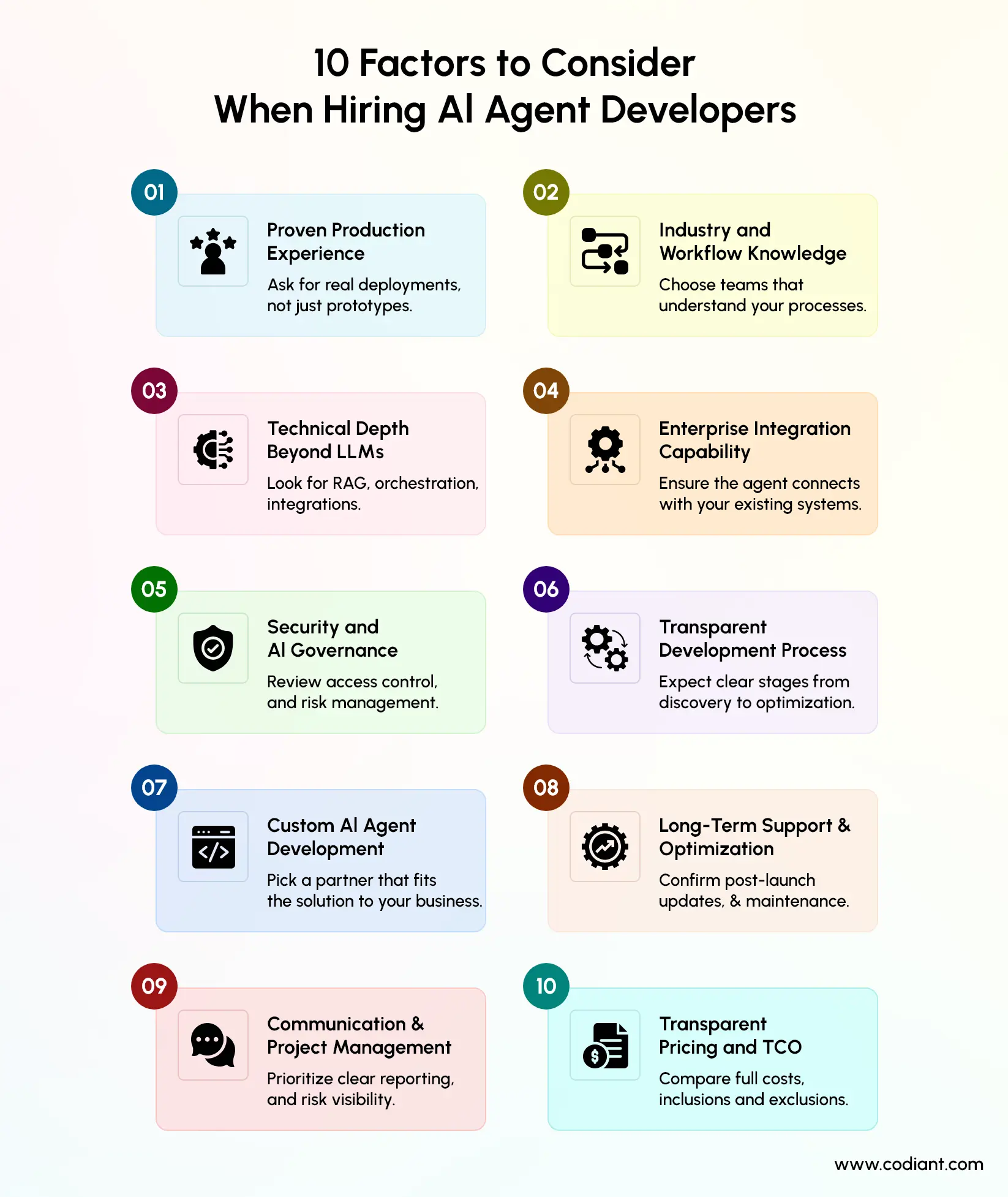
Businesses should look for production experience, business-process knowledge, strong software engineering, enterprise integration capability, AI security expertise, transparent project management, measurable evaluation methods, and long-term support.
Use the following ten factors to compare vendors consistently.
1. Proven Experience with Production AI Agents
Ask for evidence of systems operating in real business environments, not only demonstrations or proof-of-concept chatbots.
Request details about:
- The original business problem
- The users of the solution
- Systems integrated
- Actions performed
- Security controls
- Testing approach
- Performance measures
- Post-launch improvements
A company may be unable to disclose confidential client data. In that case, it should still be able to explain anonymised architecture patterns, development challenges, evaluation methods, and implementation responsibilities.
2. Understanding of Your Industry and Workflow
Industry experience can help a vendor understand terminology, process constraints, user expectations, and common integrations.
However, industry claims should be verified. Ask which projects the company has completed, what responsibilities it held, and whether references are available.
| Industry | Potential AI agent applications |
| Healthcare | Patient support, scheduling, documentation assistance |
| Financial services | Onboarding, document processing, internal policy support |
| Retail and ecommerce | Product assistance, order support, returns management |
| Manufacturing | Maintenance support, reporting, operational knowledge access |
| Logistics | Shipment support, dispatch coordination, exception management |
| Human resources | Candidate screening, onboarding, policy assistance |
| Professional services | Research, document analysis, knowledge retrieval |
High-risk applications may require stricter accuracy, oversight, documentation, and compliance controls.
3. Technical Expertise Beyond LLM Integration
An enterprise AI agent may require capabilities across:
- LLM and multimodal model integration
- Retrieval-Augmented Generation
- Agent orchestration
- Tool calling
- State and memory management
- Vector and search technologies
- Backend engineering
- Cloud infrastructure
- Identity and access management
- Evaluation frameworks
- Monitoring and observability
- Data engineering
Ask the vendor to explain its recommended architecture in plain language. A credible explanation should connect every technical component to a business or operational requirement.
4. Enterprise Integration Capability
Ask whether the company has integrated solutions with systems similar to yours.
The discussion should cover more than the names of platforms. It should include authentication, data permissions, API constraints, read-and-write operations, failure handling, auditability, and maintenance responsibilities.
A technically impressive AI virtual agent may still provide limited value if employees must manually transfer its outputs into other systems.
5. Security and AI Governance Practices
Ask the company to demonstrate how security is incorporated throughout discovery, architecture, development, testing, and deployment.
Important questions include:
- How is sensitive data identified?
- Which users can access the agent?
- Which tools can the agent call?
- Can it modify or delete records?
- Which actions require approval?
- How are interactions logged?
- How is prompt injection tested?
- How are secrets protected?
- How are incidents investigated?
- How are model and prompt changes reviewed?
Security answers should be specific to the proposed system. Generic statements such as “we follow best practices” are not enough.
6. Transparent Development Process
A clear development process reduces uncertainty and gives stakeholders regular opportunities to review decisions.
| Stage | Main purpose |
| Discovery | Define objectives, workflows, users, constraints, and metrics |
| Feasibility | Validate data, models, integrations, risks, and expected value |
| Architecture | Design system components, controls, and deployment approach |
| Prototype | Test the highest-risk assumptions |
| MVP development | Build the minimum production-relevant capabilities |
| Evaluation | Test quality, safety, security, cost, and performance |
| Deployment | Release the approved solution into its operating environment |
| Optimization | Improve the system using monitored evidence |
Ask how progress is reported, who approves scope changes, and what documentation will be delivered.
7. Ability to Build Custom AI Agents
A custom AI agent should reflect the organisation’s:
- Processes
- Business rules
- Data permissions
- Approval structure
- Customer journeys
- Software environment
- Risk tolerance
- Performance targets
Customisation should not mean building every component from the beginning. A capable vendor may combine commercial services, open-source frameworks, reusable components, and custom engineering where each is appropriate.
The important question is whether the final architecture fits the business requirement rather than forcing the business into a generic product.
A practical example of this custom approach can be seen in recruitment workflows.
Custom AI Agent Example: HireGroww
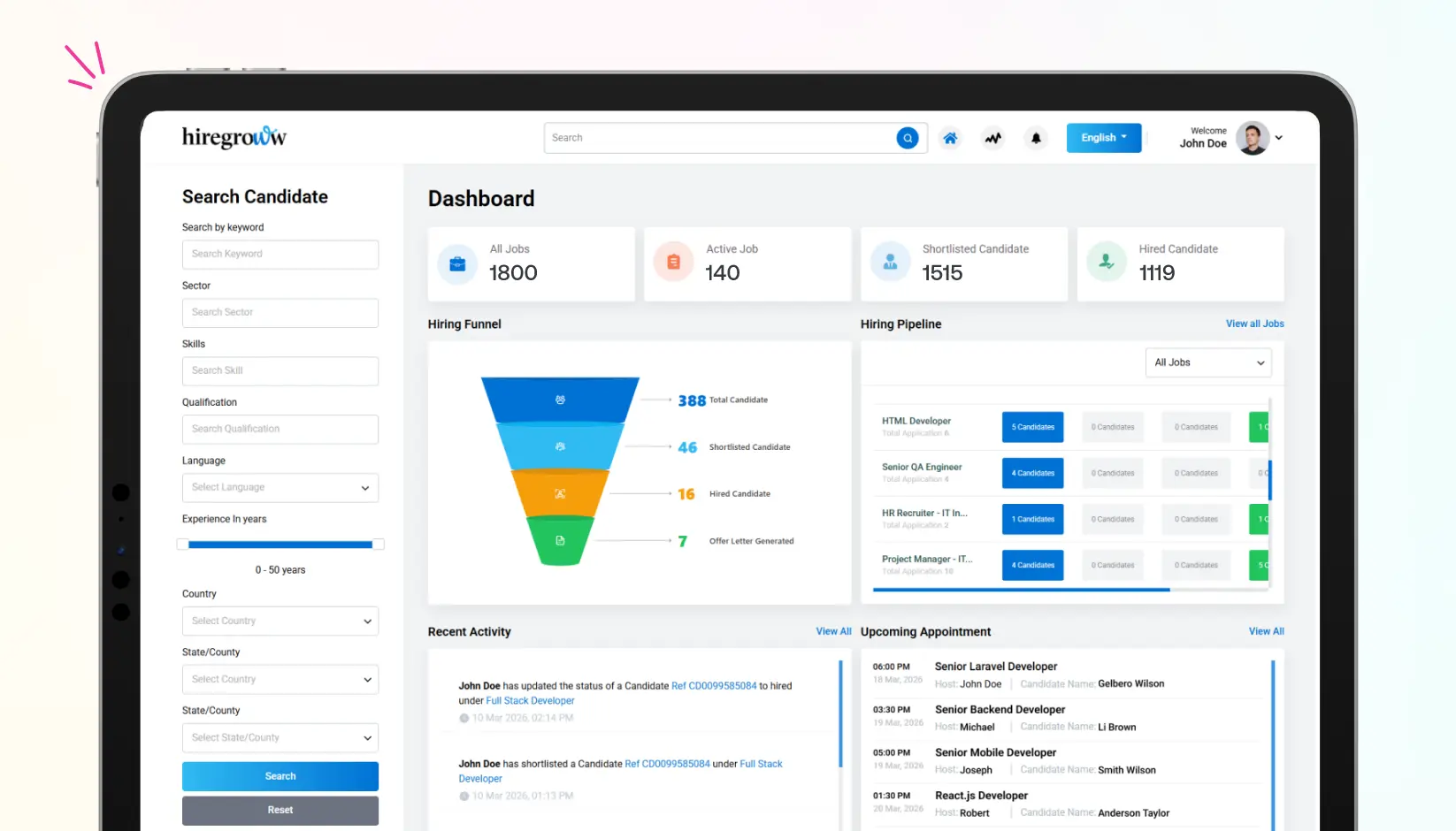
HireGroww demonstrates how an AI agent can be designed around a specific recruitment workflow rather than offered as a generic automation tool. Developed by Codiant, the platform supports recruiters across several repetitive activities while keeping final decisions under human control.
- Resume parsing and candidate analysis
- Job-to-candidate matching
- AI-assisted shortlisting
- Interview question generation
- Recruitment workflow support
- Recruiter decision assistance
This example shows that effective custom AI agents are built around defined tasks, existing processes, and clear human-approval boundaries.
8. Long-Term Support and Optimization
Confirm what happens after launch.
Post-deployment services may cover:
- Incident support
- Infrastructure maintenance
- Model updates
- Prompt changes
- Knowledge-base updates
- New integrations
- Security testing
- Performance evaluation
- Usage and cost reporting
- User feedback analysis
The agreement should also clarify response times, service levels, ownership, documentation, and exit or handover procedures.
9. Communication and Project Management
AI agent projects involve business leaders, subject specialists, developers, security teams, compliance stakeholders, IT administrators, and end users.
A suitable partner should:
- Explain technical decisions clearly
- Document assumptions
- Identify risks early
- Provide regular progress reports
- Involve users in testing
- Manage scope changes transparently
- Report failed tests as openly as successful ones
Clear communication is especially important when the system cannot meet a requested accuracy, autonomy, timeline, or budget requirement.
10. Transparent Pricing and Total Cost of Ownership
A proposal should explain both initial implementation costs and ongoing operating expenses.
The estimate should address:
- Product discovery
- AI feasibility assessment
- Data collection, cleaning, and labelling
- Model or API selection
- Retrieval and knowledge-base development
- Application engineering
- Third-party integrations
- Cloud infrastructure
- Security and compliance
- Testing and evaluation
- Monitoring and ongoing optimization
A credible estimate should state what is included, what remains excluded, and which assumptions were used. Without a defined scope, we cannot confirm an accurate project cost.
Choose the Right AI Partner Before Your Project Begins Today
Validate scope, architecture, security, integrations, and costs with experienced AI specialists first.
How Much Does AI Agent Development Cost?
AI agent development can cost $10,000 for a limited AI solution to $300,000 or more for a complex enterprise implementation. The final investment depends on the agent’s capabilities, data readiness, number of integrations, security requirements, infrastructure, expected usage, and level of autonomy.
Businesses preparing a detailed budget can review this AI agent development cost breakdown for a closer look at pricing ranges, cost drivers, development stages, and ongoing operating expenses.
Clutch reports that reviewed AI development projects commonly fall between $10,000 and $49,999, while its broader service guide places bespoke AI development projects between $10,000 and $300,000. These figures are market references, not fixed prices for every AI agent project.
Estimated AI Agent Development Cost by Project Type
| AI agent type | Typical scope | Estimated cost |
| AI agent prototype | One use case, limited data, basic interface, no critical integrations | $10,000–$25,000 |
| Knowledge-base AI agent | RAG-based answers, approved documents, admin controls, basic analytics | $25,000–$60,000 |
| Integrated business AI agent | CRM, helpdesk or ERP integration, workflow automation, user roles | $60,000–$150,000 |
| Enterprise AI agent | Multiple integrations, advanced security, monitoring, high user volume | $150,000–$300,000+ |
| Multi-agent or autonomous system | Multiple specialist agents, complex orchestration, high-risk actions, private deployment | Custom estimate |
These ranges are planning estimates based on increasing implementation complexity. We cannot confirm an accurate project cost without a defined scope, architecture, data assessment, integration requirements, and expected usage.
What Factors Affect AI Agent Development Cost?
The largest AI agent development cost drivers are workflow complexity, data preparation, integrations, security, infrastructure, model usage, testing, and ongoing optimization.
| Cost factor | How it affects the budget |
| Agent capabilities | An agent that only retrieves information costs less than one that plans tasks, calls tools, updates records, or coordinates workflows. |
| Data readiness | Unstructured, outdated, duplicated, or restricted data requires additional cleaning, labelling, governance, and retrieval work. |
| Enterprise integrations | Connecting CRM, ERP, helpdesk, payment, communication, or proprietary systems increases development and testing effort. |
| Level of autonomy | Agents permitted to perform write actions require stronger validation, permissions, approval controls, and audit trails. |
| AI model selection | Commercial APIs, open-weight models, private hosting, multimodal models, and fine-tuning have different setup and usage costs. |
| Security and compliance | Regulated or sensitive data may require encryption, role-based access, threat modelling, audit logging, and specialist reviews. |
| User volume | Higher usage increases infrastructure, inference, storage, monitoring, and availability requirements. |
| Testing and evaluation | Production agents require evaluation datasets, workflow testing, security testing, failure analysis, and user acceptance testing. |
| Post-launch support | Monitoring, prompt refinement, knowledge updates, model changes, and integration maintenance create ongoing costs. |
What is Usually Included in an AI Agent Cost Estimate?
A complete AI agent development estimate should clearly identify the work included in each project phase.
Typical inclusions are:
- Product discovery and AI feasibility assessment
- Data collection, cleaning, and labelling
- AI model or API selection
- Retrieval and knowledge-base development
- Agent workflow and orchestration design
- Web, mobile, or dashboard engineering
- Third-party and enterprise integrations
- Cloud infrastructure and deployment
- Security and governance controls
- Testing and AI performance evaluation
- Monitoring and post-launch optimization
What May Be Excluded From the Initial Quote?
Some proposals only cover initial development and exclude costs that arise during deployment or operation.
Common exclusions include:
- AI model API consumption
- Cloud hosting and database charges
- Third-party software licences
- Data migration or manual labelling
- Additional integrations
- Independent security audits
- Compliance or legal reviews
- User training
- Major scope changes
- Maintenance after the warranty period
- Future model or feature upgrades
Questions Every AI Agent Cost Estimate Should Answer
Before comparing proposals, ask:
- Which agent features and workflows are included?
- How many business systems will be integrated?
- Who is responsible for preparing and validating the data?
- Which AI models, APIs, and hosting services are assumed?
- What user volume or model usage is included?
- Which security and compliance activities are covered?
- What types of testing and evaluation will be completed?
- Is deployment and post-launch monitoring included?
- Which ongoing costs will be billed separately?
- How will new requirements and change requests be priced?
Cost takeaway: Compare vendors using the same scope, assumptions, integrations, usage levels, and support period. A lower initial quote may exclude data preparation, infrastructure, model usage, security testing, evaluation, or long-term maintenance.
What Industries Benefit Most from AI Agent Development?
Industries with high volumes of repetitive knowledge work, customer requests, document processing, system coordination, or rule-based workflows may benefit from AI agent development. The value depends more on the suitability of the process than on the industry name.
Potentially suitable workflows include:
- Searching large internal knowledge bases
- Classifying and routing requests
- Preparing document summaries
- Extracting structured information
- Coordinating routine tasks across systems
- Assisting employees with policies and procedures
- Responding to common customer requests
- Supporting scheduling and follow-up
- Identifying exceptions for human review
Understanding the specific business problems AI agents can solve can help organisations identify practical automation opportunities across customer service, operations, knowledge management, document processing, and internal workflows.
An AI-powered virtual agent may be less suitable when the process lacks reliable data, changes constantly, involves unclear responsibilities, or requires decisions that cannot safely be delegated.
The feasibility assessment should therefore evaluate the specific process, expected benefit, failure consequences, and required human oversight.
Questions to Ask Before Hiring an AI Agent Development Company
The following questions help businesses determine whether a vendor can deliver a secure, scalable, and business-focused system.
| Question | Why it matters |
| Have you built production AI agents for similar workflows? | Relevant implementation experience helps validate delivery capability. |
| Can you demonstrate a working solution or anonymised architecture? | Demonstrations show more than a list of technologies. |
| How will you determine whether an AI agent is feasible? | The vendor should validate assumptions before committing to a full build. |
| How will the agent use our business data? | This reveals the data, retrieval, permission, and privacy approach. |
| Which systems will it integrate with? | Integrations determine whether the agent can complete useful tasks. |
| How will you select models and frameworks? | Technology should be selected against defined requirements. |
| What actions can the agent perform autonomously? | Autonomy must reflect business risk and approval rules. |
| How will you test accuracy and task completion? | Performance requires repeatable evaluation, not subjective demonstrations. |
| How will you protect sensitive information? | Security should be explained at the architecture and control level. |
| What happens when the agent fails? | The system needs error handling, escalation, recovery, and auditability. |
| What is included in the estimate? | Clear inclusions and assumptions reduce unexpected costs. |
| Who owns the code, data pipelines, prompts, and documentation? | Ownership affects long-term control and vendor dependency. |
| What support is available after deployment? | Production agents require monitoring and maintenance. |
| How will knowledge transfer be handled? | Documentation and training support long-term ownership. |
Pay attention to the questions the vendor asks in return. A capable team should investigate your objectives, data, users, systems, risks, constraints, and success criteria before prescribing an architecture.
Red Flags When Evaluating AI Agent Development Companies
Warning signs include guaranteed accuracy, vague security claims, excessive focus on one model, unclear pricing, limited integration experience, and no plan for post-launch evaluation.
Warning signs include guaranteed accuracy, vague security claims, excessive focus on one model, unclear pricing, limited integration experience, and no plan for post-launch evaluation.
1. Promising perfect accuracy
AI systems can produce inconsistent or incorrect outputs. Vendors should explain how they measure performance, reduce errors, manage uncertainty, and involve people in high-risk cases.
2. Recommending technology before understanding the problem
A vendor that recommends a model, framework, or multi-agent architecture before analysing the workflow may be designing around technology rather than business requirements.
3. Focusing only on the language model
The model is not the whole system. Retrieval, integrations, permissions, orchestration, validation, user experience, monitoring, and governance frequently determine whether an agent works reliably in production.
4. Treating security as an add-on
Security should appear in the discovery notes, architecture, backlog, test plan, deployment process, and operating procedures.
5. Offering one solution for every client
Different organisations have different data, systems, rules, risks, and goals. Identical architecture recommendations may indicate insufficient discovery.
6. Avoiding measurable evaluation
A demonstration with a few successful prompts is not a complete test. The company should define repeatable evaluation cases and acceptance thresholds.
7. Providing an incomplete cost estimate
Check whether the proposal excludes infrastructure, model usage, integrations, data work, security reviews, monitoring, maintenance, or future changes.
8. Ignoring handover and ownership
Unclear ownership can make future maintenance, migration, or vendor replacement difficult.
In-House AI Team vs. AI Agent Development Company
An in-house team offers direct organisational ownership, while an AI agent development company can provide faster access to specialised delivery skills. The appropriate model depends on the company’s long-term strategy, recruitment capacity, urgency, budget, and internal technical maturity.
| Evaluation area | In-house team | Development company |
| Initial mobilisation | Requires recruitment or reassignment | Existing team may begin sooner |
| Expertise | Depends on available internal specialists | May provide a multidisciplinary team |
| Organisational knowledge | Strong direct access | Requires structured discovery |
| Delivery framework | Must be developed internally | May use established processes |
| Resource scaling | Requires hiring or contracting | Resources may be adjusted by phase |
| Knowledge retention | Remains internally | Requires documentation and handover |
| Long-term control | Direct internal control | Depends on contract and ownership terms |
| Best fit | Continuous internal AI programme | Defined implementation or capability acceleration |
Many organisations use a hybrid approach. An external partner supports architecture and initial delivery, while the internal team owns governance, business knowledge, product direction, and future operations.
Quick Vendor Evaluation Checklist
| Evaluation criterion | Confirmed |
| Relevant production AI agent experience | ☐ |
| Understanding of the target workflow | ☐ |
| Expertise beyond model integration | ☐ |
| Enterprise integration capability | ☐ |
| Clear data and retrieval strategy | ☐ |
| Security and governance methodology | ☐ |
| Structured evaluation plan | ☐ |
| Transparent delivery process | ☐ |
| Custom architecture recommendation | ☐ |
| Ongoing monitoring and support | ☐ |
| Clear ownership and handover terms | ☐ |
| Transparent total-cost estimate | ☐ |
A vendor does not need to answer “yes” to every criterion immediately. However, unresolved gaps should be investigated and documented before signing a contract.
Signs You Have Found the Right AI Agent Development Company
The right partner understands the business process before recommending technology, explains its decisions clearly, acknowledges limitations, and defines how success will be measured.
Strong indicators include:
1. It challenges an unsuitable use case
A responsible company may recommend a simpler automation, conventional software, analytics workflow, or human-led process when an AI agent is unnecessary.
2. It defines controlled autonomy
The company specifies what the agent may do, what it may not do, and which actions require human approval.
3. It documents assumptions and risks
The proposal explains dependencies, data requirements, API limitations, performance expectations, and unresolved questions.
4. It proposes measurable acceptance criteria
Success is defined using relevant indicators such as:
- Task-completion rate
- Answer correctness
- Retrieval relevance
- Escalation accuracy
- Processing time
- Automation rate
- Cost per completed task
- User satisfaction
- Error or policy-violation rate
5. It plans beyond launch
The partner discusses monitoring, updates, support, ownership, security reviews, and continuous optimization before deployment.
Why Businesses Consider Codiant for AI Agent Development?
Codiant’s AI agent and automation solutions cover use-case discovery, custom agent development, enterprise integration, testing, deployment, and continuous performance monitoring. Its stated AI agent capabilities include:
- Customer-support agents
- Recruitment assistants
- Sales and lead-qualification agents
- Employee co-pilots’
- Knowledge-management agents
- Workflow-automation agents
- Voice AI agents
- Industry-specific AI solutions
The proposed engagement should still be evaluated against the same criteria applied to every shortlisted company: relevant case evidence, architecture, security, integrations, evaluation, pricing, ownership, and long-term support.
1. Business-first discovery
The engagement begins by identifying the business process, users, systems, risks, and expected outcomes before selecting technology.
2. Custom AI agent development
The solution is designed around the organisation’s workflows, data sources, approval requirements, and software environment rather than applying one fixed product.
3. Enterprise integration
Agents can be designed to connect with CRM platforms, ERP software, knowledge bases, helpdesk applications, communication tools, document systems, APIs, and custom applications.
4. Security and governance
The proposed architecture may incorporate authentication, role-based access, encrypted communication, action controls, audit logging, and human approvals. The precise controls must be confirmed for each project.
5. Ongoing optimization
Post-launch services can include prompt updates, retrieval improvements, workflow changes, integration maintenance, model evaluation, monitoring, and technical support.
How Can Businesses Evaluate AI Agent Success and ROI?
Businesses should evaluate AI agent success by comparing post-deployment performance with a documented baseline. Metrics should reflect the business outcome, system quality, user experience, risk, and operating cost.
A practical measurement model includes five categories.
1. Business performance
- Reduction in handling time
- Increase in completed workflows
- Lower manual workload
- Faster response or resolution
- Change in conversion or retention
- Reduction in operational cost
2. AI quality
- Correct-answer rate
- Task-completion rate
- Retrieval relevance
- Unsupported-response rate
- Tool-selection accuracy
- Escalation accuracy
3. User experience
- Adoption rate
- User satisfaction
- Repeat usage
- Abandonment rate
- Human override rate
4. Risk and compliance
- Restricted-action attempts
- Sensitive-data incidents
- Policy violations
- Security-test results
- Audit completeness
5. Financial performance
A basic ROI calculation is:
ROI (%) = [(Financial benefit − total AI cost) ÷ total AI cost] × 100
For example, when an agent produces an estimated annual benefit of $180,000 and has a total annualised cost of $120,000:
ROI = [($180,000 − $120,000) ÷ $120,000] × 100 = 50%
The benefit estimate should include only outcomes that can be measured and reasonably attributed to the AI implementation. Total cost should include development, data work, integrations, infrastructure, model usage, maintenance, internal labour, training, governance, and optimization.
Conclusion
Choosing the right AI agent development company requires a structured assessment of business understanding, technical depth, architecture, integrations, security, evaluation, delivery, and long-term support.
The strongest partner is not necessarily the company using the newest model or making the boldest automation claims. It is the company that can explain how the agent will work inside your business, which risks must be controlled, how performance will be measured, and what will happen when the system encounters an uncertain or restricted situation.
Before hiring an AI agent development firm:
- Define the workflow and expected outcome.
- Establish measurable baseline performance.
- Validate data and integration readiness.
- Compare vendors using consistent criteria.
- Review production evidence rather than marketing claims.
- Require transparent assumptions, inclusions, and exclusions.
- Plan security and governance from the beginning.
- Define ownership and post-launch responsibilities.
A well-chosen development partner can help turn an AI concept into a production-ready system. A poorly chosen partner may deliver an impressive demonstration that cannot integrate, scale, operate securely, or produce measurable value. The difference becomes clear when businesses evaluate the complete solution rather than the AI model alone.
Move from AI Strategy to a Production-Ready Agent Faster Today
Design, build, integrate, and optimize an AI agent for measurable outcomes faster.
The Author

Frequently Asked Questions
Businesses should evaluate relevant project experience, workflow understanding, AI engineering skills, enterprise integrations, security, governance, testing, pricing, ownership, and long-term support. These factors provide a more complete assessment than model expertise or proposal cost alone.
The company can customise an agent by mapping the organisation’s workflows, connecting approved data sources, encoding business rules, integrating existing systems, defining user permissions, and configuring human-approval points. The resulting AI-powered virtual agent should reflect how the organisation actually operates.
The required technologies depend on the solution, but relevant capabilities may include model APIs, open-weight models, RAG, search, vector databases, agent orchestration, tool calling, backend engineering, cloud infrastructure, observability, identity management, and evaluation frameworks. Businesses should prioritise architectural judgement over a checklist of fashionable tools.
A custom AI agent may take several weeks for a limited prototype and several months for a secure, integrated production system. We cannot confirm an accurate timeline without knowing the workflow, data readiness, integrations, security requirements, testing scope, and approval process.
Businesses should establish a pre-launch baseline and then measure task completion, quality, adoption, time savings, operating costs, risk indicators, and financial benefit. ROI should use total ownership cost rather than development cost alone.
Featured Blogs
Read our thoughts and insights on the latest tech and business trends
HIPAA-Compliant App Development in 2026: How to Build Securely and Avoid Preventable Fines
- September 4, 2026
- Mobile App Development
HIPAA-compliant app development in 2026 requires six foundations: complete ePHI mapping, documented risk analysis, role-based access, encryption, signed business associate agreements, and continuous security monitoring. This matters most to healthcare CTOs, product leaders, and compliance... Read more
AI Developer Engagement Models Explained: How to Choose the Right AI Team
- August 27, 2026
- Artificial Intelligence
AI developer engagement model means deciding how external AI specialists will be assigned, managed, paid and held accountable. The main options are dedicated AI developers, AI team augmentation, time-and-material delivery, fixed-price projects and end-to-end AI... Read more
Enterprise Mobile App Development: How It Can Accelerate Your Business Growth
- August 21, 2026
- Mobile App Development
Enterprise mobile app development can accelerate growth by improving three measurable areas: workflow speed, access to business systems, and customer or employee service delivery. This matters to mid-market and enterprise leaders managing distributed teams, manual... Read more