React vs Angular vs Vue: Which Should You Choose in 2026?
Table of Contents
Subscribe To Our Newsletter
Summarize with AI
Not enough time? get the key points instantly.
For most web products in 2026, choose React for ecosystem flexibility and broad hiring reach, Angular for standardised enterprise architecture and complex workflows, and Vue for simpler adoption and faster team onboarding.
For CTOs, product leaders, and engineering managers, this decision affects delivery speed, governance, recruitment, rendering strategy, upgrade effort, and long-term maintenance. The strongest choice is the framework that matches the application’s complexity, the team’s existing skills, and the level of architectural control the organisation can sustain.
At Codiant, frontend teams support React.js, Vue.js, and AngularJS modernisation across custom web applications, SaaS products, dashboards, ecommerce platforms, and enterprise portals.
This React vs Angular vs Vue comparison covers architecture, learning curve, performance, enterprise suitability, hiring availability, and project fit, with a practical framework for selecting the right frontend technology.
In a Nutshell
- React, Angular, and Vue address three distinct needs: flexibility, structure, and progressive adoption.
- Choose based on application complexity, team expertise, governance requirements, hiring reach, and maintenance ownership.
- Allow 1–2 weeks for a representative proof of concept before finalising the framework.
- The biggest mistake is choosing by popularity without testing a real workflow and upgrade path.
- Codiant supports React.js, Vue.js, and AngularJS modernisation, aligning frontend architecture with product and maintenance requirements.
React vs Angular vs Vue: Quick Comparison
| Comparison area | React | Angular | Vue |
| Product type | UI library | Full application framework | Progressive framework |
| Primary language | JavaScript or TypeScript | TypeScript-first | JavaScript or TypeScript |
| Architectural approach | Flexible and ecosystem-driven | Opinionated and integrated | Flexible but guided |
| Learning curve | Moderate | Steeper | Generally easier |
| Built-in features | Limited core scope | Extensive first-party tooling | Focused core with official ecosystem |
| Best suited to | SaaS, consumer products, complex interfaces | Enterprise portals, regulated workflows, large teams | MVPs, dashboards, gradual modernisation |
| State management | Hooks, context, external libraries | Signals, services, RxJS and external options | Reactivity API and Pinia |
| Rendering options | Commonly provided through React frameworks | CSR, SSR, SSG and hybrid rendering | CSR, SSR and SSG, often through Nuxt |
| Team governance | Must be defined by the team | Strong conventions included | Balanced flexibility |
| Reported 2025 usage | 44.7% | 18.2% | 17.6% |
Need Help Choosing React, Angular, or Vue for Your Product?
Get expert guidance based on scalability, team skills, budget, and goals today.
Which is Better: React, Angular, or Vue?
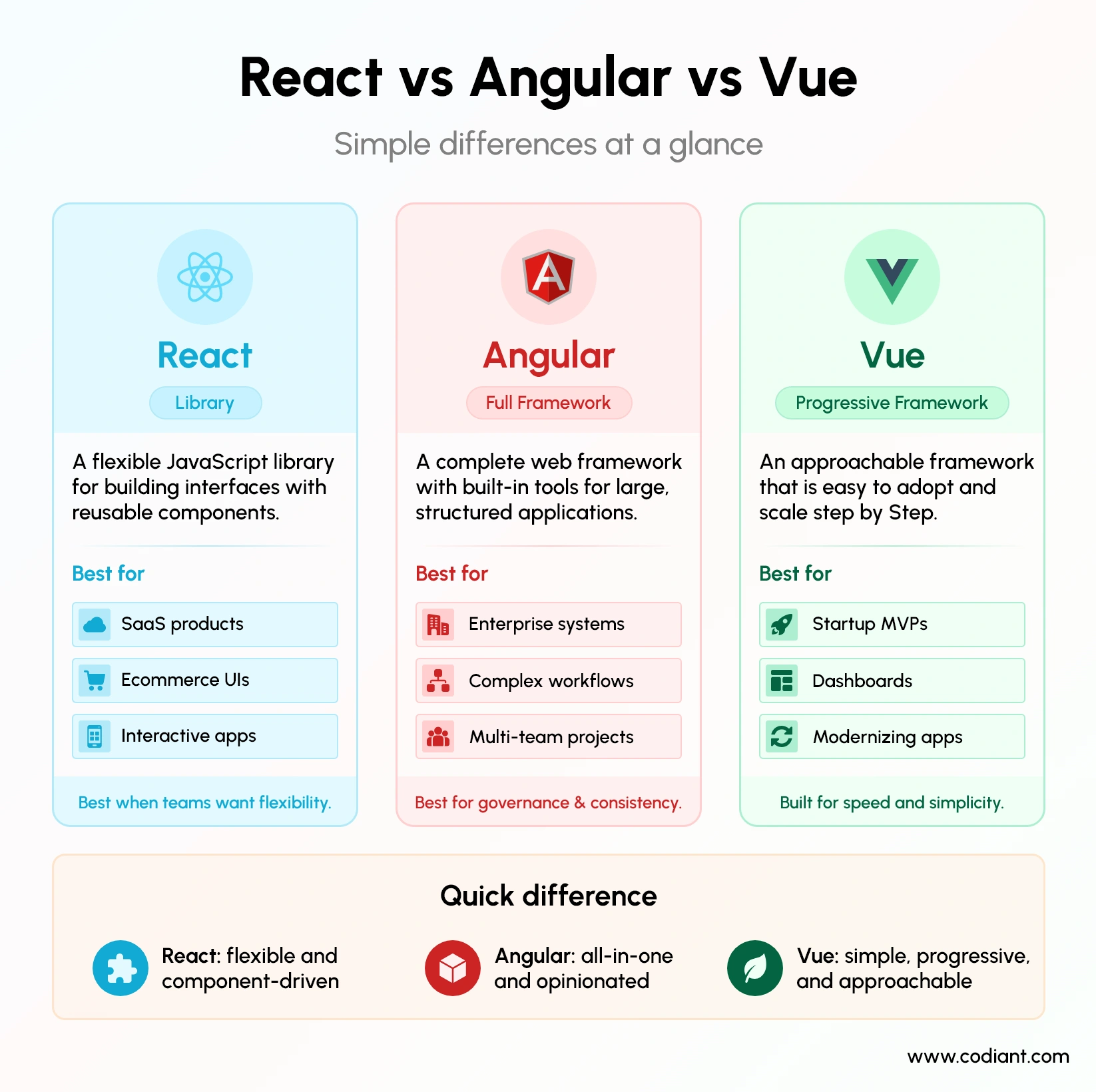
React is generally the strongest default when a business needs flexibility, access to a large ecosystem, and the ability to support different web and native product experiences. Angular is better when architectural consistency and first-party tooling matter more than flexibility. Vue is better when a team wants a simpler development experience without giving up the ability to build production applications.
The decision can be simplified as follows:
- Choose React: When the product roadmap may change, the interface is highly interactive, or the team wants freedom over routing, state management, styling, and rendering architecture.
- Choose Angular: When multiple teams must follow the same patterns across a large application, especially where forms, permissions, workflows, testing, and long-term governance are important.
- Choose Vue: When rapid onboarding, readable templates, incremental adoption, or a smaller engineering team are major priorities.
No option is universally better. A framework that reduces development time for one team may increase complexity for another. The best JavaScript framework is therefore the one that fits the organisation’s skills, product requirements, and operating model.
What Are the Differences Between React, Angular, and Vue?
The primary difference is scope. React focuses on composing interfaces from JavaScript components. Angular provides a broad collection of integrated application-development tools. Vue combines a focused core with an incrementally adoptable ecosystem.
What is React?
React is a JavaScript library for creating web and native user interfaces from reusable components. Components are JavaScript functions that return interface markup, usually written using JSX.
React.js development gives teams significant architectural freedom because the core library does not prescribe one mandatory router, application structure, data-fetching method or global state-management system.
The core library does not prescribe one mandatory router, application structure, data-fetching method, or global state-management system. That flexibility is useful for experienced teams, but it can lead to inconsistent decisions when governance is weak.
The React team now recommends that new applications begin with a React framework rather than assembling every production capability manually. Its official guidance explains that starting from scratch requires teams to choose solutions for routing, data fetching, and other common application patterns.
React is usually suitable for:
- Interactive SaaS platforms
- Consumer-facing web products
- Ecommerce interfaces
- Social or collaborative applications
- Products that may later share skills with React Native development
- Organisations with established frontend architecture standards
What is Angular?
Angular is a full web framework maintained by Google. It includes components, dependency injection, routing, forms, command-line tooling, server rendering, development tools, and automated update support within one coordinated platform.
Angular development is more opinionated than React development. Developers work within conventions established by the framework instead of selecting separate solutions for every requirement. This consistency can make large codebases easier to govern across teams, although developers must learn more Angular-specific concepts before becoming productive.
Angular’s dependency-injection system is designed to separate components from the services they require. The official documentation connects this pattern with code reuse, maintainability, scalability, and testing.
Angular is usually suitable for:
- Enterprise administration systems
- Banking, insurance, healthcare, and government portals
- Complex form-based workflows
- Applications managed by several development teams
- Products requiring consistent coding and upgrade practices
- Long-lived systems with formal governance requirements
What is Vue?
Vue is a progressive JavaScript framework designed to be approachable, performant, and incrementally adoptable. It can enhance individual sections of an existing page or support a complete single-page or server-rendered application.
Vue.js development commonly uses Single-File Components, which place a component’s template, logic and styling in one .vue file. Teams can use the Options API, which organises code into categories such as data and methods, or the Composition API, which provides more flexible functional organisation for complex applications.
Vue is usually suitable for:
- Startup MVPs
- Business dashboards
- Content-heavy interactive websites
- Gradual frontend modernisation
- Products built by small or medium-sized teams
- Teams moving from traditional HTML, CSS, and JavaScript development
React vs Vue: Which Should You Choose?
Choose React when ecosystem size, architectural flexibility, or broader developer familiarity matters most. Choose Vue when simpler templates, quicker onboarding, and a more guided development experience are higher priorities.
React offers a broader decision space
React can be integrated into part of an existing application or used through a full-stack framework for an entire product. Its flexibility makes it suitable for unusual technical requirements, but it also means teams must define their own standards for routing, state, data access, testing, folder structure, and component design. React’s official documentation explicitly supports gradual adoption and adding components to existing applications.
Vue offers a more approachable default experience
Vue uses HTML-based templates and provides an Options API that its documentation describes as more beginner-friendly because it abstracts some reactivity details and organises code into predefined groups. For larger production applications, the Vue team recommends Composition API with Single-File Components.
React vs Vue decision summary
Use React when:
- The organisation already employs React developers.
- The product needs specialised libraries or unusual integrations.
- A mobile product using React Native may follow.
- The engineering team can establish architectural standards.
- Long-term hiring reach is a leading concern.
Use Vue when:
- The team is more familiar with conventional HTML templates.
- The product needs to move from prototype to production quickly.
- The frontend will be introduced gradually into an existing system.
- The project benefits from a smaller number of architectural decisions.
- Developer onboarding speed matters more than maximum ecosystem choice.
If Vue is shortlisted, the hiring assessment should examine the key qualities to look for in Vue developers, including component architecture, reactivity, testing, communication and maintainability.
Angular vs React: Which Is Better for Complex Applications?
Angular is often better for complex applications that require consistent structure across multiple teams. React is often better when a complex product needs architectural flexibility, specialised libraries, or independent product teams that already maintain internal standards.
Angular provides first-party routing, route guards, data resolution, lazy loading, standardised forms, dependency injection, CLI tooling, and update automation. This reduces the number of foundational technology decisions a team must make before feature development begins.
React supplies the interface layer and allows teams to select the rest of their stack. This can be an advantage for platform engineering teams that want control over every architectural layer. It can become a disadvantage when different teams independently select overlapping libraries and coding patterns.
The Angular vs React decision therefore depends on governance:
| Choose Angular when | Choose React when |
| One architecture must serve several teams | Teams need freedom to adapt architecture |
| The product contains complex forms and workflows | The product contains highly specialised interfaces |
| Standardisation is a business requirement | Existing React expertise is already strong |
| First-party tooling is preferred | Best-of-breed ecosystem tools are preferred |
| Formal upgrades and support policies matter | Product experimentation matters more |
Angular also publishes a predictable release and support policy, automated ng update transformations, and step-by-step migration guidance. Major upgrades generally need to be completed sequentially rather than skipping several versions in one step.
Build a Frontend Architecture That Scales with Your Business Growth
Plan a secure, maintainable frontend with the right framework and architecture approach.
Which Framework is Best for Enterprise Applications?
Angular is frequently the strongest default for enterprise applications because it supplies an integrated architecture, formal conventions, dependency injection, routing, forms, testing support, update tooling, and published support policies. These features help organisations maintain consistency as their teams and codebases grow.
However, React may be the better enterprise choice when the organisation already has a mature frontend platform, internal component libraries, established state-management patterns, and experienced React engineers. React’s flexibility is valuable when enterprise teams need several applications with different technical requirements.
Vue is also capable of supporting enterprise applications. Its Composition API is intended to help organise and reuse logic in more complex applications, and its ecosystem includes official guidance for routing, state management, testing, security, and server rendering.
A practical enterprise recommendation is:
- Angular: Best for centralised governance and predictable architecture.
- React: Best for mature platform teams and diverse product portfolios.
- Vue: Best for focused enterprise products managed by smaller teams.
The framework alone does not create enterprise scalability. Module boundaries, automated testing, accessibility, observability, security controls, API design, release processes, and engineering governance remain equally important.
Which JavaScript Framework Is Easiest to Learn?
Vue is generally the easiest of the three for developers who already understand HTML, CSS, and basic JavaScript. Its documentation states that its introductory guide requires only basic HTML and JavaScript knowledge, while its Options API is intended to provide a more beginner-friendly organisation model.
React’s core concepts are also approachable. Developers learn components, JSX, props, state, events, lists, and Hooks. However, building a complete production application introduces additional decisions about routing, rendering, data fetching, state management, and project structure.
Angular typically has the steepest initial learning curve because developers encounter TypeScript, dependency injection, signals, templates, routing, forms, services, build tooling, and framework conventions together. That initial investment can later improve consistency because developers use a shared set of tools rather than creating their own application structure.
The easiest choice by background is often:
- Traditional HTML, CSS, and JavaScript developer: Vue
- JavaScript or functional-programming developer: React
- TypeScript, Java, C#, or structured enterprise developer: Angular
This is a practical assessment, not a universal ranking. Learning difficulty depends heavily on previous experience and the complexity of the first project.
How Do React, Angular, and Vue Compare in Performance?
React, Angular, and Vue can all deliver fast production applications. There is no credible universal benchmark proving that one framework will be fastest for every product because performance changes with bundle size, rendering mode, component design, data flow, network conditions, third-party scripts, and developer implementation.
React can use the React Compiler to handle component and value memoization automatically. Production React frameworks can also provide server rendering, streaming, code splitting, and data-fetching patterns around the React component model.
Angular uses Signals for fine-grained reactivity and supports zone less change detection, which reduces unnecessary application synchronisation. It also supports client rendering, server rendering, static generation, hydration, and route-level hybrid rendering.
Vue supports tree-shakable APIs and precompiled templates that can reduce browser-side code and runtime compilation work. Vue also supports SSR and SSG for projects where initial content delivery and search visibility are important.
A framework should therefore be tested against the application’s actual requirements. A useful proof of concept should measure:
- Initial JavaScript transferred
- Largest Contentful Paint
- Interaction to Next Paint
- Route-transition speed
- Memory consumption
- Rendering performance with realistic data
- Performance on lower-powered devices
- Server-rendering and infrastructure costs
Which Frontend Framework Is Most Popular in 2026?
React is the most popular of the three according to the latest completed, comparable developer survey available in 2026. The 2025 Stack Overflow Developer Survey reported usage of React by 44.7% of all respondents, compared with Angular at 18.2% and Vue.js at 17.6%. Among professional developers, React reached 46.9%, Angular 19.8%, and Vue.js 18.4%.
The Stack Overflow 2025 survey received more than 49,000 responses from 177 countries. Its 2026 survey is open, but the final results are not yet available. We therefore cannot confirm definitive full-year 2026 popularity figures.
Popularity should not be treated as proof of technical superiority. It can indicate easier access to learning resources, developers, integrations, and community support, but it does not determine whether a technology fits a specific product.
How Should Businesses Choose a Frontend Framework?
Businesses should evaluate the frontend development framework against the product’s operating requirements rather than selecting the technology through popularity alone.
1. Define the application type
A public ecommerce experience, an internal administration portal, a real-time collaboration product, and a regulated healthcare dashboard have different architectural needs.
2. Audit existing skills
Using a framework already understood by the team may reduce delivery risk more than selecting a theoretically ideal alternative.
Where the required expertise is unavailable internally, businesses may hire dedicated developers with experience in the shortlisted framework rather than selecting a technology only because the current team already knows it.
Include senior expertise, testing knowledge, accessibility experience, and deployment capability in the audit.
3. Estimate product complexity
Review the number of workflows, roles, integrations, real-time features, forms, data visualisations, and reusable components. Higher complexity increases the importance of architecture and governance.
4. Decide how much flexibility the team can manage
React provides more choice, Angular provides stronger defaults, and Vue offers a middle position. Flexibility is valuable only when the team has the experience to manage it consistently.
5. Assess rendering requirements
Determine whether the product needs client-side rendering, server-side rendering, static generation, or a hybrid approach. Public pages with search and initial-load requirements may need a different strategy from authenticated internal dashboards.
6. Review maintenance and upgrade responsibilities
A credible frontend development guide should define who will manage framework updates, library upgrades, vulnerability monitoring, browser compatibility, testing, and technical debt after launch.
7. Validate the choice through a proof of concept
Build one representative workflow rather than a simplified demonstration. Test a complex form, data-heavy screen, authenticated route, integration, and production deployment before finalising the stack.
React vs Angular vs Vue: Recommended Choice by Project
| Project type | Recommended starting point | Reason |
| Early-stage MVP | React or Vue | Faster experimentation and flexible product iteration |
| Large enterprise portal | Angular | Integrated architecture and consistent team conventions |
| Consumer SaaS platform | React | Broad ecosystem and support for complex interfaces |
| Internal business dashboard | Vue or Angular | Vue for simplicity, Angular for workflow complexity |
| Existing website enhancement | Vue or React | Both support gradual adoption |
| Complex form-based system | Angular | Standardised forms, validation, routing, and DI |
| Web and native product roadmap | React | Skills can extend toward the React Native ecosystem |
| Small engineering team | Vue | Lower initial complexity and approachable templates |
| Multi-team frontend programme | Angular or governed React | Choice depends on centralised versus platform-led architecture |
These are starting recommendations, not automatic decisions. Existing expertise, technical constraints, and approved organisational standards may justify a different selection.
Final Verdict: React, Angular, or Vue?
React is the safest general recommendation for many products in 2026 because it combines strong adoption, flexible component development, and a broad surrounding ecosystem. Angular is the strongest choice when a large application needs integrated tooling, predictable conventions, and central governance. Vue is the strongest choice when development simplicity, gradual adoption, and team onboarding are the main priorities.
Choose:
- React for ecosystem depth, product flexibility, and developer reach.
- Angular for enterprise structure, standardisation, and complex workflows.
- Vue for approachability, focused teams, and progressive implementation.
The final choice should follow a technical assessment covering application scope, team capability, rendering requirements, integration complexity, security, maintenance ownership, and long-term product plans.
Choose the Right Frontend Stack Before Development Begins
Evaluate architecture, scalability, skills, and maintenance needs with experienced frontend specialists.
The Author

Frequently Asked Questions
React and Vue are usually the strongest startup choices. React is preferable when the startup expects complex product growth or needs broad developer availability, while Vue is suitable when a small team prioritises speed, clarity, and rapid onboarding. Angular may be justified when the founding team already has Angular expertise or the product contains complex enterprise workflows.
All three can deliver high-performance applications when implemented correctly. Vue supports tree-shaking and precompiled templates, Angular uses Signals and modern change-detection strategies, and React offers compiler-assisted memoization and framework-level rendering options. Performance should be validated using the product’s real screens, devices, data volumes, and deployment architecture.
Angular provides the most built-in organisational structure, while React offers the most architectural flexibility. Vue can also scale effectively when teams use Composition API, clear module boundaries, TypeScript, testing, and consistent conventions. Long-term scalability depends more on architecture and engineering governance than framework choice alone.
Businesses should assess application complexity, existing skills, hiring needs, ecosystem requirements, rendering strategy, security, accessibility, integrations, testing, upgrade policies, and long-term maintenance ownership. The selection should be validated through a representative proof of concept rather than a basic demonstration.
React appears to have the largest developer community among the three based on current survey usage. The 2025 Stack Overflow Developer Survey reported React usage at 44.7%, compared with Angular at 18.2% and Vue.js at 17.6%. These figures indicate reported usage, not a precise count of every developer worldwide.
Featured Blogs
Read our thoughts and insights on the latest tech and business trends

AI Agents vs RPA: What’s the Difference and When Should You Use Each?
- August 12, 2026
- Artificial Intelligence
AI agents and Robotic Process Automation (RPA) differ in three main areas: how they make decisions, the data they can process, and how they respond when a workflow change. RPA follows predefined rules to complete... Read more

How to Outsource Mobile App Development? A Comprehensive Guide
- August 7, 2026
- Mobile App Development
To outsource mobile app development successfully, define the product scope, budget range, target platforms, delivery responsibilities, security requirements, and acceptance criteria before evaluating development partners. This preparation helps CTOs, product leaders, and founders compare proposals... Read more

How The 1-Week Free Trial Works When Hiring Full Stack Developers
- August 6, 2026
- Staff Augmentation
A 1-week free trial gives US mid-market CTOs 7 working days to evaluate a full stack developer through real project tasks before confirming a paid engagement. This trial matters when a development roadmap requires immediate... Read more