How The 1-Week Free Trial Works When Hiring Full Stack Developers
Table of Contents
Subscribe To Our Newsletter
Summarize with AI
Not enough time? get the key points instantly.
A 1-week free trial gives US mid-market CTOs 7 working days to evaluate a full stack developer through real project tasks before confirming a paid engagement. This trial matters when a development roadmap requires immediate support, but technical interviews and portfolios do not provide enough evidence of how a developer will perform inside an existing engineering environment.
CTOs can assess code quality, frontend and backend knowledge, communication, delivery discipline, problem-solving, documentation, and compatibility with the company’s tools and workflows.
LinkedIn’s Future of Recruiting 2025 report found that 93% of talent acquisition professionals consider accurate skills assessment essential for improving quality of hire. LinkedIn also reported that companies conducting the most skills-based searches were 12% more likely to make a quality hire than companies conducting the fewest.
At Codiant, companies looking to hire full stack developers receive a 1-week or 7-day free trial to test technical skills and determine whether the selected developer fits their team and work requirements.
This article covers how Codiant’s 1-week free trial works, what the trial includes and excludes, suitable evaluation tasks, the seven-day schedule, performance scoring criteria, key benefits, trial availability, engagement costs and models, replacement conditions, and the next steps after the trial.
In a Nutshell
- A 1-week free trial provides 7 working days to assess a full stack developer on real, controlled project tasks before starting a paid engagement.
- The most important criterion is production readiness, measured through code quality, task completion, communication, documentation, and integration with the existing development workflow.
- The evaluation lasts 1 week, allowing the CTO to make a hiring decision after observing practical performance rather than relying only on interviews or coding tests.
- The biggest mistake is assigning work without defined deliverables, repository access limits, acceptance criteria, and a designated reviewer, which makes the trial difficult to evaluate objectively.
- Codiant provides full stack developers with a 7-day free trial. Companies can verify technical capability and team fit before making a financial commitment.
What is a One-Week Full Stack Developer Free Trial?
A one-week full stack developer free trial is a limited evaluation engagement in which a selected developer works on an agreed task for approximately one working week. It allows both parties to test the working relationship before entering a longer hourly, monthly, dedicated or project-based contract.
Businesses planning to hire dedicated full stack developers can use the trial to verify whether the selected developer’s frontend, backend, database and integration experience matches the actual project before choosing a longer engagement.
A trial may involve five working days or seven calendar days, depending on the provider’s terms. Businesses should confirm:
- When the trial officially begins
- How many working hours are included
- Whether weekends are counted
- Which developer or developers are included
- What deliverable is expected
- Who owns the work produced
- What access the developer will receive
- What happens if the trial is discontinued
The purpose is not to obtain a large amount of unpaid development. The purpose is to generate enough evidence to decide whether the developer can contribute effectively to the project.
For example, a trial task could involve building a small dashboard component, resolving a contained backend issue, integrating one API in a sandbox environment or improving test coverage for a specific module. These tasks provide observable evidence without exposing the business to unnecessary project or security risk.
Test Full Stack Talent Before Making a Long-Term Hiring Commitment
Evaluate skills, communication, and delivery through one focused seven-day project trial first.
Too many hiring tests don’t reflect real work.
66% of developers prefer real-world coding challenges, yet outdated algorithmic tests remain widely used.
A one-week trial follows this practical approach by allowing a developer to work on a realistic, role-relevant assignment. It gives the business evidence of how the developer understands requirements, writes code, tests functionality and handles feedback.
How Does a Free Trial Work When Hiring Full Stack Developers?
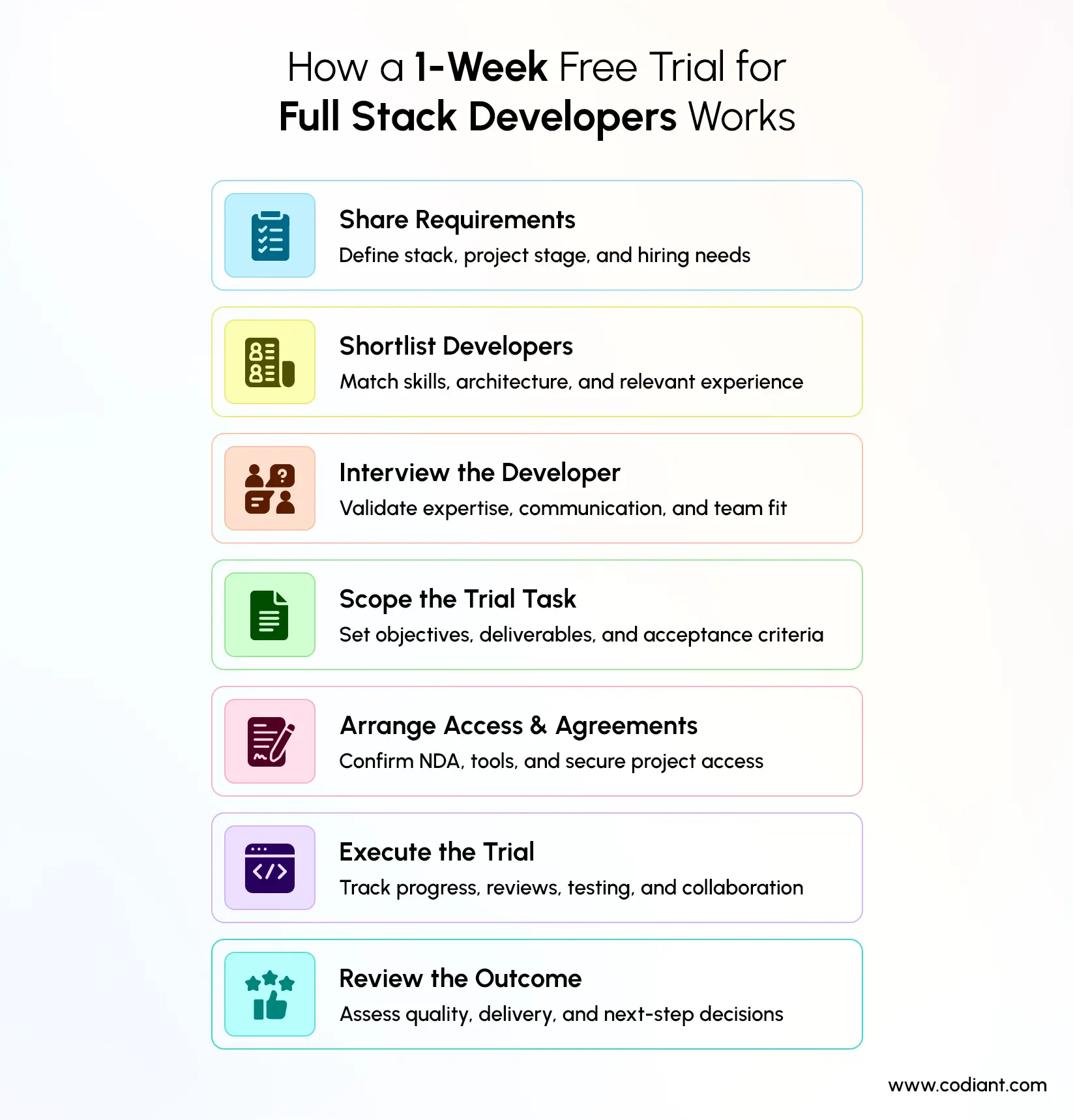
A free trial usually works through seven stages: requirements discovery, developer matching, interview, trial scoping, access setup, task execution and final evaluation. Each stage should produce a clear decision or deliverable.
1. The business shares its technical requirements
The process begins with a description of the product, technology stack, current development stage and immediate staffing need.
The requirement brief should identify:
- Frontend framework
- Backend framework
- Database technology
- Cloud platform
- Required integrations
- Existing architecture
- Developer seniority
- Preferred working hours
- Expected engagement duration
- Trial task options
A request such as “We need a full stack developer” is not specific enough for accurate matching. A more useful requirement would be:
We need a developer with React, Node.js, PostgreSQL and AWS experience to support an existing SaaS application. The developer should overlap with our product team for four hours daily and initially work on API performance and dashboard improvements.
Projects that combine application development with machine learning may require additional assessment criteria. The process used to hire AI developers in 2026 should evaluate model development, data-processing skills, system integration and deployment experience alongside conventional full-stack capabilities.
2. Suitable developer profiles are shortlisted
The provider identifies developers whose technical experience aligns with the requirement.
Businesses should review more than a technology list. A suitable profile should demonstrate relevant experience with:
- Similar product architectures
- Comparable application complexity
- Required frontend and backend frameworks
- Database design
- API development
- Testing
- Cloud deployment
- Security practices
- Distributed team collaboration
A developer who knows React and Node.js may still be unsuitable if the project requires advanced PostgreSQL optimization, regulated-data handling or high-volume distributed systems.
3. The business interviews the developer
The interview verifies whether the profile reflects the developer’s actual experience and whether the person can explain technical decisions clearly.
The interview should cover:
- Previous projects
- Architecture decisions
- Debugging approach
- Code-review experience
- Testing practices
- Security awareness
- Communication style
- Availability
- Time-zone overlap
- Understanding of the proposed trial task
Avoid relying only on theoretical questions. Use one or two situations related to the actual project.
For example:
Our React dashboard becomes slow when it loads several data sets. How would you investigate the problem before changing the code?
The answer can reveal whether the developer gathers evidence, considers frontend and backend causes, asks relevant questions and avoids premature conclusions.
4. The trial task and acceptance criteria are documented
The trial should begin only after both parties agree on a bounded assignment.
A strong trial task has:
- One clear objective
- A manageable scope
- Relevant technical depth
- Defined dependencies
- Observable output
- Written acceptance criteria
- A review process
Consider this example:
Trial objective: Add filtering to an existing order-management screen.
Expected work:
- Build the filter interface in React
- Extend the existing Node.js endpoint
- Update the database query
- Add validation
- Write relevant tests
- Submit the change through a pull request
- Document setup or implementation decisions
Acceptance criteria:
- Users can filter orders by status and date
- Invalid date ranges produce a clear error
- Existing order functionality continues to work
- Tests pass in the agreed environment
- Code follows the repository’s conventions
- No credentials or sensitive data are committed
This format makes the evaluation more objective than a vague instruction such as “Improve the order module.”
5. Contracts, confidentiality and access are arranged
The developer should receive only the access required for the trial task.
Depending on the assignment, access may include:
- Project-management board
- Communication channel
- Development repository
- Test environment
- Technical documentation
- Design files
- API documentation
- Non-production credentials
Production access should not be granted automatically. Use test data, sandbox services and restricted permissions wherever possible.
6. The developer completes the agreed trial assignment
During the working period, the developer should operate within the same basic workflow expected after hiring.
That may include:
- Daily stand-ups
- Written progress updates
- Branch and pull-request conventions
- Code reviews
- Test execution
- Issue tracking
- Technical discussions
- Final demonstration
7. Both parties review the outcome
At the end of the trial, the business reviews the work against the predefined criteria rather than relying on a general impression.
The review should answer:
- Was the required functionality completed?
- Did the developer understand the existing architecture?
- Was the code maintainable?
- Were tests added or updated appropriately?
- Did the developer identify relevant risks?
- Were progress updates clear?
- How did the developer respond to feedback?
- Were blockers escalated promptly?
- Would the team trust this person with a larger assignment?
The decision may be to continue, request a different developer, adjust the engagement model or stop the process.
Can You Hire Full Stack Developers on a Trial Basis?
Yes, some software-development providers allow businesses to hire full stack developers on a limited trial basis before entering a longer contract. Availability, duration, included hours and eligible developer profiles vary by provider.
Before accepting any full stack developers free trial, ask for written answers to these questions:
- Is the trial completely free or conditionally credited?
- Does one week mean five working days or seven calendar days?
- How many hours are included?
- Is the trial available for every developer level?
- Can more than one candidate be evaluated?
- Is the trial available for individual developers and teams?
- Who owns the code produced?
- Can trial code be used in production?
- What happens if the developer is unavailable?
- Does the contract continue automatically?
We cannot confirm these conditions universally because they depend on the provider’s specific agreement.
What Should Be Included in a Full Stack Developer Trial?
A credible trial should include a matched developer, a defined task, agreed working hours, essential tool access, observable deliverables and a structured review. Anything not stated in the trial agreement should not be assumed.
| Trial component | What should be defined |
| Developer | Name, role, seniority and technology experience |
| Duration | Start date, end date and working-day definition |
| Availability | Daily hours and time-zone overlap |
| Assignment | One bounded technical task |
| Deliverables | Code, tests, documentation, demonstration or report |
| Access | Repositories, environments, tools and permissions |
| Communication | Stand-ups, updates and review meetings |
| Quality criteria | Functionality, tests, maintainability and security |
| Ownership | Rights to code and documentation |
| Continuation | Options available after the evaluation |
What should normally remain excluded?
Unless the agreement says otherwise, a short trial should not be expected to include:
- Completion of an entire MVP
- Major architecture replacement
- Unrestricted production access
- Large-scale data migration
- Multiple unrelated features
- Emergency support outside agreed hours
- Specialist work outside the selected developer’s role
- Third-party subscriptions or cloud fees
- Guaranteed commercial outcomes
- Unlimited revisions
The trial agreement should state both inclusions and exclusions. Without a defined scope, neither the business nor the developer can evaluate performance fairly.
What Is a Practical Seven-Day Trial Schedule?
A one-week trial can be structured as a small development sprint.
| Day | Primary activity | Expected evidence |
| Day 1 | Kickoff, environment setup and requirement review | Questions, plan and confirmed acceptance criteria |
| Day 2 | Architecture review and initial implementation | Branch, task breakdown or early commit |
| Day 3 | Core frontend or backend development | Working progress and status update |
| Day 4 | Integration, validation and testing | Integrated functionality and test results |
| Day 5 | Feedback and revision | Response to review comments |
| Day 6 | Stabilization and documentation | Refined code and technical notes |
| Day 7 | Demonstration and evaluation | Demo, pull request and final review |
Some providers operate trials over five business days rather than seven active working days. The precise schedule should be established before onboarding.
What Can Businesses Evaluate During a Developer Trial?
Businesses can evaluate technical capability, delivery quality, communication, collaboration, security awareness and ownership during the trial. The strongest assessment combines code review with direct observation of how the developer handles requirements and feedback.
1. Requirement comprehension
Evaluate whether the developer:
- Identifies unclear requirements
- Asks relevant questions
- Recognises dependencies
- Confirms acceptance criteria
- Distinguishes assumptions from facts
A developer who begins coding immediately without clarifying an ambiguous task may create unnecessary rework.
2. Full stack technical ability
The trial task should provide evidence across the application layers relevant to the project. When evaluating full stack developers for complex projects, businesses should also assess how well the developer understands dependencies between the interface, APIs, backend logic, databases and infrastructure.
Depending on scope, review:
- Frontend component structure
- State management
- API design
- Backend logic
- Database queries
- Validation
- Authentication and authorization
- Error handling
- Testing
- Deployment awareness
A one-week trial cannot prove expertise in every technology. It can show whether the developer applies the necessary skills to a representative task.
3. Code quality and maintainability
Review whether the code is:
- Readable
- Consistent with project conventions
- Appropriately modular
- Free from unnecessary duplication
- Documented where clarification is needed
- Reasonably testable
- Easy for another developer to review
Do not use the number of lines written as the primary performance measure. More code does not necessarily represent more value.
4. Testing discipline
Testing expectations should be proportionate to the assignment.
Possible evidence includes:
- Unit tests
- Integration tests
- Validation tests
- Regression checks
- Manual test notes
- Reproduction steps
- Test-environment results
The goal is to determine whether the developer verifies the work rather than assuming that it functions correctly.
5. Security awareness
A short trial can reveal whether the developer treats security as part of development rather than as a final-stage check.
Review whether the developer:
- Avoids exposing credentials
- Validates external input
- Applies access controls appropriately
- Uses dependencies carefully
- Handles errors without leaking sensitive information
- Follows the project’s secure coding rules
A trial cannot provide a complete security audit. It can only provide limited evidence of the developer’s day-to-day security behaviour.
6. Communication
Evaluate whether the developer:
- Provides clear progress updates
- Explains decisions in understandable language
- Reports blockers early
- Responds within agreed working windows
- Participates constructively in meetings
- Documents important assumptions
This is especially important when businesses hire remote full stack developers, because the developer may work from a different location or time zone.
7. Response to review feedback
The first version of the work does not need to be perfect. How the developer responds to feedback may be more informative.
Look for whether the developer:
- Understands the review comment
- Discusses trade-offs professionally
- Corrects genuine issues
- Explains disagreements with evidence
- Avoids defensive or dismissive responses
- Updates tests or documentation when needed
8. Ownership and problem-solving
A suitable developer should progress independently while escalating decisions that require product, security or architecture approval.
Ownership does not mean making every decision alone. It means moving the task forward responsibly without hiding blockers or making high-risk assumptions.
Reduce Hiring Risk with a Seven-Day Full Stack Developer Trial
Validate practical skills before choosing the right long-term developer engagement model confidently.
How Can Developer Performance Be Scored Objectively?
A weighted scorecard can reduce subjective hiring decisions. The following model is a suggested framework, not an industry standard.
| Evaluation category | Suggested weight |
| Functional correctness | 20% |
| Code quality and maintainability | 15% |
| Technical problem-solving | 15% |
| Testing discipline | 10% |
| Security awareness | 10% |
| Communication | 10% |
| Collaboration and feedback response | 10% |
| Ownership and reliability | 10% |
| Total | 100% |
Rate each category from one to five.
Use this formula:
Category score = rating ÷ 5 × category weight
For example, a developer receiving four out of five for functional correctness would receive:
4 ÷ 5 × 20 = 16 points
Add all category scores to calculate the total out of 100.
The final decision should not rely on the total alone. A serious failure in security, honesty or access handling may outweigh a strong numerical score.
What Are the Benefits of a One-Week Developer Trial?
The primary benefit of a one-week developer trial is that it replaces part of the hiring uncertainty with direct evidence from a realistic assignment. The business can observe how the developer works before approving a longer engagement.
1. It verifies practical capability
Technical interviews show how candidates answer questions. A trial shows how they navigate an actual codebase, implement requirements and deliver work for review.
2. It tests communication in a real workflow
The business can observe response times, meeting participation, written updates and the developer’s ability to explain blockers.
3. It validates project compatibility
A technically capable developer may still be unsuitable for the project’s architecture, pace or collaboration model. The trial helps identify that mismatch early.
4. It supports more informed engagement decisions
After the trial, the business can choose a suitable full stack developer engagement model based on observed performance and expected workload rather than assumptions alone.
5. It can reduce onboarding uncertainty
The trial introduces the developer to the repository, tools, requirements and stakeholders. When the engagement continues, some initial orientation has already occurred.
A free trial reduces uncertainty, but it does not remove every outsourcing risk. Long-term performance, scalability decisions and production support cannot be fully evaluated in one week.
Did You Know?
In CoderPad’s State of Tech Hiring 2026, 69% of recruiters said they use resumes to assess technical talent, but only 16% believed resumes reliably predict on-the-job performance. A one-week trial helps hiring companies close this evaluation gap by assessing code quality, problem-solving, communication and delivery through actual project work.
Source: CoderPad
How Should You Choose a Trial Task?
Choose a task that is small enough to complete or meaningfully progress within one week, but realistic enough to reveal the skills required for the longer engagement.
Good tasks for an existing application
- Resolve a reproducible bug
- Build one frontend component
- Extend an existing API endpoint
- Improve a slow database query
- Add validation to a workflow
- Integrate a sandbox API
- Add tests to a contained module
- Diagnose a performance problem
- Refactor one isolated component
Good tasks for a new product
- Build a thin frontend-to-database workflow
- Create a small authentication prototype
- Develop one API-backed user story
- Configure a basic development environment
- Validate a proposed integration
- Prepare a technical proof of concept
Tasks to avoid
- “Start building our platform”
- Replace the complete application architecture
- Migrate a production database
- Handle an unresolved security incident
- Build several unrelated modules
- Deliver a complete marketplace or SaaS MVP
- Work without acceptance criteria
The task should resemble future work. Testing a frontend-heavy assignment will provide limited evidence if the long-term role mainly involves backend architecture.
How Does the Trial Support Full Stack Developer Outsourcing?
A trial supports full stack developer outsourcing by testing the operating model as well as the individual developer. Businesses can verify whether remote communication, access controls, task management and review processes function effectively before scaling the relationship.
The trial may reveal organizational issues unrelated to the developer, including:
- Incomplete documentation
- Slow access approvals
- Unclear decision ownership
- Unavailable test environments
- Delayed stakeholder feedback
- Contradictory requirements
These findings are still valuable. A successful outsourcing engagement requires the client to provide sufficient context, access and timely decisions.
Before the trial, assign:
- One business or product contact
- One technical reviewer
- One person authorized to approve access
- One final hiring decision-maker
Without clear responsibility, a one-week evaluation can be consumed by avoidable waiting.
Is a Free Trial Useful for Full Stack Developers for Startups?
A trial can be useful for startups that need to add development capacity without making an immediate long-term commitment. It can help founders verify whether a developer understands the MVP scope, existing code and near-term release priorities.
Suitable trial assignments for startups include:
- Completing one MVP user story
- Fixing a launch-blocking defect
- Connecting a frontend flow to an existing API
- Evaluating a third-party integration
- Improving onboarding or checkout functionality
- Creating test coverage for a critical module
However, full stack developers for startups should not be evaluated only on speed. Startups should also assess whether the developer avoids shortcuts that could create security, maintainability or scalability problems.
A developer who delivers fewer changes but explains risks and produces maintainable work may be a better long-term choice than someone who generates more code without adequate testing.
Is a Free Trial Available for Dedicated Development Teams?
Some providers offer trials for individual developers, while others may allow a small, multi-role team to participate. Businesses planning to hire a dedicated development team should evaluate team composition, technical coverage, communication responsibilities and coordination, not only the performance of one developer.
Before you hire a full stack development team on a trial basis, confirm:
- Number of included team members
- Roles included in the trial
- Combined working hours
- Team lead availability
- Shared deliverable
- Communication responsibilities
- Individual and team-level evaluation criteria
- Continuation pricing for each role
A team trial should assess coordination, not just individual output. For example, review whether frontend and backend developers agree on API contracts, whether QA receives testable builds and whether the team resolves dependencies without repeated escalation.
What Engagement Models Are Available After the Trial?
After the trial, businesses can usually continue through a dedicated, hourly, time-and-material or fixed-scope model. Trial performance should be considered alongside the expected long-term budget because the cost to hire dedicated developers in 2026 varies according to seniority, technical role, location, project complexity and engagement structure.
1. Dedicated developer model
A dedicated developer works primarily or exclusively on the client’s project for an agreed number of hours. When the backlog requires expertise beyond one full-stack role, businesses may instead hire dedicated developers across frontend, backend, mobile, database or other technical disciplines.
This model is suitable when:
- The backlog is ongoing
- Priorities change regularly
- Direct collaboration is required
- Long-term product knowledge matters
2. Part-time engagement
A part-time model is suitable when the business needs recurring support but does not have enough work for a full-time developer.
3. Hourly or time-and-material model
The business pays for the agreed time used.
This model may fit:
- Changing requirements
- Maintenance work
- Experimentation
- Technical discovery
- Irregular development demand
4. Fixed-cost project model
A fixed-cost model is more appropriate when scope, deliverables, timeline and acceptance criteria are stable.
What Happens When the Trial Does Not Work?
An unsuccessful trial should lead to a documented decision, not an ambiguous extension. The business should identify whether the issue resulted from developer performance, incorrect matching, unclear requirements or inadequate onboarding.
Possible outcomes include:
- End the engagement
- Interview a different developer
- Repeat the evaluation with a corrected task
- Change the required seniority
- Select a different technology specialist
- Reduce or expand the role
- Improve internal documentation before hiring again
The provider should also clarify how trial code, credentials, documentation and access will be handled after discontinuation.
Required closeout actions may include:
- Revoke repository access
- Disable temporary accounts
- Rotate shared credentials
- Transfer work and documentation
- Record unresolved issues
- Confirm intellectual-property treatment
- Close communication and project-management access
Do not retain an unsuitable developer only because the trial involved setup effort. The purpose of the evaluation is to support a defensible continuation decision.
How the 1-Week Free Trial at Codiant Works
The one-week free trial at Codiant follows a selection-first process. Businesses share their project requirements, review shortlisted full stack developer profiles, interview suitable candidates and complete onboarding before the selected developer begins the trial.
The purpose of this process is to allow the business to evaluate a relevant developer rather than assigning a resource without prior review.
1. Share the project requirements
The business provides information about the project scope, required technology stack, preferred experience level, timeline and expected team size.
A detailed requirement helps identify developers whose technical background matches the actual product environment. For example, a SaaS project may require React, Node.js, PostgreSQL and AWS experience, while another application may require Angular, Python and Azure.
2. Review shortlisted developer profiles
Suitable profiles are shortlisted based on the submitted requirements. Businesses can review each developer’s technical strengths, relevant project exposure, portfolio and available code samples before deciding who should proceed to an interview.
This step allows the business to compare candidates according to project relevance rather than relying only on broad job titles or technology lists.
3. Interview and finalize the developer
The shortlisted developer can be interviewed directly to assess technical knowledge, communication, problem-solving ability and understanding of the proposed assignment.
The interview should focus on scenarios related to the actual project. For example, the business may ask the developer to explain how they would diagnose a slow API, improve an existing database query or structure a frontend component.
The business proceeds only after identifying a candidate who appears suitable for the trial.
4. Complete onboarding and access setup
After the developer is finalized and the contract is confirmed, onboarding covers documentation, communication setup, workflow alignment and relevant project access.
Onboarding can typically be completed within 24 hours after profile selection, interview completion and contract confirmation. The actual start time may vary according to project complexity, resource availability and documentation requirements.
5. Begin the seven-day trial
The selected full stack developer begins a complimentary seven-day trial based on a clearly defined task, expected deliverables, acceptance criteria, and review process. This structure allows the client to assess technical expertise, communication, delivery discipline, and overall team fit objectively.
- Up to 56 working hours: The trial includes up to 56 hours for the assigned developer, calculated as eight hours per day across seven consecutive calendar days.
- Seven calendar days: The trial begins on the agreed start date and continues for seven consecutive calendar days.
- Intellectual-property ownership: Intellectual property created during the trial is transferred to the client only after the engagement continues successfully.
- Replacement conditions: The trial is generally offered once for the selected developer. When the developer is found unsuitable, Codiant reviews the client’s feedback and may offer a replacement where appropriate.
- Use of trial deliverables: Code, designs, features, and other trial outputs are provided for evaluation only. They may be used in a live product after the engagement is formally confirmed and the applicable commercial agreement is signed.
- Team-level eligibility: The complimentary trial generally applies to one selected developer. Trials involving a larger development team may be considered individually based on project scope, team size, and engagement requirements.
6. Review the trial outcome
At the end of the trial, the business can review the developer’s work against the agreed criteria.
The evaluation may cover:
- Functional correctness
- Frontend and backend capability
- Code quality
- Testing discipline
- Communication
- Security awareness
- Response to feedback
- Ability to meet agreed timelines
- Compatibility with the existing team
The business can then decide whether to continue with the same developer, discuss a different resource or end the evaluation without entering a longer engagement.
7. Select an engagement model
When the trial is successful, the engagement can continue through an appropriate commercial model.
- Dedicated developer engagement
- Time-and-material engagement
- Fixed-cost project engagement
The trial establishes whether the developer is suitable, while the engagement model determines how the working relationship continues after the evaluation period.
How Should Businesses Decide Whether to Continue?
Continue the engagement when the developer meets the critical technical and collaboration requirements defined before the trial. Do not base the decision solely on whether the assigned feature appears to work.
Ask these final questions:
- Would the team approve this developer’s pull request?
- Did the developer make the codebase easier or harder to maintain?
- Were assumptions communicated before implementation?
- Did the developer follow access and security requirements?
- Were updates understandable and timely?
- Did the developer respond constructively to review feedback?
- Can the developer handle the next planned assignment?
- Does the proposed engagement model match the workload?
The business should also review whether its own team provided sufficient access, requirements and feedback. A delayed environment or unavailable product owner can make developer performance appear weaker than it was.
Experience the Developer’s Workflow Before Finalizing Your Hiring Commitment Today
Observe coding standards, teamwork, and delivery discipline during a real project task.
The Author

Frequently Asked Questions
A one-week trial should include a selected developer, an agreed task, defined working hours, necessary project access, progress communication and an end-of-trial review. Exact inclusions vary, so the written agreement should specify deliverables, access, ownership, confidentiality and exclusions before the trial begins.
A business may be able to request a different developer when the initial match does not meet the agreed requirements, but the replacement process depends on the provider’s terms and resource availability. The contract should explain whether another trial is available and whether switching affects the start date or pricing.
Performance should be evaluated against predefined criteria covering functional correctness, maintainability, testing, security, problem-solving, communication and response to feedback. Pull requests, tests, demonstrations, progress updates and reviewer comments provide more reliable evidence than activity volume alone.
After the trial, the business reviews the deliverable and decides whether to continue, change developers or stop the engagement. Continuation should occur only after the commercial model, working hours, rates, responsibilities and contract terms have been approved.
After the trial, businesses can choose from dedicated full-time, part-time, hourly, time-and-material, or fixed-cost engagement models. The best option depends on whether the project needs ongoing support, flexible scaling, or a clearly defined scope and budget.
Featured Blogs
Read our thoughts and insights on the latest tech and business trends

How Much Does It Cost to Build an MVP in 2026? A Complete Pricing Guide
- September 10, 2026
- Digital Transformation
MVP development cost typically ranges from $5,000 for a basic web-based product to $150,000 or more for a complex, cross-platform solution. A custom MVP with user accounts, a backend, essential integrations and a polished interface... Read more

How Much Does It Cost to Hire a Dedicated AI/LLM Developer in 2026?
- September 8, 2026
- Artificial Intelligence Staff Augmentation
Hiring a dedicated AI or large language model (LLM) developer typically costs $35–$60 per hour for general AI engineering and $50–$200 per hour for specialised machine learning work, with enterprise pricing rising for advanced RAG,... Read more
HIPAA-Compliant App Development in 2026: How to Build Securely and Avoid Preventable Fines
- September 4, 2026
- Mobile App Development
HIPAA-compliant app development in 2026 requires six foundations: complete ePHI mapping, documented risk analysis, role-based access, encryption, signed business associate agreements, and continuous security monitoring. This matters most to healthcare CTOs, product leaders, and compliance... Read more