AI Readiness Checklist for Enterprises in 2026
Table of Contents
Subscribe To Our Newsletter
Summarize with AI
Not enough time? get the key points instantly.
AI readiness is the ability of an enterprise to adopt artificial intelligence safely, strategically, and at scale. It depends on business goals, data quality, technology infrastructure, governance, talent, security, workflow maturity, and measurable value creation.
In 2026, enterprise AI adoption is no longer limited to experiments. McKinsey’s 2025 State of AI survey reported that 88% of respondents said their organizations used AI in at least one business function, but many companies were still early in scaling AI and capturing enterprise-wide value.
This AI readiness checklist helps enterprises assess whether they are prepared for AI implementation, where gaps exist, and how to build a practical AI transformation roadmap.
Key Takeaways:
- AI readiness starts with business goals, not tools.
- Poor data quality can weaken AI performance.
- Governance must be planned before enterprise AI adoption.
- Enterprises need skills, workflows, security, and integration readiness.
- AI maturity assessment helps prioritize use cases.
- Successful AI planning requires KPIs and ownership.
- Pilots should connect to a scalable AI transformation roadmap.
- AI projects fail when strategy, data, governance, or adoption is weak.
What is an AI Readiness Checklist?
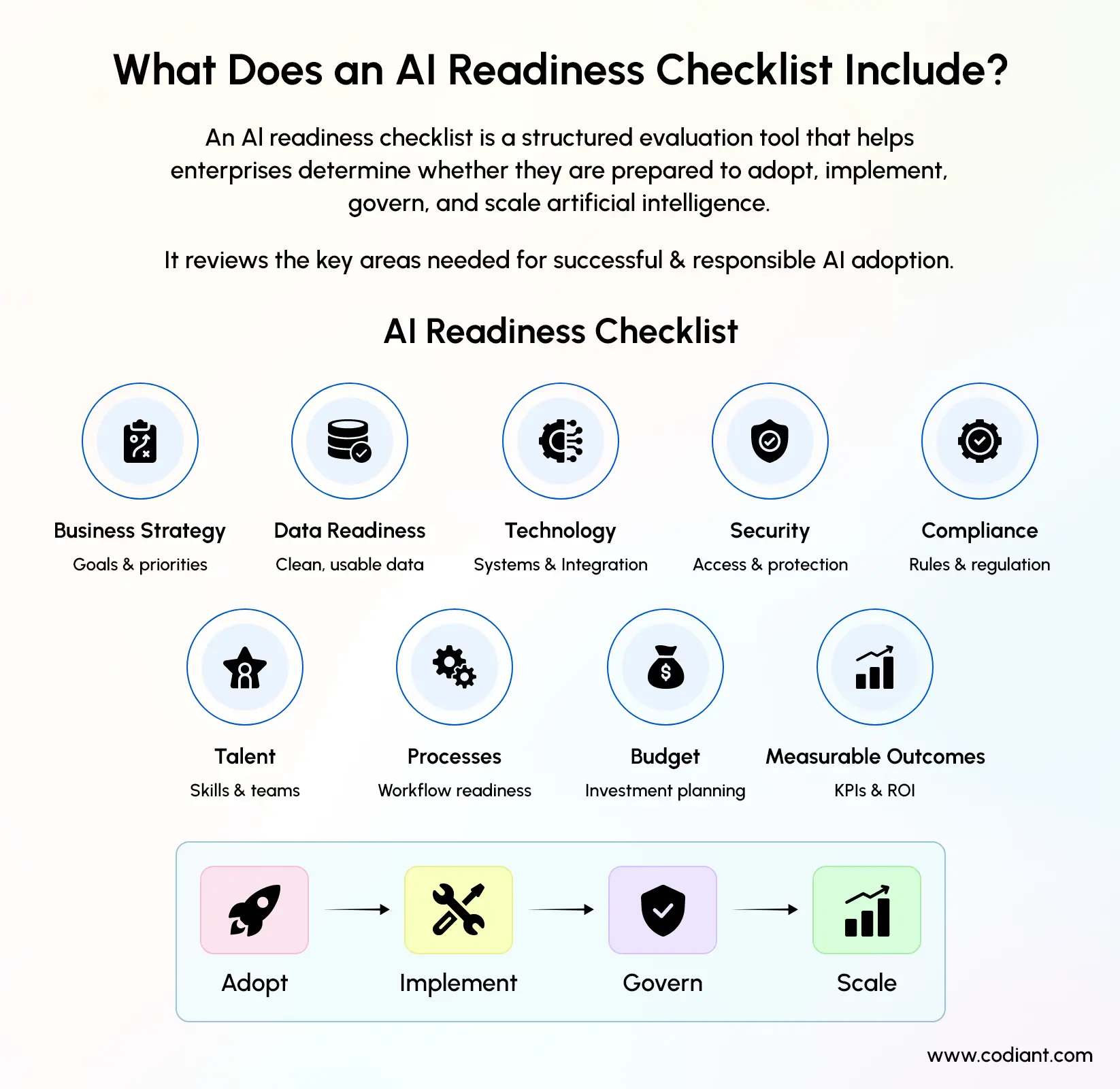
An AI readiness checklist is a structured evaluation tool that helps enterprises determine whether they are prepared to adopt, implement, govern, and scale artificial intelligence. It reviews business strategy, data readiness, technology infrastructure, security, compliance, talent, processes, budget, and measurable outcomes.
A strong AI readiness checklist does not ask only, “Can we use AI?” It asks:
- What business problem should AI solve?
- Is the required data accessible and reliable?
- Are systems ready for integration?
- Who owns AI governance?
- What risks need control?
- How will ROI be measured?
- Are employees prepared to use AI in real workflows?
For enterprises, this checklist becomes the starting point for an AI readiness assessment and a practical AI adoption framework.
Why AI Readiness Matters for Enterprises in 2026?
AI readiness matters because enterprise AI projects often fail when organizations move faster than their data, governance, workflows, or teams can support. AI tools may be easy to access, but enterprise-scale adoption requires planning, accountability, security, integration, and measurable business value.
IBM’s Global AI Adoption Index reported that limited AI skills and expertise, data complexity, and ethical concerns were among the top barriers preventing AI deployment.
Gartner also notes that value from AI has remained difficult for many organizations, with only 38% of CIOs and technology leaders rating their AI value-creation progress as excellent or good.
This makes AI readiness for business a strategic requirement, not a technical formality.
Turn AI Readiness into Real Business Momentum
Assess strategy, data, governance, and workflows before moving enterprise AI from pilot to scale safely.
How Do Enterprises Assess AI Readiness?
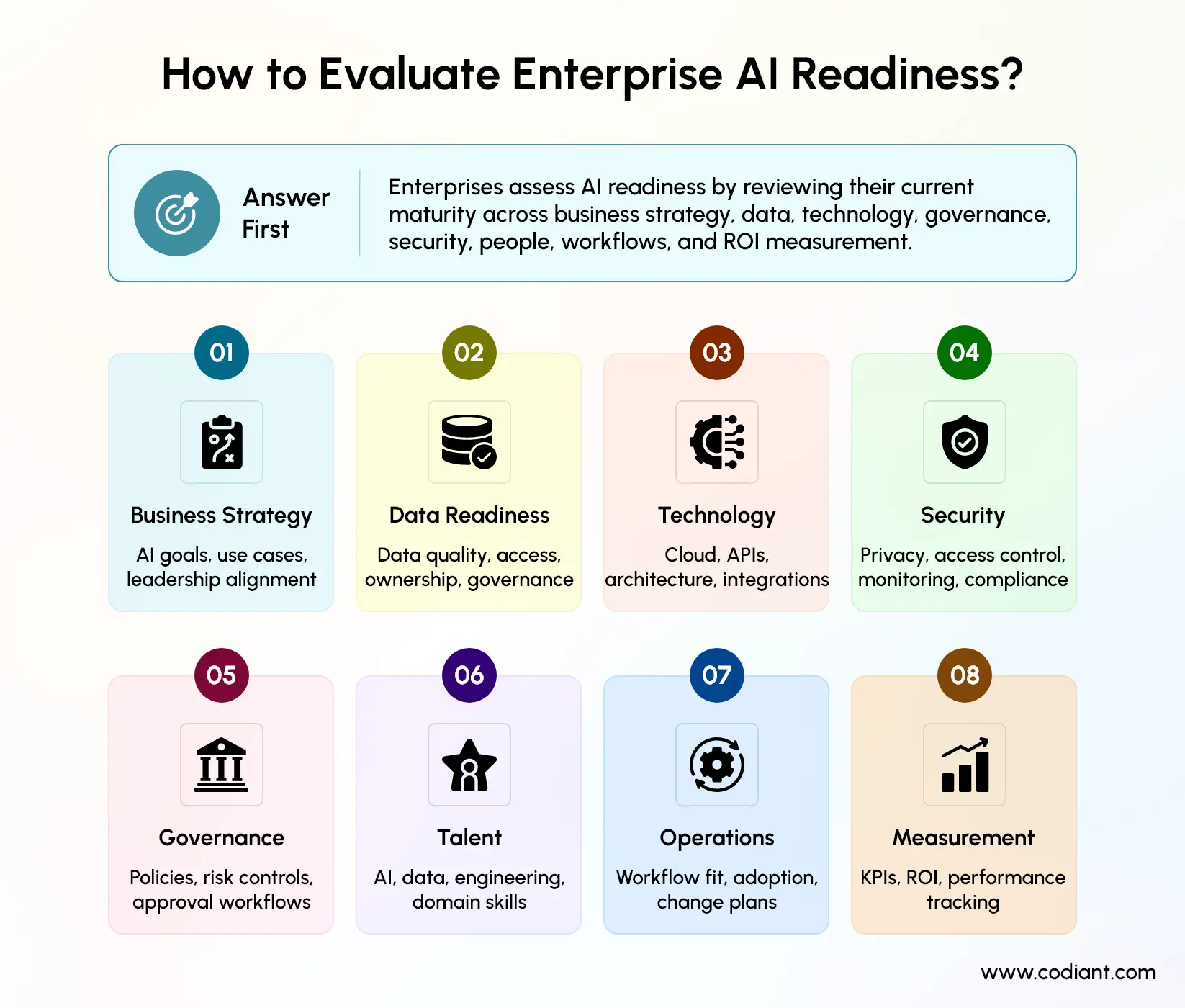
Enterprises assess AI readiness by reviewing their current maturity across business strategy, data, technology, governance, security, people, workflows, and ROI measurement. The goal is to identify whether the organization can move from AI experimentation to scalable, responsible implementation.
A practical AI readiness assessment should include these areas:
| Readiness Area | What to Assess |
| Business strategy | AI goals, use cases, leadership alignment |
| Data readiness | Data quality, access, ownership, governance |
| Technology | Cloud, APIs, architecture, integration capability |
| Security | Privacy, access control, monitoring, compliance |
| Governance | Policies, risk controls, approval workflows |
| Talent | AI, data, engineering, product, domain expertise |
| Operations | Workflow fit, change management, adoption plans |
| Measurement | KPIs, ROI model, performance monitoring |
Enterprises should score each area from low to high maturity. A low score does not mean AI cannot begin. It means the AI transformation roadmap should start with foundational fixes before scaling into high-risk or business-critical use cases.
Moderna’s Enterprise AI Readiness Approach
Moderna shows how enterprise AI adoption depends on more than giving employees access to AI tools. The company worked with OpenAI to roll out ChatGPT Enterprise and supported the adoption with leadership involvement, employee training, internal AI champions, and practical business use cases.
Before scaling ChatGPT Enterprise, Moderna had already launched mChat, an internal AI chatbot built on OpenAI’s API. According to OpenAI’s customer story, mChat was adopted by more than 80% of Moderna employees, creating a strong foundation for wider AI adoption.
After ChatGPT Enterprise was introduced, Moderna reportedly saw rapid internal experimentation and adoption:
- 750 GPTs were created across the company within two months.
- 40% of weekly active users created GPTs.
- Employees used ChatGPT Enterprise for business, legal, clinical, and operational workflows.
- The company supported adoption through training, office hours, internal forums, and AI champions.
This example highlights a key AI readiness lesson for enterprises: successful AI adoption requires strategy, culture, training, governance, data platforms, and workflow alignment. Enterprises that prepare these foundations are more likely to move from experimentation to scalable business impact.
AI Readiness Checklist for Enterprises in 2026
Use this AI readiness checklist to evaluate whether your enterprise is ready for AI implementation.
1. Is There a Clear AI Strategy for the Enterprise?
An AI strategy for enterprises defines why AI is being adopted, where it will create value, which use cases matter first, and how success will be measured. Without strategy, AI adoption often becomes scattered across disconnected pilots.
Your enterprise is strategy-ready if it has:
- Defined business goals for AI
- Prioritized use cases by value and feasibility
- Executive sponsorship
- Budget ownership
- Department-level alignment
- Clear success metrics
- A roadmap from pilot to production
A strong AI strategy should answer one question clearly: which business outcomes will AI improve?
Enterprises that are still defining their roadmap can start by understanding how to create an AI strategy for your business before selecting tools, vendors, or implementation models. This helps keep AI planning tied to business outcomes instead of disconnected experiments.
Examples include faster customer support, lower manual processing, improved forecasting, better fraud detection, smarter document handling, or personalized digital experiences.
2. Has the Enterprise Completed an AI Maturity Assessment?
An AI maturity assessment evaluates how prepared an organization is to use AI across strategy, data, technology, governance, people, and operations. It helps enterprises understand whether they are at the awareness, experimentation, implementation, scaling, or optimization stage.
A simple maturity model can look like this:
| Maturity Level | Description |
| Level 1: Awareness | AI interest exists, but no formal roadmap |
| Level 2: Experimentation | Teams test tools or pilots in isolated areas |
| Level 3: Implementation | AI use cases enter controlled production |
| Level 4: Scaling | AI is integrated across workflows and systems |
| Level 5: Optimization | AI performance, governance, and ROI are continuously improved |
3. Are Business Use Cases Prioritized Correctly?
AI use cases should be prioritized based on business value, technical feasibility, risk, data availability, and implementation effort. Enterprises should not start with the most complex use case simply because it appears innovative.
A good first AI use case usually has:
- Clear business pain
- Available data
- Repetitive workflow
- Measurable outcome
- Limited regulatory risk
- Human review option
- Integration feasibility
Examples of practical enterprise AI use cases include:
- AI customer support assistant
- Invoice processing automation
- Sales lead scoring
- Internal knowledge search
- HR resume screening support
- Predictive maintenance
- Document summarization
- Demand forecasting
- IT helpdesk automation
Customer-facing AI is often a practical starting point because it has clear workflows, measurable response-time goals, and visible user impact. For example, conversational AI for customer experience can support service teams with faster query handling, guided responses, and more consistent customer interactions.
The best AI implementation readiness starts with focused, measurable workflows before expanding into autonomous or high-risk decision-making.
4. Is Enterprise Data Ready for AI?
Data quality is one of the strongest determinants of AI readiness. AI systems depend on accurate, accessible, governed, and relevant data. If enterprise data is incomplete, duplicated, outdated, siloed, or poorly labeled, AI output quality becomes unreliable.
Enterprises should check:
- Is the required data available?
- Is it accurate and current?
- Is ownership clearly defined?
- Is sensitive data classified?
- Are duplicate records removed?
- Are access permissions controlled?
- Is there a data governance policy?
- Can data be used legally and ethically?
For AI readiness assessment, data should not be treated as an IT-only issue. Business teams, compliance teams, product owners, and engineering teams all need shared accountability.
5. Is the Technology Infrastructure AI-Ready?
AI-ready infrastructure allows enterprises to build, integrate, deploy, monitor, and scale AI systems securely. This includes cloud capability, APIs, data pipelines, model access, application architecture, observability, and integration with existing enterprise systems.
Technology readiness includes:
- Cloud or hybrid infrastructure
- API-first architecture
- Secure data pipelines
- Scalable storage
- Model hosting or API access
- Integration with CRM, ERP, HRMS, EHR, or internal systems
- Monitoring and logging
- Backup and disaster recovery
- DevOps or MLOps practices
For generative AI systems, enterprises may also need vector databases, retrieval-augmented generation pipelines, prompt management, model evaluation tools, and guardrail systems. These components help AI applications use approved business knowledge instead of relying only on general model output.
Technology readiness does not mean every system must be rebuilt. It means the enterprise understands which systems AI must connect with and whether those systems can support secure, reliable integration.
6. Are Governance and Risk Controls Defined?
AI governance defines how AI systems are approved, monitored, audited, secured, and controlled. Enterprises need governance before deploying AI into sensitive workflows, customer interactions, regulated processes, or decision-support systems.
Enterprise AI governance should define:
- Acceptable AI use
- Restricted AI use
- Data privacy rules
- Human review requirements
- Risk classification
- Model approval process
- Audit logging
- Bias testing
- Security controls
- Incident response
- Vendor evaluation
- Legal and compliance review
Governance should be proportional to risk. A low-risk internal summarization tool does not need the same controls as an AI system involved in lending, hiring, healthcare, legal review, or financial decisions.
7. Are Security and Compliance Requirements Clear?
AI implementation readiness requires strong security and compliance planning. AI systems may process sensitive data, connect with enterprise systems, generate customer-facing responses, or influence business decisions.
Security checks should include:
- Identity and access management
- Role-based access control
- Encryption in transit and at rest
- Data masking
- Prompt and output logging
- Secure API management
- Vendor risk assessment
- Model access controls
- Sensitive data filtering
- Human approval for high-risk actions
- Compliance with applicable regulations
Enterprises in healthcare, finance, insurance, education, logistics, and government need stricter controls because AI may interact with regulated data or operationally sensitive workflows.
Also read: How AI Agents Transform the Healthcare Sector
Security readiness should be reviewed before production deployment, not after a pilot becomes business-critical.
8. Does the Enterprise Have the Required AI Skills?
AI adoption requires a mix of technical, business, operational, and governance skills. Enterprises do not need every skill in-house, but they need clear ownership across strategy, engineering, data, security, compliance, and change management.
Important AI roles include:
| Role | Responsibility |
| AI strategist | Aligns AI with business goals |
| Data engineer | Prepares and manages data pipelines |
| AI/ML engineer | Builds or integrates models |
| Software engineer | Connects AI with enterprise applications |
| Security expert | Reviews access, privacy, and risk |
| Domain expert | Validates business logic and outputs |
| Product owner | Owns roadmap and adoption |
| Compliance lead | Reviews legal and regulatory fit |
| Change manager | Supports training and workflow adoption |
Enterprises can address this through internal upskilling, hiring, vendor partnerships, or dedicated AI development teams.
9. Are Workflows Ready for AI Integration?
Enterprise AI adoption succeeds when AI is embedded into real workflows instead of remaining a disconnected tool. Workflow readiness means the organization understands where AI fits, who uses it, what systems it connects to, and when humans intervene.
Before implementation, ask:
- Which workflow will AI improve?
- What task will AI perform?
- What data does the task require?
- Who reviews AI output?
- What happens if AI is wrong?
- What system records the result?
- How will employees use it daily?
- How will exceptions be handled?
For example, an AI invoice processing system should not only extract invoice data. It should connect with approval workflows, ERP systems, vendor records, exception handling, audit logs, and finance team review.
AI readiness for business depends on workflow clarity as much as model capability.
10. Is There a Measurement and ROI Framework?
Enterprises need measurable AI goals before implementation. Without KPIs, AI projects can appear active but fail to prove business value.
Useful AI KPIs include:
- Time saved per workflow
- Cost per transaction
- Response time reduction
- Error rate reduction
- Processing volume
- Employee adoption rate
- Customer satisfaction
- Revenue influenced
- Compliance exceptions
- Manual escalation rate
- Model accuracy
- Output acceptance rate
A good ROI framework should include baseline measurement before AI deployment. For example, if invoice processing currently takes 12 minutes per invoice, that baseline is needed to calculate time saved after automation.
11. Is Change Management Planned?
Change management prepares employees to trust, use, review, and improve AI-enabled workflows. Enterprise AI adoption often fails when teams are handed tools without training, context, ownership, or clear operating rules.
Change management should include:
- Role-based AI training
- Internal usage policies
- Workflow documentation
- Pilot champions
- Feedback loops
- Human escalation paths
- Adoption tracking
- Communication from leadership
Employees need to know whether AI is assisting, recommending, automating, or deciding. That distinction affects trust, accountability, and adoption.
AI transformation is not only a technology rollout. It is an operating model change.
12. Is Vendor and Platform Selection Structured?
Vendor selection is part of enterprise AI planning because platform choice affects security, cost, scalability, compliance, and long-term flexibility. Enterprises should evaluate vendors based on business fit, not only model capability.
Vendor evaluation should include:
- Data handling policy
- Security certifications
- Integration capability
- Model transparency
- Deployment options
- Pricing structure
- Support model
- Customization options
- Compliance fit
- Audit and monitoring features
- Exit strategy
- Service-level agreements
For high-risk workflows, enterprises should avoid black-box deployment without understanding data flow, retention, access control, and accountability.
The right AI adoption framework should allow pilots to scale without locking the enterprise into an unsuitable architecture.
AI Readiness Scorecard for Enterprises
An AI implementation readiness scorecard helps enterprises convert readiness discussions into measurable decisions. Each area can be scored from 1 to 5, where 1 means “not ready” and 5 means “ready to scale.”
| Area | Score 1 | Score 3 | Score 5 |
| Strategy | No AI goals | Goals exist but are broad | AI goals tied to business KPIs |
| Data | Siloed and inconsistent | Some governed data sources | AI-ready data with ownership |
| Technology | Limited integration | Partial cloud/API readiness | Scalable AI architecture |
| Governance | No AI policy | Draft governance exists | Active governance and oversight |
| Talent | No AI skills plan | Some trained teams | Cross-functional AI capability |
| Workflow | AI separate from work | Some process alignment | AI embedded into workflows |
| Security | Unclear controls | Standard IT controls | AI-specific controls and monitoring |
| Measurement | No KPIs | Basic pilot metrics | Enterprise value tracking |
A total score below 20 suggests the enterprise should focus on readiness foundations before production AI. A score between 20 and 30 suggests the organization may be ready for controlled pilots. A score above 30 suggests the enterprise may be prepared to scale selected use cases, depending on risk and data quality.
Simple AI Readiness Score Formula
Total score = strategy + data + technology + governance + security + talent + workflows + measurement
Maximum score = 24
| Score | Readiness Level |
| 8 to 12 | Low readiness |
| 13 to 18 | Moderate readiness |
| 19 to 24 | High readiness |
This score is not a certified assessment. It is a practical starting point for enterprise AI planning.
What Are the Prerequisites for AI Adoption?
The prerequisites for AI adoption include a clear business case, reliable data, executive sponsorship, technical infrastructure, governance policies, security controls, skilled teams, workflow alignment, and measurable success criteria.
Before starting enterprise AI implementation, organizations should confirm:
- The problem is worth solving with AI.
- The required data exists and can be used.
- The workflow is understood.
- The risks are known.
- The system can integrate with existing tools.
- The business team will adopt the solution.
- KPIs are defined before development begins.
AI should not be adopted only because competitors are using it. It should solve a defined business problem better, faster, or more efficiently than the current approach.
Build a Practical Enterprise AI Roadmap
Prioritize use cases, fix readiness gaps, and create a scalable plan for AI implementation success.
How Can Organizations Prepare for AI Implementation?
Organizations can prepare for AI implementation by starting with an AI readiness assessment, selecting high-value use cases, improving data quality, defining governance, preparing infrastructure, assigning ownership, and building a phased AI transformation roadmap.
A practical preparation plan includes:
- Identify business priorities.
- Map AI use cases.
- Assess data readiness.
- Review technology architecture.
- Define security and compliance needs.
- Build governance policies.
- Select pilot workflows.
- Assign cross-functional owners.
- Define KPIs and baselines.
- Launch controlled pilots.
- Review results.
- Scale successful use cases.
Enterprises that need support across readiness assessment, use case discovery, data preparation, model development, and system integration can explore structured AI development solutions to move from planning to controlled implementation.
The best enterprise AI adoption plans move in phases. They do not jump from experimentation to full automation without testing, monitoring, and human oversight.
Why Do AI Projects Fail in Enterprises?
AI projects fail in enterprises when they lack business alignment, clean data, governance, integration planning, user adoption, ownership, or measurable outcomes. Many failures are not caused by weak models. They happen because the organization is not ready to support AI in production.
This becomes even more important when enterprises plan to build AI agents that can take actions, use tools, access systems, or support multi-step workflows. Agentic AI requires stronger governance, clearer escalation rules, and tighter monitoring than simple AI assistance.
Common failure reasons include:
- No clear business problem
- Poor data quality
- Lack of executive sponsorship
- Weak governance
- Undefined risk controls
- No integration plan
- Overdependence on pilots
- Low user adoption
- Unrealistic ROI expectations
- Missing performance monitoring
- Skills shortage
- Vendor mismatch
Gartner has warned that governance gaps can create serious problems for autonomous AI agents, predicting that 40% of enterprises will demote or decommission autonomous AI agents by 2027 because of governance gaps discovered after production incidents. (Gartner)
The takeaway is clear: enterprise AI readiness must be assessed before AI becomes operationally critical.
AI Transformation Roadmap for Enterprises
An AI transformation roadmap turns readiness findings into a phased implementation plan. It helps enterprises move from isolated pilots to scalable AI adoption.
| Phase | Focus | Outcome |
| Phase 1 | AI readiness assessment | Understand current maturity |
| Phase 2 | Use case prioritization | Select high-value opportunities |
| Phase 3 | Data and infrastructure preparation | Build implementation foundation |
| Phase 4 | Pilot development | Test controlled AI workflows |
| Phase 5 | Governance and security validation | Reduce operational risk |
| Phase 6 | Production deployment | Launch AI into business workflows |
| Phase 7 | Scaling and optimization | Expand, monitor, and improve |
A strong AI transformation roadmap should be flexible. AI models, regulations, platforms, and enterprise needs change quickly, so roadmaps should be reviewed regularly.
Enterprise AI Adoption Framework
An enterprise AI adoption framework helps organizations move from idea to implementation through a repeatable decision model.
An enterprise AI adoption framework gives organizations a repeatable way to evaluate, prioritize, implement, govern, and scale AI initiatives. It connects business value, data readiness, technology capability, operational change, and measurable outcomes before implementation begins.
A useful framework includes six layers:
1. Business Layer
The business layer defines why AI is needed, which use cases matter most, who owns delivery, and how success will be measured. It ensures enterprise AI adoption starts with business outcomes, not tool experimentation alone.
2. Data Layer
The data layer checks whether enterprise data is accurate, accessible, secure, classified, governed, and traceable. It helps teams identify quality gaps, ownership issues, and lineage requirements before AI models or automation workflows are deployed successfully.
3. Technology Layer
The technology layer evaluates whether existing systems can support AI integration, scalability, security, and performance. It reviews cloud readiness, APIs, data pipelines, model access, monitoring tools, and infrastructure needed for reliable enterprise AI implementation delivery.
4. Governance Layer
The governance layer defines how AI decisions, risks, approvals, and responsibilities will be managed. It establishes policies for compliance, ethical use, human oversight, vendor control, auditability, and accountability across every enterprise AI initiative at scale.
5. Operations Layer
The operations layer maps how AI will fit into real workflows, user roles, review steps, escalation paths, and support processes. It ensures AI implementation readiness includes adoption planning, monitoring, feedback loops, and change management activities.
6. Measurement Layer
The measurement layer tracks whether AI delivers business value after deployment. It defines KPIs for ROI, accuracy, productivity, risk reduction, user adoption, process quality, and continuous improvement across the enterprise AI transformation roadmap over time.
This framework helps enterprises avoid random AI experimentation and build a repeatable model for AI implementation readiness.
AI Readiness Checklist Table
An AI readiness checklist helps enterprises quickly identify whether they are prepared for AI implementation or still need to strengthen strategy, data, governance, security, skills, and measurement. Use this table as a practical readiness scan before starting large-scale enterprise AI adoption.
| Checklist Question | Ready? |
| Is there a defined AI strategy? | Yes / No |
| Are business use cases prioritized? | Yes / No |
| Has an AI maturity assessment been completed? | Yes / No |
| Is the required data clean and accessible? | Yes / No |
| Are data privacy and usage rules defined? | Yes / No |
| Can AI integrate with enterprise systems? | Yes / No |
| Are governance policies approved? | Yes / No |
| Are security controls documented? | Yes / No |
| Are compliance requirements reviewed? | Yes / No |
| Is there a cross-functional AI team? | Yes / No |
| Are employees trained for AI-enabled workflows? | Yes / No |
| Are KPIs and baselines defined? | Yes / No |
| Is there a pilot-to-scale roadmap? | Yes / No |
| Are monitoring and feedback loops in place? | Yes / No |
| Is there a plan for continuous improvement? | Yes / No |
If several answers are “No,” the enterprise should treat AI readiness as the first project before large-scale AI implementation.
Conclusion
AI readiness in 2026 is not about buying an AI tool. It is about preparing the enterprise to use AI responsibly, securely, and measurably across real business workflows.
A strong AI readiness checklist helps organizations assess strategy, data, infrastructure, governance, security, skills, workflows, and ROI before implementation. Enterprises that complete this groundwork are better positioned to move from isolated pilots to scalable AI transformation.
The practical starting point is simple: assess readiness first, prioritize the right use cases, fix foundational gaps, and build an AI transformation roadmap that connects technology with measurable business value.
Move from AI Experiments to Scalable Adoption
Connect strategy, technology, teams, and governance to launch AI solutions with measurable business outcomes faster.
The Author

Frequently Asked Questions
AI readiness is determined by business strategy, data quality, technology infrastructure, governance, security, talent, workflow maturity, leadership support, and KPI tracking. An organization is more AI-ready when these areas are aligned before implementation begins.
Data quality is critical for AI initiatives because AI systems depend on accurate, relevant, accessible, and governed data. Poor-quality data can produce unreliable outputs, weak predictions, compliance risks, and low user trust.
Yes, enterprises need an AI strategy before implementation because it defines business goals, use cases, governance, ownership, investment priorities, and success metrics. Without strategy, AI adoption can become fragmented and difficult to scale.
AI adoption requires business leaders, data engineers, AI or machine learning engineers, software developers, security experts, compliance teams, product owners, domain experts, and change management support. Enterprises may build this internally or work with AI implementation partners.
Businesses can measure AI readiness by scoring strategy, data, technology, governance, security, talent, workflow readiness, and measurement maturity. A structured AI maturity assessment helps identify whether the organization is ready for pilots, production deployment, or enterprise-wide scaling.
Featured Blogs
Read our thoughts and insights on the latest tech and business trends
Why 63% Of Australian Business Leaders Are Prioritizing AI in 2026?
- July 14, 2026
- Artificial Intelligence
63% of Australian business leaders are prioritizing AI in 2026 because new technologies, especially artificial intelligence, are now linked to productivity, efficiency, competitiveness and long-term business resilience. KPMG Australia’s 2026 survey found that 63% of... Read more
AI Tech Stack: Choosing the Right Technology for Your Software
- July 8, 2026
- Artificial Intelligence
An AI tech stack is the combination of programming languages, frameworks, models, databases, infrastructure and engineering tools used to build and operate artificial intelligence software. The right stack depends on the problem being solved, available... Read more
AI Browser Agents Development: Steps, Costs, and Key Challenges
- July 3, 2026
- AI Agent
AI browser agent development is the process of building intelligent systems that can understand user goals, navigate websites, interact with page elements, and complete multi-step web tasks. A production-ready browser agent combines AI reasoning with... Read more