AI Tech Stack: Choosing the Right Technology for Your Software
Table of Contents
Subscribe To Our Newsletter
Summarize with AI
Not enough time? get the key points instantly.
An AI tech stack is the combination of programming languages, frameworks, models, databases, infrastructure and engineering tools used to build and operate artificial intelligence software. The right stack depends on the problem being solved, available data, security requirements, expected traffic, deployment environment and the technical skills of the development team.
Gartner predicted in 2025 that through 2026, organizations would abandon 60% of AI projects unsupported by AI-ready data. This highlights why selecting an AI tech stack involves more than choosing a popular model or development framework.
The architecture must support reliable data pipelines, secure integrations, scalable infrastructure, governance and continuous monitoring.
Key Takeaways
- An AI tech stack must match the product’s actual use case.
- Data quality matters more than the number of tools used.
- Traditional machine learning and generative AI require different components.
- Framework selection depends on model type, scale and team expertise.
- Enterprise AI needs security, evaluation, monitoring and model governance.
- Modular architecture makes models and vendors easier to replace.
- Test the proposed stack through a focused pilot before scaling.
What is an AI Tech Stack?
An AI tech stack is the complete set of technologies used to collect data, develop models, connect AI with software, deploy the system and monitor its performance. It usually combines a data layer, model layer, application layer, infrastructure layer and AI operations layer.
A standard software stack may focus on the user interface, backend services, database and hosting environment. An AI software architecture adds several requirements, including:
- Training or inference data
- Machine learning or foundation models
- Model development frameworks
- Data and workflow pipelines
- Evaluation systems
- Model and prompt versioning
- Inference infrastructure
- AI-specific security controls
- Performance and quality monitoring
The final stack may use managed cloud services, open-source AI engineering tools, custom infrastructure, or a combination of all three.
For example, a conventional prediction system may use Python, scikit-learn, PostgreSQL, MLflow, Docker and a managed cloud endpoint. A generative AI assistant may instead require a foundation model, an embedding model, retrieval logic, a vector database, an orchestration framework, prompt evaluation and content-safety controls.
There is no universal AI technology stack that is best for every software product.
Build an AI Stack That Scales with Your Software
Get expert guidance to choose reliable AI tools, models, infrastructure, and integrations.
Which Technologies Are Required for AI Development?
AI development generally requires technologies for data management, model creation, software integration, deployment and monitoring. The exact selection depends on whether the application uses conventional machine learning, deep learning, generative AI, computer vision, natural-language processing, or AI agents.
The following layers appear in many AI systems:
| AI stack layer | Primary purpose | Common technology options |
| Programming | Build models, APIs and business logic | Python, SQL, Java, JavaScript, TypeScript |
| Data storage | Store structured and unstructured information | PostgreSQL, MongoDB, object storage, data warehouses |
| Data processing | Clean, transform and schedule data workflows | Apache Spark, Apache Airflow, Python data libraries |
| Model development | Train or customize AI models | PyTorch, TensorFlow, scikit-learn, Hugging Face Transformers |
| Generative AI orchestration | Connect models, tools, memory and workflows | LangChain, LangGraph, custom orchestration code |
| Retrieval | Find relevant context for AI responses | Vector search, keyword search, hybrid retrieval |
| Application integration | Expose AI functions to software products | REST APIs, event services, message queues |
| Deployment | Package and operate services | Docker, Kubernetes, managed AI platforms |
| AI operations | Track experiments, models, prompts and evaluations | MLflow and cloud-native MLOps services |
| Observability | Record latency, errors, usage and system health | OpenTelemetry, Prometheus, cloud monitoring tools |
| Governance | Manage access, risk, auditability and data protection | Identity controls, policy engines, evaluation and audit systems |
Apache Spark supports large-scale data engineering, analytics and machine learning workloads. Apache Airflow is designed to develop, schedule and monitor batch-oriented workflows. These tools may be useful when an AI product relies on repeatable data preparation, training, indexing, or reporting pipelines.
Not every project needs every technology in this table. A focused proof of concept can use a small stack. A regulated enterprise platform may require separate systems for data lineage, identity, evaluation, security monitoring, model management and approval workflows.
What Are the Core Components of an AI Technology Stack?
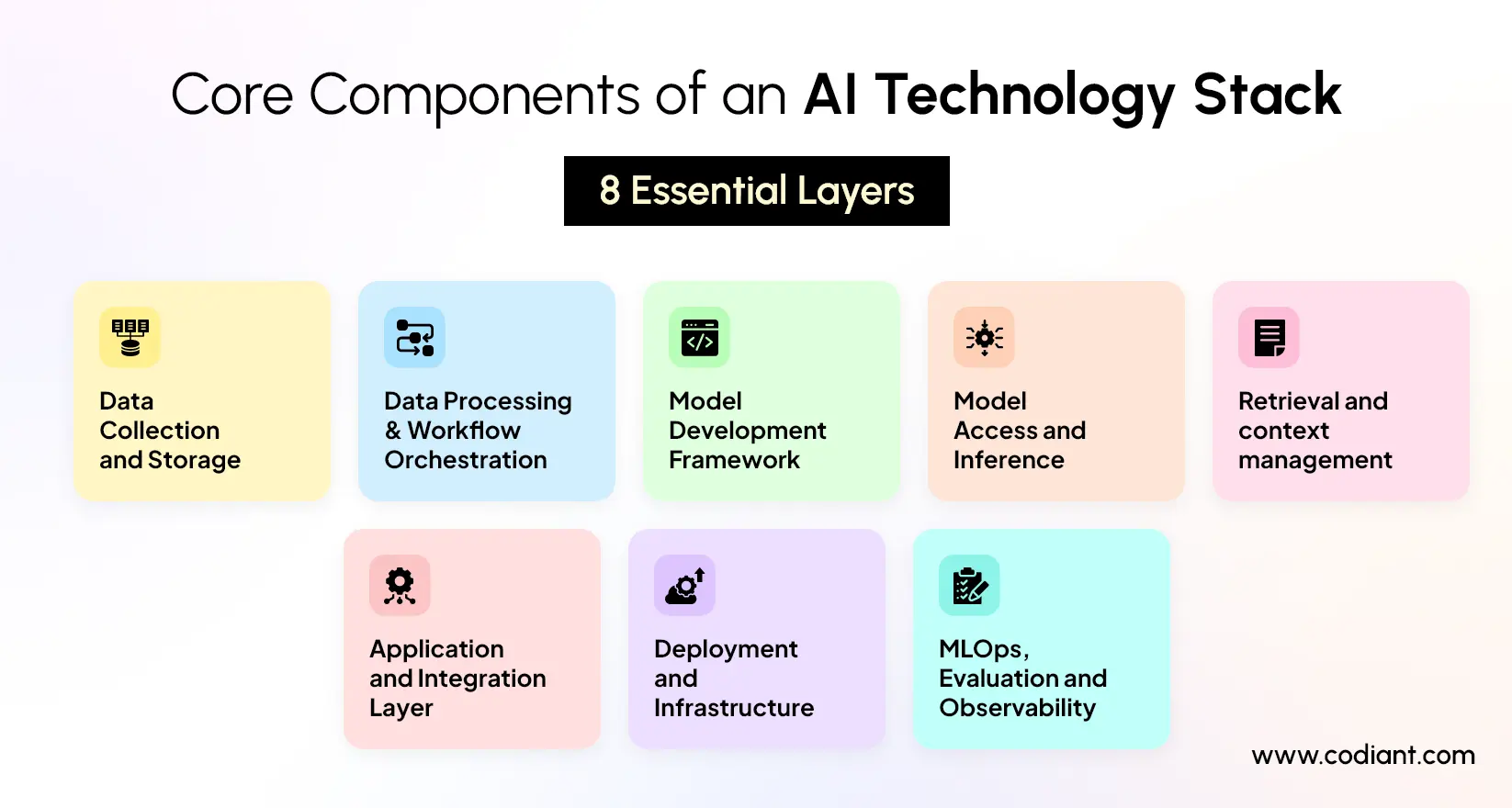
The core components of an AI technology stack are data infrastructure, model technologies, application services, deployment infrastructure, monitoring and governance. Each component supports a different stage of the AI software lifecycle.
1. Data collection and storage
AI systems require data for training, retrieval, evaluation, personalization, or real-time decision-making. The data layer may include:
- Relational databases for structured business records
- Document databases for flexible application data
- Object storage for files, images, audio and datasets
- Data warehouses for reporting and analytics
- Vector indexes for semantic retrieval
- Search engines for keyword and hybrid search
The database should be chosen according to the application’s data model and query patterns. A vector database is not automatically required simply because a product uses AI.
For example, a predictive sales model may work with structured warehouse data and require no vector search. A knowledge assistant that retrieves relevant passages from documents will normally require a retrieval index capable of searching embeddings.
2. Data processing and workflow orchestration
Raw data usually needs to be validated, cleaned, transformed, labelled, or divided into training and evaluation datasets. Generative AI applications may also need to extract text, divide documents into passages, generate embeddings, attach metadata and update search indexes.
Workflow tools can automate these processes. Apache Airflow represents workflows as directed acyclic graphs containing connected tasks. Apache Spark can process batch and streaming data across individual machines or clusters.
The appropriate choice depends on data volume and workflow complexity. A small application may use scheduled Python jobs. A larger enterprise AI stack may need distributed processing, retry logic, lineage, access controls and independent development environments.
3. Model development framework
An AI development framework provides the libraries and abstractions needed to train, fine-tune, evaluate, or run models.
Common options include:
- scikit-learn: Suitable for many classification, regression, clustering, pre-processing and model-selection tasks involving structured data.
- PyTorch: A deep-learning framework used to build and run models on CPUs and GPUs.
- TensorFlow and Keras: Tools for constructing and operating machine learning models across different environments.
- Hugging Face Transformers: A model-definition framework covering language, vision, audio, video and multimodal models.
The framework should follow the model requirements. Using a deep-learning framework for a problem that can be solved reliably with a simpler model may add unnecessary infrastructure, development time and operational complexity.
4. Model access and inference
AI software can access models in three main ways:
- Call a managed model through an API.
- Deploy an open or proprietary model on managed infrastructure.
- Operate a model on self-managed computing infrastructure.
Managed APIs can reduce the infrastructure needed for an initial product. Self-hosting can provide greater control over deployment, customization, data location and runtime behaviour, but it also creates responsibility for capacity planning, upgrades, security, scaling and monitoring.
The decision should consider output quality, latency, data sensitivity, expected usage, model availability, customization needs and total operating cost.
5. Retrieval and context management
Generative AI models do not automatically have access to current company data, internal policies, customer records or private documents. Retrieval-augmented generation addresses this limitation by retrieving relevant information from approved sources and providing it to the model as context before an answer is generated.
A retrieval layer may contain:
- Document loaders
- Text parsers
- Chunking logic
- Embedding models
- Vector or hybrid search
- Metadata filters
- Reranking models
- Access-control checks
- Source attribution
LangChain provides components for retrieval-based applications. LangGraph supports long-running, stateful workflows and agents in which steps and decisions are represented through connected nodes and shared state.
A simple question-answering tool may only need a defined retrieval pipeline. A multi-step agent that selects tools, pauses for approval, stores workflow state and recovers from failures may require more advanced orchestration.
6. Application and integration layer
The model is only one part of an AI product. Backend services must connect it with user interfaces, databases, business rules, third-party systems and authentication services.
This layer may handle:
- API requests
- User permissions
- Prompt and context assembly
- Business validations
- Tool execution
- Rate limits
- Caching
- Error handling
- Human approvals
- Response formatting
Critical actions should not depend only on unrestricted model output. Deterministic software rules should validate permissions, financial limits, required fields and other business conditions before an AI-generated action is executed.
7. Deployment and infrastructure
Docker packages an application and its required files, libraries and configuration into a container image. Kubernetes can deploy and scale containerized applications and supports the scheduling of GPU resources through device plugins.
AI infrastructure may include:
- CPUs for data processing and lighter models
- GPUs or other accelerators for demanding inference and training
- Autoscaling services
- API gateways
- Load balancers
- Queues
- Caches
- Secrets management
- Private networks
- Backup and disaster-recovery systems
Managed AI platforms can provide integrated environments for model development, training, deployment and governance. Self-managed containers may provide greater portability but require additional platform engineering.
8. MLOps, evaluation and observability
AI systems must be evaluated before release and monitored after deployment. Conventional application monitoring alone cannot determine whether a model’s output remains useful or correct.
MLflow provides functions for experiment tracking, dataset tracking, model evaluation, model registration, deployment and the evaluation of LLM and agent applications. Its model registry records model versions, metadata, aliases and lineage.
An effective monitoring layer should examine:
- Availability and error rates
- Response latency
- Token or computing usage
- Retrieval quality
- Model-output quality
- Failed tool calls
- User feedback
- Data or model drift
- Safety-policy violations
- Cost by feature, team, or customer
OpenTelemetry supports vendor-neutral collection of traces, metrics and logs. Prometheus provides systems monitoring, time-series metrics, queries and alerting capabilities.
What AI Development Frameworks Are Commonly Used?
PyTorch, TensorFlow, scikit-learn, Hugging Face Transformers, LangChain and LangGraph are commonly considered when building AI software. They solve different problems and should not be treated as direct substitutes.
| Framework | Best suited to | Important consideration |
| scikit-learn | Structured-data models and predictive analytics | Strong starting point for many conventional ML problems |
| PyTorch | Custom deep learning, language, vision and multimodal models | Requires appropriate deployment and model-operation planning |
| TensorFlow and Keras | Deep learning and structured production pipelines | Can be combined with TensorFlow Extended for ML pipelines |
| Hugging Face Transformers | Pretrained transformer models across multiple data types | Model size, licensing, hardware and deployment needs vary |
| LangChain | LLM application components, retrieval and tool integration | Additional abstractions should only be used when they add value |
| LangGraph | Stateful, multi-step workflows and AI agents | Best suited to workflows requiring control, persistence, or branching |
| MLflow | Experiment tracking, model registry, evaluation and lifecycle management | Must be integrated into the team’s release and governance process |
PyTorch, TensorFlow, scikit-learn and Hugging Face primarily support model development or use. LangChain and LangGraph focus more on generative AI application orchestration. MLflow supports the operational lifecycle around models and AI applications.
The best AI development framework is therefore the one that matches the problem. A tabular forecasting system may need scikit-learn but not LangGraph. A document-processing agent may use a foundation model, retrieval system, LangGraph workflow and MLflow evaluation without training a new model from the beginning.
What Is the Best Tech Stack for Generative AI Applications?
The best generative AI technology stack is a modular architecture that supports suitable models, controlled access to business data, reliable evaluation, secure integrations and observable production operations. The individual tools should be selected according to the use case rather than their popularity.
A practical generative AI stack may contain:
| Layer | Possible choice |
| User application | Web, mobile, chat, or business-system interface |
| Backend | Python, Java, Node.js, or an existing enterprise backend |
| Model access | Managed foundation-model API or self-hosted model |
| Retrieval | Embeddings, vector or hybrid search, metadata filters |
| Workflow | Application code, LangChain, LangGraph, or another orchestrator |
| Business data | PostgreSQL, MongoDB, search engine, warehouse, or approved APIs |
| Evaluation | Test datasets, automated checks, human review, MLflow |
| Deployment | Managed cloud endpoint, Docker, Kubernetes, or serverless services |
| Monitoring | Application telemetry, model-quality metrics, cost and safety tracking |
| Security | Identity, authorization, encryption, input controls, audit logs |
A retrieval-based assistant does not always need an autonomous agent. A predictable retrieval pipeline is usually easier to test and control when the task follows a fixed path. Agentic orchestration becomes more relevant when the system must decide which tools to use, maintain workflow state, retry operations, or request human approval.
Security must be designed into the stack from the beginning. The OWASP guidance for LLM applications covers risks such as prompt injection and other vulnerabilities that arise when models process untrusted content or interact with external tools. NIST’s AI Risk Management Framework provides a voluntary lifecycle approach for incorporating trustworthiness and risk management into AI systems.
How Does a Machine Learning Tech Stack Differ from a Generative AI Stack?
A machine learning tech stack primarily uses historical data to predict, classify, rank, detect, or forecast an outcome. A generative AI stack uses foundation models to create or transform content and may require prompts, retrieval, context management, safety controls and model-response evaluation.
| Area | Traditional machine learning | Generative AI |
| Main output | Score, class, forecast, recommendation | Text, image, audio, code, action plan |
| Typical data | Structured or labelled datasets | Documents, prompts, multimodal data, tool results |
| Common frameworks | scikit-learn, PyTorch, TensorFlow | Foundation models, Transformers, LangChain, LangGraph |
| Evaluation | Accuracy, precision, recall, error metrics | Task success, groundedness, relevance, safety, human review |
| Data access | Training and feature pipelines | Retrieval, context windows, memory, tool connections |
| Main risks | Drift, bias, data leakage, prediction error | Hallucination, prompt injection, unsafe actions, data exposure |
Many products combine both approaches. An e-commerce platform could use machine learning to rank products and generative AI to explain recommendations or answer product questions.
Also Read: How to Build a Generative AI Application: Process, Tech Stack, Cost, and Use Cases
How Should AI Software Architecture Be Designed?
AI software architecture should separate models, data access, workflow logic, business rules and user-facing services. This modular structure allows teams to change models or databases without rebuilding the complete product.
When AI must connect with older ERPs, CRMs, databases or on-premises applications, the architecture may also require APIs, containers, cloud services and hybrid integration layers. A phased approach to AI in legacy system modernization can introduce these capabilities without replacing every existing system at once.
A typical request may follow this flow:
- The user submits a request through the application.
- The backend authenticates the user and checks permissions.
- The workflow layer identifies the required task.
- The retrieval layer gathers permitted business context.
- The model produces a response or proposed action.
- Validation rules check the model output.
- A person approves high-risk actions where required.
- The response and operational telemetry are recorded.
The model gateway should isolate the rest of the application from a specific provider. Business data should be accessed through controlled services rather than embedded directly into prompts without permission checks. Model outputs should be treated as untrusted until the required validation has been completed.
For enterprise AI, this architecture also needs audit logs, model and prompt versions, data lineage, evaluation records, access policies, incident procedures and fallback behaviour.
Not Sure Which AI Technologies Fit Your Product Best?
Validate your AI architecture before investing in full-scale product development.
How Do Businesses Choose an AI Technology Stack?
Businesses should choose an AI tech stack by starting with the required outcome and working backwards to the minimum technologies needed to deliver it. The process should consider the use case, data, model strategy, operational requirements, security, team capabilities and long-term portability.
Step 1: Define the decision or task
Specify what the AI system must do.
Examples include:
- Classify customer messages
- Forecast inventory requirements
- Search internal documents
- Generate product descriptions
- Extract information from invoices
- Recommend next actions
- Automate a controlled business workflow
For cost-focused initiatives, each technology should be connected to a measurable source of operational waste, such as repetitive processing, preventable errors, excess resource use or delayed decisions. Common approaches to using AI to reduce operational costs include workflow automation, predictive planning, document processing and customer-support automation.
Define measurable success conditions before selecting tools. These may include accuracy, task-completion rate, response time, retrieval relevance, review effort, or cost per completed operation.
Step 2: Choose the simplest suitable model approach
Determine whether the problem requires:
- Rules and conventional software
- Traditional machine learning
- A managed foundation model
- Retrieval-augmented generation
- Fine-tuning
- A custom-trained deep-learning model
- A controlled AI agent
Not every automation problem requires generative AI. Not every generative AI application requires fine-tuning or autonomous agents.
Step 3: Assess the data environment
Review where the required information exists, how it is structured, who can access it and how often it changes.
Important questions include:
- Is the data structured, unstructured, or multimodal?
- Is enough reliable data available?
- Does the data contain personal or regulated information?
- Must information remain in a specific region?
- How will deleted or corrected records be updated?
- Does each user have different access rights?
- Is real-time data required?
The answers influence the database, retrieval model, hosting environment and security architecture.
Step 4: Define non-functional requirements
The stack must support more than model quality. Record requirements for:
- Response latency
- Concurrent usage
- Availability
- Recovery time
- Data residency
- Explainability
- Auditability
- Accessibility
- Integration methods
- Operational cost limits
A model that performs well in a notebook may not satisfy the response time, cost, or reliability requirements of production software.
Step 5: Evaluate team skills and operational capacity
Choose AI software development tools that the team can operate after launch. Introducing multiple new languages, frameworks, databases and cloud services at once increases maintenance requirements.
Evaluate whether the organization can manage:
- Model releases
- Prompt and evaluation changes
- Data pipelines
- GPU infrastructure
- Security patches
- Incident response
- Monitoring
- Vendor changes
Managed services may reduce infrastructure work. Self-managed technologies may provide greater control but require stronger platform capabilities.
Businesses without in-house expertise across model development, data engineering, integrations, security and MLOps can use AI development services to assess technical feasibility and define a suitable implementation architecture before committing to a production stack.
Step 6: Compare deployment and security options
Determine whether the software will run in a public cloud, private cloud, on-premises environment, edge device, or hybrid architecture.
For generative AI and agentic applications, conduct a threat assessment covering untrusted prompts, retrieved content, excessive tool permissions, sensitive-data exposure, insecure outputs and third-party dependencies.
Step 7: Test the architecture through a pilot
Build a focused vertical slice that includes real data, model access, application integration, evaluation and monitoring. Do not test only the model in isolation.
The pilot should answer:
- Can the system meet the required quality?
- Is the latency acceptable?
- Which errors occur repeatedly?
- Can the output be evaluated consistently?
- Does the architecture enforce data access?
- What is the operating cost under realistic usage?
- Can the team troubleshoot failures?
Adopt the broader enterprise AI stack only after these questions have been answered.
Which Cloud Platforms Support AI Development?
AWS, Microsoft Azure and Google Cloud provide managed platforms for building and operating AI solutions. Businesses can also deploy AI workloads on Kubernetes or other self-managed infrastructure.
| Platform | Relevant capabilities |
| Amazon SageMaker AI | Managed environments for building, training and deploying machine learning models |
| Microsoft Foundry | Enterprise platform for model access, AI application development, agents, operations and governance |
| Google Cloud Gemini Enterprise Agent Platform | Model, agent, machine learning, deployment and governance capabilities; the platform was formerly associated with the Vertex AI name |
| Kubernetes | Portable orchestration for containerized workloads, including support for scheduling GPU resources |
Official documentation describes SageMaker AI as a managed service for building, training and deploying models. Microsoft Foundry provides an integrated platform for AI application and agent development. Google Cloud’s current platform supports models, training, deployment, agents and enterprise governance.
Cloud selection should consider existing infrastructure, identity systems, data location, team expertise, model availability, commercial terms and integration requirements. A multicloud architecture should only be adopted when its business value justifies the additional operational complexity.
What Databases Are Commonly Used in AI Solutions?
AI solutions commonly use relational databases, document databases, object storage, search engines, data warehouses and vector databases. Several database types may be used within one product because they support different data and query requirements.
Common options include:
- PostgreSQL: Structured application data, transactions, metadata and vector search through extensions such as pgvector.
- MongoDB: Flexible document data and vector search stored alongside application records.
- Elasticsearch: Full-text, filtered, vector and hybrid search.
- Pinecone: Managed vector indexing and retrieval for AI applications.
- Object storage: Large files, datasets, documents, model artefacts, images, audio and video.
- Data warehouse or lakehouse: Historical analytics, reporting, model features and large-scale processing.
pgvector adds vector-similarity search to PostgreSQL. MongoDB Vector Search can query embeddings alongside document data. Elasticsearch combines vector search with text search, filters and aggregations. Pinecone provides managed vector and hybrid retrieval capabilities.
A dedicated vector database may be appropriate when vector retrieval is a central workload and requires independent scaling. An existing PostgreSQL, MongoDB, or Elasticsearch environment may be simpler when it already meets the required performance, filtering, operational and governance needs.
The decision should be tested with representative data. Vector count, embedding size, filtering requirements, update frequency, acceptable latency, backup needs and operational skills can all affect the result.
How Can Businesses Future-Proof Their AI Technology Choices?
Businesses can future-proof an AI stack by using modular interfaces, portable deployment methods, versioned assets, open telemetry and documented replacement plans. Future-proofing does not mean predicting which model or framework will dominate. It means reducing the cost of change.
The following practices improve adaptability:
- Separate model access from business logic. Use a model gateway or internal interface so the application is not tightly coupled to one provider.
- Version models, prompts, datasets and evaluations. A production response should be traceable to the assets and configuration that produced it.
- Use containers where appropriate. Container images package applications and dependencies in a consistent format that can run across supported environments.
- Prefer interoperable formats when they meet the use case. ONNX provides an open model format intended to improve interoperability across frameworks, tools, runtimes and compilers.
- Adopt vendor-neutral telemetry. OpenTelemetry can collect and export traces, metrics and logs to different monitoring backends.
- Manage infrastructure as code. Terraform allows infrastructure resources to be declared, changed and versioned through configuration.
- Maintain an exit plan. Record how models, embeddings, indexes, prompts, data and logs could be transferred or rebuilt.
- Review the stack regularly. Reassess model quality, vendor support, licences, security updates, operating costs and internal skills before renewing major commitments.
Future-proofing may still involve choosing a single cloud or model provider. The objective is not to eliminate every dependency. It is to understand each dependency and prevent unnecessary coupling.
Common AI Tech Stack Mistakes to Avoid
The most common mistake is choosing tools before defining the problem. This often produces a complex architecture that is expensive to operate but does not improve the final outcome.
Other mistakes include:
- Using generative AI when rules or conventional ML would work
- Adding an agent framework to a fixed, predictable workflow
- Selecting a vector database without testing retrieval requirements
- Ignoring permissions during document retrieval
- Evaluating only a few demonstration prompts
- Tracking infrastructure uptime but not model-output quality
- Launching without fallback or human-review procedures
- Depending on one model without documenting replacement options
- Allowing experimental code to become the production architecture
- Adding more tools than the team can securely maintain
The strongest stack is not the one with the most AI engineering tools. It is the smallest architecture that can reliably satisfy product, security, scale and governance requirements.
How Codiant Helps Businesses Build the Right AI Tech Stack?
Choosing an AI tech stack requires more than comparing tools, models, or cloud platforms. It involves evaluating business goals, data readiness, security needs, integration complexity, deployment environment, scalability expectations and long-term operating costs.
Codiant helps businesses assess these requirements and define an AI architecture that fits the actual software use case. The process may include technology consulting, data pipeline planning, model selection, retrieval design, cloud architecture, system integration, MLOps setup and governance planning.
This support is useful for companies building predictive analytics platforms, generative AI applications, enterprise knowledge assistants, computer vision systems, or controlled AI agents. A structured approach helps reduce tool overload, avoid vendor lock-in and ensure the selected stack can move from pilot to production with fewer operational risks.
Key areas of support include:
- AI feasibility assessment and architecture planning
- Model, framework and cloud platform selection
- Data pipeline and retrieval system design
- AI integration with existing software and APIs
- MLOps, monitoring and evaluation setup
- Security, governance and scalability planning
The goal is to create an AI technology stack that is practical, secure, scalable and easier to maintain as business needs and AI technologies continue to evolve.
Conclusion
Choosing an AI tech stack begins with understanding the software problem, not selecting a model or framework. The right stack must support the required data, model behaviour, integrations, security controls, operating scale and evaluation process.
Start with the smallest architecture that can prove the use case. Test it with realistic data and production conditions. Add more AI development technologies only when a measurable product, security, or operational requirement justifies them.
Turn Your AI Idea into Production-Ready Software Faster
Build secure, scalable AI solutions with the right technology foundation.
The Author

Frequently Asked Questions
The core components are data storage and processing, model development or access, application integration, deployment infrastructure, evaluation, monitoring and governance. Generative AI systems may also require embeddings, retrieval, prompt management, workflow orchestration and model-safety controls.
The stack determines how efficiently the application can process data, serve models, handle concurrent requests and monitor failures. Scalability depends on the complete architecture, including databases, queues, caches, model endpoints, computing resources and data pipelines, rather than the model alone.
AWS supports AI development through services including Amazon SageMaker AI. Microsoft provides Microsoft Foundry, while Google Cloud provides the Gemini Enterprise Agent Platform. AI workloads can also be deployed through Kubernetes or privately managed infrastructure when greater operational control is required.
Common choices include PostgreSQL, MongoDB, Elasticsearch, data warehouses, object storage and managed vector databases such as Pinecone. The correct database depends on whether the system requires transactions, document storage, analytics, semantic search, keyword search, metadata filtering, or a combination of these capabilities.
Businesses should separate models from business logic, use versioned interfaces, containerize suitable services, record model and data lineage and adopt portable observability standards. They should also document how models, data, indexes and infrastructure could be replaced if technical or commercial requirements change.
Featured Blogs
Read our thoughts and insights on the latest tech and business trends

HIPAA-Compliant App Development in 2026: How to Build Securely and Avoid Preventable Fines
- September 4, 2026
- Mobile App Development
HIPAA-compliant app development in 2026 requires six foundations: complete ePHI mapping, documented risk analysis, role-based access, encryption, signed business associate agreements, and continuous security monitoring. This matters most to healthcare CTOs, product leaders, and compliance... Read more
AI Developer Engagement Models Explained: How to Choose the Right AI Team
- August 27, 2026
- Artificial Intelligence
AI developer engagement model means deciding how external AI specialists will be assigned, managed, paid and held accountable. The main options are dedicated AI developers, AI team augmentation, time-and-material delivery, fixed-price projects and end-to-end AI... Read more

Enterprise Mobile App Development: How It Can Accelerate Your Business Growth
- August 21, 2026
- Mobile App Development
Enterprise mobile app development can accelerate growth by improving three measurable areas: workflow speed, access to business systems, and customer or employee service delivery. This matters to mid-market and enterprise leaders managing distributed teams, manual... Read more