How Year-End Engagements with a Dedicated Dev Team Can Accelerate Your 2026 Roadmap at a Lower Cost
Table of Contents
Subscribe To Our Newsletter

In a Nutshell
- Year-end is the strongest window to add development capacity, clear backlogs, and prepare your 2026 roadmap without overwhelming in-house teams.
- Dedicated development teams accelerate delivery, reduce sprint delays, and help companies ship features faster through parallel workflows and predictable execution.
- Cost savings are significant; offshore teams reduce expenses by 40–60% while eliminating HR, hiring, infrastructure, and overhead costs.
- Q4 offers better onboarding speed, discounted engagement packages, and easier availability of skilled developers due to reduced global hiring competition.
- Dedicated teams improve product stability by resolving technical debt, optimizing performance, enhancing UI/UX, and preparing architectures for 2026 scalability.
- Startups, SaaS companies, enterprises, and regulated industries benefit from year-end developer engagement to accelerate MVPs, migrations, compliance updates, and upcoming launches.
- Choosing the right dedicated team ensures long-term continuity, clear communication, secure development, and scalable capacity aligned with 2026 goals.
- Codiant helps accelerate 2026 plans with reliable dedicated teams, multi-skill engineering support, and structured workflows that reduce cost and speed up delivery.
As Q4 approaches, most product and engineering teams shift into planning mode. Budgets are finalized, pending features are pushed toward release, and the focus quietly turns to shaping what the 2026 roadmap will look like.
But with in-house teams already stretched across ongoing development, support requests, and maintenance work, it becomes difficult to close the year strong while also preparing for a fast start in January.
This is where year-end software development engagement models are becoming a practical choice. Companies are starting to bring in dedicated development teams to clear backlogs, accelerate feature upgrades, complete integration work, and support new product initiatives without overloading internal teams or increasing long-term hiring costs.
By hiring dedicated developers for 2026 in Q4 itself, businesses gain additional capacity, predictable costs, and the momentum needed to enter the new year with a cleaner slate and a faster build path.
Why Year-End Is the Best Time to Engage a Dedicated Dev Team?
Year-end is one of the most practical periods for bringing a dedicated development team into your product pipeline.
It’s the time when businesses naturally lean toward engaging dedicated teams at the end of the year because it aligns with budget cycles, reduced competition, and the urgency to finalize tech plans before the next year begins.
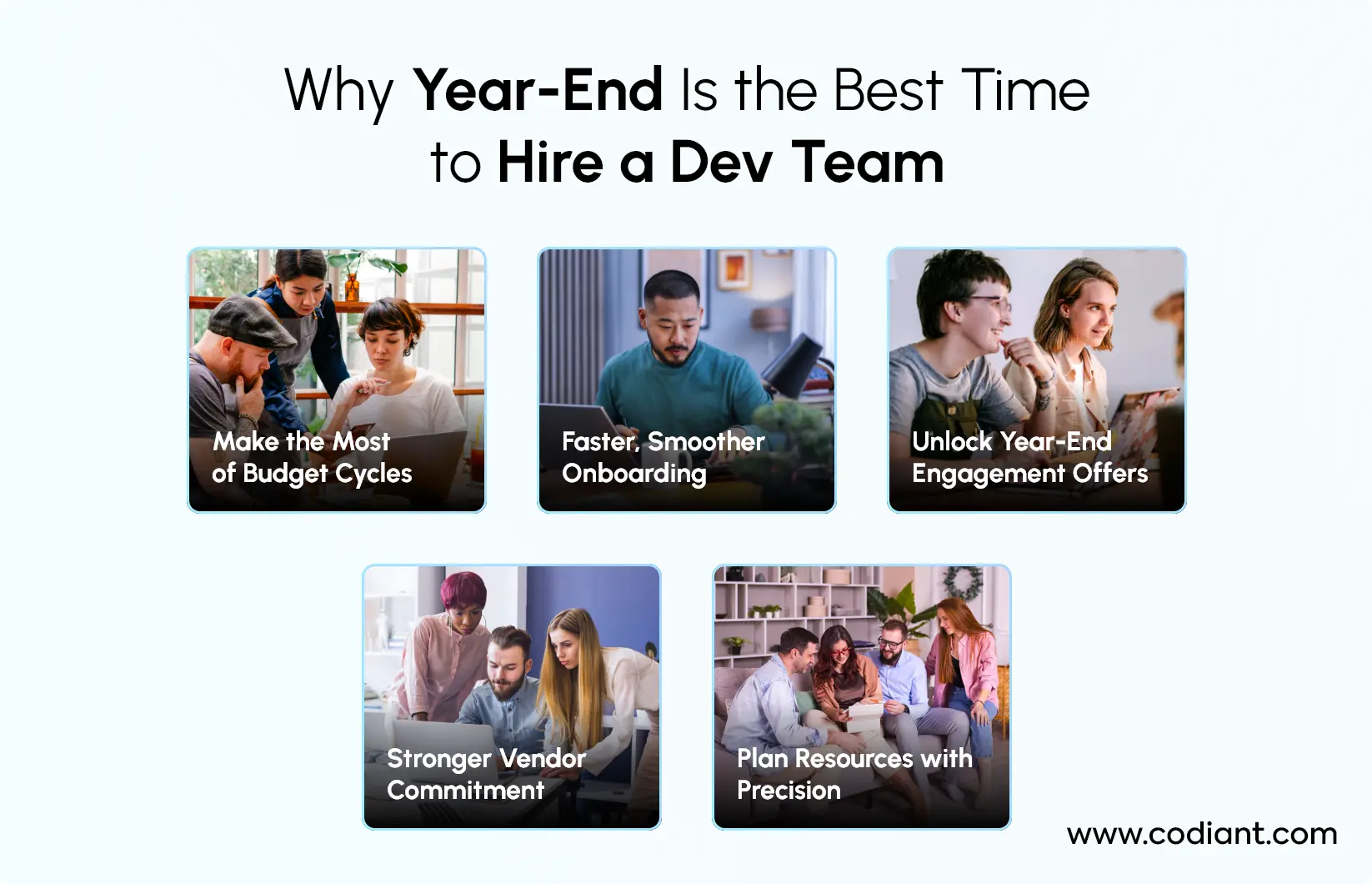
Many companies wrap up Q4 with unused budget allocations, creating a good opportunity to invest in engineering work that directly strengthens their 2026 roadmap.
Instead of letting these funds expire, product leaders use them to clear technical debt, complete pending modules, or begin new initiatives ahead of schedule.
A second advantage is reduced competition. Hiring slows down across most industries in Q4, making it easier and faster to onboard an offshore development team for startups without lengthy wait times or bidding wars.
Some key year-end benefits include:
- Budget Utilization: Unspent annual budgets can be directed into development work that accelerates your 2026 goals.
- Faster Onboarding: Fewer companies are hiring during Q4, so vendor teams typically have better availability.
- Q4 Engagement Offers: Many agencies share discounted packages, trial extensions, or bundled services to support year-end planning.
- Stronger Vendor Alignment: Service providers are finalizing contracts and resource allocations for the new year, ensuring quicker responses and clearer commitments.
- Better Resource Planning: Year-end makes year-end tech resource planning more structured, predictable, and aligned with next-year targets.
Above all, engaging a team in Q4 isn’t a rushed decision it’s a strategic move, rooted in why businesses prefer dedicated teams at the end of the year. It positions your product to start 2026 with momentum, stable staffing, and well-managed development costs.
Kickstart Your 2026 Roadmap Today
Start building momentum early with a dedicated team ready to accelerate your year-end development plans.
Key Benefits of Hiring a Dedicated Development Team for Your 2026 Roadmap
Achieving your 2026 roadmap requires more than strategic planning it needs consistent engineering capacity, predictable spending, and the ability to ship features without delays.

This is why year-end engagement has become especially advantageous for startups, who often need rapid development support without the financial burden of expanding an in-house team. A dedicated development team brings long-term stability, accelerates delivery, and creates room for innovation without increasing fixed payroll.
Here is how a dedicated development team strengthens your roadmap for 2026.
1. Faster Sprint Cycles for New Features
When engineering teams are overloaded, sprint velocity slows down and backlog items keep stacking up. A dedicated team adds instant capacity, helping you deliver faster without compromising quality. This is one of the reasons startups benefit significantly from year-end engagements, they gain immediate bandwidth to release features at a pace that keeps them competitive.
What this unlocks:
- More engineers working in parallel across modules and features
- Faster backlog clearance and shorter time between releases
- The ability to run parallel sprints for new features, tech upgrades, and fixes
- Predictable delivery cycles even when internal bandwidth is limited
Faster sprints directly translate to an accelerated 2026 roadmap.
2. Predictable, Lower Development Costs
One of the biggest advantages of a dedicated team model is cost predictability. You get a fixed pricing structure without the overheads of hiring full-time employees. This is where startups gain even more value from year-end engagement, as they can access top-tier engineering talent without stretching their funding cycles.
Cost benefits include:
- No recruitment, onboarding, HR, or training expenses
- No infrastructure or equipment cost
- Fixed monthly or hourly pricing that keeps budgets on track
- Lower long-term cost compared to in-house developers in high-salary markets
This helps maximize your development budget while keeping the roadmap realistic and financially controlled.
3. Seamless Integration with In-House Teams
Modern dedicated teams operate like an extension of your internal engineering unit. They follow your processes, adopt your communication style, and blend into your workflows. For startups that need fast-moving execution without building large teams internally, year-end engagement provides a plug-and-play talent model that integrates without friction.
Integration advantages:
- Alignment with your sprint cadence, code standards, and review process
- Transparent daily communication and shared task ownership
- Shared tools (Jira, GitLab, Slack, etc.) for smooth collaboration
- Zero friction between internal and external contributors
This allows you to scale development without creating operational silos.
4. Domain Expertise for Long-Term Projects
Long-term projects, such as rebuilding legacy systems, expanding a SaaS product, or launching a multi-phase platform, need consistent contributors who fully understand the product. For startups that may not yet have senior architects or specialists, year-end dedicated teams offer domain expertise that accelerates strategy and reduces trial-and-error.
Why domain expertise matters:
- Less time spent on knowledge transfer
- Better architectural decisions and long-term planning
- Lower risk of disruptions caused by team rotation
- Strong continuity across releases, updates, and refactors
A stable dedicated team ensures your 2026 roadmap evolves without quality dips or lost context.
5. Full Control, Visibility, and Communication
A dedicated team is not a “black box” vendor model—you manage them directly, giving you the clarity and oversight you need to move fast. Startups especially benefit here, since year-end engagements give them enterprise-level visibility without enterprise costs.
What you gain:
- Daily standups and real-time progress updates
- Direct communication with developers, QA, designers, and leads
- Full access to sprint dashboards, reports, and code repositories
- Complete clarity on timelines, dependencies, and blockers
This transparency helps prevent delays and keeps your roadmap aligned with business priorities.
6. Dedicated Team vs. In-House Developers – What You Gain
Hiring in-house talent is ideal for core roles, but it’s slower, costlier, and harder to scale. A dedicated team fills the gaps without slowing down momentum.
Why companies prefer dedicated teams for 2026:
- Faster onboarding compared to traditional hiring
- Ability to scale up or down based on project needs
- Access to multi-disciplinary talent (frontend, backend, QA, DevOps, UI/UX)
- Lower total cost of ownership than in-house teams
- No long-term liabilities like benefits or full-time salaries
For companies aiming to accelerate their 2026 roadmap, this flexibility becomes a major competitive advantage.
Partner with a Team You Can Count On.
Add a high-performing dedicated development team from Codiant and accelerate your roadmap without added hiring pressure.
How Year-End Engagements Accelerate Your 2026 Product Roadmap
Understanding how to accelerate your 2026 product roadmap starts with recognizing a common challenge: most teams enter Q4 with more pending work than they expected. Backlogs grow, feature releases shift, and technical debt expands quietly. This is why hiring a dedicated development team becomes one of the most reliable ways to accelerate a company’s roadmap, especially when internal teams are stretched thin during the final quarter.
Year-end engagements give companies instant access to skilled developers who can take over tasks the in-house team cannot prioritize during peak months. This added bandwidth ensures you walk into 2026 with a cleaner pipeline, stronger momentum, and far fewer delays.
Clear Backlogs Before They Slow Down 2026
Throughout the year, several tasks get deprioritized—small enhancements, bug fixes, UI tweaks, integration cleanups. Q4 is the ideal opportunity to resolve them. A dedicated development team is often brought in at this stage specifically because businesses want to launch new features faster and avoid backlog overload going into the next year. Dedicated developers help clear:
- Pending feature improvements
- Long-standing bugs
- UI inconsistencies
- Minor workflow refinements
- API refactoring or cleanup
This ensures the backlog doesn’t carry forward into your 2026 roadmap.
Prepare Early for Q1 2026 Releases
Many companies use year-end capacity to get ahead of next year’s targets. Dedicated teams help accelerate:
- Module completion
- Performance optimizations
- Code stability improvements
- Security hardening
- Release readiness checks
This prevents Q1 from becoming a fire-fighting period and instead sets up teams for smoother launches.
Also read: How to Hire a Dedicated Development Team? All You Need to Know
Remove Technical Debt Before It Gets Expensive
Rather than carrying outdated libraries and legacy components into 2026, businesses use Q4 capacity to clean up:
- Out-of-date dependencies
- Slow-performing modules
- Inconsistent coding standards
- Unoptimized queries
- Deprecated API versions
This is one of the key reasons’ businesses engage dedicated teams at the end of the year. It’s the last window to fix technical debt before it becomes costly or blocks next year’s development.
Upgrade Architecture & Improve Scalability
Dedicated developers can support tasks that require deeper engineering focus, such as:
- Cloud optimization
- Database restructuring
- Containerization
- Modularizing legacy components
- Performance tuning
These improvements align with how a dedicated team helps accelerate long-term product scalability, especially when companies need faster delivery and cleaner architecture going into 2026.
Refresh UI/UX for a Smoother 2026 Experience
Q4 is ideal for polishing experiences that often get overlooked:
- Onboarding flow improvements
- Dashboard redesigns
- Accessibility updates
- Mobile screen refreshes
- Navigation simplification
Refining UI/UX early reflects a broader trend: startups and enterprises alike see year-end engagements as a way to elevate product quality before next year’s growth cycle begins.
Strengthen APIs, Integrations & Infrastructure
Year-end engagements also help teams modernize their technical landscape. Dedicated developers can work on:
- New API integrations
- Fixing unstable endpoints
- Infrastructure upgrades
- CI/CD improvements
- Removing legacy connectors
These upgrades directly support the reality that a dedicated development team helps companies launch new features faster and maintain stability during high-growth phases.
Cost Advantages: Why Year-End Dedicated Teams Are More Affordable
Companies exploring affordable dedicated dev team services often find that Q4 delivers the best financial value. The combination of global talent availability, flexible contracts, and vendor-side incentives makes year-end the ideal window to scale development without stressing budgets.
In fact, many organizations choose this route specifically because hiring a dedicated development team is far more cost-effective than maintaining in-house talent, both in the short and long term.
Engaging offshore partners immediately lowers overall expenditure. Businesses can reduce development cost with offshore teams by 40–60%, thanks to global cost arbitrage and the elimination of infrastructure and tooling expenses.
Offshore teams already operate with fully equipped setups, which removes the need for additional hardware, software, or licenses on the client side.
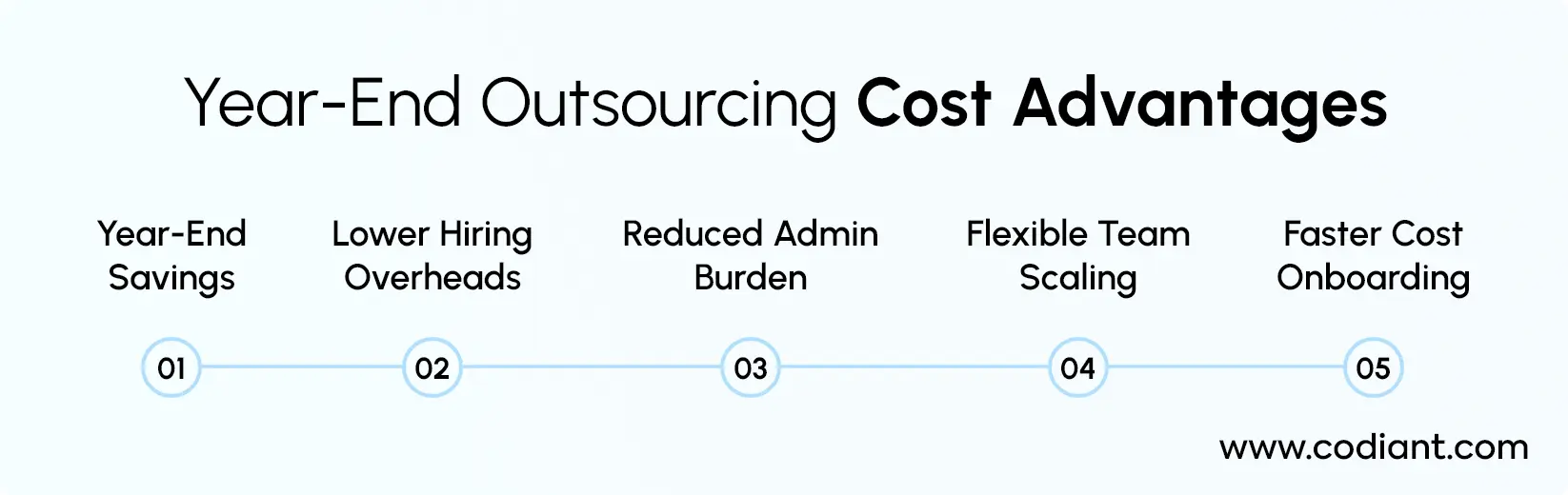
Major cost advantages include:
- Year-end promotional pricing: Vendors offer discounted rates or bundled hours to secure commitments before Q1.
- Lower overhead compared to in-house hiring: No full-time salaries, insurance, benefits, or office costs.
- Fewer HR and compliance expenses: Dedicated teams are managed by the service provider, reducing administrative burden.
- Pay-as-you-scale flexibility: Scale the team up or down based on workload without long-term employment obligations.
- Faster onboarding: Saves time and cost associated with lengthy recruitment cycles.
Another significant benefit is operational predictability. When you save development costs with a dedicated team, you gain a stable monthly pricing model with no hidden charges – allowing better planning for your 2026 roadmap.
Since teams are pre-aligned with agile structures, sprint execution becomes smoother, reducing delays and preventing cost overruns.
Overall, year-end engagements give companies cost efficiency and agility at the same time. By locking in experienced developers early, businesses maximize savings, accelerate backlog clearance, and enter 2026 with a stronger, more affordable development engine.
Slash Your 2026 Development Budget Today
Unlock massive savings and faster delivery by onboarding a high-performance dedicated dev team before year-end.
Use Cases: How Companies Use Year-End Dedicated Teams to Accelerate Projects
Year-end development engagements often become a turning point for companies aiming to enter the new year with a cleaner codebase, faster releases, and a more stable product foundation. Many organizations rely on these teams because a dedicated development team can indeed help launch new features faster, especially when internal bandwidth is limited or product timelines are aggressive.
Here are practical, real-world scenarios where dedicated teams help product leaders move quickly and reduce costs—without slowing down internal engineering workflows.
1. Startups preparing MVPs for a Q1 launch
Many early-stage startups use an offshore development team for startups to speed up their MVP build when internal capacity is limited. Year-end is ideal because founders can lock in talent quickly, accelerate sprints, and ensure product demos, investor pitches, or beta launches are ready for January or February.
This reduces time-to-market at a stage where speed directly impacts competitive advantage.
2. SaaS companies clearing technical debt before 2026
Established SaaS teams often carry legacy modules, performance issues, or long-pending refactors. Dedicated developers help them clear technical debt that in-house teams don’t have bandwidth for.
By December, companies can resolve bottlenecks, improve load times, rewrite outdated code, and enter 2026 with a stronger, more scalable product.
3. Enterprises migrating legacy systems
Large enterprises use Q4 for upgrading older systems because it’s easier to allocate budget and schedule downtime. Dedicated teams support migrations to modern stacks, rebuild internal dashboards, or integrate cloud infrastructure – without overburdening internal IT teams.
4. E-commerce brands stabilizing platforms for the next year
Retail and D2C brands rely on dedicated engineers for performance tuning, checkout optimization, security updates, and backend cleanup after festive traffic. This ensures they start the next year with a stable, high-performing platform ready for new campaigns.
5. FinTech and Healthtech firms expanding compliance features
Industries with strict regulations often use year-end teams to add compliance workflows, audit logs, encryption layers, and reporting modules. Dedicated developers help complete these updates on time, ensuring the product meets new year compliance deadlines.
How to Choose the Right Dedicated Developers for Long-Term Projects
Choosing the right dedicated developers for long-term projects is a strategic decision that impacts your delivery speed, product stability, and overall 2026 roadmap. Companies also evaluate what skills a dedicated development team can provide for 2026 projects, since the right mix of backend, frontend, cloud, DevOps, QA, and architectural expertise determines how efficiently the roadmap can be executed. The goal is to bring in a team that understands your product vision and can stay aligned with it as the workload grows.
Start with portfolio evaluation. Real projects, code samples, and relevant industry experience reveal whether the team can handle the complexity your product demands. Technical depth is equally important your roadmap may require backend expertise, API development, mobile skills, cloud deployments, automation, or strong QA coverage.
Beyond skills, communication habits often determine project success. A dedicated team that provides structured updates, overlaps time zones, and maintains transparent workflows reduces friction. Security practices should also be non-negotiable, especially if you’re dealing with sensitive data or enterprise compliance.
What to assess when choosing a long-term dedicated team:
- Proven portfolio with similar project types
- Clear technical strength across required technologies
- Reliable communication and time zone compatibility
- Strong security and access-control standards
- Ability to scale team capacity as roadmap expands
- Alignment with long-term product goals
- Stable team members who stay throughout the engagement
A team that checks these boxes will support your roadmap with consistency, speed, and predictable delivery throughout 2026.
Dedicated Team vs In-House Developers: What Works Better in 2026?
As companies prepare for 2026, the dedicated team vs in-house developers question becomes more important and understanding which industries benefit most from dedicated teams helps shape that choice. Sectors like SaaS, FinTech, Healthtech, e-commerce, logistics, and enterprise software increasingly rely on dedicated teams because they need rapid scaling, consistent delivery, and specialized expertise that is difficult to hire internally at short notice.
In-house teams provide tighter control and deep product knowledge but require significant investment in hiring, training, infrastructure, and retention. Scaling them quickly is challenging, especially during fast-moving market cycles.
Dedicated teams offer flexibility. They help you bring in specialized talent instantly, avoid fixed overheads, and accelerate release cycles without long hiring delays. For companies targeting aggressive 2026 milestones, using a dedicated team often results in faster execution at a lower operational cost.
Key differences that matter in 2026:
- Cost: In-house = high fixed costs; dedicated = predictable monthly cost
- Flexibility: Dedicated teams scale up/down faster
- Time-to-market: Dedicated teams start immediately with ready expertise
- Specialized skills: Easier to access niche experts through a vendor
- Long-term scaling: Hybrid approach often works best for complex roadmaps
Most companies find that combining both models internal ownership + external acceleration delivers the strongest competitive advantage.
Checklist for Year-End Tech Resource Planning
Effective year-end tech resource planning helps teams close Q4 smoothly and start 2026 with full momentum. Planning ahead prevents delays, reduces backlog pressure, and ensures your development cycle stays predictable when the new year begins.
Many companies follow a structured approach because planning a 2026 roadmap with external development teams requires clear visibility into what must be completed now and what needs extended capacity next year.
Start by reviewing all open tasks unresolved bugs, performance issues, pending features, migration needs, or areas where internal teams are stretched thin. Then, check your 2026 roadmap and identify where additional development capacity will be required early in the year.
A practical year-end planning checklist:
- Identify all Q4 pending tasks that must be closed
- Audit upcoming 2026 priorities and release timelines
- Pinpoint internal skill gaps slowing the team down
- Review remaining budgets and allocate for a year-end engagement
- Choose the right engagement model (dedicated team, partial extension, sprint support)
- Begin onboarding before holiday slowdowns to avoid January bottlenecks
This approach ensures you enter 2026 with a clear plan, the right team strength, and no last-minute operational stress.
Related reading: How Much Does It Cost to Hire a Dedicated Developer in 2026
How Codiant Can Help You Accelerate Your 2026 Roadmap?
Codiant supports businesses with dedicated development teams that blend speed, expertise, and cost efficiency.
Our certified developers integrate seamlessly into your workflows, strengthen your engineering capacity, and help you clear backlogs, build new features, modernize systems, and prepare your 2026 roadmap without disrupting ongoing operations.
With flexible engagement models, structured communication, and 24/7 availability across time zones, we ensure faster delivery at a significantly lower cost.
Companies rely on Codiant for long-term product development, architecture upgrades, QA automation, DevOps support, and year-end project acceleration that keeps their product pipeline moving smoothly into the new year.
Conclusion
Year-end is the most strategic window to accelerate pending projects, eliminate bottlenecks, and enter 2026 with a fully prepared product roadmap. Engaging a dedicated development team now gives companies the speed, stability, and specialized talent needed to execute faster while significantly reducing development costs.
With the right team in place, you can clear technical debt, scale features, and strengthen your product foundation before Q1 begins.
If you’re planning to build your 2026 roadmap with dedicated developers, now is the ideal time to explore engagement options. Speak to our experts to plan your resource requirements and get started effortlessly.
Supercharge Your 2026 Product Goals
Accelerate development, strengthen delivery, and reduce costs with a dedicated team ready to scale instantly.
The Author

Frequently Asked Questions
Year-end brings better pricing, quicker availability, budget flexibility, accelerated onboarding, and an ideal opportunity to prepare products and systems before 2026 development cycles begin.
Dedicated teams cut expenses by offering predictable pricing, offshore cost savings, faster delivery cycles, fewer hiring overheads, and optimized resource allocation aligned with 2026 priorities.
Engagement includes full-time developers, project management, sprint planning, documentation, QA support, communication tools, continuous delivery, and scalable resources aligned with long-term product goals.
Most teams can onboard within days, begin knowledge transfer immediately, finalize sprint plans, and start executing 2026 roadmap tasks rapidly without affecting existing operations.
Consider technical expertise, communication style, time zone alignment, scalability, cost structure, security practices, process maturity, and the team’s ability to support long-term product goals.
Featured Blogs
Read our thoughts and insights on the latest tech and business trends

List of Top AI Agent Development Companies in the USA (2026 Guide)
- March 5, 2026
- AI Agent
In a Nutshell AI agents are the next evolution of automation, going beyond chatbots to perform real business tasks. They can understand intent, connect with tools, and execute multi-step workflows across teams. Businesses are increasingly... Read more

Hire Custom Software Developers in UAE for Secure and Scalable Enterprise Solutions
- February 27, 2026
- Digital Transformation Staff Augmentation
In a Nutshell UAE enterprises are shifting toward custom software because off-the-shelf tools fail to meet complex workflows and regional compliance needs. Custom enterprise software includes ERP modernization, automation systems, secure portals, analytics dashboards, and... Read more

Top 20+ PHP Development Companies in United States (2026)
- February 24, 2026
- Web Development
PHP is one of the most reliable and popular programming languages in the world used for developing dynamic, customizable, secure and affordable web applications. In 2026, SaaS, eCommerce, healthcare, fintech and logistics companies along with Enterprise... Read more