How to Build an AI-Powered Queue Management System in Dubai, UAE
Table of Contents
Subscribe To Our Newsletter
Dubai has been steadily moving toward faster, more efficient public and private services, and this shift has increased the need for systems that reduce waiting time and improve customer flow.
With rising footfall across government centers, hospitals, retail stores, airports, banks, and telecom branches, businesses now look for practical ways to manage queues without adding more staff or expanding physical space. This is where an AI queue management system UAE is becoming relevant.
Instead of relying on traditional token counters or manual coordination, organizations are adopting smart queue management Dubai solutions that streamline the entire journey – from entry and registration to counter assignment and service completion.
These systems use real-time data and automated decision-making to predict waiting times, distribute workloads, and guide customers smoothly through each step.
In this blog, we explore how AI-powered queue system development works, what industries benefit the most, and how businesses in Dubai can build a modern, scalable solution that aligns with the city’s vision for smarter, faster, and more connected services.
What Is an AI-Powered Queue Management System?
An AI-powered queue management system is a modern digital solution that organizes and manages customer flow without relying on physical lines or manual token slips. Unlike traditional token-based systems, which simply issue numbers and require staff to manage queues manually, an AI virtual queue system UAE uses data, predictions, and automation to optimize the entire experience.
It enables customers to join a queue through multiple channels—mobile apps, QR codes, WhatsApp, kiosks, or websites—making the process faster and more convenient.
Key components include:
- Virtual Queuing: Customers join remotely and track their progress in real time.
- AI Predictions: The system forecasts wait times and adjusts queue priorities based on traffic patterns.
- Omni-Channel Entry: Multiple entry points reduce crowding and distribute footfall efficiently.
- Real-Time Analytics: Businesses receive insights on visitor flow, staff performance, and service speed.
Modern queue management software Dubai integrates with existing systems, helping organizations reduce wait times and manage operations more effectively.
How Does an AI-powered Queue Management System Work?
An AI-powered queue management system analyzes real-time customer flow, predicts wait times, and routes visitors to the right counter automatically. It uses data patterns and automation to eliminate manual queue handling and deliver faster, error-free service.
See How an AI Queue System Fits into Your Workflow
Understand how AI-driven routing, predictions, and virtual queues can be adapted to your business model.
Step-by-Step Guide: How to Build an AI Queue Management System
Developing a queue solution that works smoothly in Dubai’s fast-paced service environment requires a structured process.
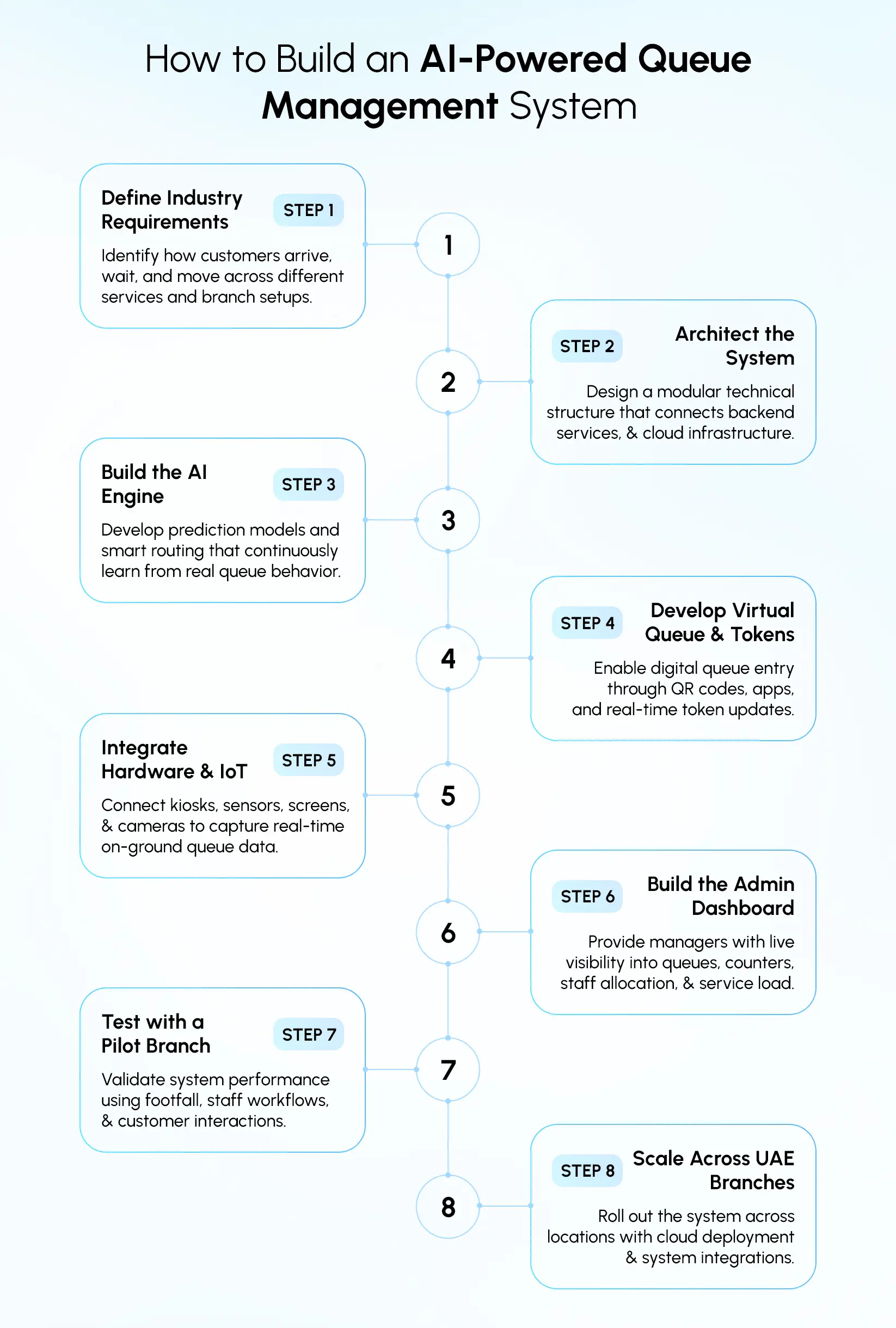
Below is a practical, detailed guide combining short paragraphs and elaborative bullet points to help you build an AI queue management system that is accurate, scalable, and aligned with real customer flow patterns across the UAE.
Step 1: Define Industry Requirements
Start by understanding how people interact with your service today. Every sector—healthcare, retail, government, banking—has a different queue behavior, and the system must match that reality.
Key requirement areas include:
- Walk-ins vs. Appointments: Identify whether most customers arrive spontaneously or through scheduled timings. Hospitals need appointment logic, while telecom centers mostly rely on walk-ins.
- Single Branch vs. Multi-Branch Setup: Multi-location deployment requires unified databases, central routing, and branch-level dashboard controls.
- Data for AI Model Training: Collect and prepare data such as:
- Historical wait times
- Service duration patterns
- Counter productivity
- Staff availability cycles
- Footfall peaks and dips
Clear requirements act as the foundation for reliable AI predictions and smoother customer flow.
Step 2: Architect the System
Once requirements are established, design the complete technical structure. The architecture must support consistent performance, integration flexibility, and a smooth experience for both staff and customers.
A modern AI-powered queue system development architecture includes:
- Backend Services: APIs, databases, token logic, routing engine.
- AI Layer: Prediction models, NLP chatbot engine, optimization algorithms.
- User Interfaces:
- Admin portal for managers
- Counter dashboard for staff
- Customer mobile/web interface
- Display screens for real-time queue updates
- Scalable Cloud Infrastructure: Hosting optimized for UAE’s compliance and low-latency requirements.
A modular architecture ensures future upgrades can be made without disrupting the full system.
Step 3: Build the AI Engine
This is the intelligence layer that drives accurate wait times and efficient routing. The engine should be designed to learn continuously from real operations.
Core AI components include:
- Predictive Wait-Time Models: Analyze historical patterns to provide real-time estimates.
- Smart Routing Algorithms: Assign customers to the most efficient counter based on service type and load.
- NLP for Chatbot Support: Allow customers to check wait times, join queues, or reschedule through automated chats.
- Reinforcement Learning: Improve decision-making as the system gathers more daily data.
Also read: Why UAE Companies Must Adopt AI & Automation Before Q1 2026
Step 4: Develop the Virtual Queue & Token Module
This part focuses on building a smooth digital entry system so customers can join queues without physical waiting. The virtual queue must be simple, mobile-friendly, and fast enough to handle high footfall. The token logic should update in real time and keep customers informed throughout their journey.
Core components include:
- QR-Based Entry: A quick scan lets users join queues instantly from the branch entrance or nearby signage.
- App/Web Onboarding: Enables customers to join the queue before arriving, improving flow during peak hours.
- IVR & WhatsApp Queuing: Essential for multilingual accessibility and convenient for UAE customers who prefer messaging-based interactions.
- Digital Token System: Issues tokens, sends live updates, and alerts customers when their turn approaches.
A well-designed virtual queue module reduces bottlenecks at entry points and gives customers better control over their waiting time.
Can AI Queue Systems Integrate With Mobile Apps and Kiosks?
Yes. AI queue systems integrate seamlessly with mobile apps, kiosks, QR check-in units, and WhatsApp queues, creating an omnichannel experience. Customers can join queues, track their position, and receive updates from any preferred device.
Step 5: Integrate Hardware & IoT
Many Dubai service environments still rely on physical devices to manage crowd movement effectively. Integrating hardware ensures real-time visibility and supports AI predictions with accurate on-ground data. The goal is to create a hybrid environment where software and devices work together seamlessly.
Useful hardware integrations include:
- Self-Service Kiosks: Allow customers to register, select services, or print tokens without staff involvement.
- Traffic Sensors: Track movement at entrances and waiting areas to measure congestion and validate predictions.
- Digital Signage Screens: Display token progress, counter numbers, and announcements clearly across the facility.
- Cameras for Occupancy Monitoring: Help assess footfall patterns and support automated crowd alerts.
Hardware integration becomes especially valuable in hospitals, airports, and government service centers where large volumes require constant visibility.
Step 6: Build the Admin Dashboard
The admin dashboard acts as the operations command center. It must give managers and staff a real-time view of queue activity, resource availability, and customer movement. This ensures quick decision-making during peak times and supports long-term optimization.
Important features include:
- Counter Control Tools: Reassign staff instantly when certain services experience unexpected spikes.
- Staff & Service Analytics: Track average handling times, staff performance, and service demand patterns.
- Real-Time Monitoring: View ongoing queues, customer load, and estimated wait times at a glance.
- Multi-Branch Management: Ideal for hospitals, banks, or government centers operating across Dubai and UAE.
A well-built dashboard helps operations teams maintain smooth service flow throughout the day.
Step 7: Test & Pilot in One Branch
Before rolling out the system across multiple locations, it is essential to validate performance in a real environment. A pilot ensures the technology works under actual conditions and provides clarity on improvements needed.
Key testing activities include:
- Load Testing: Simulates peak footfall to check system behavior under stress.
- Queue Scenario Testing: Verifies functionality across different queue types, service mixes, and rush-hour situations.
- Staff Feedback Review: Ensures counter agents find the system intuitive and efficient.
- Customer Usability Testing: Confirms the clarity, speed, and accessibility of the customer interface.
A solid pilot phase helps build confidence before full-scale deployment.
Step 8: Scale Across Dubai/UAE Branches
After a successful pilot, the next step is to expand the system across all branches. Scaling focuses on unifying operations, ensuring performance consistency, and localizing the experience for UAE audiences.
Critical scaling considerations include:
- Cloud-Based Deployment: Ensures high uptime, centralized control, and optimal performance across branches.
- Multi-Language Support: English and Arabic interfaces help meet the needs of Dubai’s diverse population.
- Systems Integration: Connect with CRM, HIS, ERP, OMS, or government APIs depending on the industry.
- Branch-Level Configuration: Adjust queue rules, service types, and workflow settings based on individual location needs.
Scaling ensures the system delivers consistent results while adapting to each branch’s operational demands.
Design an AI Queue Architecture That Fits Your Dubai Operations
From counter routing to virtual queues, our team helps you define the right components before development begins.
Core Features of a Modern AI Queue Management System
A modern queue management platform used across Dubai and the wider UAE relies on practical, outcome-driven features that reduce wait times, simplify traffic flow, and keep operations organized across high-footfall environments.
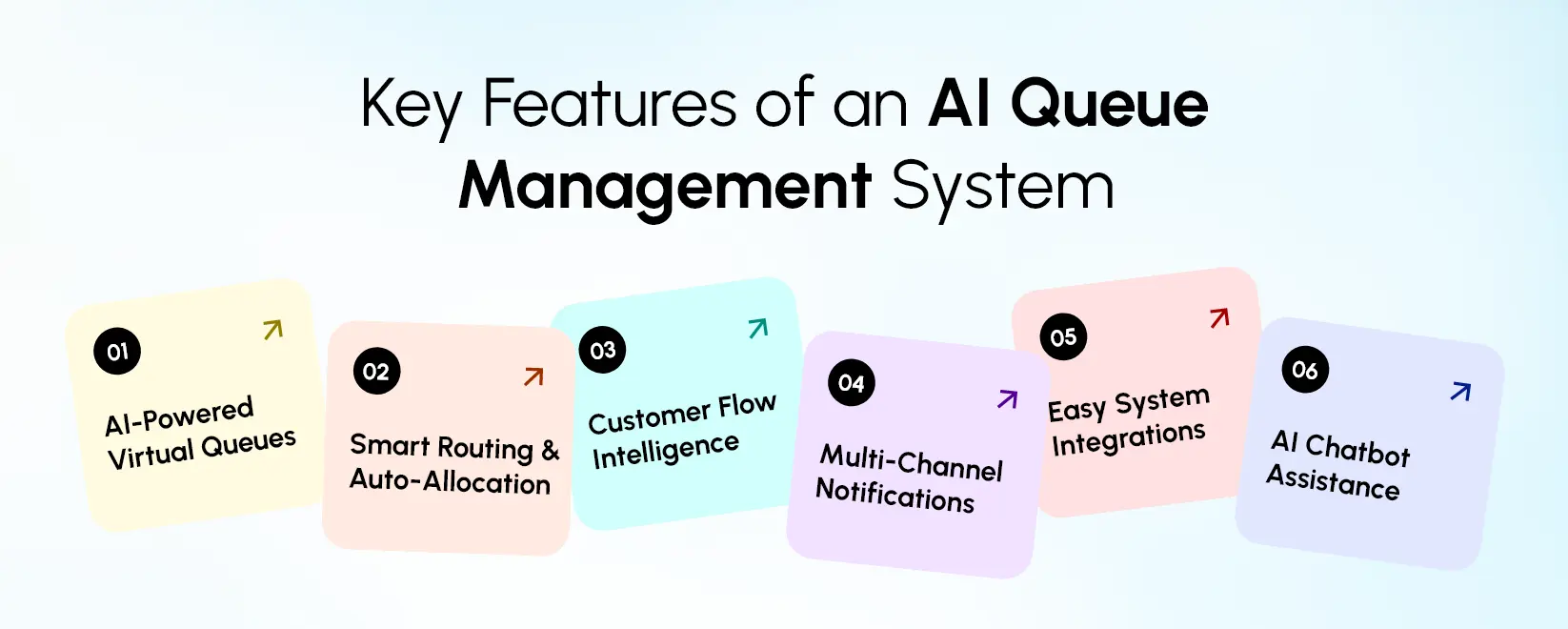
Below are the core capabilities that define today’s systems, along with how each contributes to smart queue management Dubai businesses are aiming for.
1. AI-Powered Virtual Queues
Virtual queuing removes the need for customers to physically stand in line. Users can join the queue through a mobile app, QR code at the entrance, or even WhatsApp. Behind the scenes, AI processes incoming data to estimate waiting times with greater accuracy.
These predictions adjust dynamically based on counter availability, service type, and real-time footfall, giving customers a clear idea of when they will be served.
2. Smart Routing & Auto-Allocation
Instead of routing visitors manually, the system assigns each customer to the most suitable counter or staff member. The assignment is based on service category, agent workload, customer priority, and branch-level rules.
This reduces idle counters, removes service mismatches, and keeps the flow moving smoothly during peak hours.
3. Customer Flow Management AI
This feature acts as the decision-making layer of the system. It monitors entry patterns, identifies peak intervals, and highlights bottlenecks that may cause delays. Managers get a live view of how many people are in each stage of the process and can adjust staffing or counter distribution instantly.
Such customer flow management AI helps prevent congestion before it impacts service quality.
4. Multi-Channel Notifications
Customers receive timely updates through SMS, WhatsApp messages, digital screens inside the facility, or voice announcements. These alerts notify them of token status, estimated time, counter assignment, or delays. Simple communication reduces frustration and prevents customers from repeatedly checking with staff.
5. Integration with Existing Systems
Modern solutions connect with CRMs, Hospital Information Systems (HIS), POS, ERP platforms, and government databases. This ensures unified data, fewer manual entries, and smoother customer authentication.
For example, healthcare facilities can pull appointment details instantly, while service centers can verify identity using integrated government systems.
6. AI Chatbot for Queue Handling
An AI chatbot for queue handling lets customers perform routine actions without staff involvement. They can book appointments, check token status, find the right branch, or request simple information through WhatsApp, web chat, or an in-app assistant. This reduces front-desk load and gives users a faster, self-served experience.
Tech Stack Required for an AI Queue Management System
| Category | Technologies | Purpose |
| AI / ML | Python, TensorFlow, PyTorch, Scikit-learn | Model training and predictions |
| AI Models | Reinforcement learning | Continuous system optimization |
| NLP Engines | GPT, Rasa, Dialogflow | Chatbot and automation |
| Backend | Node.js, Python, Java | Core logic and APIs |
| Architecture | Microservices | Scalability and modularity |
| Frontend | React, Vue.js | Web interface development |
| Mobile | Flutter, React Native | Mobile app development |
| Cloud & DevOps | AWS, Azure, GCP, Docker, Kubernetes | Hosting and deployment |
| Hardware / IoT | Tablets, kiosks, display units, sensors | On-site queue operations |
Cost to Build an AI Queue Management System in Dubai/UAE
The cost of developing an AI-powered queue management system in Dubai or the UAE depends mainly on the scale of the solution and the level of AI automation required.
A simple system with virtual queuing, basic dashboards, and mobile notifications typically costs AED 40,000 to AED 80,000 for a single branch.
Costs increase as more advanced features are added.
AI model complexity, such as predictive wait-time algorithms, smart routing, or AI chatbots – requires additional development and raises the budget.
If you need IoT hardware like kiosks, sensors, digital displays, or camera-based counting, the investment becomes higher.
Deploying the system across multiple locations also increases cost due to data syncing and centralized management.
There are also recurring expenses for cloud hosting, maintenance, and monitoring. Finally, custom integrations with CRM, HIS, ERP, or government systems add to development time.
For an enterprise-grade, AI-driven multi-branch system, the cost generally ranges from AED 120,000 to AED 250,000+, depending on customization and AI depth.
Why Dubai & UAE Businesses Need AI Queue Automation
Dubai is now a global smart-city hub, and residents expect fast, predictable, and well-managed service experiences. With thousands of visitors moving through government centers, hospitals, retail stores, banks, and airports every day, traditional queue systems struggle to keep pace.
Dubai businesses are adopting AI queue systems to support the city’s smart services vision, reduce service delays, and improve customer satisfaction. AI helps handle high footfall, automate routing, and create seamless service interactions across government centers, retail stores, and hospitals.
High-footfall sectors across the UAE now rely on AI queue automation for businesses because it helps them manage customer flow more accurately and efficiently.
Why this shift is happening:
- Footfall is rising across public and private service centers
- Customers expect “near-zero wait” experiences
- Manual queues lead to delays, confusion, and staff overload
- Service providers need a more structured way to control visitor movement
AI fills this gap by predicting visitor load, optimizing counter availability, and guiding customers to the right service point. This directly supports smart queue management Dubai, especially when centers deal with unpredictable walk-ins.
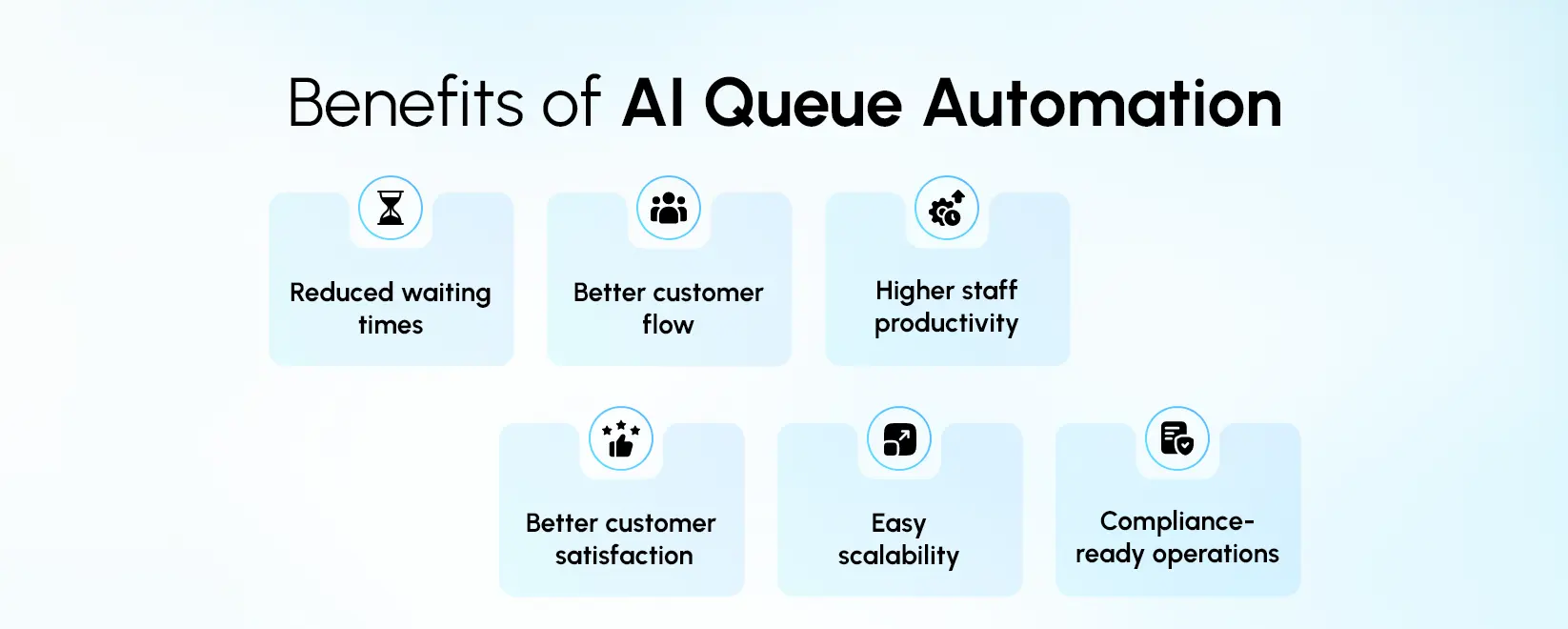
Key advantages for UAE businesses:
- Reduced waiting times through real-time load prediction.
- Better customer flow with virtual queues and automated routing.
- Higher staff productivity as manual queue handling decreases.
- Improved customer satisfaction due to transparency and timely updates.
- Easy scalability for multi-branch service networks.
- Compliance-ready operations with digital logs and traceability.
For any organization aiming to improve speed and consistency, investing in an AI solution for reducing wait times in UAE is becoming a practical, essential upgrade—not just a technology trend.
Key Industries Using AI Queue Management in UAE
AI-driven queue systems are becoming a necessity across Dubai and the wider UAE, where large volumes of customers rely on timely, well-organized services. Different sectors are adopting intelligent queue automation to improve operational speed, reduce bottlenecks, and deliver smoother experiences at every touchpoint. Below are the key industries leading this shift.
1. Government Service Centers
Government offices in Dubai—such as Emirates ID centers, visa service hubs, RTA branches, and immigration departments—handle continuous walk-ins and appointment-based visits. A government service center AI queue system helps them to:
- Forecast visitor load throughout the day
- Allocate counters based on real-time demand
- Reduce peak-hour congestion
- Ensure customers move through each step with minimal delay
AI also supports multilingual communication, making public services more accessible to residents and expats.
2. Healthcare & Hospitals
Hospitals and clinics rely on structured movement of patients to maintain safety and reduce waiting frustration. AI queue management for hospitals Dubai enables:
- AI-driven triage that categorizes patients based on urgency
- Streamlined movement between reception, doctors, labs, and billing
- Optimized appointment and walk-in blending
- Better resource planning during peak hours
This leads to improved care delivery, reduced stress for patients, and more efficient use of medical staff.
3. Retail & Shopping Malls
Footfall in malls and large retail stores can fluctuate rapidly. Through retail queue management with AI UAE, businesses can manage:
- Virtual queues for billing counters
- Queue distribution across multiple checkout lanes
- Self-service kiosk flows
- Customer notifications during peak rush
This reduces long lines, improves store navigation, and enhances overall shopping experience.
4. Banks & Financial Institutions
Banks deal with varied service categories—account queries, loan applications, teller visits, and RM meetings. AI systems help them:
- Provide real-time wait-time predictions
- Route customers to the right counter instantly
- Distribute workload among relationship managers
- Ensure priority services move faster
These features reduce service delays and strengthen customer trust.
5. Airports & Tourism Hubs
Dubai’s airports and tourism centers serve millions of passengers each year. AI supports:
- Immigration queue planning
- Baggage counter coordination
- Optimized boarding sequences
- Peak-flow forecasting during busy travel seasons
This improves passenger movement, reduces stress points, and enables smoother airport operations.
Related reading: How AI Is Transforming Property Management in the UAE by 2026
Future Trends in AI Queue Systems for UAE
As Dubai accelerates its shift toward faster, smarter citizen services, AI-driven queue systems are evolving with next-gen capabilities that make customer journeys even more seamless. Here are the key advancements shaping the future:
- Computer-vision–based counters
Cameras will automatically track queue length, customer movement, and counter availability, enabling real-time adjustments without manual intervention. - AI sentiment analysis
Systems will analyze tone, expressions, and behavior to detect frustration, allowing service teams to respond faster and improve customer satisfaction. - Autonomous service kiosks
Self-service kiosks will handle ticketing, document verification, and basic service requests, reducing dependency on staff and speeding up overall flow. - Multi-branch predictive routing
AI will recommend the best branch based on traffic, wait times, and service demand, helping customers choose the quickest option instantly. - Voice AI queues for government services
Residents will be able to book queues, check status, and manage appointments through voice commands on phones or kiosks.
These innovations will collectively shape the future of Dubai smart services AI queue systems, making public and private service experiences faster, more intelligent, and more seamless.
How Codiant Can Help You Build an AI Queue Management System?
Codiant helps businesses in Dubai and across the UAE design and deploy intelligent AI-powered queue management systems that streamline customer flow and deliver faster, more efficient service experiences. Our solutions are fully customizable and built to handle high footfall environments like government service centers, hospitals, retail chains, banks, and enterprise service hubs.
What We Deliver
- AI-driven wait-time prediction and dynamic queue routing.
- Virtual queues via mobile apps, kiosks, QR codes, and WhatsApp.
- Real-time dashboards for staff load balancing and branch monitoring.
- AI chatbots for appointment booking and queue updates.
- Integration with CRMs, HIS, ERP, and government systems.
- Multi-language support (English & Arabic) for UAE audience.
- Scalable architecture for multi-branch deployment.
With deep experience in AI, mobile app development, cloud engineering, and digital transformation, Codiant ensures smooth implementation—from strategy and design to development, testing, and ongoing support. We enable businesses to achieve measurable efficiency, reduce wait times, and elevate customer satisfaction across every touchpoint.
Conclusion
AI-powered queue management systems are transforming how businesses handle customer flow by reducing wait times, improving operational efficiency, and delivering smoother, more predictable service experiences.
With virtual queues, real-time analytics, and automated routing, companies can manage high footfall with greater accuracy and less manual effort.
Dubai and the wider UAE are ideal markets for these solutions because of their strong focus on smart services, digital transformation, and customer-first service models.
As government centers, hospitals, retail chains, and enterprises continue modernizing, AI-driven queue systems will play a key role in building faster, more efficient customer journeys across the region.
Your Next Customer Shouldn’t Have to Wait.
Adopt AI queue automation that delivers speed, clarity, and smoother experiences at every service point.
The Author

Frequently Asked Questions
Government centers, hospitals, retail stores, banks, telecom outlets, and service hubs in Dubai benefit most, as AI helps manage high footfall, reduce wait times, and streamline customer flow.
A typical stack includes Python or Node.js for backend, React or Flutter for interfaces, AI frameworks like TensorFlow, cloud hosting, APIs, and optional kiosk or IoT integrations.
AI analyzes historical data, real-time footfall, staff availability, and service patterns to estimate wait times accurately and automatically route customers for faster, smoother processing.
Yes. AI queue systems integrate easily with CRM, ERP, HIS, and POS platforms through APIs, enabling unified data, better tracking, and streamlined customer interactions across branches.
AI queue systems must follow UAE data protection laws, Dubai Digital Authority guidelines, secure data encryption, access control, and compliance with healthcare or government-specific regulations.
Costs vary by features and complexity. Basic systems start lower, while enterprise, multi-branch AI queue platforms cost more due to integrations, analytics, and customization needs.
Featured Blogs
Read our thoughts and insights on the latest tech and business trends
How to Hire AI Developers for Automation & Smart Applications- A Complete Guide for 2026
- January 29, 2026
- Staff Augmentation
In a Nutshell AI hiring in 2026 is a business decision, not just a technical one. Most AI failures happen due to wrong hiring models and unclear scope, not bad ideas. Successful automation starts by... Read more
How Much Does It Cost to Build an eCommerce Platform in Australia?
- January 27, 2026
- E-commerce
In a Nutshell eCommerce development costs in Australia typically start from AUD $10,000–$25,000 for basic stores, while advanced or enterprise platforms can range from AUD $80,000 to $250,000+ depending on complexity. Shopify offers a lower... Read more
How Long Does It Take to Develop an App in 2026?
- January 21, 2026
- Mobile App Development
In a Nutshell App development timelines depend more on scope clarity than technology speed. Simple apps take 2–4 months; complex platforms often require 9–12+ months. MVPs typically launch within 6–16 weeks when features remain tightly... Read more