How Do You Hire React.js Developers for Your Project?
Table of Contents
Subscribe To Our Newsletter

Summarize with AI
Not enough time? get the key points instantly.
To hire React.js developers effectively, use a seven-step process: define the product scope, choose the required seniority, screen relevant work, conduct a technical interview, assign a practical test, verify references, and finalise delivery terms.
For CTOs, startup founders, product managers, and engineering managers, the wrong hire can create fragile components, poor state management, weak test coverage, and costly rework across the product roadmap. The decision becomes more important when a developer must enter an existing codebase, integrate complex APIs, or support regulated and transaction-heavy workflows.
The 2025 Stack Overflow Developer Survey found that 46.9% of professional developers who answered its web frameworks and technologies question had worked extensively with React during the previous year. That broad usage creates a large hiring pool, but it does not guarantee equal capability in JavaScript, architecture, testing, performance, or collaboration.
At Codiant, selected ReactJS developers can be onboarded within 24 to 48 hours through requirements mapping, shortlisted profiles, client interviews, and structured project setup. This hiring guide covers responsibilities, skills, experience levels, engagement models, interviews, coding assessments, costs, onboarding, and common mistakes, with Codiant’s pre-vetted developer model as the practical hiring reference.
Key Takeaways
- Hire React.js developers through seven steps: scope the role, select seniority, screen work, interview, test, verify, and contract.
- Evaluate practical JavaScript, component design, state management, API integration, testing, and communication skills against your actual product requirements.
- Upwork lists median React.js developer rates of $20 to $38 per hour, while actual costs vary by scope, location, and engagement model.
- The biggest avoidable risk is hiring from a keyword-heavy CV without verifying the candidate’s exact contribution through discussion and practical assessment.
- Codiant provides pre-vetted ReactJS developers through flexible hiring models: selected developers can be onboarded within 24 to 48 hours.
What Does a ReactJS Developer Do?
A ReactJS developer builds and maintains the interactive, user-facing parts of web applications. They turn designs, workflows, and business requirements into reusable interface components that respond to user actions and display data correctly.
React is a JavaScript library for creating interfaces from individual components. These components can represent buttons, forms, tables, menus, product cards, charts, or complete screens. Developers combine them to build larger web applications, as explained in the official React documentation.
A ReactJS developer’s responsibilities commonly include:
- Converting UI/UX designs into responsive web interfaces
- Creating reusable React components
- Managing forms, user actions, and interface states
- Connecting the frontend to APIs and backend services
- Displaying loading, success, empty, and error states
- Implementing navigation and role-based interfaces
- Writing component and integration tests
- Finding and fixing frontend defects
- Improving accessibility and performance
- Reviewing code and documenting important decisions
- Working with designers, backend developers, testers, and product managers
The exact role depends on the application.
For example, a ReactJS developer may build:
- A patient appointment dashboard for a healthcare platform
- A product catalogue and checkout flow for an eCommerce business
- A course progress dashboard for an education platform
- A transaction monitoring interface for a financial application
- A campaign performance dashboard for a marketing team
- An administrative panel for a SaaS product
- A ticket management console for customer service teams
- A case and document management portal for a legal firm
A ReactJS developer normally focuses on the frontend. If the role also requires database design, server development, cloud deployment, or backend security, the company may need a full-stack developer or a broader development team.
What Skills Should You Look for in a ReactJS Developer?
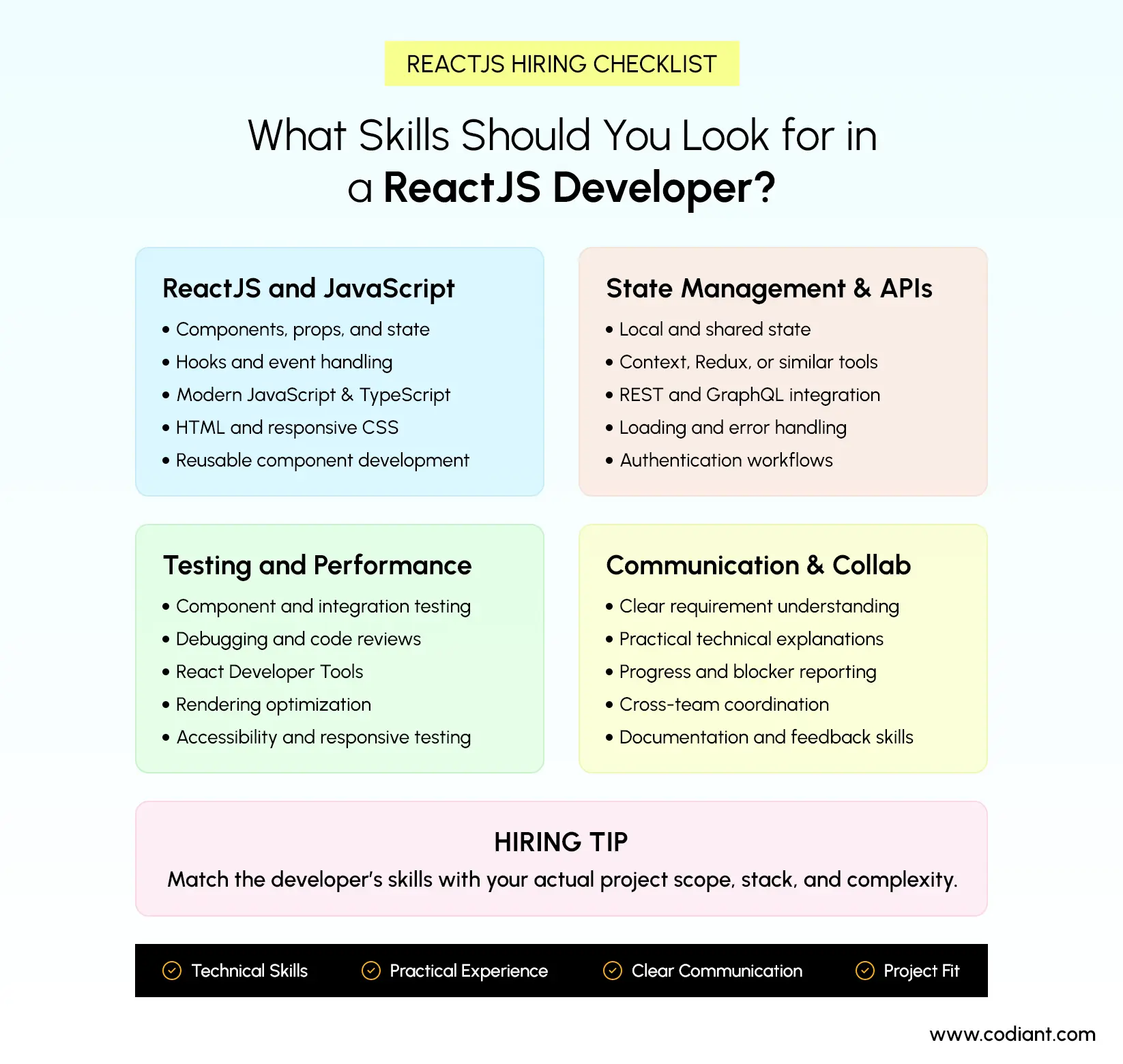
A capable ReactJS developer needs strong JavaScript knowledge, practical React experience, API integration skills, testing ability, and clear communication. The right skill level should match the complexity and risk of your project.
Do not assess candidates only by the number of React-related tools listed on their resumes. Ask how they used those tools, what problems they solved, and which parts of the application they personally delivered.
1. ReactJS and JavaScript Skills
A ReactJS developer should first understand modern JavaScript. React cannot compensate for weak knowledge of functions, objects, arrays, modules, asynchronous operations, error handling, and browser behaviour.
Important capabilities include:
- HTML and responsive CSS
- Modern JavaScript syntax
- Array and object manipulation
- Promises and asynchronous functions
- JavaScript modules
- Component-based development
- JSX syntax
- Props and state
- Event handling
- Conditional rendering
- List rendering and stable keys
- Forms and validation
- Reusable custom Hooks
- Error handling
- TypeScript, when used by the project
The developer should understand how to divide a screen into focused, reusable components. They should also know when a component has become too large or responsible for too many tasks.
Modern React development relies heavily on function components and Hooks. React’s documentation explains that Hooks support features such as state, context, references, effects, and performance management inside components. It also states that components and Hooks should remain pure so their behaviour is easier to understand and optimize. React’s Hooks reference and Rules of React provide the underlying guidance.
Ask candidates to explain their decisions in simple terms. Someone who knows React well should be able to explain why state belongs in a particular component, when a custom Hook is useful, and why an Effect is or is not required.
2. State Management and API Integration
A ReactJS developer should know how to manage changing data without making the application difficult to maintain.
State is the information an interface needs to remember. It may include:
- The item selected by a user
- The contents of a shopping cart
- The current page of a table
- Whether a menu is open
- Information entered into a form
- The authenticated user’s permissions
- Data received from an API
The developer should be able to distinguish between:
- Local state: Used by one component or a small component group
- Shared state: Required by several parts of the application
- Server data: Retrieved from an API and controlled by a backend system
- URL state: Filters, search terms, or pages represented in the address
- Form state: Values, validation messages, and submission status
React includes tools such as useState, useReducer, and Context. External state libraries can also be useful, but they should not be added automatically. The developer should choose an approach based on the application’s size, data flow, and maintenance needs.
API integration skills are equally important. A candidate should understand:
- REST or GraphQL, depending on the project
- HTTP methods and response codes
- Asynchronous requests
- Request cancellation
- Authentication workflows
- Loading and error states
- Pagination, filtering, and sorting
- Retries and duplicate requests
- Data transformation
- API error reporting
The browser’s Fetch API provides a standard interface for sending requests and processing responses. It is promise-based, so developers must understand both asynchronous JavaScript and explicit response handling. MDN’s Fetch API documentation explains this behaviour.
For example, an eCommerce product page should not show an empty screen while product data is loading. It should display an appropriate loading state, handle unavailable products, report failed requests, and prevent accidental duplicate actions.
3. Testing and Performance Optimization
A ReactJS developer should be able to test important user workflows and investigate performance problems with evidence.
Testing may include:
- Unit tests for individual functions
- Component tests for user interactions
- Integration tests for connected components
- End-to-end tests for complete workflows
- Accessibility checks
- Cross-browser and responsive testing
For example, an eCommerce checkout test may confirm that users can update quantities, apply a valid discount, see a failed payment message, and retry without losing their cart.
Performance skills should include the ability to:
- Identify unnecessary rendering
- Investigate slow components
- Reduce avoidable network requests
- Split large code bundles
- Load non-critical features only when required
- Optimize lists, images, and data-heavy screens
- Measure results before and after changes
Candidates should know how to use browser tools and the React Profiler. The official React Developer Tools documentation states that its Components and Profiler panels can inspect props, state, component structure, and performance problems.
Performance should be measured, not guessed. Google’s Core Web Vitals assess loading performance, responsiveness, and visual stability through LCP, INP, and CLS. Google’s Web Vitals guidance explains the current metrics and measurement tools.
4. Communication and Collaboration Skills
A ReactJS developer should communicate progress, risks, technical choices, and blockers clearly. This becomes especially important when the developer works remotely or joins an established team.
Look for someone who can:
- Ask questions before starting unclear work
- Explain technical choices in business language
- Break features into manageable tasks
- Provide realistic progress updates
- Raise risks before they affect delivery
- Give and receive code-review feedback
- Document important decisions
- Coordinate with design, backend, QA, and product teams
- Work within agreed communication hours
- Discuss disagreements professionally
Communication should be assessed through practical situations.
For example, ask how the candidate would respond if a marketing dashboard design required data the API did not provide. A strong answer should involve clarifying the requirement, consulting the backend team, identifying alternatives, and documenting the agreed solution.
Avoid making “culture fit” a vague personal judgement. Evaluate job-related behaviours such as reliability, clarity, ownership, collaboration, and response to feedback.
Which ReactJS Developer Experience Level Do You Need?
Choose a ReactJS developer’s experience level based on task complexity, required independence, architectural responsibility, and business risk. Years of experience can provide context, but they should not be the only selection criterion.
| Experience level | Best suited for | Expected capabilities | Typical oversight |
| Junior ReactJS developer | Defined components, UI updates, simple forms, minor defects and test maintenance | React fundamentals, JavaScript, HTML, CSS, Git and basic API use | Regular technical guidance and code review |
| Mid-level ReactJS developer | Complete features, API integrations, shared state, testing and existing application maintenance | Independent feature delivery, debugging, reusable components and collaboration across functions | Periodic architectural guidance |
| Senior ReactJS developer | Frontend architecture, complex workflows, performance, modernization and technical leadership | System design, risk management, code quality, mentoring and cross-team decision-making | High independence and ownership |
1. Junior ReactJS Developer
Hire a junior ReactJS developer for clearly defined work that has established patterns and available technical supervision.
Suitable tasks include:
- Building components from an existing design system
- Fixing straightforward interface defects
- Updating responsive layouts
- Adding form fields
- Writing basic tests
- Improving internal documentation
A junior developer should not normally be the only technical owner of a complex healthcare, finance, legal, or enterprise application. These products can involve complicated permissions, sensitive workflows, accessibility requirements, and integration risks that require experienced oversight.
2. Mid-Level ReactJS Developer
Hire a mid-level ReactJS developer when you need someone who can deliver complete features with limited supervision.
A capable mid-level developer should be able to:
- Break a feature into components
- Integrate APIs
- Manage local and shared state
- Handle loading and error conditions
- Write and maintain tests
- Review routine code changes
- Investigate defects independently
- Work with designers and backend developers
This level may suit an eCommerce account area, an education dashboard, a customer service console, or a marketing analytics interface built within an established architecture.
3. Senior ReactJS Developer
Hire a senior ReactJS developer when the role includes architecture, technical leadership, modernization, or high-risk product decisions.
Senior responsibilities may include:
- Defining frontend architecture
- Selecting appropriate development patterns
- Planning a legacy React migration
- Reviewing performance and accessibility
- Establishing coding and testing standards
- Designing complex authorization interfaces
- Mentoring other developers
- Coordinating with backend, security, DevOps, and product teams
- Investigating production incidents
- Managing technical debt
Choose a senior developer when mistakes could affect several teams, major workflows, or long-term maintainability. Do not hire a senior developer only to complete a small, well-defined component unless speed or specialist knowledge justifies the additional cost.
Which ReactJS Developer Hiring Model Should You Choose?
Choose a ReactJS hiring model based on the duration, certainty, control, skills, and delivery ownership your project requires. No single model is appropriate for every project.
| Hiring model | Best suited for | Main benefits | Important limitations |
| In-house developer | Long-term products with continuous frontend work | Direct employment, internal knowledge and close team integration | Recruitment time, employment costs and limited short-term scalability |
| Freelance developer | Small, defined or temporary assignments | Flexible access and limited commitment | Availability, continuity and management may vary |
| Dedicated developer | Ongoing work requiring external talent integrated with your team | Stable capacity, direct collaboration and easier scaling | Requires clear vendor governance and internal product direction |
| ReactJS development company | Complete projects or work needing several disciplines | Access to development, design, testing, management and deployment capabilities | Higher coordination needs and less direct control over every staffing decision |
1. In-House Developer
Choose an in-house ReactJS developer when frontend development is a permanent part of your product strategy.
This model is suitable when:
- The product will be developed and maintained continuously
- The developer needs deep internal business knowledge
- Daily collaboration with internal teams is required
- The company wants direct control over priorities and development practices
An in-house developer may suit a software company with a core SaaS platform or a financial organization maintaining several internal web applications.
However, the real cost includes more than salary. Recruitment, benefits, taxes, equipment, software, training, management, and employee retention must also be considered.
2. Freelance Developer
Choose a freelance ReactJS developer for a limited task with clear deliverables and few unresolved dependencies.
Examples include:
- Building a campaign landing page
- Fixing a defined interface issue
- Creating several reusable components
- Supporting a short release
- Conducting a frontend performance review
Freelancers can provide flexibility, but their availability may change between assignments. Confirm working hours, communication expectations, code ownership, documentation, testing, and handover requirements before work begins.
3. Dedicated Developer
Choose a dedicated ReactJS developer when you need ongoing capacity without running a complete internal recruitment process.
A dedicated developer usually works with one client for an agreed number of hours and becomes part of the client’s delivery workflow. The client commonly manages priorities while the provider handles employment and administrative responsibilities.
This model can support:
- Long-term product development
- An existing team with a ReactJS skill gap
- A growing product backlog
- Regular maintenance and feature delivery
- Temporary expansion before an important release
The model works best when responsibilities are explicit. Confirm who owns the backlog, architecture, code reviews, quality assurance, infrastructure, and final acceptance.
4. ReactJS Development Company
Choose a ReactJS development company when you need responsibility for a complete outcome rather than one individual developer.
A development company may provide:
- Business analysis
- UI/UX design
- ReactJS development
- Backend development
- Quality assurance
- DevOps support
- Project management
- Post-launch maintenance
For example, a legal firm creating a new case management portal may need design, frontend, backend, security, testing, and deployment capabilities. Hiring one ReactJS developer would not cover the complete scope.
Before choosing a company, verify who will work on the project, how changes are handled, what is included in the estimate, and how knowledge will be transferred.
How to Hire ReactJS Developers Step by Step
To hire ReactJS developers successfully, define the work first, identify the required level, compare relevant evidence, run a structured assessment, and finalize clear commercial and ownership terms.
Step 1: Define Your Project Requirements
Start by documenting the problem, users, workflows, technical environment, and expected outcome.
Include:
- Product type
- Intended users
- Required screens and workflows
- Existing or new application
- Current React version, if applicable
- JavaScript or TypeScript requirements
- State management approach
- APIs and third-party integrations
- Browser and device requirements
- Accessibility expectations
- Security or compliance requirements
- Testing requirements
- Delivery timeline
- Engagement duration
- Working-hour overlap
- Internal team structure
For example, “build a healthcare dashboard” is too broad. A useful brief should explain whether the dashboard is used by patients, clinicians, or administrators, what information it displays, which APIs provide the data, and what permissions each role requires.
Do not prescribe a technical tool when the underlying requirement is unclear. Describe the business need first, then allow qualified candidates to discuss the implementation.
Step 2: Prepare a ReactJS Developer Job Description
A ReactJS developer job description should explain the actual work, not provide a long list of unrelated technologies.
Include:
- Role purpose
- Main responsibilities
- Required ReactJS developer skills
- Current technology stack
- Expected experience level
- Project stage
- Team structure
- Required working hours
- Contract type
- Assessment process
- Compensation or budget, when possible
Separate mandatory skills from preferred skills.
For example, TypeScript may be mandatory in an established TypeScript project. GraphQL should not be mandatory when the application uses only REST APIs. Node.js should not be listed as a requirement unless the developer will perform backend work.
A focused description helps suitable candidates understand the role and reduces irrelevant applications.
Step 3: Review Experience and Project Portfolios
Review portfolios to understand what the candidate personally built, how relevant the experience is, and how they approached technical decisions.
For every relevant project, ask:
- What problem did the application solve?
- Which parts did you build?
- Did you work independently or within a team?
- Which React patterns did you use?
- How was state managed?
- Which APIs did you integrate?
- What tests did you write?
- What performance or accessibility problems did you solve?
- What would you change now?
Do not judge candidates only by visual design. A polished interface may have been created by a designer, while the candidate’s responsibility may have been limited.
Some experienced developers cannot share private client code. In that situation, ask for a detailed walkthrough, legally shareable samples, architectural explanations, references, or a focused practical task.
Step 4: Conduct a Technical Interview
A technical interview should test understanding, decision-making, and problem-solving rather than memorized definitions.
Cover:
- JavaScript fundamentals
- Components, props, and state
- Hooks and Effects
- State management
- API integration
- Testing
- Accessibility
- Performance
- Security boundaries
- Debugging
- Code organization
Use project-related scenarios. If you are hiring for an eCommerce platform, discuss product filters, carts, checkout errors, and API failures. If the role involves financial software, discuss data tables, permissions, audit-related interfaces, and sensitive-data handling.
Give candidates enough information to reason about the problem. The purpose is to understand how they think, not to catch them with incomplete questions.
Step 5: Assign a Practical Coding Test
A coding test should represent a small part of the actual role and have clear acceptance criteria.
A suitable task might ask the candidate to:
- Build a small responsive interface
- Retrieve data from a sample API
- Display loading, empty, and error states
- Add filtering or sorting
- Write several meaningful tests
- Make the interface keyboard accessible
- Explain key decisions in a short README
Avoid asking candidates to build a complete production feature or solve unrelated algorithm puzzles unless algorithms are important to the role.
Tell candidates how the submission will be evaluated. Review code organization, correctness, error handling, testing, accessibility, and reasoning. Visual polish should receive limited weight unless the role specifically requires advanced UI implementation.
Step 6: Evaluate Communication and Team Fit
Evaluate how the candidate gathers information, explains choices, receives feedback, and works with other functions.
Useful questions include:
- What do you do when acceptance criteria are unclear?
- How do you report a blocker?
- How do you disagree with a technical decision?
- How do you work with a designer when a layout is difficult to implement?
- How do you coordinate an API change with a backend developer?
- How do you explain a delay to a non-technical product owner?
Base the decision on observable professional behaviour. Avoid selecting candidates simply because their personality resembles the existing team.
For remote ReactJS developers, confirm working-hour overlap, response expectations, meeting availability, written communication ability, and preferred collaboration tools.
Step 7: Verify Work History and Finalize the Contract
Verify the information that materially affects the hiring decision.
This may include:
- Employment or contract dates
- Job title and responsibilities
- Professional references
- Education or certifications, when required
- Identity and right-to-work checks
- Legally shareable project evidence
The final agreement should define:
- Scope and responsibilities
- Working hours or capacity
- Payment structure
- Deliverables and acceptance criteria
- Intellectual-property ownership
- Confidentiality
- Data and system access
- Open-source software responsibilities
- Security requirements
- Notice and termination terms
- Documentation and handover
- Replacement conditions, when applicable
Contract and employment requirements differ by country. Obtain appropriate legal advice for the locations and engagement model involved.
What Interview Questions Should You Ask ReactJS Developers?
Ask ReactJS interview questions that reveal how candidates design components, manage data, handle failures, test workflows, and make technical trade-offs. Combine knowledge questions with scenarios from your project.
| Interview question | What it evaluates | Strong-answer indicators |
| How would you divide this screen into React components? | Component design | Clear responsibilities, reuse without unnecessary fragmentation |
| When should state remain local, and when should it be shared? | State management | Chooses the smallest suitable scope and explains trade-offs |
| When is useEffect appropriate? | Modern React understanding | Uses Effects for synchronization with external systems rather than every data change |
| How would you handle an API request? | Integration skills | Covers loading, errors, cancellation, retries and response validation |
| How would you investigate unnecessary rendering? | Performance debugging | Measures with developer tools or profiling before optimizing |
| Why are stable keys important in a rendered list? | React fundamentals | Connects keys with item identity and reliable updates |
| How would you test a checkout or booking form? | Testing strategy | Tests user behaviour, validation, submission and failure states |
| How would you make a custom menu accessible? | Accessibility | Covers semantic controls, keyboard use, focus and screen-reader support |
| How would you approach an unfamiliar React codebase? | Existing-project work | Reviews documentation, architecture, tests, dependencies and recent changes |
| How should sensitive information be handled in the frontend? | Security awareness | Recognizes that the browser is not a trusted place for secrets and relies on secure backend controls |
Follow each answer with practical questions:
- Why would you choose that approach?
- What could go wrong?
- How would you test it?
- How would the approach change as the application grows?
- What information would you need before deciding?
Do not reject candidates only because they prefer a different library. Focus on whether they understand the underlying problem and can work within your approved stack.
How Should You Assess a ReactJS Developer’s Technical Skills?
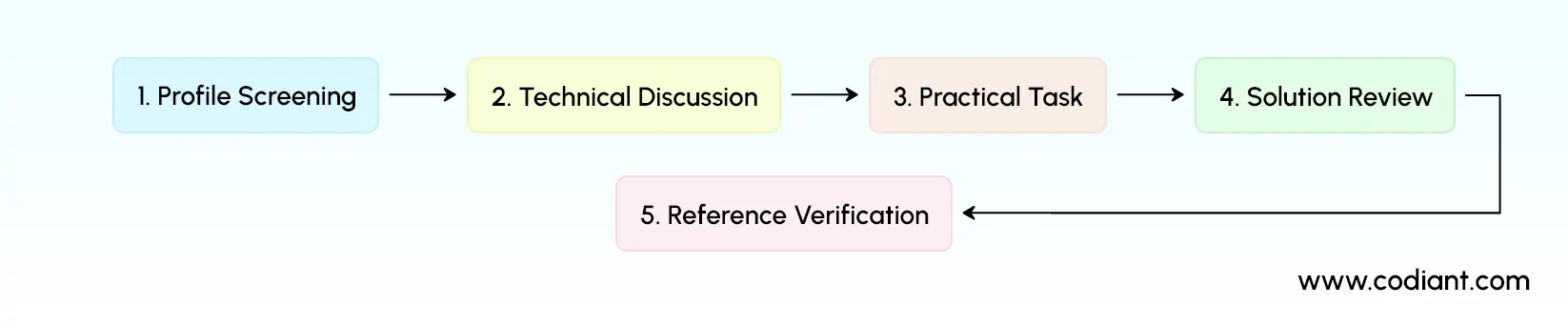
Assess a ReactJS developer through multiple forms of evidence: relevant work, a technical discussion, a focused coding exercise, and a review of the submitted solution. No single interview question can verify complete ability.
A structured assessment can follow five stages:
- Profile screening: Check whether the candidate has worked on comparable problems.
- Technical discussion: Explore React, JavaScript, APIs, testing, and project decisions.
- Practical task: Observe how the candidate applies their knowledge.
- Solution review: Ask the candidate to explain decisions and possible improvements.
- Reference verification: Confirm responsibilities and working behaviour where appropriate.
Use the same core rubric for candidates applying to the same role.
| Assessment area | Suggested weight |
| Functional correctness | 25% |
| React component and state design | 20% |
| API, loading, and error handling | 15% |
| Testing approach | 15% |
| Accessibility and responsive behaviour | 10% |
| Readability and maintainability | 10% |
| Explanation of decisions | 5% |
| Total | 100% |
This is a suggested evaluation framework, not an industry standard. Adjust the weights before reviewing submissions.
For example, a customer service platform may give more weight to real-time data and complex interface states. A marketing website may prioritize responsive implementation and performance. A legal or financial application may assign greater weight to permissions, error handling, and secure development awareness.
Review both the result and the process. A candidate who identifies a limitation, explains it clearly, and proposes a sound next step may be more suitable than someone who hides a problem behind complex code.
How Much Does It Cost to Hire ReactJS Developers?
The cost to hire a ReactJS developer varies by experience, scope, location, hiring model, and supporting skills. There is no reliable global rate that applies to every junior, mid-level, or senior ReactJS developer.
As a marketplace reference, Upwork currently displays median React.js developer rates of $20 to $38 per hour. Its detailed pricing page also reports a broader historical range of $15 to $150 per hour across React.js contracts. These figures describe activity on Upwork and should not be presented as universal market rates. Look at: Upwork React.js developer cost data.
At 160 billable hours, the displayed median range would equal:
- $20 × 160 hours = $3,200
- $38 × 160 hours = $6,080
This calculation is only an hourly marketplace illustration. It excludes platform fees, taxes, benefits, project management, design, QA, infrastructure, and other delivery costs.
Cost by Experience Level
Upwork does not divide its published rate data directly into junior, mid-level, and senior ReactJS categories. Its closest source-backed categories are shown below.
| Skill profile | Upwork’s published hourly range | How to use the benchmark |
| Basic frontend work | $15 to $50+ | Reference for defined interface tasks requiring frontend fundamentals |
| Intermediate to advanced frontend work | $35 to $100+ | Reference for complex React features and broader frontend expertise |
| Full-stack work | $30 to $150+ | Reference when React is combined with backend responsibilities |
Do not assign a level based on rate alone. A higher rate does not prove better performance, and a lower rate does not automatically indicate limited ability. Review relevant experience, practical evidence, availability, communication, and delivery responsibility together.
Cost by Hiring Model
| Hiring model | Common pricing structure | Costs to include |
| In-house developer | Annual salary | Recruitment, benefits, taxes, equipment, software, management and training |
| Freelance developer | Hourly or fixed price | Platform fees, coordination, rework, testing and handover |
| Dedicated developer | Monthly, hourly, part-time or full-time | Provider charges, project management, onboarding and team supervision |
| Development company | Fixed cost or time and materials | Discovery, design, development, QA, management, deployment and support |
A low hourly rate may produce a higher total cost if the work requires extensive correction or supervision. Compare the expected total delivery cost, not only the advertised rate.
Factors Affecting Hiring Cost
ReactJS developer hiring costs are commonly affected by:
- Developer experience and specialization
- Project scope
- Application complexity
- Frontend-only or full-stack responsibilities
- JavaScript or TypeScript requirements
- Existing code quality
- API and third-party integrations
- Testing expectations
- Accessibility requirements
- Security and compliance needs
- Developer location
- Working-hour overlap
- Contract length
- Urgency
- Design, QA, DevOps, and management support
Request an estimate against a documented scope. Without defined responsibilities, hourly rates from different candidates or providers cannot be compared fairly.
Where Can You Hire ReactJS Developers?
You can hire ReactJS developers through job platforms, freelance marketplaces, professional networks, referrals, developer communities, dedicated staffing providers, and ReactJS development companies.
| Hiring channel | Suitable for | What to verify |
| LinkedIn and Indeed | Direct and in-house recruitment | Employment history, availability and role relevance |
| Upwork and similar marketplaces | Freelance and project-based work | Contract history, samples, reviews and current availability |
| Vetted talent networks | Pre-screened contract professionals | Screening method, rates, replacement terms and trial conditions |
| GitHub and open-source communities | Discovering technical contributors | Contribution quality, ownership and interest in contract work |
| Employee and professional referrals | Candidates known within trusted networks | Use the same assessment applied to other candidates |
| Dedicated development providers | Ongoing remote capacity | Developer profiles, communication, pricing and replacement process |
| ReactJS development companies | Complete product or managed delivery | Relevant projects, team structure, process and commercial terms |
LinkedIn and Indeed currently carry React-related job listings, while Upwork publishes React-specific hiring and rate information. Toptal also provides React developers through hourly, part-time, and full-time contracts. These platforms use different selection and pricing methods, so inclusion should not be treated as an endorsement of a particular candidate or provider.
GitHub can help you inspect public repositories and open-source contributions. However, the absence of public code does not prove that a developer lacks experience. Many commercial projects are private and cannot legally be shared.
Whichever channel you choose, apply the same structured screening, interview, assessment, and verification process.
What Mistakes Should You Avoid When Hiring ReactJS Developers?
Avoid unclear requirements, resume-only decisions, trivia-based interviews, oversized coding tests, and selection based entirely on the lowest rate. These mistakes make it harder to compare candidates fairly and increase delivery risk.
1. Hiring Before Defining the Work
A vague requirement such as “we need a React expert” does not identify the application, workflows, responsibilities, or seniority needed. Define the role before evaluating candidates.
2. Confusing ReactJS and Full-Stack Development
React primarily covers the interface layer. If the developer must build APIs, databases, authentication services, or cloud infrastructure, include those responsibilities explicitly.
3. Selecting by Years of Experience Alone
Two developers with the same number of years may have handled very different levels of complexity. Review actual responsibility, project relevance, independence, and technical judgement.
4. Testing Memorized Definitions
Questions about obscure APIs or outdated patterns may not reflect the work. Use modern, project-related scenarios and practical reasoning.
5. Assigning an Excessive Coding Test
A test should provide enough evidence to support the decision. It should not ask candidates to create a complete production feature without payment or a genuine project agreement.
6. Ignoring JavaScript Fundamentals
ReactJS developers still write JavaScript or TypeScript. Weak knowledge of asynchronous operations, arrays, objects, modules, and browser behaviour can create problems even when a candidate remembers React terminology.
7. Ignoring Testing, Accessibility, and Security
A feature is not complete merely because it appears correctly on one screen. Evaluate error handling, keyboard use, testing, permissions, and frontend security boundaries.
W3C guidance states that web functionality should be operable through a keyboard wherever possible. This is particularly important for forms, menus, dialogs, and custom controls. W3C keyboard accessibility guidance explains the requirement.
8. Choosing Only by Hourly Rate
The lowest hourly rate may require more supervision, testing, correction, or rework. Compare expected output, responsibility, communication, and total delivery cost.
9. Failing to Verify Individual Contribution
A candidate may have worked on a large application without owning its React architecture or main features. Ask what they personally designed, built, tested, and maintained.
10. Starting Without Clear Ownership and Handover Terms
Define intellectual-property rights, documentation, repository ownership, access removal, acceptance criteria, and handover responsibilities before development begins.
How to Onboard a ReactJS Developer Successfully
Successful onboarding gives the ReactJS developer enough product, technical, and process context to make safe contributions. Provide access, documentation, expectations, and an initial bounded task instead of sending the developer directly into a complex feature.
Before the start date, prepare:
- Repository and project access
- Local setup instructions
- Development and test environment access
- Product overview
- User roles and workflows
- Architecture documentation
- API documentation
- Design system and component library
- Coding standards
- Branching and pull-request process
- Testing expectations
- Definition of done
- Security and data-handling requirements
- Communication channels
- Meeting schedule
- Named technical and product contacts
During the first few days:
- Explain the business problem and users.
- Walk through the main product workflows.
- Review the frontend architecture.
- Help the developer run the application locally.
- Explain the ticket and code-review process.
- Assign a low-risk but meaningful first task.
- Review the first contribution promptly.
- Discuss questions and update missing documentation.
For an existing application, pair the new developer with someone familiar with the codebase. A guided walkthrough can explain why important decisions were made and identify areas that should not be changed without broader review.
Evaluate onboarding through useful signals such as:
- Understanding of requirements
- Quality of pull requests
- Response to review feedback
- Test coverage for changed behaviour
- Defect and rework levels
- Communication of blockers
- Documentation of new decisions
Avoid measuring productivity through lines of code or hours spent online. These measures do not show whether the developer delivered correct, maintainable work.
Why Hire ReactJS Developers from Codiant?
At Codiant, we help businesses hire pre-vetted ReactJS developers based on their product requirements, existing technology stack, project duration, and preferred working model. You can review shortlisted profiles, interview the developers, and select the candidate who best fits your technical and business needs.
Our ReactJS developers work with technologies such as ReactJS, Redux, Next.js, REST APIs, GraphQL, testing frameworks, databases, and cloud platforms. They support frontend development across healthcare, fintech, eCommerce, real estate, logistics, education, SaaS, and enterprise applications.
Our hiring process includes four steps:
- Share your requirements: Tell us about your product, technology stack, timeline, and required skills.
- Review shortlisted profiles: We match your requirements with suitable ReactJS developers.
- Interview and select: You assess the shortlisted developers and choose the right candidate.
- Complete onboarding: We set up communication, project access, reporting, and development workflows.
Once you select a developer, we can complete onboarding within 24 to 48 hours, subject to developer availability and project requirements.
You can hire ReactJS developers through:
- Dedicated engagement
- Hourly engagement
- Part-time engagement
- Full-time engagement
- Time-and-material delivery
- Fixed-cost project delivery
We recommend the engagement model after reviewing your project scope, technical complexity, required capacity, delivery ownership, and long-term support needs.
The Author

Frequently Asked Questions
At Codiant, we can help you hire and onboard a selected ReactJS developer within 24 to 48 hours. The final timeline depends on how quickly you share requirements, review profiles, conduct interviews, and confirm engagement terms. Direct recruitment may take longer because it also includes sourcing and initial screening.
Hire a freelancer for a small, clearly defined task with limited coordination. Choose a dedicated ReactJS developer for ongoing development, changing requirements, or close integration with your team. At Codiant, we help you compare availability, accountability, security, continuity, working hours, and total engagement cost before making the decision.
Verify a ReactJS developer’s experience by reviewing relevant projects, individual contributions, code samples, technical decisions, and professional references. At Codiant, we share shortlisted profiles and allow you to interview developers directly or assign a focused practical task before selecting the candidate best suited to your project.
A ReactJS coding test should reflect the work the developer will perform. Include a small interface, state changes, API data, loading and error states, tests, and accessibility requirements. At Codiant, we recommend assessing functionality, code structure, reasoning, maintainability, and communication instead of speed or visual polish alone.
Yes. You can hire a ReactJS developer from Codiant to extend or improve an existing application. Our developers can add features, fix defects, strengthen tests, update dependencies, and address performance issues after reviewing your React version, architecture, state management, build process, known problems, and current development standards.
Yes. At Codiant, we offer hourly, part-time, dedicated, time-and-material, and fixed-cost options for short-term ReactJS requirements. Before onboarding, we help define deliverables, required skills, working hours, acceptance criteria, access, ownership terms, documentation, and handover so the developer can work within a clear and controlled scope.
Featured Blogs
Read our thoughts and insights on the latest tech and business trends

How Much Does It Cost to Build an MVP in 2026? A Complete Pricing Guide
- September 10, 2026
- Digital Transformation
MVP development cost typically ranges from $5,000 for a basic web-based product to $150,000 or more for a complex, cross-platform solution. A custom MVP with user accounts, a backend, essential integrations and a polished interface... Read more

How Much Does It Cost to Hire a Dedicated AI/LLM Developer in 2026?
- September 8, 2026
- Artificial Intelligence Staff Augmentation
Hiring a dedicated AI or large language model (LLM) developer typically costs $35–$60 per hour for general AI engineering and $50–$200 per hour for specialised machine learning work, with enterprise pricing rising for advanced RAG,... Read more

HIPAA-Compliant App Development in 2026: How to Build Securely and Avoid Preventable Fines
- September 4, 2026
- Mobile App Development
HIPAA-compliant app development in 2026 requires six foundations: complete ePHI mapping, documented risk analysis, role-based access, encryption, signed business associate agreements, and continuous security monitoring. This matters most to healthcare CTOs, product leaders, and compliance... Read more