AI vs Generative AI vs Agentic AI: What Businesses Should Know in 2026
Table of Contents
Subscribe To Our Newsletter
Summarize with AI
Not enough time? get the key points instantly.
Key Takeaways
- Traditional AI analyzes data and makes predictions. It is the foundation of automation tools used for decades.
- Generative AI creates content text, images, code, audio using large language models trained on massive datasets.
- Agentic AI goes a step further. It can plan, reason, take actions, and complete complex multi-step tasks with minimal human oversight.
- All three are useful for businesses, but at different stages of digital maturity and automation goals.
If you have sat in a business meeting lately, you have almost certainly heard someone use the terms AI, Generative AI, and Agentic AI interchangeably. That is a problem. Not because these terms are technically confusing, but because mixing them up leads to poor technology decisions, misaligned expectations, and wasted budgets.
Here is the truth: these three types of AI are not the same. They serve different purposes, operate differently, and require different levels of investment. If you are a business leader, marketer, developer, or strategist trying to make sense of the AI landscape in 2026, this guide will give you a clear, jargon-free explanation of all three and help you decide which one belongs in your business strategy.
💡 Did You Know?
According to McKinsey’s 2026 State of AI trust, organizations are rapidly expanding AI adoption, shifting from pilot initiatives to large-scale deployment of generative AI and emerging agentic AI solutions across key business operations.
What is Traditional AI?
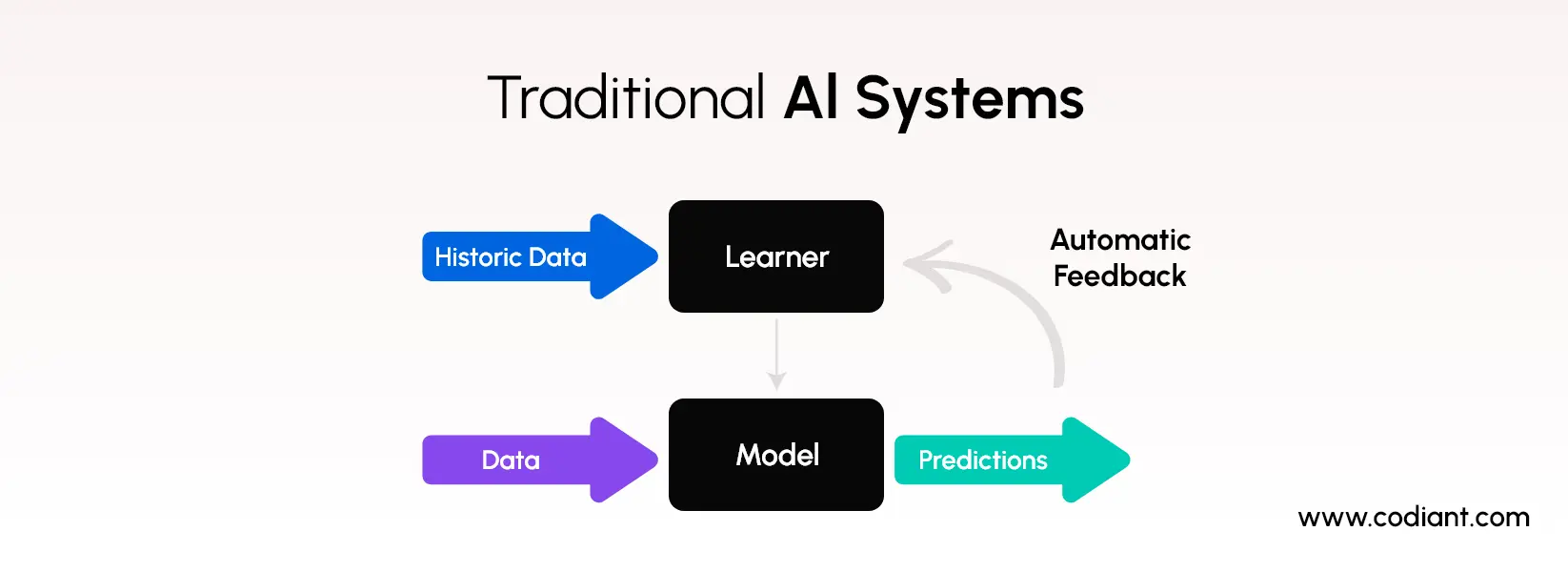
Traditional AI refers to artificial intelligence systems designed to perform specific tasks that usually require human intelligence, such as pattern recognition, prediction, classification, recommendation, language translation, fraud detection, and decision support.
Traditional AI usually works by analyzing historical data, identifying patterns, and applying those patterns to new data to make predictions or automate decisions. In business environments, AI development solutions use these models to support systems such as fraud detection tools, credit scoring models, route optimization, demand forecasting, and customer segmentation.
Unlike Generative AI, which creates new content, Traditional AI is mainly used to predict, classify, detect, rank, recommend, or optimize outcomes based on existing data.
How Does Traditional AI Work?
- Data Collection
Relevant data is collected from databases, transactions, sensors, user behavior, images, text, or business systems. - Model Training
The AI model is trained using methods such as supervised learning, unsupervised learning, regression, classification, clustering, or rule-based logic. - Pattern Recognition
The system identifies relationships, trends, anomalies, and decision rules within the data. - Prediction or Decision-Making
The trained model is deployed to predict outcomes, classify inputs, detect risks, recommend actions, or automate routine decisions. - Monitoring and Improvement
Human teams monitor performance, retrain the model with updated data, and improve accuracy over time.
Business Applications of Traditional AI
- Customer segmentation and targeting in CRM platforms
- Fraud detection and risk scoring in banking and fintech
- Predictive maintenance in manufacturing and logistics
- Recommendation engines in e-commerce and streaming
- Demand forecasting in retail and supply chain
Traditional AI is powerful, but it has one significant limitation: it can only work with what it has been explicitly trained on. It does not create. It does not imagine. And it certainly does not chat. That is where Generative AI comes in.
Data Insight
$638 Billion – Global AI Market Size (2024)
Global AI market size in 2024, projected to reach $1.8 trillion by 2030 at a CAGR of 36.6%.
What Are the 4 Types of AI?
The four types of AI are Reactive Machines, Limited Memory AI, Theory of Mind AI, and Self-Aware AI. This classification explains AI by capability, not by business use case. Today, only Reactive Machines and Limited Memory AI are widely used. Theory of Mind AI and Self-Aware AI are still theoretical or research-stage categories.
| Type | Name | What It Does | Real Example |
| Type 1 | Reactive Machines | Responds to inputs with no memory or learning. Pure stimulus-response. | IBM Deep Blue (chess computer) |
| Type 2 | Limited Memory AI | Uses past data to improve decisions over time. Can learn from experience within a session or dataset. | ChatGPT, self-driving cars, recommendation engines |
| Type 3 | Theory of Mind AI | Can understand human emotions, intentions, and social cues. Still largely theoretical. | Advanced social robots (research stage) |
| Type 4 | Self-Aware AI | Has its own consciousness, emotions, and self-understanding. Does not yet exist. | Hypothetical / AGI (Artificial General Intelligence) |
Key Insight for Businesses
Almost every AI tool available to businesses today including ChatGPT, Gemini, Claude, Copilot, and any analytics platform is Type 2: Limited Memory AI. It learns from data, improves over time, but does not have true consciousness or emotional understanding.
The leap to Type 3 and Type 4 is a long-term research frontier. For your 2026 AI strategy, focus entirely on maximizing value from Type 2 systems.
Move from AI Curiosity to Real Business Automation Faster
Discover how generative and agentic AI can improve workflows, productivity, and growth.
What is Generative AI?
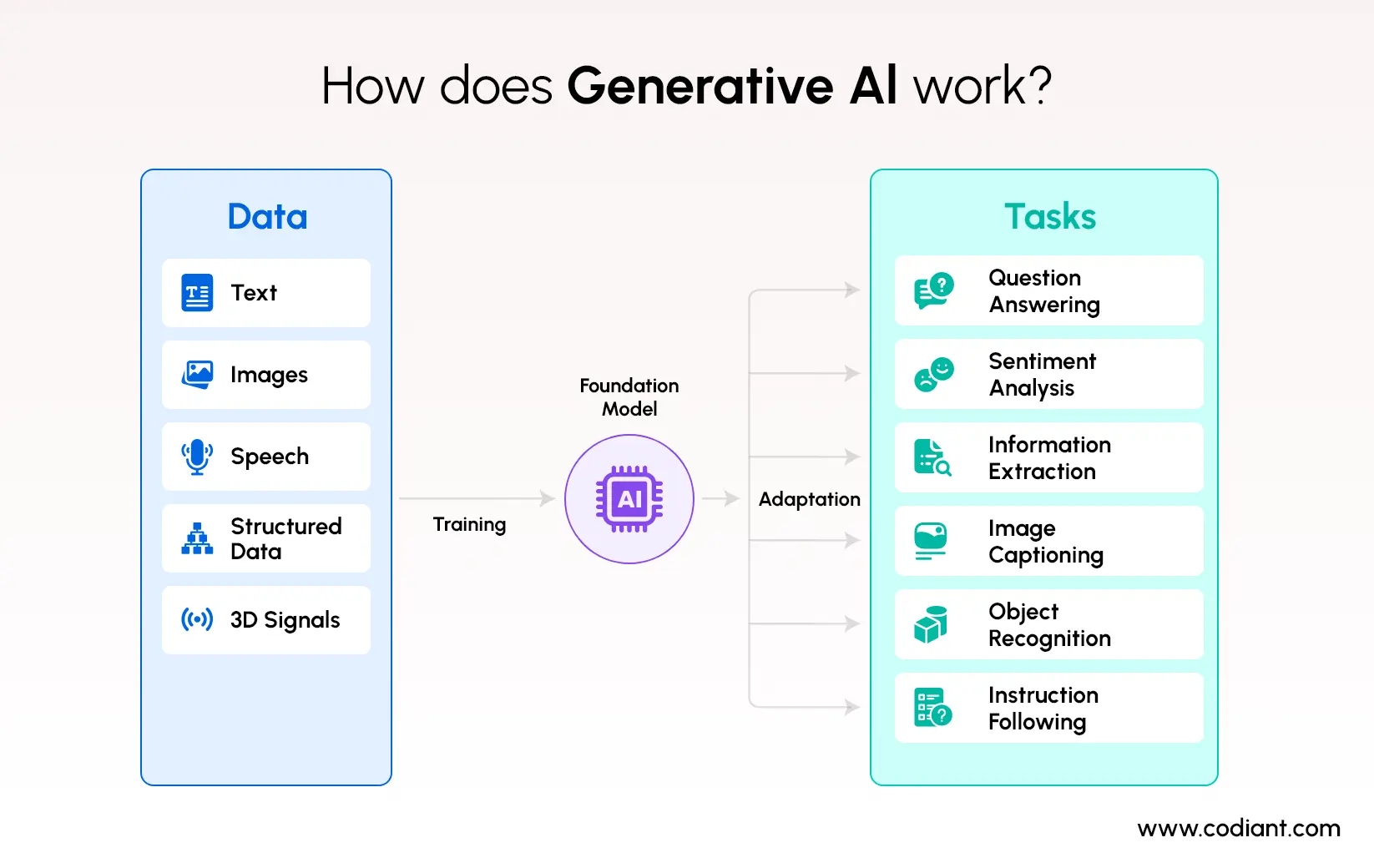
Generative AI is a category of artificial intelligence that creates new content such as text, images, videos, code, audio, and synthetic data by learning patterns from large datasets. Unlike traditional AI systems that mainly classify, detect, or predict outcomes, Generative AI produces original outputs in response to user prompts.
Most modern Generative AI systems are powered by foundation models such as Large Language Models, diffusion models, and multimodal AI models. Understanding how these systems generate content requires knowing what Generative AI is and how it works, including the training process, model architectures, prompting mechanisms, and inference workflows that enable AI to create human-like outputs across different formats.
These models are trained on large volumes of text, images, code, audio, and structured data, allowing them to identify patterns, context, language, and relationships between concepts.
What Makes Generative AI Different from Traditional AI?
Traditional AI is designed to analyze existing data and return a prediction, classification, or recommendation. For example, it may identify whether an email is spam, predict customer churn, detect fraud, or forecast demand.
Generative AI solutions are designed to create something new. They can write professional emails, generate images, summarize reports, create software code, draft product descriptions, or produce chatbot responses.
The main difference is this: Traditional AI predicts. Generative AI creates.
| Dimension | Traditional AI | Generative AI |
| Primary Goal | Predict / Classify / Detect | Create / Generate / Produce |
| Input | Structured data (numbers, labels) | Unstructured data (text, images, prompts) |
| Output | A decision, score, or category | New content: text, image, code, audio |
| Training Method | Supervised / Unsupervised learning | Foundation models on massive datasets |
| Labelled data needed? | Yes — extensive labelling required | No — learns patterns without explicit labels |
| Creativity | None — deterministic outputs | High — probabilistic, varied outputs |
| Explainability | Often explainable (feature importance) | Low — black box reasoning |
| Best Business Use | Forecasting, fraud, segmentation | Content, code, chatbots, design |
| Speed to Deploy | Months (data prep + training) | Days to weeks (prompt engineering) |
| Cost Model | High upfront investment | Low entry via API, scales with use |
What Are the Examples of Generative AI Tools?
Generative AI tools create text, images, videos, audio, code, designs, and synthetic content from user prompts. The most commonly used Generative AI tools include ChatGPT, Claude, Gemini, Midjourney, DALL·E, Adobe Firefly, GitHub Copilot, Cursor, Runway, Sora, HeyGen, ElevenLabs, Suno, and Udio.
| Category | Popular Tools | Best For | Business Use Cases |
| Text and Language | ChatGPT, Claude, Gemini, Llama models, Mistral models | Writing, Q&A, research, summarization, reasoning | Content drafting, customer support, knowledge search, report writing |
| Image Generation | Midjourney, DALL·E, Adobe Firefly, Stable Diffusion, Canva AI | Visual concepts, product images, brand graphics, illustrations | Ad creatives, blog visuals, social media posts, product mockups |
| Code Generation | GitHub Copilot, Cursor, Replit AI, Tabnine | Code completion, debugging, refactoring, test generation | Developer productivity, faster prototyping, code review support |
| Video Generation | Sora, Runway, HeyGen | Text-to-video, AI avatars, video editing, concept visualization | Product demos, training videos, sales videos, marketing campaigns |
| Audio and Voice Generation | ElevenLabs, Suno, Udio | Voiceovers, music, sound effects, audio content | Podcasts, ads, IVR systems, explainer videos, brand audio |
Which Generative AI Tool Is Right for Your Business?
- For content teams: Start with ChatGPT or Claude for writing + Canva AI or Midjourney for visuals.
- For development teams: GitHub Copilot or Cursor will give the fastest productivity gains.
- For marketing agencies: Combine Claude (strategy + copy) + Adobe Firefly (brand-safe images) + HeyGen (video).
- For enterprises with data security needs: Explore Llama 3 (self-hosted) or Tabnine (on-premise code AI).
- For non-technical founders: Replit AI lets you build and deploy without writing a line of code.
Business Applications of Generative AI
- Automated content creation for blogs, ads, social media, and emails
- AI-powered customer service chatbots and virtual assistants
- Code generation, debugging, and documentation for development teams
- Product description generation at scale for e-commerce
- Legal document drafting, contract summarization, and clause generation
- Personalized marketing copy tailored to individual user segments
Recruitment is one of the clearest business use cases of Generative AI because it involves content understanding, question generation, resume analysis, and structured decision support.
HireGroww, an AI-powered recruitment platform, uses Generative AI for resume parsing, interview question generation, candidate scoring, and automated communication, helping organizations reduce screening time and improve hiring consistency.
Did You Know?
40% Reduction in Content Production Time
Businesses using Generative AI for content and marketing reported an average 40% reduction in content production time and a 25% increase in engagement metrics.
Is ChatGPT Generative or Agentic AI?
ChatGPT in its standard form is Generative AI. It responds to prompts, generates text, and assists with tasks but it does not independently take actions or execute multi-step plans. However, when ChatGPT is used with plugins, browsing tools, or code execution, it starts to exhibit limited agentic behaviour. OpenAI’s newer Operator product is a step toward fully agentic AI.
What is Agentic AI?
Agentic AI is an artificial intelligence system that can independently plan, reason, make decisions, use external tools, and execute multi-step tasks to achieve a specific goal with minimal human intervention.
Unlike traditional AI models that primarily generate responses, Agentic AI can take actions across software systems, applications, databases, and business workflows. In enterprise use cases, AI agents and automation solutions connect these capabilities with tasks such as CRM updates, email workflows, reporting, scheduling, and data analysis.
Think of it this way: if Generative AI acts as a knowledgeable assistant that answers questions and creates content, Agentic AI acts as an autonomous digital worker that can schedule meetings, update CRM records, analyze data, send emails, generate reports, and coordinate multiple tasks without requiring step-by-step instructions.
This is why AI agents are transforming business by moving automation beyond simple task support and into goal-driven workflow execution across departments such as sales, HR, customer service, operations, and finance.
How Does Agentic AI Work?
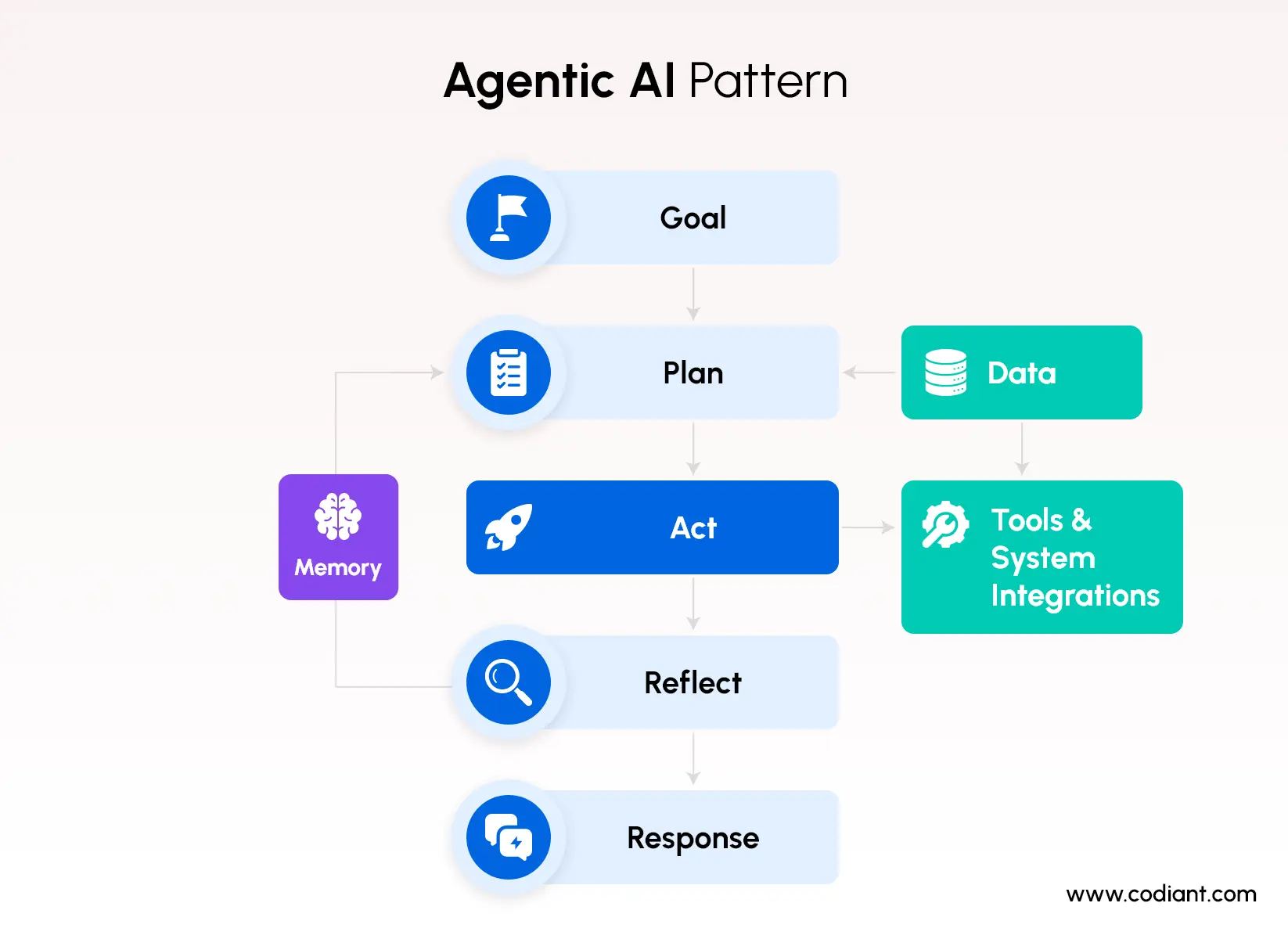
Agentic AI combines the reasoning capabilities of Large Language Models (LLMs) with planning frameworks, memory systems, APIs, databases, and workflow automation tools. It operates through four core stages:
- Goal Definition: A user provides a desired outcome or business objective rather than a list of individual instructions.
- Task Planning: The AI breaks the objective into logical sub-tasks and determines the most efficient execution path.
- Tool Execution: The system interacts with external tools such as APIs, browsers, databases, calendars, CRM platforms, and enterprise applications to complete tasks.
- Self-Correction and Adaptation: The AI evaluates results, identifies errors or obstacles, adjusts its approach, and continues working toward the goal until completion.
Business Value of Agentic AI
Agentic AI and automation solutions enables organizations to automate end-to-end workflows, reduce manual effort, improve operational efficiency, accelerate decision-making, and execute complex business processes across multiple systems with minimal human oversight.
This loop of plan → act → observe → adapt is what makes Agentic AI fundamentally different from both traditional and generative AI.
Real-World Examples of Agentic AI
- AutoGPT / BabyAGI – early experimental agents that could browse the web, write code, and complete tasks
- Microsoft Copilot Agents – enterprise agents that manage workflows across Teams, Outlook, and SharePoint
- Devin by Cognition – an AI software engineer that can independently write, test, and deploy code
- Salesforce Agentforce – autonomous customer service agents that resolve tickets end-to-end
- Zapier AI Agents – workflow automation agents that connect apps and execute multi-step business processes
Data Insight
33% of Enterprise Software Will Include Agentic AI by 2028
Gartner predicts that by 2028, 33% of enterprise software applications will include agentic AI, enabling autonomous decision-making in business processes.
Can Agentic AI Make Decisions Independently?
Yes, within the boundaries it is given. A well-configured agentic AI system can make decisions about which tools to use, which sequence to follow, how to handle errors, and when to ask for human approval. However, the best enterprise implementations today use a human-in-the-loop design for high-stakes decisions, meaning the agent handles routine tasks autonomously but escalates complex or sensitive decisions to a human.
Ready to Build Smarter AI Solutions for Your Business Today?
Turn AI ideas into scalable solutions with expert strategy, development, and implementation support.
AI vs Generative AI vs Agentic AI – The Full Comparison
The main difference between Traditional AI, Generative AI, and Agentic AI is that Traditional AI predicts outcomes, Generative AI creates new content, and Agentic AI plans and completes tasks across tools or workflows.
| Feature | Traditional AI | Generative AI | Agentic AI |
| Core Function | Analyze and predict | Create and generate | Plan, decide, and act |
| Output | Scores, classifications, recommendations, decisions | Text, images, videos, code, audio, synthetic data | Multi-step actions, completed workflows, reports |
| Human Involvement | Human setup and monitoring | Human prompts and review | Human goals and oversight |
| Example Tools | IBM Watson, Salesforce Einstein | ChatGPT, Midjourney, Gemini | AutoGPT, Devin, Microsoft Copilot agents |
| Business Use | Fraud detection, forecasting, segmentation | Content creation, coding, design, summarization | Workflow automation, CRM updates, scheduling, reporting |
| Learning Style | Supervised, unsupervised, or rule-based learning | Foundation models and multimodal models | Reasoning, planning, memory, and tool use |
| Complexity | Medium | High | Very high |
Which Industries Are Adopting Agentic AI?
Agentic AI is being adopted in industries where teams manage repetitive decisions, multi-step workflows, large data volumes, and software-based operations.
| Industry | How Agentic AI Is Used | Business Outcome |
| Financial Services | Fraud investigation, compliance checks, contract review, risk scoring, and financial analysis. | Faster reviews, stronger risk monitoring, and reduced manual compliance workload. |
| Healthcare | Patient intake, prior authorization, appointment workflows, clinical documentation, and medical record updates. | Lower administrative burden, faster patient processing, and improved care coordination. |
| E-Commerce and Retail | Inventory monitoring, dynamic pricing, product data updates, demand forecasting, and customer support automation. | Better stock control, faster response times, and more automated retail operations. |
| Software Development | Code generation, testing, debugging, documentation, and pull request preparation. | Shorter development cycles, faster issue resolution, and improved engineering productivity. |
| Marketing and Customer Experience | Content research, campaign creation, personalization, performance reporting, and customer response handling. | Faster campaign execution, improved personalization, and reduced repetitive marketing work. |
| Manufacturing | Predictive maintenance, production monitoring, quality checks, workflow coordination, and equipment alerts. | Reduced downtime, improved production efficiency, and faster operational decisions. |
| Logistics and Supply Chain | Route planning, shipment tracking, demand planning, warehouse coordination, and vendor communication. | Faster delivery planning, better visibility, and improved supply chain efficiency. |
| Insurance | Claims processing, policy review, risk assessment, document verification, and customer query handling. | Faster claim cycles, improved accuracy, and reduced manual review effort. |
| Telecom and IT Operations | Incident detection, ticket routing, network monitoring, root-cause analysis, and automated remediation. | Faster issue resolution, lower support load, and improved system reliability. |
Which AI Technology is Best for Your Business?
The best AI technology for a business depends on its size, data maturity, budget, workflow complexity, and automation goals. Businesses can use Traditional AI technologies such as machine learning, predictive analytics, computer vision, NLP, and recommendation engines for data-driven decisions.
They can use Generative AI technologies such as LLMs, foundation models, RAG, multimodal AI, and AI chatbots for content, code, search, and knowledge workflows. For complex automation, Agentic AI technologies such as AI agents, autonomous workflows, tool-calling systems, multi-agent systems, and workflow orchestration help execute tasks across business applications.
Here is a practical framework to help you decide:
Which AI Should You Prioritize?
- Early-stage businesses/SMBs: Start with Generative AI. Use ChatGPT, Claude, or Gemini for content, customer service, and coding. Low cost, high ROI, fast implementation.
- Mid-market businesses: Add Traditional AI for analytics. Use your CRM, ERP, and marketing platforms’ built-in AI features for predictions and segmentation.
- Enterprise/Scale-ups: Invest in Agentic AI. Build or buy AI agents for customer service, sales workflows, compliance, and operations. Higher investment, transformational returns.
- All businesses: The best strategy in 2026 is a layered approach Traditional AI for data intelligence, Generative AI for content and code, and Agentic AI for autonomous execution.
Business Decision Matrix
| AI Type | Best For | Top Tool | ROI Timeline | Skill Needed |
| Traditional AI | Analytics & CRM | IBM Watson | 3-6 months | Data Science |
| Generative AI | Content & Code | ChatGPT / Copilot | 1-3 months | Prompt Engineering |
| Agentic AI | Full Automation | AutoGPT / Devin | 6-12 months | AI Ops / Dev |
Is Agentic AI the Future of Enterprise Automation?
Yes, Agentic AI is becoming an important part of enterprise automation because it can plan tasks, use tools, make decisions, and complete multi-step workflows with human oversight. Unlike basic automation, Agentic AI can move from instruction to execution across systems such as CRM platforms, emails, reports, databases, and business applications.
However, the future of Agentic AI is not only about autonomy. It also depends on governance, reliability, security, and measurable business value. Enterprises need clear rules for what AI agents can do, what actions require approval, and how agent decisions are monitored.
| Area | What Enterprises Need to Know |
| Automation Value | Agentic AI can reduce manual coordination across tools, workflows, reports, CRM systems, and operational processes. |
| Human Role | Humans still define goals, approve sensitive actions, monitor outcomes, and handle judgment-heavy decisions. |
| Key Risks | AI agents can create reliability, security, governance, and workflow control risks if not managed properly. |
| Best Use Cases | Strong use cases include support automation, data analysis, CRM updates, reporting, scheduling, compliance checks, and workflow orchestration. |
| Future Outlook | Agentic AI will support enterprise automation, but successful adoption depends on clear governance, secure implementation, and measurable ROI. |
The future is not AI replacing humans. It is humans directing AI agents to handle execution, while people focus on strategy, creativity, decision-making, and business judgment.
See Also: Looking for real-world AI agent implementation partners? Explore our guide to the Top AI Agent Development Companies in the USA (2026).
How Can Businesses Implement the Right AI Strategy?
Businesses can implement AI effectively by first identifying the problem they want to solve, then choosing the right AI model for that goal. Traditional AI works best for prediction and analytics, Generative AI supports content, chat, code, and knowledge automation, while Agentic AI helps automate multi-step workflows.
Codiant supports this process by helping businesses:
- Identify high-value AI use cases
- Choose between Traditional AI, Generative AI, and Agentic AI
- Build AI chatbots, copilots, RAG systems, and automation workflows
- Integrate AI with CRM, ERP, HRMS, and support platforms
- Design secure, scalable, and governed AI solutions
Conclusion: The AI Ladder Every Business Should Climb
AI, Generative AI, and Agentic AI are not competing technologies they are sequential layers of an increasingly intelligent and autonomous stack. Most businesses are still on the first or second step of this ladder. The organizations that are moving fastest are those that understand the difference between these technologies and build a deliberate strategy for each.
Start with Generative AI to unlock immediate productivity. Build Traditional AI into your data infrastructure for intelligence. And begin experimenting with Agentic AI now, so that when it matures further and it will your business is ready to run on it.
The AI advantage in 2026 is not about having the most tools. It is about knowing which tool solves which problem and building a roadmap that compounds over time.
Not Sure Which AI Fits Your Business Best?
Compare AI options with experts and choose the right solution for your goals.
The Author

Frequently Asked Questions
Traditional AI analyzes data and makes predictions. Generative AI creates new content like text, images, and code using large language models. Agentic AI goes further it can autonomously plan and execute multi-step tasks using tools and reasoning, with minimal human input.
It depends on your goals and maturity. Generative AI offers the fastest ROI for content, customer service, and code. Traditional AI is essential for data-driven decisions and predictions. Agentic AI delivers the highest long-term value for process automation and complex workflows. The best strategy layers all three.
Agentic AI works through a loop of planning, acting, observing, and adapting. Given a high-level goal, it breaks the goal into sub-tasks, uses connected tools (APIs, browsers, databases) to execute them, reviews the results, and adjusts its approach if needed all without needing human instruction at each step.
Generative AI reduces content creation time by up to 40%, accelerates software development cycles, enables 24/7 AI-powered customer service, scales personalization at low cost, and allows small teams to produce enterprise-grade output. It is currently the most accessible and widely deployed AI category for businesses.
Yes. Gartner projects that 33% of enterprise software will include agentic AI by 2028. Agentic AI automates coordination and execution the most time-consuming part of knowledge work making it the next major wave of productivity transformation for businesses.
Featured Blogs
Read our thoughts and insights on the latest tech and business trends
AI Developer Engagement Models Explained: How to Choose the Right AI Team
- August 27, 2026
- Artificial Intelligence
AI developer engagement model means deciding how external AI specialists will be assigned, managed, paid and held accountable. The main options are dedicated AI developers, AI team augmentation, time-and-material delivery, fixed-price projects and end-to-end AI... Read more

Enterprise Mobile App Development: How It Can Accelerate Your Business Growth
- August 21, 2026
- Mobile App Development
Enterprise mobile app development can accelerate growth by improving three measurable areas: workflow speed, access to business systems, and customer or employee service delivery. This matters to mid-market and enterprise leaders managing distributed teams, manual... Read more
React vs Angular vs Vue: Which Should You Choose in 2026?
- August 14, 2026
- Technology
For most web products in 2026, choose React for ecosystem flexibility and broad hiring reach, Angular for standardised enterprise architecture and complex workflows, and Vue for simpler adoption and faster team onboarding. For CTOs, product... Read more