How Much Does It Cost to Build an eCommerce Platform in Australia?
Table of Contents
Subscribe To Our Newsletter
In a Nutshell
- eCommerce development costs in Australia typically start from AUD $10,000–$25,000 for basic stores, while advanced or enterprise platforms can range from AUD $80,000 to $250,000+ depending on complexity.
- Shopify offers a lower upfront cost and faster launch, making it suitable for startups, whereas custom eCommerce requires higher initial investment but supports complex workflows and long-term scalability.
- Integrations, UX depth and catalog complexity are the biggest cost drivers, often pushing budgets from five figures into six figures.
- Mobile eCommerce apps should be budgeted separately, with typical costs ranging from AUD $30,000 to $200,000+ based on features and integrations.
- Ongoing costs matter as much as build costs, including platform fees, apps, maintenance, SEO and conversion optimization.
- Smart planning and phased development help control spend, ensuring quality is maintained while avoiding expensive rebuilds later.
If you’re planning to launch (or rebuild) an online store in Australia, the first question is usually the same-
“What’s the real cost to build an eCommerce platform?”
And the honest answer is- it depends on what you’re building.
A clean Shopify storefront with a handful of products and basic shipping rules is a completely different project than a custom marketplace with multi-warehouse inventory, ERP integration, subscription billing and a mobile app.
So instead of vague estimates this blog breaks down what you’ll spend, where the budget goes and how to choose between Shopify and custom builds with practical ranges you can actually plan around.
You’ll also see the most common hidden costs (the ones that blow up timelines), plus sample budgets for three typical Australian builds.
Quick takeaway – In Australia, a basic eCommerce website build commonly starts around the five-figure range and advanced builds can move into mid-to-high five figures (or beyond) depending on integrations, UX depth and scalability expectations.
How Much Does It Cost to Build an eCommerce Platform in Australia?
Let’s look at the typical cost ranges offered by eCommerce agencies and development partners across Australia.
eCommerce Platform Cost Snapshot – Australia
| eCommerce Build Type | Typical Cost Range (AUD) | Best Suited For | What You Get |
| Starter Store (MVP) | $10,000 – $25,000 | Single-brand stores, limited catalog, fast launch | Theme-based UI, core product setup, payments, shipping & tax, basic SEO, launch support |
| Growth Store | $25,000 – $80,000 | Scaling D2C brands, conversion-focused retailers | Custom UX/UI, advanced search & filters, CRM/ERP integrations, performance optimization, structured QA |
| Advanced / Enterprise Commerce | $80,000 – $250,000+ | Large catalogs, B2B, marketplaces, headless commerce | Custom architecture, multi-storefronts, complex pricing, deep integrations, high scalability & availability |
Let’s break down each cost tier in detail, covering inclusions, trade-offs and real-world considerations for Australian eCommerce projects.
1. Starter store (MVP) — AUD $10,000 to $25,000
Best for- single brand, limited catalog, standard checkout, basic shipping rules, minimal custom design.
What’s usually included-
- Theme-based UI with light customization
- Product setup + collections
- Payment gateway setup
- Standard shipping + tax configuration
- Basic SEO setup + analytics
- Core testing + launch support
Many “eCommerce website cost in Australia” guides place typical eCommerce builds from ~AUD $6,000 to $20,000+ for smaller sites, depending on scope and vendor.
2. Growth store — AUD $25,000 to $80,000
Best for- serious D2C brands and retailers, conversion-focused UX, custom workflows, multiple integrations.
Adds-
- Custom UX/UI (not just a theme)
- Enhanced product discovery (filters, search, merchandising rules)
- Integrations (CRM, ERP, accounting, shipping aggregator, marketing stack)
- Performance tuning and conversion optimization
- Strong QA coverage + structured release process
3. Advanced / enterprise commerce — AUD $80,000 to $250,000+
Best for- large catalogs, multi-storefront, B2B pricing, headless commerce, marketplaces, high-availability requirements.
At this level, costs can rise significantly depending on the sophistication of the platform and operational complexity. Some vendors cite very wide ranges for “platform-like” builds, reaching well into six figures for advanced setups.
Planning an eCommerce Build in Australia?
Get a clear, itemized cost estimate aligned to your business model, platform choice, and growth roadmap.
The Biggest Decision- Shopify vs Custom eCommerce in Australia
One of the most important choices that directly impacts your ecommerce platform development cost in Australia is deciding whether to build on Shopify or invest in a custom eCommerce platform.
This decision doesn’t just affect your initial build budget. It influences your speed to market, flexibility, scalability, monthly costs and long-term control over your business.
Many Australian businesses start with Shopify to launch quickly, while others choose custom eCommerce development when their business model demands deeper customization. Understanding the trade-offs clearly can save you significant time and money later.
1. Shopify eCommerce Development in Australia- Cost, Benefits and Limits
Shopify is a hosted SaaS platform designed to help businesses launch online stores quickly with minimal technical overhead. Because hosting, security and core commerce features are handled by Shopify, the cost to build an ecommerce website in Australia using Shopify is typically lower.
However, Shopify’s simplicity comes with constraints. As your business grows, you may need paid apps or workarounds to support advanced features, which can increase ongoing costs.
Best suited for:
- Startups and D2C brands
- Small to mid-sized Australian retailers
- Businesses that prioritize speed and predictable costs
2. Custom eCommerce Development in Australia- Cost, Control and Scalability
A custom eCommerce platform is built specifically around your business workflows, customer journeys and operational needs. While the custom ecommerce platform cost is higher upfront, it provides complete flexibility and eliminates dependency on third-party apps.
Custom platforms are common among businesses with complex pricing rules, B2B workflows, large catalogs, or marketplace-style models.
Best suited for:
- Growing and enterprise-level businesses
- Brands with unique commerce logic
- Companies planning long-term platform scalability
3. Shopify vs Custom eCommerce Cost Comparison (Australia)
| Aspect | Shopify eCommerce | Custom eCommerce Platform |
| Initial Development Cost | Lower upfront cost | Higher upfront investment |
| Typical Build Range (Australia) | AUD 10,000 – 25,000 | AUD 50,000 – 250,000+ |
| Time to Launch | 4–8 weeks | 3–6+ months |
| Platform Fees | Monthly subscription + transaction fees | No platform fees (hosting costs apply) |
| Customization Flexibility | Limited to Shopify framework and apps | Fully customizable |
| Scalability | Good for standard growth | Designed for complex, high-scale growth |
| App / Plugin Dependency | High (paid apps often required) | Low (features built natively) |
| Ongoing Maintenance | Minimal technical maintenance | Requires regular maintenance |
| Best For | Fast launch, MVPs, standard stores | Complex workflows, B2B, marketplaces |
How Shopify vs Custom Impacts Your Ecommerce Website Budget in Australia?
From a budgeting perspective, Shopify keeps ecommerce website pricing in Australia predictable in the short term. You pay a lower build cost and spread expenses over monthly subscriptions and apps.
Custom eCommerce development shifts more cost upfront but can reduce long-term expenses by-
- Eliminating recurring app fees
- Avoiding platform limitations
- Supporting future expansion without replatforming
A common scenario in ecommerce development Australia is starting with Shopify for validation, then moving to a custom platform once revenue, catalog size, or operational complexity increases.
Is It Cheaper to Use Shopify or Build a Custom Ecommerce Platform?
Choose Shopify if-
- You want to launch quickly with a controlled budget
- Your product catalog and workflows are straightforward
- You prefer minimal technical maintenance
Choose Custom eCommerce if-
- Your business model requires unique features
- You expect complex integrations or B2B pricing
Long-term scalability matters more than short-term savings
What exactly are you paying for? (The 10 cost drivers that decide your budget)
When businesses ask about the cost to build an eCommerce website in Australia, the mistake they often make is assuming the price is driven by the number of pages or products.
In reality, eCommerce website pricing in Australia is shaped by a set of core cost drivers that influence effort, complexity, timelines and long-term scalability. Understanding these drivers helps you plan a realistic eCommerce website budget and avoid unpleasant surprises mid-project.
eCommerce Cost Drivers Snapshot (Quick View)
| Cost Driver | Typical Budget (AUD) |
| Platform Selection | 3,000 – 120,000+ |
| UX/UI Design | 2,000 – 30,000+ |
| Product & Catalog Logic | 1,000 – 25,000+ |
| Integrations | 3,000 – 50,000+ |
| Payments & Compliance | 1,500 – 10,000 |
| Data Migration | 2,000 – 25,000+ |
| Performance & Scalability | 2,000 – 15,000+ |
| SEO Foundations | 1,500 – 10,000 |
| QA & Testing | 2,000 – 10,000+ |
| Ongoing Support (Annual) | 10–20% of build cost |
Let’s break down the 10 most important cost drivers, along with typical budget ranges you can expect in the Australian market.
1. Platform Choice- Shopify, Open-Source, or Custom Build
The foundation of your store plays the biggest role in determining the custom ecommerce platform cost.
Choosing a SaaS platform like Shopify reduces development effort because core features such as checkout, security, and hosting are already built. In contrast, open-source or fully custom platforms require significantly more engineering and ongoing maintenance.
Cost impact in Australia:
- Shopify/BigCommerce setup- AUD 3,000 – 15,000
- Open-source implementation (Magento, WooCommerce)- AUD 15,000 – 40,000
- Fully custom eCommerce platform- AUD 40,000 – 120,000+
Why this matters:
- The more functionality the platform gives you out-of-the-box, the lower your initial ecommerce platform development cost Australia.
2. UX & UI Design Depth (Theme vs Conversion-Focused Design)
Design isn’t just about aesthetics it directly impacts conversion rates, trust and average order value.
A theme-based approach is faster and cheaper, while a custom, conversion-optimized UX requires research, wireframing, user journey mapping and iterative design work.
Budget range:
- Theme customization- AUD 2,000 – 6,000
- Semi-custom UX (modified layouts, custom sections)- AUD 6,000 – 15,000
- Fully custom UX/UI design– AUD 15,000 – 30,000+
Included work:
- Homepage, category and product page design
- Cart and checkout UX
- Mobile-first and accessibility considerations
3. Catalog Size & Product Complexity
Your online store development cost in Australia increases rapidly when product logic becomes complex.
Simple catalogs with single-SKU products are far cheaper than stores with multiple variants, bundles, subscriptions, or dynamic pricing.
Cost impact:
- Simple catalog (under 100 products)- AUD 1,000 – 4,000
- Medium complexity (variants, bundles)- AUD 4,000 – 12,000
- Advanced logic (subscriptions, custom pricing)- AUD 12,000 – 25,000+
Complexity increases with:
- Variant-heavy SKUs
- Bundles and kits
- Subscription billing
- Pre-orders and backorders
4. Third-Party Integrations (The Biggest Hidden Cost)
Integrations are one of the largest contributors to ecommerce development Australia budgets and they’re often underestimated.
Each integration involves API work, data mapping, error handling and testing.
Typical integrations:
- Payment gateways
- Shipping aggregators
- ERP/accounting software
- CRM and marketing automation
- Inventory and warehouse systems
Budget range:
- Basic integrations (1–2 systems)- AUD 3,000 – 8,000
- Multiple business integrations- AUD 8,000 – 25,000
- Enterprise-grade integrations- AUD 25,000 – 50,000+
5. Payments, Taxes & Compliance Setup
Australia-specific tax rules (GST), payment options, and compliance requirements add to the cost to build ecommerce website Australia.
The complexity grows if you support:
- Multiple payment methods
- Buy Now, Pay Later services
- Cross-border selling
- Fraud prevention workflows
Estimated cost:
- Standard payment + GST setup- AUD 1,500 – 3,000
- Advanced payment logic & risk handling- AUD 4,000 – 10,000
6. Data & Content Migration (If You’re Replat forming)
If you’re moving from an existing platform, migration is rarely straightforward.
Data must be cleaned, validated, and structured to avoid SEO loss and broken customer journeys.
Cost range:
- Small store migration- AUD 2,000 – 5,000
- Medium migration with SEO redirects- AUD 5,000 – 12,000
- Large catalogs + customer data- AUD 12,000 – 25,000+
Includes:
- Product and category migration
- Customer and order history
- URL mapping and redirects
7. Performance, Scalability & Hosting Architecture
Performance directly affects revenue. Slow stores lose conversions.
Higher budgets are required when you expect:
- High traffic volumes
- Seasonal spikes
- Large catalogs
- Headless or composable architectures
Budget allocation:
- Standard performance optimization- AUD 2,000 – 5,000
- Advanced scalability setup- AUD 6,000 – 15,000+
8. SEO & Search Foundations
SEO is not just metadata. A professional build includes technical SEO baked into the platform.
Cost impact:
- Basic SEO setup- AUD 1,500 – 3,000
- Advanced SEO (structured data, faceted navigation control)- AUD 4,000 – 10,000
This cost strongly influences long-term ROI and organic revenue.
9. QA, Testing & Release Management
Skipping proper QA is one of the fastest ways to overspend later.
Professional testing ensures:
- Checkout reliability
- Cross-device compatibility
- Analytics accuracy
- Stable post-launch performance
Budget range:
- Basic QA coverage- AUD 2,000 – 4,000
- Full regression & UAT support- AUD 5,000 – 10,000+
10. Post-Launch Support & Ongoing Enhancements
Your eCommerce platform is never “done.”
Ongoing costs include:
- Bug fixes
- Platform updates
- Feature improvements
- Conversion optimization
- Security patches
Typical annual allocation:
- Maintenance & improvements- 10–20% of initial build cost
- Monthly retainers often start from AUD 2,000+
This is a critical part of planning a realistic ecommerce website budget Australia.
Knowing what you’re paying for shifts the focus from cost to value helping you invest in the parts of your eCommerce build that actually drive growth and ROI.
Get Your eCommerce Budget Right from Day One
Avoid hidden costs and rework with a realistic ecommerce website budget built for Australia.
What Factors Affect Ecommerce Development Costs in Australia?
The cost of building an eCommerce platform in Australia is not fixed. It depends on several practical factors that directly impact development time, effort, and long-term maintenance. Below are the key elements that influence overall pricing, explained in simple terms.
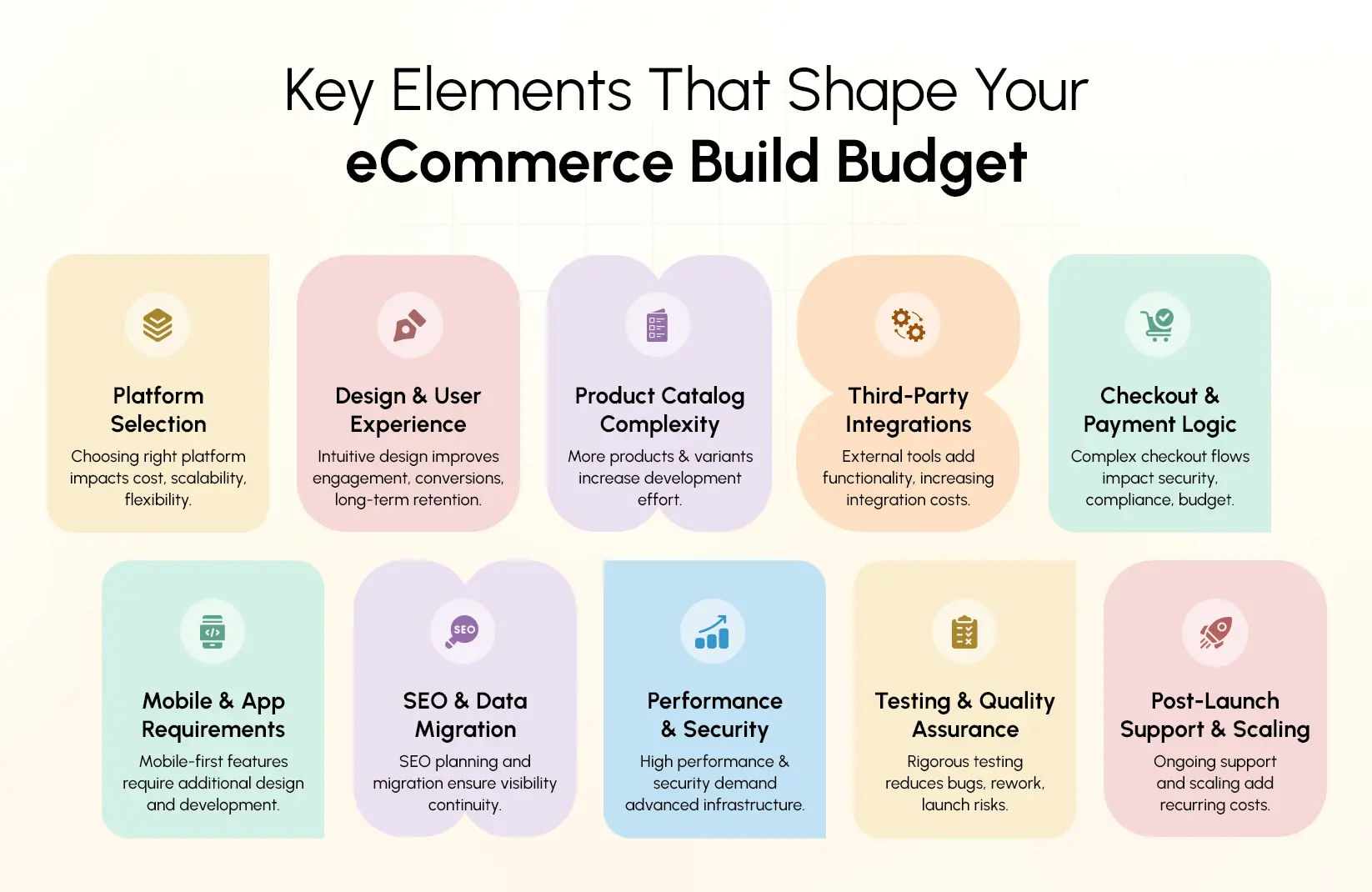
- Platform choice (Shopify, open-source, or custom build): The platform you choose has the biggest impact on cost. Shopify and similar platforms are faster and cheaper to launch. Open-source or fully custom platforms cost more because they require deeper development, testing, and ongoing maintenance.
- Design and user experience requirements: A store built using a ready-made theme costs less. Custom-designed interfaces, advanced product pages, and conversion-optimized user journeys increase design and development time, raising costs.
- Product catalog size and complexity: The number of products, variants, bundles, and categories affects cost. Large catalogs, complex pricing rules, subscriptions, or custom product configurations require additional development and testing.
- Third-party integrations: Integrating payment gateways, shipping providers, inventory systems, ERP, CRM, or marketing tools adds complexity. Each integration requires setup, testing, and error handling, which increases development effort.
- Checkout and payment complexity: Simple checkout flows are cheaper to implement. Costs rise when you add features like subscriptions, Buy Now Pay Later options, multiple currencies, tax rules, refunds, or custom discount logic.
- Mobile responsiveness and app requirements: A mobile-responsive website is standard today, but developing a separate Android or iOS app significantly increases the total cost. App development involves additional design, backend support, and maintenance.
- SEO and content migration needs: If you’re rebuilding or migrating an existing store, costs increase due to data cleanup, URL redirects, product content migration, and SEO preservation to avoid traffic loss.
- Performance, security, and scalability expectations: High-traffic stores require performance optimization, stronger security measures, and scalable infrastructure. These technical requirements increase development and hosting costs.
- Testing, quality assurance, and compliance: Proper QA ensures your store works smoothly across devices and browsers. More testing means higher upfront costs but fewer issues after launch.
- Post-launch support and future enhancements: Ongoing maintenance, feature updates, and performance improvements are often overlooked. Planning for post-launch support is essential for long-term success and should be included in the budget.
Understanding these factors helps businesses plan a realistic eCommerce development budget in Australia and avoid unexpected costs later.
Also read: How Much Does It Cost to Develop an App in 2026?
Cost breakdown- where the money goes (typical percentage split)
Here’s a useful way to plan your “cost to build ecommerce website Australia” budget-
- Discovery & solution architecture- 5–10%
- UX/UI design- 10–20%
- Front-end development- 15–25%
- Back-end development- 15–30%
- Integrations- 10–25%
- QA + UAT support- 10–15%
- DevOps / deployment- 5–10%
- Project management- 8–15%
These ranges shift based on whether you’re doing theme-based Shopify vs a custom architecture.
What Ongoing Costs Should Be Considered for an Ecommerce Platform?
Beyond development, businesses should plan for platform fees, paid apps or plugins, hosting, maintenance, security updates, and continuous improvements like SEO and conversion optimization.
These ranges shift based on whether you choose a theme-based Shopify build or a fully custom architecture, and how quickly you want to scale after launch.
Sample Budgets- 3 Realistic Australia Build Scenarios
Scenario A — Shopify MVP (fast launch)
Goal: Launch in 4–8 weeks with core commerce features
Estimated build: AUD $10,000–$25,000
Ongoing platform fee: Shopify plan pricing varies by tier (published on Shopify AU).
Typical inclusions:
- Theme selection + customization
- Catalog setup (up to a practical limit)
- Payment + shipping configuration
- Core pages + basic SEO foundation
- Analytics setup
- Launch + short stabilization support
Good for: Validating product-market fit, running paid campaigns quickly, testing offer + messaging.
Scenario B — Growth store with integrations (brand scaling)
Goal: Improve conversion, reduce operational friction, integrate key systems
Estimated build: AUD $25,000–$80,000
Typical inclusions:
- Custom UX/UI (category + PDP + checkout experience improvements)
- Advanced search and filtering
- Email/SMS automation integration
- Shipping aggregator integration
- Inventory sync or ERP/accounting integration
- Strong QA + release checklist
Good for: Established brands that already have sales velocity and need operational efficiency.
Scenario C — Custom / headless / enterprise-grade commerce
Goal: Platform differentiation and long-term scalability
Estimated build: AUD $80,000–$250,000+ (and can go beyond based on complexity)
Typical inclusions:
- Headless front-end + composable stack
- Custom workflows (B2B pricing, approvals, role-based access)
- Multi-storefront / multi-brand architecture
- Deep integrations (ERP, WMS, PIM, CRM)
- Performance and reliability engineering
- Observability + structured DevOps
Good for: Larger organizations where eCommerce is a core engine, not “just a sales channel.”
Ecommerce App Development Cost in Australia (Mobile Apps)
If mobile is part of your commerce roadmap, budget it separately from the website. In Australia, professional mobile app builds commonly land anywhere from ~AUD $30,000 to $200,000+, depending on app complexity, integrations, and UX depth.
To keep planning simple, treat eCommerce mobile apps in three bands-
- Basic commerce app (MVP): Product browsing, search, cart/checkout, login, order history, basic push notifications → typically AUD $30,000–$60,000
- Mid-level retail app: Personalization, loyalty, advanced filters, shipping tracking, deeper analytics, 2–3 integrations → typically AUD $60,000–$120,000
- Complex/marketplace-grade app: Multi-vendor, complex pricing/promotions, high-scale backend, multiple integrations, performance engineering → typically AUD $120,000–$250,000+
Quick Cost Snapshot
| App scope | Typical inclusions (minimal) | Estimated cost (AUD) |
| MVP Commerce App | Catalog + Cart + Checkout | $30k–$60k |
| Growth Retail App | Loyalty + Push + 1–3 integrations | $60k–$120k |
| Marketplace / Enterprise | Multi-vendor + complex backend | $120k–$250k+ |
What pushes the mobile cost up fastest (so you can budget correctly)
- Checkout complexity (subscriptions, BNPL flows, split payments, refunds/returns automation)
- Backend + integrations (ERP/PIM/WMS, CRM, loyalty engines, shipping aggregators)
- Personalization & search (recommendations, smart filters, merchandising rules)
- Analytics instrumentation (event schema, funnels, attribution, A/B testing readiness)
- Security & compliance (especially if you store sensitive data or require stricter controls)
The Ongoing Costs Most Teams Forget (But You Should Budget for)
Even if your build cost is fixed, total cost of ownership includes-
1. Platform fees
- Shopify plan fees (AU pricing published)
- BigCommerce plans (public pricing structure; note currency/taxes details vary by region)
2. Apps/plugins
Most Shopify stores run multiple apps (reviews, bundles, subscriptions, upsells, returns). These can become a meaningful monthly expense.
3. Hosting & infrastructure (custom/open-source)
If you’re on open-source or custom, you’ll pay for hosting, monitoring, backups, and security operations.
4. Maintenance and enhancements
A practical rule of thumb many teams use-
- Allocate 10–20% of build cost per year for maintenance + incremental improvements (more if you’re in high-growth mode).
5. CRO and SEO improvements
Your store isn’t “done” at launch. High-performing brands run continuous experiments-
- landing pages,
- bundles,
- pricing tests,
- checkout optimization,
- page speed work.
How to Reduce Ecommerce Development Cost Without Building the Wrong Thing?
Here are smart ways to control “custom ecommerce platform cost” without sacrificing quality-
Build phase 1 around revenue, not features
MVP should focus on-
- product discovery,
- trust building,
- checkout completion,
- basic fulfillment.
Everything else can be phased.
Don’t integrate everything on day one
Integrations are powerful—but costly. Start with what removes the biggest operational bottleneck.
Use theme + custom components (hybrid approach)
For Shopify builds, you can-
- start with a strong theme,
- then invest in custom sections where conversion impact is highest (PDP, bundles, cart).
Plan content and catalog cleanup early
Dirty data creates hidden costs during migration and SEO setup.
Lock scope with a clear “definition of done”
Most budget blowouts happen because teams start building before aligning on-
- user journeys,
- edge cases,
- and post-launch responsibilities.
Choosing the Right Ecommerce Development Partner in Australia
If you’re searching for an ecommerce development company Australia, evaluate partners on how they plan, not just what they build. Strong partners bring clarity early, reduce rework, and protect long-term ROI.
How Codiant helps Australian eCommerce brands
- Structured discovery & solution planning aligned to your business model, catalog complexity, and growth goals
- Platform-first guidance across Shopify, headless, and custom builds mapped to your budget and timelines
- Built-in QA & performance validation covering checkout, integrations, and cross-device testing
- SEO-safe migrations with data clean-up, redirects, and ranking protection
- Integration-ready delivery with rollback plans to avoid operational downtime
- Post-launch ownership including optimization, CRO, and scale support
Codiant doesn’t price just the build. We help define a realistic ecommerce website pricing Australia roadmap that balances launch speed, operational efficiency, and long-term scalability so your platform grows without expensive rebuilds.
Final thoughts
Budgeting for eCommerce isn’t about chasing the cheapest quote it’s about paying for the outcomes you actually need-
- a store that loads fast,
- converts reliably,
- integrates cleanly with operations,
- and scales without rebuild pain.
If your goal is simply to get online quickly, a Shopify MVP is typically the fastest route with predictable platform pricing.
If you need deep differentiation, advanced workflows, and long-term platform control, a custom build can be worth the investment especially when operations are complex.
Ready to Launch or Scale Your Online Store?
Partner with eCommerce specialists who align technology, cost, and performance to your growth goals.
The Author

Frequently Asked Questions
The total cost depends on what you want to build. A basic online store costs less, while a complex platform cost more. Key factors include the number of products, design level, custom features, integrations with other systems, and whether you need a website only or a mobile app too.
The platform you choose directly affects cost. Platforms like Shopify are quicker and cheaper to build on. Custom platforms take more time and cost more but give full control. The more customization and flexibility you need, the higher the development cost.
Many costs come after launch. These include monthly platform fees, paid apps or plugins, hosting, security updates, maintenance, and ongoing improvements. Marketing tools, SEO work, and performance upgrades also add to recurring expenses over time.
Yes. Costs can be reduced by starting with essential features, using ready-made components, and adding advanced features later. Clear planning, phased development, and choosing the right platform help control costs without affecting quality.
Start-ups usually begin with a smaller budget for a simple store and scale later. Enterprise platforms require a higher budget due to advanced features, integrations, and performance needs. The right budget depends on business size, growth plans, and technical requirements.
A basic Shopify store can take 4–8 weeks, while a custom or integration-heavy platform may take 3–6 months or longer, depending on complexity.
Featured Blogs
Read our thoughts and insights on the latest tech and business trends

How Canadian Enterprises Are Using AI Development to Cut Operational Costs in 2026
- March 12, 2026
- Artificial Intelligence
In a Nutshell Canadian enterprises are using AI to control rising operational costs. Automation replaces repetitive manual processes across departments. Most companies start with small AI pilots before scaling. Implementation can take weeks for automation,... Read more

List of Top AI Agent Development Companies in the USA (2026 Guide)
- March 5, 2026
- AI Agent
In a Nutshell AI agents are the next evolution of automation, going beyond chatbots to perform real business tasks. They can understand intent, connect with tools, and execute multi-step workflows across teams. Businesses are increasingly... Read more

Hire Custom Software Developers in UAE for Secure and Scalable Enterprise Solutions
- February 27, 2026
- Digital Transformation Staff Augmentation
In a Nutshell UAE enterprises are shifting toward custom software because off-the-shelf tools fail to meet complex workflows and regional compliance needs. Custom enterprise software includes ERP modernization, automation systems, secure portals, analytics dashboards, and... Read more