How Much Does AI Chatbot Development Cost in 2026? A Complete Business Guide
Table of Contents
Subscribe To Our Newsletter
Summarize with AI
Not enough time? get the key points instantly.
AI chatbot development costs in 2026 can range from approximately $15,000 for a focused AI chatbot MVP to $300,000 or more for an enterprise conversational AI platform. The final cost depends on the chatbot’s intelligence, knowledge sources, integrations, communication channels, security requirements, expected usage and level of customization.
A basic customer-support assistant connected to a limited knowledge base costs considerably less than a multilingual enterprise chatbot that retrieves internal data, updates CRM records, processes transactions and hands conversations to human agents.
Cost disclaimer: The figures in this blog are indicative planning estimates in US dollars, not fixed market prices or quotations. They are calculated using estimated development hours and the $50–$99 hourly range identified by Clutch as a common rate band among established AI development providers. An accurate estimate cannot be confirmed without a defined scope, technical assessment and expected-usage model.
AI Chatbot Development Cost in 2026
- A focused AI chatbot MVP may cost $15,000–$50,000.
- A custom knowledge-based chatbot may cost $35,000–$150,000.
- Enterprise conversational AI platforms may exceed $150,000–$300,000.
- Rule-based bots are generally cheaper but handle limited conversation paths.
- Generative AI adds model, retrieval, evaluation and operational expenses.
- CRM, ERP and contact-centre integrations increase engineering complexity.
- API, cloud and messaging costs continue after the chatbot launches.
- A reliable estimate must define assumptions, inclusions and exclusions.
AI Chatbot Cost Summary by Project Type
| Chatbot type | Indicative development cost | Typical timeline | Suitable for |
| Rule-based or template chatbot | $4,000–$25,000 | 2–6 weeks | FAQs, lead capture, simple workflows |
| AI chatbot proof of concept | $10,000–$30,000 | 3–6 weeks | Testing one focused use case |
| AI chatbot MVP | $15,000–$50,000 | 6–12 weeks | Customer support or internal assistance |
| Custom RAG chatbot | $35,000–$150,000 | 3–6 months | Answers based on business documents and systems |
| Multichannel conversational AI | $75,000–$200,000 | 4–8 months | Web, mobile, WhatsApp, voice or contact centres |
| Enterprise AI chatbot platform | $150,000–$300,000+ | 6–12+ months | Regulated, multilingual or high-volume operations |
These ranges are derived from approximate engineering effort multiplied by a planning rate of $50–$99 per hour. Clutch’s July 2026 chatbot-company data shows that listed providers span a much wider range, from below $25 to around $200 per hour, while $50–$99 is the most common range among established AI developers.
Turn Your AI Chatbot Idea into a Scalable Business Solution
Get a tailored roadmap, cost estimate, and development plan for your chatbot.
How Much Does It Cost to Develop an AI Chatbot in 2026?
The cost to build an AI chatbot in 2026 usually falls between $15,000 and $150,000 for a custom business implementation. Enterprise systems with complex integrations, advanced security, multilingual support or high transaction volumes can cost $300,000 or more.
The estimate changes according to the level of intelligence and operational responsibility assigned to the chatbot. Businesses comparing chatbots with computer vision, predictive analytics, custom LLMs or other systems can use a broader AI solution development cost breakdown to understand how pricing changes across AI product categories.
1. Rule-Based Chatbot: $4,000–$25,000
A rule-based chatbot follows predefined questions, buttons, decision trees and responses. It does not independently generate answers or understand open-ended requests in the same way as a modern generative AI chatbot.
Typical capabilities include:
- Frequently asked questions
- Lead-qualification forms
- Appointment requests
- Basic product navigation
- Fixed troubleshooting flows
- Human-agent handover
A rule-based bot may require approximately 80–250 hours of design, engineering, testing and deployment.
Illustrative calculation:
- 80 hours × $50 per hour = $4,000
- 250 hours × $99 per hour = $24,750
- Rounded planning range = $4,000–$25,000
This option can be practical when user questions are predictable and the chatbot is not expected to interpret complex language.
Did You Know?
AI adoption in customer service increased sharply between 2025 and 2026. Salesforce reported that the share of customer service organizations using AI agents rose from 39% in 2025 to 66% in 2026, representing a 1.7× increase within one year.
2. AI Chatbot Proof of Concept: $10,000–$30,000
A proof of concept tests whether an AI chatbot can solve one specific problem before the business funds a complete product.
For example, a company may test whether a chatbot can answer employee questions from 100 policy documents or classify customer-support requests accurately enough to route them to the correct team.
A proof of concept commonly includes:
- One model or AI API
- One knowledge source
- Limited user interface
- Basic prompt development
- Small evaluation dataset
- No production-scale integrations
- Limited security configuration
The purpose is to validate feasibility, answer quality and technical risk. It is not a production-ready chatbot.
3. AI Chatbot MVP: $15,000–$50,000
An AI chatbot MVP is a usable first release built around one or two high-priority business cases.
It might answer support questions, recommend products, collect leads or help employees search internal information. The MVP normally includes a basic administration panel, authentication, conversation history, analytics and a controlled knowledge base.
A typical MVP may require 300–500 development hours.
Illustrative calculation:
- 300 hours × $50 per hour = $15,000
- 500 hours × $99 per hour = $49,500
- Rounded planning range = $15,000–$50,000
This range assumes that the business uses an existing foundation-model API instead of training a large language model from the beginning.
4. Custom RAG Chatbot: $35,000–$150,000
A retrieval-augmented generation chatbot, commonly called a RAG chatbot, retrieves relevant information from approved business sources before producing its answer.
Its knowledge sources may include:
- Product documentation
- Company policies
- Support articles
- Contracts
- CRM records
- Service manuals
- Knowledge-base articles
- Structured databases
The system must ingest, divide, embed, store, retrieve and rank information before sending context to the language model. This creates work beyond the visible chat interface.
A custom RAG implementation can require 700–1,500 hours depending on document quality, access controls, integrations and evaluation requirements.
Illustrative calculation:
- 700 hours × $50 per hour = $35,000
- 1,500 hours × $99 per hour = $148,500
- Rounded planning range = $35,000–$150,000
5. Enterprise AI Chatbot: $150,000–$300,000+
An enterprise AI chatbot is often part of a broader generative AI application that includes workflow automation, document processing, analytics, user management and integrations with internal systems. Businesses planning a larger AI product can review a detailed generative AI app development cost breakdown to understand how application engineering, infrastructure, model usage and security affect the overall budget.
An enterprise platform may need to:
- Serve thousands of users
- Support multiple departments or countries
- Enforce role-based information access
- Connect with CRM, ERP and ticketing systems
- Process personal or regulated information
- Maintain detailed audit logs
- Route conversations to human teams
- Meet availability and latency targets
- Support multiple models or cloud regions
- Operate across web, mobile, voice and messaging channels
Projects of this scale may require 1,600–4,000 or more hours across product strategy, AI engineering, application development, DevOps, security, quality assurance and compliance.
At $50–$99 per hour, that represents approximately $80,000–$396,000 or more. A practical enterprise planning range often begins around $150,000 because security, testing, governance, integrations and production readiness account for a substantial part of the effort.
Read More: AI Agents vs RPA
What Factors Affect AI Chatbot Development Costs?
The primary factors affecting AI chatbot development cost are the chatbot’s use case, AI architecture, data quality, number of integrations, supported channels, security requirements and expected usage.
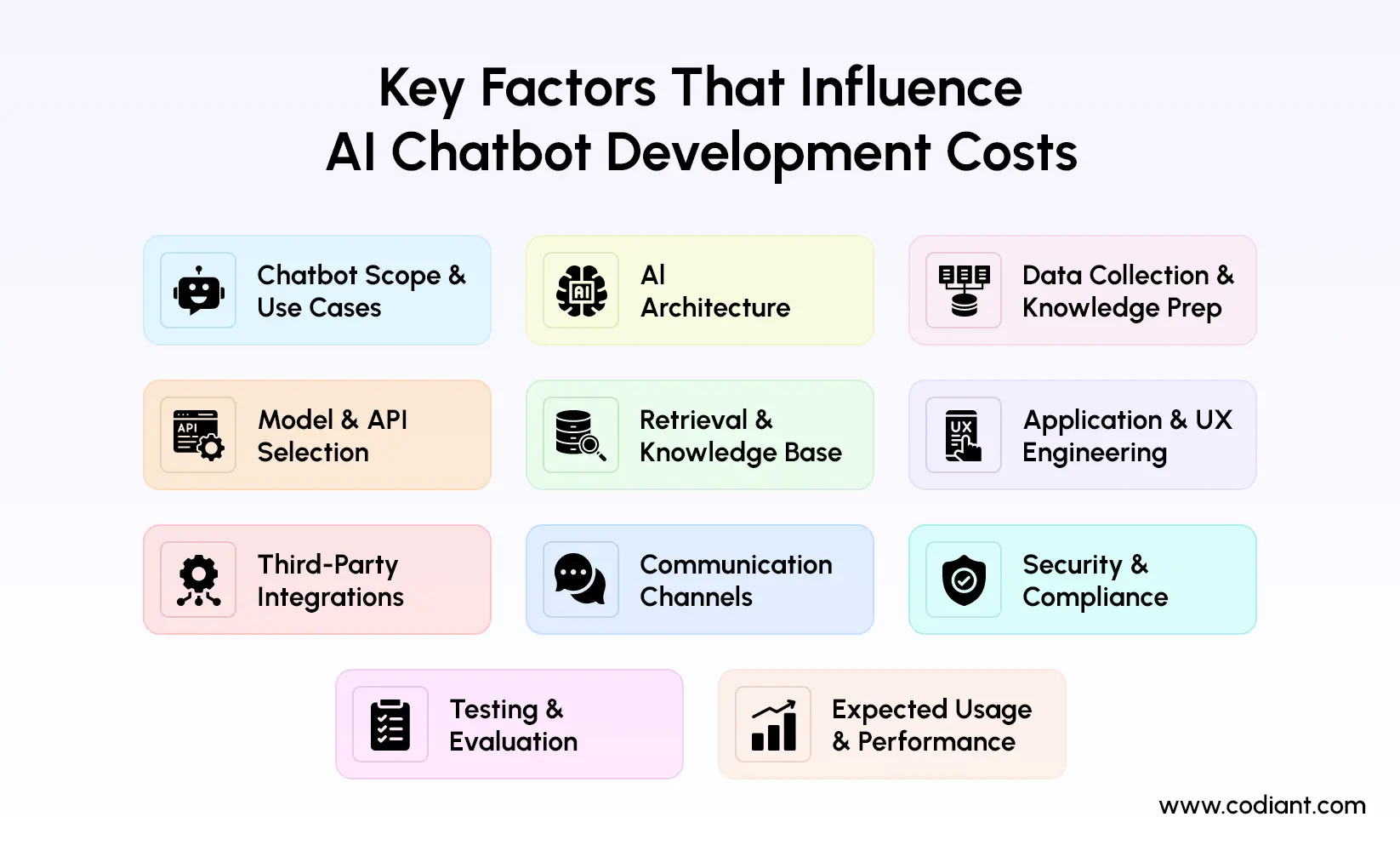
Two chatbots that appear similar to users may have very different costs behind the interface.
1. Chatbot Scope and Number of Use Cases
A chatbot answering ten approved FAQs is easier to develop than one expected to support sales, customer service, order management and employee assistance. Reviewing practical AI chatbot use cases for businesses can help stakeholders identify which workflows belong in the first release and which should be planned for later phases.
Every additional use case introduces more:
- Conversation paths
- Data sources
- permissions
- integrations
- failure conditions
- test scenarios
- reporting requirements
The first phase should therefore define what the chatbot will and will not do.
2. Rule-Based, Machine-Learning or Generative AI Architecture
A rule-based chatbot uses predefined logic. A machine-learning chatbot may classify intents and select approved responses. A generative AI chatbot creates responses dynamically using a large language model.
A rule-based chatbot uses predefined logic. A machine-learning chatbot may classify intents and select approved responses. A generative AI chatbot creates responses dynamically using a large language model. Businesses considering intent detection, sentiment analysis or context-aware responses should also understand how chatbots use natural language processing to interpret written or spoken user input.
Generative AI chatbot development generally costs more because the team must address:
- Prompt design
- Context management
- Retrieval quality
- Hallucination risks
- Model selection
- Token consumption
- Output moderation
- Evaluation
- Guardrails
- Response traceability
The cost is not simply the price of calling an AI model. The application must control how the model receives information, which actions it can perform and what happens when its confidence is low.
Also read: AI vs Generative AI vs Agentic AI: What Businesses Should Know in 2026
3. Data Collection, Cleaning and Knowledge Preparation
A chatbot cannot provide reliable business answers from disorganized, duplicated or outdated information.
Data preparation may include:
- Identifying authoritative sources
- Removing obsolete documents
- Converting unsupported formats
- Splitting content into retrievable sections
- Adding metadata
- Mapping access permissions
- Labelling test questions
- Creating expected answers
- Establishing update workflows
Poor source content can increase both initial development effort and long-term answer errors.
4. Model and API Selection
Businesses can use a commercial AI API, a managed cloud model or a self-hosted open model.
Commercial APIs reduce the infrastructure required to begin, but usage is billed according to factors such as input tokens, output tokens, model tier and tools used. OpenAI’s current API pricing, for example, differs substantially by model and processing option. Managed platforms such as Amazon Bedrock also vary pricing by model provider, modality and service tier.
A more powerful model is not automatically the most economical choice. Many systems route routine questions to smaller models and reserve advanced models for difficult requests.
5. Retrieval and Knowledge-Base Development
For business chatbots, retrieval quality often matters as much as the underlying language model.
The development team may need to configure:
- Embedding models
- Vector or hybrid search
- Metadata filtering
- Query rewriting
- Reranking
- Citations
- Document-level permissions
- Knowledge refresh schedules
- Fallback responses
A small public FAQ library may be straightforward. A knowledge base containing thousands of restricted documents across multiple departments requires deeper architecture and testing.
6. Application and User-Experience Engineering
A production chatbot requires more than an AI response endpoint.
Common application components include:
- Chat interface
- User authentication
- Conversation history
- File uploads
- Feedback controls
- Agent escalation
- Administrative dashboard
- Usage analytics
- Content management
- Notification workflows
- Mobile responsiveness
- Accessibility support
Custom interfaces and administration tools add development effort but can make the system easier to manage after launch.
7. Third-Party Integrations
Integrations allow a chatbot to perform work rather than only answer questions.
For example, it may:
- Create a CRM lead
- Check an order
- update a support ticket
- schedule an appointment
- retrieve an invoice
- verify account information
- initiate a refund request
- route a case to an employee
Each connection requires API analysis, authentication, field mapping, error handling, access control and testing. Legacy systems without reliable APIs may require middleware or custom connectors.
8. Communication Channels
A website chatbot is usually less complex than a multichannel assistant operating through:
- Mobile applications
- SMS
- Microsoft Teams
- Slack
- Social messaging
- Voice systems
- Contact-centre software
Channel providers may charge separately. Twilio, for example, currently lists its Conversations API from $0.05 per active user per month, while messaging fees vary by channel and destination.
9. Security and Compliance
Security requirements can materially increase the AI development solutions cost, especially in healthcare, finance, lms insurance, legal services, and government.
The scope may include:
- Encryption
- Single sign-on
- Multi-factor authentication
- Role-based access control
- Audit logging
- Data masking
- Retention controls
- Regional data processing
- Consent management
- Security testing
- Incident-response procedures
Data-residency requirements may also affect provider costs. For example, OpenAI’s API documentation states that eligible regional-processing endpoints for models released on or after March 5, 2026 carry a 10% uplift.
10. Testing and Evaluation
Traditional software testing checks whether features work. AI chatbot testing must also evaluate whether answers are relevant, supported, safe and consistent.
Evaluation can cover:
- Answer accuracy
- Retrieval relevance
- Citation correctness
- Unsupported claims
- Toxic or unsafe outputs
- Prompt-injection resistance
- Multilingual performance
- Response latency
- Escalation behaviour
- Cost per conversation
A chatbot intended for internal experimentation needs less formal evaluation than one giving customers financial, medical or contractual information.
11. Expected Usage and Performance
A chatbot supporting 500 conversations per month has different infrastructure requirements from one handling millions of messages.
The usage model should estimate:
- Monthly users
- Questions per user
- Average input length
- Average response length
- Retrieved context size
- Peak traffic
- Required response time
- Percentage of requests using advanced models
Without these assumptions, ongoing AI and cloud costs cannot be estimated accurately.
Build a Smarter Chatbot Without Overspending on Unnecessary Features Today
Build a Smarter Chatbot Without Overspending on Unnecessary Features Today
What is the Difference Between a Rule-based Chatbot and an AI Chatbot?
A rule-based chatbot follows predefined scripts, while an AI chatbot interprets natural-language questions and generates or retrieves responses dynamically.
A rule-based chatbot follows predefined scripts, while an AI chatbot interprets natural-language questions and generates or retrieves responses dynamically. The distinction becomes broader when comparing chatbots and conversational AI, as conversational AI may combine intent recognition, contextual understanding, machine learning and multichannel interactions within a larger system.
| Area | Rule-based chatbot | AI chatbot |
| Conversation method | Buttons, keywords and fixed flows | Natural-language understanding |
| Answers | Prewritten responses | Retrieved or generated responses |
| Flexibility | Limited to planned scenarios | Can handle varied phrasing |
| Knowledge updates | Manual flow changes | Knowledge-base updates or retraining |
| Development cost | Generally lower | Generally higher |
| Risk | Missed intent or dead ends | Incorrect or unsupported answers |
| Best use | Simple, predictable tasks | Complex support and knowledge access |
A rule-based chatbot may be the better investment when the business process is fixed and users need only a few choices. An AI chatbot is more appropriate when questions vary, information is distributed across many sources or the conversation requires context.
Many production systems use a hybrid approach: deterministic rules manage sensitive actions, while AI handles language understanding and knowledge retrieval.
What Customers Expect from AI-Powered Support in 2026?
- 74% of consumers expect customer service to be available 24/7.
- 88% expect businesses to respond faster than they did one year earlier.
- 83% believe customer experiences should be better than they currently are, despite growing AI adoption.
Source: Zendesk.com
How Long Does It Take to Build a Custom AI Chatbot?
A custom AI chatbot can take six weeks to twelve months, depending on scope. A focused proof of concept may be completed in three to six weeks, while an enterprise conversational AI system can require six months or longer.
| Development stage | Typical duration |
| Discovery and feasibility assessment | 1–3 weeks |
| Proof of concept | 3–6 weeks |
| AI chatbot MVP | 6–12 weeks |
| Custom RAG chatbot | 3–6 months |
| Enterprise platform | 6–12+ months |
A complete custom AI chatbot development process normally includes the following stages.
1. Product Discovery and AI Feasibility Assessment
The team defines users, use cases, success metrics, risks, knowledge sources, integration needs and expected usage.
This phase also determines whether AI is necessary. Some requirements can be solved more reliably with search, automation or rule-based workflows.
2. Data Collection, Cleaning and Labelling
Documents, databases and historical conversations are reviewed and prepared. The team identifies which information is authoritative and which content should not be available to the chatbot.
3. Model or API Selection
Candidate models are compared for answer quality, latency, cost, language support, data controls and tool-use capability.
4. Retrieval and Knowledge-Base Development
The team builds the pipeline that indexes information, retrieves relevant context and keeps knowledge current.
5. Application Engineering
Developers create the frontend, backend, authentication, administrative controls, analytics and conversation management.
6. Third-Party Integrations
The chatbot is connected to approved business systems, communication channels and human-support workflows.
7. Cloud Infrastructure
Development, testing and production environments are configured with monitoring, scaling, backups and deployment controls.
8. Security and Compliance
Access controls, encryption, logging, privacy requirements and security tests are implemented according to the chatbot’s data and industry.
9. Testing and Evaluation
The system is tested against representative user questions, difficult edge cases, prohibited requests and system failures.
10. Monitoring and Ongoing Optimization
After launch, the team reviews unanswered questions, retrieval failures, model behaviour, latency, user feedback and operating costs.
What is Included in an AI Chatbot Development Estimate?
A credible estimate should clearly state the included deliverables, excluded work and assumptions used to calculate the budget.
A typical estimate may include:
- Discovery workshops
- Use-case definition
- UX and conversation design
- Data-source assessment
- AI model integration
- Retrieval pipeline
- Web chat interface
- Backend development
- Selected system integrations
- Authentication
- Basic analytics
- Testing
- Cloud deployment
- Initial post-launch support
Possible exclusions include:
- Third-party licence fees
- Model-inference charges
- Cloud consumption
- Messaging fees
- Major data-cleaning work
- Translation services
- Security certification
- Legacy-system modernization
- Continuous content management
- Hardware
- 24/7 support
The estimate should also document assumptions such as monthly conversation volume, number of languages, number of integrations, response-time target and availability of APIs.
Without a defined scope, we cannot confirm an accurate AI chatbot development cost.
How Much Do AI Chatbot Integrations Cost?
A straightforward integration with a well-documented system may add approximately $3,000–$15,000, while complex CRM, ERP or legacy-system integrations can add $15,000–$50,000 or more per system.
These are planning estimates based on approximately 60–500 hours at $50–$99 per hour.
Integration costs depend on:
- API availability
- Authentication method
- Data complexity
- Read-only or write access
- Number of workflows
- Real-time synchronization
- Error-handling requirements
- Security review
- Sandbox availability
- Vendor approval processes
Retrieving a customer’s order status is simpler than allowing the chatbot to modify orders, issue credits and record the complete action history.
What Ongoing Costs Follow the Initial Development?
The initial build is only one part of business AI chatbot pricing. Businesses should also budget for models, cloud infrastructure, messaging services, monitoring, maintenance and knowledge updates.
1. AI Model Usage
Model costs depend on the selected provider, input size, output size, caching, reasoning requirements and usage volume. Providers regularly update model options and prices, so calculations should use current official pricing when the project is scoped.
2. Cloud and Data Infrastructure
Ongoing infrastructure may include:
- Application hosting
- Databases
- Vector storage
- Search services
- Logging
- Monitoring
- Backups
- Content processing
- Network traffic
3. Messaging and Channel Charges
WhatsApp, SMS, voice and contact-centre providers may charge by message, user, conversation or minute. These charges should remain separate from the software-development quote because they change with usage.
4. Maintenance and Optimization
A reasonable planning allowance for continued engineering, testing and updates is often 15%–25% of the initial development budget per year. However, this percentage is an estimate, not a universal standard.
A chatbot processing changing business information may require more frequent work than a stable internal assistant.
Is Investing in an AI Chatbot Worth It for Businesses?
An AI chatbot can be worth the investment when it solves a high-volume, measurable problem and its expected value exceeds development and operating costs.
The business case should not depend only on whether the chatbot can answer questions. It should connect chatbot performance to an operational outcome.
Useful metrics include:
- Support requests automated
- Average handling time reduced
- Leads qualified
- Conversion rate
- Agent workload
- Resolution rate
- Customer wait time
- Employee search time
- Cost per resolved conversation
- Escalation rate
- Answer accuracy
Simple AI Chatbot ROI Formula
Use the following framework:
Annual benefit = labour savings + incremental revenue + avoided operating costs
Annual net benefit = annual benefit − annual chatbot operating cost
ROI percentage = annual net benefit ÷ initial investment × 100
For example, assume a chatbot:
- Avoids $120,000 in annual support costs
- Generates $30,000 in additional annual gross profit
- Costs $40,000 annually to operate
- Requires a $100,000 initial investment
Calculation:
- Annual benefit = $120,000 + $30,000 = $150,000
- Annual net benefit = $150,000 − $40,000 = $110,000
- First-year ROI = $110,000 ÷ $100,000 × 100
- First-year ROI = 110%
This is an illustrative calculation, not a forecast. A real business case must use verified internal volumes, labour costs, expected adoption and measured chatbot performance.
How Can Businesses Reduce AI Chatbot Development Costs?
Businesses can reduce costs by narrowing the first release, using existing models, prioritizing high-value integrations and measuring performance before expanding.
1. Start With One Defined Use Case
“Build an AI chatbot for customer service” is too broad.
A more manageable scope would be:
Build a chatbot that answers delivery, return and warranty questions using approved support documents, then transfers unresolved conversations to an agent.
A focused problem reduces data, integration and testing requirements.
2. Build an MVP Before an Enterprise Platform
An MVP can validate:
- User adoption
- Answer quality
- Retrieval performance
- Escalation needs
- Cost per conversation
- Integration value
The evidence can then guide investment in additional features.
3. Use Existing Foundation Models
Training a general-purpose large language model from the beginning is unnecessary for most businesses. Existing commercial or open models can be connected to company knowledge and tools.
4. Control Retrieved Context
Sending excessive information to the model increases token consumption and may reduce answer quality. Better indexing, filtering and reranking can make retrieval more efficient.
5. Route Requests by Complexity
Routine requests can be handled by lower-cost models. Complex or high-risk questions can be routed to advanced models or human employees.
6. Prioritize Integrations
Connect only the systems required for the first business outcome. Additional integrations can be introduced after the core workflow performs reliably.
7. Define Success Before Development
Clear metrics prevent teams from spending money on features that cannot be tied to user or business value.
How Should Businesses Select an AI Chatbot Development Company?
An AI chatbot development company should be evaluated on its ability to define the use case, prepare business data, select the right architecture, integrate existing systems, evaluate AI responses and support the product after launch. Businesses comparing providers can review the scope typically covered under AI chatbot development services, including strategy, conversation design, knowledge-base development, CRM integration, deployment and continuous optimization. Ask potential providers to explain:
- How the estimate was calculated
- What is included and excluded
- Which assumptions affect the quote
- How model and vendor lock-in will be managed
- How answers will be evaluated
- How data permissions will be enforced
- How unsupported responses will be handled
- How operating costs will be monitored
- Who owns the source code and data
- What support is included after deployment
A low initial quote may exclude data preparation, production infrastructure, evaluation, security work or post-launch optimization. Compare scope, assumptions and expected deliverables rather than comparing the headline price alone.
Plan Your AI Chatbot Around Business Value, Not Features
The chatbot development cost in 2026 can range from a few thousand dollars for a controlled rule-based bot to more than $300,000 for a secure enterprise conversational AI platform.
The price becomes easier to justify when the chatbot has:
- A specific user problem
- Approved knowledge sources
- Measurable success criteria
- Defined system integrations
- Realistic usage assumptions
- Clear security requirements
- A phased delivery roadmap
Before selecting a model or development platform, determine which conversations should be automated, what information the chatbot may access and what measurable result the business expects.
Build a Costed Roadmap for Your AI Chatbot
Codiant’s AI chatbot development services can help assess feasibility, define the architecture and estimate the investment based on your data, integrations, security needs and expected usage.
The Author

Frequently Asked Questions
The biggest cost drivers are custom knowledge retrieval, CRM or ERP integrations, multilingual support, voice capabilities, advanced security, human-agent handover and transactional workflows. Features that access sensitive data or change business records require additional permissions, error handling, audit logging and testing.
A simple, well-documented integration may add approximately $3,000–$15,000, while a complex or legacy-system integration may add $15,000–$50,000 or more. These are indicative estimates based on integration effort; we cannot confirm an exact cost without reviewing the APIs, workflows, data fields and security requirements.
An off-the-shelf chatbot is suitable for standard FAQs, basic lead capture and rapid deployment. A custom AI chatbot is more appropriate when the business needs proprietary knowledge, differentiated workflows, multiple integrations, strict access controls or control over the user experience and architecture.
Companies can begin with one high-value use case, use an existing foundation model, limit initial integrations and launch an MVP before adding enterprise features. Costs can also be controlled through model routing, prompt caching, efficient retrieval and ongoing monitoring of cost per successful conversation.
Ongoing costs may include AI-model usage, hosting, vector storage, monitoring, messaging channels, knowledge-base updates, security patches and engineering support. A preliminary maintenance allowance may be 15%–25% of the initial build cost annually, but actual operating costs depend on usage, architecture and support requirements.
Featured Blogs
Read our thoughts and insights on the latest tech and business trends
HIPAA-Compliant App Development in 2026: How to Build Securely and Avoid Preventable Fines
- September 4, 2026
- Mobile App Development
HIPAA-compliant app development in 2026 requires six foundations: complete ePHI mapping, documented risk analysis, role-based access, encryption, signed business associate agreements, and continuous security monitoring. This matters most to healthcare CTOs, product leaders, and compliance... Read more
AI Developer Engagement Models Explained: How to Choose the Right AI Team
- August 27, 2026
- Artificial Intelligence
AI developer engagement model means deciding how external AI specialists will be assigned, managed, paid and held accountable. The main options are dedicated AI developers, AI team augmentation, time-and-material delivery, fixed-price projects and end-to-end AI... Read more
Enterprise Mobile App Development: How It Can Accelerate Your Business Growth
- August 21, 2026
- Mobile App Development
Enterprise mobile app development can accelerate growth by improving three measurable areas: workflow speed, access to business systems, and customer or employee service delivery. This matters to mid-market and enterprise leaders managing distributed teams, manual... Read more