Conversational AI in Healthcare: Benefits and Use Cases
Table of Contents
Subscribe To Our Newsletter

Summarize with AI
Not enough time? get the key points instantly.
Conversational AI in healthcare uses artificial intelligence to help patients, care teams, and administrative staff communicate through chat, voice, or messaging interfaces: answering routine questions, scheduling appointments, sending medication reminders, and reducing repetitive administrative work.
Why it matters: Healthcare organizations using conversational AI report up to 40% reduction in administrative call volume, while patient satisfaction scores improve due to faster, 24/7 response times.
From guiding a patient to the right service, to helping a billing team handle routine queries, these systems reduce friction without replacing the clinicians and staff at the heart of care.
The goal is not to replace doctors or nurses. The goal is to make healthcare communication faster, more consistent, and easier to manage across digital channels.
In a Nutshell
- Conversational AI helps automate patient communication and routine healthcare workflows.
- Healthcare AI chatbots support appointment booking, FAQs, reminders, and triage guidance.
- AI virtual assistants can help care teams reduce repetitive administrative tasks.
- HIPAA compliance depends on architecture, safeguards, vendor agreements, and data handling.
- EHR and EMR integration improves personalization, but increases security complexity.
- Conversational AI should support clinicians, not make unsupervised medical decisions.
- Development cost depends on scope, integrations, compliance, and AI model complexity.
What is Conversational AI in Healthcare?
Conversational AI in healthcare refers to AI-powered chat or voice systems that understand patient requests and respond through natural language. These systems can help users find information, complete administrative tasks, receive care instructions, and connect with the right healthcare service.
A basic healthcare AI chatbot may answer frequently asked questions. A more advanced AI virtual assistant for healthcare can integrate with appointment systems, EHR or EMR platforms, patient portals, billing tools, and care-management workflows.
Conversational AI usually combines:
- Natural language processing
- Machine learning
- Large language models
- Intent recognition
- Workflow automation
- Secure system integrations
- Human handoff rules
- Analytics and monitoring
For example, a patient may ask, “Can I reschedule my appointment?” The AI assistant identifies the request, checks available slots, confirms the patient’s choice, updates the scheduling system, and sends a confirmation message.
That is different from a static FAQ bot. Conversational AI can understand intent, maintain context, and complete multi-step workflows when it is designed properly.
How Does Conversational AI Work in Healthcare?
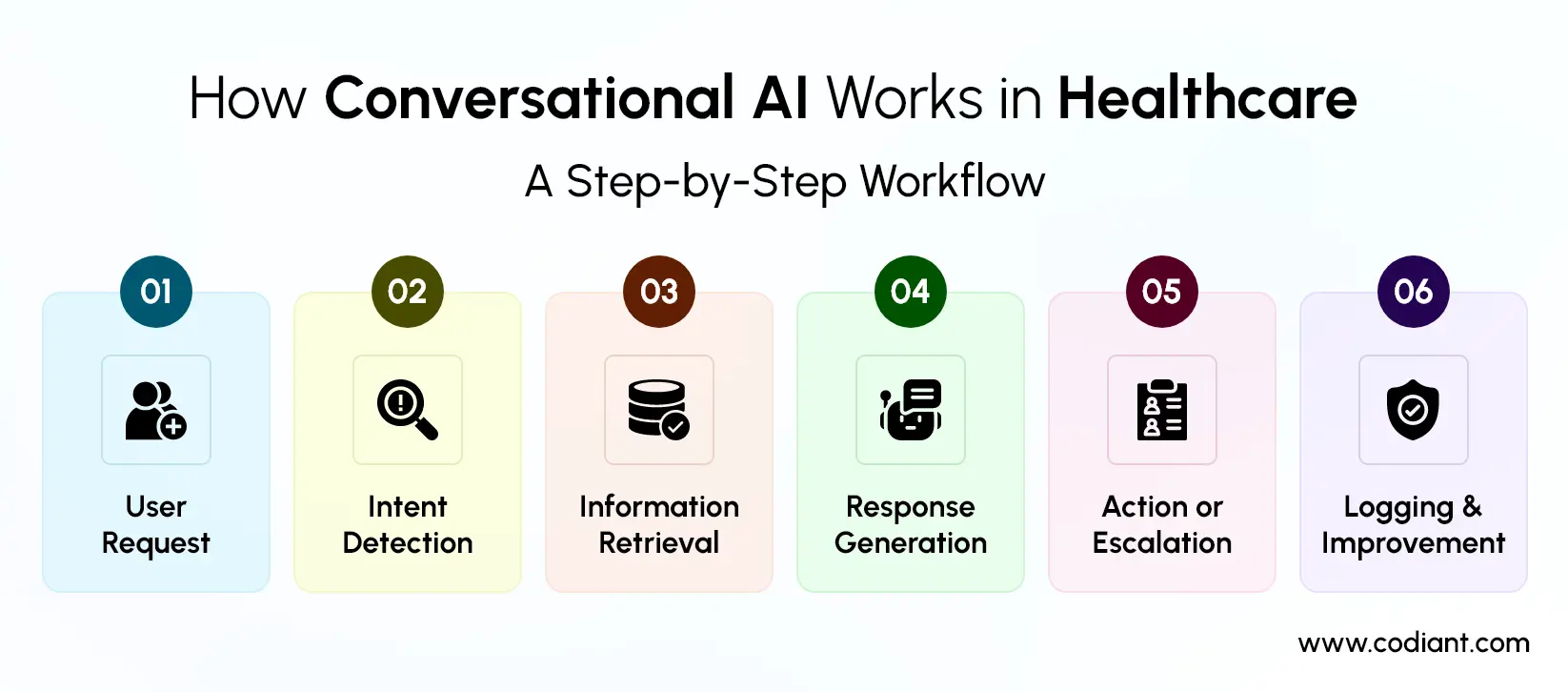
Conversational AI in healthcare works by receiving a patient or staff request, identifying the intent, retrieving the right information, and responding through a secure digital interface. When connected to backend systems, it can also perform approved actions such as booking appointments, sending reminders, or creating support tickets.
A typical conversational AI workflow includes:
- The user sends a question through chat, voice, SMS, WhatsApp, app, or patient portal.
- The AI system detects the user’s intent.
- The system checks approved knowledge sources or connected healthcare systems.
- The AI generates or selects a response.
- The system completes a workflow or escalates to a human team member.
- The interaction is logged for quality, compliance, and improvement.
In healthcare, the response process must be more controlled than in general customer service. A healthcare conversational AI solution should use approved medical content, clear escalation rules, audit logs, access controls, and privacy safeguards.
For clinical or high-risk conversations, the assistant should not act as an independent medical decision-maker. It should provide approved guidance, collect information, support navigation, and escalate when symptoms, urgency, or uncertainty require human review.
Why Is Conversational AI Becoming Important in Healthcare?
Conversational AI is becoming important in healthcare because patients expect faster digital access, while providers face rising administrative workloads. AI-powered patient engagement can help organizations respond consistently across routine requests without adding more pressure on front-desk, call-center, and clinical support teams.
Healthcare communication often involves repeated questions:
- What are your clinic hours?
- Can I book an appointment?
- Do you accept my insurance?
- How should I prepare for this test?
- Can I get a medication reminder?
- Where can I find my lab report?
- When should I contact a doctor?
These questions are important, but they do not always require live staff intervention. A healthcare AI chatbot can answer approved questions instantly and route complex cases to the right person.
The strongest use case is not replacing human care. It is reducing avoidable delays, missed follow-ups, manual coordination, and repetitive communication.
Did You Know?
In Rock Health’s 2025 Consumer Adoption of Digital Health Survey, 32% of U.S. adults reported using AI chatbots to find health information, up from 16% in 2024. The survey included 8,000 U.S. Census-matched adults.
Source: Fiercehealthcare.com
What Are the Benefits of Conversational AI in Healthcare?
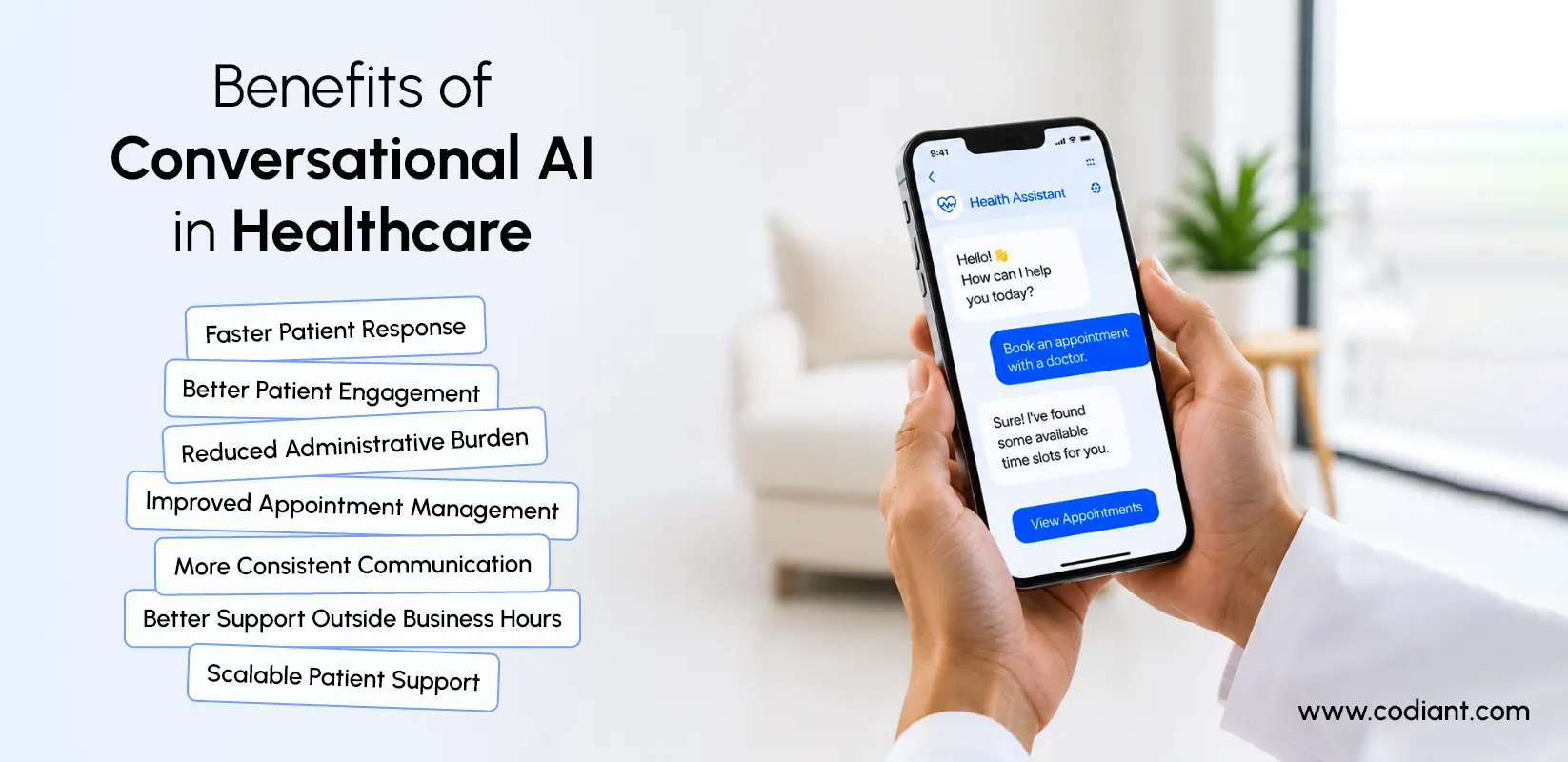
Conversational AI benefits healthcare providers by improving patient access, reducing administrative workload, standardizing communication, and supporting faster response times. It can also help patients complete routine tasks without waiting on phone lines or navigating complex portals.
1. Faster Patient Response
Conversational AI can answer routine patient questions immediately. This is useful for appointment queries, clinic hours, preparation instructions, prescription refill steps, billing questions, and basic service navigation.
Fast responses matter because delays often lead to missed appointments, repeated calls, and lower patient satisfaction.
2. Better Patient Engagement
AI-powered patient engagement helps healthcare organizations stay connected with patients before, during, and after care. The assistant can send reminders, follow-up messages, care instructions, and check-in prompts.
For example, a clinic can use conversational AI to remind patients about upcoming appointments, confirm attendance, send pre-visit instructions, and collect basic intake details.
Physicians Are Already Using AI at Work
In the American Medical Association’s 2026 Physician Survey on Augmented Intelligence, 81% of physicians reported using AI in their practices, more than double the 38% reported in 2023.
3. Reduced Administrative Burden
Healthcare staff spend significant time handling repetitive communication. Conversational AI can reduce the volume of routine calls, emails, and portal messages by automating common requests.
This gives staff more time for higher-value work such as patient coordination, complex billing support, referral management, and care-team communication.
4. Improved Appointment Management
A healthcare AI chatbot can support appointment booking, rescheduling, cancellation, waitlist updates, and reminders. When integrated with scheduling software, it can check availability and confirm slots automatically.
This reduces manual coordination and helps limit avoidable no-shows.
5. More Consistent Communication
Patients often receive inconsistent answers when information is scattered across departments. A healthcare conversational AI solution can use approved knowledge sources to provide standardized responses.
This improves clarity for patients and reduces the risk of conflicting instructions.
6. Better Support Outside Business Hours
Patients may need help after clinic hours. Conversational AI can provide 24/7 support for non-emergency questions, appointment requests, location details, insurance FAQs, and preparation instructions.
For urgent symptoms or high-risk situations, the assistant should clearly direct the patient to emergency care or human support based on approved escalation rules.
7. Scalable Patient Support
Healthcare organizations can use conversational AI to support large patient volumes across multiple locations, languages, and channels. This is especially useful for hospital networks, telehealth providers, diagnostic labs, pharmacies, and specialty clinics.
Scalability should not come at the cost of safety. Responses must remain controlled, monitored, and compliant.
How Much Does It Cost to Develop a Healthcare Conversational AI Platform?
The cost of developing a healthcare conversational AI platform depends on scope, channels, AI model complexity, compliance requirements, integrations, content preparation, and deployment environment. A simple healthcare FAQ chatbot costs much less than an enterprise conversational AI platform integrated with EHR, scheduling, billing, and patient portals.
Typical cost ranges may look like this:
| Platform Type | Typical Scope | Estimated Cost |
| Basic healthcare FAQ chatbot | FAQs, clinic information, simple routing | $10,000–$30,000 |
| Appointment and intake chatbot | Scheduling, forms, reminders, CRM or calendar integration | $30,000–$80,000 |
| AI virtual assistant for healthcare | Multi-step workflows, patient engagement, secure dashboard | $80,000–$180,000 |
| Enterprise healthcare conversational AI platform | EHR/EMR integration, compliance controls, analytics, multi-location support | $180,000–$400,000+ |
These are planning estimates, not fixed prices. Without a defined scope, integrations, compliance requirements, and support model, we cannot confirm an accurate project cost.
Major cost factors include:
- Number of user roles
- Number of channels
- Conversation complexity
- AI model selection
- Knowledge-base preparation
- EHR or EMR integration
- Scheduling integration
- Billing integration
- Authentication requirements
- HIPAA compliance planning
- Testing and validation
- Admin dashboard
- Analytics and reporting
- Maintenance and monitoring
The most expensive part is often not the chatbot interface. It is the secure integration, workflow design, compliance review, and operational testing behind it.
Read more: Cost of AI in Healthcare: Development, Integration & Implementation Guide
Conversational AI vs Healthcare Chatbot vs Healthcare Virtual Assistant
Conversational AI, healthcare chatbots, and healthcare virtual assistants are related, but they are not identical. A chatbot usually handles limited conversations. A virtual assistant can complete broader workflows. Conversational AI is the underlying technology that enables natural language interaction.
| Term | Meaning | Healthcare Example |
| Healthcare chatbot | A chat interface for limited questions or workflows | Answering clinic FAQs |
| Conversational AI | AI technology that understands and responds in natural language | Understanding appointment requests |
| AI virtual assistant for healthcare | A broader assistant that completes multi-step workflows | Scheduling visits, collecting intake, sending reminders |
| AI patient support solution | A patient-facing support system powered by automation and AI | Post-discharge check-ins and medication reminders |
For most healthcare organizations, the best starting point is a focused chatbot with clear workflows. The system can then evolve into a broader AI virtual assistant after the organization validates value, safety, and adoption.
Conversational AI Healthcare Use Cases
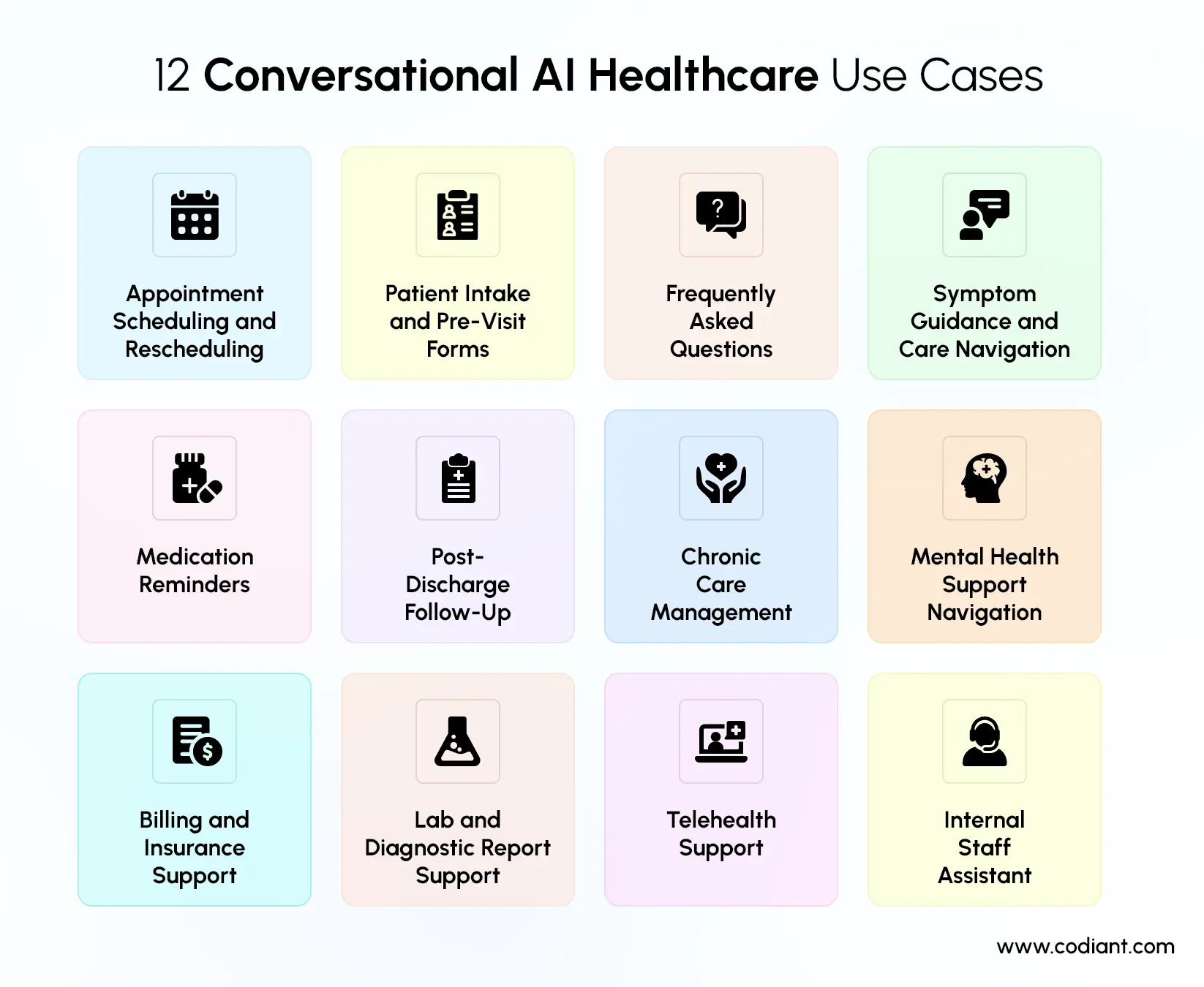
Conversational AI healthcare use cases include appointment scheduling, patient intake, symptom guidance, medication reminders, billing support, post-care follow-up, chronic care engagement, and internal staff assistance. The best use cases are repetitive, high-volume, rule-based, and supported by approved data sources.
1. Appointment Scheduling and Rescheduling
Appointment scheduling is one of the most practical healthcare conversational AI use cases. Patients can ask for available slots, choose a date, confirm the appointment, reschedule if needed, and receive automated reminders.
A scheduling assistant can support:
- New appointment booking
- Follow-up visit scheduling
- Rescheduling requests
- Appointment cancellation
- Waitlist management
- Doctor or department selection
- Reminder notifications
This use case works best when the AI assistant integrates with the provider’s scheduling system.
2. Patient Intake and Pre-Visit Forms
Conversational AI can collect patient intake information before a visit. It can ask structured questions about demographics, symptoms, allergies, medications, insurance details, and visit reason.
This helps clinics reduce front-desk delays and gives care teams more complete information before the appointment.
However, intake automation must be designed carefully. The assistant should not make clinical judgments unless it follows approved triage protocols and includes human review where required.
How a U.S. Health System Made Patient Navigation Conversational
Context: Providence needed a simpler way for patients to navigate digital care, support, billing, records, and appointment-related tasks without relying only on phone-based assistance.
Implementation: Providence launched Grace, an AI-powered chatbot inside the Providence mobile app after patient login. Grace answers questions and guides users to care and support options based on their needs.
Core Capabilities:
- Secure, personalized patient messaging
- Appointment support
- Lab and test-result navigation
- Health-record access guidance
- Bill payment support
- Financial-assistance eligibility guidance
Operational Value: Grace helps reduce patient navigation friction by moving users from general questions to the right digital or care pathway through a conversational interface.
Verified Outcome: Providence confirms Grace is a patient-facing navigation assistant. Public sources do not confirm a specific ROI figure, so ROI should not be claimed.
Source: Providence
3. Frequently Asked Questions
A healthcare AI chatbot can answer common questions about services, locations, timings, accepted insurance, preparation instructions, test requirements, billing steps, and telehealth access.
FAQ automation is a strong starting point because it is low-risk compared with complex clinical workflows.
Good FAQ topics include:
- Clinic hours
- Location and directions
- Accepted payment methods
- Insurance participation
- Prescription refill process
- Lab test preparation
- Telehealth setup
- Medical record request process
4. Symptom Guidance and Care Navigation
Conversational AI can guide patients toward the right care pathway by asking structured questions and recommending next steps based on approved protocols. It may suggest contacting a doctor, booking a primary care visit, visiting urgent care, or seeking emergency help.
This is not the same as diagnosis. A safe healthcare AI chatbot should avoid presenting itself as a doctor. It should provide navigation support and escalate uncertain or high-risk cases.
For example, if a patient reports chest pain, breathing difficulty, severe bleeding, or stroke-like symptoms, the assistant should direct the patient to emergency services immediately.
5. Medication Reminders
Conversational AI can help patients follow medication schedules by sending reminders, collecting confirmation, and escalating missed doses based on care-program rules.
This use case is common in chronic care, post-discharge recovery, elderly care, and long-term treatment plans.
Medication reminders can support:
- Dose timing
- Refill prompts
- Side-effect check-ins
- Adherence tracking
- Care-team alerts
- Patient education
The assistant should not change dosage instructions or provide medication advice outside approved clinical content.
6. Post-Discharge Follow-Up
Hospitals and clinics can use conversational AI to follow up with patients after discharge or procedures. The assistant can ask about recovery progress, confirm medication adherence, remind patients about follow-up visits, and identify warning signs.
Post-discharge AI patient support solutions can help reduce communication gaps between hospital visits and home recovery.
Useful follow-up questions may include:
- Are you experiencing new symptoms?
- Did you start your prescribed medication?
- Do you understand your discharge instructions?
- Do you need help scheduling a follow-up visit?
- Are you having difficulty reaching the care team?
High-risk responses should be routed to clinical staff.
7. Chronic Care Management
Conversational AI can support chronic care programs by checking in with patients regularly, collecting self-reported data, sending reminders, and encouraging adherence to care plans.
This can be useful for conditions such as diabetes, hypertension, asthma, heart disease, and post-surgical recovery.
The AI assistant can help patients stay engaged between visits, but it should not replace clinician-led care management.
8. Mental Health Support Navigation
Conversational AI can help users find mental health resources, book appointments, complete screening forms, and access crisis-support information.
This area requires extra caution. Mental health conversations can involve risk, vulnerability, and emergency situations. A healthcare conversational AI solution used for mental health should include crisis escalation, clear disclaimers, human handoff, and clinically reviewed content.
9. Billing and Insurance Support
Patients often contact healthcare organizations with billing and insurance questions. Conversational AI can explain payment options, collect billing inquiries, guide patients to financial assistance information, and route complex claims questions to the billing team.
The assistant can support:
- Insurance FAQ
- Payment links
- Invoice explanation
- Claim status guidance
- Prior authorization status
- Billing ticket creation
Billing workflows may involve protected health information, so access control and secure authentication are important.
10. Lab and Diagnostic Report Support
Conversational AI can notify patients when reports are available, explain how to access them, and route clinical interpretation questions to the care team.
The assistant should not interpret sensitive diagnostic results unless the organization has approved specific content and escalation workflows.
A safer design is:
- Notify the patient that the report is available
- Explain how to access it
- Offer to schedule a follow-up consultation
- Escalate interpretation questions to a clinician
11. Telehealth Support
Conversational AI can help patients prepare for virtual visits. It can send appointment links, check device readiness, answer setup questions, and collect pre-visit information.
Telehealth support assistants can reduce missed virtual visits caused by login issues, unclear instructions, or incomplete pre-visit steps.
12. Internal Staff Assistant
Conversational AI can also support healthcare staff. An internal assistant can help employees find policies, check standard operating procedures, retrieve approved templates, summarize non-clinical documents, and route operational questions.
Internal assistants should be permission-aware. A nurse, billing specialist, administrator, and physician may need different access levels.
For example, Codiant built Scribeflo, an AI-powered medical scribe platform that supports clinicians by capturing patient conversations, transcribing real-time clinical notes, and generating structured SOAP notes. This fits conversational AI in healthcare because it uses voice-based interaction, AI transcription, contextual understanding, and workflow automation to reduce manual documentation during and after consultations. According to Codiant’s Scribeflo case study, the platform helped save 60% documentation time and enabled 4x faster note generation.
Can AI Chatbots Be Used in Hospitals and Clinics?
Yes, AI chatbots can be used in hospitals and clinics when they are designed with proper safeguards, approved content, secure integrations, and human escalation. They are most effective for administrative support, patient engagement, appointment workflows, care navigation, and routine communication.
Hospitals and clinics can use conversational AI across:
- Websites
- Mobile apps
- Patient portals
- Call centers
- SMS
- Voice assistants
- Telehealth platforms
- Internal staff systems
The use case determines the risk level. A chatbot that answers parking questions is low risk. A chatbot that provides symptom guidance or post-discharge monitoring requires stronger clinical oversight, auditability, and escalation rules.
How Does Conversational AI Improve Patient Engagement?
Conversational AI improves patient engagement by making healthcare communication more timely, personalized, and accessible. It helps patients receive reminders, ask questions, complete forms, follow care instructions, and stay connected between appointments.
Patient engagement often fails because healthcare communication is fragmented. Patients may miss calls, ignore portals, forget instructions, or delay follow-ups.
AI-powered patient engagement can help by:
- Sending appointment reminders
- Collecting pre-visit information
- Sharing preparation instructions
- Following up after visits
- Supporting medication adherence
- Answering routine questions
- Routing urgent concerns
- Helping patients access records
The best engagement systems are proactive. They do not wait for the patient to search for information. They deliver the right message at the right time through the right channel.
What Are the Benefits of Conversational AI for Healthcare Providers?
Conversational AI helps healthcare providers reduce repetitive workload, improve access, support patient communication, and create more efficient digital workflows. It can improve operational consistency across departments while allowing staff to focus on complex patient needs.
Provider benefits include:
| Benefit | How Conversational AI Helps |
| Lower call volume | Automates common patient questions and appointment requests |
| Faster service | Responds instantly to routine inquiries |
| Better scheduling | Supports booking, rescheduling, reminders, and waitlists |
| Improved documentation | Captures structured patient information before visits |
| Higher consistency | Uses approved scripts and knowledge sources |
| Better follow-up | Sends automated reminders and post-care check-ins |
| Staff productivity | Reduces repetitive administrative work |
| Patient satisfaction | Improves access to timely support |
The measurable impact depends on workflow design, adoption, integration quality, and staff training. Without proper planning, even a technically strong chatbot may fail to improve operations.
Is Conversational AI HIPAA Compliant?
Conversational AI is not automatically HIPAA compliant. A healthcare conversational AI solution can support HIPAA compliance only when it is designed with appropriate administrative, physical, and technical safeguards for electronic protected health information.
For U.S. healthcare organizations, HIPAA compliance depends on how the system collects, stores, transmits, accesses, and shares protected health information. It also depends on whether the vendor acts as a business associate and signs a Business Associate Agreement where required.
Important HIPAA-related safeguards include:
- Role-based access control
- User authentication
- Encryption in transit and at rest
- Audit logs
- Secure data storage
- Minimum necessary data use
- Vendor risk management
- Business Associate Agreements
- Incident response planning
- Data retention and deletion policies
- Human review for sensitive workflows
A chatbot can be compliant in one implementation and non-compliant in another. The difference is architecture, governance, contracts, data handling, and operational controls.
For healthcare teams planning voice-based patient support, the same privacy controls should also apply to HIPAA-compliant AI voice agents for healthcare, especially when conversations involve protected health information, appointment details, or care-related instructions.
Myth vs Fact
Myth: Any healthcare chatbot using AI is automatically HIPAA compliant.
Fact: Conversational AI is HIPAA compliant only when the implementation includes required safeguards for electronic protected health information, such as access controls, audit controls, integrity controls, authentication, and transmission security. HHS states that the HIPAA Security Rule requires administrative, physical, and technical safeguards for ePHI.
Can Conversational AI Integrate With EHR and EMR Systems?
Yes, conversational AI can integrate with EHR and EMR systems when proper APIs, interoperability standards, authentication, and permission controls are in place. Integration allows the assistant to support more personalized workflows such as appointment updates, intake forms, lab notifications, and care-plan reminders.
Common integration targets include:
- EHR and EMR systems
- Patient portals
- Scheduling software
- CRM platforms
- Billing systems
- Telehealth platforms
- Pharmacy systems
- Lab information systems
- Helpdesk tools
- Analytics dashboards
EHR integration increases value, but it also increases risk. The assistant must access only the minimum required data, follow user permissions, maintain audit logs, and avoid exposing sensitive information through unsecured channels.
For many organizations, the safest approach is phased integration:
- Start with approved FAQ and appointment workflows.
- Add authenticated patient interactions.
- Integrate scheduling and intake.
- Connect EHR or EMR workflows.
- Add analytics and care-program automation.
- Expand only after security and clinical review.
What Healthcare Processes Can Be Automated Using AI Chatbots?
Healthcare AI chatbots can automate routine, repetitive, and rules-based processes that do not require complex clinical judgment. The best candidates are workflows with clear inputs, approved responses, and defined escalation paths.
Automatable healthcare processes include:
- Appointment booking
- Appointment reminders
- Patient intake
- FAQ responses
- Insurance eligibility guidance
- Billing inquiries
- Prescription refill requests
- Lab report availability alerts
- Post-discharge check-ins
- Telehealth setup support
- Care-plan reminders
- Patient satisfaction surveys
- Referral status updates
- Helpdesk ticket creation
- Staff policy lookup
Clinical decision-making should not be automated without strict governance. If a workflow can affect diagnosis, treatment, medication, or emergency response, it needs clinical validation, human oversight, and clear accountability.
How to Build a Healthcare Conversational AI Solution?
Building a healthcare conversational AI solution requires more than chatbot development. It requires healthcare workflow understanding, compliance planning, secure architecture, medical content governance, integration strategy, and ongoing monitoring.
Before development begins, many organizations benefit from choosing the right healthcare software development company that understands patient workflows, compliance needs, secure integrations, and clinical handoff requirements.
A practical development process includes:
Step 1: Define the Use Case
Start with one clear problem. Examples include reducing appointment calls, automating intake, improving post-discharge follow-up, or supporting telehealth onboarding.
Do not begin by asking, “Which AI model should we use?” Begin by asking, “Which healthcare workflow needs better communication?”
Step 2: Identify Users and Risk Level
Define whether the assistant will serve patients, doctors, nurses, billing staff, support teams, or administrators.
Then classify the risk level:
- Low risk: clinic hours, parking, location, general FAQs
- Medium risk: scheduling, intake, billing, medication reminders
- High risk: symptom guidance, post-discharge monitoring, mental health support
Risk level affects compliance, review, escalation, and testing requirements.
Step 3: Build the Knowledge Base
A healthcare AI chatbot should use approved and regularly updated content. This may include service pages, clinic policies, care instructions, FAQs, insurance information, and patient education material.
Unverified content should not be used for clinical or patient-facing responses.
Step 4: Design Conversation Flows
Conversation design should include:
- User intents
- Expected questions
- Clarifying prompts
- Safe fallback responses
- Escalation triggers
- Human handoff
- Emergency instructions
- Authentication points
- Data capture rules
Good healthcare conversation design is precise, not overly casual. It should be helpful without sounding like it is replacing medical judgment.
Step 5: Choose the AI Architecture
The architecture may include rule-based flows, retrieval-augmented generation, large language models, or a hybrid approach.
A common healthcare architecture combines:
- Rule-based workflows for sensitive actions
- Approved knowledge retrieval for informational responses
- LLM support for natural language understanding
- Human escalation for uncertain or high-risk conversations
This hybrid model gives the organization better control than relying entirely on open-ended AI responses.
For advanced workflows, healthcare organizations may need AI development solutions that combine secure integrations, workflow automation, retrieval systems, human review, and model governance within one controlled architecture.
Step 6: Integrate Healthcare Systems
System integration allows the assistant to complete real workflows. Depending on the use case, integrations may include scheduling, EHR or EMR, CRM, billing, telehealth, and notification systems.
Integration should follow least-privilege access. The assistant should only access the data needed to complete the approved task.
Step 7: Add Security and Compliance Controls
Security cannot be added at the end. It must be designed into the system from the start.
Core controls include encryption, access management, audit logs, secure APIs, authentication, data minimization, monitoring, and incident response processes.
Step 8: Test with Real Scenarios
Testing should include normal questions, edge cases, confusing user messages, incomplete data, emergency symptoms, privacy-sensitive requests, and escalation failures.
Healthcare chatbot testing should answer one question clearly:
Can this system respond safely when the user says something unexpected?
Step 9: Launch in Phases
Start with a limited use case and expand after performance review. A phased launch reduces risk and helps teams improve the system based on real-world usage.
Step 10: Monitor and Improve
Conversational AI needs ongoing monitoring. Review unanswered questions, escalation rates, patient feedback, compliance logs, and response accuracy.
Healthcare content should be updated when policies, services, clinical guidance, or regulations change.
Medical Chatbot Development: Features to Include
Medical chatbot development should focus on patient safety, workflow automation, secure integrations, and controlled communication. A healthcare chatbot should be easy for patients to use and safe for providers to manage.
Important features include:
- Natural language chat
- Voice support where needed
- Appointment scheduling
- Patient intake forms
- Symptom guidance with escalation
- Medication reminders
- Multilingual support
- EHR or EMR integration
- Telehealth integration
- Billing support
- Secure authentication
- Human handoff
- Audit logs
- Admin dashboard
- Analytics and reporting
- Knowledge-base management
- Compliance controls
Feature selection should follow the use case. A small clinic may only need scheduling, FAQs, and reminders. A hospital network may need multi-department routing, EHR integration, role-based access, and advanced reporting.
What Are the Security Considerations for Healthcare AI Solutions?
Security considerations for healthcare AI solutions include protecting electronic health information, controlling access, securing integrations, monitoring system activity, and validating AI responses. Healthcare organizations must also manage vendor risk and ensure that patient data is handled according to applicable laws.
Key security considerations include:
- Data Privacy: The system should collect only the data required for the workflow. Sensitive health details should not be requested unless necessary.
- Authentication: Patients should verify identity before accessing personal health information, appointment details, billing records, or lab-related information.
- Encryption: Data should be encrypted during transmission and storage. This reduces risk if data is intercepted or accessed improperly.
- Access Control: Role-based access ensures that users and staff can only view the data relevant to their role.
- Audit Logs: Audit logs help track who accessed information, what action occurred, and when it happened.
- Vendor Agreements: If a vendor handles protected health information for a covered entity, the organization may need a Business Associate Agreement.
- Human Escalation: The assistant should escalate high-risk or uncertain conversations to human staff.
- AI Response Governance: AI-generated responses should be controlled through approved knowledge sources, prompt guardrails, testing, and monitoring.
- Bias and Safety Review: Healthcare AI systems should be evaluated for fairness, accuracy, and patient safety across different user groups.
How to Choose the Right Healthcare Conversational AI Solution
The right healthcare conversational AI solution should match the organization’s workflows, compliance needs, integration environment, patient population, and care delivery model. The best platform is not always the most advanced one. It is the one that safely solves the right problem.
Use this checklist:
- Does it solve a defined healthcare workflow?
- Can it integrate with existing systems?
- Does it support HIPAA-ready architecture?
- Does it offer role-based access control?
- Can it use approved medical content?
- Does it provide audit logs?
- Can it escalate to human staff?
- Does it support multiple channels?
- Can non-technical teams update content?
- Does it include analytics?
- Has it been tested for edge cases?
- Can it scale across locations or departments?
Avoid tools that make broad claims without explaining privacy, data storage, clinical review, or escalation controls.
Common Mistakes in Healthcare Conversational AI Implementation
Healthcare conversational AI projects often fail when organizations start with technology instead of workflow. The safest and most useful implementations begin with a specific operational problem, approved content, and clear escalation rules.
Common mistakes include:
1. Automating Too Much Too Soon
Trying to automate scheduling, triage, billing, post-care support, and EHR workflows in one launch increases risk. Start small, validate, then expand.
2. Ignoring Compliance Until Late
HIPAA, privacy, security, auditability, and vendor agreements should be considered during planning, not after development.
3. Using Unverified Medical Content
Healthcare AI responses should be based on approved sources. Unverified or outdated content can create safety and liability risks.
4. No Human Handoff
A chatbot without escalation can frustrate users and create safety issues. Human handoff is essential for sensitive, complex, or urgent requests.
5. Weak Integration Planning
A chatbot that cannot connect with scheduling, CRM, or EHR systems may answer questions but fail to complete useful workflows.
6. Poor Testing
Healthcare users may ask unclear, emotional, urgent, or incomplete questions. Testing should include real-world conversation patterns.
7. No Monitoring After Launch
Conversational AI needs ongoing improvement. Monitor failed answers, escalation rates, patient feedback, and compliance logs.
Future of Conversational AI in Healthcare
The future of conversational AI in healthcare will likely move from simple chatbots to workflow-aware digital assistants. These assistants will support patient communication, administrative automation, care navigation, remote monitoring, and staff productivity.
Future healthcare conversational AI solutions may include:
- More personalized patient engagement
- Voice-based virtual assistants
- Multilingual patient support
- Deeper EHR and EMR integrations
- AI-assisted care coordination
- Automated documentation support
- Predictive patient outreach
- Remote monitoring conversations
- Better analytics for patient access teams
However, adoption will depend on trust. Healthcare organizations must prove that AI systems are accurate, secure, explainable, monitored, and aligned with clinical governance.
Conclusion
Conversational AI in healthcare can improve patient engagement, reduce administrative workload, support care navigation, and make routine communication more accessible. Its strongest value appears in workflows where patients need fast answers and staff need relief from repetitive tasks.
The best healthcare conversational AI solutions are not generic chatbots. They are secure, workflow-aware systems built around approved content, compliance requirements, human escalation, and integration with healthcare operations, as demonstrated by solutions from Codiant.
Healthcare organizations should begin with a focused use case, validate safety and performance, then expand into more advanced automation. When implemented carefully, conversational AI can become a practical layer between patients, providers, and digital healthcare systems.
Organizations planning long-term automation should treat conversational AI in healthcare as a secure communication layer, not just a chatbot. The goal is to connect patients, staff, systems, and approved workflows through safer, faster digital conversations.
Turn Healthcare Conversations Into Better Patient Experiences
Build secure conversational AI solutions that improve access, support, and care delivery.
The Author

Frequently Asked Questions
Conversational AI in healthcare is an AI system that communicates with patients or staff through chat, voice, or messaging interfaces. It can answer questions, automate workflows, collect information, send reminders, and route users to the right care or support team.
Conversational AI supports healthcare organizations by automating routine communication, improving patient access, and reducing administrative workload. It can help with appointment scheduling, intake, reminders, FAQs, billing support, and post-care follow-up. Complex or urgent cases should be routed to human staff.
Healthcare AI chatbots can automate appointment booking, reminders, patient intake, insurance FAQs, billing inquiries, prescription refill requests, lab report notifications, telehealth setup, and satisfaction surveys. Clinical workflows require stronger oversight, approved content, and escalation rules.
Yes, AI chatbots can be used in hospitals and clinics for scheduling, FAQs, intake, reminders, billing support, telehealth assistance, and care navigation. High-risk clinical use cases require stronger safeguards, clinical review, and human escalation.
Conversational AI improves patient engagement by making communication timely, accessible, and personalized. It can send appointment reminders, follow-up messages, preparation instructions, medication reminders, and care plan check-ins, helping patients stay connected between visits.
Conversational AI helps healthcare providers reduce routine workload, improve patient access, standardize communication, support appointment management, and scale patient support. It allows staff to spend more time on complex patient needs instead of repetitive administrative questions.
Yes, conversational AI can integrate with EHR and EMR systems through secure APIs and interoperability standards. Integration allows the assistant to support personalized workflows such as appointment updates, intake forms, care-plan reminders, and lab notifications. Access controls and audit logs are essential.
Healthcare AI solutions must protect patient data through encryption, authentication, role-based access, audit logs, secure APIs, vendor agreements, and data minimization. Systems should also include human escalation, response monitoring, and clear policies for storing and using protected health information.
Conversational AI is not automatically HIPAA compliant. It can support HIPAA compliance when designed with proper safeguards, secure architecture, data controls, audit logs, vendor agreements, and privacy policies. Compliance depends on the implementation, not the chatbot label alone.
A healthcare conversational AI platform may cost from $10,000 for a basic FAQ chatbot to $400,000+ for an enterprise solution with EHR integration, compliance controls, analytics, and multi-location workflows. The final cost depends on scope, integrations, AI complexity, security needs, and support requirements.
Featured Blogs
Read our thoughts and insights on the latest tech and business trends
HIPAA-Compliant App Development in 2026: How to Build Securely and Avoid Preventable Fines
- September 4, 2026
- Mobile App Development
HIPAA-compliant app development in 2026 requires six foundations: complete ePHI mapping, documented risk analysis, role-based access, encryption, signed business associate agreements, and continuous security monitoring. This matters most to healthcare CTOs, product leaders, and compliance... Read more

AI Developer Engagement Models Explained: How to Choose the Right AI Team
- August 27, 2026
- Artificial Intelligence
AI developer engagement model means deciding how external AI specialists will be assigned, managed, paid and held accountable. The main options are dedicated AI developers, AI team augmentation, time-and-material delivery, fixed-price projects and end-to-end AI... Read more

Enterprise Mobile App Development: How It Can Accelerate Your Business Growth
- August 21, 2026
- Mobile App Development
Enterprise mobile app development can accelerate growth by improving three measurable areas: workflow speed, access to business systems, and customer or employee service delivery. This matters to mid-market and enterprise leaders managing distributed teams, manual... Read more