How to Outsource Mobile App Development? A Comprehensive Guide
Table of Contents
Subscribe To Our Newsletter
Summarize with AI
Not enough time? get the key points instantly.
To outsource mobile app development successfully, define the product scope, budget range, target platforms, delivery responsibilities, security requirements, and acceptance criteria before evaluating development partners.
This preparation helps CTOs, product leaders, and founders compare proposals on the same requirements rather than relying on hourly rates or broad delivery promises. It is particularly important for mid-market and enterprise businesses that require backend integrations, scalable infrastructure, regulatory controls, or ongoing product development across the US, UK, UAE, and Europe.
At Codiant, dedicated mobile developers are offered on a seven-day trial before any longer-term commitment, letting clients test technical fit with real code instead of a sales pitch. The discussion breaks down product scoping, partner selection, engagement models, pricing variables, contracts, quality controls, offshore risks, and Codiant’s approach to building secure custom mobile applications.
In a Nutshell
- Mobile app development outsourcing means assigning product discovery, design, engineering, testing, deployment, or maintenance to an external partner under clearly defined scope, ownership, security, and acceptance criteria.
- Evaluate a mobile app development partner by reviewing comparable projects, proposed team members, technical architecture, security practices, client references, communication processes, and post-launch support.
- The biggest outsourcing mistake is selecting the lowest proposal before confirming its assumptions, exclusions, integrations, testing responsibilities, infrastructure costs, and maintenance coverage.
- Market Growth Reports found that 72% of companies use outsourcing partners for mobile app development.
- Codiant provides native iOS, Android, and cross-platform developers within 24 hours, with flexible hiring models and a seven-day trial to evaluate team fit before a longer engagement.
What Does It Mean to Outsource Mobile App Development?
Outsourcing mobile app development means hiring an external developer, dedicated team, or software development company to design, build, test, launch, or maintain your mobile application.
The external partner may manage the complete product lifecycle or only selected responsibilities. For example, a business may outsource:
- Product discovery and technical planning
- User research and UI/UX design
- Native iOS or Android development
- Flutter or React Native development
- Backend and API development
- Cloud infrastructure
- Third-party integrations
- Quality assurance and automated testing
- Security testing and compliance implementation
- App Store and Google Play deployment
- Maintenance and feature enhancements
Businesses commonly use mobile app development outsourcing when they lack internal mobile expertise, need to accelerate delivery, or want access to a broader technical team without recruiting each role separately.
Deloitte’s Global Outsourcing Survey found that skilled talent and agility have joined cost reduction as major outsourcing drivers. The survey also reported that 80% of participating executives planned to maintain or increase third-party outsourcing investments. This finding applies to outsourcing broadly and should not be interpreted as a mobile-development-specific statistic.
Define Your App Before Development Starts
Define features, platforms, integrations, risks, timelines, ownership, and costs before development starts.
How to Outsource Mobile App Development Successfully?
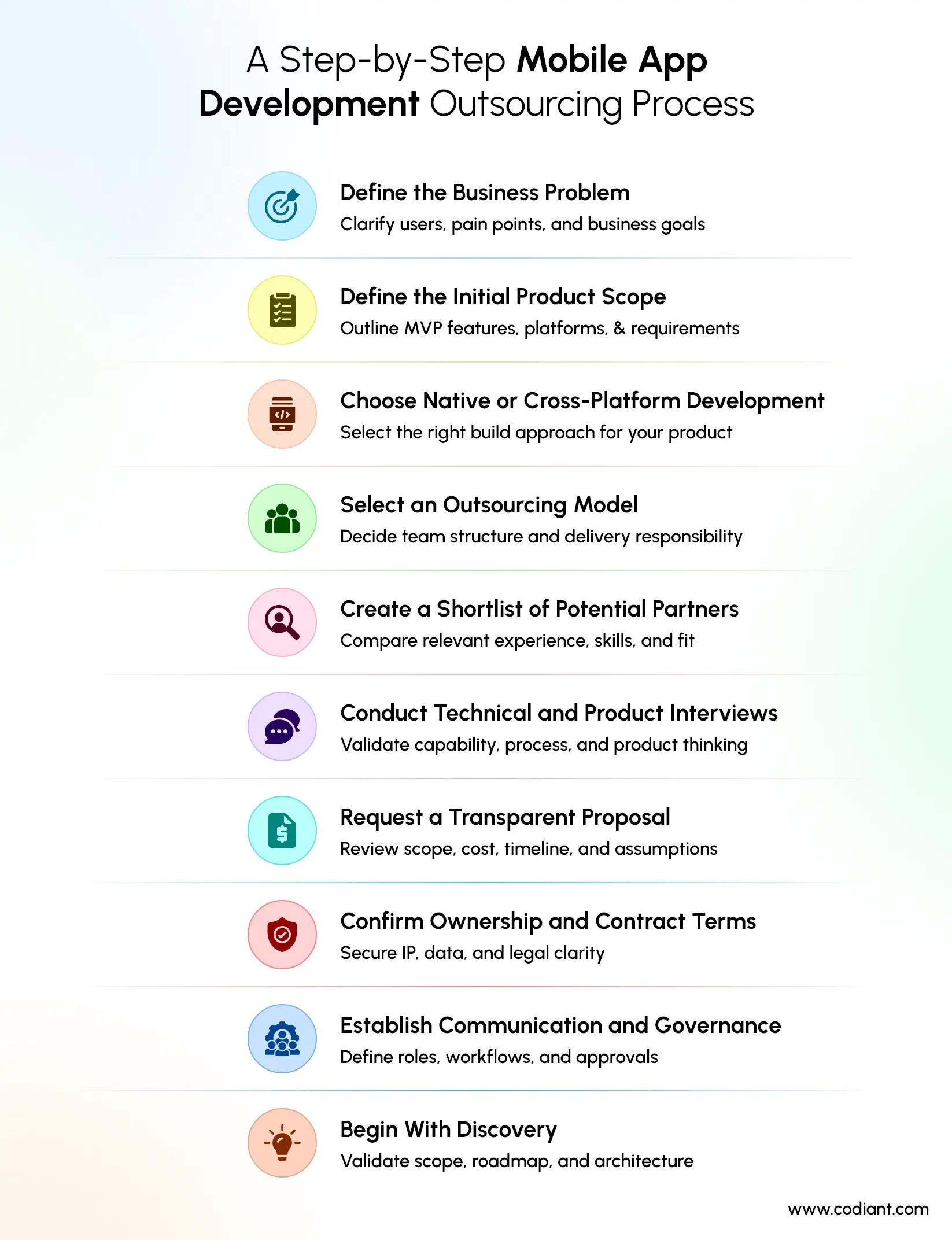
You can outsource mobile app development successfully by completing ten steps: define the business case, scope the product, select a delivery model, shortlist companies, validate capabilities, compare proposals, confirm commercial terms, establish governance, begin with discovery, and manage delivery through measurable milestones.
1. Define the Business Problem
Start by explaining the problem the app must solve rather than listing features immediately.
Document:
- Who will use the application?
- What problem do those users experience?
- How does the proposed app address it?
- What business outcome should the app support?
- How will success be measured?
- Is the app customer-facing, employee-facing, or partner-facing?
Possible success measures include completed transactions, active users, process time saved, retention, customer satisfaction, conversion rate, or reduced manual work.
A clear business case helps the outsourcing partner challenge unnecessary features and recommend an architecture aligned with real product goals.
2. Define the Initial Product Scope
Create a high-level scope before requesting estimates. The document does not need to contain every technical detail, but it should describe the main workflows and boundaries.
Include:
- Target users
- iOS, Android, or both platforms
- Core user journeys
- Essential MVP features
- Admin-panel requirements
- External systems and APIs
- Authentication requirements
- Payment or subscription features
- Data sensitivity
- Expected user volume
- Accessibility requirements
- Preferred launch window
Separate must-have features from future enhancements. Startups can also follow a structured mobile app startup planning process to validate the idea, prioritise MVP features, select a development approach, and prepare for launch.
3. Choose Native or Cross-Platform Development
Select the development approach based on performance requirements, platform coverage, budget, device capabilities, and long-term product plans.
Native development uses platform-specific technologies such as Swift for iOS and Kotlin for Android. Cross-platform frameworks such as Flutter and React Native support shared development across both platforms. Businesses comparing these approaches can review the scope of mobile app development services across native, cross-platform, backend, testing, deployment, and maintenance requirements.
Cross-platform frameworks such as Flutter and React Native allow teams to share a significant portion of the code across iOS and Android. They can reduce duplicated development work, but some platform-specific development may still be required.
4. Select an Outsourcing Model
Decide how much responsibility the external team will own.
You can outsource the complete product, hire dedicated mobile app developers, add specialists to your internal team, or divide delivery between internal and external resources. Comparing staff augmentation and project outsourcing can clarify whether your business should retain daily delivery control or transfer responsibility for the complete project to an external team.
The right model depends on:
- Stability of requirements
- Internal product-management capacity
- Project duration
- Need for flexibility
- Budget predictability
- Required control over priorities
- Availability of in-house technical leadership
A fixed-price project may suit a defined prototype. A dedicated team is usually more practical when priorities will change through user feedback and product learning.
5. Create a Shortlist of Potential Partners
Build a shortlist of three to five companies that have relevant mobile experience.
Review their:
- Mobile app portfolio
- Industry experience
- Platform expertise
- Design capabilities
- Backend and cloud skills
- Security practices
- Client reviews
- Team size
- Location and time-zone overlap
- Post-launch services
Do not judge a partner by the visual design of its portfolio alone. Ask what the team built, which constraints it faced, which integrations it completed, and what measurable outcome the product produced.
6. Conduct Technical and Product Interviews
Meet the people who may actually work on your product. A sales presentation cannot confirm how the delivery team approaches architecture, quality, security, and product decisions.
Ask the team to explain:
- How it would structure the application
- Which technology stack it recommends
- How it would validate assumptions
- How it handles changing requirements
- How it tests critical workflows
- How it manages application performance
- How it protects sensitive information
- How it releases updates
- How it handles technical debt
Strong partners should explain trade-offs rather than recommending the same stack for every application.
7. Request a Transparent Proposal
A credible proposal should state:
- Included deliverables
- Excluded responsibilities
- Features and user roles
- Technology assumptions
- Team composition
- Delivery phases
- Estimated effort
- Cost model
- Payment schedule
- Client responsibilities
- Third-party costs
- Change-request process
- Warranty or defect-resolution period
- Maintenance options
Without a defined scope and documented assumptions, an accurate project cost cannot be confirmed.
Avoid proposals that provide a single price without explaining the features, resources, timeline, integrations, or assumptions behind it.
8. Confirm Ownership and Contract Terms
The agreement should define ownership before development starts.
Confirm who owns:
- Source code
- UI designs
- Product documentation
- Databases
- Cloud accounts
- App-store accounts
- Domain names
- Analytics accounts
- Third-party licences
- Reusable components
- Intellectual property created during the project
Include confidentiality, data protection, termination, transition support, payment, warranty, and dispute-resolution terms. Legal requirements vary by location and project, so qualified legal counsel should review the final contract.
9. Establish Communication and Governance
Define how decisions, questions, risks, and approvals will be managed.
A practical governance plan should include:
- One product owner from the client
- One delivery manager from the partner
- Shared project-management tools
- Agreed sprint length
- Weekly progress meetings
- Sprint demonstrations
- Written decisions
- Risk and dependency tracking
- Escalation contacts
- Approval timelines
- Time-zone overlap
The number of meetings matters less than whether the right people can make timely decisions.
10. Begin With Discovery
Start complex projects with a paid discovery phase instead of moving directly into full development.
Discovery can produce:
- Validated product scope
- User journeys
- Prioritised backlog
- Wireframes or prototype
- Technical architecture
- Integration assessment
- Security requirements
- Delivery roadmap
- Team recommendation
- Updated cost estimate
Discovery reduces uncertainty, but it does not remove all delivery risk. Requirements can still change after users interact with the product.
What Are the Benefits of Outsourcing Mobile App Development?
The main benefits of outsourcing mobile app development are faster access to specialised talent, flexible team capacity, reduced recruitment effort, broader technical capabilities, and shared delivery responsibility.
1. Faster Access to Mobile Specialists
Recruiting separate iOS, Android, backend, QA, DevOps, design, and product specialists can take considerable time. The decision should also reflect product readiness, internal capacity, user demand, and financial runway. These signals can help determine the right time to hire mobile app developers rather than expanding the team too early or too late.
2. Flexible Team Scaling
The team can expand during intensive development phases and reduce after launch. This flexibility can be useful for MVPs, seasonal initiatives, migrations, and multi-phase product roadmaps.
3. Wider Technical Expertise
A full-service partner may provide application architecture, UX research, mobile engineering, cloud development, integrations, testing, security, deployment, and maintenance.
This is different from hiring one developer who may be highly capable but cannot independently cover every product discipline.
4. Lower Fixed Employment Overhead
Outsourcing may reduce the need for permanent recruitment, onboarding, workspace, equipment, benefits, and ongoing employment administration. However, outsourcing is not automatically cheaper. Poor requirements, rework, weak governance, and changing scope can increase total project cost.
5. Established Delivery Processes
Experienced outsourcing companies usually have existing processes for code reviews, sprint planning, testing, releases, documentation, and project reporting. Businesses should still verify that these processes are followed in practice.
How Much Does It Cost to Outsource App Development?
Outsourced app development can cost less than $10,000 for a limited prototype and exceed $100,000 for a complex production application. Clutch reports an average app development project cost of $90,780.11 and an average project duration of approximately 11 months. These figures reflect projects represented in Clutch’s dataset and should not be treated as a universal market price.
Estimated App Development Cost by Complexity
| App Type | Typical Scope | Estimated Cost |
| Limited prototype | Basic screens, clickable flows, limited or no backend | Below $10,000 |
| Simple mobile app | Standard UI, user login, basic database, limited integrations | $10,000–$30,000 |
| Mid-complexity app | Custom UI/UX, backend, admin panel, payments, APIs, notifications | $30,000–$100,000 |
| Complex application | Real-time features, advanced integrations, multiple user roles, security controls | $100,000–$250,000+ |
| Enterprise or regulated app | Complex infrastructure, high scalability, compliance, legacy integrations | Scope-based estimate |
These ranges provide an initial reference, but the final budget changes with features, platforms, integrations, architecture, team structure, and security requirements. A detailed breakdown of mobile app development costs in 2026 can help businesses evaluate these variables before approving a project estimate.
An accurate estimate cannot be confirmed until the features, platforms, integrations, security requirements, delivery responsibilities, and technical assumptions are documented.
What Factors Affect App Development Outsourcing Costs?
The final cost depends on:
- Number of platforms
- Native or cross-platform development
- Number and complexity of features
- UI/UX requirements
- Backend architecture
- Admin dashboards
- Third-party integrations
- Payment processing
- Real-time communication
- Offline functionality
- Artificial intelligence features
- Data migration
- Security and compliance
- Testing scope
- Cloud infrastructure
- Project duration
- Team location and seniority
- Maintenance requirements
Applications that include recommendations, computer vision, conversational interfaces, predictive analytics, or generative AI require additional work across data preparation, model selection, evaluation, infrastructure, and monitoring. Businesses planning these capabilities should assess whether specialised AI development outsourcing services are required alongside the mobile development team.
A basic internal application with a few workflows should not be compared with a regulated healthcare, financial, logistics, or marketplace platform. Each requires a different level of architecture, testing, security, infrastructure, and documentation.
Illustrative Dedicated Developer Cost
Based on 160 working hours per month:
| Developer Rate | Calculation | Estimated Monthly Cost |
| $25 per hour | $25 × 160 hours | $4,000 |
| $30 per hour | $30 × 160 hours | $4,800 |
| $40 per hour | $40 × 160 hours | $6,400 |
A four-developer team at the same hourly range would represent approximately:
- Minimum: $4,000 × 4 = $16,000 per month
- Maximum: $6,400 × 4 = $25,600 per month
This is an illustrative developer-cost calculation, not a complete project quote. A delivery team may also include a product manager, UI/UX designer, backend developer, QA engineer, DevOps engineer, technical architect, or security specialist. Rates may differ by role, seniority, allocation, and location.
What Should an App Development Estimate Include?
A complete estimate should identify the expected effort and cost for:
| Cost Area | What It May Include |
| Discovery and planning | Requirements, product workshops, feasibility assessment, roadmap |
| UI/UX design | User journeys, wireframes, prototypes, visual design |
| Mobile development | iOS, Android, Flutter, or React Native engineering |
| Backend development | APIs, databases, business logic, authentication |
| Admin panel | User management, content controls, reports, operational tools |
| Integrations | Payment gateways, CRM, ERP, maps, analytics, third-party APIs |
| Cloud and DevOps | Hosting setup, CI/CD, environments, monitoring |
| Quality assurance | Functional, regression, device, performance, and usability testing |
| Security | Code review, access controls, vulnerability testing, compliance work |
| Deployment | App Store and Google Play preparation and submission |
| Project management | Sprint planning, reporting, risk management, stakeholder coordination |
| Documentation | Architecture, API, deployment, and knowledge-transfer documentation |
| Maintenance | Bug fixes, operating-system updates, monitoring, and enhancements |
Should You Hire a Freelancer or an App Development Company?
Hire a freelancer for a small, clearly defined task that one specialist can complete. Choose an app development company when the product requires multiple roles, formal project management, stronger continuity, security controls, and long-term support.
| Factor | Freelance Developer | App Development Company |
| Best suited for | Small features, prototypes, maintenance | Complete products and complex systems |
| Team coverage | Usually one primary skill set | Design, mobile, backend, QA and DevOps |
| Management | Managed directly by the client | Delivery manager or project manager included |
| Scalability | Depends on individual availability | Team can usually expand or change |
| Continuity | Higher dependency on one person | Shared organisational responsibility |
| Cost structure | Often lower initial cost | Higher cost but broader coverage |
| Security process | Varies by individual | Can include documented organisational controls |
| Post-launch support | Availability may change | Support plans can be contractually defined |
Choose based on the actual product risk, not the provider category alone.
What Should You Look for in an Outsourced App Development Partner?
Look for relevant product experience, transparent processes, qualified team members, strong communication, security practices, realistic estimates, clear ownership terms, and dependable post-launch support.
1. Relevant Portfolio Experience
Review projects with similar workflows, users, technical complexity, or regulatory requirements. A company does not need to have built an identical product, but it should demonstrate experience with the most difficult parts of your application.
2. Product Thinking
A reliable mobile app development partner should ask why each feature is needed, how users will interact with it, and which assumptions should be validated before development.
Teams that immediately accept every requested feature may be executing tasks without evaluating product value.
3. Technical Capability
Evaluate experience across:
- iOS and Android development
- Flutter or React Native
- API and backend development
- Cloud architecture
- Authentication and authorisation
- Database design
- Analytics
- Third-party integrations
- Performance optimisation
- Automated testing
- App-store deployment
Ask who will make architectural decisions and how those decisions will be documented.
4. Security Practices
Security should be integrated into design, development, testing, and release activities.
OWASP describes its Mobile Application Security Verification Standard as an industry standard for mobile application security. It covers areas such as storage, cryptography, authentication, network communication, platform interaction, code quality, resilience, and privacy.
NIST’s Secure Software Development Framework provides high-level secure development practices that organisations can integrate into their software lifecycle. Ask prospective partners how their development process aligns with recognised standards relevant to your application.
Compliance cannot be confirmed merely because a vendor says it builds “secure apps.” Requirements must be defined, implemented, tested, documented, and reviewed for the specific product.
5. Transparent Team Structure
Know who will work on the project, where they are located, and how much of their time is allocated.
Request profiles for:
- Product or business analyst
- UI/UX designer
- Mobile developers
- Backend developers
- QA engineers
- DevOps engineer
- Project manager
- Technical architect
Confirm whether the company plans to replace named team members after contract signing.
6. Communication Fit
Evaluate response quality during the sales process. Delayed, incomplete, or unclear communication before the contract may indicate future delivery problems.
Check:
- Language proficiency
- Time-zone overlap
- Meeting availability
- Documentation quality
- Escalation process
- Ability to explain technical topics clearly
7. Verifiable Client References
Speak with previous clients where possible. Ask about delivery reliability, communication, change management, code quality, budget control, and post-launch support.
Do not rely only on selected testimonials published on a company website.
Get a Transparent App Development Estimate
Receive a scope-based estimate with clear assumptions, exclusions, timelines, and team costs.
Which Engagement Models Are Available for Outsourced Development?
The main engagement models are fixed price, time and materials, dedicated team, staff augmentation, and outcome-based delivery.
1. Fixed-Price Model
The company delivers a defined scope for an agreed price and timeline.
Best for: Prototypes, small applications, and projects with stable requirements.
Main limitation: Changes usually require formal scope, budget, and schedule adjustments.
2. Time-and-Materials Model
The client pays for actual time spent by the delivery team.
Best for: Evolving products, complex integrations, and iterative development.
Main limitation: The final cost is less predictable unless priorities and team capacity are actively controlled.
3. Dedicated Team Model
A stable team works primarily or exclusively on the client’s product for a monthly or hourly fee.
Best for: Long-term development, multiple releases, and products with frequently changing priorities.
Main limitation: The client needs an active product owner who can guide decisions and prioritise work.
4. Staff Augmentation
Individual specialists join the client’s existing team and processes.
Best for: Filling specific skill gaps or increasing delivery capacity.
Main limitation: Technical direction and day-to-day management usually remain with the client.
5. Outcome-Based Model
Commercial terms are connected to defined deliverables or business outcomes rather than only hours worked. Deloitte reports growing adoption of outcome-based outsourcing relationships, although suitability depends on whether outcomes can be measured and attributed clearly.
How Can Businesses Ensure Quality and Timely Delivery?
Businesses can improve quality and delivery reliability by defining acceptance criteria, maintaining one prioritised backlog, reviewing working software regularly, automating testing, controlling scope changes, and resolving dependencies quickly.
Use the following controls:
- Assign one product owner: Give one person authority to clarify requirements and approve work.
- Define acceptance criteria: State what must be true before a feature is considered complete.
- Review every sprint: Inspect working software rather than relying only on status reports.
- Maintain source-code access: Keep repositories under shared or client-controlled access.
- Automate critical tests: Prioritise authentication, payments, data handling, and core workflows.
- Track defects separately: Do not hide unresolved defects inside general development tasks.
- Control scope changes: Record their effect on cost, priority, and timeline.
- Monitor delivery risks: Track technical dependencies, third-party approvals, and delayed client decisions.
- Define release criteria: Include testing, security review, documentation, monitoring, and rollback planning.
- Plan post-launch support: Assign ownership for production incidents, analytics, updates, and user feedback.
What Are the Risks of Offshore Mobile App Development?
The main offshore mobile app development risks are communication gaps, unclear ownership, hidden dependencies, time-zone delays, inconsistent quality, data-security concerns, and overdependence on one provider.
These risks can be reduced by:
- Requiring written documentation
- Establishing overlapping work hours
- Using shared repositories and project tools
- Naming key team members in the agreement
- Defining security and access controls
- Retaining ownership of accounts and source code
- Reviewing architecture and code quality
- Maintaining transition documentation
- Avoiding long payment commitments before milestones
- Creating an exit and knowledge-transfer plan
Offshore development is not inherently lower quality. Delivery quality depends on team capability, governance, technical standards, communication, and accountability.
What Common Mistakes Should Companies Avoid?
The most common outsourcing mistakes are beginning with an unclear scope, choosing the lowest bid, ignoring team composition, delaying security planning, and treating launch as the end of the project.
- Selecting Only by Price: A low estimate may exclude design, backend development, QA, integrations, infrastructure, project management, or post-launch work. Compare what each proposal includes rather than comparing headline prices.
- Outsourcing Product Ownership: The external partner can support strategy, but the business must still own its users, priorities, commercial goals, and final decisions.
- Skipping Discovery: Moving directly into coding can cause teams to automate unclear processes or build features that have not been validated.
- Ignoring Security Until Testing: Security decisions affect architecture, authentication, data storage, integrations, logging, infrastructure, and release processes. They cannot always be added effectively at the end.
- Failing to Confirm IP Ownership: The contract should clearly state who owns code, designs, documentation, databases, and other project assets.
- Planning Only for Launch: Mobile operating systems, devices, dependencies, store requirements, user expectations, and security risks continue to change. Budget for monitoring, maintenance, fixes, and planned improvements.
Why Choose Codiant as Your Mobile App Development Partner?
Codiant supports mobile app projects from initial discovery through development, deployment, and ongoing maintenance. Businesses can use the company for complete product delivery or add individual developers to an existing team, depending on their scope and internal capabilities.
Its mobile app development services cover:
- Product discovery and technical planning
- UI/UX design and prototyping
- Native iOS and Android development
- Flutter and React Native development
- Backend systems and API integrations
- Quality assurance and app testing
- Cloud deployment and release support
- Application modernisation and maintenance
Codiant also offers flexible engagement options, including dedicated developers, full remote teams, part-time resources, and project-based delivery. This allows businesses to select a model based on project duration, requirement stability, internal management capacity, and expected team size.
Conclusion
Successful mobile app development outsourcing begins before the first developer is assigned. It requires a clear business case, prioritised scope, suitable engagement model, verified partner, transparent estimate, defined ownership, secure development process, and active delivery governance.
Do not choose a mobile app development company solely because it offers the lowest hourly rate or fastest promised launch. Compare the complete delivery model, team capability, assumptions, exclusions, security controls, communication process, and post-launch responsibilities.
A dependable outsourcing partner should help you make better product decisions, identify risks early, and build a maintainable application that can continue evolving after release.
Test Your Mobile Team Before Committing!
Evaluate dedicated mobile developers through real project work during a seven-day trial.
The Author

Frequently Asked Questions
Define the business goal, users, platforms, features, budget, and timeline. Shortlist qualified partners, evaluate their portfolios and technical teams, compare scope-based proposals, finalise ownership and security terms, and begin with discovery. Manage development through prioritised sprints, acceptance criteria, demonstrations, testing, and documented release controls.
Review relevant mobile projects, client references, team profiles, technology expertise, security processes, communication practices, and post-launch capabilities. Request a proposal that clearly explains assumptions, exclusions, deliverables, effort, and responsibilities. Select the company that demonstrates realistic planning and product understanding rather than simply presenting the lowest estimate.
Businesses can choose fixed-price, time-and-materials, dedicated-team, staff-augmentation, hybrid, or outcome-based models. Fixed price suits stable requirements, while time and materials supports changing scope. Dedicated teams work well for long roadmaps. Staff augmentation is appropriate when an internal team already manages product and technical delivery.
Assign a product owner, define acceptance criteria, maintain a prioritised backlog, and review working software every sprint. Require code reviews, automated testing, security checks, performance monitoring, and shared repository access. Track risks, dependencies, defects, decisions, and scope changes separately so delivery issues remain visible and actionable.
Avoid starting with vague requirements, selecting solely by price, skipping technical interviews, and leaving security or ownership terms undefined. Businesses should not outsource product responsibility completely or approve estimates without assumptions and exclusions. They should also plan for maintenance, analytics, operating-system updates, support, and continuous product improvement.
Featured Blogs
Read our thoughts and insights on the latest tech and business trends
How The 1-Week Free Trial Works When Hiring Full Stack Developers
- August 6, 2026
- Staff Augmentation
A 1-week free trial gives US mid-market CTOs 7 working days to evaluate a full stack developer through real project tasks before confirming a paid engagement. This trial matters when a development roadmap requires immediate... Read more

How Mobile Apps Improve Logistics and Supply Chain Management in Australia?
- July 31, 2026
- Mobile App Development
Mobile apps improve logistics and supply chain management in Australia by digitising five high-friction workflows: dispatch, route planning, driver communication, proof of delivery, and inventory updates. For founders, CEOs, CTOs, CIOs, and operations leaders, that... Read more

Conversational AI in Healthcare: Benefits and Use Cases
- July 29, 2026
- Healthcare
Conversational AI in healthcare uses artificial intelligence to help patients, care teams, and administrative staff communicate through chat, voice, or messaging interfaces: answering routine questions, scheduling appointments, sending medication reminders, and reducing repetitive administrative work.... Read more