What Business Problems Can AI Agents Solve for Enterprises in 2026?
Table of Contents
Subscribe To Our Newsletter
Summarize with AI
Not enough time? get the key points instantly.
AI agents solve enterprise business problems by automating multi-step workflows across customer support, finance, HR, IT, sales, supply chain, legal and marketing. In 2026, the most practical use cases include reducing support backlogs, processing invoices, screening candidates, resolving IT tickets, managing sales follow-ups, detecting supply chain exceptions and reviewing contracts with human approval for risky decisions.
Deloitte states that 80% of automation leaders are expected to accelerate AI agent investments over 2025, and that one-third of enterprise software applications were forecast to include agentic capabilities by 2028.
Key Takeaway
- AI agents solve enterprise problems across customer support, finance, HR, IT, sales, supply chain, legal and marketing.
- Enterprise AI agents deployments that include audit trails and human-in-the-loop controls reduce compliance incidents by up to 73% – governance is not optional, it’s the deployment condition.
- They automate multi-step workflows, not just simple rule-based tasks.
- The highest-ROI use cases are customer support automation, invoice processing, recruitment workflows, IT helpdesk automation and contract review.
- Start with invoice processing, IT helpdesk ticketing, or recruitment screening. These three workflows deliver measurable ROI within 8–12 weeks and have the lowest integration risk for first AI agent deployments.
At Codiant, we’ve built and deployed AI agents solutions across logistics, fintech, and healthcare enterprises and the pattern is consistent: companies that start with a single high-volume, rules-heavy workflow see ROI within one quarter. Below, we define AI agents and map the 20 highest-impact enterprise problems AI agents are solving in 2026, with real deployment data and the governance framework required to do it safely.
What Are AI Agents in Enterprise Environments?
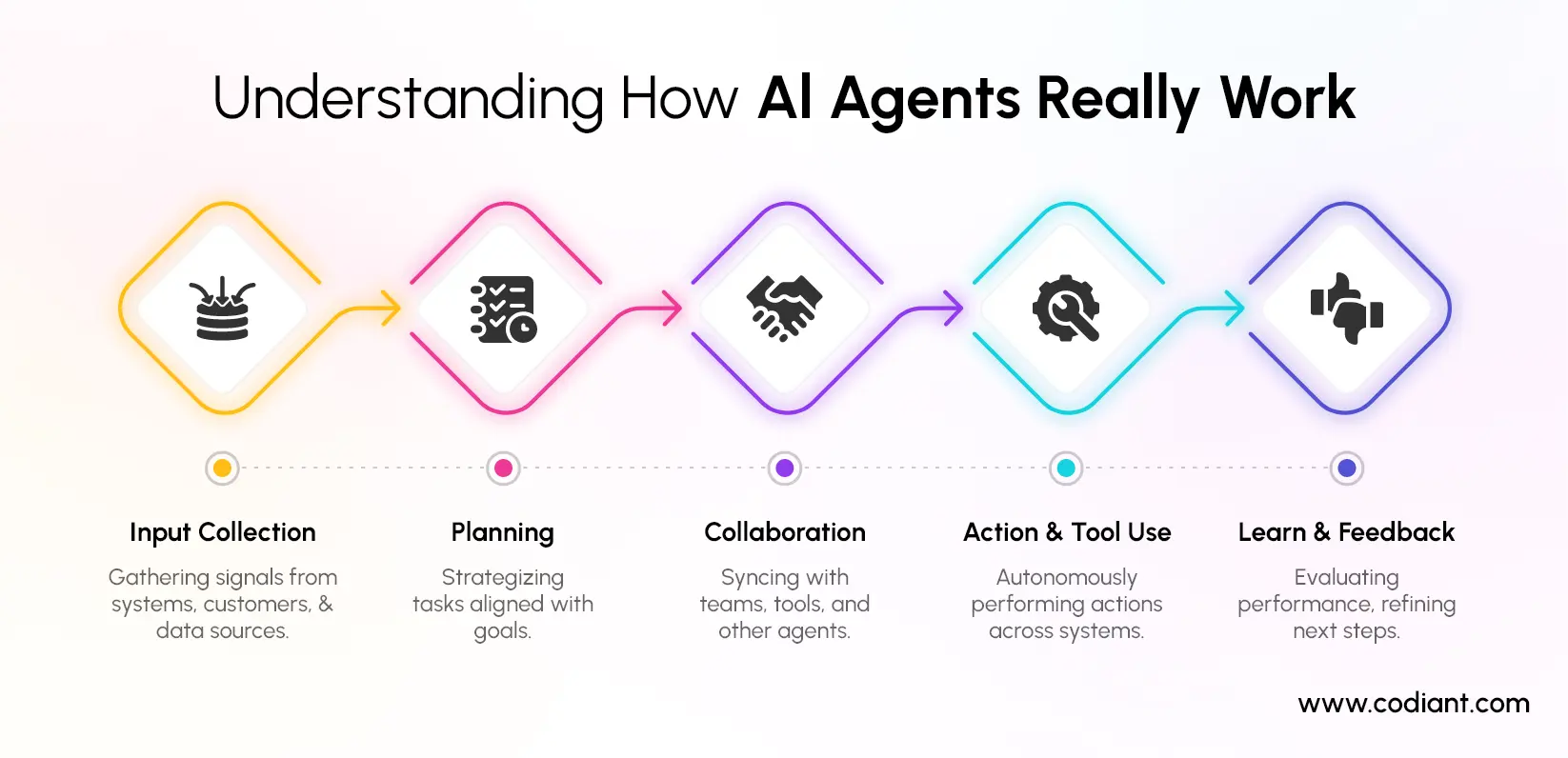
An AI agent in an enterprise context is an autonomous software system powered by large language models (LLMs) or other AI models that can perceive its environment, make decisions and take actions to achieve a defined goal without step-by-step human instruction.
Unlike traditional automation (which follows fixed rules), AI agents can:
- Understand natural language instructions
- Plan multi-step tasks independently
- Use tools like web search, databases, APIs and code execution
- Adapt their approach based on outcomes
- Collaborate with other AI agents in multi-agent pipelines
Think of an AI agent as a tireless digital employee who reads context, decides what to do next, executes the action, checks the result and iterates all in seconds. Enterprise AI automation built on agents can now handle tasks that previously required experienced knowledge workers.
This shift is part of a larger movement where AI agents are transforming business operations from simple task automation into autonomous decision-support systems across departments.
What are the Top Business Problems AI Agents Solve for Enterprises in 2026?
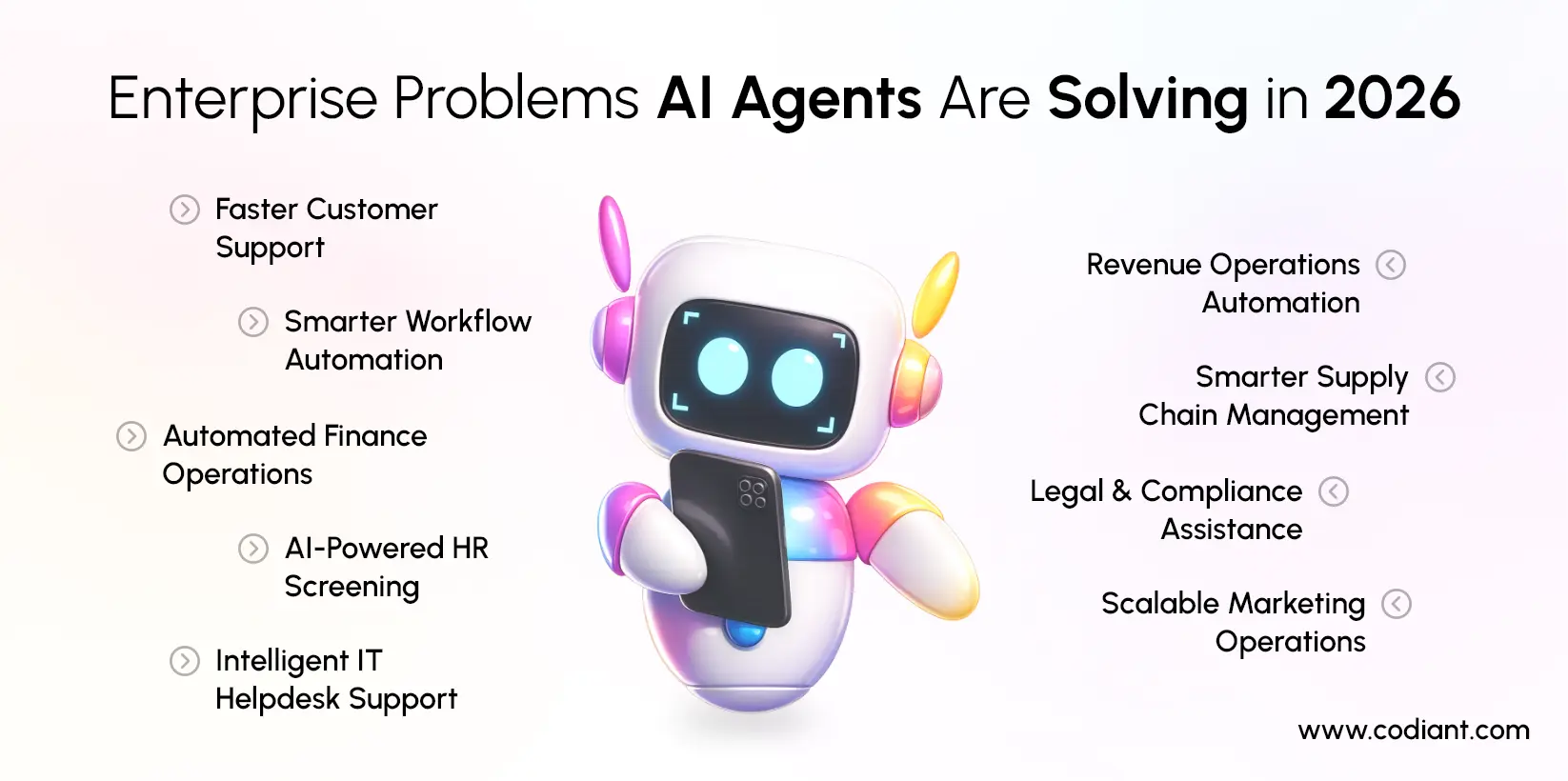
AI agents can solve enterprise problems related to customer support, sales follow-ups, HR screening, finance processing, IT support, data analysis, compliance monitoring, workflow automation and knowledge retrieval. They help enterprises reduce manual effort, improve response time, standardize decisions and automate repetitive or multi-step business processes.
1. Customer Support & Service Operations
AI agents solve customer support challenges by automating repetitive queries, resolving service requests faster, supporting multilingual conversations and escalating complex issues to human teams when needed.
Traditional customer service operations are expensive, hard to scale and often inconsistent across channels. AI agents for customer support now handle:
- Tier-1 and Tier-2 support queries
- Order tracking, refunds and account management
- Multilingual support across chat, email and voice
- Sentiment analysis for high-risk escalation
- Proactive customer updates before issues are raised
For businesses where calls, follow-ups and missed inquiries directly affect revenue, voice AI for lead generation can extend this automation beyond chat and email into real-time customer conversations.
Companies like Klarna publicly reported that its AI assistant handled 2.3 million customer conversations in its first month, doing work equivalent to 700 full-time agents. Klarna also reported that the assistant matched human customer satisfaction levels and reduced average resolution time from 11 minutes to under 2 minutes.
2. Slow, Manual Business Process Workflows
AI agents solve manual workflow problems by extracting information, validating data, routing approvals, triggering actions and reducing dependency on repetitive human intervention.
Enterprises lose thousands of hours annually to data entry, document processing, approval routing, report generation and compliance checks. AI workflow automation through agents helps reduce these bottlenecks.
AI agents can read unstructured documents such as invoices, contracts and emails. They can extract relevant data, compare it with business rules, update enterprise systems and trigger downstream workflows.
In enterprise environments, these agents usually connect with ERP, CRM, document management platforms, finance tools and internal databases to complete tasks across multiple systems.
How JPMorgan Used AI to Speed Up Contract Intelligence?
JPMorgan Chase deployed an AI agent system called COiN (Contract Intelligence) that reviews commercial loan agreements. A task that previously required 360,000 hours of lawyer time annually is now completed in seconds. The system processes documents with higher accuracy than human reviewers, extracting key clauses, flagging anomalies and generating summaries automatically.
3. Finance & Accounting Automation
AI agents solve finance and accounting problems by automating invoice processing, reconciliation, reporting, anomaly detection and compliance documentation.
Finance departments often manage high-volume, rule-based and document-heavy workflows. AI agents can support:
- Invoice processing and accounts payable workflows
- Month-end and quarter-end financial close support
- Fraud detection and anomaly flagging
- Audit trail generation
- Budget variance analysis with natural language explanations
Instead of only speeding up finance tasks, AI agents improve consistency by reducing manual handoffs and repetitive data entry. In enterprise finance systems, these agents can connect with accounting software, ERP systems, payment platforms, vendor databases and approval workflows.
4. HR & Talent Operations
AI agents solve HR problems by automating repetitive hiring, onboarding, employee support and workforce administration tasks.
Human resources is one of the highest-volume enterprise functions. AI agents now support end-to-end recruitment pipelines and employee lifecycle workflows, including:
- Resume screening and candidate scoring
- Interview scheduling and candidate communication
- Onboarding paperwork, training assignment and access provisioning
- HR policy Q&A through internal AI assistants
- Employee feedback and sentiment analysis from surveys
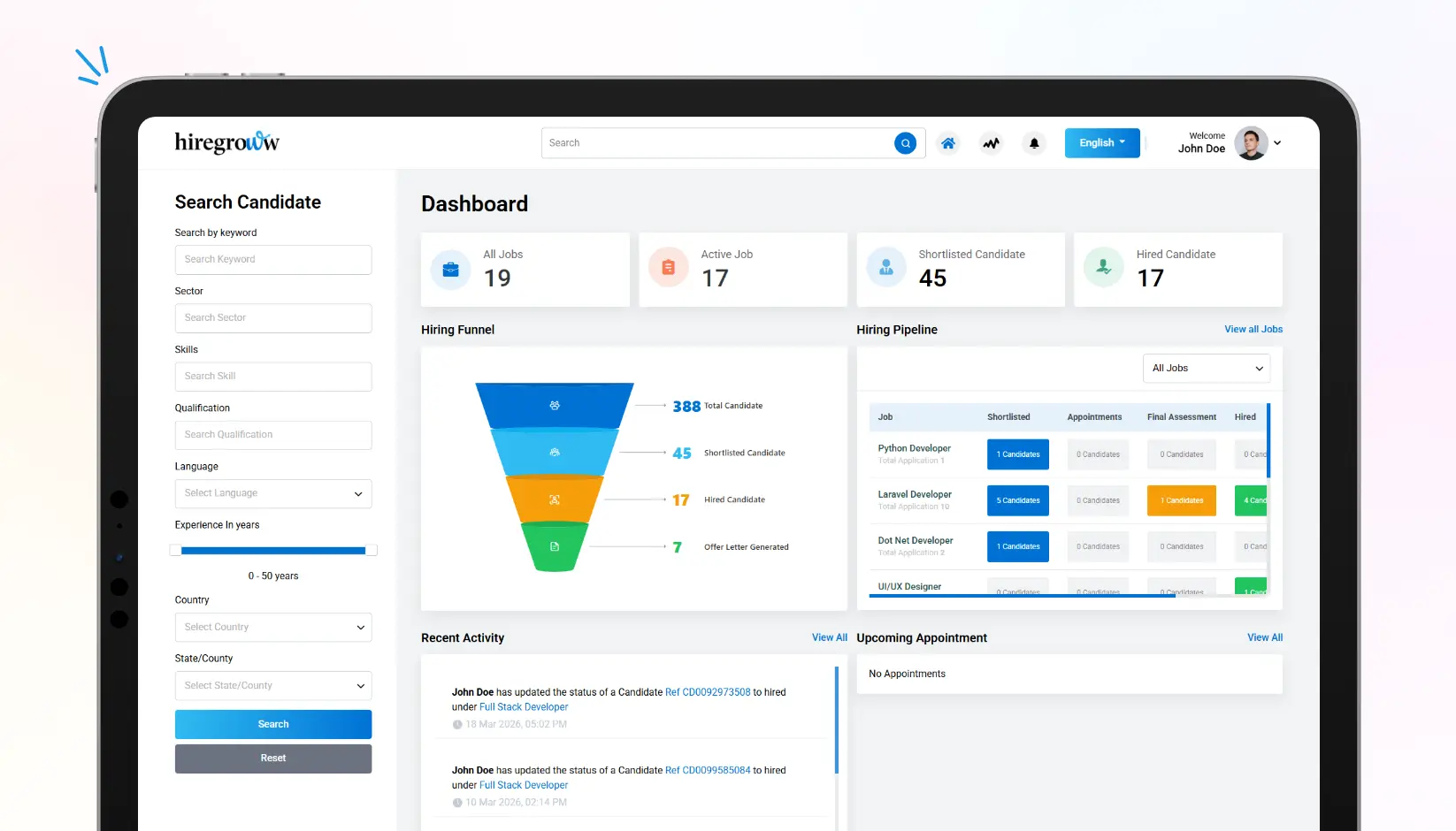
For recruitment, AI agents can go beyond resume filtering. They can parse resumes, match candidates to job requirements, generate role-specific interview questions, score interview responses and automate candidate communication.
For example, Codiant’s HireGroww shows how AI-powered hiring workflows can reduce manual screening effort and bring more consistency to candidate evaluation.
This makes HR teams more available for culture building, employee development, workforce planning and people-focused decisions that require human judgment.
5. IT Operations & Helpdesk Automation
AI agents solve IT operations problems by resolving repetitive tickets, supporting access requests, monitoring alerts and triggering approved remediation workflows.
IT teams face a constant flow of repetitive requests such as password resets, access provisioning, software installation, system troubleshooting and device support. AI-powered enterprise solutions can manage:
- Level 1 and selected Level 2 helpdesk tickets
- Infrastructure alert analysis and approved remediation
- Security patch tracking and compliance checks
- User access management and offboarding workflows
- Proactive monitoring and incident response support
In enterprise IT setups, AI agents usually connect with ticketing systems, identity management tools, cloud platforms, monitoring dashboards and internal knowledge bases.
6. Sales & Revenue Operations
AI agents solve sales operations problems by reducing non-selling work and helping revenue teams manage research, follow-ups, CRM updates and pipeline insights.
Sales teams spend significant time on activities that do not directly involve selling. AI agents for enterprise sales can handle:
- Lead enrichment using firmographic and intent data
- Personalized outreach sequence creation
- CRM updates, notes and deal stage maintenance
- Meeting preparation briefs from account history
- Forecasting and pipeline analysis with natural language reporting
The business value is simple: sales teams get more time for conversations, negotiations and relationship building.
7. Supply Chain & Procurement
AI agents solve supply chain and procurement problems by monitoring supplier activity, automating purchase workflows, forecasting demand signals and improving operational visibility.
Global supply chains are complex, volatile and increasingly digitized. AI agents can support:
- Supplier performance monitoring
- Purchase order creation and vendor communication
- Demand forecasting using multiple data sources
- Inventory optimization across warehouses
- RFQ process support and supplier comparison
In enterprise procurement workflows, AI agents can connect with ERP systems, supplier portals, inventory tools, contract repositories and market data sources.
8. Legal & Compliance
AI agents solve legal and compliance problems by supporting contract review, policy checks, regulatory monitoring, due diligence and audit documentation.
Legal teams often deal with repetitive document-heavy tasks. AI agents in legal operations can:
- Review and summarize contracts
- Identify clauses, obligations and missing terms
- Monitor regulatory updates
- Support due diligence workflows
- Generate compliance reports and audit documentation
- Answer employee questions on internal policies
These agents are most useful when connected with contract lifecycle management tools, document repositories, compliance databases and internal policy systems.
For sensitive legal workflows, human review remains essential. AI agents should support legal teams, not independently make high-risk legal decisions.
9. Marketing & Content Operations
AI agents solve marketing operations problems by helping teams create, personalize, analyze and optimize content at scale.
Marketing teams face growing demand for content, personalization, campaign testing and performance reporting. AI agents in marketing can support:
- SEO blog drafts, product descriptions and ad copy
- Personalized email campaign variations
- Campaign performance analysis
- A/B testing recommendations
- Brand mention and competitor monitoring
In enterprise marketing setups, AI agents can connect with CMS platforms, CRM systems, analytics tools, ad platforms, email tools and customer data platforms.
The best use of AI agents in marketing is not fully automated publishing. It is faster research, better personalization, consistent reporting and human-reviewed content production.
Which Enterprise AI Agent Should You Build First?
The best AI agent to build first depends on the business problem, process volume, risk level and expected ROI. Enterprises should start with workflows that are repetitive, data-heavy and easy to measure.
| Business Problem | Best AI Agent Type | Ideal Department |
| High support ticket volume | Customer Support Agent | Customer Service |
| Slow invoice approvals | Finance Automation Agent | Finance |
| Manual resume screening | Recruitment Agent | HR |
| Repetitive IT tickets | IT Helpdesk Agent | IT Operations |
| Delayed contract review | Legal Review Agent | Legal |
| Poor CRM hygiene | Sales Operations Agent | Revenue Teams |
Build AI Agents That Solve Real Enterprise Workflow Bottlenecks Faster
Identify high-impact use cases, automate repetitive work, and scale secure AI agents with measurable outcomes.
How Much Does It Cost to Implement AI Agents?
AI agent implementation costs range from $500–$5,000/month for basic SaaS usage to $50,000–$500,000+ for enterprise-grade custom builds. The final cost depends on model usage, number of workflows, integrations, data security, compliance needs, human approval layers and ongoing monitoring.
| Approach | Typical Cost Range | Best For |
| SaaS AI Agent Platform | $500–$5,000+ per month | Small teams, standard workflows, fast deployment |
| Microsoft Copilot Studio | $200 per month for 25,000 Copilot Credits | Microsoft 365 users building internal agents |
| Salesforce Agentforce | Around $2 per conversation | Customer-facing sales, service and CRM agents |
| API-Based Custom Agent | $5,000–$50,000 for MVP setup, plus usage-based model cost | Startups and mid-sized teams building focused workflows |
| Enterprise Custom AI Agent | $50,000–$500,000+ | Complex workflows, private data, governance and legacy system integration |
| Large Enterprise / Multi-Agent System | $500,000–$2M+ | Multi-department automation, compliance-heavy industries, advanced orchestration |
For a more detailed pricing view, including cost factors, development stages and optimization strategies, read this AI agent development cost breakdown before finalizing your implementation budget.
Model usage is usually billed separately. For example, OpenAI API pricing is token-based, with flagship models priced per 1 million input and output tokens. Google Gemini API pricing also uses per-token pricing, while AWS Bedrock pricing varies by model provider, modality, throughput tier and usage volume.
Enterprises should also budget for hidden and ongoing costs such as cloud hosting, vector databases, RAG pipelines solutions, API calls, security testing, compliance review, monitoring dashboards, human approval workflows, maintenance and employee training.
A practical way to evaluate cost is to compare it with the value unlocked. For example, if a $100,000 AI agent implementation saves 3,000 employee hours annually, the business should calculate the cost of those hours, error reduction, faster turnaround time and productivity gains before judging the investment.
Which Industries Are Using AI Agents the Most?
AI agents are being adopted fastest in industries where work is repetitive, data-heavy, rule-driven and connected to multiple enterprise systems. Financial services, healthcare, retail, manufacturing, technology and professional services are leading adoption because these sectors depend heavily on document processing, customer service, compliance, operations and decision automation.
| Industry | Common AI Agent Use Cases | Business KPIs to Measure |
| Financial Services | Fraud detection, compliance checks, loan processing, KYC review, risk monitoring | Processing time, fraud alerts, compliance exceptions, approval speed |
| Healthcare | Clinical documentation, patient triage, billing support, claims review, appointment assistance | Documentation time, claim accuracy, patient response time, admin workload |
| Retail & E-commerce | Customer service, inventory alerts, order tracking, personalization, returns management | Resolution time, cart recovery, repeat purchases, support cost per ticket |
| Manufacturing | Supply chain monitoring, quality control, predictive maintenance, production reporting | Downtime, defect rate, maintenance cost, production cycle time |
| Technology | IT operations, code generation, DevOps automation, incident response, internal support | Deployment speed, ticket resolution, incident response time, developer productivity |
| Professional Services | Contract review, research support, proposal generation, report drafting, compliance documentation | Review time, document accuracy, billable productivity, turnaround time |
AI agents create the highest business value when they are applied to workflows with clear rules, high volume, measurable outcomes and repeatable decision paths. Instead of treating agents as generic AI tools, enterprises should map them to specific functions such as customer support, finance operations, HR workflows, procurement, legal review, or IT service management.
How Do AI Agents Automate Workflows?
AI agents automate workflows by understanding a business goal, reading relevant data, planning the next steps and taking action through connected tools, APIs, databases, or enterprise applications. They reduce manual effort by completing repetitive tasks such as invoice checks, CRM updates, ticket routing, document review and approval workflows.
A typical enterprise AI agent operates through the following workflow loop:
- Receive a goal
The agent starts with a human instruction or a system trigger, such as “A new invoice has arrived” or “A customer support ticket needs routing.” - Understand context
The agent reads relevant information from connected systems, such as past invoices, vendor records, customer history, approval policies, CRM data, or internal knowledge bases. - Plan actions
The agent breaks the goal into logical steps. For example, it may extract line items, match them to a purchase order, check the budget code, detect discrepancies and prepare an approval request. - Execute tools
The agent calls approved tools or APIs to update databases, send emails, create tickets, trigger workflows, generate summaries, or move tasks to the next stage. - Evaluate the outcome
The agent checks whether the goal was completed correctly. If something is missing, unclear, or risky, it can retry, request more information, or escalate the case to a human reviewer. - Log and learn
The agent records its actions, inputs, outputs, timestamps and decision path for auditability, monitoring and future improvement.
This loop helps enterprises move from manual task handling to governed workflow automation. In high-volume environments, AI agents can process multiple workflow instances at the same time, while humans stay involved for exceptions, approvals and high-risk decisions.
Turn One Repetitive Workflow into Your First AI Agent Pilot
Start with one measurable use case, add governance, and build toward scalable enterprise automation success.
Enterprise AI Agent Adoption Roadmap
Enterprises should adopt AI agents by starting with one measurable workflow, testing it through a controlled pilot, adding governance controls and scaling only after performance is proven. This reduces operational risk and helps teams measure business value before expanding agents across departments.
A practical AI agent adoption roadmap includes:
- Identify repetitive workflows with high manual effort
Start with tasks that consume time, involve repeated decision-making, or require employees to move data between systems. - Calculate current time, cost and error rate
Before automation, measure how long the workflow takes, how many people are involved, how often errors occur and how much the process costs. - Select one high-impact use case for a pilot
Choose a workflow that is important but not overly risky. Good starting points include internal support, invoice processing, document summarization, CRM updates, or ticket classification. - Connect the agent with required systems
Integrate the agent with CRM, ERP, HRIS, ticketing tools, email systems, databases, knowledge bases, or communication platforms. - Add governance controls and access permissions
Use role-based access control, least-privilege permissions, audit logs, data protection rules and approval workflows. - Keep human approval for sensitive decisions
High-risk actions such as financial approvals, contract execution, employee actions, legal decisions and customer-impacting changes should remain human-reviewed. - Measure performance against clear KPIs
Track metrics such as handling time, cost per task, first-pass accuracy, escalation rate, error reduction, compliance exceptions and employee hours saved. - Expand successful agents across departments
Scale only after the pilot proves measurable value, stable performance, secure access and reliable governance.
This roadmap makes AI agent adoption safer, measurable and easier to scale across enterprise functions. Once the first use case is clear, the next step is understanding how to build AI agents step by step, from workflow mapping and model selection to integration, testing and deployment.
Common Mistakes Enterprises Make with AI Agents
The most common mistake enterprises make with AI agents is treating them as plug-and-play tools instead of governed operational systems. Successful AI agent projects need clear KPIs, secure system access, human approval gates, audit trails, evaluation pipelines and continuous monitoring.
Common mistakes include:
- Starting without a measurable business KPI.
- Automating a broken workflow instead of improving the process first.
- Choosing tools before defining the business outcome.
- Giving agents too much system access too early.
- Skipping human review for high-risk actions.
- Ignoring audit trails, compliance and data security.
- Failing to test for prompt injection, data leakage and unsafe tool use.
- Scaling too quickly without performance evaluation.
- Measuring activity instead of business impact.
- Treating agent performance as fixed instead of continuously monitored.
The most successful enterprise AI agent deployments begin small, prove measurable value and scale only after governance, security and performance controls are in place.
Are AI Agents Secure for Enterprises?
AI agents can be secure for enterprises when they are deployed with proper governance controls such as role-based access, audit logs, data protection, human approval gates, red-team testing and continuous monitoring. The main risk is not the agent itself, but giving it uncontrolled access without security policies and oversight.
Key enterprise security considerations include:
- Data isolation
Enterprise-grade AI agents should be designed so sensitive business data is protected through private environments, approved APIs, secure data pipelines and strict access policies. - Role-based access control
Agents should only access the systems, files, records and workflows they are explicitly authorized to use. - Least-privilege permissions
AI agents should not receive broad system access. They should be limited to the minimum permissions needed for the assigned task. - Audit trails
Every action taken by an AI agent should be logged with timestamps, inputs, outputs, system calls and approval history. - Human-in-the-loop approval
Sensitive actions such as large payments, contract execution, legal approvals, employee terminations, or customer-impacting decisions should require human review before completion. - Prompt injection testing
Enterprises must test whether malicious or hidden instructions can manipulate the agent into ignoring policies, exposing data, or taking unauthorized actions. - Secure tool execution
Agents that can call APIs, update records, send emails, or trigger workflows should be monitored carefully to prevent unsafe automation. - Continuous monitoring
Agent performance, accuracy, security behavior, escalation rate and policy compliance should be reviewed regularly.
Frameworks and standards such as NIST AI RMF and ISO/IEC 42001 can help enterprises structure AI governance, risk management, accountability and responsible AI operations. SOC 2 Type II can support broader security assurance, but AI-specific controls depend on the organization’s control design, system scope and audit requirements.
The safer way to say it is this: AI agents can be enterprise-ready when they are deployed with strong governance, controlled access, human oversight and continuous evaluation.
What Is the ROI of AI Agents for Businesses?
The ROI of AI agents comes from time savings, lower operational costs, faster cycle times, reduced errors, better customer response and improved employee productivity. Enterprises should measure ROI against clear KPIs such as handling time, cost per task, escalation rate, accuracy, compliance exceptions and hours saved.
Common ROI areas include:
- Cost reduction
AI agents reduce manual effort in repetitive workflows such as invoice processing, support routing, document review, reporting and internal service requests. - Speed improvement
Processes that previously took hours or days can move faster when agents retrieve data, prepare summaries, update systems and route approvals automatically. - Error reduction
AI agents can reduce manual errors in structured workflows when they are connected to reliable data, business rules, validation checks and human review gates. - Revenue support
Sales and customer success teams can use AI agents for lead prioritization, follow-up reminders, account research, proposal support and CRM updates. - Employee productivity
Teams can spend less time on repetitive administrative work and more time on decision-making, customer relationships, strategy and problem-solving.
A simple ROI calculation can be:
AI agent ROI = Annual value created from automation minus implementation and operating cost, divided by implementation and operating cost.
For example, if an AI agent project costs $300,000 and helps reduce $1.2 million in annual manual processing cost, the gross first-year value is $900,000 before ongoing maintenance, platform, governance and monitoring costs.
The strongest ROI usually comes from workflows with high volume, clear rules, frequent repetition and measurable business outcomes.
Can AI Agents Replace Human Employees?
AI agents are more likely to automate repetitive tasks than replace entire human roles. They are effective for structured, high-volume, rule-based work, while humans remain essential for empathy, judgment, creativity, strategy, accountability and complex decision-making.
AI agents are strong at:
- High-volume repetitive tasks
- Structured and semi-structured data processing
- Consistent execution across workflows
- 24/7 support for routine operations
- System updates, summaries, routing and reminders
- Drafting, classification, extraction and validation tasks
AI agents still struggle with:
- High-stakes emotional conversations
- Ambiguous situations with no clear precedent
- Ethical judgment and accountability
- Deep strategic thinking
- Complex relationship management
- Physical-world actions without robotics
- Decisions requiring human context, empathy, or discretion
AI is transforming the way businesses operate by eliminating repetitive, low-value tasks from employees’ daily workflows, allowing teams to focus on higher-value responsibilities. With advancements in AI browser agents development, organizations can further automate browser-based tasks, improve productivity, and streamline business operations. In well-managed enterprises, however, humans continue to play a critical role in oversight, exception handling, customer relationships, strategic decision-making, and final accountability.
How Are Enterprises Building AI Agents?
Enterprises build AI agents by combining foundation models, agent frameworks, connected business tools, memory systems, governance layers and evaluation pipelines. This stack allows agents to understand goals, access approved systems, complete tasks and remain auditable in production.
A typical enterprise AI agent stack includes:
- Foundation model
Enterprises use large language models from providers such as OpenAI, Anthropic, Google, Meta, or enterprise-hosted open-source model ecosystems. - Agent framework
Frameworks such as LangGraph, AutoGen, CrewAI, or proprietary enterprise platforms help orchestrate reasoning, planning, tool use and multi-step execution. - Tool layer
The agent connects with real business systems such as CRM, ERP, HRIS, databases, ticketing tools, email, calendars, communication platforms and document repositories. - Memory and context layer
Agents use short-term and long-term context to maintain continuity across tasks, conversations, users and business processes. - Knowledge and retrieval layer
Enterprises often connect agents to internal knowledge bases, RAG systems, policies, documents, product data, or customer records so answers and actions are grounded in business information. - Governance layer
This includes access control, audit logs, human approval gates, policy enforcement, data protection, compliance checks and monitoring. - Evaluation pipeline
Enterprises continuously test agent accuracy, safety, response quality, tool use, escalation behavior and workflow performance before and after deployment.
Enterprise platforms such as Microsoft Copilot Studio, Salesforce Agentforce, AWS Bedrock Agents, Google Gemini Enterprise Agent Platform and ServiceNow AI capabilities provide pre-built infrastructure for building, deploying, managing and governing AI agents across business workflows.
The most effective enterprise AI agents are not standalone chatbots. They are connected, governed, measurable systems that can reason over business context, take approved actions and escalate when human judgment is required.
How Enterprises Can Build AI Agent Solutions with Codiant?
Enterprise AI agent solutions work best when they are built around a measurable business problem, connected workflows, secure data access and clear governance controls. Instead of starting with a tool, enterprises should first identify where AI agents can reduce manual effort, improve response speed, or support better decision-making.
Codiant supports this process by helping enterprises move from use case discovery to secure AI agent implementation across support, HR, finance, operations, sales and compliance workflows.
Explore Codiant’s AI agent solutions to see how custom agents can be designed for customer support, workflow automation, sales enablement, HR onboarding, data insights and industry-specific use cases.
AI agent development usually includes:
- Workflow analysis and AI agent opportunity mapping.
- Custom AI agent architecture and development.
- LLM, RAG, API, CRM, ERP and database integration.
- Human-in-the-loop approval flows.
- Security, access control and audit trail implementation.
- Testing, optimization and performance monitoring.
For enterprises planning AI business transformation in 2026, the safest approach is to start with one measurable use case, build with governance and scale only after performance is proven.
The Bottom Line
AI agents solve enterprise business problems by automating repetitive workflows, speeding up decisions, reducing manual errors, and helping teams work across customer support, finance, HR, IT, sales, supply chain, legal, and marketing.
The real value of AI agents is not just automation. It is their ability to understand context, use enterprise tools, follow business rules, and complete multi-step tasks with human oversight where needed.
For enterprises, the best way to start is simple: identify one high-volume workflow, define clear KPIs, add governance from day one, and scale only after the agent proves measurable value.
Get Expert Guidance on Enterprise AI Agent Implementation
Validate your use case, integration needs, governance risks, and expected business outcomes.
The Author

Frequently Asked Questions
AI agents in enterprise environments are autonomous software systems powered by large language models that can perform multi-step business tasks independently. Unlike traditional automation, they can reason, plan, use tools and adapt to new information without step-by-step human instruction.
AI agents improve business operations by automating high-volume repetitive tasks, reducing processing times from days to minutes, eliminating human error in structured workflows, operating 24/7 without fatigue and freeing human employees to focus on strategic and creative work that requires judgment.
Financial services, healthcare, retail, technology and professional services are the leading adopters of AI agents in 2026. Financial services leads due to high transaction volumes and compliance requirements. Healthcare follows due to clinical documentation and administrative burden reduction.
Yes, when deployed with proper governance. Enterprise AI agents can be run on private cloud or on-premise infrastructure, use role-based access controls, maintain full audit trails and include human approval gates for high-risk actions. Compliance with NIST AI RMF and ISO 42001 is now standard practice at leading enterprises.
Enterprises report an average ROI of 3.5x over three years according to McKinsey’s 2026 State of AI survey. Payback periods range from 3-6 months for high-volume use cases (customer service, invoice processing) to 8-14 months for broader enterprise deployments. Cost reductions of 30-60% are commonly reported in automated functions.
Featured Blogs
Read our thoughts and insights on the latest tech and business trends
How Much Does AI Chatbot Development Cost in 2026? A Complete Business Guide
- July 24, 2026
- AI Chatbot Development
AI chatbot development costs in 2026 can range from approximately $15,000 for a focused AI chatbot MVP to $300,000 or more for an enterprise conversational AI platform. The final cost depends on the chatbot’s intelligence,... Read more
How to Hire a Dedicated Node.js Developer in 2026: Complete Guide
- July 22, 2026
- Staff Augmentation
To hire a dedicated Node.js developer in 2026, evaluate candidates against five criteria: production Node.js experience, API architecture, database proficiency, cloud deployment skills, and communication within your delivery model. This matters for CTOs at US... Read more
AI Readiness Checklist for Enterprises in 2026
- July 20, 2026
- Artificial Intelligence
AI readiness is the ability of an enterprise to adopt artificial intelligence safely, strategically, and at scale. It depends on business goals, data quality, technology infrastructure, governance, talent, security, workflow maturity, and measurable value creation.... Read more