What Is Agentic Commerce & How to Develop It for Faster Conversions in 2026
Table of Contents
Subscribe To Our Newsletter

Summarize with AI
Not enough time? get the key points instantly.
Ecommerce has always had one big problem.
Shoppers want speed. Brands want conversions. But the journey between “I need this” and “I bought this” still has too much friction.
A customer searches, opens five tabs, compares prices, checks reviews, looks for delivery dates, hunts for a coupon, adds to cart, gets distracted, and may never return.
That gap is exactly where agentic commerce enters.
In 2026, ecommerce is no longer only about displaying products online. It is about building intelligent systems that understand buyer intent, guide decisions, automate actions, and help shoppers move faster from discovery to purchase.
Agentic commerce uses AI agents to search, compare, recommend, manage carts, support checkout, and assist after purchase. It goes beyond chatbots, product suggestions, or basic automation.
For ecommerce brands, conversions now depend on how well their product data, pricing, inventory, checkout, and customer journey work with intelligent AI agents.
What Is Agentic Commerce?
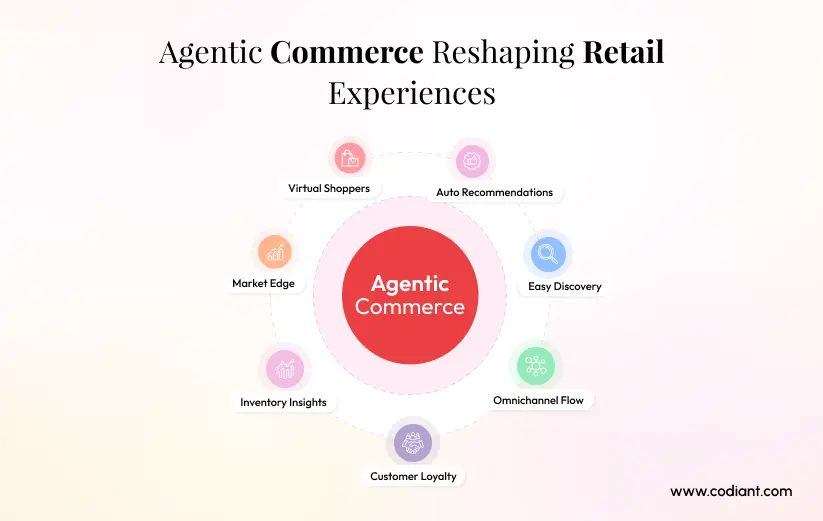
Agentic commerce is an AI-powered commerce model where AI agents solutions help customers or businesses complete shopping-related tasks with minimal manual effort.
In simple words, it means ecommerce systems become more proactive.
Instead of waiting for a shopper to click through every page, an AI agent can understand what the shopper wants, ask the right follow-up questions, compare suitable options, check product availability, apply preferences, recommend the best choice, and guide the user toward checkout.
For example, a customer may type:
“I need running shoes under $120 for flat feet, mostly for daily walking, delivered before Friday.”
In traditional ecommerce, the customer has to search, filter, compare, read reviews, check size charts, and decide manually.
In agentic AI in ecommerce, the system can:
- Understand the user’s need and constraints
- Filter products based on budget, use case, foot type, delivery date, and reviews
- Compare options across brand, comfort, size, return policy, and stock
- Recommend the best-fit products
- Explain why each product fits
- Add the selected item to cart
- Assist with checkout or handoff to a human-controlled payment step
This is the difference between a website that displays products and an intelligent ecommerce system that actively helps users buy.
Adobe Digital Insights found that AI-driven visits to U.S. retail sites increased 393% year over year in Q1 2026. More importantly, AI-referred shoppers converted 42% better than non-AI visitors in March 2026.
This signals a clear shift: shoppers using AI tools are not only browsing. They are arriving with stronger purchase intent.
McKinsey describes agentic commerce as shopping powered by intelligent AI agents that anticipate, personalize, and automate steps in the buying process to create more frictionless experiences.
Ready to Make Your Ecommerce Store Agentic?
Build AI-driven shopping workflows that guide customers from search to checkout.
How to Develop Agentic Commerce for Faster Conversions?
Now comes the practical part: how can a business actually build it? Here is a step-by-step agentic commerce development roadmap.
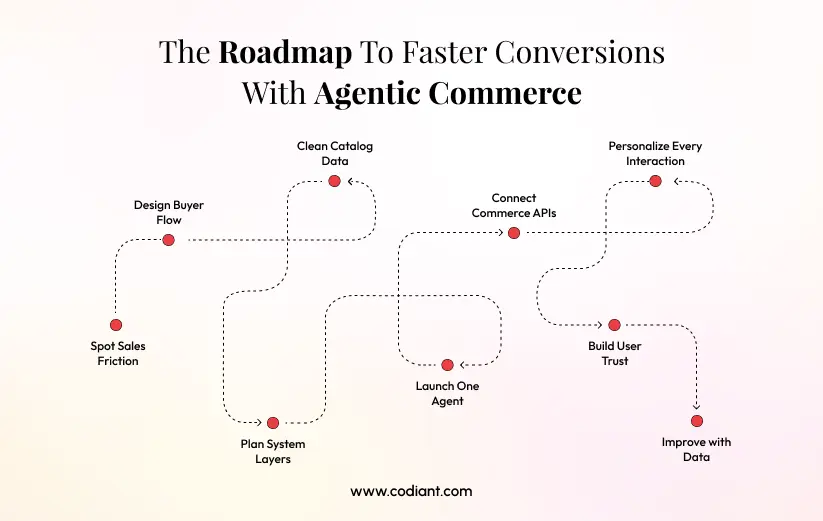
Step 1: Define the Conversion Problem Clearly
Do not start with AI. Start with the business problem.
Ask:
- Where are users dropping off?
- Are shoppers struggling with product discovery?
- Is cart abandonment high?
- Are support queries delaying purchases?
- Are recommendations weak?
- Is checkout too slow?
- Are repeat purchases not happening?
- Are B2B buyers stuck in manual approval cycles?
Agentic commerce works best when it solves a specific friction point.
For example:
- Fashion brand: size recommendation and styling assistant
- Grocery platform: automated cart building and replenishment
- Electronics store: product comparison assistant
- B2B marketplace: quote and reorder automation
- Beauty brand: routine builder and personalized recommendations
- Furniture store: room-based product matching
A clear problem leads to a useful AI agent.
A vague “we need AI” approach leads to expensive experiments.
Step 2: Map the AI-Powered Customer Journey
Before development, map how the AI-powered customer journey should work.
A good map includes:
- Entry point: website, app, chatbot, WhatsApp, voice, email, AI search, marketplace
- User intent: browse, compare, buy, reorder, return, ask, track
- Agent role: advisor, recommender, cart builder, support assistant, checkout helper
- Data needed: customer profile, product data, inventory, pricing, policies
- Actions allowed: recommend, compare, add to cart, create wishlist, apply offer, start checkout
- Human approval points: payment, subscription, high-value order, account changes
- Success metric: conversion rate, AOV, repeat order, lower support tickets
This journey map helps you decide what the AI agent should do and what it should not do.
Step 3: Prepare Your Product Data for AI Agents
This is one of the most important steps.
AI agents are only as good as the data they can read.
If your product titles are vague, descriptions are thin, specs are missing, inventory is outdated, and return policies are unclear, the AI agent will struggle.
For agentic commerce, your product data should include:
- Clear product names
- Complete descriptions
- Use cases
- Compatibility details
- Product attributes
- Size, color, material, weight, dimensions
- Price and discounts
- Stock status
- Delivery estimates
- Warranty information
- Return and exchange policy
- Customer reviews
- FAQs
- Product images and alt text
- Structured schema markup
BigCommerce notes that agentic commerce platforms need open, composable architectures, APIs, real-time inventory, and rich product data so agents can interact with storefronts, carts, and checkout functions programmatically.
Data Box: Product Data Is the New Conversion Layer
In agentic commerce, AI agents need structured product data, real-time inventory, and API access to recommend and transact accurately. Brands with weak catalog data may become harder for AI shopping assistants to understand, compare, and recommend.
Step 4: Choose the Right Agentic Commerce Architecture
A strong agentic commerce platform usually has multiple layers.
Frontend layer
This is where customers interact with the AI agent.
It can be:
- Website chat
- Mobile app assistant
- Voice assistant
- WhatsApp commerce bot
- AI search interface
- Product page assistant
- Checkout assistant
Intelligence layer
This is the AI brain.
It includes:
- LLM
- Intent detection
- Agent orchestration
- Recommendation engine
- Semantic search
- Personalization logic
- Decision rules
- Guardrails
Commerce layer
This connects the AI agent with ecommerce functions.
It includes:
- Product catalog
- Pricing
- Cart
- Checkout
- Orders
- Payments
- Inventory
- Shipping
- Promotions
- Loyalty
Enterprise integration layer
For larger businesses, agentic commerce also connects with:
- CRM
- ERP
- PIM
- OMS
- CDP
- Marketing automation
- Customer support tools
- Analytics platforms
Governance layer
This controls safety, compliance, and approvals.
It includes:
- Authentication
- Permissions
- Consent management
- Audit logs
- Fraud detection
- Payment security
- Human-in-the-loop review
This layered approach helps you build an intelligent system that is flexible, secure, and scalable.
Step 5: Build the First AI Agent Around One High-Value Use Case
Do not try to automate the entire ecommerce journey on day one.
Start with one use case that has clear ROI.
Good starting points include:
Product finder agent
Helps users find the right product based on needs, preferences, budget, and context.
Best for: fashion, electronics, furniture, beauty, grocery, healthcare, fitness.
Comparison agent
Compares products and explains differences in simple language.
Best for: electronics, appliances, SaaS, insurance, B2B equipment.
Cart recovery agent
Understands abandoned cart reasons and helps users complete purchase.
Best for: D2C brands, marketplaces, subscription commerce.
Reorder agent
Reminds customers to reorder based on purchase cycle.
Best for: grocery, supplements, pet care, beauty, office supplies.
Customer support sales agent
Answers questions and guides customers toward the right purchase.
Best for: all ecommerce businesses.
B2B procurement agent
Automates repeat orders, quotes, approvals, and vendor comparisons.
Best for: wholesale, manufacturing, healthcare procurement, office supplies, industrial ecommerce.
Starting small helps your team test the technology, measure performance, improve accuracy, and expand safely.
Step 6: Connect the Agent with Real-Time Commerce APIs
A true agentic commerce system must take action.
That means your AI agent should connect with APIs for:
- Product search
- Inventory checks
- Pricing updates
- Cart creation
- Wishlist creation
- Coupon validation
- Checkout initiation
- Payment status
- Order tracking
- Returns and exchanges
- Customer profile updates
Without these integrations, the agent becomes a conversational layer only.
With integrations, it becomes a commerce operator.
This is the heart of AI shopping automation.
Step 7: Add Personalization and Recommendation Logic
Personalization is where agentic commerce becomes powerful.
The AI agent should consider:
- Past purchases
- Browsing behavior
- Cart behavior
- Search history
- Budget range
- Brand preferences
- Location
- Delivery needs
- Loyalty status
- Product reviews
- Similar customer behavior
- Real-time session intent
For example, two customers may search for “best laptop.”
One is a student with a $700 budget. Another is a designer needing high graphics performance. A third is a business buyer purchasing 30 units.
An agentic system should not show the same results to all three.
That is the value of intelligent ecommerce systems. They understand context and personalize action.
Step 8: Design Trust, Consent, and Human Control
Agentic commerce can feel magical. But if it feels too aggressive, users may not trust it.
You need clear control points.
The AI agent should tell users:
- What it is doing
- Why it recommends something
- What data it is using
- When it needs approval
- What action will happen next
- How users can change or cancel the action
For payments, subscriptions, high-value purchases, account changes, and sensitive data, human confirmation should be required.
This is especially important because agentic commerce is still new. Trust will decide adoption.
Step 9: Test, Monitor, and Optimize
Agentic commerce development does not end after launch.
You need continuous optimization.
Track:
- Product recommendation accuracy
- Search success rate
- Conversion rate
- Add-to-cart rate
- Checkout completion
- Revenue per user
- Abandoned cart recovery
- Average response quality
- Escalation to human support
- User satisfaction
- Hallucination or incorrect response rate
- Failed API actions
Also review agent conversations regularly.
Look for moments where users are confused, recommendations are weak, or the agent fails to complete a task.
That is how you improve AI conversion optimization ecommerce over time.
How Agentic Commerce Works?
Agentic commerce works through a combination of AI agents, data, APIs, workflows, reasoning models, and commerce infrastructure.
A typical agentic commerce journey may look like this:
- Intent capture
The shopper expresses a goal through chat, voice, search, or behavior. The system identifies what the user wants, what constraints matter, and what action should happen next. - Context understanding
The AI agent studies the shopper’s preferences, history, location, budget, size, purchase frequency, cart behavior, loyalty status, and browsing patterns. - Product discovery and comparison
The agent searches the catalog, reads structured product data, checks real-time availability, compares options, and filters irrelevant products. - Decision support
The system explains which products fit best, why they fit, what trade-offs exist, and which option gives the highest value. - Action execution
The agent may add products to cart, trigger discount logic, create a bundle, start checkout, schedule replenishment, or pass the user to a payment flow. - Post-purchase automation
After purchase, the agent can help with delivery updates, returns, exchanges, reorder reminders, loyalty offers, and support requests.
This is why AI shopping automation is more powerful than simple automation. Traditional automation follows fixed rules. Agentic systems can reason through goals, adapt to context, and decide the next best action.
Traditional Ecommerce vs Agentic Commerce
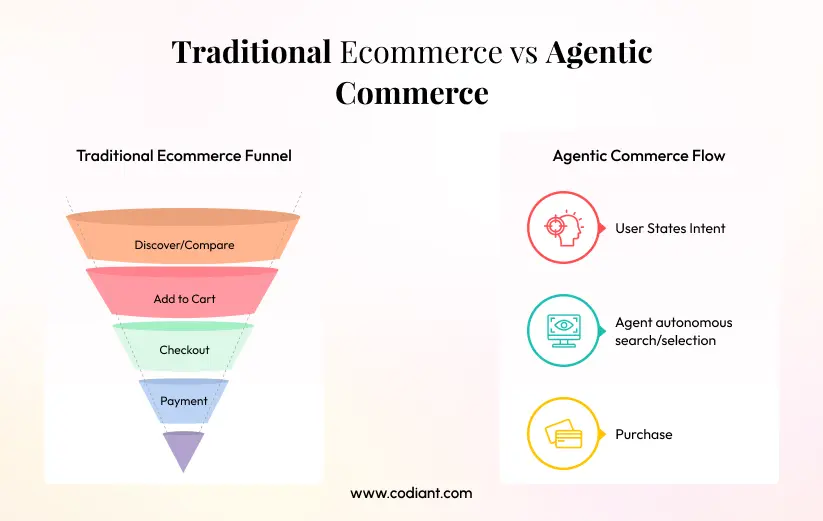
Traditional ecommerce development depends heavily on manual user action. The shopper must do most of the work.
Agentic commerce shifts some of that work to AI.
| Area | Traditional Ecommerce | Agentic Commerce |
| Product discovery | Search bars, filters, categories | AI agents understand intent and recommend suitable products |
| Personalization | Basic recommendations based on history | Real-time, context-aware personalization |
| Customer support | FAQ, live chat, ticketing | AI agents resolve queries and guide purchase decisions |
| Conversion optimization | UX changes, offers, retargeting | AI-led decision support and journey automation |
| Checkout | User manually completes steps | Agent can prepare checkout, apply logic, and reduce friction |
| Customer journey | Mostly reactive | Proactive, guided, and automated |
| Data use | Segmented customer data | Real-time behavioral, transactional, and preference data |
The biggest difference is control.
In traditional ecommerce, users control every step. In agentic commerce, users still approve important actions, but AI agents handle much of the research, comparison, and operational work around the purchase.
That creates a faster path from interest to conversion.
How AI Agents Improve Ecommerce Conversion Speed by 47%?
Speed is one of the biggest conversion factors in ecommerce. The longer shoppers spend searching, comparing, and waiting for answers, the easier it becomes for them to leave.
AI agents shorten that path. According to Rep AI’s ecommerce shopper behavior data, shoppers complete purchases 47% faster when assisted by AI, mainly because the buying journey becomes more guided and less confusing.
Instead of making users figure everything out alone, AI agents help them move faster through key steps like:
- Product discovery: They understand natural language searches and show relevant products quickly.
- Product comparison: They compare price, features, reviews, delivery, and use cases in one place.
- Instant answers: They resolve doubts around size, fit, return policy, shipping, or warranty.
- Cart confidence: They recommend bundles, add-ons, or better alternatives before checkout.
- Checkout support: They reduce last-minute hesitation by guiding users through the final step.
For brands, this means fewer slow-moving sessions and fewer abandoned carts. The real value of agentic commerce is not just faster browsing. It helps shoppers make confident purchase decisions with less effort.
Why Agentic AI Improves Ecommerce Conversions?
Conversions improve when friction decreases.
Most ecommerce drop-offs happen because users face too much confusion, too many choices, hidden costs, poor recommendations, slow support, unclear delivery timelines, or complicated checkout.
Agentic AI in ecommerce helps solve these problems by making the buying journey more guided and personalized.
1. It reduces decision fatigue
A shopper may not want to browse 80 products. They want the right three.
Agentic systems can narrow choices based on user intent, preferences, budget, reviews, inventory, delivery expectations, and product attributes. This makes the decision easier.
2. It creates faster product discovery
The AI agent can understand natural language queries better than traditional filters.
Instead of forcing users to search by category, color, size, and price separately, the agent can process complex needs in one prompt.
For example:
“Find me a formal laptop bag under $100 that fits a 16-inch laptop and looks premium.”
That is much more natural than using multiple filters.
3. It personalizes the full customer journey
Basic personalization says, “You viewed shoes, here are more shoes.”
An AI-powered customer journey says, “You bought running shoes three months ago, usually purchase fitness products on weekends, prefer neutral colors, and may need replacement insoles based on usage patterns.”
That level of personalization can influence product discovery, offers, bundles, reminders, and post-purchase retention.
4. It improves cart recovery
An AI agent can understand why a cart was abandoned.
Was shipping too high? Was the size unavailable? Did the user compare alternatives? Did they hesitate because of delivery time?
Based on that, the system can send a smarter recovery message, suggest an alternative, offer a bundle, or answer a pending concern.
5. It connects support with sales
In traditional ecommerce, support and sales are often separate.
In AI-driven commerce solutions, the support agent can become a conversion assistant. It can answer product questions, compare plans, recommend sizes, explain policies, and help the customer complete checkout.
Salesforce reported that AI and agents accounted for $262 billion of 2025 holiday spend, showing how AI-assisted shopping is already influencing major commerce moments.
Data Box: AI Is Already Influencing Large-Scale Holiday Spend
Salesforce reported that AI and agents accounted for $262 billion of 2025 holiday shopping spend. During Cyber Week 2025, Salesforce also said AI and agents drove $67 billion in sales and influenced 20% of purchases through personalized recommendations and conversational customer service.
Core Benefits of AI-Driven Commerce Systems
The benefits of AI-driven commerce systems go beyond faster checkout. They impact marketing, sales, operations, customer experience, and retention.
1. Better customer intent understanding
Agentic systems can understand what shoppers mean, not just what they type. This helps brands serve better recommendations and reduce irrelevant product exposure.
2. Higher conversion potential
When users get the right product faster, they are more likely to buy. AI agents reduce unnecessary steps and guide shoppers through decisions.
3. Improved average order value
AI agents can create smart bundles, recommend relevant add-ons, and suggest upgrades based on customer needs. This feels more helpful than random upselling.
4. Lower support workload
AI agents can answer product, delivery, policy, return, and payment questions instantly. Human teams can focus on complex or high-value cases.
5. Stronger retention
Agentic commerce can automate replenishment reminders, subscription suggestions, loyalty rewards, and personalized reactivation campaigns.
6. More efficient operations
Internally, agents can support pricing, inventory alerts, product catalog updates, campaign suggestions, merchandising decisions, and customer segmentation.
This makes ecommerce automation with AI useful across the full business, not only the storefront.
Key Use Cases of Agentic Commerce
Agentic commerce can be applied across many ecommerce scenarios. Here are the most practical use cases for 2026.
1. AI shopping assistants
An AI shopping assistant helps users find, compare, and select products through conversation.
It can answer questions like:
- Which product is best for my budget?
- What is the difference between these two models?
- Will this item fit my requirement?
- Is there a better alternative available?
- Can I get this before Friday?
This is one of the most common starting points for agentic commerce development.
2. Personalized product discovery
Instead of static product listing pages, brands can create dynamic discovery journeys. The AI agent can recommend products based on customer goals, behavior, purchase history, and real-time context.
This is useful for fashion, beauty, electronics, grocery, furniture, fitness, healthcare products, and B2B supplies.
3. Smart cart building
Agentic systems can build carts automatically based on user needs.
For example, a grocery customer can say:
“Create a weekly meal plan for a vegetarian family of four under $120.”
The agent can suggest meals, create a grocery cart, check availability, substitute out-of-stock items, and help the user complete the order.
Instacart’s ChatGPT integration, for example, brought grocery planning and checkout into a conversational shopping experience using OpenAI’s Agentic Commerce Protocol.
4. AI-based upselling and cross-selling
Traditional upselling often feels forced.
Agentic upselling feels contextual.
If someone buys a camera, the AI agent may suggest a memory card, lens cleaner, tripod, or carrying case based on actual use case. If someone buys skincare, it may suggest a routine that matches their skin type and concerns.
The difference is relevance.
5. Automated replenishment
For consumables, agentic commerce can predict when a customer may need to reorder.
This works well for:
- Grocery
- Pet food
- Supplements
- Skincare
- Medicines and wellness products
- Office supplies
- Industrial supplies
The agent can remind the user, suggest reorder, adjust quantity, and prepare checkout.
6. B2B ecommerce automation
B2B buying is often slow. It includes approvals, quotations, bulk pricing, repeat orders, vendor checks, purchase limits, and negotiations.
Agentic commerce can automate many of these steps.
For example, a procurement agent can:
- Compare approved suppliers
- Check contract pricing
- Generate repeat orders
- Route approvals
- Validate budgets
- Recommend reorder quantities
- Track delivery and invoices
This is why agentic commerce is not only a D2C trend. B2B brands can benefit heavily from intelligent ecommerce systems.
7. AI-powered checkout support
Checkout friction kills conversions.
AI agents can help users complete checkout by answering last-minute questions around shipping, returns, payment options, warranty, offers, or delivery timelines.
OpenAI and Stripe introduced the Agentic Commerce Protocol as an open standard for programmatic commerce flows between buyers, AI agents, and businesses. Stripe explains that ACP helps businesses make checkouts agent-ready so customers using AI agents can buy products directly from where they discover them.
Shoppers into Faster Ecommerce Conversions
Use AI agents to personalize journeys, reduce friction, and improve purchase decisions.
Technologies Required to Build an Agentic Commerce Platform
Building an agentic commerce platform requires more than adding a chatbot to your website.
You need a connected AI-commerce architecture.
1. Large language models
LLM-based solutions help the system understand natural language, generate responses, interpret user intent, and manage conversations.
These models support product search, comparison, recommendations, FAQs, and guided buying.
2. AI agent framework
An agent framework helps the AI system plan, reason, use tools, call APIs, and complete tasks.
This is what separates agentic commerce from a basic chatbot.
3. Product catalog intelligence
Your product data must be structured, accurate, and machine-readable.
This includes:
- Product titles
- Descriptions
- Variants
- Images
- Pricing
- Inventory
- Specifications
- Delivery timelines
- Return rules
- Reviews
- Compatibility data
- Category hierarchy
Poor product data leads to poor AI recommendations.
4. Recommendation engine
A recommendation engine helps personalize products, bundles, offers, and next-best actions.
It may use behavioral data, purchase history, similarity matching, collaborative filtering, semantic search, or real-time customer intent.
5. Vector database
A vector database helps store and retrieve product information, FAQs, policies, user preferences, and knowledge base content in a way AI systems can understand semantically.
This is important for natural product discovery.
6. APIs and integrations
Agentic commerce depends on APIs.
The AI agent needs access to:
- Product catalog
- Search
- Cart
- Checkout
- Payment gateway
- CRM
- CMS
- ERP
- Inventory system
- Order management system
- Shipping provider
- Loyalty system
- Customer support platform
Without API access, the agent can talk but cannot act.
7. Payment and checkout infrastructure
Agentic commerce requires secure, controlled payment flows.
Protocols like OpenAI and Stripe’s ACP and Google’s Agent Payments Protocol are part of the growing infrastructure around agent-led transactions. Google describes AP2 as an open protocol designed to enable secure, reliable, and interoperable agent commerce for developers, merchants, and payment providers.
8. Security and governance layer
AI agents need strict guardrails.
This includes:
- User consent
- Authentication
- Authorization
- Fraud detection
- Data privacy
- Payment security
- Human approval for sensitive actions
- Audit trails
- Role-based access
- Compliance checks
Agentic systems must be useful, but they must also be safe.
9. Analytics and feedback loop
Every agentic commerce platform should track:
- Intent categories
- Product recommendation accuracy
- Conversion rate
- Cart abandonment
- Revenue per session
- Agent-handled queries
- Escalation rate
- Average order value
- Repeat purchase rate
- Customer satisfaction
- Failed task rate
This data helps improve the AI system over time.
How Long Does It Take to Develop an Agentic Commerce Solution?
The timeline depends on complexity, integrations, data readiness, and required automation level.
A basic AI shopping assistant may take 8 to 12 weeks if the product catalog is clean and integrations are simple.
A mid-level agentic commerce system with product discovery, recommendations, cart support, CRM integration, and analytics may take 3 to 5 months.
A full-scale enterprise solution with multi-agent workflows, ERP, OMS, PIM, payment orchestration, real-time inventory, governance, and advanced personalization may take 6 to 12 months or more.
A practical roadmap looks like this:
| Phase | Timeline | What Happens |
| Discovery and strategy | 1–2 weeks | Use case selection, journey mapping, success metrics |
| Data preparation | 2–4 weeks | Product catalog cleanup, content structuring, schema readiness |
| MVP development | 6–10 weeks | First AI agent, frontend interface, core integrations |
| Testing and optimization | 2–4 weeks | Accuracy testing, UX improvements, guardrails |
| Advanced integrations | 6–12 weeks | CRM, ERP, OMS, payment, personalization, analytics |
| Scale and expansion | Ongoing | More agents, more channels, deeper automation |
The key is to begin with a conversion-focused MVP instead of waiting to build the entire system.
Can Agentic Commerce Integrate with Existing Ecommerce Platforms?
Yes. Agentic commerce can integrate with existing ecommerce platforms.
Businesses do not always need to rebuild their entire ecommerce system.
Agentic solutions can be connected with platforms like Shopify, Magento, BigCommerce, WooCommerce, Salesforce Commerce Cloud, custom marketplaces, headless commerce systems, and enterprise ecommerce platforms.
The integration usually depends on:
- API availability
- Product catalog structure
- Checkout flexibility
- Cart access
- Payment gateway compatibility
- Inventory system integration
- Customer data access
- Security requirements
- Existing CRM and ERP setup
For smaller brands, the first version may work as an AI shopping assistant connected to product catalog and cart.
For larger businesses, the agent may connect with PIM, OMS, CRM, marketing automation, support systems, and payment infrastructure.
OpenAI’s developer documentation describes ACP as a connective layer between merchants and ChatGPT users, helping ChatGPT ingest structured catalog data, understand inventory, and surface relevant products in context.
This shows where commerce is heading: stores must become easier for AI agents to read, understand, and interact with.
Industries That Can Benefit Most from Agentic Commerce
Agentic commerce can work across many sectors, but some industries will benefit faster because their buying journeys are complex, repetitive, or highly personalized.
1. Fashion and apparel
AI agents can help with size, fit, styling, occasion-based shopping, returns reduction, and personalized outfit recommendations.
2. Beauty and skincare
Agents can recommend routines based on skin type, concerns, climate, budget, ingredients, and previous purchases.
3. Grocery and food delivery
AI agents can build carts, plan meals, manage dietary preferences, suggest substitutions, and automate replenishment.
4. Electronics
Customers often compare specs, reviews, prices, and compatibility. Agentic systems can simplify these decisions.
5. Furniture and home decor
AI agents can recommend products based on room size, style, color palette, budget, and existing furniture.
6. Healthcare and wellness commerce
For non-prescription wellness, fitness, and healthcare products, agents can guide users toward suitable products while maintaining compliance boundaries.
7. B2B ecommerce
B2B buyers deal with bulk orders, repeat purchases, negotiated pricing, approval flows, and procurement rules. Agentic commerce can reduce manual work significantly.
8. Travel and hospitality commerce
Agents can build trip packages, compare stays, suggest add-ons, manage preferences, and automate booking flows.
9. Automotive parts and accessories
AI agents can match products based on vehicle type, model, compatibility, and maintenance needs.
The best industries for agentic commerce are those where customers need guidance before buying.
Common Mistakes to Avoid in Agentic Commerce Development
Agentic commerce has huge potential, but many businesses will get it wrong.
Here are the mistakes to avoid.
Mistake 1: Treating it like a chatbot project
A chatbot answers questions.
An agentic commerce system understands goals, uses tools, accesses data, and performs actions.
If your system cannot connect to catalog, cart, inventory, checkout, or CRM, it is not truly agentic.
Mistake 2: Ignoring product data quality
Poor data creates poor recommendations.
Before building agents, clean your product catalog.
Mistake 3: Automating too much too soon
Do not give AI full control without testing.
Start with assisted actions, then move toward deeper automation once accuracy and trust improve.
Mistake 4: Not defining business KPIs
Agentic commerce should improve measurable outcomes.
Track conversion rate, revenue per session, cart recovery, AOV, repeat purchase, and support cost reduction.
Mistake 5: No human approval layer
Users should approve important actions, especially payment and subscription decisions.
Mistake 6: Forgetting compliance and privacy
AI systems must handle customer data responsibly.
Make consent, transparency, and security part of the architecture from day one.
Future of Agentic Commerce in 2026 and Beyond
Agentic commerce is still developing, but the direction is clear.
Shopping will become more conversational, automated, personalized, and agent-led.
In 2026, businesses will likely see growth in:
- AI-native product discovery
- Agent-ready checkout
- Conversational commerce inside AI assistants
- AI-led B2B procurement
- Automated replenishment
- Personalized shopping agents
- AI-powered merchandising
- Multi-agent commerce workflows
- Agent-to-agent negotiation
- Machine-readable storefront optimization
Google announced new open standards and AI tools for retailers in January 2026 to help them connect with shoppers in an agentic commerce era. OpenAI and Stripe have also worked on ACP as an open standard for AI-agent commerce flows.
This means businesses need to prepare for two kinds of customers:
Human shoppers and AI agents acting for human shoppers.
That shift changes SEO, product content, checkout, customer support, analytics, and conversion strategy.
The brands that prepare early will have an advantage.
Read more: AI vs Generative AI vs Agentic AI: What Businesses Should Know in 2026
Final Thoughts
So, what is agentic commerce?
It is the next stage of ecommerce where AI agents help shoppers discover, compare, decide, and buy with less friction.
For businesses, it is not only a technology trend. It is a conversion opportunity.
The brands that win in 2026 will not be the ones that simply add an AI chatbot solution to their website. They will be the ones that build connected, intelligent, data-ready, API-driven commerce systems that help customers make better buying decisions faster.
Agentic commerce development requires strategy, clean product data, AI agents, integrations, personalization, security, and continuous optimization.
But the payoff can be significant.
Faster discovery. Smarter recommendations. Lower drop-offs. Better support. Higher conversion potential. Stronger retention.
In short, agentic commerce turns ecommerce from a passive storefront into an active buying assistant.
And in 2026, that may become one of the biggest differences between brands that get traffic and brands that convert it.
Your Store Shouldn’t Wait for Shoppers to Decide
Codiant builds agentic commerce systems that guide, compare, recommend, and move buyers faster.
The Author

Frequently Asked Questions
An agentic commerce platform usually requires large language models, AI agent frameworks, recommendation engines, vector databases, product catalog systems, commerce APIs, payment integrations, inventory systems, CRM, analytics, and security layers. For advanced platforms, businesses may also need ERP, OMS, PIM, CDP, and agent-ready checkout infrastructure.
A basic AI shopping assistant can take around 8 to 12 weeks. A mid-level agentic commerce solution with recommendations, cart support, and integrations may take 3 to 5 months. A full enterprise-grade platform with advanced automation, payments, ERP, OMS, and governance can take 6 to 12 months or more.
Yes. Agentic commerce can integrate with existing ecommerce platforms such as Shopify, Magento, BigCommerce, WooCommerce, Salesforce Commerce Cloud, and custom ecommerce systems. The ease of integration depends on API access, catalog structure, checkout flexibility, inventory systems, payment gateway setup, and customer data availability.
Industries with complex, personalized, or repeat buying journeys benefit the most. These include fashion, beauty, grocery, electronics, furniture, healthcare and wellness commerce, B2B ecommerce, travel, automotive parts, and subscription-based businesses. Any brand where customers need guidance before purchase can benefit from agentic AI.
Agentic commerce personalizes the customer experience by using purchase history, browsing behavior, preferences, budget, location, product data, real-time intent, and previous interactions. Instead of showing generic recommendations, the AI agent guides each shopper toward products, bundles, offers, and actions that match their specific needs.
Featured Blogs
Read our thoughts and insights on the latest tech and business trends

Enterprise Mobile App Development: How It Can Accelerate Your Business Growth
- August 21, 2026
- Mobile App Development
Enterprise mobile app development can accelerate growth by improving three measurable areas: workflow speed, access to business systems, and customer or employee service delivery. This matters to mid-market and enterprise leaders managing distributed teams, manual... Read more
React vs Angular vs Vue: Which Should You Choose in 2026?
- August 14, 2026
- Technology
For most web products in 2026, choose React for ecosystem flexibility and broad hiring reach, Angular for standardised enterprise architecture and complex workflows, and Vue for simpler adoption and faster team onboarding. For CTOs, product... Read more
AI Agents vs RPA: What’s the Difference and When Should You Use Each?
- August 12, 2026
- Artificial Intelligence
AI agents and Robotic Process Automation (RPA) differ in three main areas: how they make decisions, the data they can process, and how they respond when a workflow change. RPA follows predefined rules to complete... Read more