How to Identify High-ROI AI Opportunities in Your Business?
Table of Contents
Subscribe To Our Newsletter
Summarize with AI
Not enough time? get the key points instantly.
Artificial Intelligence has shifted from being an experimental technology to becoming a core driver of business growth. Today, organizations are no longer asking “Should we adopt AI?” they are asking “Where should we use AI to generate maximum ROI?”
And that’s where most businesses struggle.
Because implementing AI is not the challenge anymore. Identifying high-ROI AI opportunities in business is.
Many companies invest heavily in AI tools, automation platforms, and machine learning models, yet fail to see meaningful returns. The reason is simple: they start with technology instead of business value.
The reality is AI is not a magic solution. It only delivers results when applied to the right problems.
In this guide, we’ll break down how to systematically identify AI use cases for business that actually generate measurable impact whether it’s cost savings, revenue growth, or operational efficiency.
Understanding ROI in AI: What Businesses Often Get Wrong
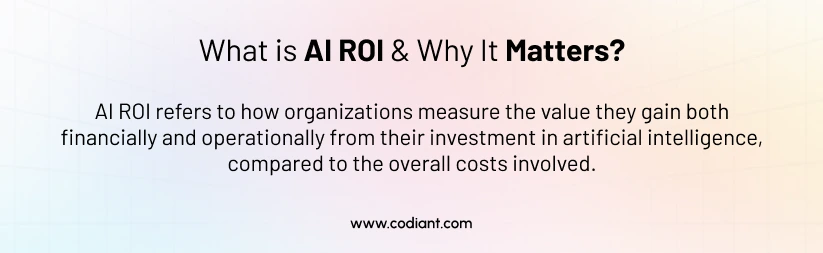
Before diving into opportunities, it’s critical to understand what ROI of AI implementation actually means in a real business context.
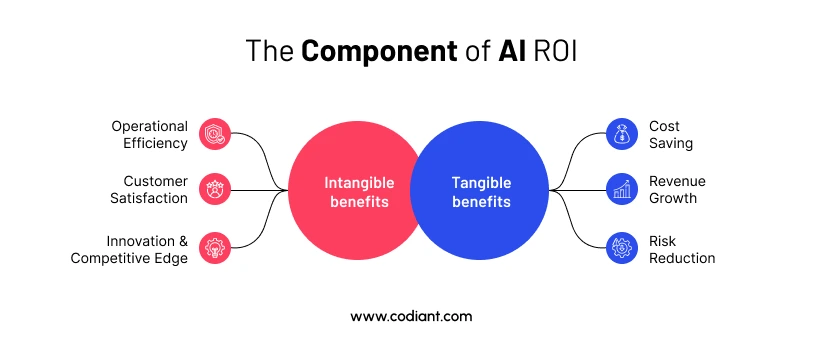
Most organizations think of ROI purely in financial terms, such as how much revenue AI generates versus how much it costs. While that’s important, the return on investment from AI development solutions is much broader and often more nuanced, encompassing operational efficiency, productivity improvements, customer experience enhancement, and long-term business growth beyond direct revenue generation.
AI delivers value across multiple dimensions:
- Direct Financial Gains – Increased revenue through better targeting, recommendations, and pricing strategies
- Cost Optimization – Reduction in manual labor, errors, and operational inefficiencies
- Time Efficiency – Faster processes, quicker decisions, reduced turnaround time
- Customer Experience Improvements – Personalized interactions, faster support, better engagement
- Strategic Advantage – Better forecasting, predictive insights, and competitive positioning
For example, an AI-powered recommendation engine may not just increase sales it also improves customer retention and lifetime value. Similarly, an AI chatbot doesn’t just reduce support costs; it enhances customer satisfaction by offering instant responses.
This is why AI investment ROI should always be evaluated holistically, not just through short-term revenue metrics.
Businesses that fail to recognize this often underestimate the true impact of AI or worse, abandon initiatives too early.
Discover Your High-Impact AI Opportunities Today
Stop guessing where AI fits identify opportunities that actually drive measurable ROI and business growth.
Step-by-Step Framework to Identify High-ROI AI Opportunities
A structured, outcome-focused approach helps businesses pinpoint where AI delivers maximum impact, ensuring smarter investments, faster adoption, and measurable returns.
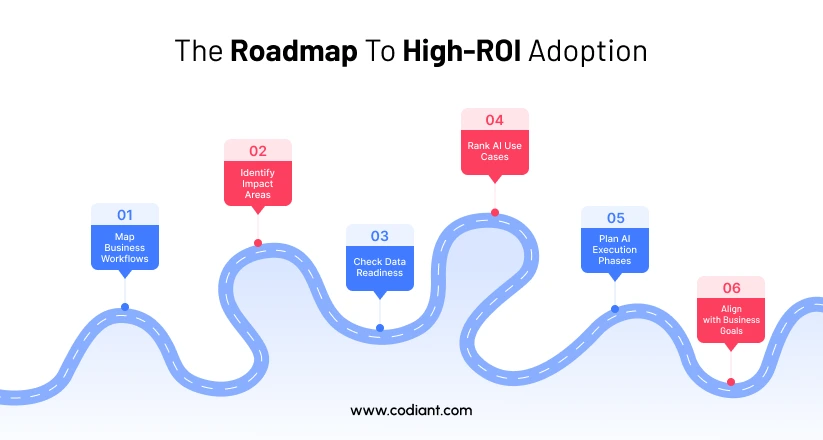
Step 1: Analyze Your Business Processes Deeply
The foundation of identifying AI opportunities in business lies in understanding your operations at a granular level.
You need to break down your workflows across departments and examine how work actually gets done.
Look at:
- Sales processes
- Marketing campaigns
- Customer support workflows
- Operational tasks
- Financial processes
- HR functions
Instead of looking at high-level activities, go deeper.
Ask questions like:
- Where are employees spending the most time?
- Which tasks are repetitive and manual?
- Where do delays or bottlenecks occur?
- Which processes are prone to errors?
These insights reveal potential AI automation use cases.
For instance:
- Manual data entry → AI-based data extraction and automation
- Lead qualification → AI-driven scoring models
- Customer inquiries → AI chatbots and virtual assistants
The goal is to identify processes where human effort is high, but value addition is relatively low.
These are the areas where AI can deliver immediate and measurable ROI.
Step 2: Focus on Business Impact, Not Just Automation
Automation alone does not guarantee ROI.
To identify high-value opportunities, you must connect AI use cases directly to business outcomes.
Every potential AI initiative should answer:
- Will this reduce operational costs?
- Will this increase revenue?
- Will this improve customer experience?
- Will this enhance decision-making speed or accuracy?
High-ROI AI use cases for business typically fall into three major categories:
- Cost Reduction
AI can automate repetitive processes, reduce errors, and optimize resource utilization.
Examples include:
- Invoice processing automation
- AI-driven document management
- Workforce optimization
- Revenue Growth
AI can directly impact revenue by improving targeting, personalization, and conversions.
Examples include:
- Recommendation engines
- Predictive sales analytics
- Dynamic pricing strategies
- Efficiency & Productivity
AI can accelerate processes and improve output quality.
Examples include:
- Automated reporting
- Real-time analytics
- Decision support systems
If an AI use case doesn’t clearly align with at least one of these categories, it’s unlikely to generate strong ROI.
Step 3: Assess Data Readiness Before Anything Else
AI is only as powerful as the data it is trained on.
Before finalizing any AI implementation roadmap, businesses must evaluate their data ecosystem.
Key questions to consider:
- Do we have sufficient historical data?
- Is the data structured or unstructured?
- Is it clean, accurate, and accessible?
- Are there data silos across departments?
For example:
- CRM data enables predictive sales models
- Customer support logs power AI chatbots
- Transaction data supports demand forecasting
If your data is incomplete or fragmented, your priority should be data preparation and integration, not AI implementation.
This step is critical because poor data quality directly reduces AI investment ROI.
Many AI projects fail not because of poor models, but because of poor data.
Step 4: Prioritize AI Opportunities Using a Scoring Framework
Once you identify multiple opportunities, the next challenge is prioritization.
Not all AI use cases should be implemented at once.
A structured approach helps you focus on high-impact opportunities.
Evaluate each use case based on:
- Business Impact – Revenue growth, cost savings, or efficiency gains
- Implementation Complexity – Technical difficulty and integration requirements
- Data Availability – Quality and accessibility of data
- Time to Value – How quickly results can be achieved
Use a simple scoring system to rank opportunities.
High-ROI opportunities typically have:
- High impact
- Moderate to low complexity
- Strong data availability
- Short time to value
Starting with these “quick wins” helps build momentum and validates your AI adoption strategy.
Step 5: Build a Phased AI Implementation Roadmap
One of the most effective ways to ensure ROI is to adopt a phased approach.
Instead of large-scale transformation, follow a structured AI implementation roadmap:
Phase 1: Pilot
Start with 1–2 high-impact use cases.
Build a minimal viable solution and test outcomes.
Phase 2: Optimization
Refine models, improve accuracy, and integrate with workflows.
Phase 3: Scaling
Expand AI across departments and automate additional processes.
This approach reduces risk and ensures that each stage delivers measurable value.
It also answers a common concern that businesses have how to start AI in a company without overinvesting.
Step 6: Align AI with Long-Term Business Strategy
AI should not be treated as a standalone initiative.
A strong AI strategy for companies aligns with broader business goals.
For example:
- If your goal is customer retention → Focus on personalization AI
- If your goal is operational efficiency → Focus on automation
- If your goal is innovation → Focus on predictive analytics
This alignment ensures that AI investments contribute directly to AI business transformation, rather than becoming isolated experiments.
Build a Scalable AI Strategy That Delivers ROI
Align AI with your business goals and unlock long-term growth, efficiency, and competitive advantage.
High-ROI AI Use Cases Across Business Functions
To better understand where to use AI in business, let’s explore practical applications across departments.
1. Customer Support
AI chatbots solutions, automated ticket routing, and sentiment analysis reduce response time and improve customer satisfaction.
2. Sales & Marketing
AI enables lead scoring, personalized campaigns, and customer segmentation, driving higher conversions and engagement.
3. Operations
Demand forecasting, supply chain optimization, and workflow automation improve efficiency and reduce costs.
4. Finance
AI-powered fraud detection, expense tracking, and financial forecasting enhance accuracy and risk management.
5. Human Resources
Resume screening, employee analytics, and attrition prediction streamline hiring and improve workforce planning.
These AI automation use cases are widely adopted because they consistently deliver measurable ROI.
Which Businesses Benefit the Most from AI?
While AI can be applied across industries, certain businesses experience faster adoption and significantly higher returns due to the nature of their operations and data maturity. Organizations that benefit the most from AI typically operate in environments where decision-making, efficiency, and customer experience directly impact revenue and scalability.
Businesses that see the strongest results usually have:
- Large volumes of structured and unstructured data generated across operations
- Repetitive operational processes that consume time and resources
- Customer-facing interactions requiring personalization and responsiveness
- Complex decision-making scenarios involving multiple variables and predictions
Industries leading in AI adoption strategy include:
- E-commerce – personalization, recommendations, dynamic pricing
- Healthcare – diagnostics, patient management, clinical workflows
- Finance – fraud detection, risk assessment, predictive analytics
- Logistics – route optimization, demand forecasting, inventory planning
- SaaS – automation, customer insights, churn prediction
However, AI is no longer limited to large enterprises. With the rise of affordable tools, APIs, and cloud-based platforms, small and mid-sized businesses can now leverage AI effectively to streamline operations, improve customer engagement, and compete with larger players.
How to Measure and Track AI ROI Effectively?
Once AI solutions are implemented, measuring outcomes becomes essential to validate success and guide future investments. Without a structured approach to tracking performance, businesses risk underestimating the true value of AI or failing to identify areas for improvement.
To effectively measure the ROI of AI implementation, organizations must define clear success metrics aligned with business goals. These metrics should capture both financial impact and operational improvements.
Key metrics include:
- Cost savings achieved through automation and reduced manual effort
- Revenue growth driven by better targeting, personalization, and insights
- Process efficiency improvements, including reduced turnaround times
- Customer satisfaction levels through faster and more accurate service
- Time reduction in completing tasks or decision-making processes
For example:
- AI chatbots can reduce customer support costs by up to 30%
- Predictive analytics solutions can increase sales conversions by 15–20%
- Workflow automation can cut processing time by nearly 50%
The most effective approach is to compare pre-AI and post-AI performance consistently. This ensures that AI investment ROI remains transparent, measurable, and continuously optimized over time.
Common Mistakes That Reduce AI ROI
Even with a well-defined strategy, many organizations fail to achieve expected outcomes due to avoidable mistakes during implementation and adoption. These challenges often arise not from the technology itself, but from gaps in planning, execution, and alignment.
Some of the most common mistakes include:
- Choosing overly complex use cases without sufficient data or readiness
- Ignoring employee training, leading to low adoption and resistance
- Poor system integration, resulting in disconnected workflows
- Setting unrealistic expectations for immediate results
- Failing to monitor and optimize AI models continuously
One of the biggest issues is treating AI as a one-time project rather than an evolving capability. AI systems require regular updates, performance monitoring, and alignment with changing business needs.
Organizations that succeed with AI focus not just on deployment, but on long-term adoption, usability, and scalability. By avoiding these common pitfalls and maintaining a continuous improvement mindset, businesses can significantly enhance their AI investment ROI and ensure sustained value from their AI initiatives.
The Future: AI as a Core Business Driver
AI is rapidly evolving from a supporting tool to a core business capability.
Organizations are shifting from experimentation to outcome-driven implementations.
The focus is no longer on adopting AI but on using it strategically to:
- Drive growth
- Improve efficiency
- Enhance customer experiences
Businesses that identify high-ROI opportunities early will gain a significant competitive advantage.
Read more: AI Tools vs Custom AI Development: Which One Fits Your Business Model?
Conclusion
Identifying high-ROI AI opportunities is not about technology it’s about strategy.
When businesses focus on the right processes, align AI with goals, and prioritize impact, the results are transformative.
AI can:
- Reduce costs
- Increase revenue
- Improve efficiency
- Enhance decision-making
The key lies in starting small, focusing on measurable outcomes, and scaling strategically.
AI is not just an investment. It’s a long-term business advantage.
Identify the Right AI Opportunities Before You Invest
Not all AI initiatives deliver ROI but the right ones can transform your business.
We help companies discover, validate, and scale AI opportunities that drive real impact.
The Author

Frequently Asked Questions
AI ROI refers to the measurable value generated from AI investments compared to the cost, including financial gains, efficiency improvements, and strategic advantages.
Begin by identifying high-impact problems, evaluating data readiness, and launching small pilot projects before scaling AI across operations.
Departments like sales, marketing, customer support, operations, finance, and HR all benefit from AI through automation, analytics, and improved decision-making.
Costs vary based on complexity, tools, and scale. Basic solutions may start small, while enterprise-level AI systems require higher investment.
Some AI initiatives deliver ROI within a few months, while more advanced implementations may take 6–12 months depending on complexity and scale.
Featured Blogs
Read our thoughts and insights on the latest tech and business trends

Enterprise Mobile App Development: How It Can Accelerate Your Business Growth
- August 21, 2026
- Mobile App Development
Enterprise mobile app development can accelerate growth by improving three measurable areas: workflow speed, access to business systems, and customer or employee service delivery. This matters to mid-market and enterprise leaders managing distributed teams, manual... Read more

React vs Angular vs Vue: Which Should You Choose in 2026?
- August 14, 2026
- Technology
For most web products in 2026, choose React for ecosystem flexibility and broad hiring reach, Angular for standardised enterprise architecture and complex workflows, and Vue for simpler adoption and faster team onboarding. For CTOs, product... Read more
AI Agents vs RPA: What’s the Difference and When Should You Use Each?
- August 12, 2026
- Artificial Intelligence
AI agents and Robotic Process Automation (RPA) differ in three main areas: how they make decisions, the data they can process, and how they respond when a workflow change. RPA follows predefined rules to complete... Read more