How to Build an AI-Powered Dental Practice Platform? – A Complete Guide
Table of Contents
Subscribe To Our Newsletter
Summarize with AI
Not enough time? get the key points instantly.
In a Nutshell
- AI is transforming dental practices into data-driven intelligent systems.
- Dental platforms combine clinical, operational and patient management tools together.
- AI enables faster diagnosis and improves treatment decision accuracy significantly.
- Automation reduces administrative workload and improves clinic operational efficiency.
- Core features include diagnostics, scheduling, billing, analytics and engagement tools.
- Building AI dental software requires strong architecture and domain expertise.
- Compliance and data security are critical in healthcare software development.
- Development cost varies based on complexity, features and AI capabilities.
- Choosing the right development partner impacts product success greatly.
- Future dental platforms will be predictive, automated and highly personalized.
The dental industry is going through a quiet but powerful transformation.
Clinics that once relied on manual records, disconnected systems and time-consuming workflows are now moving toward intelligent, AI-driven platforms that streamline operations, improve diagnosis and enhance patient experience.
This shift isn’t just about adopting new technology. It’s about rethinking how dental practices operate at every level.
From patient onboarding to diagnosis, treatment planning, billing and follow-ups, AI in dental practice is redefining efficiency, accuracy and scalability.
If you’re planning to build a dental app with AI capabilities or develop a full-fledged AI-powered dental clinic management system, leveraging AI development solutions can help streamline the process. This guide will walk you through everything you need to know, from architecture and features to cost and development strategy.
Step-by-Step Process to Build an AI Dental Platform
Building a robust AI-powered dental solution requires a structured approach.
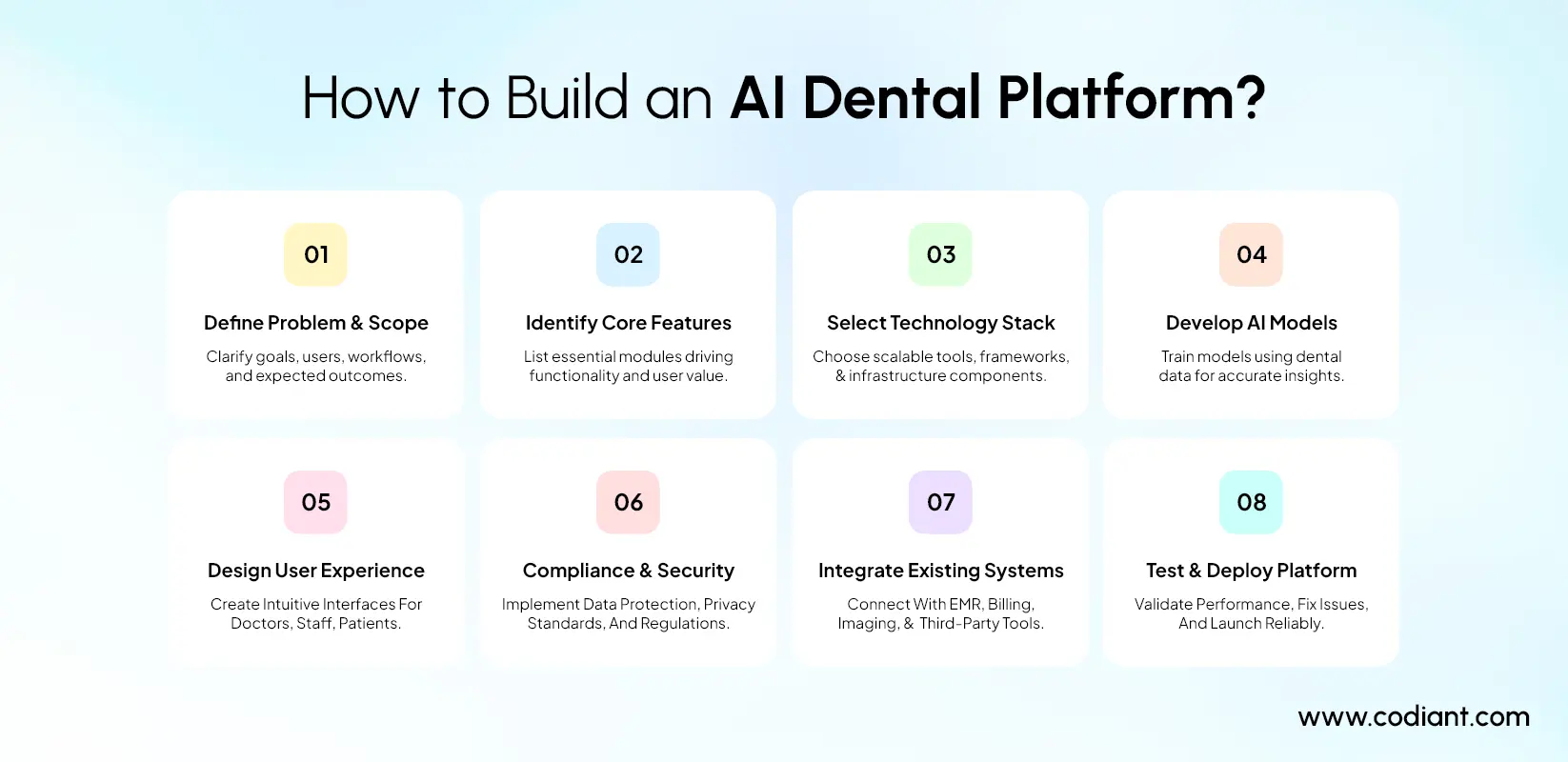
Step 1- Define the Problem and Scope
Start with clarity.
Are you building:
- A full dental clinic ecosystem?
- A diagnostic AI tool?
- A patient engagement platform?
Defining the scope early helps avoid unnecessary complexity later.
Build Your AI Dental Platform Today
Turn your dental idea into scalable AI-powered platform with expert team.
Step 2- Identify Core Features
Based on your use case, decide what features are essential.
A strong dental clinic management system AI should include:
- Digital patient records (EHR/EMR)
- AI-powered diagnostics
- Appointment automation
- Billing and invoicing
- Reporting dashboards
- Integration with imaging devices
Step 3- Choose the Right Tech Stack
For AI healthcare software development, your technology choices matter.
Typical stack includes:
- Frontend– React, Angular
- Backend– Node.js, Python, .NET
- AI/ML- TensorFlow, PyTorch, OpenCV
- Database- PostgreSQL, MongoDB
- Cloud- AWS, Azure, GCP
Step 4- Develop AI Models
This is where intelligence comes in.
AI models can be built for:
- Image recognition (X-ray analysis)
- Predictive analytics solutions (treatment outcomes)
- NLP (chatbots, voice input)
- Recommendation systems (treatment plans)
Training requires high-quality dental datasets and domain-specific validation.
Step 5- Design User Experience
Dental professionals are not tech experts.
Your platform must be:
- Easy to navigate
- Fast and responsive
- Clinically intuitive
- Mobile-friendly
A clean UI can significantly improve adoption.
Step 6- Ensure Compliance & Security
Healthcare data is sensitive.
Your platform must comply with:
- HIPAA (US)
- GDPR (Europe)
- Local healthcare regulations
Security measures include:
- Data encryption
- Role-based access
- Audit logs
- Secure cloud infrastructure
Step 7- Integration with Existing Systems
Most clinics already use some form of software.
Your solution should integrate with-
- Existing EHR systems
- Imaging devices
- Payment gateways
- Insurance platforms
This ensures smoother adoption.
Step 8- Testing and Deployment
Testing should include-
- Functional testing
- AI accuracy validation
- Performance testing
- Security testing
Once validated, deploy using cloud infrastructure for scalability.
Cost of Building AI Dental Software
One of the first questions businesses ask before starting development is simple.
How much does it actually cost to build an AI-powered dental platform? The honest answer is that there is no fixed number.
The cost of custom dental software development depends on multiple variables, including platform type, feature complexity, AI capabilities, integrations, and compliance requirements.
Let’s break this down in a practical and structured way.
Cost Breakdown by Platform Type
The platform you choose directly impacts development time and cost.
| Platform Type | Description | Estimated Cost |
| Web App | Accessible via browsers, ideal for clinic dashboards | $20,000 – $60,000 |
| Mobile App (Single Platform) | Android or iOS app for patients/dentists | $25,000 – $70,000 |
| Cross-Platform App | Single codebase for Android + iOS | $40,000 – $100,000 |
| Web + Mobile Ecosystem | Complete platform with admin + apps | $80,000 – $180,000+ |
A full dental clinic management system AI usually requires both web and mobile interfaces.
Cost Breakdown by Feature Complexity
Not all dental platforms are built the same.
The number and depth of features significantly affect cost.
| Feature Level | Includes | Estimated Cost Impact |
| Basic | Patient records, scheduling, billing | Low ($20K–$50K) |
| Moderate | Reporting, integrations, automation | Medium ($50K–$120K) |
| Advanced | AI diagnostics, predictive analytics, chatbots | High ($120K–$300K+) |
The more intelligent and automated the system, the higher the investment.
Cost Breakdown by AI Capabilities and Complexity
AI is the biggest cost driver in modern dental platforms.
| AI Feature | Description | Cost Impact |
| AI Chatbot | Patient queries, appointment booking | $5,000 – $15,000 |
| Image Analysis (X-rays) | Detect cavities, infections | $20,000 – $60,000 |
| Predictive Analytics | Treatment outcomes, patient trends | $15,000 – $40,000 |
| Voice-to-Text (Documentation) | Automated clinical notes | $10,000 – $30,000 |
| Recommendation Engine | Treatment suggestions | $15,000 – $35,000 |
AI development involves data collection, model training, testing, and validation, which increases both time and cost.
Cost Breakdown by Integration Requirements
Dental platforms rarely operate in isolation. They need to connect with multiple systems.
| Integration Type | Examples | Cost Impact |
| EHR/EMR Systems | Patient records sync | $10,000 – $30,000 |
| Imaging Devices | X-ray, CBCT machines | $10,000 – $25,000 |
| Payment Gateways | Stripe, Razorpay | $5,000 – $15,000 |
| Insurance APIs | Claim processing | $10,000 – $25,000 |
More integrations mean more complexity and higher development effort.
Cost Breakdown by Compliance and Security
Healthcare applications require strict compliance.
This is not optional.
| Compliance Requirement | Description | Cost Impact |
| HIPAA/GDPR | Data privacy regulations | $10,000 – $40,000 |
| Data Encryption | Secure storage and transfer | $5,000 – $15,000 |
| Access Control | Role-based permissions | $3,000 – $10,000 |
| Audit Logs | Activity tracking | $3,000 – $8,000 |
Security layers add to cost but are critical for trust and legal compliance.
Cost Breakdown by Development Team Location
Where your development team is based also affects pricing.
| Region | Hourly Rate | Approx Project Cost |
| USA/UK | $80 – $150/hour | $150K – $400K+ |
| Europe | $50 – $100/hour | $100K – $250K |
| India | $20 – $50/hour | $40K – $150K |
This is why many businesses choose offshore partners for AI dental software development.
Cost Breakdown by Development Phases
Understanding how cost is distributed across phases gives better clarity.
| Phase | Activities | Estimated Cost |
| Discovery & Planning | Requirement analysis, roadmap | $5,000 – $15,000 |
| UI/UX Design | Wireframes, prototypes | $8,000 – $25,000 |
| Development | Frontend + backend coding | $30,000 – $120,000 |
| AI Model Development | Training, testing, validation | $20,000 – $100,000 |
| Integration | APIs, third-party systems | $10,000 – $40,000 |
| Testing & QA | Performance, security testing | $5,000 – $20,000 |
| Deployment | Cloud setup, launch | $3,000 – $10,000 |
Overall Estimated Cost Snapshot
Here’s a simplified view of total cost ranges based on solution complexity-
| Solution Type | Description | Estimated Cost |
| Basic Dental Software | Scheduling + patient records | $30,000 – $60,000 |
| Mid-Level Platform | Automation + integrations | $60,000 – $150,000 |
| Advanced AI Platform | Full AI-powered ecosystem | $150,000 – $300,000+ |
Hidden Costs to Consider
Many businesses overlook these additional expenses-
- Data acquisition for AI training
- Cloud hosting and infrastructure
- Ongoing maintenance and updates
- AI model retraining and optimization
- Customer support and scaling
These can add 15–25% annually to your total investment.
Is AI Dental Software Worth the Investment?
At first glance, the cost may seem high.
But the ROI tells a different story.
AI-powered dental platforms help:
- Reduce administrative costs by up to 40%
- Improve patient retention through better experience
- Increase diagnostic accuracy
- Optimize clinic operations and staff productivity
Over time, the efficiency gains and revenue growth often outweigh the initial investment.
Related reading: How to Hire the Right Healthcare Software Development Company
Why AI is Transforming Dental Practices?
Dental clinics generate a massive amount of data every day. Patient records, X-rays, treatment histories, prescriptions, billing data, insurance claims the list keeps growing. Understanding this information becomes even more important when considering specialized care, such as what is an orthodontist a dental specialist who focuses on diagnosing, preventing, and correcting misaligned teeth and jaws, often using braces, aligners, and other corrective devices.
Traditionally, most of this data remained underutilized.
That’s where AI changes the game.
Modern AI dental software development focuses on turning this data into actionable insights.
AI-powered systems can:
- Analyze dental X-rays for early detection of cavities or gum disease
- Automate appointment scheduling and patient communication
- Predict treatment outcomes based on historical data
- Assist dentists in clinical decision-making
- Reduce administrative workload significantly
In simple terms, AI is helping dental clinics move from reactive care to proactive and predictive care.
What an AI-Powered Dental Platform Actually Includes?
Before you jump into development, it’s important to understand what you’re building.
An AI-powered dental platform is not just a software tool. It’s an integrated ecosystem combining clinical, operational & patient-facing systems.
A complete dental practice management software AI platform typically includes:
- Patient Management System: Handles patient records, appointment history, medical data & communication.
- Clinical Decision Support: Uses AI models to assist dentists with diagnosis and treatment planning.
- Imaging & Diagnostics Integration: AI analyzes dental images such as X-rays, CBCT scans & intraoral photos.
- Billing & Insurance Automation: Streamlines invoicing, claim processing & insurance verification.
- Appointment & Scheduling Engine: Automates bookings, reminders, cancellations & rescheduling.
- Analytics & Reporting Dashboard: Provides insights into clinic performance, patient trends & revenue.
- Patient Engagement Tools: Includes chatbots, reminders, feedback systems & personalized communication.
This combination forms the foundation of modern dental automation software.
Upgrade Your Dental Practice with AI
Automate workflows, improve diagnosis, and enhance patient experience using AI.
Key Features Every AI Dental Platform Must Have
Building a competitive product takes more than ticking basic feature boxes. You need systems that actually solve really clinical and operational friction. Here’s what that looks like in practice.
1. AI-Based Diagnostics
AI reviews dental X-rays and imaging data with speed and consistency that’s hard to match manually. It flags cavities, gum issues, and subtle abnormalities early. The real value is not just detection but reducing oversight and improving confidence in clinical decisions.
2. Smart Scheduling
Scheduling sounds simple until it isn’t. AI systems handle appointment flows dynamically, adjusting for urgency, cancellations, and patient behavior. No-shows drop. Dentist time gets optimized. The calendar starts working like a system, not a spreadsheet.
3. Automated Documentation
Documentation has always been the silent time drain in clinics. AI changes that. Voice input converts into structured clinical notes in seconds. Dentists spend less time typing and more time focusing on patients, without compromising record accuracy.
4. Predictive Analytics
Historical patient data stops being static. AI analyzes patterns to anticipate treatment needs and highlight potential risks early. This shifts care from reactive to proactive, which is where modern clinics want to be.
5. Chatbots & Virtual Assistants
Front desks are busy for a reason. AI assistants take over routine interactions such as bookings, reminders, and basic queries. Patients get instant responses. Staff workload drops. Communication becomes consistent and always on.
6. Treatment Planning Assistance
Treatment planning often depends on experience and time. AI adds another layer by recommending options based on data, history, and clinical guidelines. It does not replace judgment, but it sharpens it and speeds up decisions.
These are the capabilities shaping next-generation AI tools for dentists.
How AI Improves Dental Clinic Operations?
AI is not just a technology layer. It changes how clinics function day to day.
1. Faster Diagnosis
AI processes imaging and patient data almost instantly. What used to take careful manual review now happens in seconds. Early detection improves, and treatment decisions move faster without cutting corners.
2. Reduced Administrative Work
Administrative tasks quietly consume hours every day. AI automates scheduling, billing, and documentation workflows. Staff time gets redirected toward patient care, which is where it matters most.
3. Better Patient Experience
Patients notice speed and consistency. AI enables timely reminders, personalized communication, and smoother interactions across touchpoints. The experience feels organized, not fragmented.
4. Data-Driven Decisions
Gut-based decisions have limits. AI-backed insights bring clarity using real patient data. Dentists can refine treatments, optimize workflows, and understand clinic performance with more precision.
5. Increased Revenue Efficiency
Efficiency shows up in numbers. Fewer missed appointments, better scheduling, and optimized treatment planning all contribute to stronger revenue outcomes. Operations become tighter without increasing effort.
This is why dental practice management software AI is shifting from optional to essential.
Challenges in AI Dental Software Development
Building AI in healthcare is not plug-and-play. There is real hurdles and ignoring them usually leads to problems later.
- Data Availability: AI models rely on high-quality datasets. Without enough clean and relevant data, accuracy suffers quickly.
- Regulatory Compliance: Healthcare regulations are strict and often region-specific. Missing compliance is not a minor issue. It can stop deployment entirely.
- Integration Complexity: Most clinics already use legacy systems. Connecting new AI platforms with existing tools can get complicated and time-consuming.
- User Adoption: Not every dentist is ready to switch workflows overnight. Resistance to change is real, especially when systems feel unfamiliar.
- Accuracy Requirements: In healthcare, close enough is not acceptable. AI outputs must be highly reliable, especially when tied to clinical decisions.
Choosing the right dental software development company often makes the difference between a working product and one that struggles in real-world environments.
How to Choose the Right Development Partner?
Your development partner plays a critical role in success.
Look for:
- Experience in AI healthcare software development
- Proven track record in healthcare projects
- Understanding of compliance requirements
- Strong UI/UX capabilities
- Ability to scale and support long-term
A good partner doesn’t just build software. They help you build a product that works in real-world clinical environments.
Future Trends in AI Dental Platforms
The future of AI in dental practice is already evolving.
Key trends include:
- Real-time AI diagnostics during patient visits
- Voice-assisted dental workflows
- Personalized treatment plans using predictive AI
- Integration with wearable health devices
- Fully automated clinic operations
The next generation of dental platforms will be more intelligent, connected, and patient-centric.
How Codiant Can Help You Build an AI Dental Platform?
Building a production-ready AI dental platform requires both technical expertise and deep healthcare understanding.
At Codiant, we specialize in custom dental software development tailored to modern clinical needs.
We help you:
- Design scalable dental clinic management system AI platforms
- Build AI-powered diagnostics and automation tools
- Ensure compliance with healthcare standards
- Integrate seamlessly with existing systems
- Deliver user-friendly solutions for real-world adoption
Whether you’re a startup or an enterprise, we bring the expertise needed to transform your vision into a scalable product.
Read more: Top 10 Healthcare Software Development Companies in the USA for 2026
Final Thoughts
The dental industry is no longer just about treatments. It’s about intelligent care delivery powered by data and technology. Clinics that adopt AI today are not just improving efficiency. They are building a future-ready practice that delivers better outcomes, faster services, and superior patient experiences.
If you’re planning to build dental app with AI, now is the time to invest in the right strategy, technology, and development partner. Because in the coming years, AI won’t be a competitive advantage. It will be the standard.
Launch Custom Dental Software Faster
Build secure, scalable and compliant dental software tailored to your needs.
The Author

Frequently Asked Questions
An AI-powered dental platform is a software system that uses artificial intelligence to automate workflows, assist diagnosis, and improve patient management in dental clinics.
AI improves efficiency by automating tasks, enhancing diagnostics, optimizing scheduling, and providing actionable insights for better decision-making.
The cost typically ranges from $30,000 to $300,000+ depending on features, AI capabilities & complexity.
Yes, modern platforms are designed to integrate with EHR systems, imaging tools & billing systems for seamless workflows.
Yes, when built with proper compliance, encryption & validation, AI systems are secure and reliable for healthcare use.
Featured Blogs
Read our thoughts and insights on the latest tech and business trends

AI Readiness Checklist for Enterprises in 2026
- July 20, 2026
- Artificial Intelligence
AI readiness is the ability of an enterprise to adopt artificial intelligence safely, strategically, and at scale. It depends on business goals, data quality, technology infrastructure, governance, talent, security, workflow maturity, and measurable value creation.... Read more
Why 63% Of Australian Business Leaders Are Prioritizing AI in 2026?
- July 14, 2026
- Artificial Intelligence
63% of Australian business leaders are prioritizing AI in 2026 because new technologies, especially artificial intelligence, are now linked to productivity, efficiency, competitiveness and long-term business resilience. KPMG Australia’s 2026 survey found that 63% of... Read more
AI Tech Stack: Choosing the Right Technology for Your Software
- July 8, 2026
- Artificial Intelligence
An AI tech stack is the combination of programming languages, frameworks, models, databases, infrastructure and engineering tools used to build and operate artificial intelligence software. The right stack depends on the problem being solved, available... Read more