How to Hire AI Developers for Automation & Smart Applications- A Complete Guide for 2026
Table of Contents
Subscribe To Our Newsletter
In a Nutshell
- AI hiring in 2026 is a business decision, not just a technical one.
- Most AI failures happen due to wrong hiring models and unclear scope, not bad ideas.
- Successful automation starts by defining outcomes, not choosing tools.
- Not all automation needs AI knowing when to use AI matters.
- Data readiness is as important as developer skill.
- Dedicated AI developers deliver better ROI for long-term automation projects.
- Hourly hiring works best for PoCs and short experiments.
- In-house AI teams offer control but come with higher cost and slower execution.
- Strong AI teams combine AI, data, backend, and domain expertise.
- Real-world deployment experience matters more than certifications.
- AI automation services help reduce risk for first-time AI adopters.
- Future-proof AI hiring focuses on adaptability, ethics, and long-term partnerships.
AI has moved out of demos and into day-to-day business operations. In 2026, it’s running workflows, flagging risks, personalizing user experiences, and quietly handling work that once needed entire teams.
Yet most AI projects don’t fail because of bad ideas. They fail because of hiring mistakes.
AI developers are not interchangeable with traditional engineers. They work with uncertain data, changing models, and systems that need constant tuning after launch. When businesses hire the wrong talent or the right talent in the wrong way projects stall, costs rise, and “AI initiatives” turn into unused experiments.
This complete hiring guide explains how to hire AI developers for automation and smart applications in 2026, based on what actually works in real deployments not theory or trends.
Why Hiring AI Developers in 2026 Is a Strategic Decision
In 2026, the use of AI has developed. Companies now are no longer asking if they need to use AI but where and how fast they can deploy it.
Now, businesses turn to AI developers for:
- Automating repetitive business processes
- Building intelligent customer-facing applications
- Improving decision-making with predictive insights
- AI operationally integrated with existing products and processes
This shift has increased demand for AI engineers for business automation and dedicated AI developers who can move beyond theory and deliver production-ready systems.
Hiring AI developers in 2026 is not just about writing models it’s about building systems that integrate cleanly, scale reliably & deliver measurable ROI.
Your AI Hiring Decision Will Define Your 2026 Roadmap
Get clarity on skills, costs, and hiring models before committing budget to AI automation.
How Do I Hire AI Developers for Automation Projects?
Hiring the right AI talent for automation isn’t just about finding “AI people.” In 2026, it’s about choosing developers who can translate business workflows into reliable, scalable automation that works in production. Here’s a practical 7-step process you can follow.
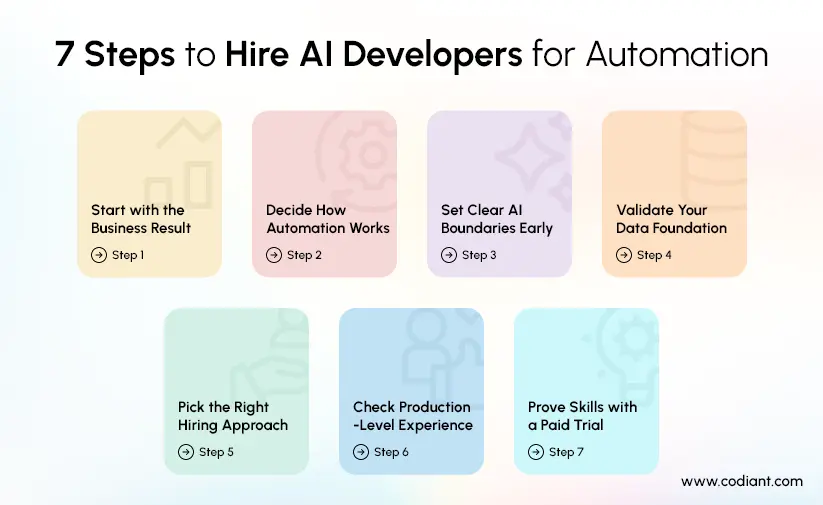
Step 1- Define the Automation Outcome (Not Just the Feature)
Start with the end result you’re looking for, not the tech you want to use. Clarify-
- Which workflow needs automation?
- Is the aim saving money, speedier delivery, fewer mistakes or improved decision-making?
- What does “success” mean in quantifiable terms (hours saved, accuracy improvement, SLA achievement)?
This is what enables you to hire AI developers for automation with the right mindset and good domain fit.
Step 2- Identify the Automation Type
Not all automation requires AI. Determine the type of automation you are building –
- Rule-based workflow automation (deterministic logic)
- AI automation (learning and getting better with data)
- Hybrid automation (rules+AI decision layer)
The right developer depends on whether you need simple orchestration or advanced AI intelligence.
Step 3- Lock the AI Scope Early
AI projects fail when scope stays fuzzy. Decide upfront-
- Rule-based automation vs machine learning
- Single automation module vs full AI-powered application
- MVP vs enterprise-grade automation
This clarity determines whether you should hire machine learning developers, AI engineers, or a full AI app development team.
Step 4- Check Data Readiness Before Hiring
Automation AI is only as strong as the data behind it. Validate-
- Do you have enough data to train or fine-tune models?
- Is the data clean, labeled & accessible?
- Are there privacy/security constraints (PII, compliance, internal policies)?
If data is weak then you’ll need a data engineer or a developer experienced in working with imperfect datasets.
Step 5- Choose the Right Hiring Model
Pick a model based on timeline, complexity and internal capacity-
- Hire in-house AI developers (best for core IP + long-term R&D)
- Hire dedicated AI developers (best for long-term execution and continuity)
- Hire AI developers hourly (best for PoCs, audits, short tasks)
- Partner with AI automation development services (best when you need end-to-end delivery)
Your hiring model impacts cost, speed & long-term maintainability.
Step 6- Evaluate Real-World Delivery, Not Just Knowledge
In 2026, certificates don’t guarantee execution. Prioritize proof of-
- Deployed AI systems (not just notebooks)
- Real automation use cases in production
- Handling messy data, drift, failures and iteration cycles
- Integration experience with APIs, CRMs/ERPs, workflows, cloud
Ask candidates to walk through one project end-to-end- problem → data → approach → deployment → monitoring.
Step 7- Run a Short-Paid Trial (The Best Filter)
Before committing long-term, assign a real mini-task-
- One automation workflow mapping
- A small model prototype + evaluation
- A data pipeline sample
- An integration test with your system
A short-paid trial quickly reveals communication, problem-solving and execution quality especially for hire AI engineers for business automation roles.
Understanding the Role of AI Developers in Automation & Smart Applications
Before you hire AI engineers for smart applications, it’s important to understand what they actually do.
AI developers typically work across multiple layers-
- Data processing and preparation
- Model selection, training & evaluation
- Integration with applications, APIs & workflows
- Deployment, monitoring & optimization
Unlike traditional developers, AI developers must think statistically, experimentally & iteratively. Their work directly impacts automation accuracy, system reliability & long-term performance.
This is why businesses increasingly prefer hiring AI app development teams rather than isolated freelancers.
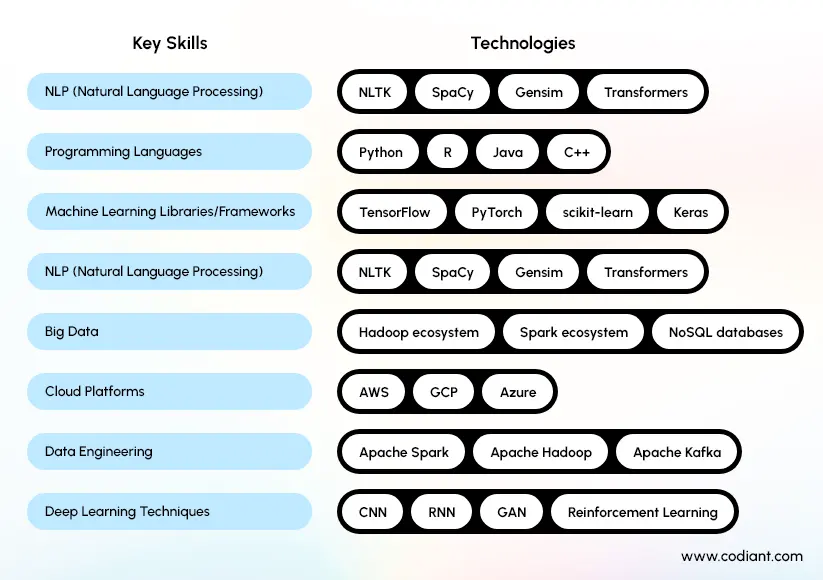
What Skills Should AI Developers Have in 2026?
AI skill requirements have evolved rapidly. In 2026, businesses need developers who combine technical depth with applied problem-solving.
1. Core Technical Skills
AI developers should have strong expertise in-
- Python, JavaScript, or Java
- Machine learning frameworks (TensorFlow, PyTorch)
- Data processing tools and pipelines
- API development and system integration
If you plan to hire AI engineers for smart applications, ensure they understand both model development and deployment.
2. Automation & Business Logic Skills
For automation-focused roles, developers must understand-
- Workflow automation
- Decision engines
- Event-driven systems
- Process optimization
This is especially important when hiring AI engineers for business automation.
3. AI Architecture & Deployment Skills
In 2026, AI developers should know-
- Model serving and monitoring
- Cloud-based AI infrastructure
- MLOps pipelines
- Security and compliance basics
These skills ensure AI systems don’t break after launch.
4. Soft Skills & Collaboration
Strong AI developers can-
- Translate business problems into AI solutions
- Communicate model limitations clearly
- Work closely with product and operations teams
This makes them valuable contributors not just coders.
What Types of Applications Can AI Developers Build?
AI developers in 2026 work across nearly every industry. Depending on your goals, they can build:
1. Automation-Focused Applications
- Intelligent document processing
- Workflow automation tools
- AI-powered RPA systems
- Predictive maintenance platforms
2. Customer-Facing Smart Applications
- AI chatbots and virtual assistants
- Recommendation engines
- Personalized user experiences
- Voice and vision-based interfaces
3. Data-Driven Decision Systems
- Forecasting and demand planning tools
- Fraud detection systems
- Risk analysis platforms
- Business intelligence automation
A skilled AI app development team can tailor solutions to your industry, data maturity and growth stage.
Read more: How Can AI Help Businesses Cut Costs in 2026
How Much Does It Cost to Hire AI Developers in 2026?
Cost is one of the most important and most misunderstood factors when planning AI initiatives. In 2026, the cost to hire AI developers varies widely based on experience level, hiring model, geography and project complexity.
Before choosing a hiring approach, it’s useful to look at a high-level cost comparison.
AI Developer Hiring Cost Overview (2026)
| Hiring Model | Experience Level | Typical Cost Range | Best Suited For |
| Hourly Hiring | Junior AI Developer | $30–$50/hour | Small tasks, experiments |
| Hourly Hiring | Mid-Level AI Engineer | $50–$90/hour | Feature builds, PoCs |
| Hourly Hiring | Senior AI Architect | $90–$150/hour | System design, audits |
| Dedicated Developers | Offshore | $3,000–$6,000/month | Long-term automation projects |
| Dedicated Developers | Onshore | $7,000–$12,000/month | Enterprise-grade AI systems |
| In-House Hiring | Full-Time Employee | $120,000–$200,000+/year | Core IP, R&D teams |
These figures reflect average 2026 market rates and may vary depending on industry, data complexity and AI maturity.
Hourly Hiring Model- Flexible but Limited
Many businesses choose to hire AI developers hourly when they want flexibility or are testing AI feasibility before committing long-term.
Typical Hourly Rates in 2026
- Junior AI developers- $30–$50/hour
- Mid-level AI engineers- $50–$90/hour
- Senior AI architects- $90–$150/hour
Hourly hiring works best when-
- You are running short-term experiments
- You need a proof-of-concept (PoC)
- The scope is clearly defined and limited
- You want expert input for model reviews or architecture guidance
However, hourly hiring has limitations. Developers often lack long-term product context, which can slow iteration. Costs can also become unpredictable if requirements evolve a common scenario in AI projects.
For complex or ongoing automation systems, hourly models often become less cost-effective over time.
Dedicated AI Developers- Best Cost-to-Value Ratio for 2026
Hiring dedicated AI developers has become the preferred approach for startups, scale-ups and even enterprises in 2026 especially for automation and smart application development.
Monthly Cost Range
- Offshore dedicated AI developers- $3,000–$6,000/month
- Onshore dedicated AI developers- $7,000–$12,000/month
This model provides-
- A fixed monthly cost
- Full-time focus on your product
- Better understanding of your data, users & workflows
- Faster iteration and continuous optimization
Dedicated developers behave like an extension of your internal team. Over time, they gain domain knowledge, reduce rework & build more reliable AI systems.
For businesses building AI automation development services, workflow intelligence, or data-driven products, dedicated hiring usually delivers the fastest ROI.
In-House AI Hiring Costs- High Investment, High Commitment
Building an in-house AI team offers maximum control, but it comes with the highest total cost.
Beyond salary, companies must account for-
- Recruitment and onboarding time
- Employee benefits and compliance
- Cloud infrastructure and tooling
- Training and retention costs
In 2026, a full-time AI engineer can cost anywhere between $120,000 to $200,000+ per year, depending on location and seniority.
In-house hiring is best suited for-
- Large enterprises
- Companies building proprietary AI IP
- Long-term research and platform development
For most mid-sized businesses, however, in-house hiring slows execution and increases financial risk.
Which Hiring Model Delivers the Best ROI?
For many organizations in 2026, dedicated or outsourced AI automation development services strike the ideal balance between cost, speed and quality.
They allow businesses to-
- Launch AI faster
- Scale teams up or down easily
- Avoid long-term payroll commitments
- Access specialized AI skills on demand
The key is aligning the hiring model with your business goals not just your budget.
Cost Is Important but Outcome Matters More
While cost matters, the real question businesses should ask is-
How quickly will this AI solution start delivering value?
Cheaper developers who lack real-world experience often lead to-
- Poor model performance
- Integration failures
- Rebuilds and delays
In contrast, experienced AI developers even at higher rates usually reduce total cost by building systems that actually work in production.
Should Businesses Hire In-House or Dedicated AI Developers?
This is one of the most important strategic decisions in AI hiring.
In-House AI Developers
Best for-
- Large enterprises
- Core AI intellectual property
- Long-term R&D investment
Challenges include-
- High hiring costs
- Longer recruitment cycles
- Talent retention risks
Dedicated AI Developers
Best for-
- Startups and mid-sized businesses
- Fast product development
- Automation projects with defined scope
Dedicated developers offer flexibility, scalability and access to specialized skills without long-term overhead.
Hybrid Approach (Most Popular in 2026)
Many companies-
- Keep AI strategy in-house
- Hire dedicated AI developers for execution
This model balances control with speed and cost efficiency.
AI Hiring Mistakes Cost More Than AI Development
Get expert-led guidance to hire AI engineers correctly before automation complexity spirals out of control.
Hiring AI Developers for Automation vs Smart Applications
While related, these two use cases require slightly different skill emphasis.
AI Developers for Automation
- Strong workflow and systems thinking
- Experience with business process optimization
- Integration with ERP, CRM & legacy systems
AI Developers for Smart Applications
- Focus on user experience and real-time interaction
- Knowledge of recommendation systems, NLP, or computer vision
- Ability to balance accuracy with performance
Understanding this difference helps you hire the right talent faster.
Common Mistakes to Avoid When Hiring AI Developers
Even experienced teams make avoidable mistakes-
- Hiring based only on resumes, not real projects
- Overengineering AI where simpler automation would work
- Ignoring data readiness and quality
- Underestimating integration and maintenance needs
A solid AI development hiring guide helps you avoid these pitfalls early.
How to Build the Right AI App Development Team?
For most organizations, AI success depends less on individual talent and more on team composition. AI products require collaboration across data, engineering and business domains.
Core Roles in a High-Performing AI App Development Team
- AI / Machine Learning Engineer: Responsible for model selection, training, evaluation and optimization. This role focuses on turning data into intelligent behavior.
- Data Engineer: Handles data pipelines, ingestion, cleaning and storage. Without strong data engineering, AI systems fail before they begin.
- Backend Developer: Integrates AI models into applications, APIs and workflows. Ensures scalability, security and system performance.
- Product or Domain Specialist: Bridges the gap between business goals and technical execution. Helps ensure AI outputs are relevant, actionable and aligned with real-world use cases.
Why Cross-Functional Teams Work Best
AI is not a standalone feature it’s part of a larger system. Cross-functional teams-
- Reduce misalignment between models and business needs
- Improve deployment speed
- Ensure scalability and maintainability
This structure enables businesses to build AI solutions that move beyond experimentation into reliable production systems.
When to Use AI Automation Development Services?
Not every organization is ready to build an internal AI team. In such cases, partnering with AI automation development services can dramatically reduce risk and time to market.
Situations Where External AI Services Make Sense
- You are building your first AI or automation project
- Internal teams lack AI-specific expertise
- Speed to market is critical
- You need end-to-end delivery, not just model development
Key Advantages of AI Automation Development Services
- Proven Frameworks and Best Practices: Experienced providers bring battle-tested architectures, reducing trial-and-error.
- Lower Experimentation Costs: You avoid costly mistakes by leveraging teams that have already solved similar problems.
- End-to-End Implementation: From data preparation and model development to deployment and monitoring, everything is handled under one roof.
For many businesses, especially in early AI adoption stages, this approach delivers faster ROI and smoother execution.
Future-Proofing Your AI Hiring Strategy
AI technology evolves faster than most organizational structures. In 2026, hiring for long-term AI success requires a forward-looking mindset.
Hire Adaptable Thinkers, Not Tool Specialists
Tools and frameworks change quickly. What lasts is the ability to-
- Learn new techniques
- Adapt to changing data and requirements
- Solve problems creatively
Developers who understand fundamentals outperform those who only know specific tools.
Invest in Long-Term AI Partnerships
Short-term hiring often leads to fragmented systems. Long-term partnerships-
- Preserve institutional knowledge
- Improve system quality over time
- Reduce rebuilding and technical debt
This is especially valuable for automation platforms and AI-driven products.
Prioritize Ethical and Responsible AI Development
In 2026, businesses are accountable for how AI systems behave. Ethical AI practices include-
- Bias detection and mitigation
- Data privacy and compliance
- Transparent decision-making
Hiring developers who understand responsible AI protects both users and brand reputation.
Related reading: Top 20 AI Development Companies in USA in 2026
How Codiant Can Help You Hire and Build AI Solutions?
Codiant helps businesses move from AI ideas to working automation and smart applications without hiring guesswork. Our teams focus on execution, not experimentation, ensuring AI systems are production-ready, scalable, and aligned with real business workflows.
We support organizations at every stage of their AI journey, including:
- Hiring dedicated AI developers and full AI app development teams
- Building automation systems and smart applications end to end
- Integrating AI into existing products, workflows, and enterprise systems
- Providing long-term AI development and optimization support
With hands-on delivery experience across industries, Codiant helps you build AI that actually works in the real world.
Final Thoughts- Hiring AI Developers the Smart Way in 2026
Hiring AI developers in 2026 is about more than filling roles it’s about building intelligent systems that grow with your business.
Whether you plan to hire AI developers hourly, build a dedicated AI development team, or partner with AI automation experts, success depends on clarity, alignment & realistic expectations.
By understanding skills, costs, hiring models & application types, businesses can confidently hire AI engineers for automation and smart applications and turn AI from a buzzword into a competitive advantage.
Still Deciding How to Hire AI Developers?
Get direct answers tailored to your automation use case, budget, and timeline today.
The Author

Frequently Asked Questions
In 2026, businesses should look beyond degrees and certificates. Good AI developers should have hands-on experience building real AI systems, working with data, and deploying models into live applications. Practical problem-solving skills matter more than academic background.
AI developers automate workflows by teaching systems to make decisions on their own. They use data and logic to reduce manual work, speed up processes, and improve accuracy. This helps businesses save time, lower costs, and run operations more efficiently.
Hourly hiring works best for short tasks or testing ideas. Dedicated AI developers are ideal for long-term projects and ongoing automation. Team-based models work well when building complete AI products that need multiple skills like data, backend, and AI engineering.
Simple automation projects can take a few weeks. More advanced AI-powered applications usually take three to six months, depending on data quality, system complexity, and integrations. Timelines improve when goals and scope are clearly defined from the start.
Industries like healthcare, finance, retail, manufacturing, logistics, and SaaS benefit the most. AI helps these sectors automate tasks, analyze data faster, reduce errors, and deliver better customer experiences without increasing operational costs.
Featured Blogs
Read our thoughts and insights on the latest tech and business trends
How to Hire the Right Healthcare Software Development Company – Complete Guide
- April 8, 2026
- Healthcare
In a Nutshell Choosing the right healthcare software partner ensures long-term success outcomes. Healthcare software requires domain expertise, compliance knowledge and technical capabilities. Always prioritize HIPAA compliant software development for secure patient data. Evaluate company... Read more
AI Tools vs Custom AI Development- Which One Fits Your Business Model?
- April 6, 2026
- Artificial Intelligence
In a Nutshell AI tools offer quick setup but limited flexibility for businesses. Custom AI solutions adapt deeply to unique workflows and requirements. AI SaaS tools reduce upfront costs but increase long-term expenses. Custom AI... Read more
Mobile App Personalization Using AI- Benefits, Use Cases & Implementation
- March 31, 2026
- Artificial Intelligence
In a Nutshell: AI helps mobile apps understand users and personalize experiences effectively. Apps learn from user behavior, improving recommendations over time automatically. Personalized content increases engagement, making users spend more time inside. AI driven... Read more