How AI Agents Transform the Healthcare Sector?
Table of Contents
Subscribe To Our Newsletter
In a Nutshell
- AI agents in healthcare go beyond automation by acting autonomously, learning continuously, and orchestrating workflows end to end not just generating insights.
- Agentic AI shifts healthcare from reactive to proactive, enabling early risk detection, continuous monitoring, and personalized, adaptive care pathways.
- Clinical workflows benefit immediately through intelligent task routing, real-time risk escalation, automated documentation, and dynamic scheduling reducing burnout and delays.
- AI-driven patient care becomes continuous and personalized, with agents managing follow-ups, adherence, engagement, and 24/7 support without adding staff workload.
- The biggest impact in 2026 comes from action-oriented use cases, including autonomous care coordination, predictive population health, intelligent clinical trials, revenue cycle optimization, and hospital command centers.
- Successful AI transformation in healthcare depends on trust and design, prioritizing interoperability, explainability, human oversight, and gradual scaling.
- Healthcare organizations that adopt agent ecosystems early will build more resilient, efficient, and patient-centric systems defining the next era of care delivery rather than reacting to it.
Healthcare industry is standing at a turning point. Rising patient volumes, clinician burnout, fragmented systems, and increasing compliance pressures have made it clear that incremental digitization is no longer enough. Healthcare organizations now need systems that think, adapt, and act autonomously not just software that records data.
This is where AI agents in healthcare come into play.
Unlike traditional automation or rule-based tools, healthcare AI agents operate with contextual understanding, decision logic, and goal-oriented behavior. They don’t just assist workflows; they orchestrate them end-to-end.
In this in-depth guide, we explore how agentic AI in healthcare is reshaping clinical operations, patient engagement, diagnostics, and care delivery along with what healthcare leaders should expect by 2026 and beyond.
What Are AI Agents in Healthcare?
At a foundational level, AI agents in healthcare are autonomous or semi-autonomous software entities designed to perceive their environment, make decisions, and execute actions aligned with predefined goals. Unlike single-purpose algorithms, agents operate as systems often collaborating with other agents and human professionals.
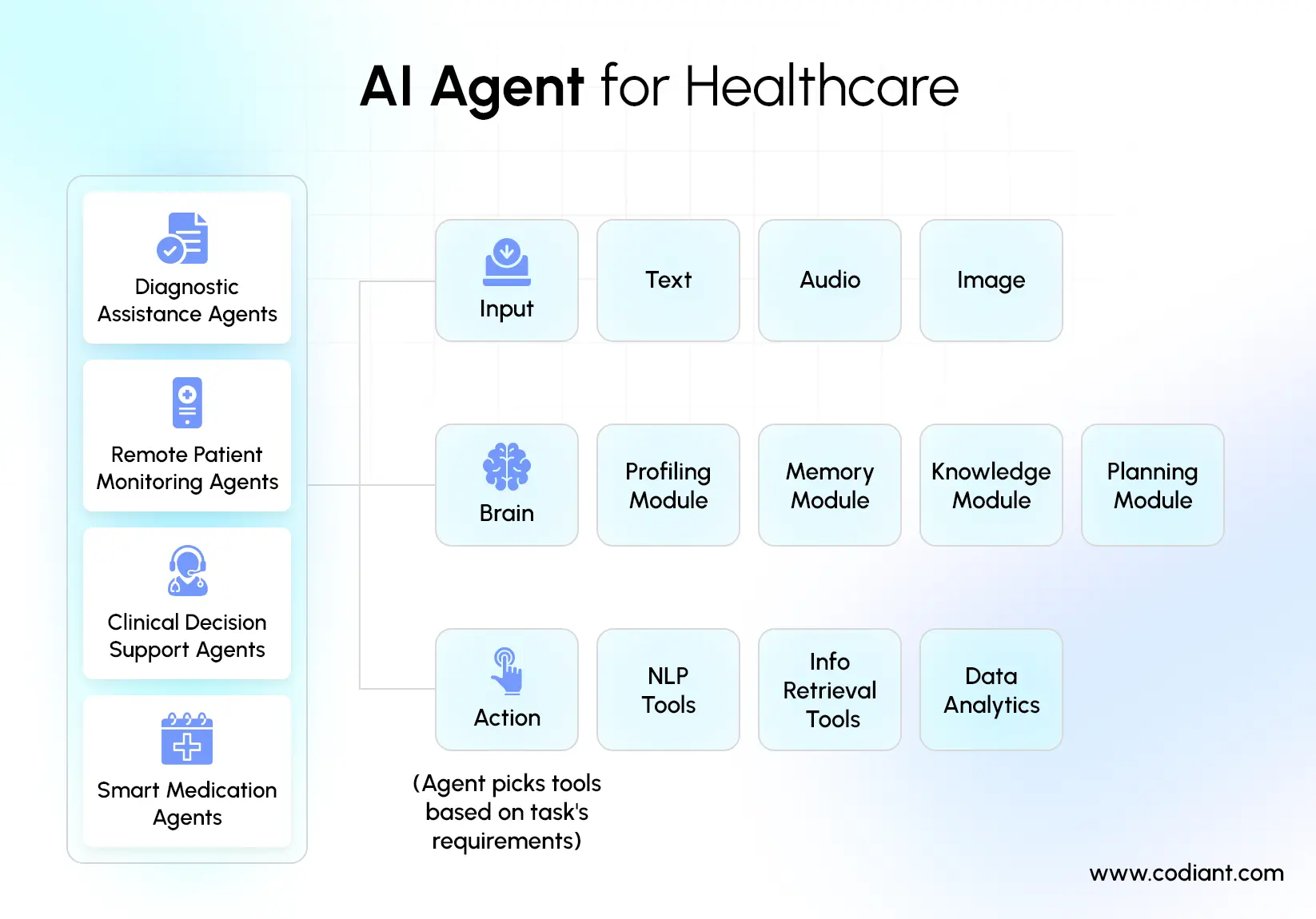
How AI Agents Differ from Traditional Healthcare AI
Traditional healthcare AI:
- Analyzes historical data
- Generates predictions or insights
- Requires human action to execute decisions
Healthcare AI agents:
- Monitor live data streams
- Take initiative based on objectives
- Execute actions across systems
- Learn continuously from outcomes
This distinction is critical. Intelligent agents for healthcare do not simply “support” workflows; they become part of the workflow.
From Experiments to Working Healthcare AI
Design, deploy, and scale AI agents that actually reduce workload, improve decisions, and integrate cleanly into real healthcare workflows.
The Core Capabilities of Healthcare AI Agents
To clearly understand the AI transformation in healthcare, it helps to break down the core capabilities that make agentic systems practical, safe, and impactful in real-world care environments.
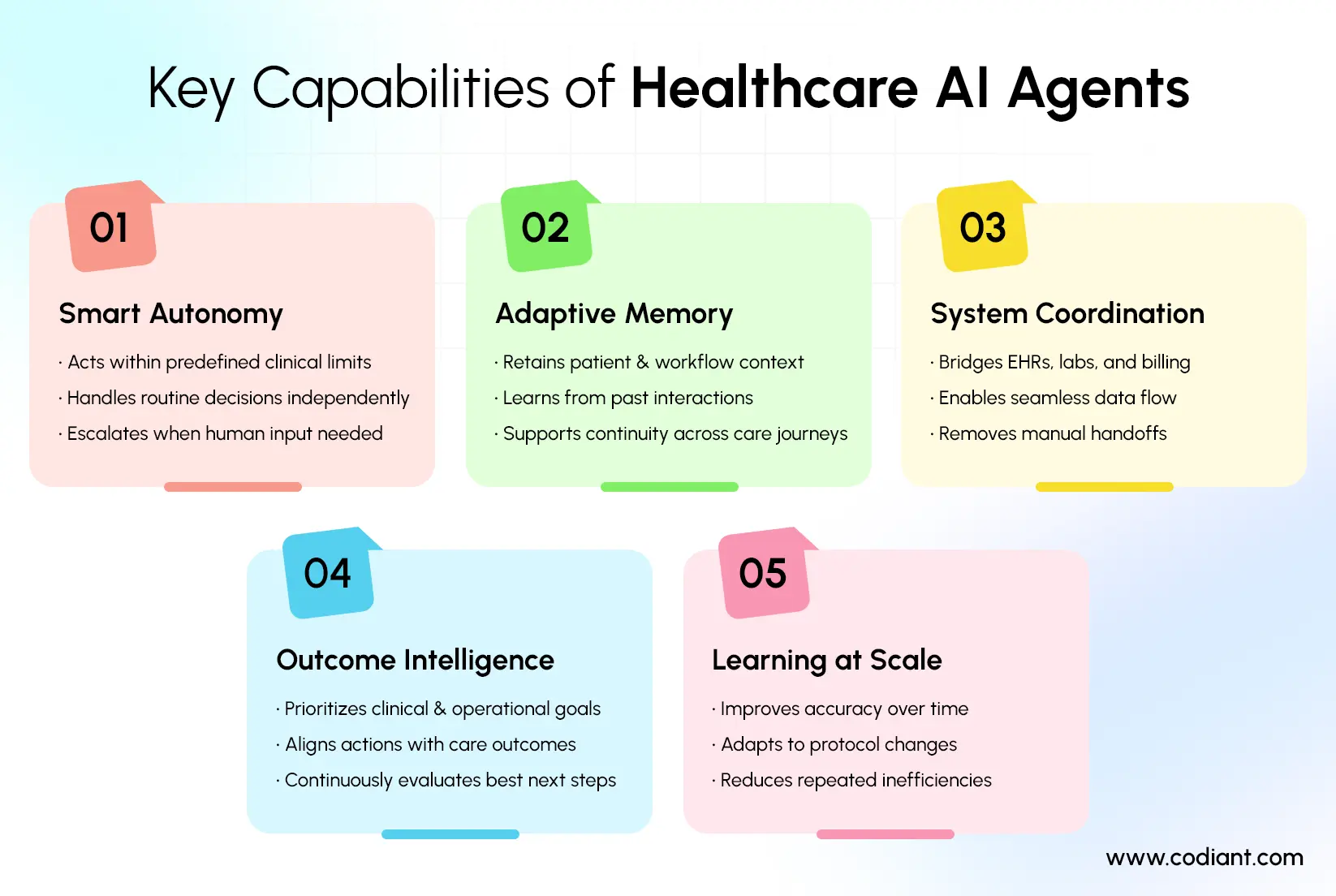
1. Autonomy with Guardrails
Healthcare AI agents can act on their own, but always within clearly defined rules. They don’t replace doctors or administrators; they support them by handling routine decisions and escalating only when human judgment is required.
In simple terms, they can:
- Triage incoming cases based on urgency
- Assign tasks to the right care teams
- Trigger alerts when thresholds are crossed
Human oversight stays intact, ensuring safety and trust.
2. Contextual Memory
Unlike basic automation, healthcare AI agents remember past interactions and outcomes. This memory helps them understand patients and workflows over time instead of treating every situation as new.
This allows agents to:
- Track patient history across visits
- Learn clinician preferences and workflows
- Understand long-term care patterns
As a result, decisions feel more informed, consistent, and personalized.
3. Multi-System Orchestration
Healthcare environments rely on many disconnected systems. AI agents act as connectors, moving information smoothly across platforms without manual effort.
They can work across:
- Electronic Health Records (EHRs)
- Lab and imaging systems
- Billing and claims platforms
- Patient apps and communication tools
This orchestration reduces delays, errors, and repeated data entry.
4. Goal-Driven Reasoning
Healthcare AI agents don’t just follow fixed rules. They are designed to work toward specific outcomes that matter to providers and patients.
Common goals include:
- Reducing readmissions
- Improving patient adherence
- Shortening diagnosis and treatment time
- Optimizing staff utilization
The agent continuously chooses actions that best support these goals.
Read more: Top Reasons Why Healthcare Providers Need Mobile Apps Today
5. Continuous Learning
Every action an AI agent takes creates feedback. Over time, the agent learns what works and what doesn’t, making smarter decisions with experience.
Continuous learning helps agents:
- Improve accuracy over time
- Adapt to new protocols and data
- Reduce repetitive mistakes
- Support more proactive patient care
This is what makes AI-driven patient care increasingly effective and future-ready.
Why Healthcare Needs Agentic AI Now?
Healthcare systems worldwide are under unprecedented strain. Rising patient volumes, workforce shortages, regulatory complexity, and cost pressures have pushed traditional models to their limits.
AI automation in healthcare addresses these challenges at scale.
The Industry Pain Points AI Agents Solve
- Clinician burnout from administrative overload
- Fragmented patient journeys across disconnected systems
- Delayed diagnoses and treatment decisions
- Inefficient resource utilization
- Inconsistent patient engagement and follow-up
Healthcare AI agents tackle these issues not by adding more dashboards but by automating decisions, coordination, and follow-through.
How Agentic AI Differs from Conventional AI
Traditional healthcare AI focuses on prediction:
- Risk scores
- Image classification
- Outcome probabilities
Agentic AI in healthcare, by contrast, focuses on action.
| Traditional AI | Agentic AI |
| Makes predictions | Takes goal-driven actions |
| Works in isolation | Collaborates across systems |
| Requires manual triggering | Operates continuously |
| Static model outputs | Adaptive decision-making |
An AI agent doesn’t just flag a deteriorating patient it initiates the care pathway, notifies staff, schedules diagnostics, and updates records automatically.
That shift from insight to execution is transformative.
How AI Agents Power Every Part of the Healthcare Ecosystem?
The true power of AI-powered healthcare solutions emerges when agents operate across the entire healthcare ecosystem.
1. Providers: Hospitals, Clinics, and Care Networks
Healthcare AI agents support:
- Clinical decision support
- Workflow automation
- Capacity management
- Patient engagement
- Quality and safety monitoring
2. Payers: Insurance and Managed Care Organizations
Agents optimize:
- Claims processing
- Fraud detection
- Utilization management
- Member engagement
- Risk adjustment
3. Life Sciences and Pharma
Agentic AI accelerates:
- Drug discovery
- Clinical trial optimization
- Pharmacovigilance
- Real-world evidence analysis
4. Digital Health and Healthtech Platforms
Startups and vendors embed agentic AI in healthcare to:
- Deliver scalable virtual care
- Automate onboarding and support
- Personalize health journeys
AI for Clinical Workflow Automation: From Chaos to Coordination
One of the most immediate impacts of AI solutions for clinical workflow automation is the removal of manual, fragmented processes that slow decisions, exhaust staff, and increase clinical risk.
How do AI Agents Improve Clinical Workflows?
1. Intelligent Task Routing
AI agents triage incoming requests, assess acuity, match clinician skills and availability, prioritize urgency, and automatically assign tasks across departments, reducing delays, handoffs, overload, and ensuring patients reach care faster.
2. Real-Time Risk Escalation
Agents continuously analyze vitals, labs, imaging, and clinical notes in real time, detecting deterioration patterns early, triggering alerts, escalating cases, and enabling timely interventions before conditions worsen or complications arise.
3. Automated Documentation
Agentic systems listen to consultations, extract structured clinical data, summarize encounters, generate compliant notes, and sync documentation into EHRs automatically, reducing clerical effort, errors, and clinician burnout across care settings.
4. Dynamic Scheduling
AI agents continuously adjust schedules using real-time demand, cancellations, emergencies, and staffing constraints, optimizing coverage, minimizing wait times, balancing workloads, and maintaining care continuity without manual intervention across departments daily.
The outcome is a self-optimizing clinical environment where workflows adapt dynamically instead of breaking under pressure.
AI-Driven Patient Care: From Reactive to Proactive
Traditional healthcare responds after symptoms escalate. AI-driven patient care shifts this model toward continuous, proactive engagement, where risks are anticipated and interventions happen earlier.
How Healthcare AI Agents Enhance Patient Care
1. Personalized Care Pathways
AI agents create adaptive care plans by continuously learning from patient-specific data rather than relying on static protocols. These pathways evolve as patient conditions, behaviors, and environments change.
Key capabilities include:
- Integration of medical history, lifestyle patterns, and comorbidities
- Consideration of genomics and social determinants of health
- Dynamic updates based on treatment response and adherence
2. Continuous Monitoring
Instead of episodic check-ins, AI agents enable round-the-clock clinical awareness. Signals from connected devices and patient inputs are analyzed continuously to identify subtle changes early.
This allows:
- Early detection of deterioration or non-adherence
- Reduced hospital readmissions through timely intervention
- Better management of chronic and post-acute conditions
3. Intelligent Follow-Ups
Healthcare AI agents remove the burden of manual follow-up coordination by managing it automatically and intelligently.
They can:
- Track medication adherence and symptom progression
- Trigger reminders, education, or clinician reviews
- Escalate only high-risk cases to care teams
This ensures no patient falls through the cracks while clinicians focus on complex care decisions.
4. 24/7 Patient Engagement
Conversational AI agents act as always-available digital care companions, extending access beyond clinic hours without increasing staff workload.
They support patients by:
- Answering routine health and treatment questions
- Guiding self-care and next steps
- Reducing unnecessary visits and anxiety
Together, these capabilities enable intelligent agents for healthcare to deliver care that is predictive, preventive, and deeply personalized marking a decisive shift from reactive treatment to continuous health management.
What Would Change If Your Healthcare Systems Worked for You?
Imagine AI agents handling coordination, follow-ups, documentation, and alerts so clinicians focus on care, not clicks.
AI Healthcare Use Cases 2026: Where Agents Deliver the Most Impact
As healthcare organizations move through 2026, AI adoption is no longer about experimentation. A common question shaping strategic decisions today is what are the main use cases of AI agents in healthcare, as real value now comes from agents that operate autonomously, connect fragmented systems, and turn insights into action. These intelligent systems are delivering impact in areas where complexity, scale, and speed matter most.
1. Autonomous Care Coordination
Care coordination remains one of healthcare’s most resource-intensive challenges. AI agents now act as digital care orchestrators, ensuring patients move seamlessly across providers and care settings.
AI agents support care teams by:
- Scheduling and rescheduling appointments automatically
- Managing referrals across primary, specialty, and post-acute care
- Sharing patient context across systems in real time
- Tracking follow-ups to reduce missed care and readmissions
The result is smoother patient journeys with fewer administrative touchpoints.
2. Predictive Population Health
Population health has shifted from retrospective reporting to proactive intervention. Healthcare AI agents continuously analyze clinical records, claims data, and behavioral signals to surface risk early.
These agents enable:
- Early identification of high-risk patient groups
- Automated preventive outreach and care prompts
- Scalable intervention programs without staffing overload
This allows providers to focus on prevention rather than late-stage treatment.
3. Intelligent Clinical Trials
Clinical trials are becoming faster and more efficient with agent-driven automation. AI agents now manage complex trial operations end to end.
Key contributions include:
- Automated patient recruitment and eligibility screening
- Continuous participant monitoring and data validation
- Real-time compliance and documentation support
This shortens trial timelines while maintaining regulatory rigor.
4. AI-Driven Revenue Cycle Management
Revenue cycle inefficiencies quietly erode margins. In 2026, AI agents optimize financial workflows from front-end coding to back-end collections.
They help by:
- Improving coding accuracy and claims quality
- Reducing denials through proactive issue detection
- Accelerating reimbursements with minimal human intervention
5. Hospital Command Centers
AI-powered command centers provide hospitals with a real-time operational nerve center.
Agentic systems coordinate:
- Bed availability and patient flow
- Staffing and shift optimization
- Supply chain readiness and emergency response
This enables faster decisions, better resource utilization, and improved resilience across hospital operations.
Building AI-Powered Healthcare Solutions the Right Way
Successfully implementing AI-powered healthcare solutions isn’t about deploying the most advanced models it’s about making the technology work reliably inside real clinical environments. A structured, outcome-focused approach ensures that healthcare AI agents deliver value without disrupting care delivery or clinician trust.
Step 1: Start with High-Impact Workflows
Begin where inefficiencies are most visible and measurable. Clinical documentation, appointment scheduling, patient triage, and follow-ups consume significant clinician time and directly affect patient experience. Applying AI automation in healthcare to these workflows delivers faster ROI while minimizing operational risk.
Step 2: Design for Interoperability
For AI agents in healthcare to be effective, they must work seamlessly across EHR systems, medical devices, lab platforms, and patient engagement tools. Interoperable design ensures agents enhance workflows instead of creating new silos.
Step 3: Prioritize Trust
Trust is foundational in healthcare. Agent decisions must be explainable, auditable, and aligned with clinical judgment. Keeping clinicians in the loop strengthens adoption and ensures AI-driven patient care remains safe and accountable.
Step 4: Scale Gradually
Start small with pilot deployments. Measure outcomes, refine agent behavior, and scale only after clinical and operational confidence is established. This phased approach reduces risk while supporting long-term AI transformation in healthcare.
Benefits of AI Automation in Healthcare
The shift toward AI-powered healthcare solutions delivers measurable benefits:
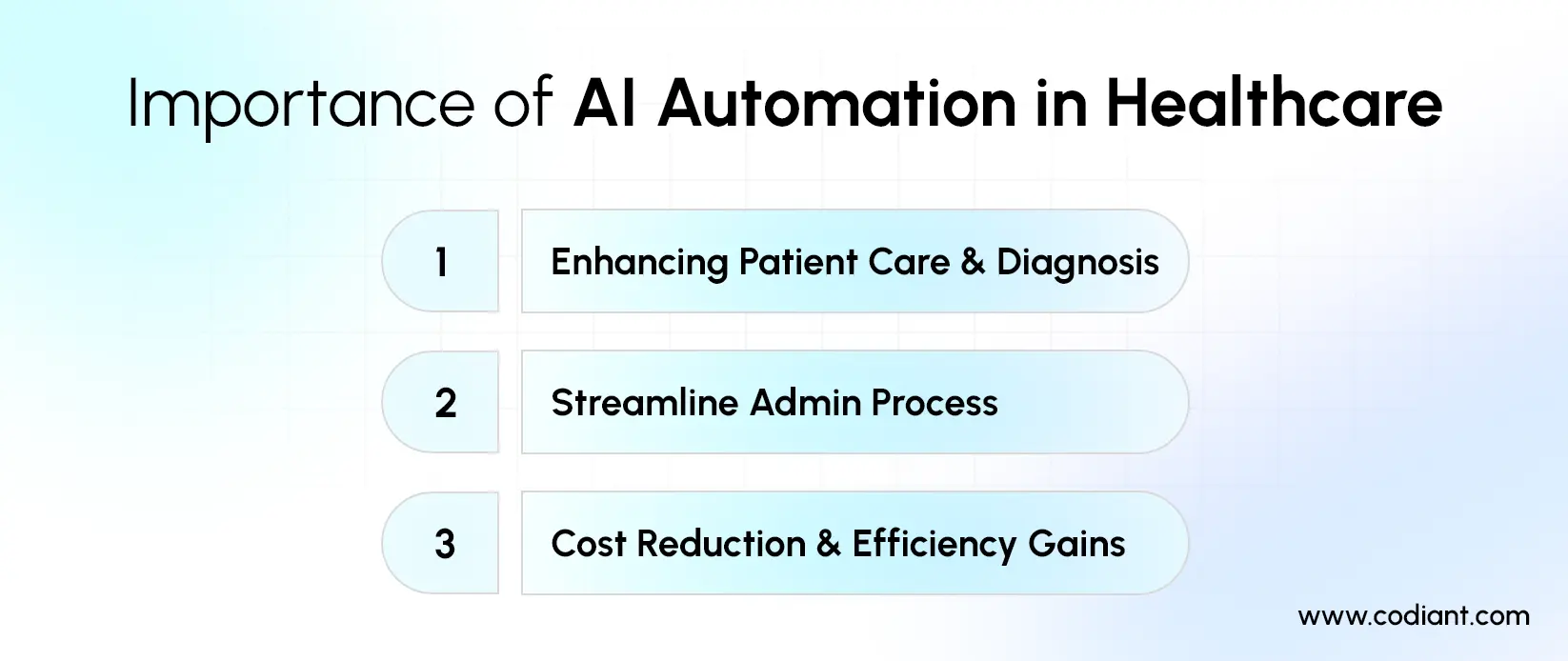
1. Operational Efficiency
- Faster workflows
- Reduced manual effort
- Lower administrative costs
2. Clinical Quality
- Fewer errors
- Better adherence to protocols
- Earlier interventions
3. Patient Experience
- Faster responses
- Personalized interactions
- Improved continuity of care
4. Workforce Sustainability
- Reduced burnout
- Better task prioritization
- More time for human-centered care
Challenges and Ethical Considerations
Despite its promise, AI transformation in healthcare must be implemented responsibly.
1. Data Privacy and Security
AI agents operate on sensitive health data, requiring:
- Robust encryption
- Access controls
- Compliance with healthcare regulations
2. Transparency and Explainability
Clinicians must understand why an agent made a recommendation black-box systems are unacceptable in clinical contexts.
3. Human Oversight
AI agents should augment, not replace, medical judgment. Clear escalation paths and override mechanisms are essential.
4. Bias and Fairness
Training data must be diverse and monitored continuously to avoid reinforcing healthcare disparities.
Related reading: Healthcare Chatbots Development – AI Features, Use Cases & Benefits
The Future of AI Transformation in Healthcare
By 2026, the most successful healthcare organizations will not be those with the most AI tools but those with cohesive AI agent ecosystems.
We will see:
- AI agents collaborating across departments
- Continuous learning healthcare systems
- Real-time, adaptive care delivery
- Stronger patient-provider relationships
Healthcare will evolve from system-centric to intelligence-centric.
How Codiant Can Help You Build Agentic Healthcare Systems?
Codiant partners with healthcare organizations to move beyond pilots and build production-ready AI agents that work reliably inside real clinical environments. Our approach combines healthcare domain expertise, secure AI engineering, and workflow-first design to ensure adoption, trust, and measurable outcomes.
We help you:
- Identify high-impact AI agent use cases aligned with clinical, operational, and business priorities.
- Design and integrate healthcare AI agents across EHRs, devices, and patient platforms without disrupting care delivery.
- Implement compliant, explainable AI systems with built-in governance, auditability, and human oversight.
- Scale agentic AI safely from focused pilots to enterprise-wide deployment.
With Codiant, AI agents don’t stay experimental they become a dependable part of your healthcare operations.
Final Thoughts
The rise of AI agents in healthcare marks a fundamental shift from software as a tool to AI as a teammate.
With agentic AI in healthcare, organizations can:
- Automate intelligently
- Deliver proactive, personalized care
- Support clinicians at scale
- Build resilient, future-ready systems
As AI-driven patient care becomes the standard, healthcare leaders who invest early in intelligent agents will define the next era of care delivery not just adapt to it.
Have Questions About AI Agents in Healthcare?
Speak directly with specialists who design, deploy, and scale agentic systems in real healthcare environments.
The Author

Frequently Asked Questions
Traditional healthcare automation follows fixed rules and executes predefined tasks when triggered. AI agents in healthcare go a step further by understanding context, learning from outcomes, and making decisions aligned with care goals. They can monitor live data, adapt workflows dynamically, and coordinate actions across systems making them far more flexible and intelligent than rule-based automation.
Healthcare AI agents can automate a wide range of clinical and operational processes, including documentation, patient triage, appointment scheduling, care coordination, follow-ups, billing workflows, and population health monitoring. These agents support both clinical teams and administrative staff, enabling scalable AI automation in healthcare without compromising care quality.
AI agents integrate through secure APIs, interoperability standards, and middleware layers that connect EHRs, lab systems, imaging tools, and medical devices. This allows AI for clinical workflow automation to operate within existing hospital infrastructure, ensuring data flows seamlessly without disrupting established clinical processes.
AI agents must comply with healthcare regulations such as HIPAA for data privacy, GDPR where applicable, and region-specific clinical safety and data protection standards. Additionally, agentic AI in healthcare should support auditability, explainability, and human oversight to meet ethical and regulatory expectations.
Healthcare organizations should begin by identifying high-impact workflows, launching small pilot projects, and building strong data foundations. Involving clinicians early, prioritizing trust, and scaling gradually helps ensure successful adoption of intelligent agents for healthcare while driving long-term AI transformation in healthcare.
Yes. AI agents in healthcare significantly reduce administrative workload by automating time-consuming tasks such as clinical documentation, appointment scheduling, referral management, billing workflows, and follow-ups. By handling these repetitive processes end-to-end, healthcare AI agents free clinicians and staff from manual data entry and coordination tasks, allowing them to focus more on patient care while improving operational efficiency and reducing burnout.
Featured Blogs
Read our thoughts and insights on the latest tech and business trends
Top iPhone App Development Companies in USA in 2026
- February 18, 2026
- Mobile App Development
In a Nutshell The USA remains one of the strongest hubs for premium iPhone app development in 2026, especially for fintech, healthcare, retail, and SaaS brands. Choosing the right iOS partner goes beyond portfolios; the... Read more

How to Choose the Right AI Development Partner in the USA (Enterprise Guide 2026)
- February 12, 2026
- Artificial Intelligence
In a Nutshell Enterprise AI success starts with clear business goals, not vague plans like “we need AI.” The best AI development partners deliver real production systems, not just impressive demos or prototypes. Industry alignment... Read more
How AI Is Transforming Transport & Logistics Operations in Real Time
- February 10, 2026
- Artificial Intelligence Logistics & Transportation
In a Nutshell: AI in transport & logistics is enabling faster, smarter decision-making across fleets, warehouses, and supply chains. Real-time logistics optimization improves route planning, dispatching, and delivery efficiency as conditions change. AI-driven forecasting and... Read more