Hire Dedicated AI Engineers- Cut AI Development Costs by 45%
Table of Contents
Subscribe To Our Newsletter
In a Nutshell
- Hiring dedicated AI engineers significantly reduces development costs and timelines.
- Offshore teams provide global talent access without high local salary costs.
- Dedicated AI teams eliminate long hiring cycles and recruitment overhead.
- No infrastructure investment required when working with AI outsourcing partners.
- Flexible resource allocation ensures payment only for active project work.
- Faster execution leads to reduced timelines and lower overall project costs.
- AI outsourcing services help businesses scale teams based on demand.
- Remote AI engineers enable high-quality development without geographical limitations today.
- Dedicated teams improve productivity through continuous collaboration and domain understanding.
- Businesses achieve innovation faster by optimizing costs and leveraging global expertise.
AI isn’t expensive because of the technology. It’s expensive because of the people, time, and structure required to build it right.
Most businesses don’t realize this upfront. They start with a simple AI idea maybe automation, maybe predictions, maybe smarter workflows. But once execution begins, the real costs show up. Hiring skilled engineers takes months. Salaries are high. Infrastructure adds another layer. And suddenly, what looked like a smart investment starts stretching budgets.
That’s exactly why many companies are rethinking how they build AI.
Instead of hiring everything in-house, they’re choosing to hire dedicated AI engineers teams that work remotely but operate like an extension of their business. The result is faster execution, access to better talent, and significantly lower costs.
Let’s break down how this model works and why it’s becoming the smarter way to build AI.
Why AI Development Feels So Expensive Today?
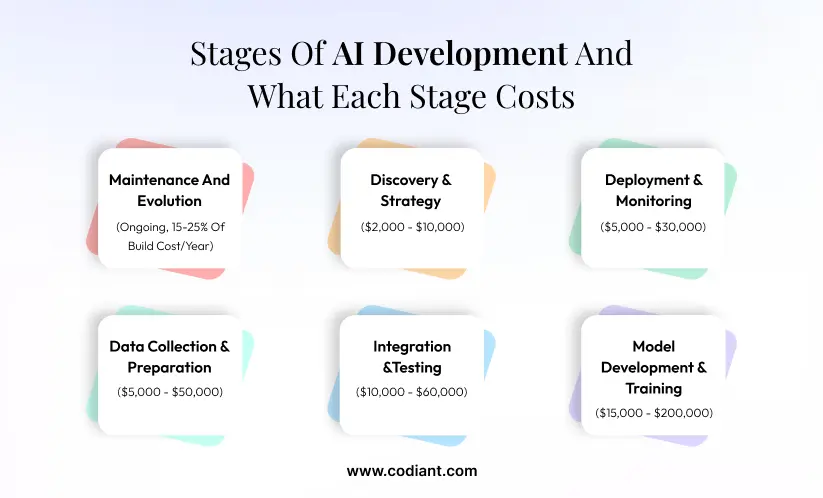
AI projects don’t operate like traditional software development.
You’re not just hiring developers. You’re building a multi-layered ecosystem that includes-
- Data engineering
- Machine learning model development
- Model training and optimization
- Deployment and monitoring
- Cloud infrastructure
That means multiple specialists working together and each role comes with a premium cost.
In markets like the US, experienced AI engineers often command six-figure salaries. When you add benefits, infrastructure, and management overhead, the total cost multiplies quickly.
This is where businesses begin to rethink their approach and explore AI outsourcing services or offshore AI development teams.
Stop Overspending on AI Development Today
Reduce costs, access global AI experts, and accelerate project delivery without compromising quality or long-term scalability.
What “Hiring Dedicated AI Engineers” Actually Means
This isn’t outsourcing in the traditional sense.
When you hire dedicated AI engineers, you’re not handing over a project and waiting for delivery. You’re building a team that works with you continuously.
Think of it as an extension of your internal team but without the overhead.
These engineers:
- Work exclusively on your project
- Follow your workflows and tools
- Collaborate in real time with your team
- Stay aligned with your long-term goals
This model sits somewhere between in-house hiring and outsourcing and that’s exactly why it works.
Where Does the 45% Cost Reduction Actually Come From?
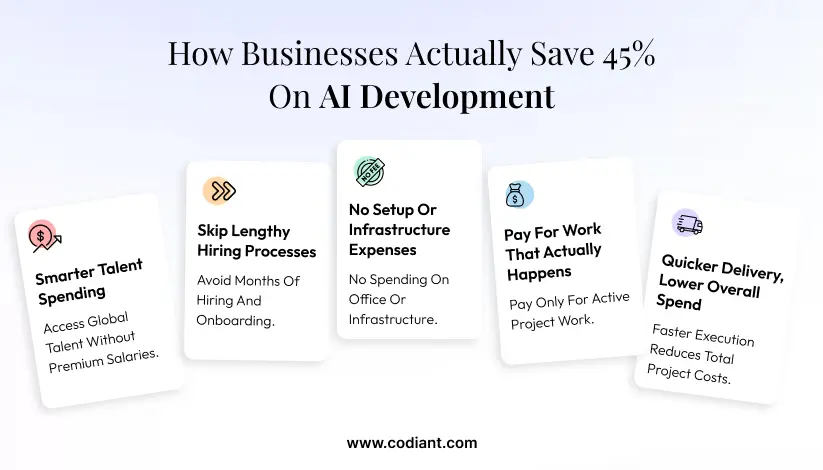
At first glance, a 45% reduction in AI development solutions costs might sound like a bold claim. But when you break down how traditional AI teams are built versus how dedicated teams operate, the math starts to make sense.
The savings don’t come from cutting corners. They come from eliminating inefficiencies that most businesses don’t even realize they’re paying for.
Let’s unpack this layer by layer.
1. Talent Cost Optimization, Not Talent Compromise
One of the biggest cost drivers in AI development is talent.
In high-cost markets like the US or Western Europe, hiring experienced AI engineers often means paying premium salaries, not necessarily because of better skills, but because of local market demand and living costs.
When businesses tap into global talent pools through offshore AI development teams, they gain access to equally skilled engineers at significantly lower costs. Countries like India and Eastern Europe have strong AI ecosystems, highly trained engineers, and extensive experience working with global clients.
The key difference?
You’re paying for capability, not geography.
2. Hidden Recruitment Costs Disappear
Hiring AI engineers isn’t just about salaries. It’s a long, resource-heavy process.
Think about everything involved:
- Sourcing candidates
- Screening and technical interviews
- HR coordination
- Notice periods and onboarding delays
For niche roles like AI and machine learning, this process can take 2–4 months or more, during which your project is essentially on hold.
With a dedicated AI team model, this entire cycle is compressed into days. Pre-vetted engineers are ready to start almost immediately.
That’s not just cost saving it’s opportunity cost recovery.
You’re not losing months waiting to build your team.
3. Infrastructure and Operational Overhead Gets Eliminated
Building an in-house AI team comes with operational baggage.
You need:
- Office space
- High-performance systems
- Software licenses
- Cloud infrastructure setup
- IT support
These costs add up quickly and often go unnoticed because they’re distributed across departments.
When you work with AI outsourcing services, all of this is already handled. The team comes fully equipped with the required tools, environments, and infrastructure.
You’re no longer investing in setup you’re investing directly in outcomes.
4. You Pay for Productivity, Not Idle Capacity
One of the most overlooked inefficiencies in in-house teams is underutilization.
There are always phases in AI development where certain roles are less active. For example:
- Data engineers may not be needed during model deployment
- ML engineers may not be fully engaged during data collection phases
But when you hire full-time employees, you’re paying them regardless of utilization.
With a dedicated AI team cost model, resources are aligned with project needs. You scale roles up or down based on the stage of development.
This shift from fixed cost to variable, usage-based cost is where a significant portion of savings comes from.
5. Faster Execution Reduces Overall Project Cost
Time is one of the most underestimated cost factors in AI development.
Delays in hiring, onboarding, or execution don’t just slow progress they increase costs through:
- Extended timelines
- Delayed product launches
- Lost market opportunities
Dedicated teams are built for speed. They’ve already worked on similar use cases, understand development workflows, and can start contributing immediately.
This reduces:
- Ramp-up time
- Trial-and-error cycles
- Development bottlenecks
The result is faster delivery, which directly translates into lower overall project costs.
Bringing It All Together
When you combine:
- Optimized global talent costs
- Eliminated recruitment delays
- Zero infrastructure investment
- Flexible resource utilization
- Faster execution cycles
You’re not just saving money in one area you’re restructuring the entire cost model of AI development.
That’s what makes a 45% cost reduction not just possible, but practical for businesses that adopt the dedicated team approach.
And more importantly, these savings come without compromising quality, speed, or scalability which is what truly makes this model sustainable.
Read more: Complete Guide to Selecting an AI Development Partner in the USA 2026
Understanding the Cost Structure in Detail
One of the biggest myths around AI hiring is simple but misleading lower cost equals lower quality.
In reality, the difference in pricing is rarely about skill. It’s about where the talent is located and how the cost structure is built around it.
AI engineers across the world often work on the same frameworks, tools, and global products. Many offshore developers contribute to US-based startups, enterprise AI platforms, and cutting-edge research. The capability gap is far smaller than most assume.
So why does the pricing differ so much?
Because you’re not just paying for skills you’re paying for economic conditions, operational costs, and market demand in that region.
AI Engineer Cost Comparison Snapshot
Here’s a simplified comparison to visualize the cost structure:
| Cost Factor | US / In-House Team | Offshore AI Team |
| Hourly Rate | $100 – $200+ | $25 – $60 |
| Annual Cost per Engineer | $120K – $200K+ | $30K – $80K |
| Recruitment Cost | High (agencies, time, HR) | Minimal / Included |
| Time to Hire | 1–3 months | 1–2 weeks |
| Infrastructure Cost | High | Included / Minimal |
| Scalability | Limited, slow | High, on-demand |
| Flexibility | Low | High |
| Overall Cost Efficiency | Low | High |
What Actually Drives AI Engineer Costs?
Let’s break this down into the core components.
1. Geography-Based Salary Structures
In the US, salaries are influenced by high living costs, competitive hiring markets, and demand-supply gaps.
In offshore regions like India, Poland, or Ukraine, engineers may have the same technical expertise but operate within different economic environments. This naturally reduces compensation expectations without affecting capability.
2. Market Demand and Talent Shortage
AI talent is in high demand globally, but the shortage is more intense in regions like the US.
This drives salaries even higher due to competition between companies trying to hire from the same limited talent pool.
Offshore markets, however, often have a larger pool of trained engineers, which stabilizes pricing.
3. Operational and Business Costs
When you hire locally, you’re not just paying salary. You’re also covering:
- Office infrastructure
- Insurance and benefits
- Taxes and compliance
- Equipment and IT support
With offshore or remote teams, these operational costs are either significantly lower or completely absorbed by the service provider.
4. Billing Models and Flexibility
In-house hiring follows a fixed cost model you pay full salaries regardless of workload.
Offshore teams often follow flexible billing:
- Hourly
- Monthly
- Dedicated resource models
This allows businesses to align costs directly with productivity.
Why This Difference Matters for Businesses?
The cost gap isn’t just about saving money it changes how businesses approach AI entirely.
Instead of limiting AI initiatives due to budget constraints, companies can:
- Run multiple AI experiments simultaneously
- Scale teams as projects grow
- Invest more in innovation rather than overhead
- Reduce financial risk in early-stage AI adoption
This is why many companies that once relied only on in-house teams are now shifting toward offshore AI development teams or hybrid models.
In-House vs Offshore AI Teams- A Real-World Comparison
This is where most businesses hesitate.
On paper, in-house teams seem like the safer choice. But in practice, they often come with limitations.
In-House Teams
- High fixed costs
- Limited scalability
- Longer hiring cycles
- Talent shortages in specific regions
Offshore AI Development Teams
- Lower operational costs
- Faster onboarding
- Access to global expertise
- Easy scalability
This doesn’t mean in-house is obsolete. In fact, many companies now combine both keeping strategy in-house while execution is handled by an offshore AI development team.
How Businesses Actually Find Reliable AI Engineers?
Finding the right talent is often more challenging than deciding the model itself.
Some companies try hiring directly, but evaluating AI talent requires deep technical understanding. Others rely on freelance platforms, which work for small tasks but not for long-term AI development.
The most effective approach is partnering with companies that specialize in providing AI developers for hire. These teams are pre-vetted, experienced, and ready to integrate into your workflows.
For businesses targeting high-quality output with cost efficiency, it’s common to hire AI developers USA projects through offshore teams, combining global expertise with controlled budgets.
What a High-Performing AI Engineer Brings to the Table?
AI development is not just about coding. It’s about solving complex problems using data.
A strong AI engineer typically combines-
- Proficiency in Python and AI frameworks like TensorFlow or PyTorch
- Experience with machine learning and deep learning models
- Ability to clean, structure, and interpret data
- Exposure to real-world use cases like NLP or computer vision
- Understanding of cloud platforms and deployment pipelines
But beyond technical skills, what really matters is the ability to translate business problems into AI solutions.
That’s why when companies hire machine learning engineers, they look for both technical depth and practical thinking.
Why Dedicated AI Teams Deliver Better Outcomes?
There’s a difference between working with a vendor and working with a team.
Freelancers or short-term vendors often focus on task completion. Dedicated teams focus on outcomes.
Because they work continuously on your product, they-
- Understand your data deeply
- Improve models over time
- Align with your product roadmap
- Deliver faster iterations
This continuity is what drives better results not just lower costs.
Build Smarter AI Solutions Without Hiring In-House Teams
Launch AI faster with dedicated engineers, flexible scaling, and optimized costs tailored to your business needs.
The Rise of Remote AI Engineers
A few years ago, building a team meant hiring locally. Today, that’s no longer the case.
With remote collaboration tools and global talent access, companies are building distributed teams that work just as efficiently as in-house teams. Remote AI engineers are now a core part of how modern AI products are built.
This shift has removed geographical barriers and made high-quality AI talent accessible to businesses of all sizes.
A Practical Approach to Hiring AI Engineers
If you’re planning to build an AI team, the process doesn’t have to be overwhelming. Start by clearly defining your use case. Whether it’s automation, recommendation systems, or predictive analytics, clarity at this stage saves time later.
Next, choose the right hiring model. For most businesses, a dedicated team offers the best balance between control and cost. Then comes evaluation. Reviewing past projects, understanding technical capabilities, and starting with a small pilot can help reduce risk.
Once you’re confident, scaling becomes much easier.
Mistakes That Can Cancel Out Your Cost Savings
Even with the right AI hiring model, execution mistakes can quickly reduce cost efficiency significantly.
- Starting without a clear AI consulting and strategy leads to misaligned efforts and unclear business outcomes.
- Prioritizing low-cost resources over expertise often results in poor quality and expensive rework.
- Weak communication structures create delays, confusion, and reduced productivity across distributed AI teams.
- Lack of clear expectations impacts accountability, slowing progress and affecting overall project performance significantly.
The Future of AI Talent Acquisition
The shift is already happening.
Companies are moving toward flexible, distributed teams instead of rigid hiring structures. The focus is no longer on where your team is located but on how effectively they can deliver.
AI talent is becoming global. Hiring models are becoming flexible. And businesses that adapt to this shift are gaining a clear advantage.
Related reading: Complete Guide to Hiring AI Developers for Automation & Smart Applications in 2026
How Codiant Helps You Build AI Cost-Efficiently?
Building AI doesn’t have to mean high costs, long delays, or complex hiring cycles. At Codiant, we help businesses adopt a smarter approach by combining global AI talent with structured delivery models.
We act as your extended AI team focused on outcomes, not overhead.
- Pre-vetted AI engineers aligned to your project goals.
- Faster onboarding with minimal setup and zero hiring delays.
- Flexible scaling based on evolving project needs.
- Expertise across ML, NLP, computer vision, and AI deployment.
With Codiant, you don’t just reduce costs you accelerate innovation while staying in control of quality and timelines.
Final Thoughts
AI is no longer limited to large enterprises with massive budgets. Today, even growing businesses can build powerful AI solutions if they choose the right approach. When you hire dedicated AI engineers, you’re not just reducing costs. You’re unlocking speed, flexibility, and access to expertise that would otherwise be difficult to achieve.
The combination of AI outsourcing services, offshore AI development teams, and remote AI engineers is redefining how AI products are built. And the businesses that embrace this model early are the ones that will scale faster and compete smarter.
Ready to Build AI Without Overspending?
Cut development costs, access top AI talent, and launch scalable AI solutions with a dedicated team built around your business goals.
The Author

Frequently Asked Questions
A dedicated AI development team is a group of AI specialists who work exclusively on your project, functioning like an extended in-house team.
Traditional hiring can take months, while dedicated or offshore teams can often be onboarded within days.
It reduces costs, provides access to global talent, and allows faster scaling without long hiring cycles.
Clear communication, defined workflows, and regular updates help maintain alignment and productivity.
Yes, dedicated AI teams are highly flexible and can be scaled based on evolving project needs.
Featured Blogs
Read our thoughts and insights on the latest tech and business trends
How to Hire the Right Healthcare Software Development Company – Complete Guide
- April 8, 2026
- Healthcare
In a Nutshell Choosing the right healthcare software partner ensures long-term success outcomes. Healthcare software requires domain expertise, compliance knowledge and technical capabilities. Always prioritize HIPAA compliant software development for secure patient data. Evaluate company... Read more
AI Tools vs Custom AI Development- Which One Fits Your Business Model?
- April 6, 2026
- Artificial Intelligence
In a Nutshell AI tools offer quick setup but limited flexibility for businesses. Custom AI solutions adapt deeply to unique workflows and requirements. AI SaaS tools reduce upfront costs but increase long-term expenses. Custom AI... Read more
Mobile App Personalization Using AI- Benefits, Use Cases & Implementation
- March 31, 2026
- Artificial Intelligence
In a Nutshell: AI helps mobile apps understand users and personalize experiences effectively. Apps learn from user behavior, improving recommendations over time automatically. Personalized content increases engagement, making users spend more time inside. AI driven... Read more