How AI Reduces Patient Wait Times by 50% in UAE Hospitals
Table of Contents
Subscribe To Our Newsletter
In a Nutshell
- AI helps UAE hospitals reduce patient wait times by up to 50% using smart triage, predictive scheduling, and automated patient flow management.
- Emergency departments benefit from faster severity scoring, load balancing, and congestion forecasting.
- AI-driven queue management and workflow automation significantly reduce bottlenecks across outpatient departments, EDs, labs, and radiology.
- By 2026, AI-enabled clinical operations will be central to digital health transformation in the UAE, aligned with national goals.
The UAE healthcare system is entering a defining moment. With rising patient volumes, chronic disease prevalence, and demand for faster care, hospitals face enormous pressure to deliver seamless experiences while maintaining clinical quality. Traditional models like paper-based triage, manual queue handling, and reactive scheduling are no longer sustainable in an environment where efficiency directly impacts patient outcomes.
This is where AI in UAE healthcare is becoming a fundamental enabler of transformation. Across Dubai, Abu Dhabi, Sharjah, and emerging medical hubs, hospitals are adopting AI-driven triage, automation, digital assistants, and predictive analytics to solve one of their biggest challenges: long patient wait times.
AI is not just enhancing operations; it is re-engineering how care is delivered. Smart hospitals in the UAE are deploying intelligent queue systems, real-time demand forecasting, and workflow automation engines, dramatically reducing delays from registration to discharge.
As the nation accelerates toward digital health transformation UAE 2026, AI is becoming the backbone of faster decision-making, optimized operations, and better patient experience. This blog explains how AI is reducing patient wait times by nearly half, the technologies making it possible, and what this means for the future of UAE healthcare.
Why Patient Wait Times Are a Critical Issue in UAE Hospitals?
Patient wait times are one of the most significant indicators of healthcare system efficiency. Despite substantial investments in infrastructure, UAE hospitals face increasing pressure due to:
Growing population and expat influx
Cities like Dubai and Abu Dhabi continue to expand rapidly, placing higher demand on emergency departments, outpatient clinics, and specialist services.
Rise in chronic lifestyle diseases
Diabetes, cardiovascular issues, and respiratory illnesses are increasing, requiring more follow-up visits and complex care pathways.
Manual and fragmented workflows
Even in modern hospitals, administrative tasks—registration, bed management, documentation—are still managed manually, contributing to long queues.
Limited real-time visibility
Without predictive tools, hospitals struggle to anticipate peak loads and staff allocation.
Emergency department overload
EDs across the UAE often see large surges during evenings and weekends, leading to extended door-to-doctor times.
These challenges cannot be solved with manpower alone. The answer lies in healthcare automation UAE, where AI automates, accelerates, and optimizes every touchpoint in the patient journey.
Your Wait-Time Problem Has a Data-Driven Fix
Predictive models, smart triage, and automated queues can eliminate bottlenecks faster than traditional process changes.
What a 50% Reduction in Wait Times Means for UAE Healthcare?
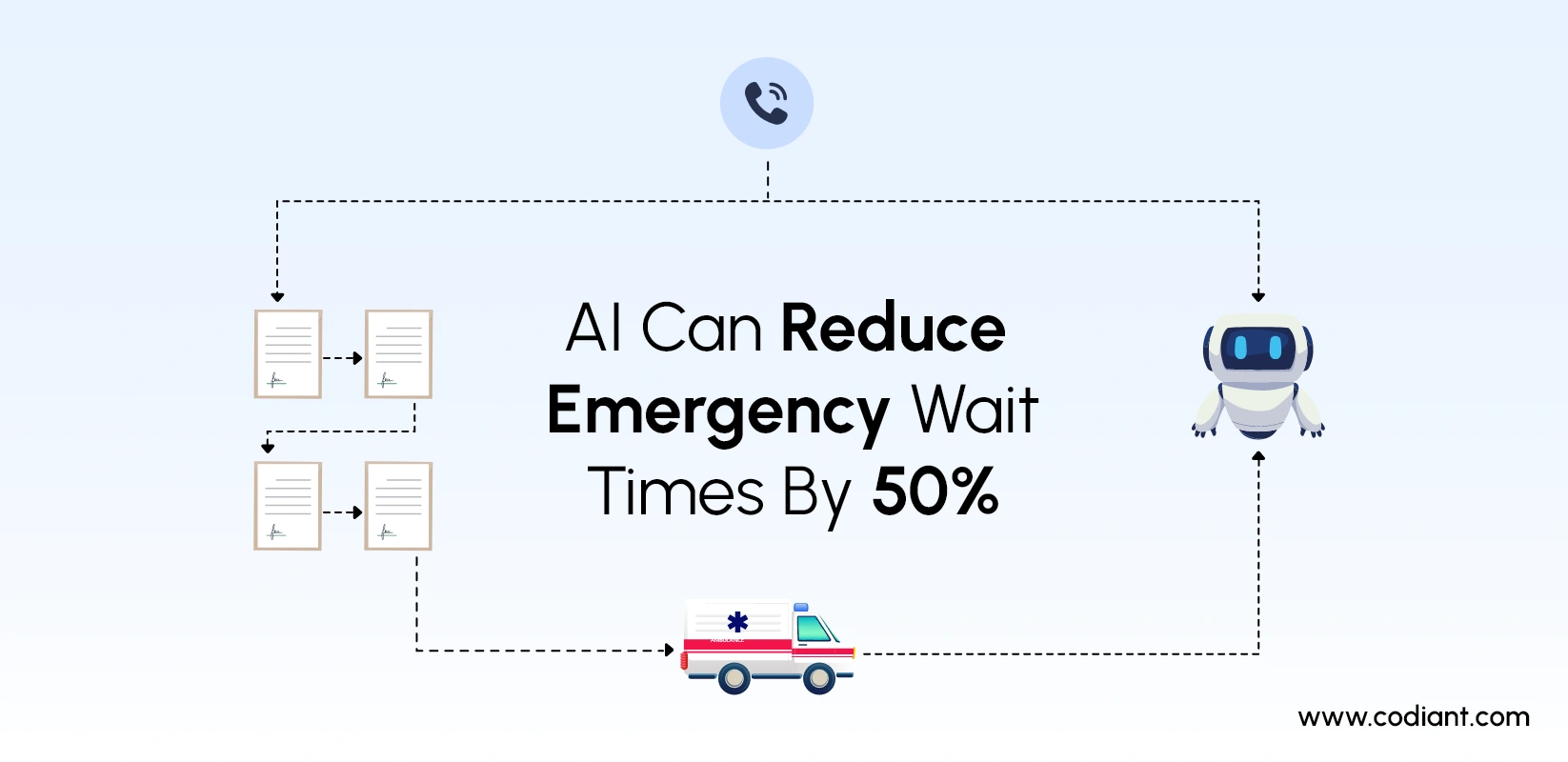
Reducing wait times by half leads to powerful system-wide benefits:
- Higher patient satisfaction and loyalty
- Lower staff burnout and better morale
- Reduced operational costs
- Faster diagnosis and treatment
- Increased hospital throughput
- Better emergency response outcomes
AI-enabled patient flow optimization is not just an efficiency improvement, it is a competitive advantage for hospitals in a rapidly growing healthcare market.
Read more: Why UAE Companies Must Adopt AI & Automation Before Q1 2026
How AI Reduces Patient Wait Times by Up to 50%
AI tackles the wait-time challenge through triage optimization, queue automation, scheduling intelligence, and workflow efficiency. Here’s how:
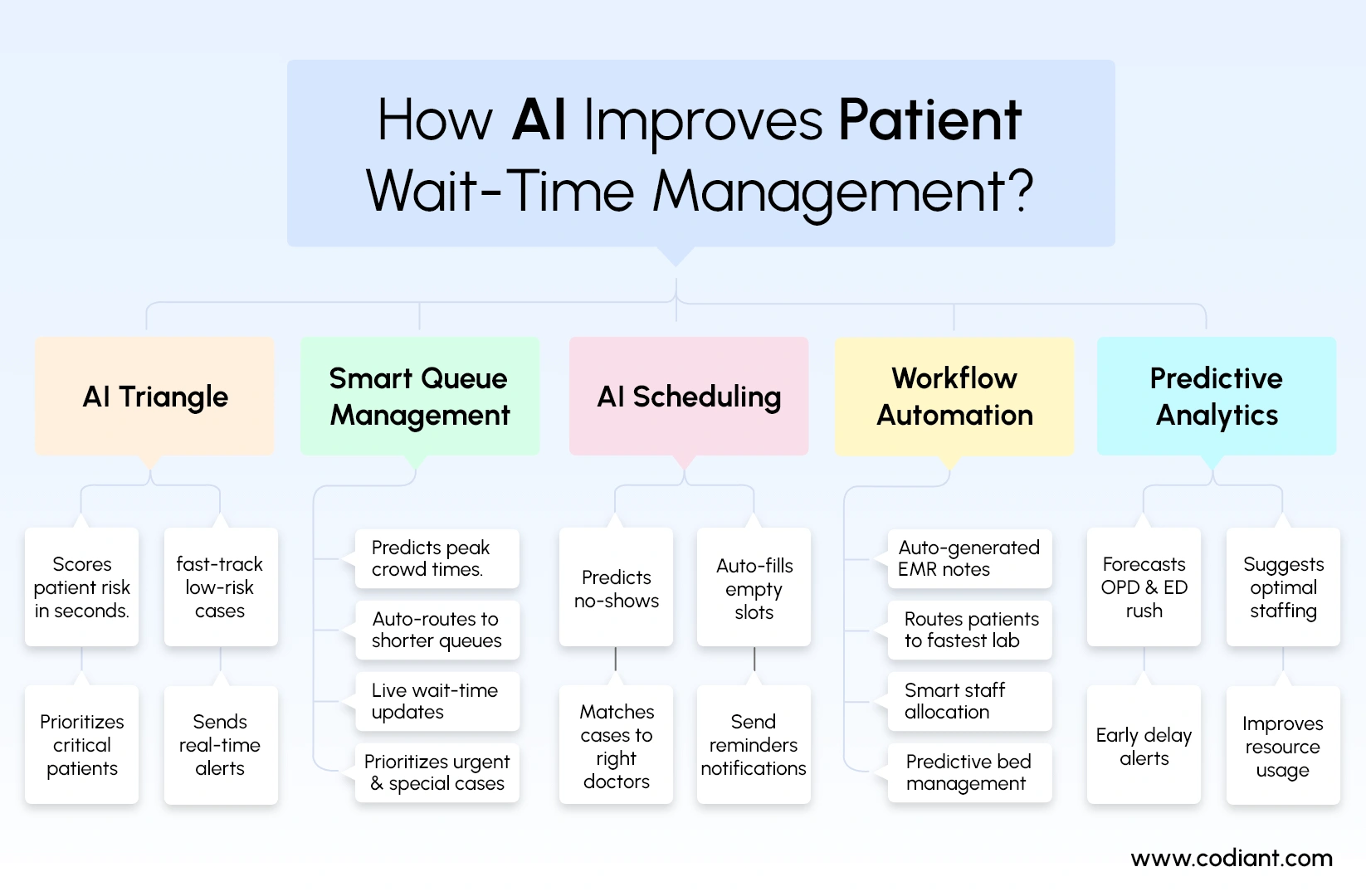
1. AI-Powered Patient Triage System UAE
Traditional triage depends heavily on nurse availability, manual scoring, and subjective assessment. AI solutions transforms this process by:
- Instant risk scoring: AI models analyze symptoms, vitals, medical history, and past admission patterns to categorize patients within seconds.
- Reduced ED congestion: Low-risk patients are redirected to fast-track units, while high-risk patients get prioritized care.
- Consistency and accuracy: AI reduces variability in triage decisions, leading to safer and faster patient classification.
- Real-time alerts: Systems notify clinicians when a patient’s risk escalates based on ongoing monitoring.
This approach has helped early adopters of AI for emergency department UAE reduce triage delays by 30–50%.
2. AI Queue Management for Hospitals
Hospitals typically use static queues that fail during peak hours. AI-enabled queue engines solve this by:
- Predicting crowd fluctuations: Models anticipate patient load by analyzing historical data, weather, appointment patterns, and city-wide events.
- Dynamic queue allocation: Patients are routed to sectors with the shortest processing time.
- Real-time patient updates: Patients receive accurate wait-time predictions via SMS, mobile apps, or digital kiosks.
- Automatic service prioritization: Elderly patients, urgent cases, and pregnant women can be prioritized intelligently.
As a result, hospitals using AI queue management for hospitals have seen OPD wait times drop dramatically.
3. AI Appointment Scheduling UAE
No-shows, long gaps between appointments, and inefficient scheduling lead to significant delays. AI improves this by:
- Predictive scheduling: AI identifies high no-show risk appointments and fills slots automatically.
- Smart doctor allocation: Scheduling engines match case complexity with the right physician based on availability and expected consultation duration.
- Automated reminders: Patients receive timely reminders, reducing no-show rates by up to 25%.
- Capacity forecasting: Hospitals can plan daily patient loads more accurately.
This AI-driven scheduling reduces bottlenecks, helping clinics handle 20–30% more patients without adding staff.
4. AI Hospital Workflow Automation
- Documentation and EMR updates: AI-powered NLP engines instantly convert clinical conversations into structured EMR entries, significantly reducing administrative workload for clinicians.
- Lab and radiology routing: AI analyzes current departmental load to route patients toward the fastest available diagnostic unit, minimizing unnecessary waiting periods.
- Smart resource allocation: Intelligent automation distributes tasks among nurses, technicians, and support staff based on workload, urgency, and real-time departmental demand.
- Automated bed management: Predictive algorithms forecast discharge timings accurately, enabling hospitals to optimize bed turnover and accelerate new patient admissions.
- Outcome sentence: This intelligent automation accelerates patient journeys, strengthens clinical efficiency, and substantially improves overall staff productivity during peak operational hours.
5. Predictive Analytics for Hospitals UAE
- Forecast peak hours: Predictive analytics evaluates historical patterns to accurately forecast OPD and emergency surges, ensuring hospitals prepare adequately.
- Optimize staffing: AI models align staffing levels with expected patient loads, reducing bottlenecks and preventing workforce underutilization during slower periods.
- Anticipate bottlenecks: Real-time predictive insights alert administrators to potential delays early, enabling proactive interventions before queues escalate uncontrollably.
- Improve resource utilization: Hospitals leverage AI-driven forecasts to maximize utilization of diagnostic units, consultation rooms, and procedural spaces across departments.
Turn Hospital Delays into Real-Time Decisions
AI gives teams instant clarity on demand, capacity, and next steps reducing wait times without operational strain.
Real-World Examples from Smart Hospitals in the UAE
While names may be generalized, several UAE healthcare groups have piloted or implemented AI-based patient flow systems:
Dubai Health (DHA)
AI triage and predictive flow tools help EDs reduce congestion, routing non-emergency cases to remote consultation units.
SEHA (Abu Dhabi Health Services)
AI-driven scheduling and queue management systems optimize outpatient volumes and reduce specialist backlog.
Fakeeh University Hospital & Mediclinic
Use AI for radiology prioritization, appointment load balancing, robotic process automation (RPA), and self-service patient flows.
Cleveland Clinic Abu Dhabi
Implements AI-assisted clinical documentation and workflow task automation.
These examples highlight the growing momentum of smart hospitals UAE and the nation’s commitment to UAE healthcare AI innovation.
Impact of AI on Emergency Departments in the UAE
Emergency departments face the highest pressure in the healthcare ecosystem. AI is delivering major improvements:
- Faster triage decisions: AI reduces triage time from several minutes to seconds.
- Reduced door-to-doctor times: Patients reach physicians faster, especially high-risk cases.
- Automatic escalation: AI alerts clinicians when patient vitals or symptoms indicate worsening conditions.
- ED flow optimization: Predictive analytics engines reduce hallway overflow by forecasting incoming volumes.
For hospitals adopting AI for emergency department UAE, average congestion has dropped significantly.
AI’s Role in Future UAE Healthcare – Vision 2026 and Beyond
The UAE is positioning itself as a global leader in digital health. The government’s 2026 transformation objectives include:
- Nationwide AI integration across hospitals: Covering triage, diagnostics, scheduling, and decision support.
- Expansion of remote care and telehealth: AI assistants streamline intake and reduce physical visits.
- Unified medical data ecosystems: Creating seamless AI-driven continuity of care.
- Predictive and preventive care models: Shifting healthcare upstream to reduce ED admissions.
As digital health transformation UAE 2026 accelerates, AI will transition from optional technology to standard infrastructure.
Challenges and Considerations in AI Adoption
Despite strong potential, hospitals must overcome:
- Data fragmentation: Different EMR systems limit unified AI insights.
- Staff training needs: Clinicians must trust and understand AI recommendations.
- Integration complexity: AI must connect smoothly with HIS, PACS, and lab systems.
- Compliance and governance: Patient privacy and clinical safety must remain top priorities.
However, with structured implementation, these challenges can be mitigated effectively.
Related reading: How AI Is Transforming Property Management in the UAE by 2026
How Codiant Helps UAE Hospitals Implement AI-Powered Automation
Codiant partners with hospitals and healthcare groups across the UAE to deploy intelligent automation aligned with clinical workflows and regulatory compliance. Our solutions streamline patient movement from arrival to discharge, reducing operational bottlenecks and improving clinical efficiency.
Our Expertise Includes:
- AI triage & symptom assessment tools
- AI queue management & patient flow engines
- Predictive scheduling and appointment optimization
- NLP-based clinical documentation automation
- Workflow automation across labs, radiology & nursing
- Real-time analytics dashboards for administrators
- Seamless integration with HIS, EMR, PACS & billing systems
With Codiant, hospitals achieve faster operations, better outcomes, and measurable reductions in wait times.
Conclusion
AI is redefining how healthcare systems operate in the UAE. From triage to discharge, every stage of the patient journey becomes faster, more predictable, and more efficient when healthcare providers hire AI developers to embed intelligent solutions into hospital workflows.
As smart hospitals continue to expand and digital health transformation accelerates toward 2026, the early adopters of AI will lead the market with superior patient experiences and operational excellence.
AI is not just transforming UAE hospitals it is shaping the future of care delivery. And the time to adopt it is now.
Your Hospital Can Move 50% Faster Too.
Adopt practical AI automation designed for UAE workflows that streamline clinical operations without disrupting daily care.
The Author

Frequently Asked Questions
AI speeds up triage, predicts busy hours, automates queues, and improves scheduling so patients move through the system faster.
Hospitals use AI triage systems, smart queue management, predictive scheduling, automation tools, and real-time analytics dashboards.
Yes. AI quickly assesses patient urgency and uses predictive scheduling to fill gaps, reduce no-shows, and balance doctor workloads.
AI identifies high-risk patients sooner, reduces triage delays, forecasts ED crowding, and ensures faster door-to-doctor times.
It reduces manual work, speeds up documentation, improves task assignment, and streamlines patient flow across departments.
Most hospitals see visible improvements in patient wait times and workflow efficiency within 60–120 days.
They struggle with longer queues, unpredictable patient loads, manual errors, slow triage, and higher operational strain.
AI predicts peak times, reallocates resources, and manages queues dynamically so hospitals can handle more patients without delays.
AI has improved diagnosis, reduced wait times, supported automation, and helped hospitals move toward smarter, data-driven care.
AI enables faster decision-making, improves care accuracy, automates workflows, and supports the UAE’s digital health goals.
Growing patient numbers, chronic diseases, limited manpower, and the need for faster service are key challenges today.
AI has improved efficiency, enhanced patient outcomes, reduced manual work, and strengthened hospital operations across UAE facilities.
AI is widely used in triage, diagnostics, radiology, scheduling, documentation automation, queue management, and predictive analytics.
Tools include AI radiology readers, early disease detection models, lab automation systems, and AI-based image recognition platforms.
AI triage, queue management, smart scheduling, predictive analytics, and workflow automation are the key solutions.
AI uses medical history, symptom patterns, and real-time data to assign accurate severity scores and schedule patients efficiently.
Yes. AI connects with HIS, EMR, PACS, and other systems through APIs to enhance current workflows without replacing them.
Hospitals typically need triage data, appointment history, staffing details, patient volumes, and real-time operational data.
They track reduced wait times, higher patient throughput, improved staff productivity, fewer bottlenecks, and better patient satisfaction scores.
Featured Blogs
Read our thoughts and insights on the latest tech and business trends
How to Hire AI Developers for Automation & Smart Applications- A Complete Guide for 2026
- January 29, 2026
- Staff Augmentation
In a Nutshell AI hiring in 2026 is a business decision, not just a technical one. Most AI failures happen due to wrong hiring models and unclear scope, not bad ideas. Successful automation starts by... Read more

How Much Does It Cost to Build an eCommerce Platform in Australia?
- January 27, 2026
- E-commerce
In a Nutshell eCommerce development costs in Australia typically start from AUD $10,000–$25,000 for basic stores, while advanced or enterprise platforms can range from AUD $80,000 to $250,000+ depending on complexity. Shopify offers a lower... Read more
How Long Does It Take to Develop an App in 2026?
- January 21, 2026
- Mobile App Development
In a Nutshell App development timelines depend more on scope clarity than technology speed. Simple apps take 2–4 months; complex platforms often require 9–12+ months. MVPs typically launch within 6–16 weeks when features remain tightly... Read more