How Mobile Apps Improve Logistics and Supply Chain Management in Australia?
Table of Contents
Subscribe To Our Newsletter
Summarize with AI
Not enough time? get the key points instantly.
Mobile apps improve logistics and supply chain management in Australia by digitising five high-friction workflows: dispatch, route planning, driver communication, proof of delivery, and inventory updates.
For founders, CEOs, CTOs, CIOs, and operations leaders, that means replacing phone calls, spreadsheets, and delayed status reports with real-time coordination across drivers, warehouses, customers, and back-office teams. The operational value is especially relevant to freight carriers, courier networks, last-mile businesses, distributors, retailers, and ecommerce companies managing geographically dispersed deliveries.
The Australian Government’s Department of Infrastructure reported in 2025 that the domestic freight task is projected to increase by 26% between 2020 and 2050, reaching approximately 964 billion tonne-kilometres. The department also stated in 2025 that freight and logistics accounts for about 8.6% of Australia’s national GDP, reinforcing the need for scalable digital capacity.
At Codiant, internal project estimates indicate clients spend 64% less time on routine logistics tasks; for a business managing 100 deliveries daily, the model estimates approximately 1,063 staff hours saved across 22 working days.
This article covers app-enabled dispatch, tracking, warehousing, automation, integration, and implementation priorities, with Codiant’s logistics product-development perspective.
Key Takeaways
- A logistics mobile app connects five core workflows: dispatch, tracking, inventory, driver communication, and proof of delivery.
- The strongest evaluation criterion is real-time integration with existing TMS, WMS, ERP, GPS, and customer systems.
- Start with a focused 12-week pilot covering one depot, delivery region, or high-volume operational workflow.
- Avoid building an isolated app that creates duplicate data and cannot communicate across transport modes or business systems. (Department of Infrastructure & Transport)
- Codiant develops integrated logistics platforms; internal project estimates indicate 64% less time spent on routine logistics tasks.
Why Mobile Apps Matter for Logistics and Supply Chain Management in Australia?
Mobile apps matter because logistics work happens across moving locations, not only inside offices. Drivers, warehouse teams, dispatchers, customers, suppliers and managers all need the same operational truth, but they rarely sit in the same place.
Australia moves a huge volume of goods every year across road, rail, ports, warehouses, cities and regional areas.
Most of this freight moved by rail and road, with rail carrying about 447 billion tonne-kilometres and road carrying about 253 billion tonne-kilometres. For logistics companies, this shows why real-time tracking is important. They need clear visibility of vehicles, shipments, orders and delivery status at every stage.
A logistics mobile app helps teams answer practical questions faster-
- Where is the vehicle now?
- Which order is delayed?
- Which driver is available?
- What stock is ready for dispatch?
- Which warehouse task is pending?
- Has the customer received proof of delivery?
- Which route has traffic, weather or delivery exceptions?
Without a mobile system, these answers often depend on calls, messages, spreadsheets, emails and manual status updates. That creates delays, duplicate work and poor customer visibility.
With the right logistics automation software, field data can move into the system as work happens. The app becomes the live connection between transport execution and supply chain planning.
Turn Logistics Delays into Faster, Smarter, More Connected Operations Today
Build a mobile solution that connects fleets, warehouses, drivers and customers seamlessly.
Australia’s Online Shopping Growth Is Creating More Delivery Demand
Australian online shopping reached $82.6 billion in 2025, up 14% year-on-year. Australia Post also reported that 9.8 million Australian households shopped online in 2025 and 41% of households purchased online at least fortnightly. This means logistics companies are handling more frequent orders, tighter delivery expectations and higher customer demand for tracking updates. Mobile apps help manage this pressure by connecting dispatch, drivers, warehouses and customer notifications in real time.
How Can Mobile Apps Solve Supply Chain Challenges?
Mobile apps solve supply chain challenges by improving visibility, coordination, accountability and speed across teams that usually work in different locations. They help replace delayed manual updates with structured real-time data.
Supply chain problems often begin when information moves slower than goods. A shipment may be delayed, stock may be unavailable, a vehicle may be underused or a customer may be waiting, but the team may not know early enough to act.
A supply chain mobile app helps solve this by connecting the main workflow stages:
- Order received
- Stock checked
- Picking assigned
- Goods packed
- Dispatch scheduled
- Driver assigned
- Vehicle loaded
- Shipment tracked
- Delivery completed
- Proof uploaded
- Customer notified
- Invoice triggered
When each stage is updated digitally, managers can see where delays or errors occur. In more advanced systems, AI in transport and logistics operations can use these live updates to predict delays, identify route risks and trigger alerts before disruptions affect the wider supply chain.
Challenge 1: Poor Shipment Visibility
Without real-time visibility, teams often rely on manual calls to know where shipments are. Mobile apps solve this through GPS tracking, status updates, geofencing, ETA alerts and delivery confirmation.
Challenge 2: Manual Dispatch Planning
Manual dispatch planning can lead to poor vehicle utilization and delayed deliveries. A mobile-based dispatch system can assign jobs based on driver availability, location, delivery priority, capacity and service windows.
Challenge 3: Warehouse Errors
Warehouse errors happen when stock movement is not recorded accurately. A warehouse management app can reduce errors by using barcode scanning, digital pick lists, bin-level inventory visibility and dispatch confirmation.
Challenge 4: Delayed Customer Updates
Customers often contact support when they cannot see shipment progress. Mobile apps can automate status updates, delivery notifications and proof of delivery sharing.
Challenge 5: Fragmented Systems
Many logistics companies use separate systems for orders, vehicles, warehouse activity, accounting and customer service. A mobile app can act as the field-facing layer that connects operational data into central business systems.
This is one of the main reasons supply chain digital transformation is important. It is not only about replacing paper with apps. It is about creating one reliable operating view across the supply chain.
How Do Mobile Apps Solve Logistics and Supply Chain Challenges?
Mobile apps improve logistics operations by turning disconnected field activities into real-time digital workflows. They help dispatchers assign jobs, drivers update delivery status, warehouse teams confirm stock movement and managers monitor performance from one shared platform.
The biggest improvement is visibility. When vehicles orders, documents, inventory and delivery status are updated through mobile apps, logistics teams can act on current data instead of waiting for end-of-day reports.
For example, a driver can receive a delivery route on the app, scan packages at pickup, upload proof of delivery, report a delay and complete a digital checklist. The dispatcher can see the same updates instantly. The customer service team can answer customer queries without calling the driver.
Mobile apps improve logistics operations in five core ways:
| Logistics area | How mobile apps improve it |
| Dispatch | Assign jobs, update routes, track driver status, manage exceptions |
| Fleet operations | Track vehicles, driver behaviour, maintenance, fuel and utilization |
| Warehouse workflows | Scan inventory, manage picking, packing, putaway and dispatch |
| Delivery management | Capture proof of delivery, customer signatures, photos and timestamps |
| Management reporting | Monitor KPIs, delays, costs, asset usage and service performance |
This is especially useful in Australia because non-bulk domestic freight is heavily road dependent. The Australian Government states that over 75% of non-bulk domestic freight is currently carried on roads.
For road-heavy operations, mobile apps can improve coordination between drivers, depots, warehouses and customers.
For many Australian transport operators, this shift is part of broader transport and logistics software development services where fleet visibility, freight movement, warehouse coordination and delivery tracking are connected into one operational workflow.
They cannot remove every external challenge, such as weather disruption or fuel price changes, but they help companies detect issues earlier and respond faster.
What Features Should a Logistics Mobile App Include?
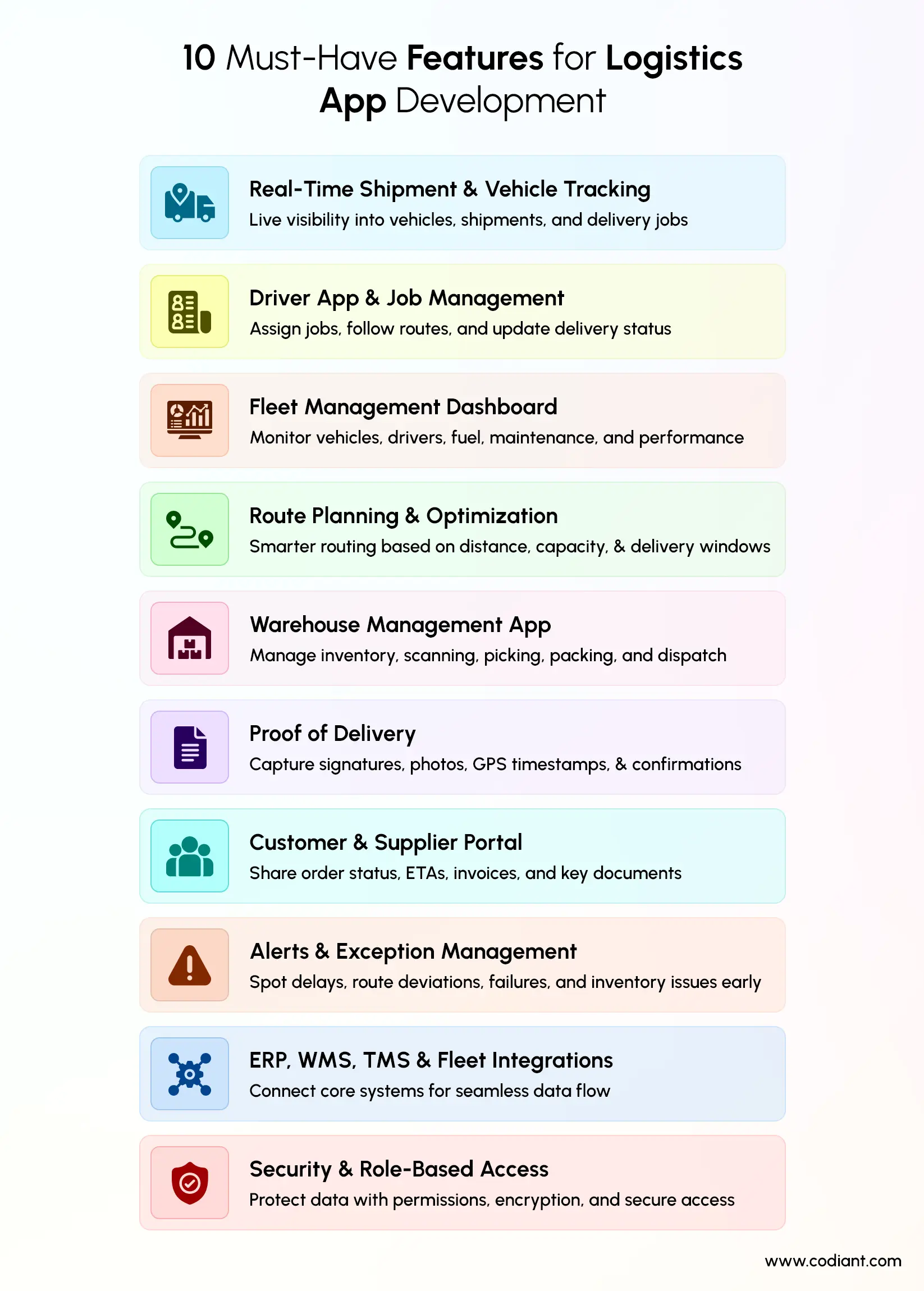
A logistics mobile app should include real-time tracking, dispatch management, route planning, driver communication, inventory visibility, proof of delivery, alerts, reporting and system integrations. The final feature list should depend on whether the app is built for fleet operations, warehouse management, last-mile delivery, freight forwarding or end-to-end supply chain control.
This is why the cost and features of a logistics and transportation app should always be mapped to real workflows such as dispatch, fleet tracking, proof of delivery, warehouse scanning, route planning and customer updates.
A credible logistics app development company should not begin by selling features. It should first map the business workflow, user roles, data sources, operational risks and integration requirements.
Here are the most important features for logistics app development Australia projects.
1. Real-Time Shipment and Vehicle Tracking
Real-time tracking allows teams to see the current location of vehicles, shipments and delivery jobs. This feature is usually supported by GPS, telematics devices, driver mobile apps or third-party fleet systems.
For transport operators, tracking helps answer three questions quickly:
- Where is the shipment?
- Is it on schedule?
- Does anyone need to act now?
This is one of the core features in transportation mobile app development because customers now expect better delivery visibility across B2B and B2C supply chains.
2. Driver App and Job Management
A driver app helps drivers receive jobs, follow assigned routes, update status, report issues, upload documents and complete delivery tasks.
Common driver app features include:
- Login and shift start
- Assigned jobs
- Pickup and drop-off details
- Route navigation
- Status updates
- Delivery notes
- Proof of delivery
- Incident reporting
- Digital checklists
This reduces dependency on phone calls and gives dispatch teams cleaner operational data.
3. Fleet Management Dashboard
Fleet management app development helps logistics companies manage vehicles, drivers, routes, fuel, maintenance, inspections and vehicle usage.
A useful fleet dashboard may include:
- Vehicle location
- Vehicle availability
- Driver assignment
- Maintenance reminders
- Fuel usage trends
- Route history
- Idle time
- Safety alerts
- Trip performance
The goal is not just tracking. The goal is better asset utilization.
4. Route Planning and Optimization
Route planning helps logistics teams assign efficient routes based on distance, delivery windows, vehicle capacity, driver availability and road conditions.
Advanced systems may use AI or optimization algorithms to suggest better route sequences. AI logistics solutions Australia can also support predicted arrival times, exception alerts and delivery risk scoring when enough reliable data is available.
AI should not be added only as a marketing feature. It works best when clean historical data, operational rules and business constraints are available.
5. Warehouse Management App
A warehouse management app helps teams manage inventory and movement inside the warehouse. It can support barcode scanning, stock receiving, picking, packing, putaway, cycle counting and dispatch confirmation.
This is important because delivery performance often depends on warehouse accuracy. If stock is not picked, packed and dispatched correctly, even the best transport app cannot fix the customer experience.
A warehouse mobile app may include:
- Barcode or QR scanning
- Stock lookup
- Bin location
- Pick list management
- Packing confirmation
- Returns processing
- Inventory adjustment
- Dispatch scan
- Supervisor approvals
6. Proof of Delivery
Proof of delivery helps confirm that goods reached the right person, place and time. It may include a digital signature, photo, GPS timestamp, barcode scan or recipient confirmation.
This feature is valuable for customer service, dispute handling, billing and compliance.
7. Customer and Supplier Portal
A customer portal gives clients visibility into orders, shipment status, delivery ETAs, invoices and documents. A supplier portal can help vendors update stock, confirm dispatch and manage purchase order details.
For B2B logistics, this reduces support calls and improves transparency.
8. Alerts and Exception Management
Exception alerts help teams identify problems before they become expensive failures.
Common alerts include:
- Vehicle delayed
- Route deviation
- Missed delivery window
- Inventory mismatch
- Failed delivery
- Temperature issue
- Driver inactive
- Pending approval
- Document missing
The value of logistics automation software is not only automation. It is also early warning.
9. ERP, WMS, TMS and Fleet System Integrations
Most logistics companies already use multiple systems. A mobile app should connect with existing ERP, warehouse management, transport management, CRM, accounting, telematics, payment and customer support systems where needed.
Integration is often one of the biggest cost and complexity drivers in logistics software development.
10. Security and Role-Based Access
Logistics apps may handle customer names, addresses, driver details, vehicle data, shipment records, invoices and delivery documents. In Australia organisations covered by the Privacy Act must notify affected individuals and the OAIC when a data breach involving personal information is likely to result in serious harm.
Security features should include:
- Role-based access control
- Multi-factor authentication
- Data encryption
- Audit logs
- Secure APIs
- Device/session management
- Backup and recovery
- Admin controls
- Privacy-aware data retention
The Australian Cyber Security Centre recommends the Essential Eight as a baseline set of mitigation strategies, while also noting no strategy set can guarantee protection against all cyber threats.
These features become more valuable when they are connected into one workflow. Codiant applied this approach for AirMove, an Australia-based on-demand logistics delivery platform for customers, movers, packers, logistics businesses and transport owners. The solution was delivered across iOS android and web in six months, using Laravel and React Native.
It included:
- Vehicle booking and scheduled deliveries
- Fare estimation, payments and billing
- Live shipment and driver tracking
- Driver request management and GPS routing
- Admin tools for fleet, dispatchers, customers, invoices and trip reports
The outcome: simpler booking, better communication, fewer manual calls and smoother logistics operations.
What Results Can Logistics Businesses Expect From Mobile Apps?
Logistics businesses can expect mobile apps to reduce manual coordination, improve shipment visibility, accelerate dispatch decisions, and provide reliable delivery data across drivers, warehouses, customers, and operations teams. The clearest results appear when the app replaces repeated phone calls, spreadsheets, paper records, and disconnected status updates rather than simply adding another interface.
Codiant’s internal project estimates indicate 64% less time spent on routine logistics tasks. For a business completing 100 deliveries daily across 22 working days, the model estimates approximately 1,063 staff hours saved:
100 deliveries × 22 days = 2,200 deliveries
1,063 hours ÷ 2,200 deliveries = approximately 29 staff minutes saved per delivery
Logistics leaders should measure results through operational KPIs such as:
- Average dispatch and vehicle-assignment time
- Staff hours spent on manual data entry
- On-time pickup and delivery rates
- Failed or rescheduled deliveries
- Customer status enquiries
- Proof-of-delivery completion
- Inventory and shipment-record accuracy
- Cost per delivery or consignment
These outcomes are strongest when the mobile app shares real-time data with the company’s transport management system, warehouse management system, ERP, GPS provider, payment systems, and customer portal. A standalone app may digitise individual tasks, but an integrated platform can remove duplicate work across the complete logistics workflow.
Verification note: The 64% and 1,063-hour figures are Codiant internal estimates. We cannot confirm these figures through an independently audited public source, so they should not be presented as guaranteed outcomes.
How Does AI Enhance Logistics Mobile Apps?
AI logistics solutions improve supply chains by helping teams predict, prioritize and automate decisions using operational data. AI is most useful when logistics companies already collect reliable data from vehicles orders, warehouses, routes, customers and delivery events.
AI can support:
- Route optimization
- ETA prediction
- Demand forecasting
- Vehicle maintenance prediction
- Inventory replenishment suggestions
- Delivery exception alerts
- Fuel usage analysis
- Warehouse slotting recommendations
- Driver performance insights
- Customer service automation
However, AI is not a shortcut for poor data quality. If shipment records are inconsistent, delivery timestamps are missing, addresses are inaccurate or inventory data is outdated, AI output may be unreliable.
A practical AI logistics roadmap should include:
- Data audit
- Workflow mapping
- Clean event tracking
- API and system integration
- Pilot AI use case
- Human review and validation
- Controlled rollout
- Monitoring and optimization
For many logistics companies, the first AI use case should be narrow. Predictive ETAs, delay alerts, route recommendations or demand forecasting are often more realistic than attempting full autonomous planning immediately.
Make Every Shipment Visible from Dispatch Through Final Delivery Today
Improve tracking, routing, proof of delivery and operational control in real time.
What are the Best Logistics App Use Cases in Australia?
The best use cases for logistics app development in Australia are the ones that reduce manual coordination, improve visibility and support faster operational decisions. The right use case depends on the company’s business model.
1. Fleet Management App
Useful for transport companies, courier fleets, field service teams and delivery operators.
Core value:
- Vehicle visibility
- Driver assignment
- Maintenance alerts
- Fuel tracking
- Safety monitoring
- Route history
2. Warehouse Management App
Useful for distributors, retailers, manufacturers, 3PL providers and eCommerce fulfilment teams.
Core value:
- Inventory visibility
- Barcode scanning
- Picking accuracy
- Dispatch confirmation
- Returns processing
- Stock movement tracking
3. Last-Mile Delivery App
Useful for retailers, food delivery, courier businesses, furniture delivery, healthcare logistics and parcel networks.
Core value:
- Delivery tracking
- Customer notifications
- Proof of delivery
- Failed delivery handling
- ETA updates
- Driver routing
4. Freight Forwarding App
Useful for companies managing multi-party shipments across air, sea, road and rail.
Core value:
- Shipment documents
- Milestone tracking
- Customer updates
- Compliance records
- Partner coordination
- Exception alerts
5. Supply Chain Visibility App
Useful for companies that need one dashboard across suppliers, warehouses, transport providers and customers.
Core value:
- End-to-end visibility
- Order status
- Inventory availability
- Delay alerts
- Supplier performance
- Reporting
How Much Does Logistics App Development Cost?
The cost of logistics app development depends on app scope, number of user roles, mobile platforms, backend complexity, integrations, data volume, security requirements, AI features and ongoing support. Without a defined scope, we cannot confirm an accurate project cost.
As a broad external benchmark, Clutch reports that most mobile app development projects reviewed on its platform usually range between $10,000 and $49,999, while the average app development project cost in its dataset is $90,780.11. Clutch also states that features, UX complexity, backend development, real-time updates, geolocation and complex algorithms can increase overall cost.
For logistics-specific apps, a practical planning estimate should separate simple, mid-level and enterprise-grade builds.
| App type | Planning estimate | Typical scope |
| Basic logistics MVP | AUD 45,000–90,000 | Driver app, job list, status updates, basic tracking, admin dashboard |
| Mid-level logistics app | AUD 90,000–180,000 | Fleet tracking, dispatch, proof of delivery, warehouse workflows, reports |
| Enterprise logistics platform | AUD 180,000–400,000+ | ERP/WMS/TMS integrations, AI, multi-branch workflows, advanced security |
| Ongoing support | 15%–25% of initial build yearly | Maintenance, updates, monitoring, cloud, security fixes, feature improvements |
These are planning estimates, not fixed prices. They should be validated through discovery, solution architecture, technical feasibility assessment and integration review.
What Should a Credible Estimate Include?
A credible estimate for logistics app development Australia should clearly state-
- What features are included
- Which user roles are included
- Which platforms are included, such as iOS android, web admin or tablet
- Which integrations are included
- Whether AI features are included
- Whether cloud hosting is included
- Whether data migration is included
- Whether security testing is included
- What remains excluded
- Which assumptions were used
Major Logistics App Cost Drivers
The biggest cost drivers are usually:
- Product discovery and workflow mapping: This includes business analysis, user roles, operational flows and scope definition.
- UI/UX design: Logistics apps need simple interfaces because users may be drivers, warehouse workers, dispatchers, managers or customers.
- Backend engineering: The backend manages orders, users, vehicles, inventory, documents, notifications and reporting.
- Real-time features: GPS tracking, live ETAs, route updates and event notifications require more engineering than static forms.
- Integrations: ERP, fleet, telematics, warehouse, payment, accounting and customer support integrations can significantly affect effort.
- AI and automation: AI logistics solutions Australia may require data collection, cleaning, model/API selection, validation and monitoring.
- Security and compliance: Role permissions, encryption, audit logs, secure APIs and privacy controls need to be planned from the beginning.
What Is Usually Excluded from the Estimate?
Unless clearly included, an initial estimate may exclude:
- Hardware devices
- Telematics subscriptions
- ERP licence costs
- Cloud usage beyond agreed limits
- App store fees
- Data migration
- Long-term AI model monitoring
- Third-party API charges
- Staff training
- Legal compliance review
This is why a fixed price without scope can be misleading.
Case Study: How UPS Used Route Optimization to Improve Logistics Efficiency
UPS, one of the world’s largest logistics companies, developed ORION, a route optimization system designed to improve pickup and delivery operations.
ORION uses advanced fleet telematics, algorithms and more than 250 million address data points to create optimized delivery routes for UPS drivers. By December 2015, ORION was being used by 35,000 UPS drivers in the United States.
The results show how logistics software can create measurable operational value. INFORMS reported that UPS expected ORION to reduce travel by 100 million miles per year, save 10 million gallons of fuel and reduce emissions by 100,000 metric tons annually after full deployment.
The same report estimated annual savings and cost avoidance of US$300 million to US$400 million.
What Australian logistics companies can learn?
The UPS case shows that logistics apps and route optimization tools work best when they are connected to reliable operational data, driver workflows, fleet systems and change management. We cannot confirm that the same cost savings would apply to Australian logistics businesses, but the case proves that route optimization and logistics automation can deliver measurable gains when implemented at scale.
Source: https://pubsonline.informs.org/do/10.1287/orms.2016.03.10/full/
What Australian Requirements Should a Logistics App Support?
An Australian logistics app should support five priority requirements: privacy protection, heavy-vehicle compliance, secure data handling, low-connectivity operations, and compliant customer communications. The exact controls should be defined according to the company’s fleet type, operating jurisdictions, customer contracts, and information collected.
1. Privacy and location-data protection
Logistics apps may collect driver names, phone numbers, delivery addresses, photographs, signatures, vehicle locations, and customer information. Organisations covered by the Privacy Act 1988 must follow the Australian Privacy Principles, while APP 11 requires reasonable steps to protect personal information from loss, misuse, unauthorised access, modification, or disclosure. Location permissions should be purpose-specific, transparent, and limited to what the delivery workflow requires.
2. Data-breach response
The platform should include access controls, audit logs, encryption, session management, backup procedures, and an incident-response workflow. Under the Notifiable Data Breaches scheme, covered organisations must notify affected individuals and the OAIC when an eligible breach is likely to cause serious harm.
3. Heavy-vehicle operational compliance
For vehicles over 4.5 tonnes, the app may need to record information supporting fatigue, loading, scheduling, vehicle access, and Chain of Responsibility processes. The Heavy Vehicle National Law applies across participating Australian jurisdictions but does not apply in Western Australia or the Northern Territory, where separate requirements must be considered.
4. Offline and low-connectivity operation
Drivers should be able to access assigned jobs, capture signatures, record delivery evidence, and save status updates when mobile coverage is unavailable. The Australian Government continues to fund new and upgraded infrastructure for identified mobile black spots, so continuous connectivity should not be assumed across regional delivery routes.
5. Customer notification controls
Logistics apps using branded SMS notifications should also account for Australia’s SMS Sender ID requirements. The national register commenced in 2026, and businesses using branded sender IDs should coordinate registration with their telecommunications or messaging provider. Promotional content should remain separate from operational delivery messages.
How to Build a Logistics Mobile App for Australia?
A logistics mobile app should be built around the actual operating workflow, not around a generic feature checklist. The right process starts with discovery and ends with measurable operational improvement.
Step 1: Define the Business Problem
Start by identifying the biggest operational issue.
Examples:
- Too many missed delivery windows
- Manual driver coordination
- Poor fleet visibility
- Warehouse picking errors
- Delayed proof of delivery
- No customer shipment visibility
- High admin workload
- Fragmented reporting
A focused problem creates a cleaner app scope.
For companies building specifically for the Australian market, working with a software development company in Sydney can make discovery more practical when the product needs to reflect local delivery models, customer expectations and operating conditions.
Step 2: Map User Roles
A logistics app may serve multiple users:
- Drivers
- Dispatchers
- Warehouse staff
- Fleet managers
- Operations managers
- Customers
- Suppliers
- Admins
- Finance teams
Each user role needs different permissions, screens and workflows.
Step 3: Choose MVP Features
A logistics MVP should include only the features needed to prove operational value.
A good MVP might include:
- Driver login
- Job assignment
- Status updates
- GPS tracking
- Proof of delivery
- Admin dashboard
- Customer notifications
- Basic reports
Do not overload the MVP with every possible feature. A smaller, reliable app is better than a large system that is hard to adopt.
Step 4: Design for Field Conditions
Logistics apps must work in real operating conditions. Drivers and warehouse workers need fast screens, clear buttons, offline support where needed and simple workflows.
Design should account for:
- Low connectivity areas
- Fast scanning
- One-hand use
- Large tap targets
- Minimal typing
- Clear error messages
- Fast image upload
- Battery usage
- Device compatibility
Step 5: Plan Integrations Early
Integrations should be planned before development begins. ERP, WMS, TMS, fleet tracking, accounting and customer communication systems can affect data architecture.
Late integration planning often increases cost and rework.
Step 6: Build Security Into the Architecture
Security should not be added after development. It should be part of authentication, API design, storage, logging, permissions and monitoring.
Australian businesses should also consider privacy obligations when apps collect personal information such as customer addresses, signatures, driver details and delivery documents. The OAIC explains that covered entities must notify affected individuals and the OAIC when a personal information breach is likely to result in serious harm.
Step 7: Test with Real Users
Testing should include office users and field users.
Test cases should include:
- Driver job completion
- Failed delivery
- Damaged goods report
- Warehouse scan mismatch
- Route change
- Offline mode
- Slow network
- Duplicate order
- Wrong address
- App crash recovery
- Admin permission errors
A logistics app succeeds only when it works reliably under pressure.
Step 8: Launch in Phases
Start with one region, depot, fleet group or warehouse workflow. Measure adoption, errors, time saved and operational issues before expanding.
A phased launch reduces risk and gives teams time to improve training, workflows and support.
How to Choose a Logistics App Development Company?
A logistics app development company should understand logistics workflows, mobile UX, backend systems, integrations, security, cloud infrastructure and long-term support. The right partner should ask operational questions before giving a price.
When comparing logistics app development companies, the evaluation should focus on domain experience, integration capability, mobile UX, real-time tracking, security and post-launch support rather than portfolio claims alone.
Before hiring a partner, ask:
- Have you built logistics, fleet, warehouse or supply chain apps before?
- How will you map our workflows before development?
- What integrations can you support?
- How will you handle real-time tracking?
- How will the app work in low-connectivity areas?
- What security controls are included?
- How will you test the app with field users?
- What is included and excluded in the estimate?
- How will support and maintenance work after launch?
- How will you measure operational success?
A good development partner should help you avoid overbuilding. Not every logistics company needs AI, IoT, advanced analytics and enterprise integrations in the first release. The first release should solve a clear operational problem and create a foundation for future automation.
What Mistakes Businesses Should Avoid During Logistics Software Development?
The most common mistake in logistics software development is building features before understanding workflows. Logistics apps fail when they look good in demos but do not match real dispatch, warehouse, driver or customer operations.
Avoid these mistakes:
- Building Without Discovery: Skipping discovery leads to unclear scope, missed workflows and higher rework costs.
- Ignoring Integration Complexity: A logistics app usually needs to connect with existing systems. Ignoring this early can delay the project.
- Overloading the MVP: Too many features slow down development and make user adoption harder.
- Designing Only for Managers: Drivers, warehouse workers and dispatchers need simple, fast, practical screens.
- Forgetting Offline and Low-Signal Scenarios: Some delivery routes, depots and warehouse zones may have poor connectivity. The app should be designed accordingly if those scenarios apply.
- Treating Security as a Later Step: Security, privacy and access control should be part of architecture from day one.
- Not Measuring Results: A logistics app should be measured against operational KPIs such as delivery accuracy, dispatch time, vehicle utilization, customer queries, proof-of-delivery speed and warehouse error rates.
How Does Codiant Build Logistics Apps for Australian Businesses?
Codiant builds logistics applications by mapping the operational workflow first, then designing the mobile, web, integration, and data components around measurable logistics outcomes. The process can cover product strategy, information architecture, business analysis, UX/UI design, application development, deployment, and continuous optimisation.
1. Map the existing logistics workflow
Codiant identifies how orders move from booking to dispatch, vehicle allocation, pickup, tracking, proof of delivery, invoicing, and customer support. This reveals where employees repeat data entry, rely on calls or spreadsheets, and wait for information from another system.
2. Define role-specific applications
The solution is structured around the people operating it, which may include customers, drivers, dispatchers, warehouse teams, fleet managers, finance teams, and administrators. Each role receives access to the functions and data required for its responsibilities.
3. Connect the operational technology
Codiant develops logistics solutions that can integrate with ERP and CRM platforms, IoT devices, GPS services, third-party APIs, payment gateways, and existing business systems. Its published logistics capabilities include GPS tracking, route analytics, operational reporting, and real-time shipment visibility.
4. Build and validate the highest-value workflows
Rather than digitising every process simultaneously, the initial release can prioritise functions such as dispatch automation, live tracking, driver updates, digital proof of delivery, and customer notifications. Performance can then be evaluated against baseline measures such as task time, delivery volume, failed deliveries, and manual staff hours.
5. Deploy, monitor, and optimise
Following deployment, Codiant monitors solution performance and introduces updates as operational requirements change. Its Australian logistics project, AirMove, was developed across mobile and web platforms with booking, Google Maps-based route tracking, online payments, real-time delivery management, and consignment notifications.
The objective is not merely to launch an app, but to create a connected logistics system that reduces repetitive work while giving Australian operators clearer control over deliveries, drivers, costs, and customer communication.
Are Mobile Logistics Apps Worth the Investment in Australia?
Mobile apps improve logistics and supply chain management in Australia by giving teams real-time visibility, faster coordination, cleaner data and better control over daily operations. The strongest results come when logistics app development starts with workflow discovery, clear scope, practical MVP planning, secure architecture and integration readiness.
For Australian logistics companies, the opportunity is not just to build an app. It is to build a connected operating system for fleet, warehouse, delivery, customer and management workflows.
A strong logistics app should answer the daily questions every operations team asks:
- Where is it?
- Who is handling it?
- What changed?
- What needs action?
- What can be improved next?
That is where mobile apps create measurable value in logistics and supply chain management.
Start Your Supply Chain Digital Transformation with The Right App
Plan a scalable platform around your workflows, integrations, users and goals today.
The Author

Frequently Asked Questions
Logistics app development commonly uses mobile frameworks such as Flutter, React Native, Swift and Kotlin; backend technologies such as Node.js, Java, Python or .NET; and cloud platforms such as AWS, Azure or Google Cloud. It may also use GPS, maps APIs, barcode scanning, push notifications, telematics APIs, databases, analytics tools and AI/ML services.
Yes, logistics apps can integrate with ERP, fleet management, warehouse management, transport management, accounting, CRM, telematics and customer support systems. Integration scope should be confirmed during discovery because each system has different APIs, data formats, security rules and workflow dependencies.
A basic logistics MVP may take 3-5 months, while a mid-level logistics mobile app may take 5-8 months. An enterprise platform with ERP, WMS, TMS, AI, multi-location workflows and advanced security can take 8-12 months or longer. Clutch reports that mobile app development projects in its dataset usually take about 11 months, but actual timelines vary by scope and complexity.
AI-powered logistics applications can support predictive ETAs, route optimization, demand forecasting, delivery risk alerts, inventory planning, vehicle maintenance prediction and customer service automation. These benefits depend on reliable data, clean workflows and continuous monitoring.
Logistics companies can improve operational efficiency by digitizing dispatch, driver updates, warehouse scanning, proof of delivery, customer notifications, fleet tracking and performance reporting. The best starting point is the workflow that causes the most delays, manual effort or customer complaints.
Featured Blogs
Read our thoughts and insights on the latest tech and business trends

Conversational AI in Healthcare: Benefits and Use Cases
- July 29, 2026
- Healthcare
Conversational AI in healthcare uses artificial intelligence to help patients, care teams, and administrative staff communicate through chat, voice, or messaging interfaces: answering routine questions, scheduling appointments, sending medication reminders, and reducing repetitive administrative work.... Read more

Top 7 ReactJS Development Companies in USA for 2026
- July 27, 2026
- Technology
React JS development companies design, build and maintain interactive web applications using the React library, typically combining frontend engineering with UI/UX design, API integration, testing and long-term support. The seven best React JS development companies... Read more

How Much Does AI Chatbot Development Cost in 2026? A Complete Business Guide
- July 24, 2026
- AI Chatbot Development
AI chatbot development costs in 2026 can range from approximately $15,000 for a focused AI chatbot MVP to $300,000 or more for an enterprise conversational AI platform. The final cost depends on the chatbot’s intelligence,... Read more