Why 63% Of Australian Business Leaders Are Prioritizing AI in 2026?
Table of Contents
Subscribe To Our Newsletter
Summarize with AI
Not enough time? get the key points instantly.
63% of Australian business leaders are prioritizing AI in 2026 because new technologies, especially artificial intelligence, are now linked to productivity, efficiency, competitiveness and long-term business resilience.
KPMG Australia’s 2026 survey found that 63% of Australian business leaders ranked new technologies as their number one concern for 2026, with AI-related issues emerging as the leading business challenge.
Based on recent AI project discussions with Australian businesses, one pattern is clear: leaders are treating AI as a productivity, continuity and competitiveness decision, not just a technology upgrade. Their focus is shifting toward faster service, leaner workflows, stronger governance and better use of existing teams.
Key Takeaways:
- 63% of Australian business leaders ranked new technologies as their top 2026 concern.
- AI adoption in Australia is rising, but confidence and governance still need work.
- Australian SMEs reached 44% AI adoption in February 2026.
- AI supports productivity, automation, decision-making, customer service and cost control.
- Enterprise AI Australia strategies are shifting from pilots to business transformation.
- Strong AI strategy requires governance, data readiness, training and measurable use cases.
- AI consulting Australia partners help businesses move from ideas to scalable AI systems.
- No AI investment guarantees ROI without clear scope, process alignment and adoption planning.
Why Are Australian Business Leaders Prioritizing AI in 2026?
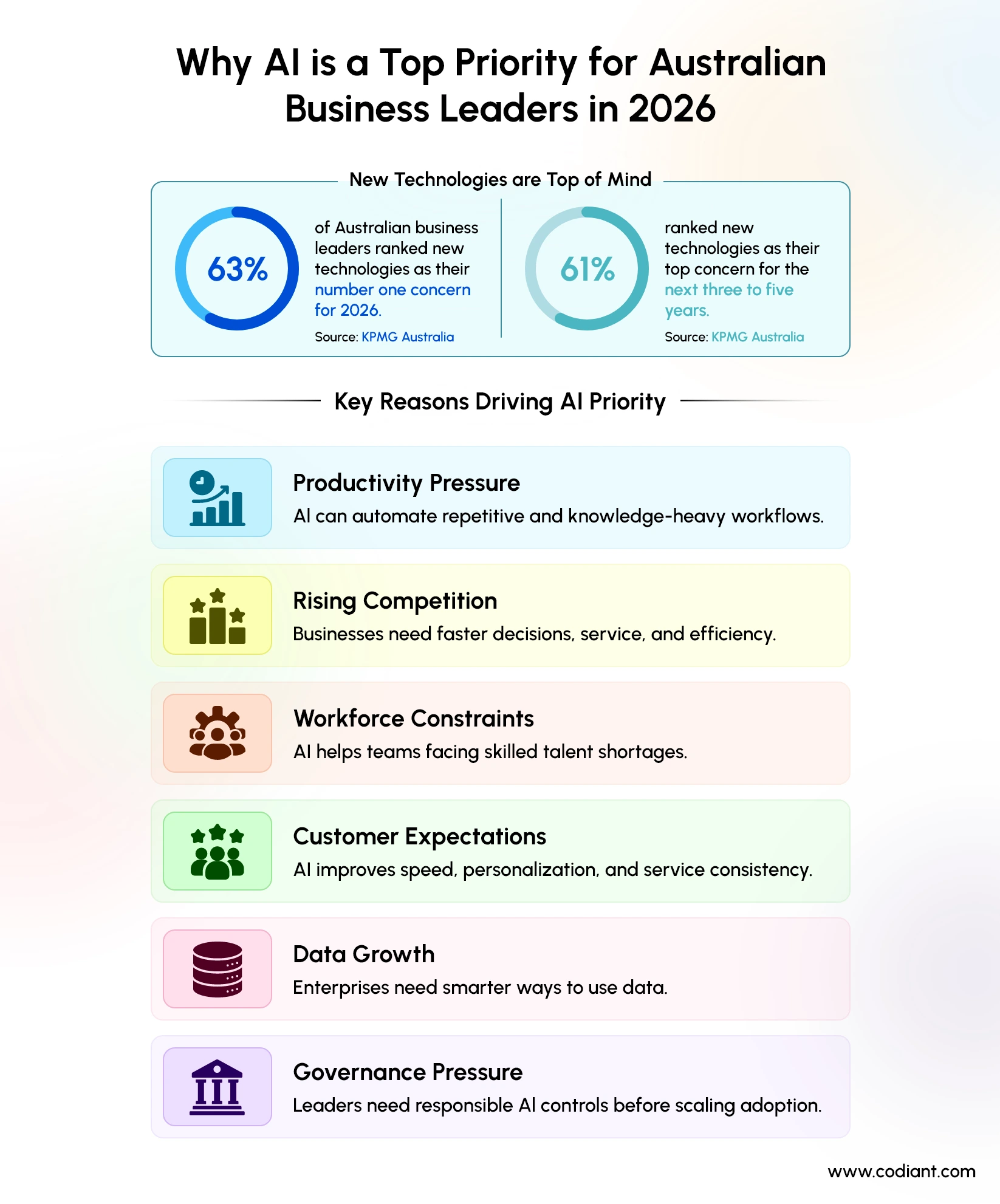
Australian business leaders are prioritizing AI in 2026 because AI has moved from a future technology discussion to a board-level business priority. It now affects productivity, workforce planning, customer experience, cyber risk, operational efficiency and competitive positioning.
KPMG Australia reported that 63% of surveyed Australian business leaders ranked new technologies as their number one concern for 2026, while 61% ranked new technologies as their top concern for the next three to five years. (KPMG)
This does not mean every business already has mature AI systems. The National AI Centre notes that Australian businesses are adopting AI, but confidence, clarity and trust still lag. (National AI Centre)
For business leaders, the priority is not simply “using AI.” The real priority is deciding where artificial intelligence for business can produce measurable value without creating unmanaged risk.
Key reasons include:
| Driver | Why it matters for Australian businesses |
| Productivity pressure | AI can automate repetitive and knowledge-heavy workflows. |
| Rising competition | Businesses want faster decisions, faster service and lower operating friction. |
| Workforce constraints | AI can support teams where talent is expensive or difficult to hire. |
| Customer expectations | AI can improve response speed, personalization and service consistency. |
| Data growth | Enterprises need better ways to search, summarize, classify and act on data. |
| Governance pressure | Leaders need responsible AI controls before scaling adoption. |
The takeaway is clear: AI strategy Australia discussions are no longer only technical. They are now commercial, operational and governance-led.
💡 Did You Know?
According to the Productivity Commission, artificial intelligence has the potential to become an important driver of Australia’s future productivity growth.
Turn AI Priority into a Practical Business Advantage Today
Build AI solutions that improve workflows, reduce manual effort, and support measurable business outcomes.
What Does the 63% Figure Actually Mean?
The 63% figure comes from KPMG Australia’s 2026 “Keeping us up at Night” survey, where business leaders ranked new technologies as their top concern for the year ahead. The source links this concern strongly with AI-related issues, not with a simple “AI spending” metric.
This distinction matters. The figure does not confirm that 63% of Australian businesses have fully implemented AI. It confirms that new technology, led by AI concerns, is at the top of leadership agendas.
A more accurate interpretation is:
- Australian leaders see AI as a major strategic issue.
- AI is tied to future competitiveness and productivity.
- Leaders are concerned about both opportunity and risk.
- Many businesses still need clearer implementation pathways.
How Strong Is AI Adoption in Australia Right Now?
AI adoption in Australia is growing, but maturity varies by business size, industry and use case. The National AI Centre reported that SME AI adoption rebounded to 44% in February 2026, the strongest result in several months.
The same National AI Centre update also states that Australian businesses and organisations are adopting AI, while confidence, clarity and trust remain challenges.
That means Australia is moving from awareness to adoption, but not every business has reached enterprise-grade implementation.
Common adoption stages
| Stage | What it looks like |
| Awareness | Leaders know AI matters but have no roadmap. |
| Experimentation | Teams use tools such as chatbots, copilots, or generative AI assistants. |
| Workflow adoption | AI is embedded into customer service, reporting, marketing, HR, or finance. |
| Enterprise AI | AI connects with internal systems, data, governance and measurable KPIs. |
| AI transformation | AI reshapes business models, operations, products and customer journeys. |
For many Australian businesses, the next step is moving beyond scattered tool usage into structured business AI transformation.
Why Are Australian Businesses Investing in AI in 2026?
Australian businesses are investing in AI in 2026 because AI can improve productivity, reduce manual workload, support faster decisions and help companies modernize customer and internal operations. The Productivity Commission says AI could underpin a new wave of productivity growth in Australia, although outcomes depend on effective adoption.
AI investment is also increasing because business leaders are under pressure to modernize without increasing costs at the same pace. AI automation solutions Australia businesses commonly explore include document processing, customer support automation, forecasting, knowledge search, workflow automation and generative AI for enterprises.
Main investment reasons
- Productivity improvement
AI can reduce time spent on repetitive tasks such as manual reporting, document review, email classification, scheduling and data entry. - Operational efficiency
AI can connect workflows across departments, reducing delays between sales, support, finance, HR and operations. - Better decision support
AI can analyze large datasets, summarize trends, detect anomalies and help managers make faster decisions. - Customer experience improvement
AI chatbots, recommendation engines and customer service copilots can improve response speed and personalization. - Competitive pressure
Businesses that delay AI adoption may lose speed, cost advantage and customer responsiveness.
The practical reason is simple: AI is becoming part of how modern businesses operate, not just a technology add-on.
How Is AI Transforming Australian Enterprises?
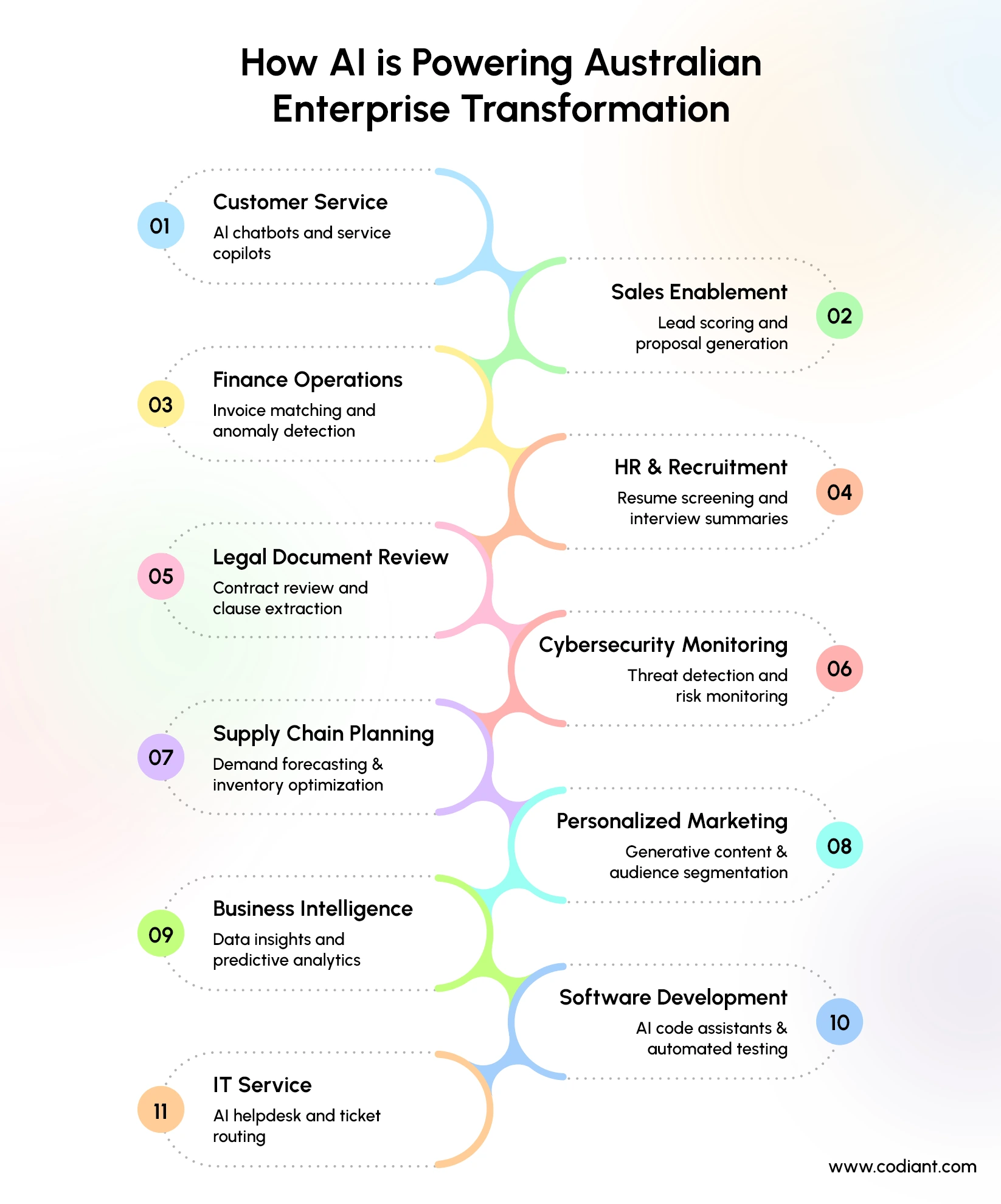
AI is transforming Australian enterprises by automating workflows, improving decision-making, accelerating customer response and turning business data into usable insights. Enterprise AI Australia projects are increasingly focused on measurable business outcomes rather than isolated experiments.
In 2026, enterprises are looking at AI across functions such as:
- Customer service
- Sales enablement
- Finance operations
- HR and recruitment
- Legal document review
- Cybersecurity monitoring
- Supply chain planning
- Marketing personalization
- Business intelligence
- Software development
The Productivity Commission’s 2025 report says AI could increase multifactor productivity over the next decade, although it also notes uncertainty around the exact scale of gains.
Enterprise AI examples by function
| Business function | AI use case | Business value |
| Customer support | AI chatbot or service copilot | Faster response and lower support load |
| Finance | Invoice matching and anomaly detection | Fewer manual checks and better fraud visibility |
| HR | Resume screening and interview summaries | Faster hiring workflows |
| Sales | Lead scoring and proposal generation | Better prioritization and shorter sales cycles |
| Operations | Workflow automation | Reduced delays and repeated manual coordination |
| Legal | Contract review and clause extraction | Faster document analysis |
| IT | AI helpdesk and ticket routing | Improved service response |
| Marketing | Generative AI content and segmentation | Faster campaign production |
The strongest enterprise AI projects usually start with one high-value workflow, prove measurable impact and then scale across related processes.
Which Industries in Australia Benefit Most from AI?
Industries in Australia that benefit most from AI include healthcare, finance, retail, logistics, manufacturing, education, agriculture, professional services and government services. These industries typically manage large volumes of data, repeated workflows, compliance requirements, or customer interactions.
Industry-wise AI opportunities
| Industry | High-value AI use cases |
| Healthcare | Patient triage, clinical documentation, appointment automation, claims processing |
| Finance | Fraud detection, risk scoring, customer support, compliance monitoring |
| Retail | Product recommendations, demand forecasting, inventory planning, customer personalization |
| Logistics | Route optimization, delivery prediction, warehouse automation, shipment tracking |
| Manufacturing | Predictive maintenance, quality inspection, production planning |
| Agriculture | Crop monitoring, yield forecasting, soil and weather analytics |
| Education | Personalized learning, student support, assessment assistance |
| Professional services | Document review, proposal drafting, knowledge search, research automation |
| Real estate | Property recommendations, lead qualification, document automation |
| Government services | Citizen service automation, form processing, internal knowledge access |
The best-fit industries are usually those with repetitive processes, fragmented data, high service demand, or expensive manual decision cycles.
What Are the Biggest Benefits of AI for Businesses?
The biggest benefits of AI for businesses include productivity improvement, cost optimization, better customer experience, faster decision-making, improved accuracy and scalable automation. These benefits are strongest when AI is connected to a clear business problem.
AI should not be adopted only because competitors are using it. It should be mapped to a measurable outcome such as reduced handling time, faster reporting, higher conversion, fewer errors, or better customer satisfaction.
Key benefits of artificial intelligence for business
| Benefit | What it means |
| Faster workflows | AI reduces manual steps in repeated processes. |
| Better decisions | AI helps analyze data and summarize patterns. |
| Lower operational burden | Teams spend less time on routine tasks. |
| Improved customer service | AI can support 24/7 responses and faster resolution. |
| Higher consistency | AI applies defined rules and workflows repeatedly. |
| Better scalability | Businesses can handle more work without proportional team expansion. |
| Stronger knowledge access | Employees can search and summarize internal documents faster. |
| More personalization | AI can tailor messages, recommendations and offers. |
The strongest value comes when AI is designed around business processes, not added as a disconnected tool.
Cost reduction is one of the most common objectives behind enterprise AI initiatives, but the biggest savings usually come from redesigning workflows rather than simply automating individual tasks. Businesses evaluating this approach may also find it useful to understand how AI helps businesses cut costs in 2026.
Why Is Enterprise AI Different from Basic AI Tool Usage?
Enterprise AI is different from basic AI tool usage because it connects AI with business systems, governed data, security controls, workflows and measurable performance goals. Basic AI tools may improve individual productivity, but enterprise AI changes how teams and processes operate.
For example, a sales employee using a generative AI tool to draft emails is basic AI usage. A company integrating AI with its CRM, customer data, lead scoring model, proposal workflow and approval process is enterprise AI.
Basic AI vs enterprise AI
| Area | Basic AI tool usage | Enterprise AI |
| Scope | Individual tasks | Business workflows |
| Data | User-provided prompts | Connected business systems |
| Governance | Limited | Defined policies and accountability |
| Security | Tool-dependent | Enterprise-grade controls |
| Measurement | Informal productivity | KPIs, dashboards, ROI tracking |
| Scalability | User-by-user | Organization-wide |
| Risk control | Often unclear | Managed through governance |
Australian enterprises should not confuse AI experimentation with AI transformation. The gap between the two is strategy, governance, integration and adoption.
What Role Does Generative AI Play for Enterprises?
Generative AI for enterprises helps create, summarize, classify, search and transform information across business workflows. It is especially useful for document-heavy, communication-heavy and knowledge-heavy operations.
Common enterprise use cases include:
- Drafting proposals and reports
- Summarizing meetings and documents
- Creating customer support responses
- Generating marketing content
- Searching internal knowledge bases
- Converting unstructured documents into structured data
- Supporting software development
- Automating HR and recruitment communication
However, generative AI should be deployed with clear rules. Businesses planning custom enterprise solutions should also understand the development lifecycle involved in building a generative AI application, from selecting models and preparing data to deployment and governance.
The takeaway: generative AI is powerful, but enterprise value depends on responsible implementation.
What Are the Biggest Challenges When Implementing AI?
The biggest challenges when implementing AI include unclear strategy, poor data readiness, weak governance, low employee trust, integration complexity, security risk and difficulty measuring ROI. These barriers often matter more than the AI model itself.
Common AI implementation challenges
| Challenge | Why it creates risk |
| No clear AI strategy | Teams run disconnected experiments without business impact. |
| Poor data quality | AI outputs become unreliable when source data is incomplete or inconsistent. |
| Weak governance | Nobody owns risk, accuracy, security, or approval rules. |
| Integration complexity | AI tools fail to connect with existing CRM, ERP, HRMS, or legacy systems. |
| Employee resistance | Teams may avoid tools they do not understand or trust. |
| Security concerns | Sensitive data may be exposed without proper access controls. |
| ROI uncertainty | Leaders cannot justify scale without measurable outcomes. |
The most practical solution is to begin with a defined use case, identify the expected outcome, assess data readiness and create governance before scaling.
Find the Right AI Use Case Before You Invest
Identify where automation, generative AI, and predictive intelligence can create real business value.
How Can Australian Companies Start Their AI Journey?
Australian companies can start their AI journey by identifying one business problem, assessing data readiness, selecting a measurable use case, defining governance, building a pilot and scaling only after results are proven. AI should begin with business value, not tool selection.
The Australian Government’s Guidance for AI Adoption recommends that organisations decide who is accountable and build AI literacy across the organisation.
Step-by-step AI adoption roadmap
- Define the business problem
Choose a process where delays, manual work, high costs, or inconsistent output are visible.
Selecting the right use case often determines whether an AI initiative succeeds or stalls. Focusing on processes with measurable business impact is generally a better starting point than attempting organisation-wide implementation.
This article on identifying high-ROI AI opportunities in your business explains practical evaluation criteria.
- Identify measurable outcomes
Examples include reduced response time, fewer manual hours, faster reporting, improved lead conversion, or fewer processing errors. - Assess data readiness
Check whether data is accurate, accessible, secure and relevant to the AI use case. - Choose the right AI solution
Decide whether the business needs generative AI, predictive analytics, automation, computer vision, conversational AI, or a custom AI model. - Set governance rules
Define accountability, human review, data access, risk classification and escalation rules. - Build a controlled pilot
Start with one workflow, limited users and measurable KPIs. - Evaluate ROI and risk
Compare performance before and after implementation. - Scale gradually
Expand only when the use case proves operational value and user adoption.
This approach reduces the risk of investing in AI without a practical business outcome.
Which AI Solutions Deliver the Fastest Business Value?
AI solutions that deliver the fastest business value usually automate repetitive, high-volume, low-complexity workflows while improving processes such as AI lead scoring, AI chatbots, document processing, reporting automation, meeting summarization, lead qualification and internal knowledge search.
Fast-value AI use cases work best when:
- The process is repetitive.
- The data source is available.
- The output can be reviewed.
- The workflow has measurable time or cost impact.
- The risk level is manageable.
Fast-value AI use cases
| AI solution | Typical business value |
| AI chatbot | Reduces repetitive support queries |
| AI document processing | Extracts data from invoices, forms, contracts and reports |
| AI knowledge assistant | Helps teams search internal documents faster |
| AI meeting assistant | Summarizes calls and action items |
| AI reporting automation | Speeds up recurring business reports |
| AI lead scoring | Helps sales teams prioritize high-intent prospects |
| AI recruitment assistant | Screens resumes and summarizes candidates |
| AI workflow automation | Moves tasks between systems with fewer manual steps |
These use cases often work well as first AI projects because they are easier to scope, test and measure.
Also read: If customer service automation is one of your first AI initiatives, explore these 10 compelling reasons why your business needs an AI chatbot.
How Can Businesses Measure the ROI of AI Investments?
Businesses can measure AI ROI by comparing the cost of implementation with measurable improvements in time saved, cost reduced, revenue increased, error rates reduced and customer experience improved. ROI should be measured against a defined baseline before AI is introduced.
A simple AI ROI formula is:
AI ROI = (Financial benefit from AI − AI investment cost) ÷ AI investment cost × 100
For example, if an AI automation project saves AUD 120,000 in annual operational effort and costs AUD 60,000 to implement, the ROI calculation is:
(120,000 − 60,000) ÷ 60,000 × 100 = 100% ROI
This is only a simplified calculation. A complete ROI model should also include maintenance, cloud costs, training, governance, integration, monitoring and change management.
AI ROI metrics to track
| Metric | What to measure |
| Time saved | Hours reduced per task or workflow |
| Cost reduction | Lower manual effort or operational expense |
| Revenue impact | Higher conversion, retention, or order value |
| Productivity | Output per employee or team |
| Error reduction | Fewer mistakes, rework, or compliance issues |
| Response time | Faster support or internal processing |
| Adoption rate | Number of active users using AI tools |
| Customer satisfaction | CSAT, NPS, resolution quality |
Without a baseline, we cannot confirm whether AI has produced measurable ROI.
What Should an AI Strategy in Australia Include?
An AI strategy in Australia should include business goals, use case prioritization, data readiness, governance, security, compliance, technology architecture, employee training, implementation roadmap and ROI measurement. A strategy is necessary because disconnected AI tools rarely create enterprise-level transformation.
The National AI Centre’s guidance focuses on safe and responsible AI adoption, including accountability and organisational AI literacy. (Industry.gov.au)
AI strategy checklist
| Strategy area | Key question |
| Business goal | What outcome should AI improve? |
| Use case selection | Which workflow creates measurable value? |
| Data readiness | Is the required data accurate, secure and accessible? |
| Governance | Who owns AI decisions, risks and approvals? |
| Security | How will sensitive data be protected? |
| Technology | Should the business use APIs, open-source models, or custom AI? |
| Integration | Which systems must AI connect with? |
| Training | Do employees know how to use AI responsibly? |
| Measurement | What KPIs prove success? |
| Scaling | How will successful pilots expand across the business? |
A strong AI strategy does not start with “Which model should we use?” It starts with “Which business outcome should improve?”
How Can AI Consulting Australia Partners Support Transformation?
AI consulting Australia partners support transformation by helping businesses identify high-value use cases, assess feasibility, build AI roadmaps, design responsible AI workflows, integrate AI with existing systems and measure business outcomes. This support is useful when internal teams lack AI engineering, data, or governance expertise.
Businesses looking for end-to-end AI development solutions should evaluate partners that can support strategy, custom development, enterprise integration, deployment, and long-term optimization, not just model implementation.
That includes consulting, prototyping, custom AI development, integration, deployment, monitoring and continuous optimization.
What an AI partner should provide
- AI opportunity assessment
- Use case prioritization
- Data readiness audit
- AI solution architecture
- Generative AI development
- AI automation development
- Chatbot and voice agent development
- AI integration with CRM, ERP, HRMS, or internal systems
- Security and governance planning
- Pilot development
- ROI measurement framework
- Scaling and maintenance support
The right partner should not recommend AI for every problem. A credible partner should also identify where automation, analytics, or process redesign may be more suitable than AI.
How Codiant Helps Australian Businesses Build AI Solutions
Codiant supports Australian businesses with AI consulting, AI development, automation, generative AI integration and enterprise software engineering. For companies exploring AI adoption in Australia, Codiant can help move from idea validation to scalable implementation with a business-first approach.
Codiant’s AI development services can support:
- AI strategy and feasibility consulting
- Custom AI application development
- Generative AI for enterprises
- AI chatbot and virtual assistant development
- AI automation solutions Australia businesses can integrate into workflows
- Predictive analytics and recommendation systems
- AI-powered mobile and web application development
- Enterprise AI integration with existing business systems
For Australian companies, the advantage is not just building an AI feature. The value is developing AI systems that match business workflows, user needs, security expectations and measurable outcomes.
Conclusion
Australian business leaders are prioritizing AI in 2026 because AI is now directly connected to productivity, competitiveness, customer experience and business resilience. The 63% figure from KPMG Australia shows that new technologies, strongly led by AI-related concerns, have become a top leadership priority.
However, AI adoption in Australia is not only about using new tools. The real opportunity is building responsible, measurable and workflow-connected AI systems. Businesses that start with clear use cases, strong governance, reliable data and measurable ROI will be better positioned to turn AI from experimentation into transformation.
Build Scalable AI Solutions for Australian Business Growth
Move from AI experiments to secure, integrated, and outcome-focused enterprise AI implementation.
The Author

Frequently Asked Questions
AI adoption among Australian businesses is driven by productivity pressures, customer expectations, workforce constraints, competitive pressures, and data growth, as businesses increasingly seek operational efficiency. The National AI Centre reported a 44% AI adoption rate among SMEs in February 2026.
Businesses can measure AI ROI by comparing implementation costs with measurable benefits such as time saved, cost reduced, revenue increased, errors reduced and customer response improved. A baseline is required before implementation to confirm impact.
The biggest AI implementation challenges are unclear strategy, poor data quality, weak governance, integration complexity, security risk, low employee trust and difficulty measuring ROI. The National AI Centre notes that confidence, clarity and trust still lag in Australian AI adoption.
An AI development partner can support digital transformation by identifying practical use cases, building AI roadmaps, developing custom AI systems, integrating AI with business platforms, setting governance controls and measuring ROI after deployment.
Featured Blogs
Read our thoughts and insights on the latest tech and business trends

How Much Does It Cost to Build an MVP in 2026? A Complete Pricing Guide
- September 10, 2026
- Digital Transformation
MVP development cost typically ranges from $5,000 for a basic web-based product to $150,000 or more for a complex, cross-platform solution. A custom MVP with user accounts, a backend, essential integrations and a polished interface... Read more

How Much Does It Cost to Hire a Dedicated AI/LLM Developer in 2026?
- September 8, 2026
- Artificial Intelligence Staff Augmentation
Hiring a dedicated AI or large language model (LLM) developer typically costs $35–$60 per hour for general AI engineering and $50–$200 per hour for specialised machine learning work, with enterprise pricing rising for advanced RAG,... Read more

HIPAA-Compliant App Development in 2026: How to Build Securely and Avoid Preventable Fines
- September 4, 2026
- Mobile App Development
HIPAA-compliant app development in 2026 requires six foundations: complete ePHI mapping, documented risk analysis, role-based access, encryption, signed business associate agreements, and continuous security monitoring. This matters most to healthcare CTOs, product leaders, and compliance... Read more