How to Hire Software Developers in Australia in 2026: Process, Skills, and Costs
Table of Contents
Subscribe To Our Newsletter

Summarize with AI
Not enough time? get the key points instantly.
To hire software developers in Australia in 2026, define your technical requirements and project scope, select an engagement model that matches your budget and timeline, assess candidates through practical engineering evaluations, and calculate the total cost of employment, including salary, superannuation, recruitment, and tooling. These steps give businesses a repeatable hiring framework, from initial role definition through to onboarding and productive delivery.
Australia needs more than 60,000 new technology professionals every year to meet growing demand, according to the Australian Computer Society’s Digital Pulse report. This makes reactive, unstructured hiring a significant risk for businesses competing for the same limited talent pool.
Vivek Singh, Vice President – Strategic Growth & Partnerships at Codiant, who has matched pre-vetted software developers across more than 80 Australian businesses, observes that most hiring delays do not begin with a shortage of available developers. They begin with an incomplete brief. When a business cannot clearly define the required technology stack, team structure, or delivery outcome, even a well-qualified developer cannot be matched, contracted, or onboarded without friction and lost time.
Without a structured approach, businesses risk hiring for the wrong seniority level, underestimating total employment costs, failing to meet data privacy obligations, or losing weeks of delivery time because of misaligned expectations between the developer and the internal team.
In a Nutshell
- Define the project, technology stack, responsibilities, and expected outcomes first.
- Hiring software developers in Australia typically costs approximately AUD 85,000 to AUD 130,000 per year in base salary.
- Senior developers may cost around AUD 140,000 to AUD 170,000, while AI, machine-learning, architecture, and other specialised roles may range from approximately AUD 155,000 to AUD 213,000 in major Australian markets.
- Permanent employees provide continuity but involve wider employment-related costs.
- Contractors work well for temporary, urgent, or specialist requirements.
- Dedicated developers offer ongoing capacity without expanding internal headcount.
- Offshore teams can reduce costs but require strong governance and communication.
- Evaluate practical engineering ability, not only qualifications or interview performance.
- Check privacy, security, intellectual property, and data-access requirements before hiring.
What Does Hiring Software Developers in Australia Mean in 2026?
Hiring software developers in Australia in 2026 means securing the technical expertise needed to build, modernise, test, or maintain software through permanent recruitment, contracting, remote hiring, dedicated teams, or outsourcing. The right hiring model depends on the project duration, required skills, budget, delivery timeline, and level of control the business wants to retain.
Software and applications programmers in Australia design, develop, test, maintain, and document software according to business and technical requirements. Jobs and Skills Australia reported approximately 203,200 people employed in this occupation group, with median full-time earnings of AUD 2,537 per week as of its latest published occupation data.
However, businesses do not always need to recruit permanent employees. A company may instead hire:
- Permanent software developers
- Fixed-term employees
- Independent contractors
- Freelance developers
- Dedicated development teams
- Remote developers in Australia
- Offshore software developers
- A custom software development company
The correct model should follow the business requirement. A permanent employee may suit a long-term product team, while a dedicated or outsourced team may be more appropriate for a defined product build, rapid capacity expansion, or access to skills unavailable internally.
Build Your Australian Development Team Without Delays or Hiring Risks
Access vetted developers with the right skills, engagement model, and delivery experience for your project.
How Can Businesses Hire Software Developers in Australia?
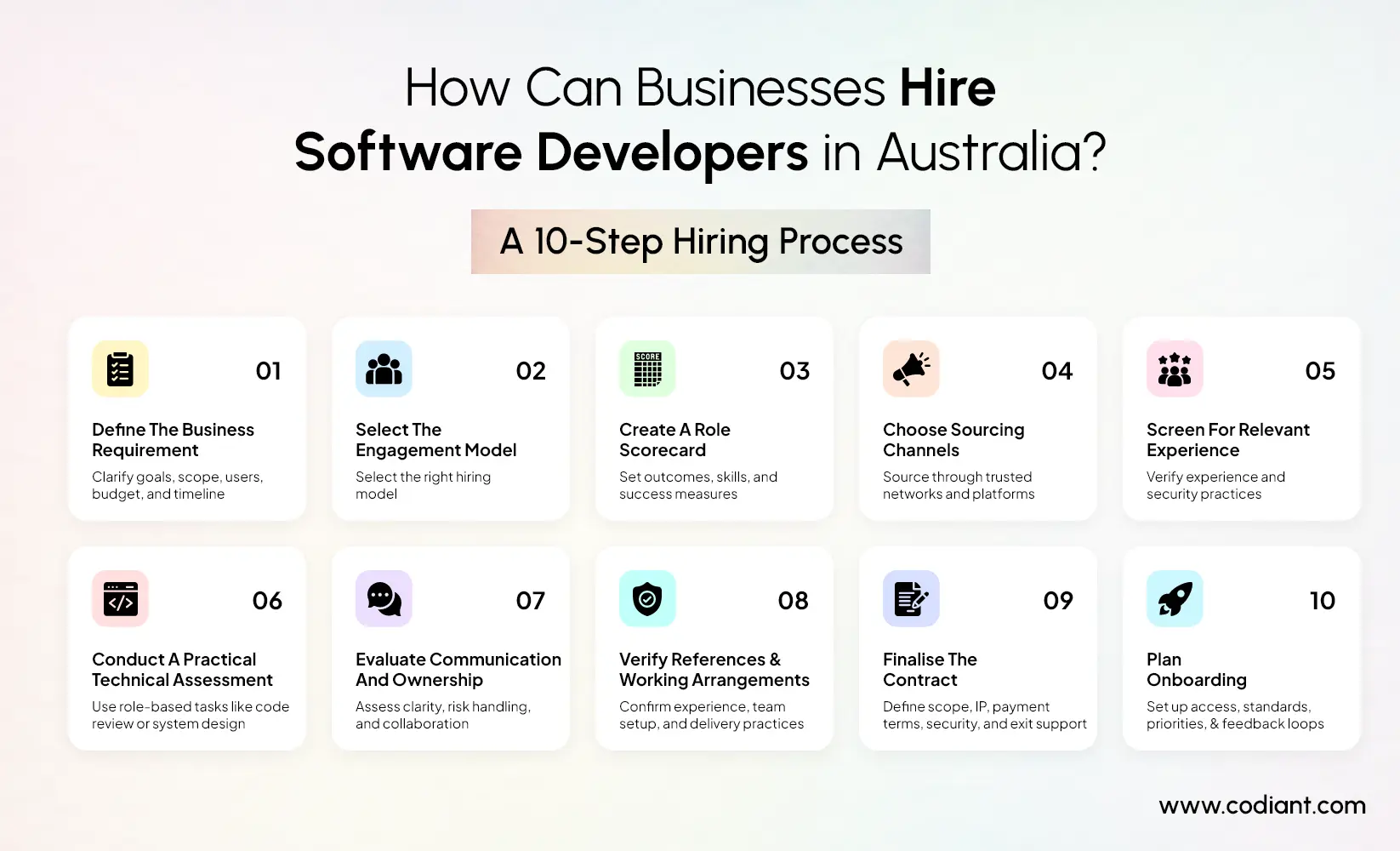
Businesses can hire software developers in Australia by defining their project requirements, choosing an engagement model, sourcing suitable candidates, evaluating technical and communication skills, verifying experience, finalising contractual terms, and planning onboarding. They may recruit permanent employees, engage contractors, hire dedicated developers, or partner with local or offshore software development companies.
A structured hiring process helps businesses select developers who have the right technical expertise, relevant product experience, and ability to deliver within the actual working environment.
Step 1: Define the business requirement
Start with the problem the developer is expected to solve.
Document:
- Product or project objective
- User groups
- Required platforms
- Core features
- Existing systems
- Integration requirements
- Security expectations
- Delivery timeline
- Budget boundaries
- Internal team structure
Do not begin with a list of programming languages before defining the product requirement.
Step 2: Select the engagement model
Choose between a permanent employee, contractor, freelancer, dedicated developer, offshore team, or project-based partner.
Consider:
- Expected engagement duration
- Stability of the scope
- Internal management capacity
- Urgency
- Required time-zone overlap
- Ownership of delivery
- Budget predictability
- Need for future maintenance
Step 3: Create a role scorecard
A role scorecard should define measurable outcomes rather than listing every available technology.
For example:
- Role: Senior full-stack developer
- Objective: Build and release a secure customer portal
- Expected outcomes: Complete authentication, account management, API integration, automated testing, and production deployment
- Essential skills: React, Node.js, PostgreSQL, AWS, API security, and CI/CD
- Success measures: Code quality, release reliability, milestone delivery, and maintainable documentation
Step 4: Choose sourcing channels
Businesses can find software developers in Australia through:
- Australian job platforms
- Professional networking platforms
- Specialist technology recruiters
- Employee referrals
- Developer communities
- Freelance marketplaces
- Universities and graduate programmes
- Software development companies
- Staff augmentation providers
- Offshore development partners
The sourcing channel should match the engagement model. A job platform may suit permanent recruitment, while a verified development provider may be more appropriate for a complete team. Businesses planning an iOS, Android, or cross-platform product may also evaluate a mobile app development company in Australia when they need product strategy, design, development, testing, and post-launch support.
Step 5: Screen for relevant experience
Review whether the candidate has solved comparable problems.
Look for:
- Relevant product experience
- Appropriate technology knowledge
- Evidence of production delivery
- Testing and deployment experience
- Security awareness
- Clear explanation of personal contribution
- Experience working within a team
- Ability to discuss failures and improvements
A long list of technologies does not prove practical expertise.
When screening a large number of applicants, businesses can use AI to organise resumes, identify role-relevant experience, match candidates against defined criteria, and support interview scheduling. Learning how to integrate AI into recruitment can help reduce repetitive administrative work while keeping human reviewers responsible for candidate assessment and final hiring decisions.
Step 6: Conduct a practical technical assessment
Use an assessment that reflects the actual role. A backend developer might review an API design, while a senior engineer might discuss architecture trade-offs.
Suitable methods include:
- Pair-programming exercise
- Small take-home task
- Code review
- Debugging exercise
- System-design discussion
- Existing portfolio review
- Architecture case study
Avoid assigning unpaid tasks that resemble a complete commercial feature. Keep the assessment proportionate to the role.
Step 7: Evaluate communication and ownership
Ask candidates to explain:
- How they clarify incomplete requirements
- How they identify delivery risks
- How they handle production incidents
- How they review AI-generated code
- How they disagree with a technical decision
- How they estimate unfamiliar work
- How they maintain documentation
Step 8: Verify references and working arrangements
Confirm the candidate’s role in previous projects, employment dates, delivery responsibilities, and collaboration style.
For development companies, verify:
- Client references
- Relevant case studies
- Team composition
- Employee retention
- Subcontracting practices
- Security controls
- Delivery methodology
- Escalation process
- Replacement policy
Step 9: Finalise the contract
The agreement should clearly address:
- Scope and responsibilities
- Payment terms
- Intellectual property
- Confidentiality
- Data access
- Security requirements
- Subcontracting
- Deliverables
- Acceptance criteria
- Notice periods
- Knowledge transfer
- Exit support
Legal advice may be necessary for high-value, regulated, or cross-border engagements.
Step 10: Plan onboarding
Provide access, documentation, product context, architecture information, development standards, and named contacts.
A practical onboarding plan should cover:
- Business and product overview
- Repository access
- Environment setup
- Coding standards
- Branching and review process
- Security training
- Current priorities
- First deliverable
Regular feedback sessions
How Much Does It Cost to Hire Software Developers in Australia?
Hiring software developer in Australia typically costs approximately AUD 85,000 to AUD 130,000 per year in base salary. Senior developers may cost around AUD 140,000 to AUD 170,000, while AI, machine-learning, architecture, and other specialised roles may range from approximately AUD 155,000 to AUD 213,000 in major Australian markets.
The final cost depends on the developer’s experience, location, technology stack, specialization, and engagement model. Businesses should also budget for superannuation, recruitment, equipment, software tools, onboarding, employee benefits, and internal management costs.
The following figures are indicative 2026 market benchmarks rather than guaranteed hiring rates.
| Hiring option | Indicative cost basis | Best suited for |
| Permanent software developer | Approximately AUD 85,000 to AUD 130,000 base salary | Long-term product development |
| Senior developer | Approximately AUD 140,000 to AUD 170,000 base salary | Complex architecture and technical leadership |
| AI or machine-learning engineer | Approximately AUD 155,000 to AUD 213,000 base salary in major markets | AI-intensive applications |
| Independent contractor | Agreed hourly or daily rate | Short-term or specialist work |
| Dedicated development team | Monthly fee based on team composition | Ongoing external development capacity |
| Offshore development company | Hourly, monthly, or project-based commercial rate | Cost-sensitive scaling and specialist access |
Dedicated team pricing also changes according to developer seniority, technical role, location, team size, and engagement duration. A detailed breakdown of the cost to hire dedicated developers in 2026 can help businesses compare hourly, monthly, and full-time engagement options before setting a hiring budget.
SEEK reported an advertised salary range of approximately AUD 85,000 to AUD 105,000 for software developer roles and AUD 105,000 to AUD 125,000 for software engineer roles in April 2026. Differences between sources are expected because job titles, cities, seniority levels, advertised vacancies, and data-collection methods vary.
How Should Businesses Calculate the Full Cost of a Local Developer?
Businesses should calculate the full cost of a local developer by adding the base salary, superannuation, recruitment expenses, equipment, software, employee benefits, insurance, training, payroll administration, and management overhead. Using median weekly earnings of AUD 2,537, the estimated annual cost is approximately AUD 147,755 after adding 12% superannuation, before other employment expenses.
A simple calculation is:
Total annual employment cost = Base salary + superannuation + recruitment + equipment + software + benefits + management overhead
For example, Jobs and Skills Australia reported median full-time earnings of AUD 2,537 per week for software and applications programmers.
Annualised earnings:
AUD 2,537 × 52 weeks = AUD 131,924
The Australian super guarantee rate is 12% in 2026.
Estimated superannuation:
AUD 131,924 × 12% = AUD 15,830.88
Base earnings plus superannuation:
AUD 131,924 + AUD 15,830.88 = AUD 147,754.88
This calculation does not include recruitment, laptops, development tools, employee benefits, insurance, payroll administration, training, or management time. It should therefore be treated as a starting point rather than a final hiring budget.
Businesses should also determine whether superannuation obligations apply to contractors. Some contractors paid mainly for their labour may qualify for superannuation under Australian rules.
What Factors Affect Software Developer Rates in Australia?
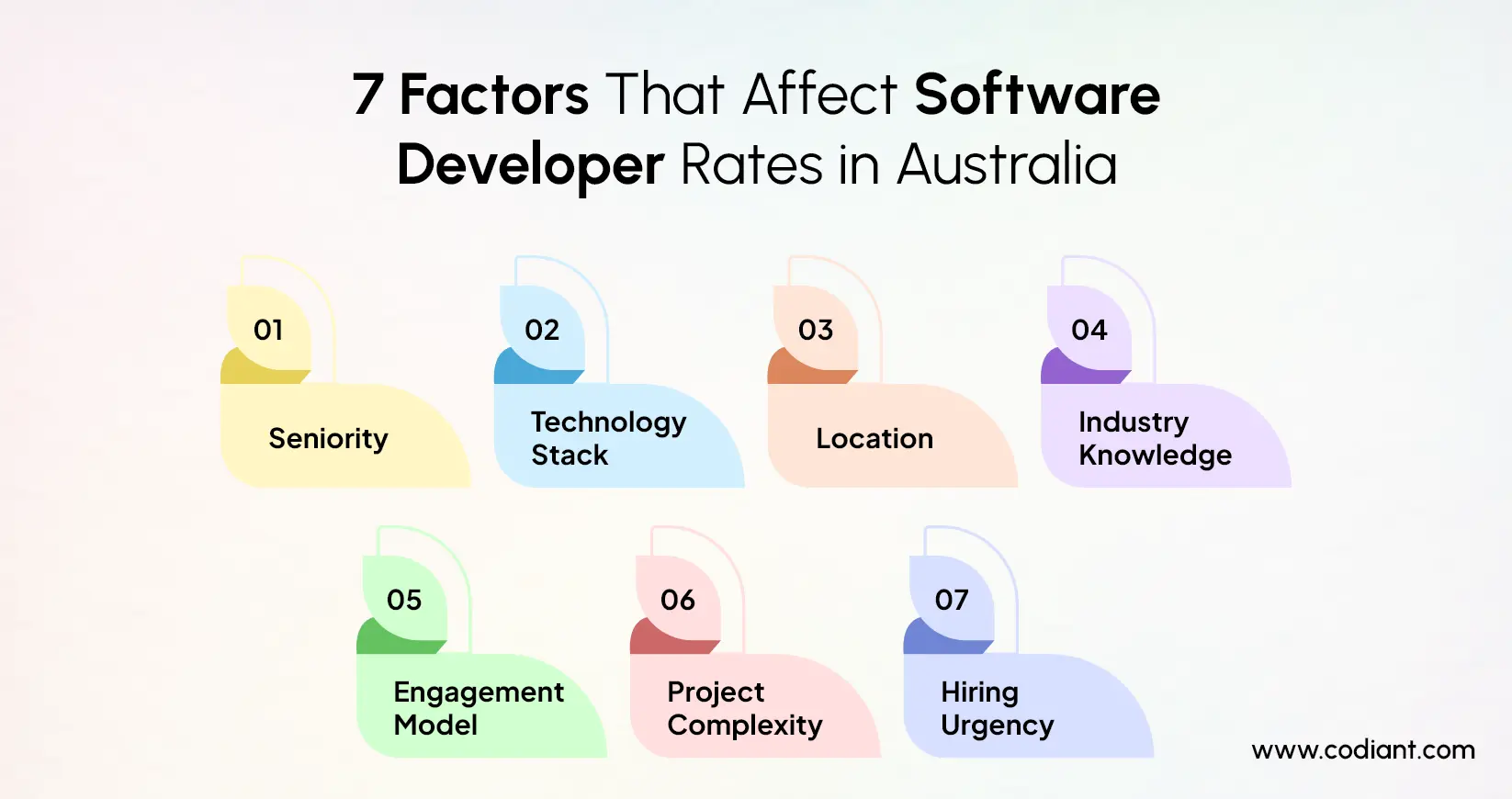
Software developer rates in Australia depend on seven main factors: experience level, technical specialization, location, industry knowledge, engagement model, project complexity, and hiring urgency. Rates are generally higher for senior developers, specialists in AI, cloud, cybersecurity, or data engineering, and professionals working on complex or regulated software products.
The main cost factors include:
1. Seniority
Junior developers generally require more supervision, while senior engineers may independently handle architecture, code quality, security, mentoring, and technical decisions.
2. Technology stack
Skills involving widely available technologies may be easier to source. Specialist expertise in AI, cloud architecture, cybersecurity, data engineering, legacy modernisation, or enterprise platforms may command higher rates. Hays reported that AI, cloud, and cybersecurity capabilities continued to attract premium contractor rates in its FY2025–26 market guide.
3. Location
Salary expectations differ across Sydney, Melbourne, Brisbane, Perth, Canberra, regional markets, and remote roles. Robert Half’s 2026 salary guide reported location-based premiums above its national benchmarks for Sydney, Perth, Melbourne, and Brisbane.
4. Industry knowledge
A developer working on healthcare, banking, insurance, government, education, or other regulated products may need knowledge beyond programming. Domain experience can reduce onboarding time and prevent costly design or compliance errors.
5. Engagement model
A contractor’s apparent hourly rate may be higher than an employee’s salary-equivalent rate because contractors may cover their own leave, insurance, administration, and periods without work. A dedicated team rate may also include project management, quality assurance, infrastructure support, and replacement coverage.
6. Project complexity
Real-time systems, multi-tenant SaaS platforms, AI applications, high-volume marketplaces, financial platforms, and heavily integrated enterprise systems require different levels of engineering expertise.
7. Hiring urgency
Businesses that need developers immediately may pay more for recruitment, contractor availability, or accelerated onboarding.
Which Hiring Model Should a Business Choose?
Businesses should choose permanent employees for ongoing internal development, independent contractors for short-term specialist work, dedicated developers for flexible long-term capacity, project-based outsourcing for clearly defined deliverables, and offshore developers for wider talent access and potential cost efficiency.
The right model depends on the project duration, scope stability, required expertise, budget, and level of internal control.
1. Permanent Employees
Permanent employees are suitable when software development is a continuing business capability. They develop deeper product knowledge and can support long-term architecture, maintenance, and internal collaboration.
However, permanent hiring involves employment obligations, onboarding, equipment, retention, performance management, and continuity planning.
2. Independent Contractors
Contractors are useful for temporary projects, specialist requirements, staff replacement, audits, migrations, or delivery peaks. They can often begin faster than permanent employees.
Businesses must correctly determine whether a worker is genuinely a contractor and whether employment or superannuation obligations apply. Contractors negotiate their own rates and conditions, but Australian government guidance notes that some contractors may still qualify for superannuation.
3. Dedicated Developers
Dedicated developers work for one client or product for an agreed period while remaining employed by a development provider. Businesses can hire dedicated developers when they need consistent external capacity, direct collaboration, and greater flexibility without recruiting every team member as a permanent employee.
Dedicated developers in Australia or overseas can be useful when a business need:
- Long-term development capacity
- A stable external product team
- Faster team expansion
- Specific technical expertise
- Direct participation in agile ceremonies
- Greater flexibility than permanent recruitment
4. Project-Based Outsourcing
Under a project-based model, the software development company accepts responsibility for agreed deliverables, milestones, and outcomes.
This approach works best when the scope can be clearly defined. Businesses that require support across discovery, design, engineering, testing, deployment, and maintenance may work with a custom software development partner instead of hiring each specialist separately.
5. Offshore Software Development
Offshore software developers may provide access to larger talent pools and different commercial rates. Clutch reported that many software development companies listed on its platform charged between USD 24 and USD 49 per hour, although actual rates vary significantly by location, seniority, scope, and provider.
This global benchmark should not be converted into an automatic project estimate. Businesses must compare the complete delivery cost, including project management, communication, quality assurance, rework, security, and knowledge transfer.
How Long Does It Take to Hire Software Developers?
Hiring a permanent software developer in Australia generally takes four to eight weeks from requirement definition to offer acceptance. Senior or specialist roles may take longer, while contractors and dedicated developers from an established software development partner may be available within a shorter period.
| Hiring stage | Typical timeframe | What happens during this stage |
| Requirement definition | 2 to 5 days | The business defines the role, skills, responsibilities, budget, and expected outcomes. |
| Candidate sourcing and screening | 1 to 3 weeks | Recruiters or hiring teams identify, review, and shortlist suitable candidates. |
| Technical assessment | 3 to 7 days | Candidates complete a coding task, system-design discussion, or role-specific evaluation. |
| Final interviews and approval | 3 to 7 days | Technical leaders, managers, and stakeholders assess the shortlisted candidates. |
| Offer negotiation | 2 to 5 days | The business confirms salary, benefits, start date, and employment terms. |
| Notice period and onboarding | 1 to 4 weeks or more | The selected developer completes their notice period and begins onboarding. |
The final timeline depends on talent availability, role complexity, salary competitiveness, location, interview stages, internal approvals, and the selected candidate’s notice period.
Scale Faster with Dedicated Developers Aligned to Your Business Goals
Add experienced developers to your team and accelerate product delivery without expanding permanent internal headcount.
Where Can You Find Software Developers in Australia?
Businesses can find software developers in Australia through local job platforms, professional networks, specialist recruiters, referrals, and software development companies. Jobs and Skills Australia reports that approximately 203,200 software and applications programmers are employed nationally, but availability varies by location, technology, and experience level.
Useful sourcing channels include:
- SEEK and LinkedIn: Suitable for permanent, contract, and remote roles.
- Specialist technology recruiters: Helpful for senior or hard-to-fill positions.
- Employee referrals and developer communities: Useful for reaching candidates who may not be actively applying.
- Universities and graduate programmes: Appropriate for junior development roles.
- Dedicated development partners: Suitable when a business needs a verified team rather than one employee.
- Offshore software companies: Useful for broader talent access and scalable delivery capacity.
Compare candidates or providers using the same criteria, including relevant project experience, technical assessment results, communication, security practices, references, availability, and total engagement cost.
The Indian Developer Hiring Myth, Busted
Myth: Businesses hire Indian developers only to reduce software development costs.
Fact: Cost may influence the decision, but India also provides access to a large and rapidly expanding developer community. GitHub reported that India added more than 5.2 million developers to its platform in 2025, making it the largest source of new GitHub developers that year.
Should Businesses Hire Local or Offshore Developers?
Businesses should hire local developers when they need close collaboration, Australian working hours, local market knowledge, or on-site support. Offshore developers may be more suitable when the business needs faster team expansion, specialist skills, or better cost control.
The right choice depends on the project requirements, budget, security needs, and preferred working model.
| Comparison factor | Local developers | Offshore developers |
| Collaboration | Easier for meetings, workshops, and in-person discussions | Collaboration usually happens through online meetings and project tools |
| Working hours | Work within Australian business hours | May work in different time zones, with agreed overlap hours |
| Local knowledge | Better understanding of Australian users, regulations, and business processes | May require additional guidance on local requirements |
| Talent access | Limited to available local professionals | Provides access to a wider global talent pool |
| Hiring speed | Specialist roles may take longer to fill | Established providers may build teams more quickly |
| Cost | Salaries and contractor rates are generally higher | Commercial rates may be lower, depending on location and expertise |
| Team expansion | Permanent hiring can take time | Teams can often be scaled up or down more easily |
| Communication | Faster communication during local working hours | Requires clear documentation and regular communication |
| Security needs | Suitable when local access or residency is required | Suitable when strong contracts, access controls, and data safeguards are in place |
| Best suited for | Local products, regulated projects, and stakeholder-heavy work | Scalable development, specialist skills, and cost-sensitive projects |
When Should Businesses Use a Hybrid Model?
A hybrid model combines local leadership with offshore development support. The Australian team can manage product strategy, stakeholder communication, architecture, and compliance, while offshore developers handle engineering, testing, maintenance, and release support.
This model can provide local control while giving the business access to a larger and more flexible development team.
What Skills Should Software Developers Have in 2026?
Software developers in 2026 should have strong programming skills, system design knowledge, cloud and database expertise, testing discipline, secure coding awareness, and experience with modern development workflows.
They should also know how to use AI-assisted coding tools responsibly, review generated code, solve business problems, communicate technical decisions, and collaborate effectively with product, design, and engineering teams.
The exact technology stack depends on the product, platform, and project requirements.
Did You Know?
GitHub’s 2025 data showed that TypeScript was the most widely used language by contributors, followed by Python and JavaScript. Python was also commonly used in AI-related projects.
1. Core Technical Skills
Relevant technical skills may include:
- JavaScript and TypeScript
- Python
- Java
- C# and .NET
- PHP
- Kotlin or Swift
- React, Angular, or Vue
- js, Django, Spring, or ASP.NET
- SQL and NoSQL databases
- REST and GraphQL APIs
- Cloud platforms such as AWS, Microsoft Azure, or Google Cloud
- Docker and container orchestration
- CI/CD pipelines
- Automated testing
- Git and code-review workflows
2. Architecture and engineering skills
Strong developers should understand:
- System design
- Scalability
- Database modelling
- API design
- Performance optimisation
- Observability
- Error handling
- Technical documentation
- Refactoring
- Secure coding
- Maintainability
3. AI-assisted development skills
AI coding tools can streamline code completion, documentation, testing, debugging, and code exploration, helping accelerate the software development process. While these tools improve efficiency, organizations that hire AI developers gain the expertise needed to validate AI-generated code, identify security vulnerabilities, address licensing issues, and ensure the final solution is reliable, scalable, and aligned with business objectives.
The ability to produce code with an AI assistant is not sufficient evidence of engineering competence. Businesses should evaluate whether candidates understand why the code works, how it fails, how it should be tested, and how it fits the wider system.
AI product development may also require capabilities beyond conventional application engineering, including data preparation, model development, retrieval systems, cloud infrastructure, evaluation, deployment, and monitoring. Businesses planning an AI-focused product should understand how hiring dedicated AI engineers affects team composition, development capacity, and overall project costs.
4. Communication and business skills
Software developers should be able to:
- Clarify unclear requirements
- Explain technical decisions
- Communicate delivery risks
- Estimate work realistically
- Document important decisions
- Collaborate with designers and product managers
- Participate constructively in code reviews
- Understand the business outcome behind a feature
How Do Businesses Evaluate Developer Expertise?
Businesses should evaluate developer expertise through evidence of relevant work, practical problem-solving, technical communication, code quality, and understanding of production systems.
A useful evaluation scorecard can include:
| Assessment area | What to examine |
| Programming ability | Correctness, readability, maintainability |
| System design | Scalability, trade-offs, failure handling |
| Testing | Unit, integration, and end-to-end approach |
| Security | Authentication, validation, access control |
| Delivery | Estimation, prioritisation, release planning |
| Collaboration | Communication, feedback, documentation |
| Product understanding | Connection between code and user outcomes |
| AI tool usage | Validation, security, and accountability |
Use the same evaluation criteria for comparable candidates. This makes the decision more consistent and reduces reliance on personal impressions.
What Security and Compliance Checks Matter When Hiring Offshore Developers?
Australian businesses hiring offshore developers should check how company data will be accessed, stored, protected and deleted. They should also confirm who owns the code, whether subcontractors are involved, how security incidents will be handled, and whether the arrangement meets Australian privacy requirements.
Before giving an offshore development team access to business, customer or employee data, review:
- What information the developers can access
- Whether access to live systems is necessary
- Where the data will be stored
- How access will be approved, monitored and removed
- Whether the provider uses subcontractors
- How data is encrypted during storage and transfer
- Which secure coding practices the team follows
- How quickly security incidents must be reported
- How data will be returned or deleted after the contract ends
- Which privacy, industry and contractual rules apply
Hiring offshore developers is not automatically a compliance risk. The arrangement can be managed safely when the business limits data access, uses clear contracts, verifies security practices and regularly reviews how information is handled.
What Common Mistakes Should Businesses Avoid?
Businesses should avoid hiring developers without defining the role, choosing candidates only by price, using irrelevant coding tests, and overlooking communication, security, and knowledge-transfer requirements. These mistakes can lead to unsuitable hires, delivery delays, unstable software, repeated rework, and higher long-term development costs.
1. Hiring Before Defining the Requirement
An unclear role attracts unsuitable candidates and makes technical evaluation inconsistent. Businesses should define the product objective, responsibilities, required skills, expected outcomes, and engagement duration before beginning the search.
2. Selecting Only on Hourly Rate
The lowest rate may create higher total costs if the developer requires extensive supervision, produces unstable code, misses deadlines, or causes repeated rework. Businesses should compare experience, productivity, quality, and total delivery cost rather than hourly rates alone.
3. Using Generic Coding Tests
An assessment that does not reflect the actual role may reject capable developers or favour candidates trained specifically for interview puzzles. Technical assessments should evaluate the skills and problems the developer will handle in the project.
4. Ignoring Communication Skills
Distributed software development depends on clear written communication, accurate documentation, expectation management, and early escalation of risks. Technical expertise alone may not be enough when a developer cannot communicate decisions or delivery challenges effectively.
5. Overloading One Developer
A single full-stack developer may not replace the combined expertise of software architects, UI/UX designers, quality assurance engineers, DevOps professionals, security specialists, and product managers. The required team structure should match the product’s complexity.
6. Skipping Reference Checks
Claims about previous projects, team size, technical responsibilities, security certifications, and client results should be verified. Reference checks help businesses confirm whether the candidate or development partner has delivered similar work successfully.
7. Failing to Plan Knowledge Transfer
Businesses should retain access to source-code repositories, documentation, infrastructure, credentials, deployment processes, and architectural decisions throughout the engagement. A clear knowledge-transfer plan reduces dependence on one developer or external provider.
Software Developer Hiring Checklist
A software developer hiring checklist should confirm that the role, budget, assessment process, legal terms, security requirements, and onboarding plan are clearly defined before an offer or contract is issued. Reviewing these areas helps businesses reduce hiring risks and establish clear expectations for both internal and external developers.
Before signing an agreement or issuing an employment offer, confirm that:
- The business objective is documented.
- The developer’s responsibilities are clearly defined.
- The role has measurable outcomes.
- The required technical and industry skills are identified.
- The engagement model matches the business requirement.
- The salary or commercial rate has been benchmarked.
- Superannuation and employment obligations have been reviewed.
- The candidate has completed a role-relevant assessment.
- References or relevant case studies have been verified.
- Intellectual-property ownership is documented.
- Confidentiality obligations are included.
- Data-access requirements are defined.
- Security expectations are included in the contract.
- Subcontracting rules are clear.
- Onboarding responsibilities are assigned.
- Code repositories and documentation remain accessible.
- Knowledge-transfer and exit procedures are agreed.
Why Hire Software Developers from Codiant?
Businesses that need faster access to skilled software developers in Australia can hire dedicated developers from Codiant without going through a long recruitment cycle. Codiant helps Australian businesses hire pre-vetted software developers across web, mobile, cloud, AI, backend, frontend, QA, DevOps, and full-stack development needs. Instead of spending weeks sourcing, screening, assessing, and onboarding candidates, businesses can access ready-to-start developers aligned with their technology stack, project scope, and delivery model.
With Codiant, businesses can:
- Hire software developers within 24 hours
- Start with a 7-day free trial
- Scale developers up or down based on project needs
- Choose flexible engagement models
- Work with experienced developers across modern technologies
- Get support for onboarding, replacement, delivery coordination, and team scaling
- Reduce hiring delays without compromising technical quality
This model is especially useful for startups, product companies, agencies, and enterprises that need reliable development capacity without the time, cost, and risk of traditional recruitment.
Conclusion
To hire software developers in Australia successfully in 2026, businesses should begin with the product requirement rather than a generic list of technologies. The next step is to choose the right engagement model, establish a realistic budget, evaluate candidates through practical evidence, and define security, intellectual-property, and delivery responsibilities in writing.
Permanent employees provide long-term continuity. Contractors offer temporary flexibility. Dedicated developers support ongoing capacity, while offshore software development can provide broader talent access and alternative cost structures.
The best choice is not automatically the cheapest or most local option. It is the model that gives the business the required expertise, reliable communication, appropriate control, and sustainable delivery cost.
Build Your Development Team Faster with Codiant
Hire skilled software developers for your Australian project with flexible engagement, quick onboarding, and a 7-day free trial.
The Author

Frequently Asked Questions
Hiring costs are affected by experience, technology stack, role complexity, location, industry knowledge, project duration, engagement model, and urgency. Specialist knowledge involving AI, cybersecurity, cloud infrastructure, architecture, or regulated systems may increase the required salary or commercial rate.
Businesses should combine portfolio review, practical technical assessment, system-design discussion, references, and structured interviews. The evaluation should examine code quality, testing, security, communication, product understanding, and the candidate’s individual contribution to previous projects.
Businesses can hire permanent employees, fixed-term staff, independent contractors, freelancers, remote developers, dedicated developers, offshore teams, or project-based software development companies. Each model offers a different balance of control, flexibility, cost, and delivery responsibility.
Startups can control hiring costs by defining a focused MVP, prioritising essential roles, using existing cloud services, avoiding unnecessary technical complexity, and selecting a flexible engagement model. A senior technical lead supported by a smaller delivery team may be more effective than hiring several junior developers without adequate supervision.
Dedicated developers provide consistent capacity, direct collaboration, continuity, and greater flexibility than repeatedly hiring short-term freelancers. The model can help a business expand its team without directly managing every employment, recruitment, and replacement responsibility.
Featured Blogs
Read our thoughts and insights on the latest tech and business trends

AI Developer Engagement Models Explained: How to Choose the Right AI Team
- August 27, 2026
- Artificial Intelligence
AI developer engagement model means deciding how external AI specialists will be assigned, managed, paid and held accountable. The main options are dedicated AI developers, AI team augmentation, time-and-material delivery, fixed-price projects and end-to-end AI... Read more

Enterprise Mobile App Development: How It Can Accelerate Your Business Growth
- August 21, 2026
- Mobile App Development
Enterprise mobile app development can accelerate growth by improving three measurable areas: workflow speed, access to business systems, and customer or employee service delivery. This matters to mid-market and enterprise leaders managing distributed teams, manual... Read more

React vs Angular vs Vue: Which Should You Choose in 2026?
- August 14, 2026
- Technology
For most web products in 2026, choose React for ecosystem flexibility and broad hiring reach, Angular for standardised enterprise architecture and complex workflows, and Vue for simpler adoption and faster team onboarding. For CTOs, product... Read more