How AI Startups Can Claim R&D Tax Credits in 2026?
Table of Contents
Subscribe To Our Newsletter

Summarize with AI
Not enough time? get the key points instantly.
In a Nutshell
- The R&D tax credit allows AI startups to recover a portion of their innovation costs.
- Through R&D credits, startups can recover up to $500K per year against payroll taxes.
- You can typically claim 6% to 10% of qualified R&D expenses.
- Even if your startup is not profitable, you can offset payroll taxes.
- Activities like model development, algorithm tuning, and experimentation often qualify.
- Failed experiments still count as eligible R&D work.
- Eligible expenses include engineering salaries, cloud costs, and contractor fees.
- You can claim credits retroactively for up to 3 years.
- State-level credits can be combined with federal credits for higher savings.
- Proper documentation and tracking are critical for successful claims.
- Most AI startups miss out simply due to lack of awareness or structure.
Building an AI startup isn’t cheap. Between hiring data scientists, training models, and experimenting with infrastructure, costs pile up fast. And here’s the reality most of that spending happens long before revenue even begins.
But what if a portion of those costs could come back to you?
That’s exactly what the R&D tax credit is designed to do. It rewards companies for investing in innovation even if the outcome isn’t successful. Yet, many AI startups either don’t know about it or assume they don’t qualify.
This guide explains everything in a clear, straightforward way no complicated terminology or unnecessary detail. Just the essentials AI founders need to understand how their development efforts can translate into real financial returns.
What Is the R&D Tax Credit?
The R&D tax credit is a government incentive that allows businesses to reduce their tax liability based on qualified research and development activities.
In simple terms:
If you’re building, testing, or improving technology you could get money back.
There are two key types:
- Federal R&D Tax Credit – Available across the U.S.
- State R&D Tax Credits – Offered by many individual states
For AI startups, this means activities like building machine learning models, optimizing algorithms, or experimenting with data pipelines can potentially qualify.
Build Smarter AI While Reducing Development Costs Strategically
Align AI strategy with tax incentives to boost start-up growth.
How the R&D Tax Credit Evolved Over Time?
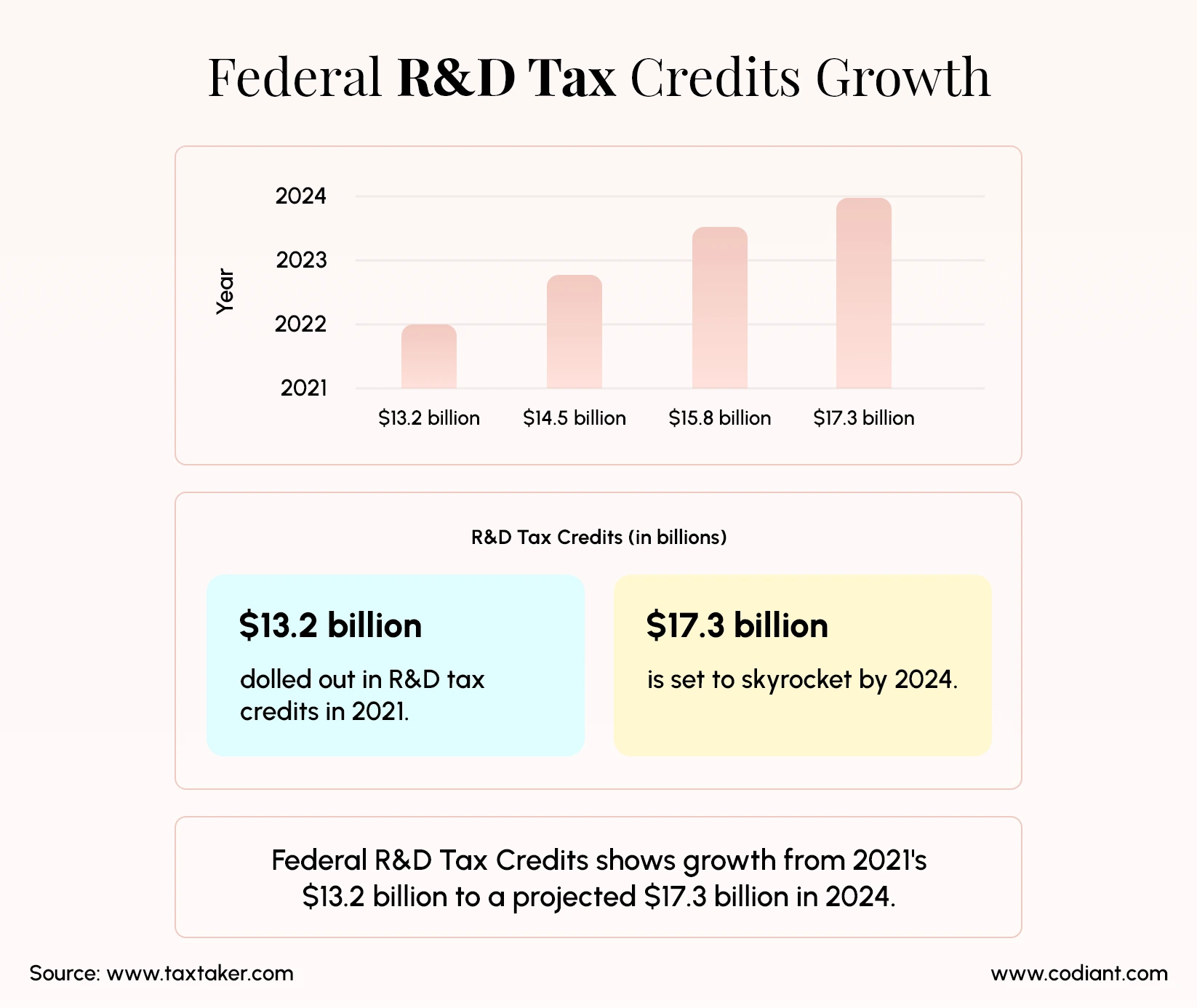
The R&D tax credit was introduced in 1981 to encourage U.S. businesses to invest more in innovation, research, and technology development. What began as a short-term incentive was extended repeatedly over the years before becoming a permanent part of the tax code in 2015, giving companies long-term confidence to invest in R&D.
Key developments that shaped the credit include:
- 1981- Introduced under the Economic Recovery Tax Act.
- 2015- Made permanent through the PATH Act; startups allowed to offset payroll taxes.
- 2023- Expanded to cover both Social Security and Medicare payroll taxes, increasing the cap to $500,000.
- Broader inclusion of software, digital, and emerging technologies.
Today, the R&D tax credit has grown into a multi-billion-dollar incentive, with annual claims projected to exceed $17 billion yet many AI startups still overlook its full potential.
Why the R&D Tax Credit Matters for AI Startups?
AI startups operate in a high-risk, high-investment environment. You’re constantly experimenting, iterating, and refining systems that may or may not work.
That’s exactly the kind of work the R&D tax credit rewards.
Key Benefits for AI Startups
- Reduces tax liability – Direct savings that lower overall business tax burden.
- Offsets payroll taxes – Claim credits even before startup becomes profitable.
- Extends runway – More capital available to fuel growth and scaling.
- Rewards experimentation – Even failed experiments qualify as eligible research activities.
- Supports continuous innovation – Encourages ongoing improvements in models and AI systems.
- Improves cash flow predictability – Provides consistent financial relief during uncertain growth stages.
- Makes hiring more sustainable – Offsets costs of hiring expensive AI and data talent.
- Strengthens investor confidence – Signals efficient capital usage and stronger financial discipline
For early-stage founders, this can mean the difference between scaling faster or running out of resources.
💡 Did You Know?
AI startups can claim R&D tax credits for up to 3 previous years.
So, if your start-up has been building, experimenting, and scaling AI products without filing there’s still untapped money waiting to be recovered.
How Much Can AI Startups Save?
The exact savings from the R&D tax credit depend on how much your startup spends on qualifying activities. However, most AI startups typically recover-
6% to 10% of their qualified R&D expenses.
This includes costs related to engineering salaries, model experimentation, cloud infrastructure, and technical development.
What makes this powerful is that these are expenses you’re already incurring the credit simply helps you recover a portion of that investment.
Example Savings Scenarios
To understand the real impact, here’s how it plays out across different startup stages:
| Startup Stage | Annual R&D Spend | Estimated Credit (6–10%) | Impact |
| Early-Stage Startup | $500,000 | $30,000 – $50,000 | Covers hiring costs for 1–2 months or cloud expenses |
| Growth-Stage AI Company | $2,000,000 | $120,000 – $200,000 | Funds additional engineers or accelerates product development |
| Scaling AI Team | $5M+ | $300,000 – $500,000+ | Supports expansion, infra scaling, and market growth |
Why This Matters for AI Startups?
AI development is capital-intensive by nature. Training models, running experiments, and iterating on performance require continuous investment.
The R&D tax credit helps you:
- Recover a portion of high experimentation costs
- Reduce burn rate without cutting innovation
- Reinvest into product, hiring, or infrastructure
- Extend your runway without raising additional capital
And here’s the key insight:
Even failed experiments count.
Unlike traditional ROI, where only successful outcomes matter, the R&D credit rewards the process of innovation itself.
The Bigger Picture
That $50K or $200K might not seem massive at first glance but for a startup-
- It could fund an additional ML engineer
- Cover months of cloud compute costs
- Or support faster iteration cycles
In a competitive AI world, that extra capital can directly translate into speed, efficiency, and better product-market fit.
What Activities Qualify for R&D Tax Credit in AI?
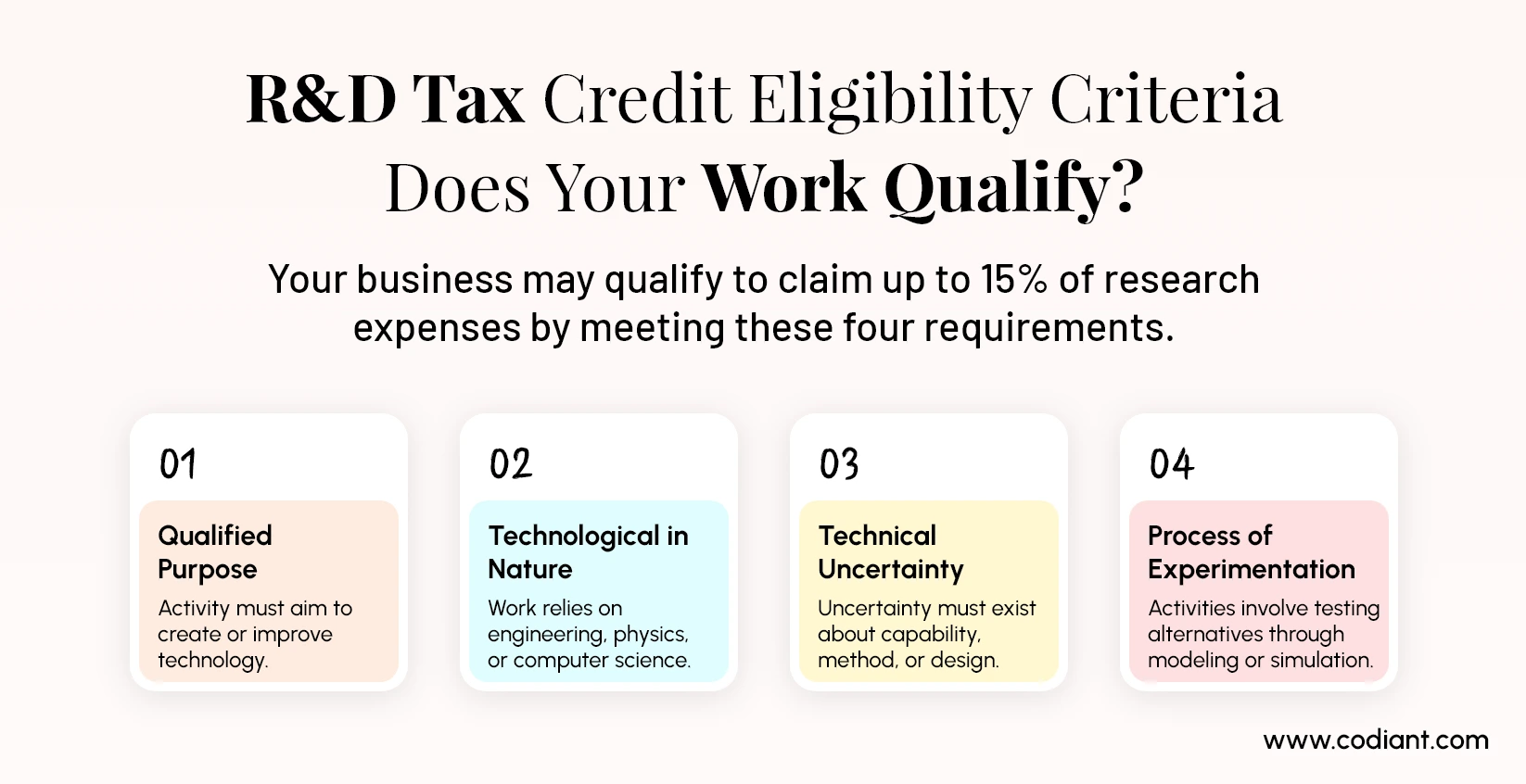
To be eligible, your work must meet the IRS’s four-part qualification criteria focused on innovation, technical complexity, uncertainty, and structured experimentation.
1. Developing or Improving a Product or Process
Your work should focus on creating new AI solutions or significantly enhancing existing software, systems, or processes to deliver improved functionality or performance.
2. Applying Technical or Scientific Principles
The activity must rely on core technical disciplines like computer science, engineering, or data science, involving systematic problem-solving rather than routine or non-technical tasks.
3. Addressing Technical Uncertainty
Your team should be solving challenges where the outcome, method, or feasibility is not known in advance, requiring exploration, analysis, and decision-making.
4. Following an Experimental Development Process
The work must involve testing different approaches, refining models, analyzing results, and iterating continuously to achieve the desired technical outcome or performance improvement.
AI-Specific Activities That Qualify
This is where things get interesting. AI startups often qualify more than they realize.
Common Qualifying Activities
- Developing machine learning models
- Training and fine-tuning algorithms
- Building data pipelines and ETL systems
- Experimenting with NLP or computer vision models
- Improving model accuracy and performance
- Testing different architectures or frameworks
Even if a model fails or doesn’t reach production it can still qualify.
Examples of Qualifying vs Non-Qualifying Activities
✅ Qualifying Activities
- Designing a recommendation engine
- Testing multiple ML models for accuracy
- Optimizing AI inference speed
- Building proprietary algorithms
❌ Non-Qualifying Activities
- Routine data entry
- UI/UX design without technical innovation
- Basic software maintenance
- Using pre-built AI tools without modification
Quick Comparison Table
| Category | Qualifying Activities | Non-Qualifying Activities |
| Development Work | Building custom ML models, algorithms | Using pre-built tools without modification |
| Experimentation | Testing multiple approaches, model tuning | Routine execution without testing variations |
| Technical Complexity | Solving performance or scalability challenges | Basic maintenance or bug fixes |
| Innovation Level | Creating new capabilities or improving existing ones | Repetitive or standard operational tasks |
| Outcome Requirement | Iterative learning (even failed attempts qualify) | No experimentation or learning involved |
Common Misconceptions Among Founders
Let’s clear a few things up.
- “We’re not profitable, so we can’t claim it”
You can offset payroll taxes instead. - “Only big companies qualify”
Startups benefit the most. - “Our work isn’t innovative enough”
If you’re solving technical challenges, it likely qualifies. - “We just use AI tools”
Using tools doesn’t count, but building or improving systems does.
What Expenses Can Be Claimed?
This is where the actual savings come from.
Eligible Expenses Include:
- Salaries of developers, engineers, data scientists
- Cloud computing costs (AWS, GCP, Azure)
- Contractor and consultant fees
- Prototyping and testing expenses
For AI startups heavily investing in cloud infrastructure, this becomes a major advantage.
AI Activities That Qualify for R&D Tax Credits
This is where things get interesting. AI startups often qualify more than they realize.
Common Qualifying Activities
- Developing machine learning models
Creating custom machine learning development models from scratch to solve business problems using structured or unstructured datasets effectively. - Training and fine-tuning algorithms
Training models with datasets and continuously fine-tuning parameters to improve accuracy, efficiency, and real-world performance outcomes. - Building data pipelines and ETL systems
Designing scalable data pipelines and ETL processes to collect, clean, transform, and prepare data for machine learning workflows. - Experimenting with NLP or computer vision models
Testing various NLP or computer vision techniques to improve understanding, classification, detection, or prediction capabilities in applications. - Improving model accuracy and performance
Iterating on models to enhance prediction accuracy, reduce latency, optimize resource usage, and improve overall system reliability. - Testing different architectures or frameworks
Evaluating multiple model architectures, frameworks, or tools to identify the most efficient and scalable solution for specific AI use cases.
Even if a model fails or doesn’t reach production, it can still qualify.
Do AI Token and API Costs Qualify for R&D Tax Credit?
With the rise of generative AI development solutions, token usage has become a significant expense for startups. However, when it comes to R&D tax credits, eligibility depends on how those tokens are used, not simply on the volume of usage.
When Token Costs May Qualify?
Token and API expenses can be included in your R&D claim if they are directly tied to technical experimentation and development work.
Common qualifying scenarios include:
- Testing and refining prompts to improve model outputs
- Evaluating LLM responses for accuracy, quality, and performance
- Running experiments to optimize latency, cost, or system efficiency
- Building and testing new AI features with uncertain outcomes
- Iterating on embeddings, retrieval systems, or fine-tuning workflows
In these cases, token usage is part of active R&D not just consumption.
When Token Costs Typically Do Not Qualify?
Costs tied to routine or production usage are generally excluded.
Non-qualifying scenarios include:
- Customer-facing AI features running at scale
- Automated content generation without testing or iteration
- Standard product operations using pre-trained models
- Reselling AI outputs or services
If there’s no experimentation or technical uncertainty, it likely doesn’t qualify.
What You Need to Document?
To support your claim, maintain clear records that connect token usage to R&D work:
- Project objectives and technical challenges
- Experiments conducted and iterations performed
- Team members involved and time allocation
- Token usage mapped to development or testing tasks
- Outcomes, including failed experiments
Practical Tax Point (Often Overlooked)
For U.S.-based startups, this becomes even more valuable.
- Qualified small businesses can use the R&D tax credit to offset payroll taxes
- Some guidance suggests startups can claim up to $500,000 per year through this route
This means even pre-revenue AI startups can benefit from token-related R&D spend.
If your company operates outside the U.S. (for example, in India), the treatment of such expenses differs. You’ll need to evaluate eligibility based on local tax regulations and incentives.
Your AI Development Costs Can Actually Pay Back
Turn engineering efforts into financial returns with strategic R&D planning.
How to Claim the R&D Tax Credit?
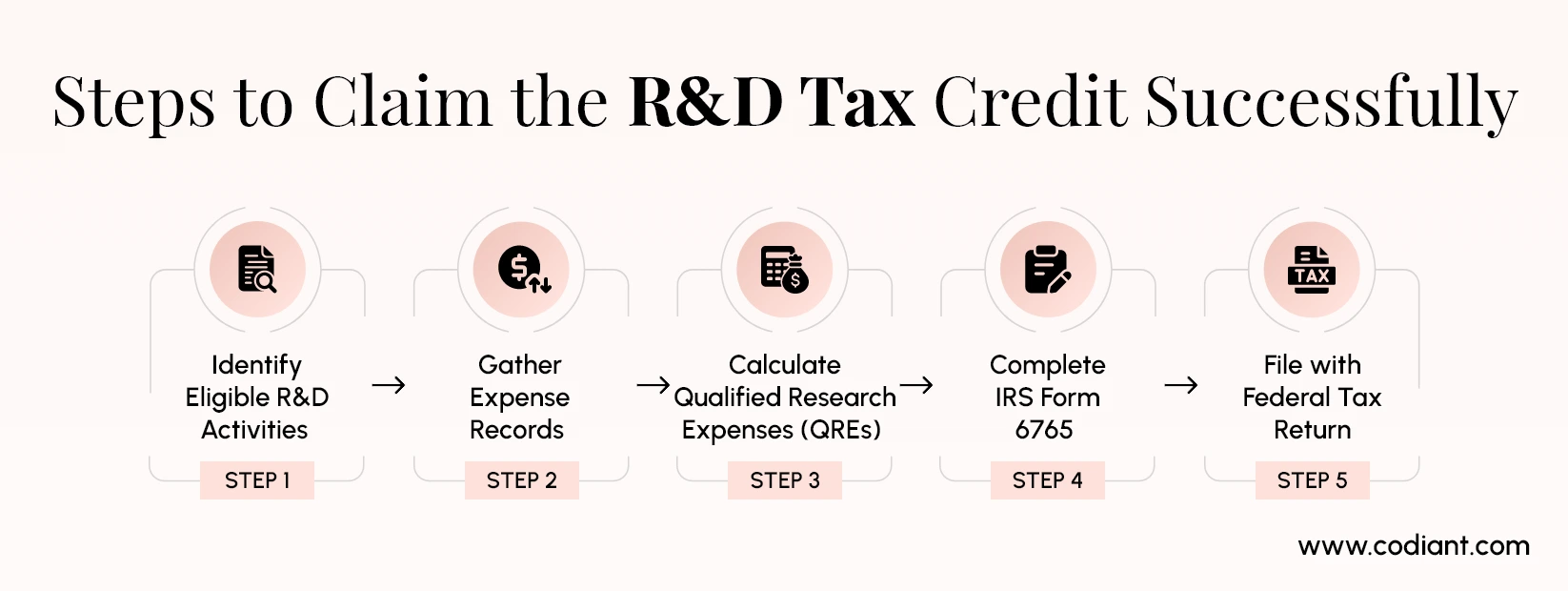
Here’s a simplified step-by-step process to claim the R&D tax credit while ensuring compliance with IRS guidelines and documentation requirements.
1. Identify Eligible R&D Activities
Review engineering, product, and data science workflows to identify activities meeting IRS four-part test, including experimentation, uncertainty, and technological development.
2. Collect Documentation and Expense Records
Gather technical documents, code repositories, project notes, payroll data, contractor invoices, and cloud usage reports to substantiate qualified research activities.
3. Calculate Qualified Research Expenses (QREs)
Determine eligible costs including employee wages, contractor payments, and cloud infrastructure expenses directly associated with qualified R&D activities and experimentation.
4. Complete IRS Form 6765 Accurately
Fill out Form 6765, selecting appropriate calculation method, reporting QREs, and ensuring consistency with financial statements and supporting documentation records.
5. File with Your Federal Tax Return
Submit the completed credit form along with your federal income tax return, ensuring deadlines, accuracy, and proper alignment with financial disclosures.
Startups can also apply the credit against payroll taxes (up to $250,000 annually) under Section 41, making it accessible even without profitability.
Documentation Requirements (Critical Step)
This is where many startups struggle.
You need to maintain:
- Technical documentation (code, experiments, iterations)
- Time tracking for R&D activities
- Financial records and expense breakdowns
- Testing and validation reports
The more structured your documentation, the smoother the claim process.
State-Level R&D Tax Credits
In addition to federal benefits, many U.S. states offer their own R&D tax credits to further encourage innovation.
These credits can be claimed alongside federal incentives, helping AI startups unlock even greater financial value from their development efforts.
While eligibility rules and credit percentages vary by state, they often reward similar activities like software development, machine learning experimentation, and technical problem-solving.
Some key advantages include:
- Refundable credits – Receive cash benefits even with low tax liability
- Carryforward benefits – Use unused credits in future tax years
- Stackable savings – Combine state and federal credits for higher returns
For AI startups operating across multiple states, this can significantly amplify total savings and improve overall capital efficiency.
Challenges AI Startups Face in Claiming Credits
Despite the benefits, many startups miss out.
Common challenges:
- Lack of awareness
- Poor documentation practices
- Confusion around eligibility
- Underestimating qualifying activities
The biggest issue? Most founders don’t realize they qualify until it’s too late.
Best Practices to Maximize Your R&D Tax Credit
Want to get the most out of it? Start early and build the right systems from day one.
- Track R&D work in real-time
- Align engineering and finance teams
- Document experiments consistently
- Work with experienced tax advisors
- Break down projects into clearly defined R&D activities
- Maintain detailed time allocation for technical team members
- Capture failed experiments and iterations, not just successful outcomes
- Tag cloud and infrastructure costs linked directly to R&D efforts
- Review eligibility quarterly instead of waiting until year-end
- Stay updated with changing IRS guidelines and compliance rules
- Standardize internal processes for documentation and reporting
- Leverage tools or platforms that automate R&D tracking
Treat R&D credits as part of your financial strategy, not an afterthought.
Real-World Use Case- AI Startup Claiming R&D Credits
An early-stage AI startup building a recommendation engine spent over $800K on model development, data engineering, and experimentation.
Initially, they assumed they didn’t qualify.
After proper evaluation:
- Identified qualifying activities
- Documented engineering work
- Filed for R&D credits
Outcome:
- ~$70K tax credit secured
- Extended runway by 3+ months
- Reinvested into hiring and product scaling
That’s the real impact not just savings, but growth acceleration.
Future of R&D Tax Credits for AI Companies
AI is rapidly becoming a priority sector globally.
Governments are:
- Increasing incentives for AI innovation
- Supporting deep tech development
- Encouraging domestic technological advancement
For startups, this means one thing-
More opportunities to benefit from R&D incentives
Conclusion- Turning Innovation Into Financial Advantage
AI startups are built on experimentation. Trial, error, iteration that’s the process. The R&D tax credit recognizes that effort and rewards it.
If you’re building AI systems, training models, or solving technical challenges you’re already doing the hard part. Now it’s about making sure you don’t leave money on the table.
Transform AI Development into A Strategic Financial Growth Lever
Use expert consulting to unlock credits and accelerate innovation cycles.
The Author

Frequently Asked Questions
Work like building machine learning models, improving algorithms, testing different approaches, and solving technical problems usually qualifies as R&D activities.
Yes, startups without profit can still claim credits by offsetting payroll taxes, helping reduce costs even during early growth stages.
Most AI startups can claim around 6 to 10 percent of their eligible R&D expenses, depending on activities and documentation.
Yes, cloud costs like AWS or Google Cloud qualify if used for training models, testing systems, or running R&D-related experiments.
It usually takes a few months after filing taxes to receive the credit, depending on processing time and claim accuracy.
Featured Blogs
Read our thoughts and insights on the latest tech and business trends

Enterprise Mobile App Development: How It Can Accelerate Your Business Growth
- August 21, 2026
- Mobile App Development
Enterprise mobile app development can accelerate growth by improving three measurable areas: workflow speed, access to business systems, and customer or employee service delivery. This matters to mid-market and enterprise leaders managing distributed teams, manual... Read more

React vs Angular vs Vue: Which Should You Choose in 2026?
- August 14, 2026
- Technology
For most web products in 2026, choose React for ecosystem flexibility and broad hiring reach, Angular for standardised enterprise architecture and complex workflows, and Vue for simpler adoption and faster team onboarding. For CTOs, product... Read more

AI Agents vs RPA: What’s the Difference and When Should You Use Each?
- August 12, 2026
- Artificial Intelligence
AI agents and Robotic Process Automation (RPA) differ in three main areas: how they make decisions, the data they can process, and how they respond when a workflow change. RPA follows predefined rules to complete... Read more