How to Build a Remote Development Team That Actually Delivers Results?
Table of Contents
Subscribe To Our Newsletter

Summarize with AI
Not enough time? get the key points instantly.
In a Nutshell
- Remote teams give access to global talent and faster scaling.
- Structure matters more than location in remote teams.
- Clear goals define successful remote development outcomes.
- Hiring ownership-driven developers improves long-term productivity.
- Communication systems are critical for remote team success.
- Tools ensure visibility, collaboration and accountability across teams.
- Processes create consistency and reduce execution confusion.
- Focus on outcomes instead of tracking working hours.
- Trust and autonomy drive better performance in remote teams.
- Scaling requires systems, leadership and structured onboarding.
Remote work is no longer a trend. It’s how modern tech teams are built.
From startups to enterprises, companies are shifting toward a remote software development team model to access global talent, reduce costs and scale faster. But here’s the reality most blogs won’t tell you.
Just hiring remote developers doesn’t guarantee results.
Many remote teams fail because of poor structure, weak communication and unclear ownership. So the real question isn’t whether you should go remote.
It’s how to build a remote development team that actually delivers outcomes, not excuses. Let’s break it down.
Why Businesses Are Moving to Remote Development Teams?
Building a remote engineering team gives you access to talent beyond geographic limits. Instead of competing locally, you’re hiring globally.
Here’s why companies prefer this model:
- Access to top-tier developers worldwide
- Faster hiring compared to local recruitment
- Reduced infrastructure and operational costs
- Ability to scale teams quickly
- 24/7 productivity across time zones
But while the advantages are clear, execution is where most businesses struggle.
Build a Remote Team That Actually Performs
Stop struggling with hiring delays and inconsistent output. Build a structured, high-performing remote team that delivers real business results.
Steps to Build a High-Performing Remote Development Team
Building a successful remote team requires clear planning, structured execution, and the right systems to ensure consistent performance, collaboration & measurable outcomes.
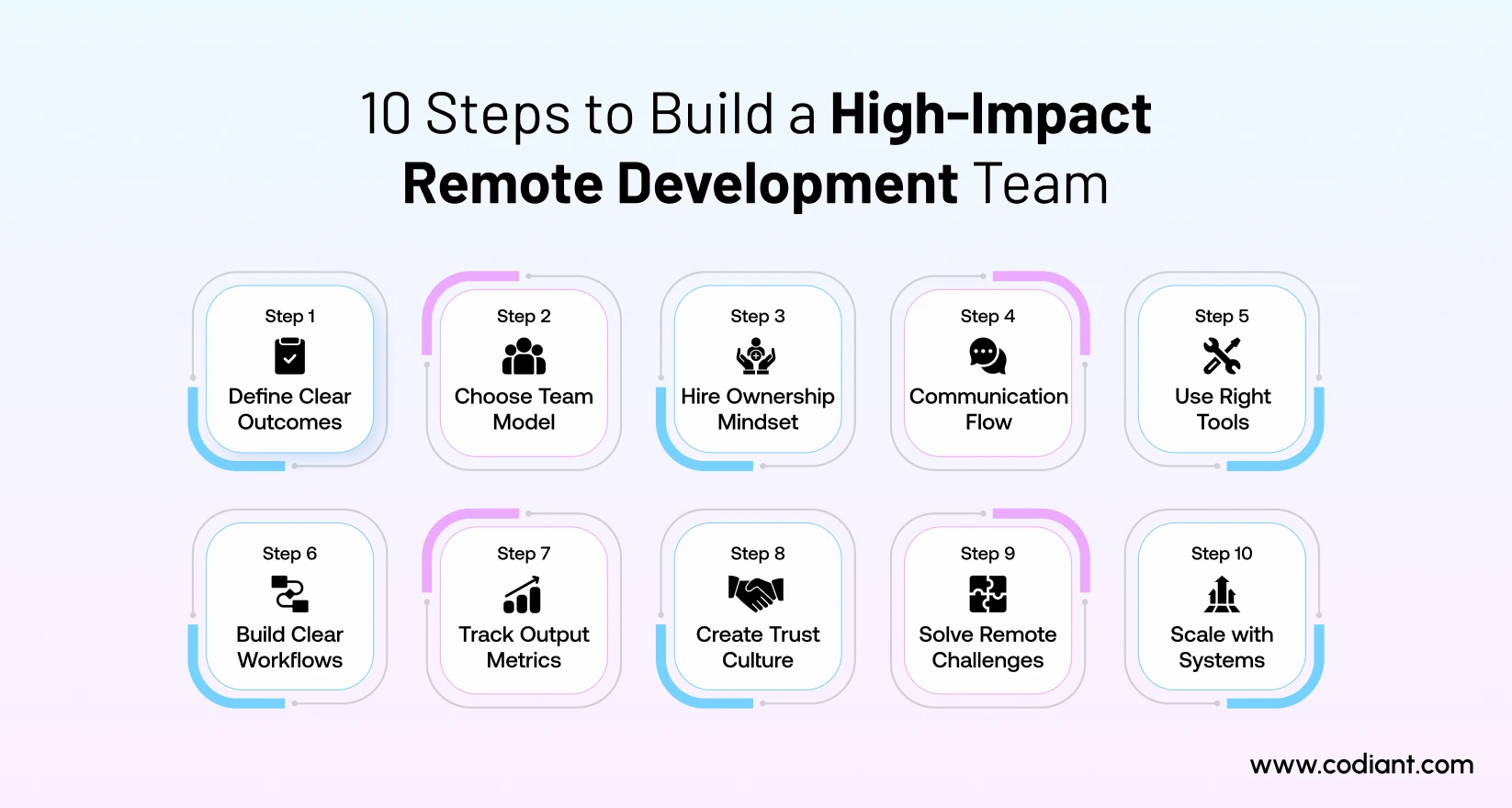
Step 1- Define Clear Goals Before You Hire
Before you even think about how to hire remote developers, you need clarity.
Ask yourself:
- What are you building?
- What skills are required?
- What timeline are you targeting?
- What outcomes define success?
Many companies rush into hiring without defining expectations. That leads to delays, rework & frustration.
A remote team works best when goals are crystal clear from day one.
Step 2- Choose the Right Remote Team Structure
There is no one-size-fits-all approach when it comes to offshore development team setup.
You need to choose a structure that aligns with your business needs:
- Dedicated Remote Team
A full team working exclusively on your project. Best for long-term development.
- Staff Augmentation
Hire specific developers to extend your in-house team.
- Project-Based Team
Outsource the entire project with defined deliverables.
Each model impacts how you manage remote developers and how accountability is maintained.
Step 3- Hire for Skills + Ownership (Not Just Talent)
Technical skills matter. But in a remote engineering team, mindset matters more.
When you build a remote development team, look for developers who:
- Communicate clearly
- Take ownership of tasks
- Work independently without constant supervision
- Are proactive problem solvers
Because remote environments don’t allow micromanagement.
The best remote developers act like owners, not employees.
Step 4- Build a Strong Communication System
Communication is the backbone of any remote software development team.
Without it, even the best developers fail.
Here’s what works:
- Daily stand-ups (async or live)
- Weekly sprint reviews
- Clear documentation for every task
- Defined communication channels
Also, separate communication types:
Clarity in communication directly impacts productivity.
Step 5- Use the Right Remote Team Management Tools
To successfully manage remote developers, tools are non-negotiable.
Here are essential remote team management tools:
1. Project Management
- Jira
- Trello
- ClickUp
2. Communication
- Slack
- Microsoft Teams
3. Code Collaboration
- GitHub
- GitLab
- Bitbucket
4. Documentation
- Notion
- Confluence
5. Time Tracking & Productivity
- Hubstaff
- Time Doctor
These tools help you track work, maintain visibility & ensure accountability.
Related reading: Build In-House vs Hire a Development Agency: Real Cost Comparison
Step 6- Set Clear Processes and Workflows
Remote teams fail when processes are unclear.
To ensure smooth execution:
- Define development workflows (Agile/Scrum)
- Set sprint cycles
- Create clear task ownership
- Maintain proper documentation
A structured workflow ensures your remote team productivity doesn’t depend on individuals it depends on systems.
Step 7- Focus on Output, Not Activity
One of the biggest mistakes companies make is tracking hours instead of results.
Instead of asking-
“How many hours did you work?”
Ask-
“What did you deliver?”
To ensure productivity in a remote development team:
- Define KPIs (deliverables, quality, timelines)
- Track sprint completion rates
- Measure code quality and performance
Productivity in remote teams is about outcomes, not online presence.
Step 8- Create a Culture of Ownership and Trust
Remote teams cannot function without trust.
Micromanagement kills productivity.
Instead:
- Give autonomy to developers
- Encourage accountability
- Recognize contributions
- Build transparency
When people feel trusted, they perform better.
This is what separates average teams from high-performing distributed development teams.
Step 9- Overcome Common Remote Team Challenges
Every remote team faces challenges.
The difference is how you handle them.
Common Challenges:
- Communication gaps
- Time zone differences
- Lack of team bonding
- Misaligned expectations
- Productivity tracking issues
How to Solve Them:
- Use async communication effectively
- Overlap working hours for collaboration
- Conduct regular team check-ins
- Maintain clear documentation
- Use performance dashboards
Challenges are normal. Poor systems are the real problem.
Step 10- Scale Your Remote Team the Right Way
Once your initial team is stable, you can start scaling remote teams.
But scaling requires structure.
To scale effectively:
- Standardize onboarding processes
- Create reusable documentation
- Build team hierarchies (Tech Lead, Manager, etc.)
- Use performance tracking systems
Scaling without systems leads to chaos, while with structure it leads to growth.
Scale Your Remote Engineering Team Faster
Looking to scale without compromising quality or speed? Build a remote team that grows with your business, not against it.
What a High-Performing Remote Development Team Looks Like?
A successful distributed development team is not just a group of people working from different locations. It’s a well-structured system designed to deliver consistent, high-quality outcomes.
The difference between an average remote team and a high-performing one lies in how clearly everything is defined and executed.
A team that actually delivers results has:
- Clearly defined roles and responsibilities: Every team member knows exactly what they own. There’s no confusion, no overlap & no dependency bottlenecks slowing down progress.
- Strong technical leadership: A capable tech lead or engineering manager ensures direction, code quality & decision-making stay aligned with business goals.
- Transparent communication processes: Communication is not random. It’s structured, documented & accessible to everyone, reducing misunderstandings and delays.
- Well-documented workflows: From onboarding to deployment, everything is documented. This makes scaling easier and ensures continuity even when team members change.
- Measurable performance metrics: Teams don’t rely on assumptions. They track sprint velocity, delivery timelines & output quality to ensure accountability.
When these elements are missing, remote teams often struggle with delays, confusion, and inconsistent results. But when they are in place, remote teams can outperform traditional in-house teams in both speed and efficiency.
Best Remote Team Productivity Tips That Actually Work
Productivity in a remote software development team doesn’t happen automatically. It needs to be intentionally designed.
Most teams lose productivity not because of lack of effort, but because of poor systems, unnecessary meetings & communication overload.
Here are practical, proven remote team productivity tips that actually make a difference:
- Keep meetings short and focused: Long meetings drain energy and reduce productivity. Stick to clear agendas and avoid discussions that can be handled asynchronously.
- Avoid unnecessary communication overload: Too many messages, channels & notifications create noise. Keep communication structured and relevant to avoid distraction.
- Use async updates whenever possible: Not everything needs a meeting. Async updates help teams across time zones stay aligned without interrupting deep work.
- Set clear deadlines for every task: Ambiguity kills productivity. Every task should have a defined timeline and expected outcome.
- Encourage deep work hours: Developers need uninterrupted time to build. Minimize distractions and create blocks of focused work time.
- Document everything: Documentation reduces repeated questions, ensures clarity & helps new team members onboard faster.
These are simple changes, but when applied consistently, they can dramatically improve how your remote engineering team performs.
How to Ensure Long-Term Success of Remote Teams?
Building a remote team is relatively easy. Sustaining performance over time is where most companies fail.
A high-performing remote development team is not built overnight. It evolves through continuous improvement, strong leadership, and the right systems.
To ensure long-term success:
- Continuously optimize workflows: What works today may not work tomorrow. Regularly evaluate and refine your processes to improve efficiency.
- Invest in team training: Upskilling your developers keeps them motivated and ensures your team stays competitive with evolving technologies.
- Upgrade tools and processes: As your team grows, your tools and workflows must evolve to support scale and complexity.
- Monitor team performance regularly: Track key metrics like delivery timelines, code quality & productivity to identify gaps early and take corrective action.
- Maintain strong leadership: Leadership sets the tone. A strong leader ensures alignment, resolves conflicts & keeps the team focused on outcomes.
Long-term success comes from consistency, not one-time effort.
When you invest in systems, people & processes, your remote engineering team doesn’t just sustain performance it keeps getting better over time.
Read more: Hire Dedicated AI Engineers: Cut AI Development Costs by 45%
Conclusion
Building a remote development team isn’t just about hiring people from different locations. It’s about creating a system where communication is clear, processes are structured & outcomes are measurable.
When done right, a remote software development team can outperform traditional in-house teams in speed, efficiency & scalability.
But success doesn’t happen by chance. It happens by design. If you focus on structure, ownership, and execution your remote team won’t just work. It will deliver.
Build a Remote Team That Delivers Real Business Results
Stop wasting time on misaligned teams and missed deadlines build a remote development team designed for speed, ownership, and measurable outcomes.
The Author

Frequently Asked Questions
A remote development team is a group of software developers working from different locations while collaborating digitally to build, manage & deliver software products.
You can hire remote developers through global talent platforms, outsourcing agencies, or dedicated hiring partners based on your project requirements and budget.
Key tools include project management platforms like Jira, communication tools like Slack, code repositories like GitHub, and documentation tools like Notion.
Performance can be tracked using KPIs such as task completion rates, code quality, sprint velocity & productivity tracking tools.
Yes, remote development reduces infrastructure costs, offers access to global talent & improves efficiency, making it a cost-effective approach for most businesses.
Featured Blogs
Read our thoughts and insights on the latest tech and business trends

How Mobile Apps Improve Logistics and Supply Chain Management in Australia?
- July 31, 2026
- Mobile App Development
Mobile apps improve logistics and supply chain management in Australia by digitising five high-friction workflows: dispatch, route planning, driver communication, proof of delivery, and inventory updates. For founders, CEOs, CTOs, CIOs, and operations leaders, that... Read more

Conversational AI in Healthcare: Benefits and Use Cases
- July 29, 2026
- Healthcare
Conversational AI in healthcare uses artificial intelligence to help patients, care teams, and administrative staff communicate through chat, voice, or messaging interfaces: answering routine questions, scheduling appointments, sending medication reminders, and reducing repetitive administrative work.... Read more

Top 7 ReactJS Development Companies in USA for 2026
- July 27, 2026
- Technology
React JS development companies design, build and maintain interactive web applications using the React library, typically combining frontend engineering with UI/UX design, API integration, testing and long-term support. The seven best React JS development companies... Read more