AI Tools vs Custom AI Development- Which One Fits Your Business Model?
Table of Contents
Subscribe To Our Newsletter
Summarize with AI
Not enough time? get the key points instantly.
In a Nutshell
- AI tools offer quick setup but limited flexibility for businesses.
- Custom AI solutions adapt deeply to unique workflows and requirements.
- AI SaaS tools reduce upfront costs but increase long-term expenses.
- Custom AI requires investment but delivers higher long-term business value.
- AI tools work best for standard use cases and simple automation.
- Custom AI excels in complex operations requiring data-driven intelligent decision-making.
- Scaling businesses eventually outgrow tools and shift toward custom AI.
- Enterprise needs demand security, integration, and customization beyond AI tools.
- Hybrid approach combines tools for speed and custom AI for advantage.
- Choosing right AI approach depends on goals, data, and growth plans.
AI is no longer a “future investment.” It’s already shaping how businesses operate, compete and grow in 2026.
From automating customer support to predicting demand, AI is now embedded across industries. But here’s the real question most businesses are stuck on-
Should you use ready-made AI tools or invest in custom AI development?
It sounds simple, but this decision can impact your cost, scalability, competitive advantage and long-term growth.
Some businesses move fast with plug-and-play AI SaaS tools. Others build deeply customized AI systems tailored to their workflows.
Both approaches work. But not for everyone.
Let’s break down AI tools vs custom AI development in a way that actually helps you decide what fits your business model.
Understanding AI Tools vs Custom AI Development
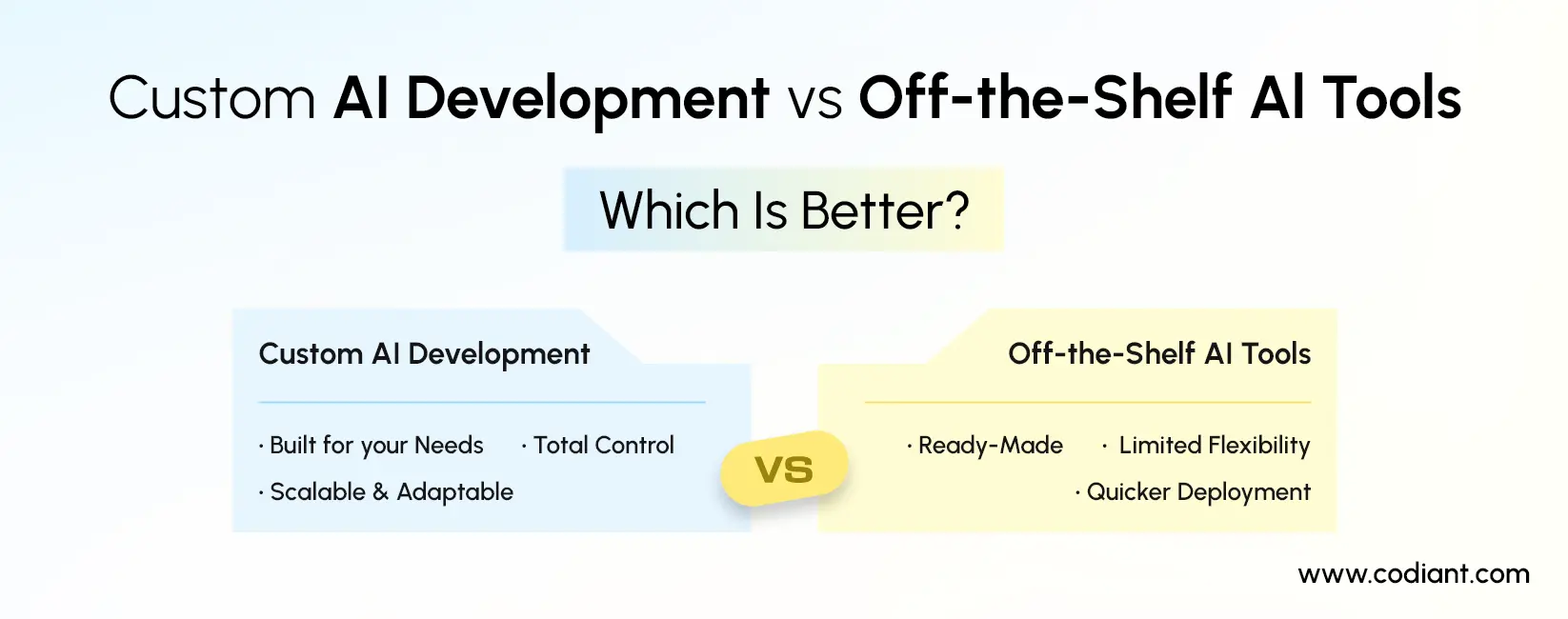
Before choosing between AI software vs custom AI solution, it’s important to understand what each actually means in a real-world business context.
What Are AI Tools?
AI tools are ready-to-use software solutions built for general use cases. Think chatbots, analytics platforms, content generators, recommendation engines, and automation tools.
These are typically offered as SaaS (Software as a Service), meaning-
- You subscribe and start using instantly
- No heavy development required
- Features are pre-built for common business needs
Examples include AI writing tools, CRM automation, or AI-powered marketing platforms.
They are designed for speed and convenience.
Build AI That Actually Fits Your Business
Move beyond generic tools and create AI aligned with your workflows and goals.
What Is Custom AI Development?
Custom AI development involves building AI solutions from scratch (or semi-scratch) tailored to your specific business processes.
Instead of adapting your business to a tool, the tool is built around your business.
This includes-
- Custom machine learning models
- AI-driven workflows
- Proprietary data training
- Deep system integrations
This is where AI development for businesses becomes strategic rather than just functional.
AI Tools vs Custom AI Development- Core Differences
Let’s get straight to the comparison that most businesses care about.
A Quick Comparison Overview
A quick side-by-side overview to help businesses evaluate AI tools and custom AI development effectively before investing decisions.
| Factor | AI Tools (SaaS-Based) | Custom AI Development |
| Flexibility | Designed for general use cases with limited customization options | Fully tailored to business workflows, logic, and operational needs |
| Implementation Speed | Quick setup; can be deployed within hours or days | Requires time for development, training, testing, and deployment |
| Cost Structure | Low upfront investment with recurring subscription costs | Higher initial investment with long-term cost optimization potential |
| Scalability | Scales within predefined limits, often restricted by pricing tiers and features | Built to scale alongside business growth, data expansion, and evolving requirements |
| Customization | Minimal; businesses adapt to the tool’s capabilities | Extensive; solution is designed around business-specific requirements |
| Integration Capability | Limited integrations based on available APIs | Deep integration across internal systems, tools, and workflows |
| Data Utilization | Uses standardized models with limited control over data usage | Leverages proprietary data for more accurate and contextual outcomes |
| Performance Optimization | Generic performance across industries and use cases | Continuously optimized for specific business goals and use cases |
| Competitive Advantage | Improves efficiency but offers little differentiation | Enables unique capabilities and creates long-term competitive edge |
| Best Fit For | Startups, SMBs, and businesses with standard operational needs | Enterprises, product companies, and data-driven organizations |
- Flexibility vs Convenience
AI tools are convenient. You sign up, configure, and start using. Custom AI is flexible. It adapts to your workflows, not the other way around.
If your processes are standard, tools work fine. If your workflows are unique, tools start to break.
- Speed of Implementation
AI tools win here.
You can deploy them in days or even hours.
Custom AI development takes time-
- Data preparation
- Model training
- Testing and iteration
This makes tools ideal for quick wins, while custom AI is better for long-term strategy.
- Cost Comparison- AI SaaS vs Custom AI Cost
This is where most decisions get influenced.
AI tools have-
- Low upfront cost
- Subscription-based pricing
- Predictable expenses
Custom AI development involves-
- Higher initial investment
- Development and infrastructure cost
- Ongoing optimization
But here’s what many businesses miss-
AI SaaS vs custom AI cost is not just about price. It’s about ROI.
If a custom solution reduces operational cost by 40% or improves conversion rates significantly, it often pays for itself.
- Scalability and Growth
AI tools scale… to a limit.
They are built for general use, so scaling often comes with-
- Feature limitations
- Pricing tiers
- API restrictions
Custom AI, on the other hand, is built for your scale.
It evolves with your business, data, and user base.
This is why enterprise AI vs SaaS tools is not even a fair comparison at scale.
- Competitive Advantage
Here’s the biggest differentiator.
Using AI tools gives you efficiency.
Building custom AI gives you differentiation.
If your competitors are using the same tools, you’re not gaining an edge you’re just keeping up.
Custom AI allows you to-
- Build unique customer experiences
- Leverage proprietary data
- Create defensible business models
Strategic Scenarios Where AI Tools Deliver Immediate Value
There are clear situations where the build vs buy AI solutions decision naturally leans toward adopting ready-made tools.
AI tools are best suited for businesses that prioritize speed, simplicity, and cost-efficiency over deep customization.
They work particularly well when-
- Rapid deployment is critical and timelines are tight
- The use case is standardized, such as marketing automation, customer support, or analytics
- Budget constraints limit large upfront investments
- The organization is still exploring AI adoption and testing feasibility
- Internal AI expertise or technical bandwidth is limited
For startups and growing businesses, AI tools provide a practical entry point into AI adoption. They enable teams to unlock immediate operational value without the complexity of building and maintaining custom systems. As these businesses also focus on improving their visibility in AI-powered search, best AEO tools can help optimize content for answer engines and increase the chances of being surfaced in relevant AI-generated responses.
Benefits of Custom AI Development
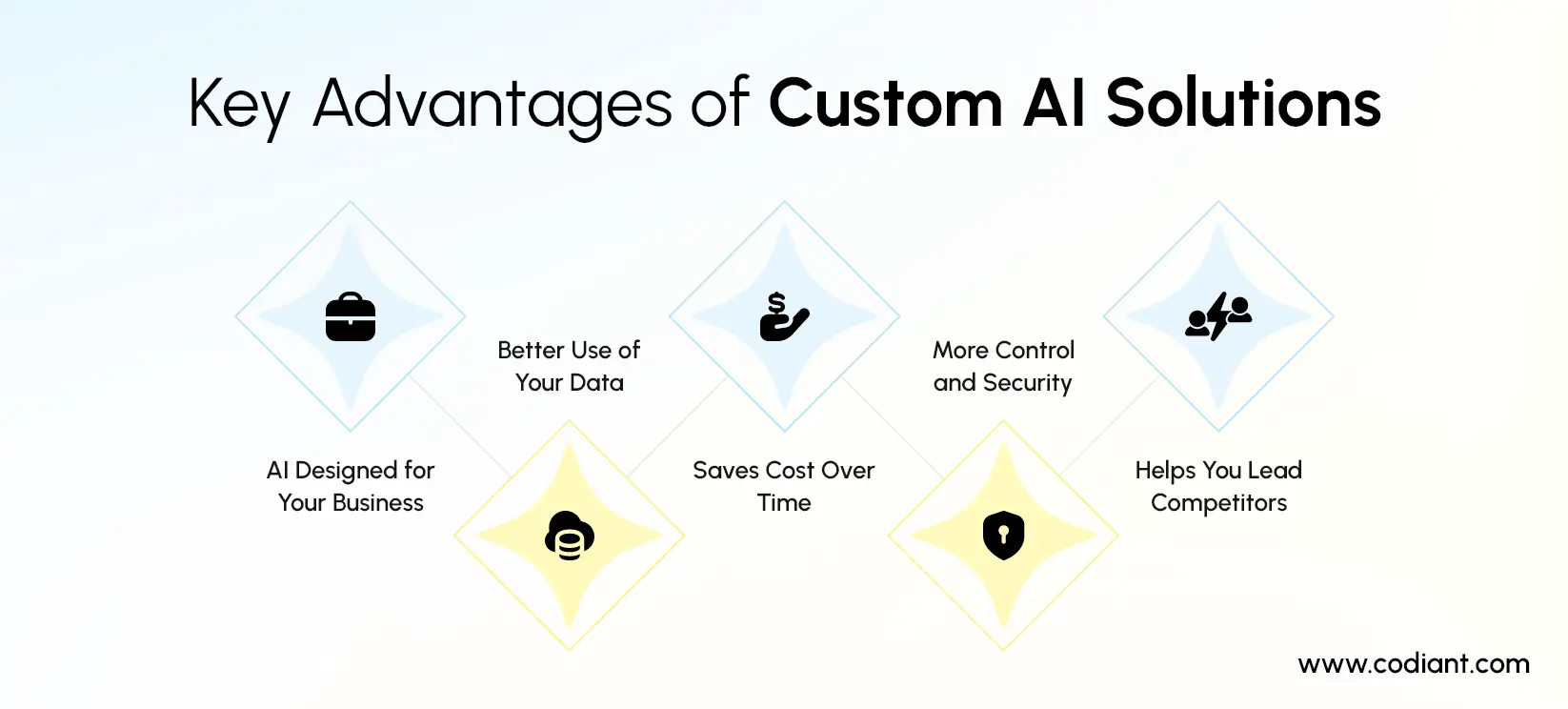
Let’s talk about why businesses invest in custom AI despite higher upfront costs.
- Tailored to Business Needs
Custom AI is designed specifically for your workflows, industry, and data.
No compromises.
- Better Data Utilization
Your proprietary data becomes your biggest asset.
Custom AI models learn from your data, giving better insights and predictions.
- Long-Term Cost Efficiency
While initial costs are higher, custom AI reduces-
- Manual effort
- Operational inefficiencies
- Dependency on third-party tools
- Enhanced Security and Compliance
With custom AI, you control-
- Data storage
- Access
- Compliance requirements
This is critical for industries like healthcare, finance, and government.
- Competitive Differentiation
Custom AI is not just a tool it becomes part of your business identity.
When Custom AI Development Becomes a Strategic Imperative
As business complexity increases, the limitations of generic tools become more apparent. This is where custom AI transitions from an option to a necessity.
Custom AI development is the right approach when-
- Business workflows are unique and cannot be standardized
- Decision-making depends heavily on proprietary data and insights
- Seamless integration with existing systems is essential
- AI plays a central role in delivering core products or services
- Long-term scalability, flexibility, and control are business priorities
This approach is particularly relevant for-
- Large enterprises managing complex operations
- Product-driven companies building AI-enabled platforms
- Data-intensive businesses leveraging large datasets
- Organizations aiming to automate processes at scale
In these scenarios, the choice between custom AI development vs SaaS AI shifts from a technical consideration to a strategic business decision that directly impacts growth and differentiation.
Evaluating the Limitations of AI Tools in Enterprise Environments
AI tools can deliver meaningful value in the early stages of adoption. They are effective for handling well-defined, repeatable tasks such as basic automation, reporting, and customer interactions.
However, enterprise environments introduce a different level of complexity.
As operations scale, businesses require-
- Advanced decision-making capabilities driven by contextual intelligence
- Strict data governance, security, and regulatory compliance
- Highly customized workflows across departments
- Integration across multiple internal and external systems
This is where standard AI tools begin to show limitations. They are not designed to adapt deeply to complex enterprise ecosystems.
As a result, many organizations initially adopt AI tools for quick wins but gradually transition toward custom AI systems to support long-term operational and strategic needs.
Why AI Tools and Custom AI Serve Fundamentally Different Roles?
AI tools and custom AI are often compared as alternatives, but in reality, they address different layers of business needs.
AI tools offer speed, accessibility, and ease of use. They are designed to solve common problems efficiently and with minimal setup.
Custom AI, in contrast, is built for alignment. It is designed to reflect the unique logic, workflows, and data structures of a business.
A useful way to think about this-
- AI tools enable faster execution
- Custom AI enables smarter decision-making and differentiation
Because of this distinction, most businesses do not fully replace one with the other.
Instead, they adopt a hybrid approach-
- Use AI tools to handle standardized, non-core functions
- Identify gaps where tools fall short
- Build custom AI solutions for high-impact, business-critical operations
This layered approach allows organizations to balance speed, cost, and innovation without overcommitting to extreme.
Still Confused Between AI Tools and Custom AI?
Let our experts evaluate your needs and recommend the right AI approach.
Challenges of Custom AI Development
To be fair, custom AI isn’t perfect.
It comes with-
- Higher upfront investment
- Longer development timelines
- Need for skilled AI teams
- Continuous maintenance
This is why not every business should jump into it immediately.
AI Tools vs AI Solutions Comparison- Real-World Perspective
Let’s simplify this decision with a practical lens.
| Factor | AI Tools | Custom AI Development |
| Setup Time | Fast | Slow |
| Cost | Low upfront | High upfront |
| Flexibility | Limited | High |
| Scalability | Moderate | High |
| Customization | Minimal | Full |
| Competitive Advantage | Low | High |
Which AI Solution Is Better for Scaling Businesses?
Scaling changes everything.
As your business grows-
- Data increases
- Complexity increases
- Customer expectations rise
AI tools may help initially, but they often become restrictive.
Custom AI becomes the foundation for scalable growth because it evolves with your needs.
This is why high-growth companies eventually invest in custom AI, even if they started with tools.
Hybrid Approach- The Smart Middle Ground
Here’s what most successful businesses actually do.
They don’t choose one over the other.
They combine both.
- Use AI tools for standard processes
- Build custom AI for core operations
This approach balances-
- Speed
- Cost
- Innovation
It also reduces risk while allowing gradual AI maturity.
How to Decide the Right AI Approach for Your Business?
Ask yourself these questions-
- Is AI central to my business model or just supportive?
- Do I have unique workflows or standard ones?
- How important is scalability in the next 2–3 years?
- Do I rely heavily on proprietary data?
- What’s my budget vs expected ROI?
Your answers will guide you toward the right approach.
AI Adoption Is Shifting from Experimentation to Strategy
The discussion is no longer limited to AI tools vs custom AI development. Most businesses have already crossed the experimentation phase.
The real shift is happening in how AI is being applied across operations. Organizations that treat AI as a quick plug-in for isolated tasks may see early efficiency gains, but those gains often plateau.
In contrast, businesses that integrate AI into their core processes decision-making, workflows, and customer experiences are seeing sustained impact. They are not just using AI; they are operationalizing it.
This shift marks a transition from tactical adoption to strategic implementation. And that is where long-term value is created.
Conclusion- Choosing the Right AI Approach for Your Business
Selecting between AI tools vs custom AI development is less about preference and more about business alignment.
AI tools are effective for speed, accessibility, and standard use cases. They help teams move quickly and deliver immediate results.
Custom AI, on the other hand, becomes essential when businesses require deeper control, scalability, and differentiation. It enables organizations to build systems that reflect their unique processes and leverage their data more effectively.
In practice, most businesses do not operate at either extreme. They begin with AI tools, identify operational gaps, and gradually invest in custom AI where it drives the most value.
The key is not choosing one over the other but understanding when each approach fits and evolving your AI strategy as your business grows.
Turn AI into Your Competitive Advantage
Design scalable AI solutions that grow with your business and data needs.
The Author

Frequently Asked Questions
AI tools are pre-built software solutions that use artificial intelligence to perform tasks like automation, analysis, or content generation. They work on predefined models and are accessible via subscriptions.
Custom AI development involves creating tailored AI systems designed specifically for a business’s needs, workflows, and data, enabling deeper integration and scalability.
AI tools are more cost-effective in the short term due to low upfront costs, while custom AI becomes more cost-efficient long-term through higher ROI and automation benefits.
Yes, many businesses start with AI tools and gradually transition to custom AI as their needs grow and processes become more complex.
The decision depends on your business size, goals, budget, data complexity, and whether AI is a core or supporting function in your operations.
Featured Blogs
Read our thoughts and insights on the latest tech and business trends
How Much Does It Cost to Build an MVP in 2026? A Complete Pricing Guide
- September 10, 2026
- Digital Transformation
MVP development cost typically ranges from $5,000 for a basic web-based product to $150,000 or more for a complex, cross-platform solution. A custom MVP with user accounts, a backend, essential integrations and a polished interface... Read more
How Much Does It Cost to Hire a Dedicated AI/LLM Developer in 2026?
- September 8, 2026
- Artificial Intelligence Staff Augmentation
Hiring a dedicated AI or large language model (LLM) developer typically costs $35–$60 per hour for general AI engineering and $50–$200 per hour for specialised machine learning work, with enterprise pricing rising for advanced RAG,... Read more

HIPAA-Compliant App Development in 2026: How to Build Securely and Avoid Preventable Fines
- September 4, 2026
- Mobile App Development
HIPAA-compliant app development in 2026 requires six foundations: complete ePHI mapping, documented risk analysis, role-based access, encryption, signed business associate agreements, and continuous security monitoring. This matters most to healthcare CTOs, product leaders, and compliance... Read more