How Canadian Enterprises Are Using AI Development to Cut Operational Costs in 2026
Table of Contents
Subscribe To Our Newsletter

In a Nutshell
- Canadian enterprises are using AI to control rising operational costs.
- Automation replaces repetitive manual processes across departments.
- Most companies start with small AI pilots before scaling.
- Implementation can take weeks for automation, months for enterprise AI.
- AI improves efficiency, forecasting, and decision-making.
- Finance, healthcare, retail, and manufacturing lead AI adoption.
- Early adopters gain faster, leaner, and more scalable operations.
Operating a large enterprise in Canada has never been cheap. Labor costs are rising. Supply chains remain unpredictable. Regulatory compliance continues to expand. Add global competition to the mix and the pressure becomes obvious.
Enter artificial intelligence.
Not the experimental kind companies played with five years ago. The operational kind. The type that sits inside business processes quietly eliminating inefficiencies.
Across Canada, enterprises are investing heavily in AI development services Canada to make operations leaner. Finance teams are automating reporting. HR departments are screening candidates with machine learning models. Supply chains are using predictive analytics to prevent inventory chaos.
This is not a theoretical shift. It is operational survival.
The companies that understand this are moving toward AI digital transformation Canada initiatives that target one outcome above all others: reduce operational expenses without slowing growth.
A decade ago, cost reduction meant layoffs or outsourcing. In 2026, it increasingly means automation.
The result is a new wave of enterprise AI solutions Canada designed to streamline operations across entire organizations.
Why Enterprises in Canada Are Betting Big on AI?
Canadian enterprises are not adopting AI because it is fashionable. They are adopting it because inefficiency is expensive.
Large organizations run on processes. Thousands of them. Procurement approvals. Customer service tickets. Financial reconciliations. Data entry. Compliance reporting.
Each process requires time, labor, and infrastructure.
Did you know?
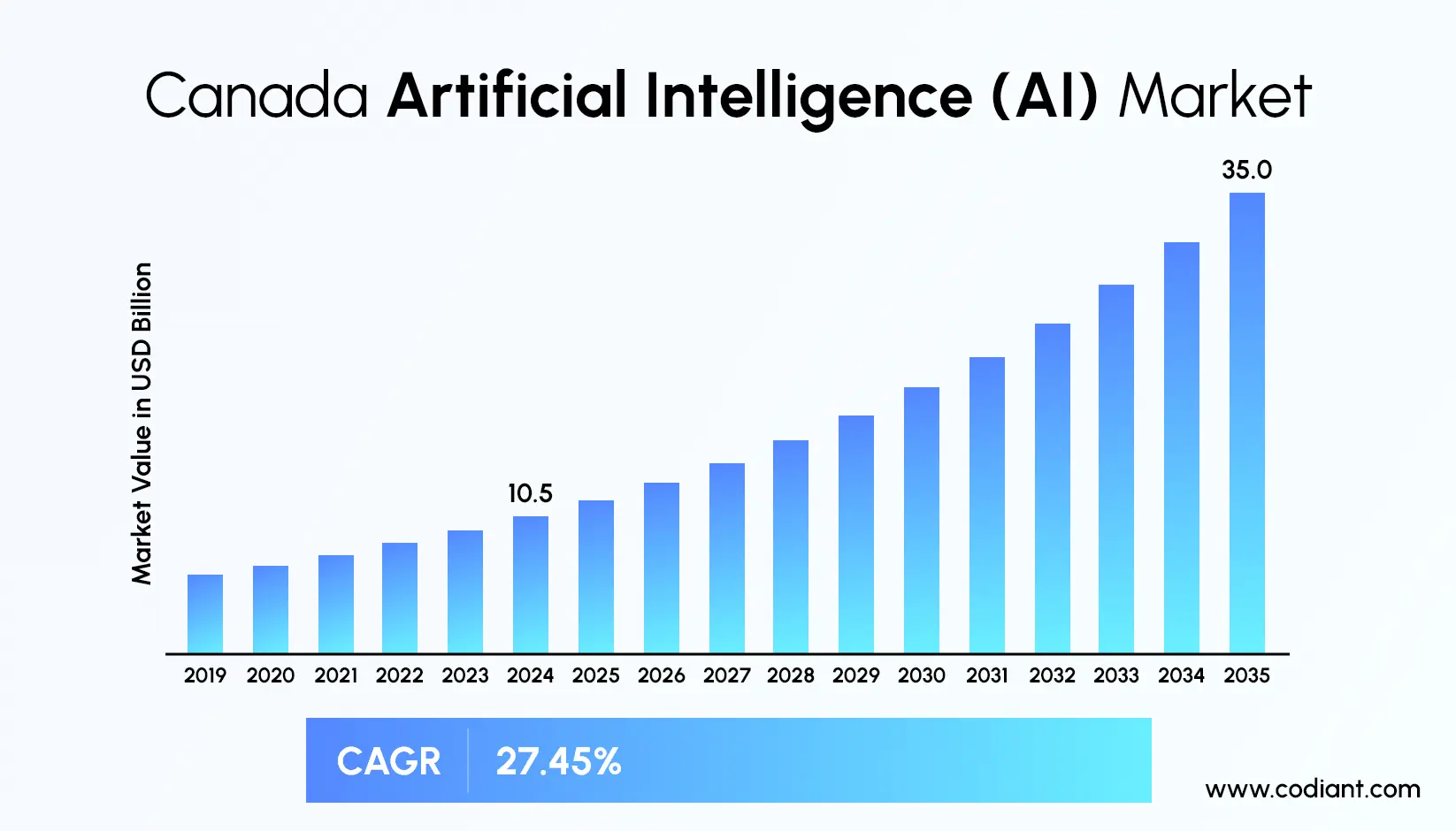
Canada’s artificial intelligence market is growing at an incredible pace. It was valued at $9.57 billion in 2024 and is expected to reach $12.49 billion in 2025, with a strong 27.45% annual growth rate projected through 2035.
Source: https://www.marketresearchfuture.com/reports/canada-artificial-intelligence-ai-market-44601
Artificial intelligence excels at handling structured and repetitive work. That is exactly where operational costs hide.
Companies working with AI consulting services Canada providers often discover that a surprising amount of internal work is rule based. Documents follow predictable patterns. Customer requests fall into common categories. Operational decisions rely on historical data.
Perfect territory for automation.
Once AI systems enter the workflow, tasks that once required hours can be completed in minutes.
That is why demand for AI development company Canada partners continues to grow. Enterprises want systems that integrate directly into existing operations rather than sitting in isolated pilot projects.
The goal is simple. Fewer inefficiencies. Faster execution. Lower costs.
Turn Operational Costs into Competitive Advantage
Discover how AI automation can streamline workflows, reduce operational costs, and improve enterprise productivity across departments.
What AI Development Costs Enterprises in 2026
Below is a typical cost snapshot for enterprise AI projects in 2026.
Typical Enterprise AI Development Cost Breakdown (Canada – 2026)
| AI Solution Type | Typical Enterprise Use Case | Estimated Cost Range |
| AI Workflow Automation | Document processing, invoice automation, HR screening | $40,000 – $120,000 |
| AI Chatbots & Support Automation | Customer service automation, ticket routing | $60,000 – $180,000 |
| Predictive Analytics Platforms | Demand forecasting, financial forecasting, risk modeling | $120,000 – $350,000 |
| Computer Vision Systems | Manufacturing quality inspection, warehouse monitoring | $150,000 – $500,000 |
| Enterprise AI Data Platforms | Company-wide AI intelligence layer across operations | $400,000 – $1M+ |
One question surfaces early in most boardroom discussions.
How Much Does AI Actually Cost?
The answer depends on scope.
A simple automation project designed to streamline document processing costs far less than a company-wide predictive analytics platform.
Several factors influence investment levels:
- complexity of the solution
- data availability and quality
- infrastructure requirements
- integration with existing enterprise systems
Many organizations begin with pilot projects. These small deployments test whether automation delivers measurable value before scaling further.
Working with experienced AI consulting services Canada providers often reduces risk during these early phases.
When successful, AI projects typically produce cost savings that outweigh the initial development investment.
How Long Enterprise AI Implementation Takes?
Below is a typical timeline for enterprise AI implementation 2026 projects.
Enterprise AI Implementation Timeline Breakdown
| Implementation Phase | Key Activities |
| AI Strategy & Opportunity Assessment | Identify automation opportunities, define business goals, select AI use cases |
| Data Preparation & Infrastructure Setup | Data cleaning, labeling, pipeline creation, cloud infrastructure setup |
| Model Development & Training | Machine learning model design, training, optimization |
| System Integration | Integrating AI with ERP, CRM, internal systems, APIs |
| Testing & Performance Validation | Model testing, performance tuning, operational reliability checks |
| Deployment & Workflow Automation | Launch AI systems into live enterprise operations |
Typical Total Implementation Time
| AI Project Type | Average Implementation Timeline |
| AI Workflow Automation | 8 – 12 weeks |
| AI Chatbot & Customer Support Automation | 10 – 14 weeks |
| Predictive Analytics Platforms | 4 – 6 months |
| Enterprise AI Intelligence Platforms | 6 – 12 months |
AI implementation rarely happens overnight. Enterprises follow a staged process. The first stage involves strategy development. Organizations analyze operational workflows to identify automation opportunities.
Next comes data preparation. AI models require structured datasets to function effectively. Development teams then build and train machine learning models tailored to specific enterprise tasks.
Integration follows. The AI system connects with existing enterprise software platforms. Testing ensures the technology performs reliably under real operational conditions.
Small automation initiatives may launch within two or three months. Large scale enterprise AI implementation 2026 programs can take six to twelve months depending on scope.
The Real Benefits Enterprises See After AI Adoption
Companies implementing AI rarely focus on one outcome alone. Multiple operational improvements emerge simultaneously.
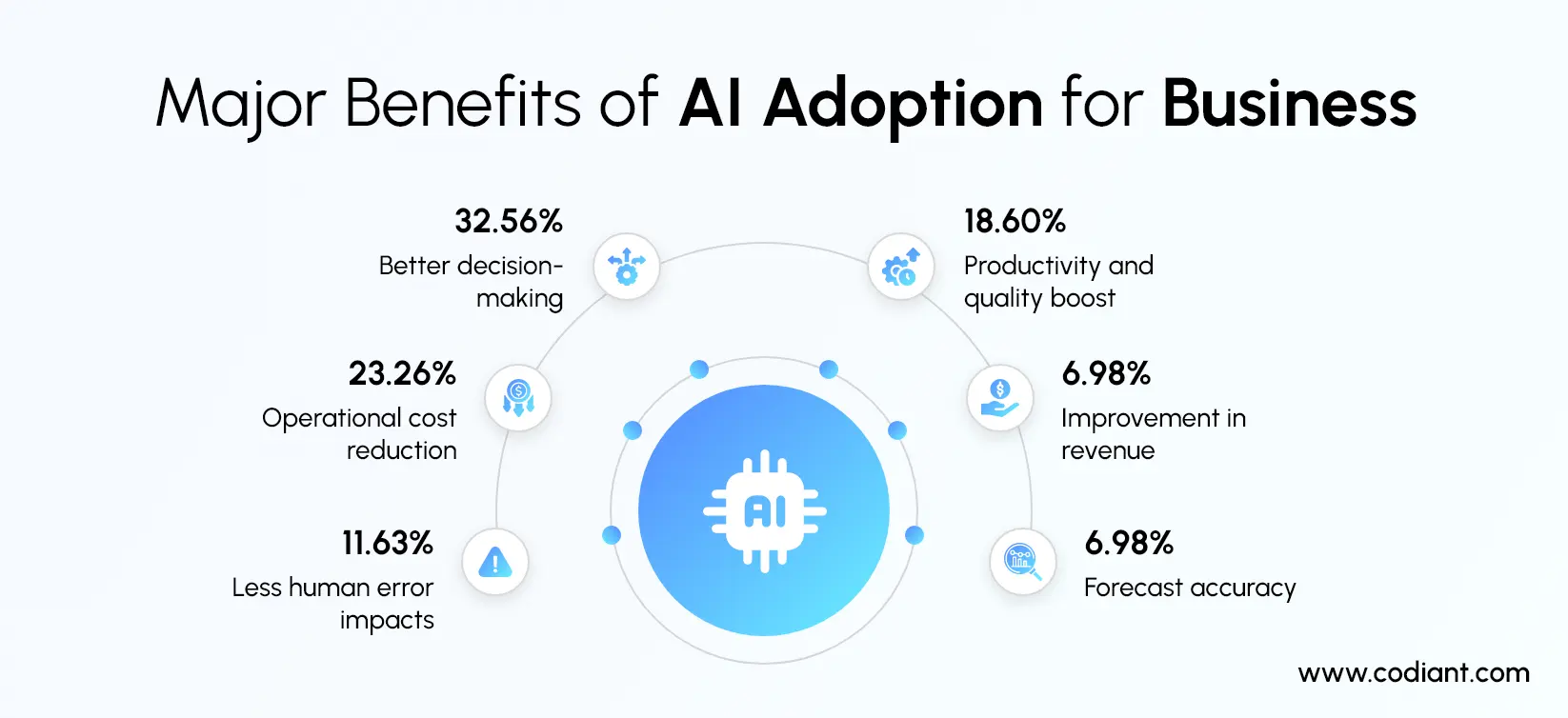
Cost reduction is the most obvious. Automation eliminates repetitive work and reduces manual labor requirements.
Decision making improves as well. AI systems analyze operational data in real time, providing insights managers can act on quickly.
Scalability becomes easier. AI systems can handle growing workloads without requiring equivalent increases in staffing.
Enterprises deploying AI workflow automation solutions frequently report faster processing times, fewer operational errors, and improved service quality.
Those improvements explain why AI automation for businesses Canada continues to expand across industries.
Where AI Actually Reduces Operational Costs?
The phrase “AI reduces costs” gets repeated often. The mechanics are worth unpacking.
AI lowers expenses by replacing slow manual processes with automated workflows that operate continuously.
1. Process Automation
Manual tasks dominate enterprise operations. Invoice processing, document verification, compliance checks. Each requires employee time.
With AI automation for enterprise operations, these tasks are handled by intelligent systems that read documents, classify information, and trigger next steps automatically.
The effect is immediate. Processing speeds increase while operational overhead declines.
2. Workforce Productivity
Automation does not eliminate employees. It removes friction from their work.
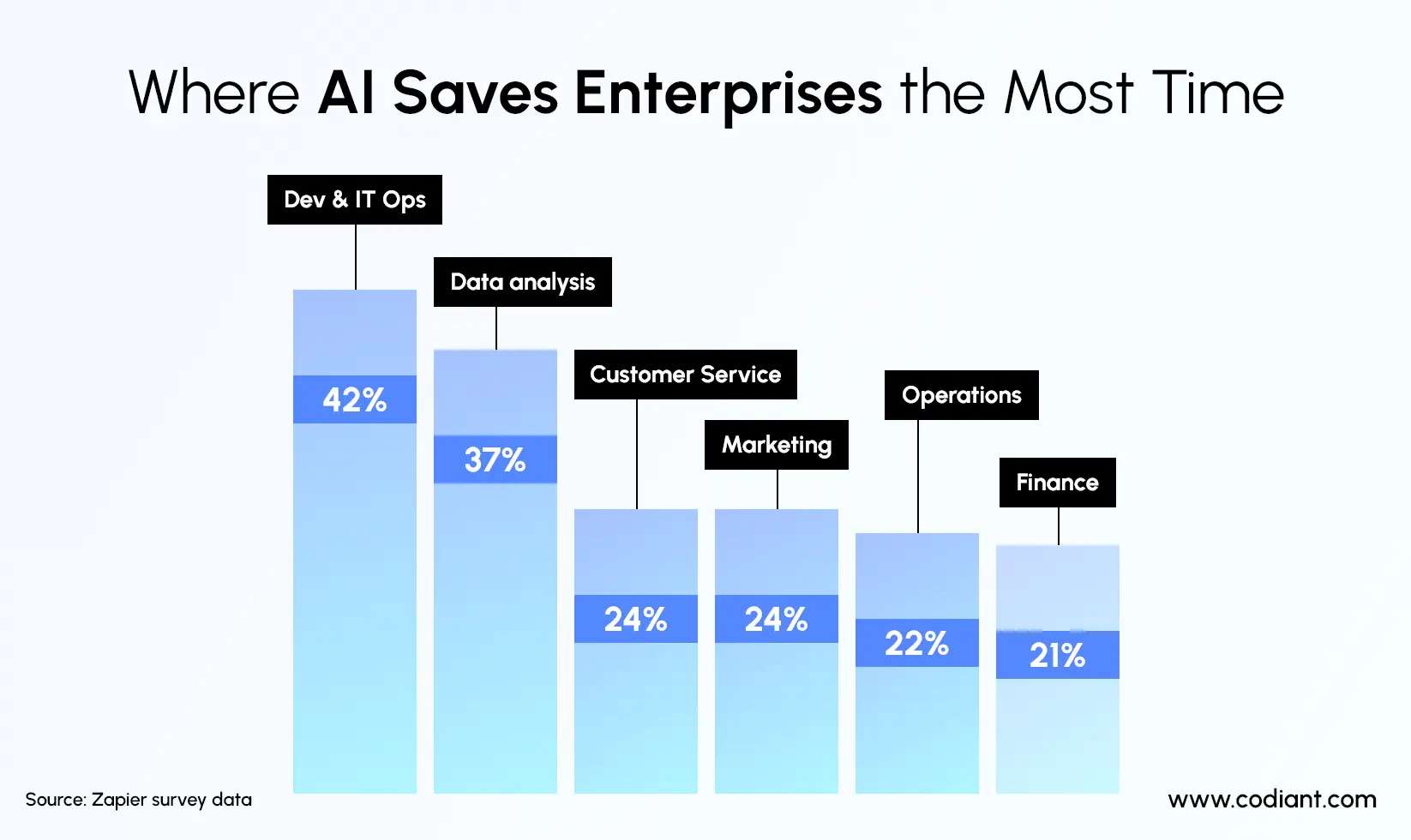
An employee supported by AI tools can complete more tasks in less time. Customer service agents handle more tickets. Finance teams close reporting cycles faster.
Organizations adopting AI automation for businesses Canada frequently see productivity gains without expanding their workforce.
3. Predictive Insights
Many operational costs originate from poor forecasting. Overstocked inventory. Unexpected equipment failures. Staffing mismatches.
AI models analyze historical data to detect patterns humans often miss. That insight prevents expensive mistakes.
4. Supply Chain Optimization
Modern supply chains involve thousands of moving parts. Forecast demand incorrectly and warehouses overflow. Predict too little and sales disappear.
Advanced AI workflow automation solutions help enterprises predict demand more accurately, reducing both storage costs and missed revenue opportunities.
Build Enterprise AI Solutions That Deliver Real ROI
Explore custom AI development services designed to automate processes, optimize operations, and scale business performance.
Where AI Fits in Enterprise Workflows?
Artificial intelligence solutions is spreading across enterprise departments faster than many executives expected.
Not every use case requires complex machine learning. Many rely on intelligent automation integrated into everyday workflows.
1. Finance and Accounting
AI systems now read invoices, categorize expenses, and reconcile financial records. Fraud detection algorithms flag suspicious transactions before they become major losses.
Finance teams move faster while reducing human error.
2. Customer Support
AI-powered chatbots answer common questions instantly. Voice assistants route calls intelligently.
Human agents focus on complex cases rather than repetitive requests.
3. HR and Recruitment
Recruitment used to involve reviewing hundreds of resumes manually.
AI systems screen candidates, identify skill matches, and help recruiters shortlist applicants quickly. That reduces administrative effort while improving hiring speed.
4. Supply Chain Management
Predictive analytics help companies forecast product demand, plan shipments, and avoid warehouse bottlenecks.
5. IT Operations
AI monitoring systems detect anomalies in network activity and system performance. Problems get addressed before they cause downtime.
These capabilities are quickly becoming standard for enterprise AI implementation 2026 initiatives.
Industries in Canada Moving Fastest with AI
Some industries have embraced artificial intelligence faster than others. The common factor is operational complexity.
1. Financial Services
Banks and financial institutions rely heavily on AI for fraud detection, credit scoring, and risk analysis.
Regulatory compliance automation has also becomes a major focus.
2. Healthcare
Hospitals and healthcare providers use AI to analyze patient data, assist diagnostics, and streamline administrative operations.
3. Retail and E-commerce
Retailers deploy AI to forecast demand, optimize pricing, and personalize customer experiences.
Inventory management improves dramatically when machine learning predicts buying patterns.
4. Manufacturing
Factories rely on AI systems that monitor equipment performance. Predictive maintenance prevents costly shutdowns.
5. Logistics
Transportation companies use AI to optimize delivery routes and improve fleet management efficiency.
These sectors illustrate how AI digital transformation Canada is reshaping entire industries.
The Challenges Companies Encounter During AI Implementation
AI adoption is not always smooth. Data quality remains one of the most common obstacles. Inconsistent or incomplete data can limit the effectiveness of machine learning models.
Legacy software systems also complicate integration. Many enterprises operate on infrastructure built long before modern AI platforms existed.
Another challenge involves internal expertise. Skilled AI engineers and data scientists remain in high demand.
This explains why many organizations collaborate with specialized AI development company Canada providers who bring both technical knowledge and implementation experience.
Employee adaptation also matters. Workers must learn to operate alongside automated systems rather than relying on traditional workflows.
Organizations that manage this transition carefully see the strongest results.
How Codiant Helps Enterprises Implement AI Efficiently?
Adopting AI across enterprise operations can feel complex. The technology, the data, the integrations. This is where the right development partner makes a difference. Codiant helps Canadian enterprises move from AI strategy to real operational impact without unnecessary complexity.
Our team focuses on building practical enterprise AI solutions Canada that streamline workflows, automate repetitive processes, and reduce operational overhead across departments.
Codiant supports enterprises with:
- Custom AI development services Canada aligned with business goals
- AI workflow automation for finance, HR, customer support, and supply chain
- Predictive analytics platforms that improve operational decision making
- Seamless integration with ERP, CRM, and enterprise systems
The objective is straightforward: deploy AI that delivers measurable efficiency and long-term cost reduction.
The Future of Enterprise AI in Canada
Artificial intelligence will become more deeply embedded inside enterprise operations over the next several years. Future systems will not simply automate tasks. They will manage workflows autonomously, analyzing data continuously and adjusting operations dynamically.
AI agents capable of executing complex processes are already emerging. For Canadian enterprises, the direction is clear. Companies investing in enterprise AI solutions Canada today are building operational infrastructure designed for the next decade.
Efficiency, speed, and intelligent decision making will define competitive advantage. AI is becoming the engine behind all three.
Conclusion
Operational efficiency has become a defining challenge for modern enterprises. Canadian companies facing rising costs are increasingly turning to artificial intelligence as a practical solution.
Through automation, predictive analytics, and intelligent decision systems, organizations are redesigning how work happens across departments.
The shift toward AI development services Canada is not about experimentation. It is about operational survival in an increasingly competitive environment.
Enterprises that embrace AI early gain measurable advantages. Lower operational costs. Faster workflows. Better strategic decisions.
Those advantages compound over time.
Automate Enterprise Workflows With AI
Implement intelligent automation solutions that eliminate inefficiencies, improve decision making, and reduce operational expenses.
The Author

Frequently Asked Questions
Enterprises commonly automate finance processes, customer support operations, HR recruitment workflows, supply chain management, and IT monitoring. AI systems handle repetitive tasks such as document processing, ticket routing, data classification, and predictive forecasting, which significantly reduces administrative workloads.
AI improves efficiency by automating routine processes, analyzing operational data continuously, and identifying performance bottlenecks. Intelligent systems streamline workflows, reduce manual effort, and help teams make faster decisions using real time insights derived from enterprise data.
Financial services, healthcare, manufacturing, retail, and logistics are among the industries experiencing the strongest benefits from AI adoption. These sectors manage large volumes of data and operational complexity, making them ideal candidates for AI driven automation and predictive analytics.
Organizations typically measure AI ROI by analyzing operational cost savings, productivity improvements, and error reduction. Metrics such as faster processing times, reduced labor hours, and improved forecasting accuracy help determine the financial value of AI investments.
Common challenges include poor data quality, integration with legacy enterprise systems, shortage of AI specialists, and internal resistance to automation. Strategic planning and collaboration with experienced AI consulting partners can help enterprises overcome these obstacles.
Featured Blogs
Read our thoughts and insights on the latest tech and business trends
List of Top AI Agent Development Companies in the USA (2026 Guide)
- March 5, 2026
- AI Agent
In a Nutshell AI agents are the next evolution of automation, going beyond chatbots to perform real business tasks. They can understand intent, connect with tools, and execute multi-step workflows across teams. Businesses are increasingly... Read more

Hire Custom Software Developers in UAE for Secure and Scalable Enterprise Solutions
- February 27, 2026
- Digital Transformation Staff Augmentation
In a Nutshell UAE enterprises are shifting toward custom software because off-the-shelf tools fail to meet complex workflows and regional compliance needs. Custom enterprise software includes ERP modernization, automation systems, secure portals, analytics dashboards, and... Read more

Top 20+ PHP Development Companies in United States (2026)
- February 24, 2026
- Web Development
PHP is one of the most reliable and popular programming languages in the world used for developing dynamic, customizable, secure and affordable web applications. In 2026, SaaS, eCommerce, healthcare, fintech and logistics companies along with Enterprise... Read more