How AI Is Transforming Property Management in the UAE
Table of Contents
Subscribe To Our Newsletter
In a Nutshell
- AI is becoming the operating backbone of modern property management in the UAE, driving efficiency, tenant satisfaction, and cost optimization across residential, commercial, and mixed-use portfolios.
- Predictive maintenance delivers the highest ROI, reducing equipment breakdowns by 30–50% critical in the UAE’s climate-intensive environment dominated by HVAC load.
- AI-powered tenant management and chatbots transform service delivery, handling 60–80% of routine enquiries and shortening response times from hours to seconds.
- AI-driven inspections and automated workflows streamline operations, cutting manual effort by up to 40% and accelerating move-in/move-out processes fourfold.
- Real estate companies using AI for pricing, forecasting, and asset planning gain a strategic advantage, improving rental yields and portfolio performance.
- Digital transformation in UAE property management is no longer optional as developers align with smart-city mandates, DLD digitization, and rising tenant expectations.
- Codiant’s AI solutions offer modular, scalable adoption, enabling property managers to start small chatbots, maintenance, inspections and expand to full automation at their own pace.
The UAE’s real estate market is expanding quickly, with new communities, mixed-use developments, and growing tenant populations across Dubai and Abu Dhabi.
As portfolios scale, the operational workload behind maintaining buildings, handling tenant requests, and managing assets has become more demanding and more time-sensitive.
To keep up, property management companies are turning to AI-driven systems that bring structure, speed, and accuracy into daily operations.
These tools are already proving their value: predictive maintenance is reducing unexpected breakdowns, automated inspections are cutting reporting time, and intelligent tenant support is improving response rates across large portfolios.
For many operators, these improvements are no longer optional – they’re becoming core to running efficient, resilient, and tenant-friendly properties in the UAE.
This blog breaks down how AI is being applied in real estate operations today, which use cases deliver the strongest impact, and how UAE property managers can adopt these solutions in a practical, measurable way.
Why AI Is Becoming Essential in UAE Property Management?
The UAE real estate market is one of the fastest-growing globally. With communities expanding across Dubai South, Dubai Creek Harbour, Yas Island, Masdar City, Sharjah Waterfront, and Ras Al Khaimah, the operational complexity behind maintaining properties has increased significantly.
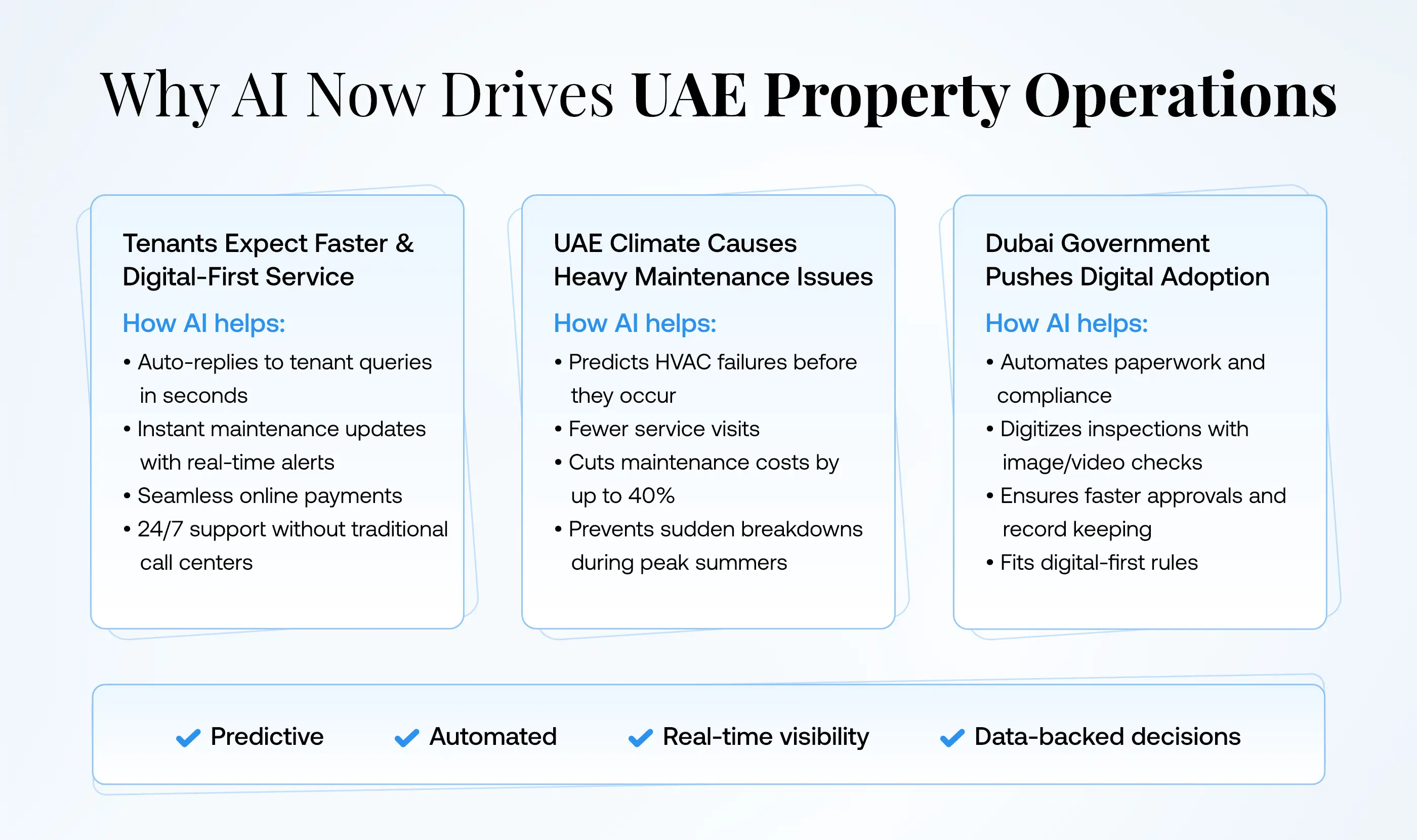
Three structural shifts are driving the demand for AI:
1. Rising Tenant Expectations
Tenants increasingly expect the responsiveness they get from modern digital services: instant support, transparent updates, and frictionless payments. Traditional call-center-dependent workflows are no longer enough.
2. High Maintenance Load Driven by Climate
The UAE’s climate puts heavy stress on HVAC systems, plumbing, and building assets. Unpredictable failures create cost inefficiencies and service disruptions-issues AI predictive models can minimize.
3. Dubai’s Digital-First Vision
Government-led innovations such as Paperless Dubai, DLD’s digital contract systems, and proactive smart-city initiatives are accelerating the shift toward digital transformation in UAE property management. As smart compliance standards rise, conversational AI for government is emerging as a key enabler, helping property operators streamline communication, automate processes, and meet evolving regulatory expectations with ease.
The result? Property management is shifting from reactive operations to predictive, autonomous, and insight-driven systems-powered by AI.
Bring Your Portfolio Closer to “Smart City” Standards.
Adopt AI that aligns with Dubai and Abu Dhabi’s digital-first expectations for buildings, tenants, and operations.
Case Study: Occupy360 – A Ready-to-Go Property Management Platform
One of the strongest examples of digital transformation in the GCC is Occupy360, a ready-to-go property management solution developed by Codiant for a leading real-estate group managing residential and commercial units across Bahrain and the wider region.
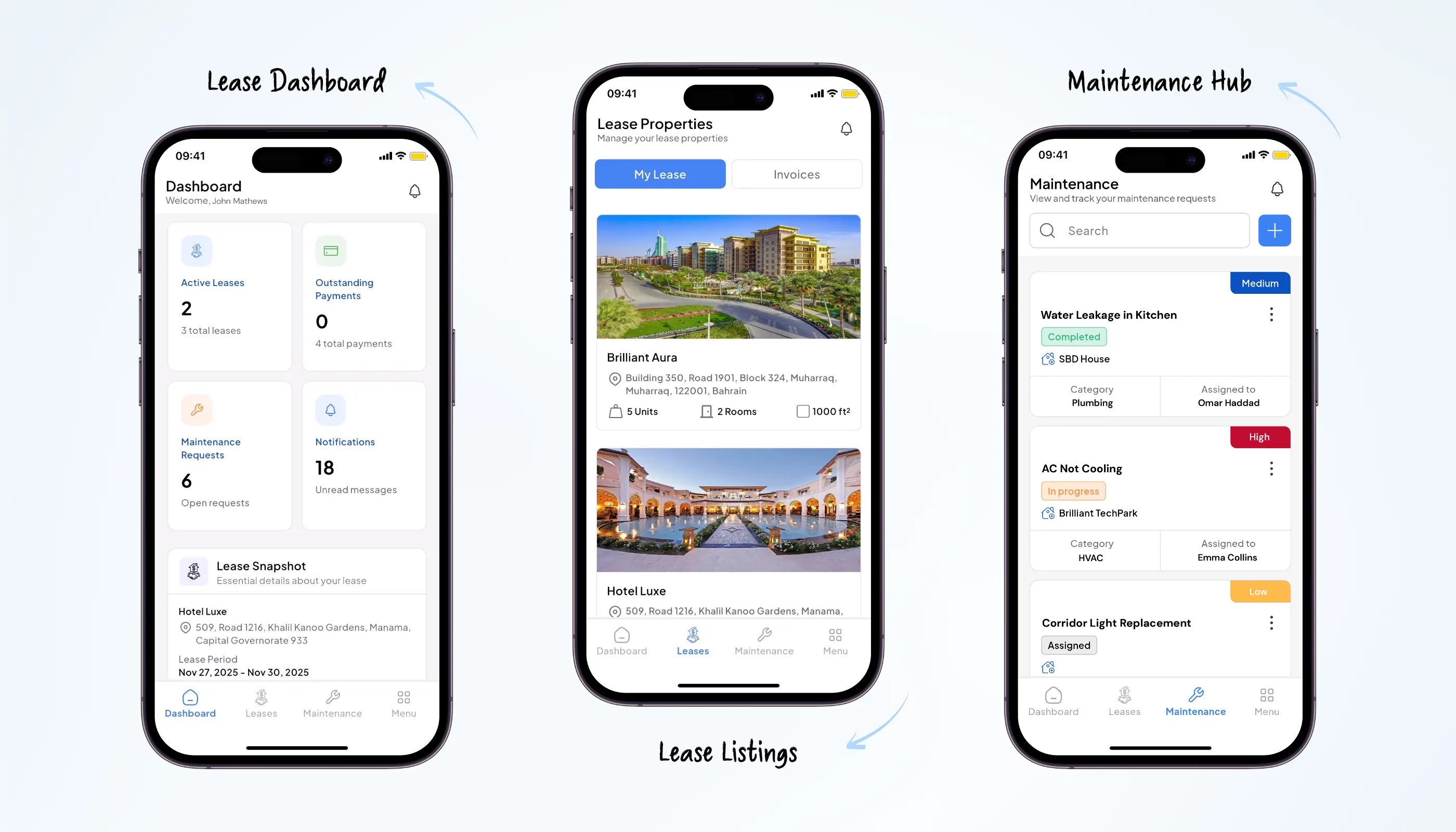
Before Occupy360, the organization operated through scattered tools, manual coordination, and limited visibility. Maintenance requests, tenant communication, and technician tracking lacked real-time structure, slowing down service delivery.
With Occupy360, these workflows moved into a single digital ecosystem. The platform centralizes leases, payments, maintenance, communication, and analytics-supported by AI-driven reminders, smart routing, and automated updates that accelerate daily operations.
Within the first months, the group saw:
- 40% faster maintenance resolution.
- Higher tenant satisfaction through self-service features.
- Better financial clarity with digital invoicing and tracking.
- Smarter decisions via live performance dashboards.
As one of Codiant’s flagship ready-to-go platforms, Occupy360 highlights how AI-powered systems are reshaping property management across the GCC and accelerating the UAE’s shift toward smarter, data-driven real estate operations.
Also read: How Much Does It Cost to Develop an AI System in Dubai?
What AI Means for Property Management?
AI is not a single tool; it is an intelligence layer that enhances core functions. In the UAE context, AI property management solutions combine:
- Machine learning for forecasting, rent pricing, and asset behavior
- NLP for understanding tenant messages
- Computer vision for property inspections
- Predictive analytics for maintenance
- Automation engines for workflows and approvals
- Integrations with IoT devices in buildings
This moves companies from manual, people-heavy operations to automated, self-learning systems that deliver consistency and speed at scale.
AI-Powered Tenant Management: Redefining Experience
Tenant experience is emerging as the competitive differentiator for UAE property operators. With growing options across Dubai and Abu Dhabi, tenants are more likely to stay with brands that deliver responsiveness, transparency, and simplicity.
AI is enabling that shift.
Key Capabilities
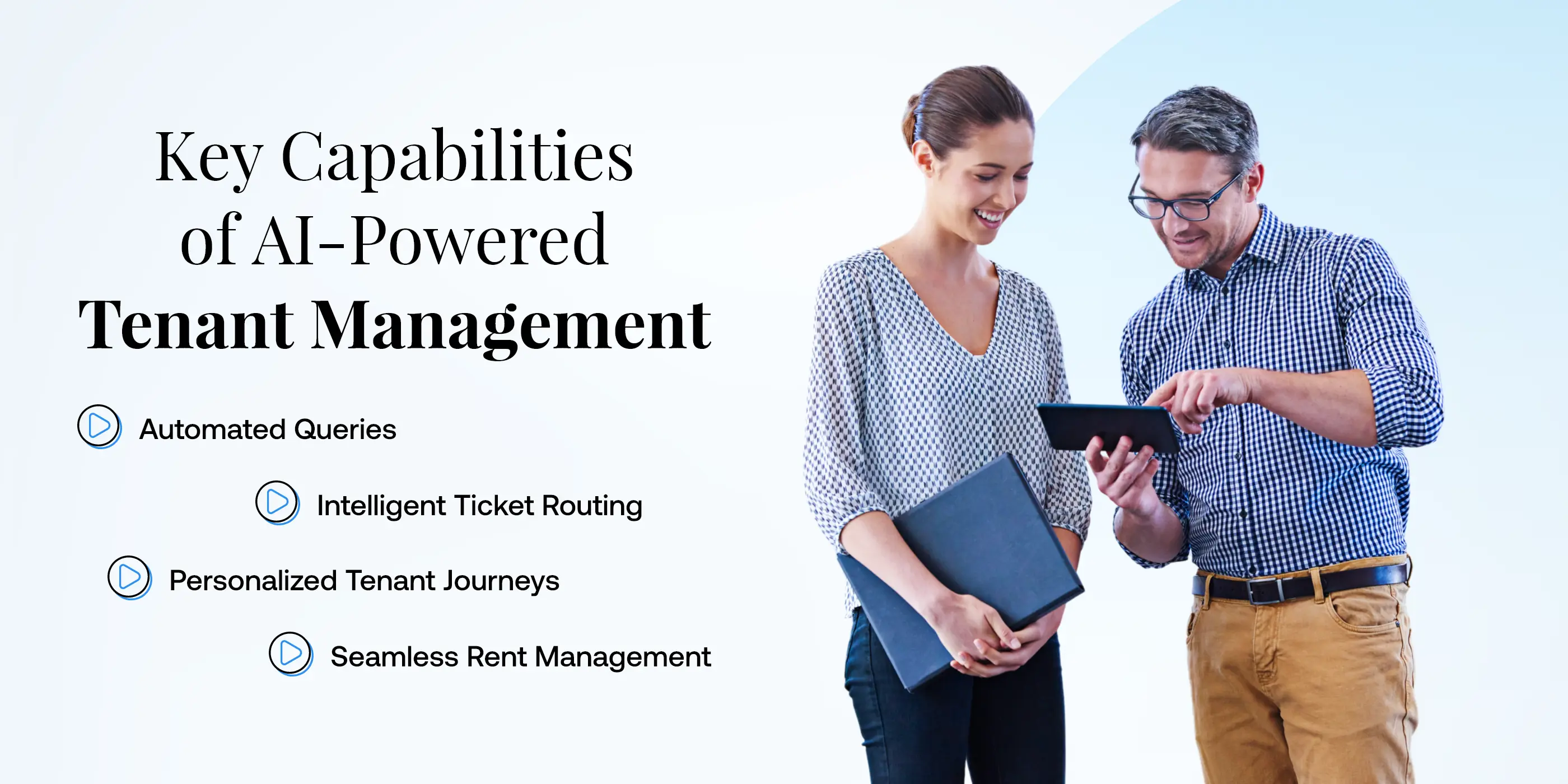
1. Automated Communication & Queries
AI chatbots for real estate UAE handle 60–80% of routine questions-rent schedules, maintenance status, lease agreements-freeing teams for complex requests.
2. Intelligent Ticket Routing
AI understands the nature of tenant issues and routes them automatically to the right technician or department, eliminating manual triaging.
3. Personalized Tenant Journeys
Using behavioral data, AI predicts renewals, flags disengaged tenants, and generates targeted communication that improves satisfaction and retention.
4. Seamless Rent Management
AI-based nudges, reminders, and digital payment flows improve on-time rent collection-especially valuable for large portfolios.
This marks the rise of AI-powered tenant management, where communication becomes instant, proactive, and consistently high-quality.
AI Chatbots for Real Estate in the UAE
With diverse tenant demographics and multilingual needs, property companies are increasingly turning to AI-driven conversational systems.
AI chatbots for real estate UAE offer:
- 24/7 support in English, Arabic, Hindi, Filipino, and more
- Instant responses for leasing, payments, and maintenance
- Integration with CRM, accounting, and ticketing systems
- Reduced call-center dependency
UAE companies adopting AI chatbots assistants report up to 50% lower support costs and significant increases in tenant satisfaction scores.
Predictive Maintenance Using AI in UAE Buildings
Facilities in the UAE endure extreme heat, humidity, and sand exposure-conditions that accelerate wear and tear. Predictive maintenance powered by AI and IoT solutions is proving invaluable.
How It Works
- Sensors monitor HVAC, water systems, electricity, elevators, and fire safety devices.
- AI models analyse patterns to detect failures before they occur.
- The system automatically creates maintenance tickets.
- Technicians are dispatched prior to downtime.
AI predictive maintenance UAE reduces emergency breakdowns by 30–50%, increases asset lifespan, and ensures uninterrupted tenant comfort.
For large communities, malls, and commercial buildings, this single capability can transform operations overnight.
AI Automation for Daily Property Management Tasks
Most UAE property operators still see AI as a set of tools. In reality, AI is becoming the operational backbone-a quiet, invisible infrastructure that stabilizes buildings, reduces uncertainty, and improves predictability.
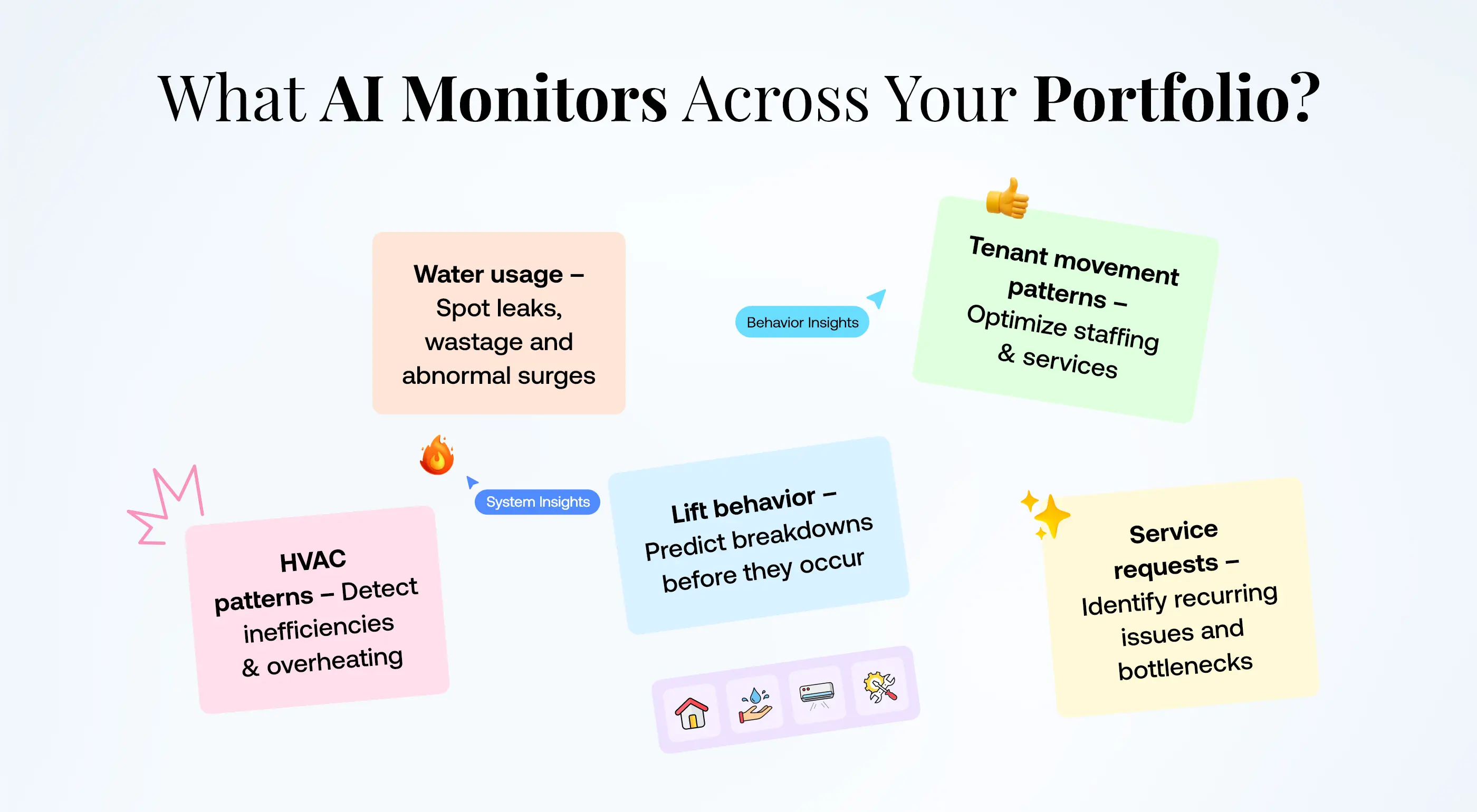
AI continuously interprets signals across HVAC systems, water usage, lift behavior, tenant movement patterns, and service requests. It converts this constant stream of noise into structured insights:
- Which assets are likely to fail next week?
- Which communities will see occupancy drop in Q2?
- Which tenant clusters require proactive engagement?
- Which buildings are experiencing unusual energy behavior?
This shift-from reactive maintenance to intelligence-driven operations-is what differentiates smart property management UAE from conventional models. Instead of adding more manpower, AI development solutions adds more situational awareness, which is far more scalable.
Companies that adopt AI early begin to manage buildings the way aviation manages flights: highly instrumented, constantly monitored, and predictable.
Common Data Gaps in UAE Real Estate Companies
The UAE property market generates enormous data-service requests, meter readings, tenant profiles, inspection images-but most companies remain insight-poor because teams rely on manual compilation.
AI eliminates this gap by building a unified intelligence layer that:
- Detects patterns humans cannot see
- Spots anomalies in occupant behavior
- Predicts budget deviations
- Benchmarks performance across buildings
- Connects tenant experience metrics with operational decisions
This is not about dashboards; it’s about decision intelligence.
A leading Dubai property operator recently discovered that 18% of its maintenance cost was spent on the same recurring defects across four communities-an insight surfaced only after deploying an AI anomaly-detection engine.
These are the types of revelations that change capital planning, vendor performance management, and team allocation.
AI transforms property companies from “managing issues” to engineering outcomes.
How AI Enhances Tenant Services?
UAE tenants today expect the same experience they get from global digital services-instant responses, multilingual support, mobile-first transactions, and proactive communication.
AI elevates the property experience from transactional to anticipatory.
What changes:
1. Zero-lag communication
Instead of 6-hour delays in email turnaround, AI assistants resolve 70–80% of tenant needs instantly-without increasing staff.
2. Situational empathy
AI systems recognize patterns (e.g., repeated AC complaints from the same unit) and escalate intelligently.
3. Predictive retention
Models identify at-risk tenants 3–4 months before their renewal date, enabling targeted retention actions.
4. Personalized living
Residents of modern communities increasingly receive tailored communication-service schedules, community alerts, payment nudges-each tuned to their behavior.
The result is not just efficiency; it’s a new service standard that becomes a brand advantage for UAE developers and property managers.
The Economics of AI: How UAE Operators Unlock 4 Levers of ROI
Unlike traditional software-which adds efficiency but not economic transformation-AI unlocks four distinct ROI levers:
1. OpEx Compression
Predictive maintenance and automated workflows remove 25–40% of avoidable operational cost.
2. Revenue Stabilization
Better tenant experience → higher retention → fewer vacancy months → stronger rental yield.
3. Asset Life Extension
AI-driven health monitoring extends the lifespan of HVAC, pumps, lifts, and energy assets by years.
4. Workforce Multiplier Effect
Teams don’t work harder-they work augmented.
A maintenance coordinator who handled 70 tickets per week can now manage 200+ with the same bandwidth. For UAE operators managing large portfolios, these levers compound into millions of dirhams saved annually.
This is where AI for landlords and property managers becomes strategic-not operational.
Bring UAE-Grade Efficiency to Your Property Portfolio.
Implement predictive, automated, always-on systems that align with Dubai’s smart-city vision and 2026 digital mandates.
AI for Faster and More Accurate Property Inspections
Manual property inspections are one of the most error-prone, subjective processes in UAE real estate. AI changes this dynamic with computer vision–verified inspections.
The strategic value:
• Every defect is timestamped, geo-tagged, and visually verified.
• Disputes drop sharply because evidence is objective.
• Snagging cycles for new handovers compress from weeks to days.
• Portfolios finally achieve inspection standardization across all communities.
In one Abu Dhabi community, AI-based inspection analysis surfaced defects previously unnoticed by human inspectors-resulting in a 14% reduction in tenant disputes during move-outs.
AI doesn’t make inspectors redundant-it makes them far more consistent, credible, and defensible.
How AI Unlocks a New Model of Facility and Asset Stewardship
Facility management teams in the UAE carry one of the highest operational loads globally due to climate intensity and high occupancy churn.
AI introduces a shift from asset upkeep to asset stewardship:
Before AI:
- Teams respond after failures occur
- Energy optimization depends on manual adjustments
- Maintenance planning uses fixed intervals
- Asset life cycles are estimated, not measured
After AI:
- Failures surface before tenants experience them
- Energy systems tune themselves based on predictive models
- Maintenance is dynamic and needs-based
- Asset decisions rely on data, not intuition
This transition is what separates legacy FM operations from AI in facility management UAE-a model where buildings essentially “self-report” their health.
AI in Property Management UAE: 4 Proven Strategies Used by Leading Operators
Many blogs talk about “AI adoption steps.” But UAE operators don’t transform in a linear path-they follow four practical playbooks observed in the market:
Strategy 1: Tenant Experience First
Start with AI chatbots, self-service portals, and automated communication.
This delivers immediate wins-higher satisfaction scores and reduced support load.
Best for: midsize property companies managing 1,000–8,000 units.
Strategy 2: Predictive Ops First
Begin with HVAC predictive maintenance, water pump monitoring, and intelligent ticket routing-especially in climates like the UAE.
Best for: communities, mixed-use developments, commercial towers.
Strategy 3: Inspection Modernization First
Deploy AI-driven inspections to standardize move-in/out, snagging, and compliance.
Best for: large developers and FM operators handling frequent turnovers.
Strategy 4: Portfolio Intelligence First
Integrate AI analytics to forecast rent, occupancy, NOI, and asset performance-ideal for companies aiming for portfolio-wide optimization.
Best for: developers and multi-city operators across Dubai, Abu Dhabi, Sharjah.
What’s common across all four?
They begin with a high-impact AI pilot, prove ROI fast, upskill their team, and then expand across the portfolio.
This is exactly how transformation becomes sustainable, not overwhelming.
Challenges in Implementing AI
Despite the benefits, real estate leaders face obstacles:
- Fragmented data across systems
- Limited AI skills in property teams
- Integration complexity with legacy platforms
- Resistance to process automation
- Budget allocation for digital transformation
However, modern AI platforms and solution providers reduce these barriers significantly through modular, plug-and-play implementations.
Related reading: AI in Real Estate Industry: A Transformative Revolution
How UAE Companies Can Begin Their AI Transformation?
A practical roadmap that many UAE operators follow:
1. Assess Operational Gaps
Identify repetitive processes, maintenance inefficiencies, and delays.
2. Choose Priority Use Cases
Most companies begin with tenant support automation or predictive maintenance.
3. Select Scalable AI Property Management Solutions
Modern systems offer pre-built modules for chatbots, inspections, workflows, and analytics.
4. Run a Pilot
Start with one building or community to prove ROI.
5. Train Teams & Standardize Workflows
Upskilling operational teams ensures long-term adoption.
6. Scale Across Portfolio
A phased rollout ensures stability and maximizes ROI.
This structured approach reduces risk and accelerates value creation.
The Future of Smart Property Management in the UAE
The next five years will see AI push the industry toward autonomous operations.
What’s coming:
- Self-healing buildings powered by AI
- Drone-based inspections
- Automated energy optimization
- Generative AI for contracts and documentation
- AI + Digital twins for large-scale communities
- Fully integrated IoT ecosystems
The UAE is positioned to lead this global shift, thanks to its smart-city vision and rapid technology adoption.
How Codiant Helps UAE Real Estate Companies Modernize With AI?
Codiant supports real estate developers, facility management firms, and property operators across the UAE in accelerating their digital transformation through tailored, high-impact AI solutions.
Our teams combine deep real-estate domain expertise with strong engineering capabilities to help companies automate operations, enhance tenant experience, and improve asset performance using scalable, region-ready technology.
We deliver AI-powered tenant communication systems, predictive maintenance models, automated inspections, and workflow automation tools that reduce operational load and increase service efficiency.
Codiant also integrates AI into existing PMS, ERP, FM, and IoT ecosystems ensuring smooth transition without disrupting day-to-day operations.
With modular AI components, fast implementation cycles, and a strong focus on ROI, Codiant enables property management companies to move from manual processes to data-driven, intelligent operations.
For UAE real-estate leaders seeking future-ready transformation, Codiant offers the technical foundation and strategic guidance to scale with confidence.
Conclusion
AI is no longer a future trend-it is the driving force behind the next phase of UAE real estate evolution. Property management companies that adopt AI early gain faster operations, stronger tenant satisfaction, higher occupancy, and a competitive advantage in an increasingly sophisticated market.
Across Dubai and Abu Dhabi, forward-thinking operators are already integrating predictive maintenance, AI chatbots, automated inspections, and smart workflows into their daily operations. As the landscape grows more competitive, companies that invest in AI today will define the next decade of operational excellence.
For UAE property management teams exploring modernization, AI-powered platforms provide a practical path to automate, optimize, and scale with confidence-helping landlords and developers stay ahead in a fast-changing market.
Give Your Property Portfolio a Smart Upgrade!
Deploy AI tools tailored for UAE real estate – faster maintenance, better insights, and happier tenants.
The Author

Frequently Asked Questions
AI is used to automate tenant queries, predict equipment failures, streamline maintenance workflows, analyse building data, optimize rent pricing, and support inspections through image recognition.
AI helps real estate companies improve tenant experience, reduce manual workload, speed up decision-making, prevent equipment downtime, and run operations with more accuracy and transparency.
Yes. By automating routine tasks and predicting maintenance issues early, AI can lower operating costs by 25–40% depending on portfolio size.
Sensors collect data from HVAC, water, and electrical systems. AI analyses these patterns to detect abnormalities and alerts teams before a failure occurs, preventing costly breakdowns.
There isn’t a single “best” solution. The ideal platform depends on portfolio size, workflows, and integration needs. Many firms use modular AI tools that plug into their existing systems.
AI chatbots provide 24/7 support, answer common questions instantly, track requests, and offer updates—reducing response time and improving tenant satisfaction.
Yes. AI can detect issues in photos and videos, classify maintenance requests, prioritize tasks, and generate reports with high consistency.
Most AI tools offer APIs that connect to current CRMs, ERPs, facility systems, and ticketing platforms. Integration usually starts with one workflow—like tenant support or maintenance.
AI can automate tenant queries, job assignments, rent reminders, document processing, inspection analysis, contract management, and maintenance scheduling.
By predicting issues early, automating repetitive tasks, and optimizing technician schedules, AI reduces emergency repairs and lowers resource waste.
Yes. Modern AI solutions are designed to layer on top of existing software through APIs, webhooks, and data connectors.
AI ensures fast responses, transparent updates, personalized reminders, and consistent communication across WhatsApp, email, web portals, and mobile apps.
AI platforms must follow UAE data protection rules, use encrypted data storage, secure APIs, role-based access controls, and comply with local cybersecurity standards.
Featured Blogs
Read our thoughts and insights on the latest tech and business trends
Why UAE Companies Must Adopt AI & Automation Before Q1 2026
- December 11, 2025
- Artificial Intelligence
In a Nutshell 2026 is the inflection point where AI shifts from a competitive advantage to a basic operational requirement in the UAE. Vision 2030 policies are moving from planning to execution, accelerating digital mandates... Read more
How AI Helps eCommerce Businesses Scale Faster: 10+ Proven Strategies
- December 4, 2025
- E-commerce
Running an eCommerce business today means managing more products, more customers, and more data than most teams can handle manually. As order volumes rise, tasks like customer support, inventory planning, product discovery, and marketing start... Read more
How to Choose the Right AI Solutions for Your Existing App
- December 1, 2025
- Artificial Intelligence
Businesses today are under pressure to move faster, deliver personalized experiences, and operate with greater accuracy. This is why many enterprises and startups are now looking for ways to add AI features to their mobile... Read more