Why UAE Companies Must Adopt AI & Automation Before Q1 2026
Table of Contents
Subscribe To Our Newsletter
In a Nutshell
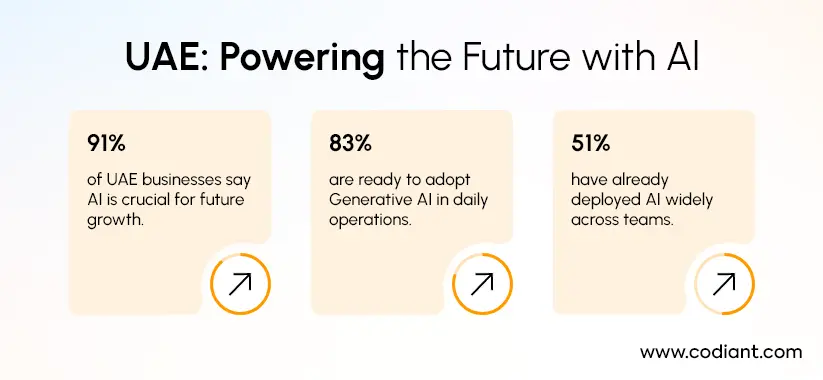
- 2026 is the inflection point where AI shifts from a competitive advantage to a basic operational requirement in the UAE.
- Vision 2030 policies are moving from planning to execution, accelerating digital mandates across real estate, banking, logistics, retail, and public services.
- UAE customers now expect AI-powered speed, personalization, and 24/7 service, making manual processes unsustainable.
- Regional competition is intensifying, with Saudi Arabia, Qatar, and Bahrain investing aggressively in AI raising the bar for UAE enterprises.
- AI delivers measurable ROI within 60–120 days, including lower operational costs, faster workflows, and improved customer satisfaction.
- Companies that delay adoption risk higher costs, customer churn, and widening technology debt, making future transformation harder.
- SMEs benefit equally, using AI to automate tasks, scale without large teams, and compete with enterprise players.
- A structured AI adoption roadmap – use case identification, data readiness, pilots, cross-department automation, and enterprise scaling is essential for UAE businesses to stay future-ready.
The UAE has always moved faster than the rest of the world-whether it’s building world-class cities in record time, powering digital government initiatives, or adopting emerging technologies long before they become mainstream. But as we move toward Q1 2026, a new wave of urgency is rising across boardrooms, operations floors, and digital transformation teams.
AI is no longer an upgrade. It’s becoming the baseline for how UAE companies run, scale, and compete.
From AI adoption in UAE businesses to nationwide commitments under UAE Vision 2030 AI initiatives, the message is clear: companies that embrace AI and automation now will thrive in the next decade. Those who delay will fall behind in a market where speed, efficiency, and intelligence define every advantage.
This blog breaks down why 2026 is the inflection point, how fast industries are shifting, and what UAE enterprises must do today to stay ahead of the curve.
The 2026 Turning Point: Why UAE Businesses Can’t Wait Any Longer
The Gulf region is entering an unprecedented transformation cycle. Between 2024 and 2026, the UAE is expected to see:
- Explosive growth in AI automation solutions
- Stricter digital governance frameworks
- A surge in AI-powered customer expectations
- Massive productivity improvements driven by automation
- New business models powered by generative AI, predictive intelligence, and autonomous systems
But why Q1 2026 specifically?
Because three forces are converging simultaneously:
1. Vision 2030 AI Mandates Are Moving From Policy → Execution
The UAE government is pushing strong incentives for digital transformation. Regulators, free zones, and industry bodies are rolling out guidelines that favor AI-first operations across real estate, logistics, energy, finance, and retail.
2. Consumers Expect AI-Driven Experiences
UAE customers have higher digital expectations than global averages.
Instant responses. 24/7 support. Personalized interactions. Smart recommendations.
If your business doesn’t deliver this by 2026, someone else will.
3. Competitive Pressure From the Region
Saudi Arabia, Qatar, and Bahrain are investing billions in national AI strategies.
Regional competition is intensifying.
UAE companies cannot afford to wait.
Accelerate Your 2026 AI Readiness
Build intelligent workflows, automated operations, and AI-powered customer experiences with Codiant-your end-to-end AI transformation partner.
How AI Is Transforming UAE Industries in Real Time?
AI isn’t theoretical anymore-it’s live inside UAE enterprises today. And it’s reshaping everything from operations to customer experience.
Below is a sector-wise look at How UAE businesses use AI right now.
Real Estate & Property Management
The UAE property market thrives on speed, transparency, and premium service-making it one of the strongest adopters of AI.
Large developers and facility management companies are using AI to handle everything from tenant communication to equipment health monitoring. Instead of relying on manual inspections or delayed emails, AI now anticipates problems before they occur.
Where AI is making impact:
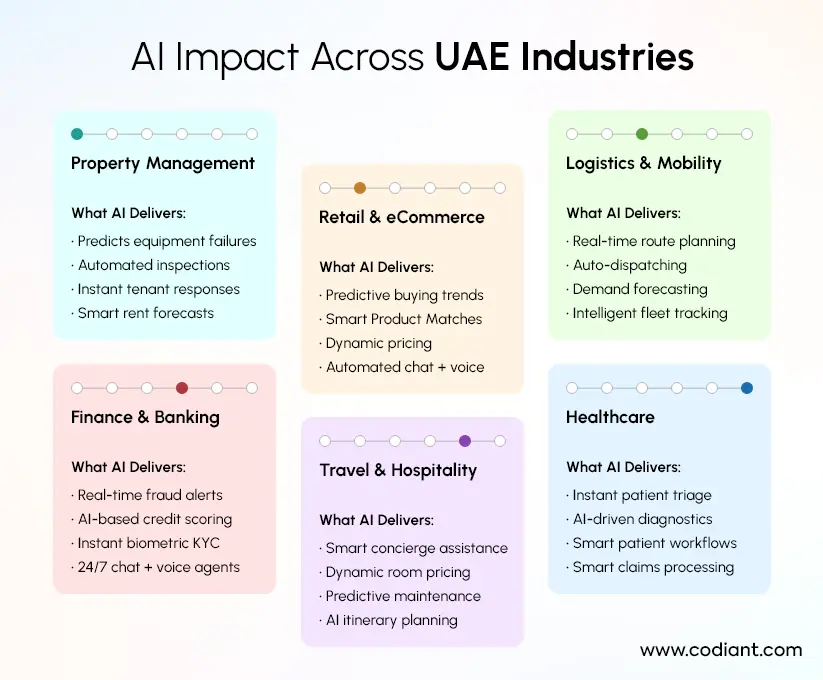
- Predictive maintenance prevents sudden AC or elevator failures during peak season.
- AI-driven tenant support answers queries instantly, reducing response time by nearly 80%.
- AI-powered inspections cut manual site visits by 60%, improving accuracy and consistency.
- Automated rent forecasting helps property teams anticipate market trends.
For a market built on premium living standards, this shift isn’t optional-it’s becoming the new definition of smart property management UAE.
Retail & eCommerce
The retail sector is undergoing a massive AI-driven upgrade as shoppers demand more personalized, faster, and seamless experiences-both online and offline.
UAE brands are using AI to:
- Predict buying patterns weeks in advance
- Recommend products tailored to user behavior
- Optimize pricing dynamically during promotions
- Automate customer service through AI chat and voice bots
Fast-growing eCommerce brands highlight that AI-led personalization alone has improved conversions by 20–30%. Meanwhile, automated fulfillment and forecasting reduce stockouts, increase repeat purchases, and elevate customer experience across digital commerce platforms.
In a country with a booming online shopping culture, AI is quickly becoming the engine behind consistent conversions and higher shopper satisfaction.
Logistics & Mobility
Logistics companies in the UAE face constant pressure: faster deliveries, rising fuel prices, and volatile demand patterns. AI helps them stay ahead by turning operational chaos into predictable, optimized workflows.
AI tools now support:
- Real-time route optimization to reduce delivery times
- Intelligent fleet tracking for safety and transparency
- Demand forecasting that predicts upcoming delivery surges
- Automated dispatching based on driver availability, load type, and route
The impact is immediate. Companies report:
- Lower operational costs
- Fewer delays
- Faster decision-making
- Smoother end-to-end execution
In a region where mobility and logistics underpin almost every sector, AI is becoming the secret advantage behind speed, precision, and reliability.
Finance & Banking
The UAE financial sector has always been ahead of global digital adoption trends-and AI is now accelerating that lead.
Banks and fintech platforms are using AI to enhance security, personalize banking, and automate back-office operations.
Key adoption areas include:
- Fraud detection using real-time anomaly detection models
- Risk scoring and credit assessment powered by machine learning
- Identity verification through biometric and document AI
- Chatbots and voice agents that reduce support load by 60–80%
From instant KYC to AI-driven loan approvals, financial institutions are proving that AI for business growth UAE is not just about efficiency-it’s about transforming trust, security, and customer value, especially when partnered with a reliable mobile app development company in UAE.
Travel & Hospitality
The UAE’s tourism industry thrives on luxury, personalization, and memorable experiences. AI is now helping hotels, resorts, and travel operators deliver that at scale.
How AI elevates travel:
- Smart concierge services offering instant multilingual assistance
- Demand-based room pricing to maximize occupancy
- Predictive maintenance to avoid service disruptions
- AI itinerary planners that customize recommendations for each traveler
Major hospitality groups are also using AI to predict seasonal patterns, optimize staffing, and tailor offers to guest preferences-creating hyper-personalized experiences for millions of visitors.
In a competitive tourism market, AI is becoming the invisible force behind delight, efficiency, and operational excellence.
Healthcare
Healthcare in the UAE is shifting toward intelligent, patient-centric models-and AI is leading the charge.
Hospitals, clinics, and diagnostic centers now use AI to:
- Automate patient workflows from registration to discharge
- Assist clinicians with AI-powered diagnostic recommendations
- Triage patient queries through conversational AI
- Automate insurance claims using document intelligence
With faster turnaround times, fewer errors, and more consistent care delivery, AI is transforming how medical services operate, enabling smarter clinical decisions and streamlined workflows. Through AI healthcare automation in UAE, providers are enhancing operational efficiency, improving patient outcomes, and delivering safer, more connected healthcare experiences at scale.
The ROI: What UAE Companies Gain by Adopting AI Today
Every boardroom wants numbers, not hype. Here are tangible gains UAE businesses are experiencing through AI:
1. Up to 40% reduction in operational costs
Automation eliminates repetitive processes, manual tasks, and inefficiencies.
2. 2–3X faster workflow execution
AI eliminates bottlenecks across HR, finance, operations, and sales.
3. 70–80% of customer queries resolved instantly
Conversational AI reduces support workload, improves satisfaction, and boosts brand loyalty.
4. 30–50% improvement in productivity
AI assistants, predictive analytics, and automation pipelines empower teams to work smarter.
5. Higher revenue through personalization
AI-driven recommendations and customer insights drive conversions across industries.
These are the real AI benefits for UAE companies-and businesses adopting early will lead the next growth wave.
Unlock UAE-Ready AI Solutions Built for Immediate ROI
Codiant helps enterprises accelerate automation, modernize workflows, and achieve fast, measurable impact with AI.
If you’re ready to scale intelligently, we’re ready to guide you.
Accelerate your AI journey with Codiant.
The Hidden Cost of Waiting Until After 2026
Companies delaying AI adoption face far bigger risks than they realize.
You will lose customers.
UAE customers prefer AI-enabled brands that respond instantly, personalize experiences, and deliver convenience.
Competitors will outrun you.
AI-first companies scale 4X faster because their operations run on data, not guesswork.
Your workforce will slow down.
Teams that rely on outdated processes cannot match the efficiency of AI-powered operations.
Integration costs will rise.
The longer you wait, the harder and more expensive it becomes to transition.
Tech debt will pile up.
Legacy systems become harder to modernize each year.
This is why Why UAE companies need AI is not just a trend-it’s a survival factor.
Why AI Matters Even More for UAE SMEs
AI is no longer a big-enterprise-only strategy. SMEs across the UAE are adopting automation to compete with larger players without increasing operational costs.
AI for SMEs in UAE enables:
- Automated invoicing
- AI-driven marketing
- Customer support bots
- Smart CRM insights
- Inventory forecasting
- Fraud detection
- Automated reporting
Small companies are seeing massive impact with minimal investment.
Related reading: How to Build an AI-Powered Queue Management System in Dubai, UAE
The AI Adoption Roadmap for UAE Companies
Most UAE organizations want to adopt AI, but many don’t know where to start or how to scale without disrupting current operations. The roadmap below breaks AI adoption into a clear, actionable sequence tailored for the region’s business environment-fast-moving, competitive, and aligned with Vision 2030 ambitions.
This is the practical, UAE-ready blueprint for moving from early experimentation to enterprise-wide automation between 2024 and 2026.
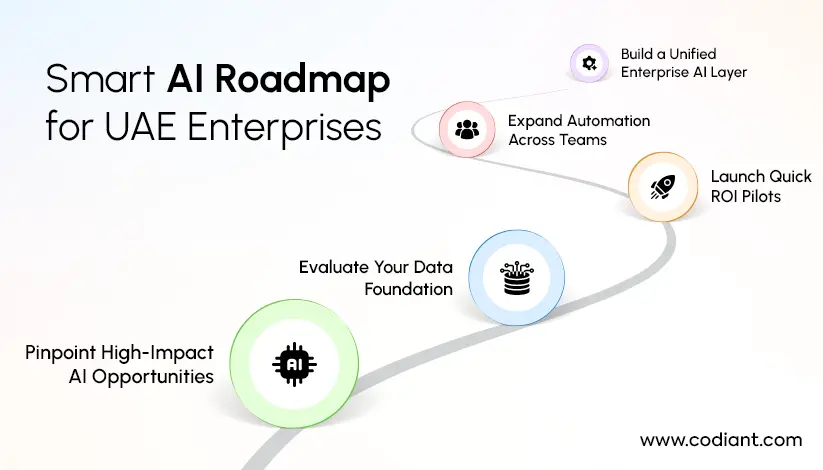
Step 1: Identify Priority Use Cases
Every AI journey begins with clarity-not technology. UAE businesses should start by identifying the 3–5 high-impact opportunities where AI can deliver measurable improvements within 60–120 days. Typically, these overlap with:
- Customer service (chatbots, voice bots, ticket triage)
- Back-office automations (finance, HR, documentation)
- Sales & marketing (campaign automation, lead scoring, personalization)
- Logistics and field operations (route optimization, dispatch automation)
- Real estate operations (tenant management, maintenance alerts)
The goal at this stage is simple: start small, pick easy wins, and build confidence internally.
UAE enterprises that begin with clear use cases see faster ROI and smoother adoption across teams.
Step 2: Assess Data Readiness
AI is only as powerful as the data behind it. Before deploying any models or automation pipelines, companies must evaluate the following:
- Data quality: Is information clean, accurate, and updated?
- Data accessibility: Do teams have access to the right data, or is data siloed?
- Data sources: CRM, ERP, IoT systems, emails, forms, customer chats-what needs integration?
- Security & compliance: Does the current infrastructure meet UAE data governance requirements?
- Cloud maturity: Are systems ready for scalable AI workloads?
This phase ensures your AI systems don’t just “work”-they work accurately, securely, and consistently.
Most UAE businesses find this step transformative because it gives them visibility into the gaps slowing down growth.
Step 3: Build Pilot Projects
Pilot projects are the bridge between intention and impact. Instead of attempting a full-company overhaul, UAE companies should begin with 1–2 controlled, measurable pilots such as:
- A conversational AI assistant for customer queries
- Automated reconciliation for finance
- AI-based demand forecasting for inventory
- Predictive maintenance model for facility or equipment
- Workflow automation for HR or procurement
A pilot shouldn’t take more than 6–10 weeks and must deliver visible ROI-higher efficiency, reduced cost, faster turnaround time, or increased customer satisfaction.
These early wins become powerful internal momentum builders.
Step 4: Integrate Automation Across Departments
Once AI value is proven, it’s time to scale horizontally across the organization. This is where companies start integrating AI into end-to-end workflows, not just isolated tasks.
Common enterprise-wide automation uses cases in UAE companies include:
- Employee onboarding automation
Smart workflows that handle paperwork, ID verification, training, and access setup. - Predictive maintenance
AI models analyze equipment, building systems, or fleet assets to prevent failures. - Intelligent workflow routing
AI routes tasks, tickets, and approvals to the right teams automatically. - Document intelligence
Automated document reading, extraction, validation, and filing for contracts, invoices, and compliance forms. - Conversational AI
Chatbots and voice bots that handle customer support, internal ops queries, and HR support 24/7.
By this stage, AI is no longer a project-it becomes a connected automation layer powering multiple department simultaneously.
This is how automation in UAE enterprises transitions from isolated experiments to a full operational backbone.
Step 5: Scale with Enterprise AI Platforms
Scaling AI requires more than adding new tools. It requires building a unified intelligence layer that connects data, teams, and processes across your organization.
This means:
- Creating a centralized AI hub instead of scattered tools
- Integrating all models, workflows, and data pipelines
- Establishing governance, monitoring, and version control
- Training teams to work with AI systems confidently
- Upgrading legacy tech to be AI-compatible
- Building long-term automation strategies aligned with Vision 2030
At this stage, UAE companies shift from “using AI” to becoming AI-powered organizations.
The transformation becomes:
- Technical-modernizing systems and workflows
- Strategic-aligning AI with business goals
- Cultural-building a workforce comfortable with automation
- Operational-running the business with intelligence at every layer
This is the phase where UAE enterprises see the biggest benefits: reduced costs, higher productivity, stronger customer loyalty, and faster scaling.
Also read: How AI Is Transforming Property Management in the UAE
Vision 2030: How the UAE Is Accelerating AI at a National Level
To truly understand the urgency, you must understand the bigger picture.
The UAE is investing heavily in:
- National AI talent development
- AI research labs
- Smart city ecosystems
- AI-driven public services
- Cloud modernization
- Autonomous mobility
- Energy optimization
Every major policy signals one thing: AI is the center of national progress. That’s why AI transformation UAE is not optional-it’s the new foundation of economic competitiveness.
How Codiant Can Help UAE Enterprises Accelerate AI Adoption?
Codiant partners with UAE organizations to move from experimentation to enterprise-wide AI transformation with measurable ROI and minimal disruption.
Our AI experts help companies modernize operations, automate workflows, and build scalable intelligence layers aligned with Vision 2030.
We support you across the entire journey:
• Identifying high-impact AI use cases
• Implementing conversational AI, automation, and predictive systems
• Integrating AI into existing ERPs, CRMs, and cloud platforms
• Creating long-term AI roadmaps tailored to UAE regulations and industry needs
Codiant ensures your business becomes future-ready – faster, smarter, and AI-powered.
Conclusion: 2026 Is Not the Future-It’s the Deadline
As we move toward 2026, businesses partnering with an AI Development Company in UAE are already gaining the speed, intelligence, and automation required to compete. By Q1 2026, AI won’t be a differentiator it will be the basic standard for operating in the UAE region.
Companies that adopt it now will accelerate, while those that wait will spend years catching up. The decision is simple: Adopt AI early, or fall behind in a market designed for speed, intelligence, and automation. Businesses looking to scale smarter can hire enterprise software developers in UAE to build AI-driven solutions that ensure long-term competitive advantage.
Future-Proof Your Business Before 2026 Arrives
Transform operations, enhance customer experiences, and unlock new revenue with enterprise-grade AI and automation.
The Author

Frequently Asked Questions
Because by 2026, AI will shift from a competitive advantage to a basic business requirement. Companies that adopt early enjoy faster operations, lower costs, and higher customer satisfaction-while late adopters struggle with rising tech debt and tougher competition.
The UAE government is investing heavily through Vision 2030, national AI policies, digital government initiatives, and AI-friendly regulations. Free zones and ministries actively support enterprises with AI sandboxes, incentives, and technology infrastructure.
AI helps companies automate manual work, reduce operational costs, improve customer experience, predict demand, and make faster data-backed decisions. It accelerates growth while strengthening long-term competitiveness.
Real estate, retail, logistics, banking, hospitality, travel, and healthcare are seeing the fastest gains. However, almost every UAE industry-from SMEs to large enterprises-can benefit from AI-driven automation.
Yes. AI cuts costs by automating repetitive tasks, reducing errors, improving workforce productivity, preventing equipment failures, and speeding up customer support. Most companies see 20–40% cost savings.
Most UAE companies see measurable results within the first 60–120 days. Pilots in customer support, workflows, and predictive maintenance often deliver the fastest returns.
Delayed companies face higher integration costs, slower operations, customer churn, and stronger competition. Waiting makes transformation harder as AI becomes the market standard by 2026.
By connecting AI tools to existing ERPs, CRMs, cloud systems, and databases. Modern APIs, automation engines, and data pipelines make integration smooth without disrupting daily operations.
Changing customer expectations, Vision 2030 acceleration, rising competition, increasing operational costs, and the need for faster digital transformation all make early adoption critical.
AI automates routine work, eliminates manual errors, optimizes resource usage, handles support queries instantly, and predicts operational issues-helping teams work faster and smarter.
Conversational AI, workflow automation, predictive maintenance, document intelligence, and AI-powered analytics deliver quick wins and immediate business impact.
Start with assessing data readiness, selecting priority use cases, launching small pilots, integrating automation tools, and then scaling with a unified AI platform.
Yes. AI tools today are cloud-based, affordable, and easy to integrate. SMEs can start small, automate key workflows, and scale gradually without needing large tech teams.
Featured Blogs
Read our thoughts and insights on the latest tech and business trends
How to Hire the Right Healthcare Software Development Company – Complete Guide
- April 8, 2026
- Healthcare
In a Nutshell Choosing the right healthcare software partner ensures long-term success outcomes. Healthcare software requires domain expertise, compliance knowledge and technical capabilities. Always prioritize HIPAA compliant software development for secure patient data. Evaluate company... Read more
AI Tools vs Custom AI Development- Which One Fits Your Business Model?
- April 6, 2026
- Artificial Intelligence
In a Nutshell AI tools offer quick setup but limited flexibility for businesses. Custom AI solutions adapt deeply to unique workflows and requirements. AI SaaS tools reduce upfront costs but increase long-term expenses. Custom AI... Read more
Mobile App Personalization Using AI- Benefits, Use Cases & Implementation
- March 31, 2026
- Artificial Intelligence
In a Nutshell: AI helps mobile apps understand users and personalize experiences effectively. Apps learn from user behavior, improving recommendations over time automatically. Personalized content increases engagement, making users spend more time inside. AI driven... Read more