
HospitraCare - Smart Healthcare Platform for Modern Hospitals and Clinics
HospitraCare is a hospital and clinic management system designed to streamline operations, manage patient workflows, and improve care delivery for healthcare providers.
Book a Demo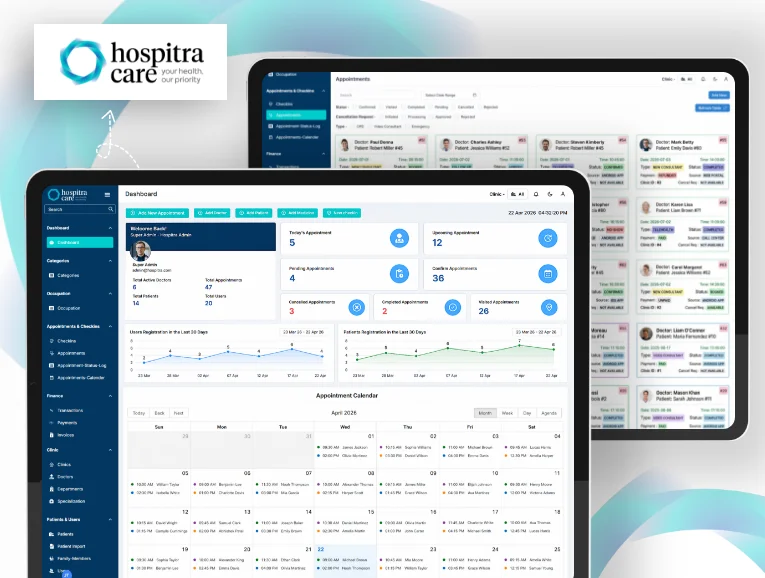
About the project
HospitraCare is a market-ready hospital and clinic management platform designed to streamline operations, manage patient workflows, and digitize healthcare delivery. It supports providers with unified tools for scheduling, EMR, billing, and teleconsultation, improving efficiency, accuracy, and overall patient experience.
Challenge
Healthcare providers relied on disjointed systems for appointments, records, billing, and consultations, causing operational inefficiencies and data silos. Existing tools lacked unified workflows and scalability. Codiant identified the need for an integrated platform that simplifies management while ensuring compliance, real-time access, and seamless coordination across stakeholders.
Approach
Codiant’s product and engineering teams collaborated to design a unified healthcare platform focused on usability and scalability. Extensive workflow mapping and feature prioritization ensured critical modules like patient management, billing, and telehealth were tightly integrated. Agile development enabled rapid iterations, ensuring a stable, market-ready system aligned with real-world clinical and administrative needs.
Discovery phase
Conducted stakeholder analysis across clinics, doctors, and administrative staff to identify workflow bottlenecks, inefficiencies, and essential system requirements.
Market Research
The global healthcare IT market is projected to exceed $974 billion by 2030, growing at a CAGR of 17%.
The Gap
Existing healthcare systems operated in silos, lacking unified control across clinical, administrative, and financial workflows. HospitraCare addressed this by delivering a centralized platform integrating patient management, billing, telehealth, and analytics into one scalable ecosystem.
Audience Struggles
Fragmented Systems: 68% clinics used multiple tools, causing workflow delays and errors.
Operational Inefficiency: 54% staff time lost managing manual scheduling and records.
Revenue Leakage: 37% clinics faced billing inaccuracies impacting overall financial performance.
User Insights
| Tasks | Emotions | Challenges | Opportunities |
|---|---|---|---|
| Patient Registration | 😓 Overloaded | Manual entry and fragmented records slow patient onboarding and increase administrative burden. | Digital intake forms with centralized records enable faster, error-free patient onboarding across departments. |
| Appointment Scheduling | 😣 Frustration | Managing appointments across doctors and locations leads to conflicts, delays, and missed slots. | Smart scheduling with real-time availability ensures efficient booking and reduced patient wait times. |
| Medical Records Access | 😕 Confusion | Patient history scattered across systems makes it difficult for doctors to access complete information quickly. | Unified EMR system provides instant access to patient history, improving diagnosis and care continuity. |
| Prescription Management | 😟 Pressure | Writing and managing prescriptions manually increases errors and consumes valuable consultation time. | Digital prescription tools standardize entries, reduce errors, and speed up doctor workflows. |
| Billing & Payments | 😤 Stress | Complex billing processes and manual calculations lead to inaccuracies and delayed payments. | Automated billing with integrated payments ensures accuracy, transparency, and faster revenue cycles. |
| Queue & Check-In | 😠 Anxiety | Long waiting times and lack of visibility frustrate patients and disrupt clinic flow. | QR-based check-in and live queue tracking improve patient experience and clinic efficiency. |
| Reporting & Insights | 😐 Uncertainty | Lack of real-time data makes it difficult to track performance, revenue, and patient trends. | Real-time dashboards provide actionable insights for better decision-making and operational control. |
| Multi-Clinic Management | 😵 Complexity | Managing multiple locations without centralized control leads to inconsistencies and inefficiencies. | Centralized admin controls enable seamless management across clinics with unified data visibility. |
Opportunity
Healthcare providers relied on disconnected systems for appointments, records, billing, and consultations, creating inefficiencies and operational silos. Existing tools lacked integration and scalability. HospitraCare addressed this gap with a unified platform that streamlines workflows, improves coordination, and reduces administrative overhead across clinics and hospitals.
Execution Timeline
1. Research & Discovery
2. Structure & Concept
3 Weeks3. Design & Prototyping
4 Weeks4. Development & Testing
12 WeeksResearch Phase
Codiant conducted in-depth research across clinics, hospitals, /and administrative teams to understand workflow gaps and operational bottlenecks. The study revealed heavy reliance on manual processes, lack of real-time visibility, and poor system interoperability. Insights highlighted the need for a unified solution that simplifies workflows while ensuring scalability, usability, and compliance across healthcare environments.
Visual Research
A detailed analysis of existing healthcare platforms revealed cluttered interfaces and complex navigation flows that increased cognitive load for users. The product design focused on simplicity, structured layouts, and intuitive workflows. Key takeaways included minimizing steps for critical actions, improving accessibility of patient data, and creating a clean interface for faster decision-making.
User Persona Development

Dr. Tyler Donovan
42
General Physician & Clinic Owner
Austin, USA
Persona Snapshot:
A practice-focused healthcare provider aiming to streamline clinic operations while improving patient care and reducing administrative workload.
Goals:
Improve patient flow and reduce waiting time across daily appointments
Increase operational efficiency while maintaining accurate patient records
Optimize revenue through streamlined billing and reduced errors
Challenges:
Disconnected systems create delays in accessing patient information
Manual processes increase workload and reduce consultation efficiency
Limited visibility into clinic performance impacts decision-making
How HospitraCare Helps:
- Unified EMR system enables faster access to patient data and improves care delivery.
- Automated scheduling reduces no-shows and optimizes daily operations.
- Integrated billing system improves accuracy and accelerates revenue collection.

Rachel Sinclair
35
Hospital Operations Manager
New York, USA
Persona Snapshot:
An operations-focused manager responsible for optimizing hospital workflows, improving coordination, and ensuring smooth day-to-day administrative functioning.
Goals:
Streamline multi-department coordination and reduce operational delays
Improve reporting visibility for better resource and performance management
Ensure compliance while maintaining efficient administrative workflows
Challenges:
Lack of centralized systems creates communication gaps across departments
Manual reporting delays decision-making and reduces operational efficiency
Managing multiple clinics without unified control leads to inconsistencies
How HospitraCare Helps:
- Centralized admin dashboard provides unified control and improves coordination.
- Real-time analytics enable better visibility for data-driven decisions.
- Multi-clinic management ensures consistent workflows across locations.
Ideation
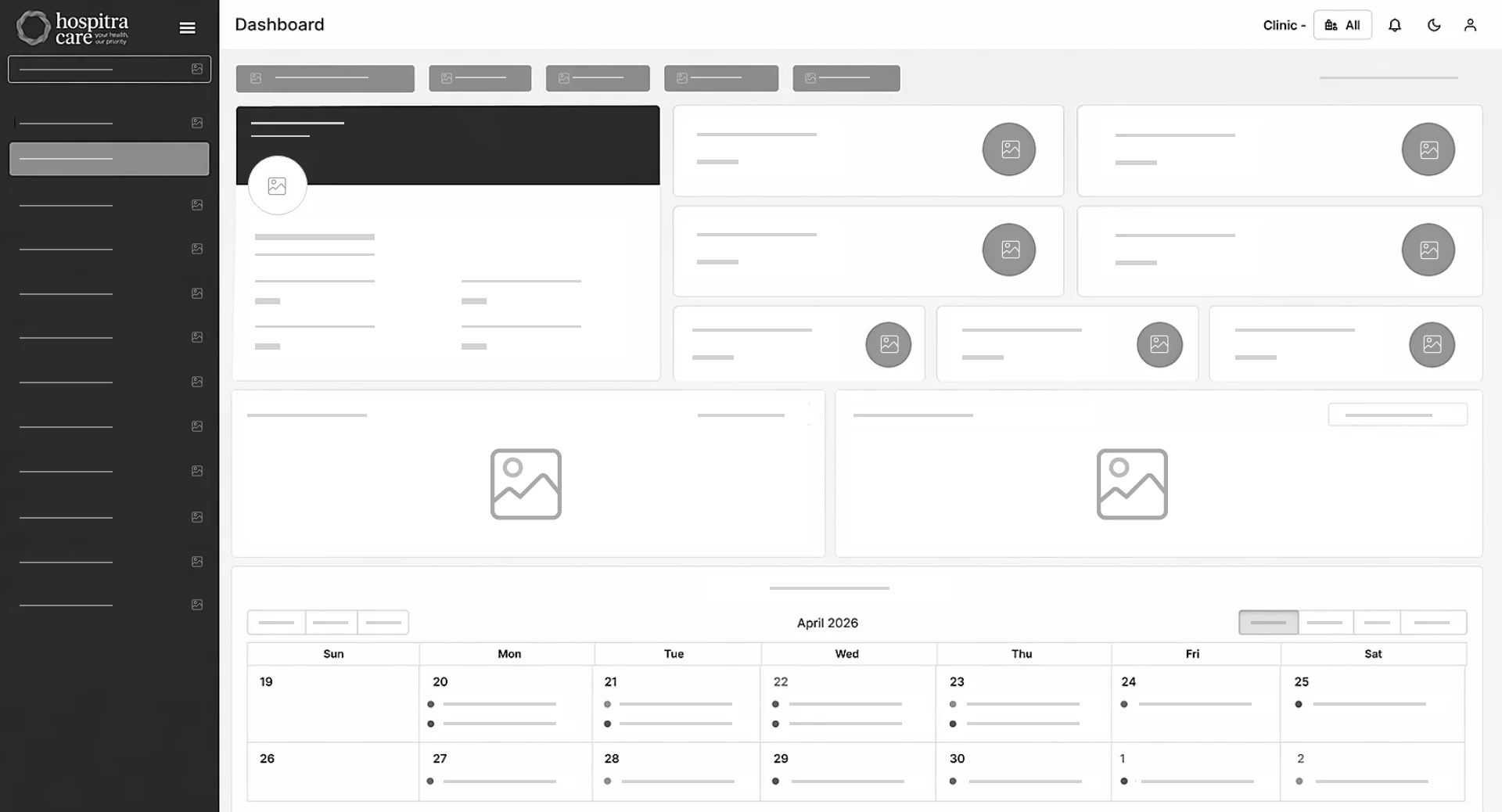
The ideation phase was driven by insights from healthcare providers, administrators, and front-desk staff facing fragmented workflows and operational inefficiencies. The core focus was to design a system that simplifies daily tasks while improving speed and decision clarity. Early concepts prioritized unifying patient management, scheduling, and billing into a single interface. Each idea was shaped around real clinical scenarios, ensuring usability across roles. Initial sketches emphasized reducing manual steps, minimizing data duplication, and enabling seamless coordination across departments.
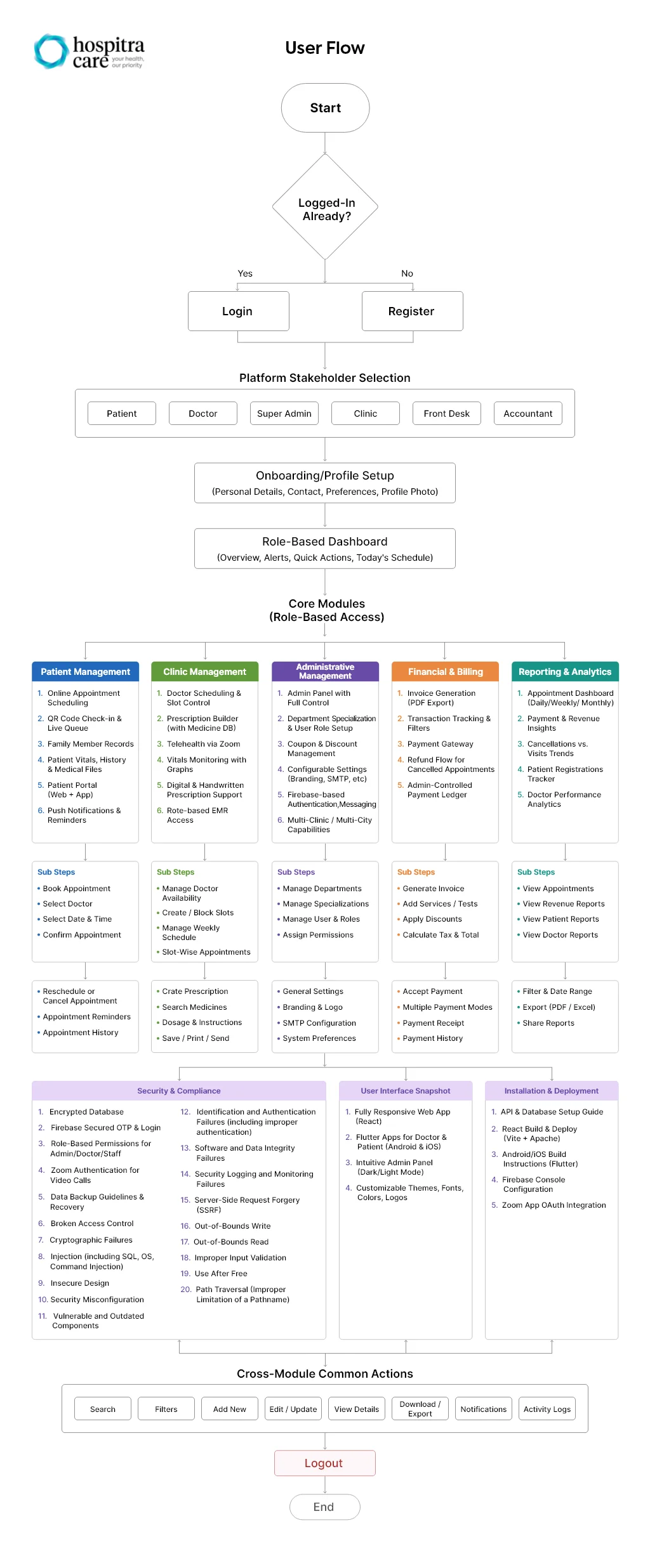
User flow
Wireframing
Feature concepts
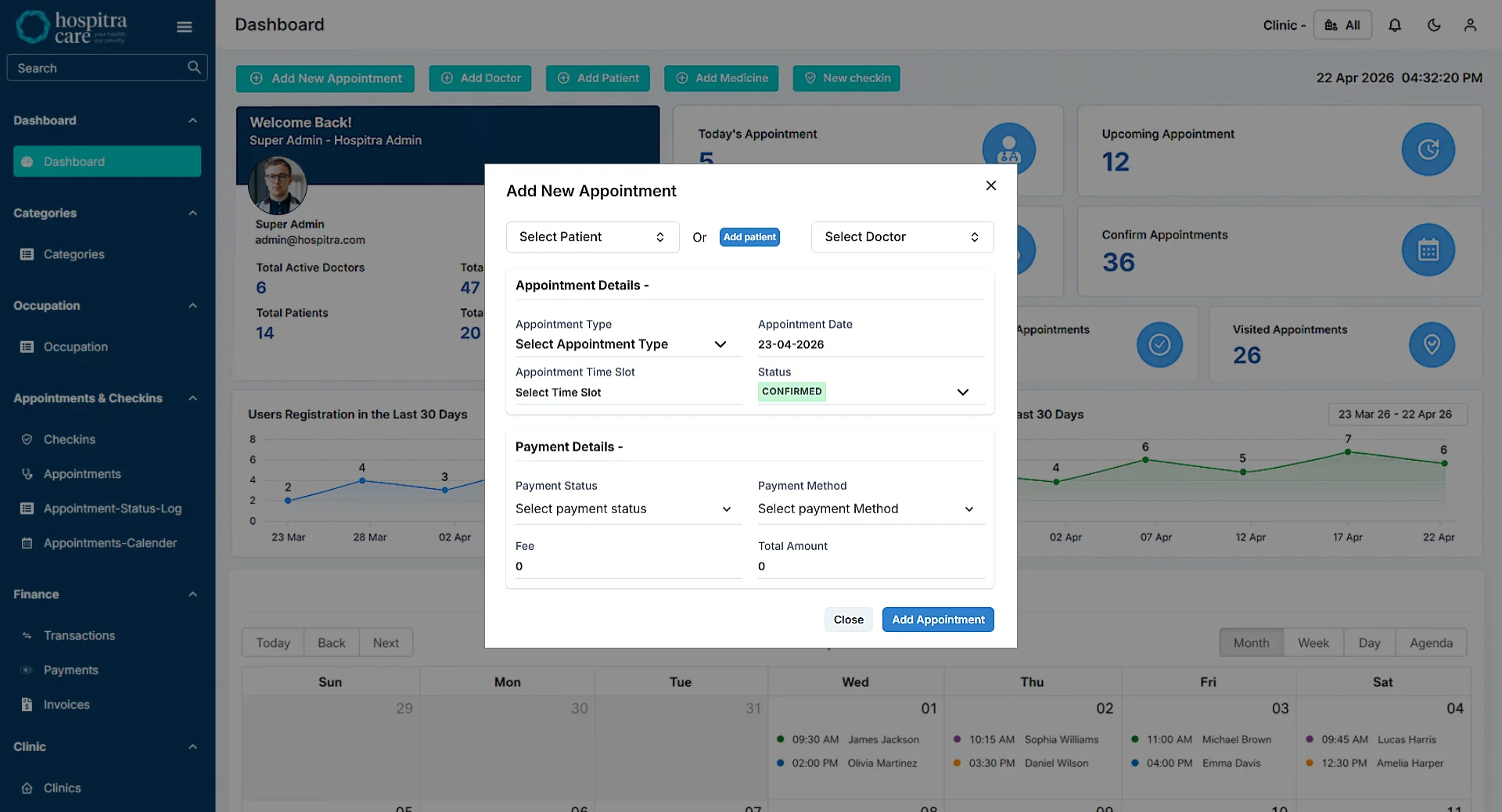
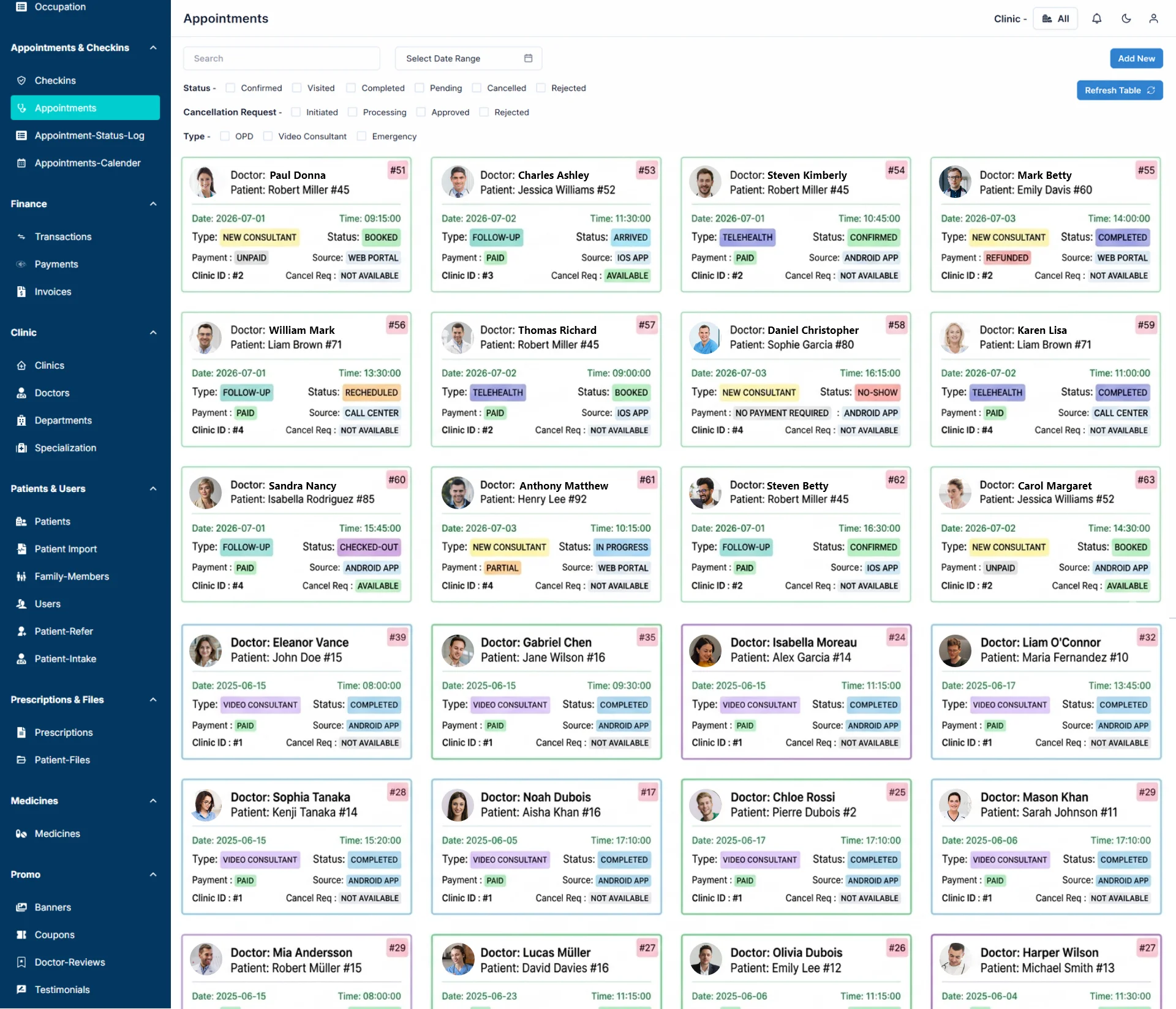
1. Online Appointment Scheduling
Patients can book appointments online with real-time availability across multiple doctors.
2. QR Code Check-In & Queue Management
Patients check in using QR codes with live queue tracking and updates.
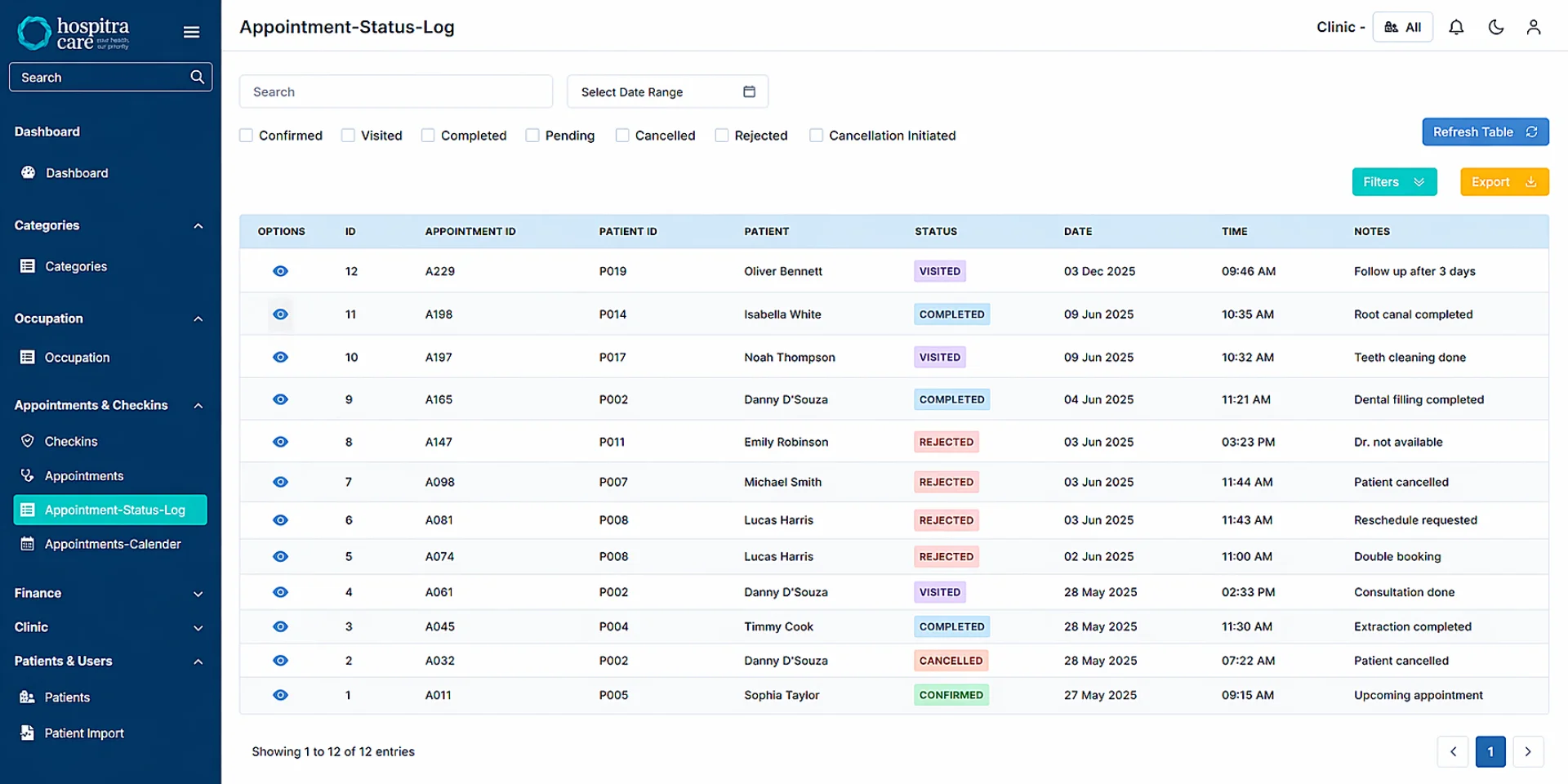
3. Patient Records Management
Centralized system stores patient history, vitals, reports, and medical documents securely.
4. Doctor Scheduling & Slot Control
Doctors manage availability, define slots, and control schedules for appointments efficiently.
5. Prescription Builder
Doctors create digital prescriptions using built-in medicine database for accuracy and consistency.
6. Telehealth Integration
Enables video consultations through Zoom for remote patient care and follow-ups.
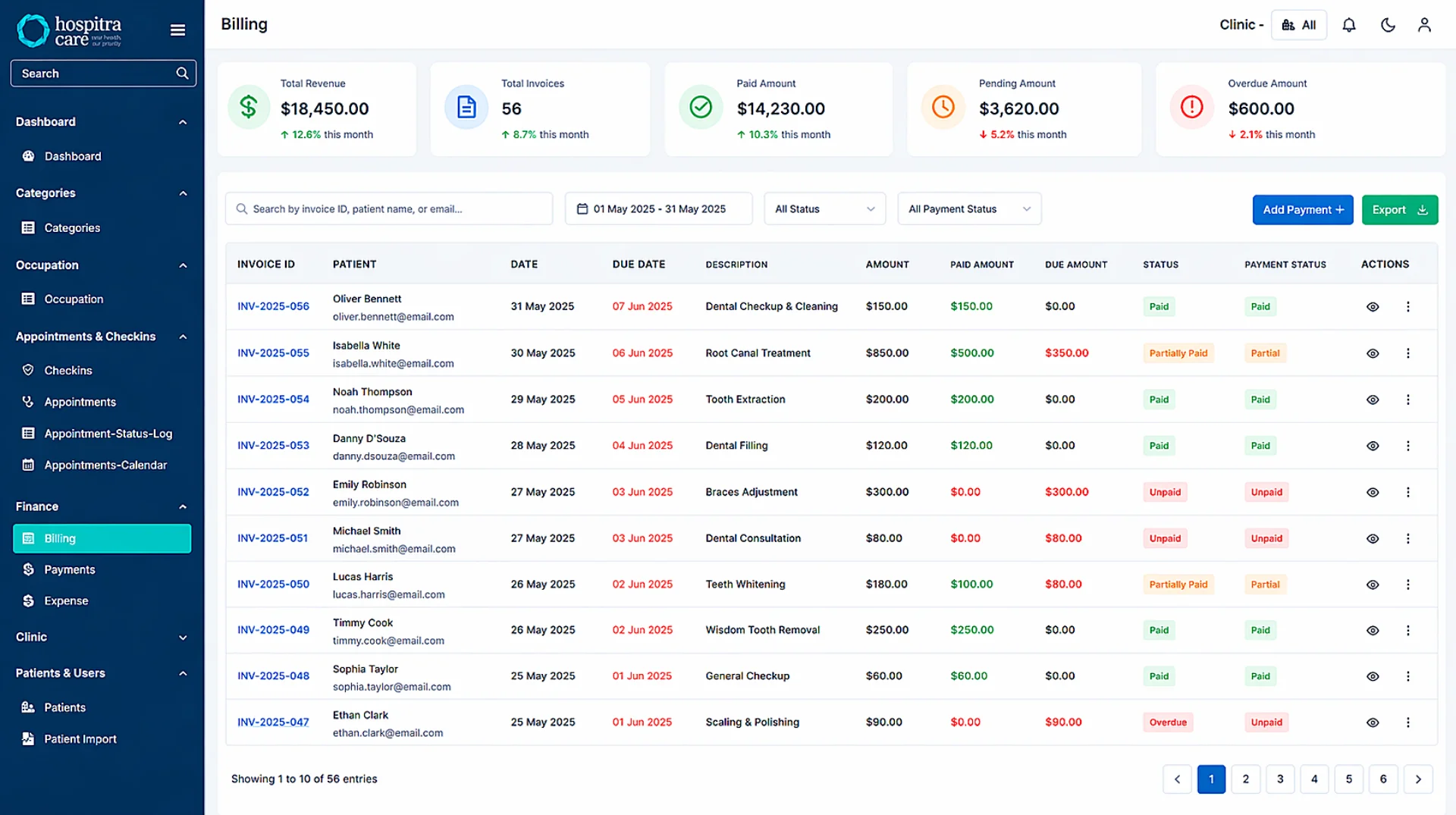
7. Billing & Invoice Management
System generates invoices, tracks payments, and manages refunds for appointments seamlessly.
8. Role-Based Access Control
Different users access features based on roles ensuring secure and controlled operations.
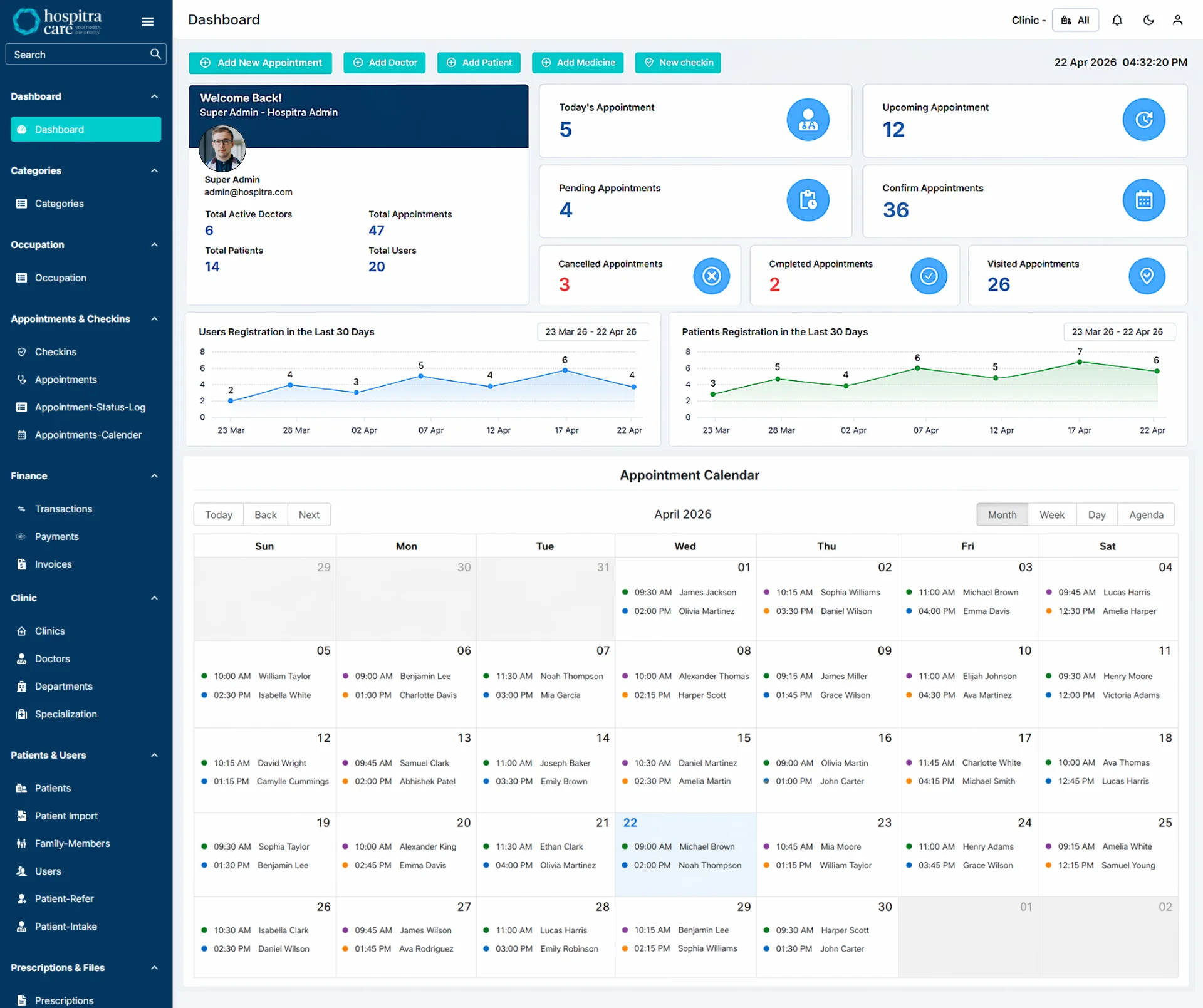
9. Reporting & Analytics Dashboard
Provides insights into appointments, revenue, trends, and doctor performance metrics.
10. Multi-Clinic Management
Centralized platform manages multiple clinics, locations, and operations with unified control.
High fidelity designs
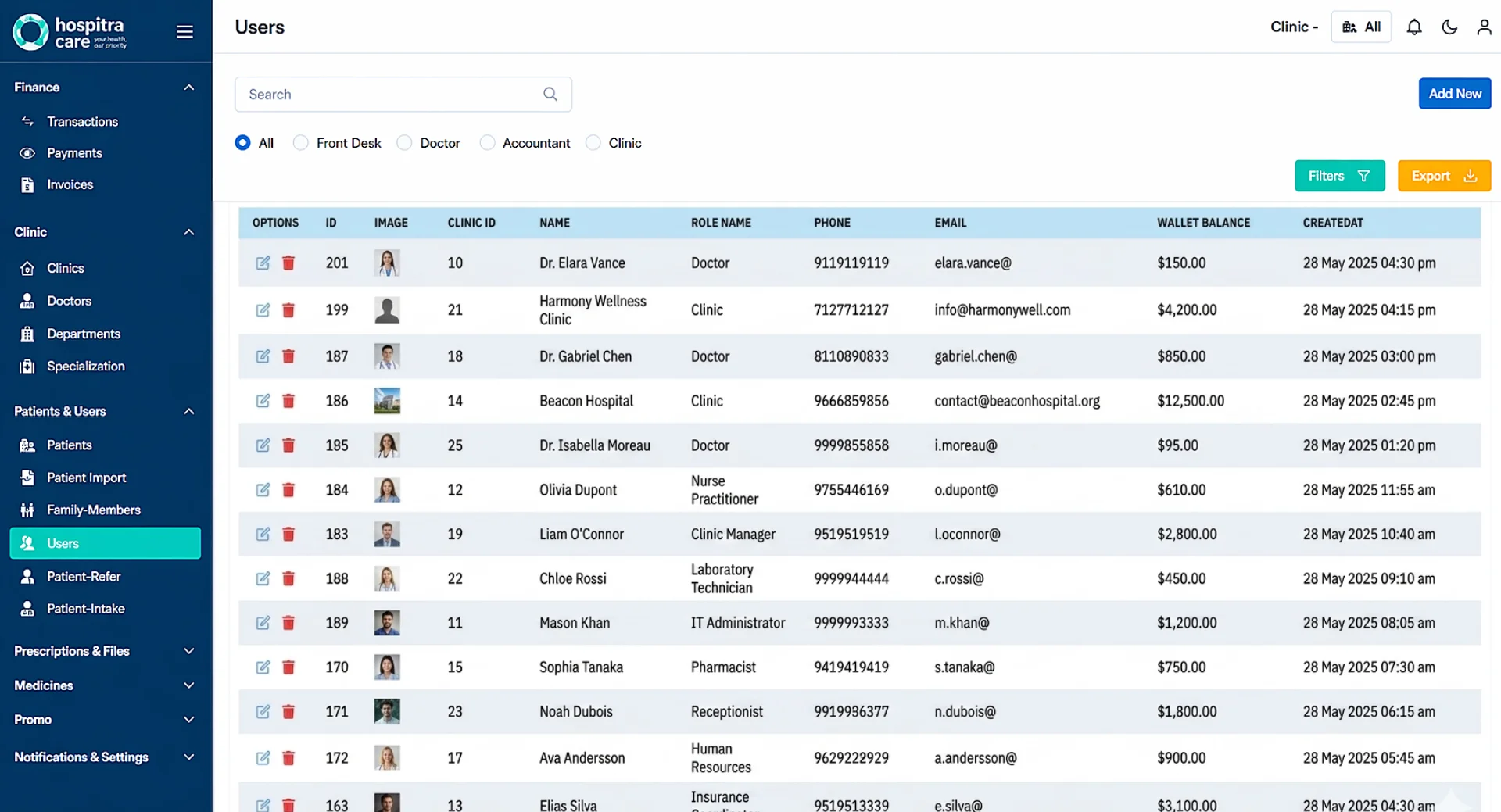
Development
We have used the most suitable technologies that would meet the requirements of this product. We have chosen this tech stack on the basis of scalability and efficiency.
 React JS
 MySQL
MySQL
 Figma
Figma
 Illustrator
 Photoshop
 Laravel
 AWS
AWS
 Stripe
The result
HospitraCare was successfully delivered as a unified, scalable healthcare management platform that streamlined clinical, administrative, and financial workflows within a single ecosystem. The solution eliminated reliance on fragmented tools, enabling seamless coordination between patients, doctors, and staff across web and mobile interfaces.
Healthcare providers experienced a significant improvement in operational efficiency, with up to 45% reduction in manual administrative workload and 30% faster patient onboarding through digitized workflows. Appointment management and queue handling became more structured, reducing patient wait times by nearly 25%.
The integrated billing and reporting system improved financial accuracy and visibility, resulting in 20% fewer billing errors and faster revenue cycles. Real-time dashboards enabled better decision-making, enhancing overall clinic performance and resource utilization.
By consolidating multiple systems into one platform, HospitraCare reduced operational complexity, improved care delivery, and positioned healthcare providers with a future-ready digital infrastructure built for scale.