HIPAA-Compliant App Development in 2026: How to Build Securely and Avoid Preventable Fines
Table of Contents
Subscribe To Our Newsletter
Summarize with AI
Not enough time? get the key points instantly.
HIPAA-compliant app development in 2026 requires six foundations: complete ePHI mapping, documented risk analysis, role-based access, encryption, signed business associate agreements, and continuous security monitoring.
This matters most to healthcare CTOs, product leaders, and compliance teams because one weak vendor, API, cloud configuration, or workforce process can expose protected health information even when the application itself is encrypted.
It also affects healthcare organizations evaluating whether a development partner can support compliance across architecture, documentation, operations, and post-launch controls.
At Codiant, our healthcare app development experience spans secure patient-facing applications, clinical workflows, protected integrations, access controls, and compliance-focused cloud architectures. HIPAA-Compliant App Development in 2026 draws on this experience to explain compliance requirements, development steps, security controls, penalties, cost ranges, testing, and launch readiness.
Key Takeaways
- HIPAA-compliant apps require six controls protecting ePHI throughout its complete lifecycle securely.
- Risk analysis must map every user, vendor, system, and ePHI transfer accurately.
- HIPAA app development commonly costs $40,000 to $500,000+, depending on complexity scope.
- The biggest failure is treating encryption alone as complete HIPAA compliance evidence.
- HIPAA Journal reported 772 healthcare breaches in 2025, affecting 138.5 million people, mostly through hacking.
- Codiant structures HIPAA discovery around ePHI, vendors, safeguards, and launch evidence requirements.
What Does HIPAA-Compliant App Development Mean in 2026?
HIPAA-compliant app development means designing, engineering, deploying and operating an application in accordance with the applicable HIPAA Privacy, Security and Breach Notification Rules.
The HIPAA Security Rule applies to covered entities and their business associates. Covered entities include health plans, healthcare clearinghouses and healthcare providers that conduct specified electronic healthcare transactions. A business associate is an organization or person that creates, receives, maintains or transmits PHI while performing certain functions or services for a covered entity.
Not every wellness, fitness or medical app automatically falls under HIPAA. If the company developing or operating the app is neither a covered entity nor a business associate, HIPAA may not apply directly. Other federal or state privacy, breach-notification, consumer-protection or medical-device requirements may still apply. HHS provides a mobile health application decision tool to help developers identify relevant federal regulatory frameworks.
The first stage of any HIPAA app development project should therefore be regulatory and data scoping not interface design or coding.
For healthtech founders, regulatory scoping should run alongside mobile app startup validation so the target problem, user demand, MVP scope and business model are tested before substantial development spending begins.
Important HIPAA Security Rule Update for 2026
The current HIPAA Security Rule remains in effect. HHS proposed substantial modifications in December 2024, but the proposal had not become a final rule as of July 2026. The proposed changes include mandatory multifactor authentication in many circumstances, more explicit encryption requirements, technology asset inventories, network mapping, vulnerability scanning and stronger documentation obligations.
Development teams should comply with the current rule while monitoring the proposed changes. Designing for stronger controls now can reduce expensive architectural rework if new requirements are finalised later.
Find HIPAA Gaps Before They Become Costly Compliance Failures Later
Assess data flows, vendors, safeguards, and documentation before development risks multiply rapidly.
What Makes a Mobile App HIPAA Compliant?
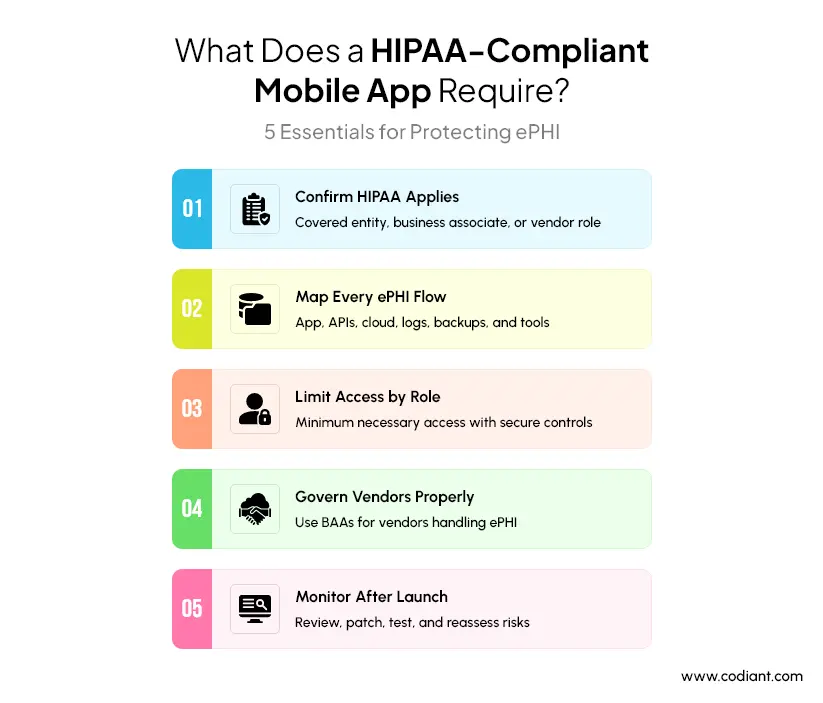
A mobile app supports HIPAA compliance when it protects ePHI through appropriate administrative, physical and technical safeguards and operates within documented privacy, vendor-management and breach-response processes.
The Security Rule requires regulated entities to preserve the confidentiality, integrity and availability of ePHI. They must protect it against reasonably anticipated threats, inappropriate uses and unauthorised disclosures while ensuring workforce compliance.
In practical terms, five conditions must be addressed.
1. HIPAA must apply to the app or organization
The organization must determine whether the app is being operated by or on behalf of a covered entity or business associate. This depends on the company’s role, the services it performs, its relationship with healthcare organizations and how it handles patient information.
For example, an independent consumer fitness app may fall outside HIPAA, while the same technology supplied to a hospital for patient monitoring may make the vendor a business associate.
2. Every ePHI flow must be identified
The team must document what data is collected, why it is needed, where it enters the system and where it travels. This includes:
- Mobile and web interfaces
- Backend services and databases
- APIs and integration layers
- Logs, backups and analytics systems
- Customer-support tools
- Notification services
- Cloud storage
- Development and testing environments
- Third-party software development kits
HHS describes risk analysis as the foundational step in protecting ePHI. The assessment must cover all ePHI that the organization creates, receives, maintains or transmits, not only the primary production database.
3. Access and use must be appropriately limited
Users, employees, administrators, support teams and connected systems should only receive the access required for their authorised functions.
A clinician may require access to complete clinical records, while a scheduling employee may need only the patient’s name, contact details and appointment information. The permissions should be enforced through server-side access controls rather than relying solely on what the mobile interface displays.
The Security Rule requires access to ePHI to be authorised according to the user’s or recipient’s role, consistent with the Privacy Rule’s minimum-necessary standard.
4. Vendors handling ePHI must be governed appropriately
Cloud hosts, communication providers, analytics platforms, support tools and subcontractors may become business associates when they create, receive, store or transmit ePHI on behalf of a regulated entity.
A business associate agreement must establish permitted uses, required safeguards, incident-reporting duties, subcontractor obligations and the handling of PHI when the relationship ends. Even a cloud provider that stores encrypted ePHI without possessing the decryption key may still qualify as a business associate.
5. Compliance must continue after release
A secure build can become vulnerable through unpatched software, excessive permissions, undocumented configuration changes, exposed credentials or newly introduced third-party tools.
The Security Rule requires periodic technical and non-technical evaluation, regular review of system activity and modification of safeguards when risks or operational environments change.
How Do You Build a HIPAA-Compliant Healthcare App?
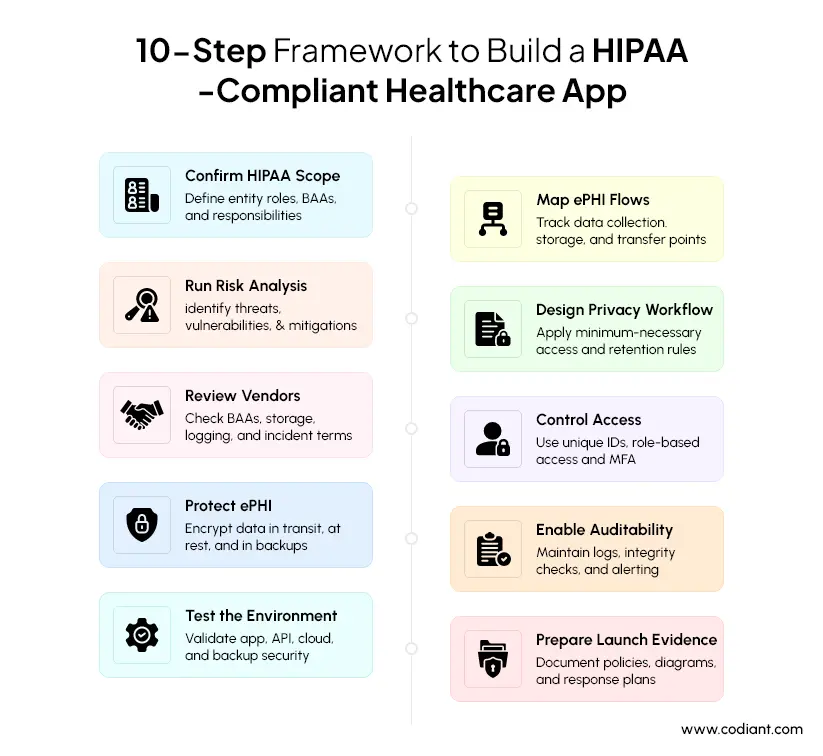
To build a HIPAA-compliant healthcare app, complete legal and data scoping first, perform a risk analysis, design a security architecture, select appropriate vendors, implement safeguards, test the complete environment and establish ongoing compliance operations.
The following ten-stage process provides a practical framework for HIPAA app development.
Step 1: Confirm HIPAA applicability and organizational responsibilities
Start by answering:
- Who owns and operates the application?
- Who determines how patient data will be used?
- Is the client a covered entity?
- Will the development company access production ePHI?
- Which vendors will create, receive, maintain or transmit ePHI?
- Will subcontractors require access?
- Are other health privacy or medical regulations relevant?
The answers determine which organizations need BAAs and which party is responsible for privacy notices, patient requests, access policies, security incidents and breach notifications.
A healthcare software development company should not assume that selecting a “HIPAA-ready” cloud environment resolves these responsibilities. HHS does not certify or endorse particular technologies as HIPAA compliant.
Step 2: Create an ePHI inventory and data-flow map
Document the complete path of every sensitive data element.
The map should show:
- Collection point
- User or system creating the data
- Transmission path
- Processing service
- Storage location
- Backup destination
- Authorised recipients
- Retention period
- Deletion or de-identification method
Include less obvious sources such as crash reports, support tickets, temporary files, screenshots, email alerts, push notifications and analytics events. A data-flow map helps reveal whether information is reaching systems that were never intended to process PHI.
Step 3: Conduct a formal HIPAA security risk analysis
Assess potential threats and vulnerabilities affecting the confidentiality, integrity and availability of all ePHI.
The analysis should examine:
- Unauthorised account access
- Stolen credentials
- Excessive privileges
- Insecure APIs
- Unencrypted devices or backups
- Misconfigured cloud storage
- Malicious or vulnerable third-party components
- Ransomware and service disruption
- Insider misuse
- Accidental disclosure
- Lost mobile devices
- Inadequate logging
- Weak incident detection
- Failed backup restoration
The output should connect each identified risk to a mitigation, accountable owner, target date and residual-risk decision. HHS does not mandate one specific risk-analysis methodology, but it does require an accurate and thorough assessment.
Organizations without dedicated privacy and security teams may use HIPAA compliance consulting services to identify control gaps, plan remediation, conduct technical testing and prepare compliance documentation before launch.
Step 4: Design privacy and minimum-necessary workflows
Privacy controls should influence product functionality, not merely the privacy policy.
Review whether the app:
- Collects only information required for a defined purpose
- Separates clinical, billing and administrative permissions
- Supports authorised access and disclosure workflows
- Allows appropriate correction or amendment processes
- Records relevant disclosures where required
- Prevents PHI from appearing in unnecessary notifications
- Applies retention and deletion rules consistently
- Supports the organization’s patient-access obligations
Avoid collecting extra health data simply because it could become useful later. Every additional data element expands the impact of inappropriate access or disclosure.
Step 5: Select vendors that can support the required safeguards
Before choosing a cloud, communication, payment, analytics, AI or customer-support vendor, determine whether the vendor will encounter PHI.
Evaluate:
- Will the vendor sign a suitable BAA?
- Which products or configurations does the BAA cover?
- Can data be encrypted and segregated?
- Where will data be stored and processed?
- Does the vendor use subcontractors?
- How are incidents reported?
- Can access logs be obtained?
- What happens to data after termination?
- Can security documentation or independent assurance reports be reviewed?
A BAA does not transfer all compliance responsibility to the vendor. Both parties remain responsible for obligations applicable to their roles.
Step 6: Build identity, authentication and access controls
Every user should have a unique identity. Permissions should be centrally managed and enforced by the backend.
Secure healthcare app development commonly includes:
- Unique user accounts
- Role-based or attribute-based access
- Least-privilege permissions
- Strong password controls
- Multifactor authentication based on risk
- Secure password reset and account recovery
- Session expiration
- Revocation of terminated or compromised accounts
- Additional verification for sensitive actions
- Protected administrator access
- Emergency-access procedures where required
The current Security Rule requires access control and identity verification but does not prescribe one universal authentication product. OWASP’s Mobile Application Security Verification Standard also recommends secure authentication and authorisation protocols, server-side enforcement and additional authentication for sensitive operations.
Case Example: Planning HIPAA Compliance Across Telemedicine Workflows
Virtual MD is a HIPAA-compliant telemedicine application built by Codiant for patients, doctors, clinics and hospitals in the United States. Developed in six months, its multi-user structure shows why HIPAA requirements must be considered across the complete application not added after development.
The platform includes:
- Separate patient, doctor, clinic and administrator modules
- OTP-based registration and login for patients and doctors
- Medical history, prescriptions and insurance management
- Video, phone and home-visit appointment workflows
These functions involve different users accessing different categories of health information. They illustrate why role permissions, data-flow mapping, vendor review and security testing must be defined before launch to reduce preventable compliance gaps. The published case study does not disclose every technical safeguard used.
Step 7: Protect ePHI in Storage and Transmission
Electronic health information should be protected while travelling across networks and while stored in databases, files, backups and mobile devices.
The architecture should consider:
- Encryption in transit
- Encryption at rest
- Managed encryption-key storage
- Key rotation and revocation
- Secure mobile storage
- Tokenisation where appropriate
- Separation of identifiers from clinical data
- Encrypted backups
- Secure data deletion
- Restrictions on copying or exporting data
The current Security Rule describes some encryption implementation specifications as addressable. “Addressable” does not mean optional. The organization must implement the specification when reasonable and appropriate or document why an equivalent alternative is appropriate.
OWASP similarly recommends secure storage, protected cryptographic functionality and encrypted network communication for sensitive mobile applications.
Step 8: Implement auditability, integrity and incident detection
The app should create enough evidence to reconstruct important events without exposing PHI unnecessarily in logs.
Record events such as:
- Successful and failed authentication
- Access to patient records
- Record creation and modification
- Administrative actions
- Permission changes
- Data exports
- Sensitive API requests
- Security alerts
- Unusual access patterns
- Account-recovery events
Audit logs should be protected against unauthorised alteration and retained according to documented operational and legal requirements.
The Security Rule requires mechanisms to record and examine activity in systems containing ePHI. It also requires controls that protect ePHI against inappropriate alteration or destruction.
Avoid placing clinical records, access tokens, passwords or complete API payloads in diagnostic logs.
Step 9: Test the product and operating environment
Testing must cover more than whether the screens work.
A pre-release programme should include:
- Architecture and threat-model review
- Static application security testing
- Software composition analysis
- Secret scanning
- API security testing
- Mobile application penetration testing
- Cloud configuration review
- Access-control testing
- Encryption verification
- Audit-log verification
- Backup-restoration testing
- Incident-response exercises
- Privacy and data-flow validation
OWASP MASVS can provide a technical testing baseline for mobile storage, cryptography, authentication, network communication, platform interaction, code quality and privacy. It does not replace HIPAA analysis, but it can help translate risk-management decisions into verifiable mobile security controls.
Step 10: Prepare operational evidence before launch
The organisation should be able to show not only that safeguards exist, but also why they were selected and how they are maintained.
Pre-launch evidence may include:
- Risk analysis and risk-treatment plan
- System and data-flow diagrams
- Access-control matrix
- Vendor and subcontractor inventory
- Executed BAAs
- Security policies and procedures
- Incident-response plan
- Contingency and disaster-recovery plan
- Penetration-test results
- Remediation records
- Workforce training records
- Change-management procedures
- Monitoring and vulnerability-management plan
Security Rule documentation generally must be retained for six years from its creation date or the date it was last in effect, whichever is later.
Which Security Features Are Required for HIPAA Compliance?
HIPAA requires security outcomes and safeguard standards rather than prescribing one fixed technology stack. Required areas include access control, audit controls, integrity protection, authentication and transmission security, supported by administrative and physical safeguards.
The following table distinguishes regulatory obligations from practical app implementations.
| Security area | HIPAA obligation | Practical app implementation |
| Access control | Permit access only to authorised people or software | Unique accounts, role-based permissions, least privilege and session controls |
| Authentication | Verify the identity of people seeking access | Strong authentication, protected recovery and risk-based MFA |
| Audit controls | Record and examine system activity | Centralised, tamper-resistant access and administrative logs |
| Data integrity | Prevent improper alteration or destruction | Validation, version history, controlled updates and integrity monitoring |
| Transmission security | Protect ePHI sent through electronic networks | Encrypted API, app, web and integration traffic |
| Encryption | Evaluate and implement when reasonable and appropriate or document an equivalent measure | Encryption at rest, in transit and for backups with controlled keys |
| Contingency planning | Maintain backup, recovery and emergency-mode procedures | Tested backups, restoration exercises and continuity plans |
| Incident response | Identify, respond to, mitigate and document incidents | Alerts, response playbooks, investigation records and escalation paths |
| Device and media controls | Govern devices and media containing ePHI | Secure disposal, wiping, inventory controls and restricted local storage |
| Workforce security | Authorise and supervise workforce access | Joiner, mover and leaver procedures, training and access reviews |
Mobile-specific protections should also address secure on-device storage, sensitive information in notifications, screen previews, backups, clipboard access, inter-process communication and third-party SDK behaviour.
Is multifactor authentication mandatory under HIPAA?
The current HIPAA Security Rule does not explicitly mandate MFA in every situation. It requires appropriate access controls, authentication and risk management. MFA may therefore be necessary when the risk analysis shows that passwords alone do not reduce risk to a reasonable and appropriate level.
The proposed Security Rule update would make MFA an express requirement in many circumstances, but that proposal was not yet final as of July 2026. Building MFA into the architecture now is a prudent future-readiness measure, particularly for administrators, remote access and users handling sensitive clinical data.
What Are the Penalties for HIPAA Violations?
HIPAA violations can result in corrective action, settlement payments, civil monetary penalties and, in certain knowing or intentional cases, criminal prosecution.
For civil penalties assessed on or after January 28, 2026, HHS published the following inflation-adjusted ranges for qualifying violations occurring on or after November 2, 2015. The amount depends on the organisation’s level of knowledge, reasonable diligence, willful neglect and corrective action.
| Violation category | Minimum per violation | Maximum per violation |
| Organisation did not know and, with reasonable diligence, would not have known | $145 | $73,011 |
| Violation resulted from reasonable cause, not willful neglect | $1,461 | $73,011 |
| Willful neglect corrected within the permitted period | $14,602 | $73,011 |
| Willful neglect not corrected within the permitted period | $73,011 | $2,190,294 |
The regulation also lists a calendar-year cap of $2,190,294 for violations of an identical requirement or prohibition. Civil penalty amounts are adjusted periodically, and OCR retains enforcement discretion when evaluating individual matters.
Criminal penalties may apply when a person knowingly obtains or discloses individually identifiable health information in violation of HIPAA. HHS describes maximum criminal penalties ranging from a $50,000 fine and one year of imprisonment to a $250,000 fine and ten years of imprisonment when conduct involves intent to sell, transfer or use the information for commercial advantage, personal gain or malicious harm.
A fine is not the only possible consequence. Organisations may also incur:
- Incident investigation costs
- Required breach notifications
- Corrective-action obligations
- Security remediation expenses
- Operational disruption
- Contractual claims
- Loss of customer or provider confidence
- Additional scrutiny from regulators and commercial partners
For breaches of unsecured PHI, affected individuals generally must be notified without unreasonable delay and no later than 60 days after discovery. Breaches affecting 500 or more individuals must also be reported to HHS within that period, with media notification required in certain circumstances.
Estimate Your HIPAA App Cost Before Development Begins with Confidence
Define scope, integrations, security controls, testing, infrastructure, and support assumptions clearly upfront.
How Much Does HIPAA-compliant App Development Cost?
HIPAA-compliant app development typically requires a planning budget of $40,000 to $500,000 or more in 2026. A focused MVP may cost approximately $40,000–$80,000, while a healthcare platform with EHR integrations, telehealth, remote monitoring, AI capabilities or enterprise infrastructure may exceed $250,000–$500,000. Current industry estimates vary considerably, so these figures should be treated as preliminary market benchmarks, not a fixed project quotation.
HIPAA App Development Cost by Project Complexity
| Project type | Typical scope | Estimated 2026 cost |
| Basic HIPAA-compliant MVP | Secure authentication, limited user roles, appointment scheduling, patient intake, encrypted storage, audit logging and a basic admin panel | $40,000–$80,000 |
| Mid-complexity healthcare app | Patient and provider portals, secure messaging, telehealth, multiple user roles, dashboards and limited EHR or FHIR integration | $80,000–$180,000 |
| Advanced healthcare platform | Bidirectional EHR integration, remote patient monitoring, payments, workflow automation, multi-platform access and disaster recovery | $180,000–$350,000 |
| Enterprise healthcare system | Multi-tenant architecture, multiple clinical integrations, AI capabilities, high availability, advanced governance and large-scale data processing | $350,000–$500,000+ |
Budget should be evaluated alongside the delivery schedule. Codiant’s 2026 app development timeline guide places simple applications at approximately 2–4 months, medium-complexity applications at 4–8 months and complex or enterprise platforms at 9–12 months or longer. HIPAA-focused projects may require additional time when they involve extensive integrations, risk documentation, penetration testing or remediation.
These ranges were developed by comparing current healthcare software pricing guides. Published estimates place simple healthcare apps at approximately $25,000–$80,000, mid-level applications at roughly $40,000–$180,000 and advanced or enterprise systems anywhere from $180,000 to more than $500,000.
We cannot confirm an accurate HIPAA app development cost without a documented scope. The final investment depends on the healthcare workflows, platforms, integrations, data volume, regulatory responsibilities, security architecture and operational requirements involved.
What Is Included in HIPAA App Development Costs?
A reliable estimate should account for the complete secure healthcare app development lifecycle rather than software coding alone.
1. Product discovery and HIPAA compliance scoping
The team must define user roles, healthcare workflows, PHI and ePHI data flows, regulatory responsibilities, vendor relationships and foreseeable security risks. This phase establishes which safeguards and business associate agreements may be required.
2. UX design and application engineering
The cost increases with the number of mobile or web platforms, user types, administrative panels, clinical workflows, accessibility requirements and offline capabilities. A complete mobile app development lifecycle also includes product planning, UI/UX design, platform engineering, testing, deployment and post-launch support. Separate patient, provider and administrator applications therefore require more work than a single-purpose application.
3. Backend and healthcare data architecture
A HIPAA-focused backend may require encrypted databases, identity management, role-based permissions, key management, audit infrastructure, protected backups, isolated environments and disaster-recovery procedures.
4. EHR, FHIR and third-party integrations
EHR or EMR systems, laboratories, pharmacies, insurance platforms, medical devices, payment gateways and telehealth providers can substantially increase the project scope. Each integration introduces additional authentication, data-mapping, error-handling, logging and security requirements.
5. Security and compliance engineering
This work may include:
- Threat modelling and risk analysis
- Role-based access controls
- Multifactor authentication
- Encryption at rest and in transit
- Audit trails and security monitoring
- Secure API development
- Data-retention controls
- Incident-response planning
- Vendor and BAA review support
HIPAA does not prescribe one universal technology stack. HHS states that regulated organizations must select reasonable and appropriate security measures after considering their size, complexity, infrastructure, security costs and the probability and criticality of risks to ePHI.
6. Testing and independent security assessment
The budget should include functional testing, access-control validation, API security testing, mobile penetration testing, cloud-configuration review, dependency scanning, backup-restoration testing and remediation.
External penetration tests, legal reviews or independent HIPAA assessments may be priced separately unless the development proposal explicitly includes them.
7. Cloud infrastructure and ongoing optimisation
Costs continue after deployment. Post-launch requirements may include:
- Secure cloud hosting
- Monitoring and alerting
- Software and dependency patching
- Vulnerability management
- Backup and recovery testing
- Periodic access reviews
- Security reassessments
- Compliance documentation updates
- Incident-response readiness
HHS requires regulated entities to review system activity, periodically evaluate safeguards and reassess risks as technologies and operating environments change.
How Should HIPAA App Development Cost Be Calculated?
A transparent estimate should use the following structure:
Estimated project cost = delivery hours × blended team rate + infrastructure + third-party services + external assessments + post-launch support
For example, if an application requires an estimated 2,500 delivery hours at a blended rate of $40 per hour, the core development calculation would be:
2,500 hours × $40 = $100,000
This is only an illustrative calculation. Cloud usage, video services, EHR vendor charges, legal review, external penetration testing and long-term monitoring may remain outside the core engineering price unless specifically included.
Which Mistakes Commonly Cause HIPAA Compliance Failures?
The most damaging failures often arise from incomplete governance and architecture rather than one missing checkbox.
1. Treating HIPAA as an encryption project
Encryption is important, but it does not replace access management, risk analysis, audit controls, vendor agreements, workforce policies, incident response or contingency planning.
2. Starting compliance review after development
Late-stage review may reveal that the chosen analytics platform, notification service, database design or integration cannot support the required safeguards or BAA terms.
3. Using cloud services without reviewing the covered products
A vendor may offer a BAA for selected services but not for every product, configuration or third-party add-on. The contract and architecture must align.
4. Exposing PHI through tracking or analytics tools
Tracking technologies on authenticated patient portals and mobile apps may access information such as medical record numbers, appointment dates, diagnoses or treatment details. HHS requires regulated entities to evaluate those disclosures, establish BAAs when necessary and protect collected ePHI under the Security Rule.
5. Logging sensitive data
Development logs, crash reports and support systems can unintentionally receive patient details, credentials, tokens or complete request payloads.
6. Failing to reassess risk after changes
Adding an AI development services, analytics SDK, new API, remote-support tool or cloud region may materially change the ePHI environment. Voice-enabled systems require additional review of recordings, transcription providers, LLM access, identity verification, retention rules and EHR permissions. The process for building HIPAA-compliant AI voice agents demonstrates how these controls apply to healthcare conversations and automated workflows.
7. Assuming a security audit provides permanent compliance
HHS does not require or provide a universal HIPAA certification. An external assessment can provide valuable evidence, but compliance still depends on how the organisation operates and maintains its safeguards after the assessment.
How Should a Healthcare App Be Monitored After Launch?
Post-launch HIPAA compliance requires continuous observation of access, vulnerabilities, system changes, vendor relationships and security incidents.
The operating plan should include:
- Centralised security monitoring
- Review of high-risk access events
- Regular vulnerability scanning
- Dependency and patch management
- Periodic penetration testing
- Account and privilege reviews
- Backup-restoration exercises
- Vendor reassessment
- Incident-response drills
- Risk-analysis updates
- Policy and training updates
- Documentation of security decisions
HHS requires regulated entities to regularly review records that track system access, detect security incidents and re-evaluate safeguards as risks and environments change.
HIPAA software development is therefore not finished when the app reaches the App Store or production environment. The application must remain supportable, observable and defensible throughout its active lifecycle.
Build HIPAA Compliance Into the Product, Not Around It
The safest approach is to make privacy and security architectural requirements from the first discovery session.
Codiant can help plan and engineer secure healthcare applications around defined workflows, data flows, integrations, access controls and operating responsibilities. A confirmed estimate should follow a structured discovery and risk-scoping exercise rather than an unsupported universal price.
Build HIPAA Compliance into Every Stage Before Your App Launches
Plan secure architecture, access controls, testing, and monitoring with healthcare specialists early.
The Author

Frequently Asked Questions
Essential requirements include determining whether HIPAA applies, identifying all ePHI, conducting a risk analysis and implementing appropriate administrative, physical and technical safeguards. Regulated entities must also manage workforce access, vendor relationships, documentation, incident response and breach-notification responsibilities.
Important measures include role-based access, secure authentication, encryption, audit logging, integrity protection, protected network transmission, secure backups and incident monitoring. The exact controls should be selected through a documented risk analysis because HIPAA is technology-neutral and does not mandate one universal security stack.
Yes, but the work may require more than adding encryption or MFA. The organisation must assess the existing data architecture, access model, vendors, logs, infrastructure, policies and operating procedures before determining whether remediation or partial redevelopment is appropriate.
They should complete a formal risk analysis, review data flows and BAAs, test access controls, conduct security testing, verify logging and backup procedures, and document the resulting evidence. HHS does not provide an official product certification, so verification depends on documented evaluation against the applicable HIPAA requirements.
Common failures include incomplete risk assessments, excessive access, missing BAAs, unsecured tracking technologies, sensitive data in logs, weak incident response and outdated safeguards. Compliance can also fail when organizations introduce new vendors or functionality without reassessing how the changes affect ePHI.
Featured Blogs
Read our thoughts and insights on the latest tech and business trends

AI Developer Engagement Models Explained: How to Choose the Right AI Team
- August 27, 2026
- Artificial Intelligence
AI developer engagement model means deciding how external AI specialists will be assigned, managed, paid and held accountable. The main options are dedicated AI developers, AI team augmentation, time-and-material delivery, fixed-price projects and end-to-end AI... Read more

Enterprise Mobile App Development: How It Can Accelerate Your Business Growth
- August 21, 2026
- Mobile App Development
Enterprise mobile app development can accelerate growth by improving three measurable areas: workflow speed, access to business systems, and customer or employee service delivery. This matters to mid-market and enterprise leaders managing distributed teams, manual... Read more

React vs Angular vs Vue: Which Should You Choose in 2026?
- August 14, 2026
- Technology
For most web products in 2026, choose React for ecosystem flexibility and broad hiring reach, Angular for standardised enterprise architecture and complex workflows, and Vue for simpler adoption and faster team onboarding. For CTOs, product... Read more