How Much Does It Cost to Hire a Dedicated AI/LLM Developer in 2026?
Table of Contents
Subscribe To Our Newsletter
Summarize with AI
Not enough time? get the key points instantly.
Hiring a dedicated AI or large language model (LLM) developer typically costs $35–$60 per hour for general AI engineering and $50–$200 per hour for specialised machine learning work, with enterprise pricing rising for advanced RAG, MLOps, security and domain-specific requirements.
Upwork’s current marketplace benchmarks place AI engineers at approximately $35–$60 per hour and machine learning engineers at $50–$200 per hour, making accurate role definition essential before comparing candidates.
For CTOs, product leaders and founders, the hourly rate represents only one part of the total cost because data preparation, model evaluation, integrations, cloud usage, governance and ongoing optimisation may require additional capacity.
At Codiant, businesses can onboard pre-vetted AI developers within 24 hours and assess delivery quality and team compatibility through a seven-day free trial. The analysis below covers hourly and monthly costs, pricing drivers, engagement models and hiring steps, with Codiant’s rapid onboarding model as the practical hiring reference.
In a Nutshell
- Dedicated AI developers generally cost $35–$60 hourly, while specialised machine learning engineers may charge $50–$200 hourly.
- Prioritise production experience in RAG, model evaluation, MLOps, integrations and AI security over general programming experience.
- At 160 hours per month, $35–$200 hourly equals $5,600–$32,000 monthly, excluding infrastructure, API and data costs.
- The biggest mistake is comparing hourly rates before defining data, evaluation, security and integration requirements.
- Codiant provides pre-vetted AI developers within 24 hours along with a seven-day free trial supports performance and team-fit assessment.
How Much Does It Cost to Hire a Dedicated AI/LLM Developer?
The cost to hire a dedicated AI or LLM developer generally ranges from $4,800 to $24,000+ per month, assuming 160 working hours and market rates between $30 and $150+ per hour. These figures are planning estimates, not universal vendor prices.
Upwork lists AI developer rates of approximately $30 to $150 per hour. Its broader AI engineer benchmark places entry-level professionals at $30 to $50, intermediate engineers at $50 to $75, and experts at $75 to more than $100 per hour. Generative AI specialists may cost between $50 and $200 per hour, depending on their experience, location and project scope.
Here is how the estimated monthly cost is calculated:
| Developer type | Illustrative hourly rate | Monthly calculation | Estimated monthly cost |
| Junior AI developer | $30–$50 | Rate × 160 hours | $4,800–$8,000 |
| Mid-level AI engineer | $50–$75 | Rate × 160 hours | $8,000–$12,000 |
| Senior AI/LLM developer | $75–$150+ | Rate × 160 hours | $12,000–$24,000+ |
| Advanced ML specialist | $120–$200+ | Rate × 160 hours | $19,200–$32,000+ |
These calculations estimate developer capacity only. They may exclude solution architecture, UI/UX design, data labelling, cloud usage, model API charges, security assessments and ongoing model monitoring.
Build Your AI Team Without Paying for Unnecessary Expertise Today
Get vetted developers matched to your scope, budget, timeline, and technical needs.
What is Included in the Cost of Hiring an AI Developer?
A credible AI development estimate should identify the work included, the responsibilities excluded and the assumptions used to calculate developer hours. Without a defined scope, we cannot confirm an accurate project cost.
Depending on the assignment, dedicated AI developers may contribute to:
- Product discovery and AI feasibility assessment
- Data collection, cleaning and labelling
- Model or third-party API selection
- Prompt and context-engineering workflows
- Retrieval and knowledge-base development
- AI application and backend engineering
- Model fine-tuning and evaluation
- Third-party software integrations
- Cloud infrastructure and deployment
- Security and regulatory compliance
- Automated and human-led testing
- Monitoring and ongoing optimisation
Some projects may require broader AI development services covering strategy, data engineering, model development, integration, deployment and ongoing optimisation.
For example, an LLM application may need an AI engineer, backend developer, data engineer, DevOps specialist and quality-assurance engineer. Hiring one developer does not automatically cover the entire product lifecycle.
A transparent estimate should therefore clarify:
- Included: Developer hours, assigned responsibilities, working schedule, communication, reporting and agreed deliverables.
- Excluded: Model usage charges, cloud services, external datasets, software licences, specialist security audits and third-party platform fees unless explicitly included.
- Assumptions: Available data, supported integrations, expected traffic, target accuracy, response-time requirements and stakeholder availability.
Read more: How to Build a Generative AI Application?
What is the Hourly Rate for LLM Developers?
The hourly rate for an LLM developer generally ranges from $50 to $200+, depending on the developer’s experience, location and technical responsibilities. Basic API integration sits at the lower end, while enterprise RAG, model optimisation, agent architecture and secure deployment command higher rates.
| LLM Development Requirement | Indicative Hourly Rate | Typical Responsibilities |
| Basic LLM API integration | $50–$75 | Connecting an existing model API to a website, application or internal workflow. |
| Prompt engineering and workflow setup | $60–$90 | Creating system prompts, reusable templates, structured outputs and prompt-testing workflows. |
| LLM chatbot development | $65–$100 | Building conversational interfaces, context management, session memory and backend integrations. |
| Basic RAG development | $75–$110 | Connecting documents to an LLM using embeddings, vector search and simple retrieval pipelines. |
| Advanced enterprise RAG | $100–$150 | Designing multi-source retrieval, reranking, metadata filtering, citations and access-controlled knowledge systems. |
| Retrieval evaluation and optimisation | $100–$160 | Measuring retrieval quality, improving chunking and reranking, and testing answer relevance. |
| AI agent development | $100–$175 | Building agents that use APIs, databases, business tools and multi-step decision workflows. |
| Multi-agent system architecture | $125–$200+ | Designing specialised agents, orchestration logic, shared memory, routing and failure recovery. |
| LLM fine-tuning and alignment | $110–$200+ | Preparing datasets, training models, running evaluations and improving task-specific behaviour. |
| Hallucination and citation evaluation | $90–$150 | Building test datasets and measuring groundedness, factual accuracy, citation quality and failure rates. |
| Model routing and inference optimisation | $110–$200+ | Selecting models dynamically and reducing token usage, latency and infrastructure costs. |
| Private or on-premise LLM deployment | $125–$200+ | Hosting models within private infrastructure and implementing security, monitoring and access controls. |
| Regulated enterprise LLM systems | $150–$200+ | Supporting governance, auditability, data privacy and industry-specific compliance requirements. |
Arc reports that remote AI and LLM developers in markets such as Eastern Europe and Latin America may charge approximately $75–$95 per hour. Senior AI engineers in Eastern Europe may exceed $150 per hour, particularly when advanced engineering expertise is required.
An LLM developer for hire responsible only for basic API integration will normally cost less than an engineer expected to:
- Design a multi-source RAG architecture
- Improve retrieval relevance and answer grounding
- Evaluate hallucinations and citation accuracy
- Implement AI agents with controlled tool access
- Build model-routing and fallback logic
- Manage prompt versions and evaluation experiments
- Add guardrails, permissions and access controls
- Optimise token consumption and response latency
- Deploy models within enterprise infrastructure
The title “LLM developer” alone is therefore not sufficient for estimating cost. Businesses should define the expected architecture, data sources, integrations, performance requirements, security controls and deployment responsibilities before comparing hourly rates.
What Affects AI Developer Pricing?
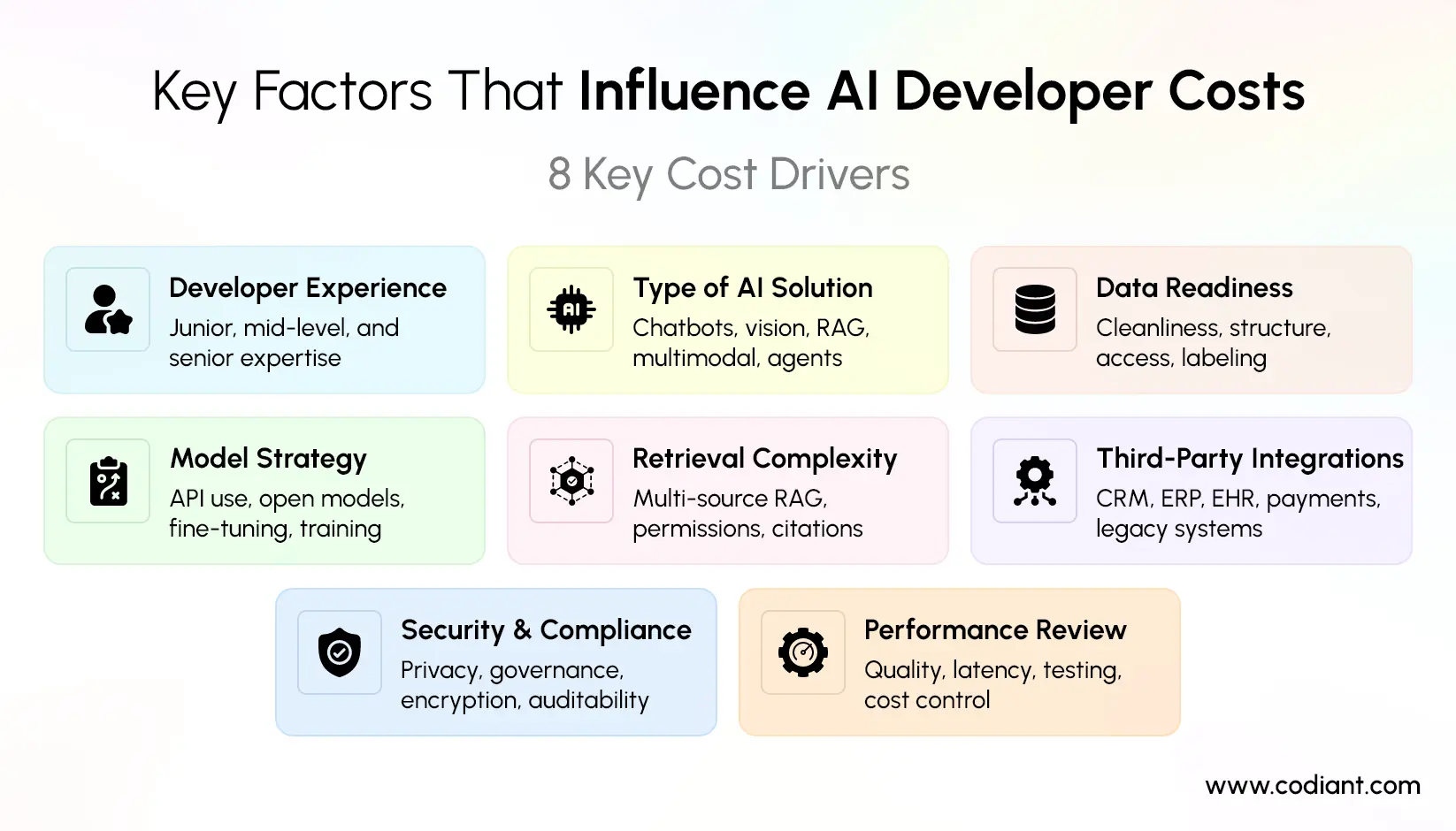
AI developer pricing is primarily affected by the developer’s experience, technical specialisation, project complexity, data condition, deployment requirements and geographic location. The engagement duration and number of supporting roles also influence the final budget.
1. Developer experience
Junior developers may handle API integrations, data processing scripts and well-defined development tasks. Senior developers can make architectural decisions, identify model limitations, design evaluation frameworks and lead production deployments.
A higher hourly rate does not always produce a higher total cost. An experienced engineer may complete a difficult task faster and avoid architecture or security mistakes that require expensive rework.
2. Type of AI solution
A rules-based chatbot, recommendation engine, custom computer-vision model and enterprise LLM assistant involve different skills and development effort.
Basic API-based applications are normally less expensive than systems requiring custom training, fine-tuning, complex retrieval, multimodal processing or autonomous agent workflows.
3. Data readiness
AI projects become more expensive when the available data is incomplete, inconsistent, duplicated, unlabelled or spread across disconnected systems.
The developer may need to:
- Identify relevant sources
- Remove sensitive information
- Standardise formats
- Build data pipelines
- Label training examples
- Create access permissions
- Validate data quality
- Establish update processes
Data preparation may require a dedicated data engineer rather than being treated as a small AI development task.
4. Model strategy
Using an existing model through an API can reduce initial engineering requirements. Hosting an open model, fine-tuning a model or training a specialised system generally requires additional infrastructure and machine learning expertise.
When choosing an AI solution for an existing application, businesses should consider accuracy, privacy, latency, scalability, vendor dependency and operating costs rather than model popularity alone.
5. Retrieval complexity
A basic knowledge chatbot may use a small set of structured documents. An enterprise RAG system may need to retrieve information from document stores, databases, cloud drives, CRMs, ticketing systems and internal applications.
Permission-aware retrieval, source citations, data freshness and document-level access control increase development complexity.
6. Third-party integrations
Connecting AI to an existing website is normally simpler than integrating it with several enterprise systems.
Costs may rise when the developer must connect with:
- CRM and ERP platforms
- EHR or healthcare systems
- Ecommerce platforms
- Payment infrastructure
- HR and payroll software
- Document-management tools
- Messaging and collaboration systems
- Legacy databases and applications
Codiant’s AI development process includes model deployment and integration across cloud, on-premise and edge environments, showing why integration experience matters when selecting enterprise AI developers.
7. Security and compliance
Projects involving healthcare, financial, legal, employee or customer information require stronger access controls, encryption, auditability and data-governance measures.
A developer experienced in prototypes may not have the skills required to build secure, compliant production systems. Enterprises should assess both AI expertise and secure software-engineering experience.
8. Performance and evaluation requirements
“Build an accurate chatbot” is not a measurable scope.
The business must define:
- Expected answer quality
- Acceptable response time
- Supported languages
- Required citation accuracy
- Escalation conditions
- Harmful-content controls
- Test datasets
- Human-review requirements
- Maximum operating budget
The more rigorous the acceptance criteria, the more time developers need for testing and optimisation.
Should Businesses Hire Freelance or Dedicated AI Developers?
Businesses should hire freelance AI developers for short, isolated assignments and dedicated AI developers for continuous, integrated or business-critical development. The best option depends on scope duration, technical risk, internal management capacity and the need for long-term knowledge retention.
| Requirement | Freelancer | Dedicated developer |
| Short technical assignment | Suitable | May be unnecessary |
| Ongoing product development | Less predictable | Suitable |
| Full-time availability | Not always available | Usually defined |
| Long-term knowledge retention | Higher continuity risk | Better continuity |
| Enterprise integrations | Depends on individual | Easier to support with a team |
| Rapid team scaling | Requires separate hiring | Can be scaled through provider |
| Project management | Managed internally | May include provider support |
| Security processes | Must be verified individually | Can follow organisational controls |
A freelancer may be appropriate for prompt improvements, an API proof of concept, model evaluation or a specific data-processing task.
A dedicated development team is usually better suited to:
- Multi-month product roadmaps
- Enterprise software integrations
- Continuous model evaluation
- Regulated-industry applications
- Large knowledge bases
- AI agent development
- Ongoing feature releases
- Systems requiring consistent support
The decision should not be based only on the AI engineer hourly rate. Businesses should also evaluate availability, accountability, communication, code ownership, documentation, replacement support and access to complementary specialists.
Turn Your AI Requirements into a Transparent Hiring Estimate Today
Share your use case and receive the right developer or team recommendation.
What Engagement Model is Best for AI Development?
A dedicated engagement model is usually best when the AI scope will evolve over several months. Fixed-cost development is more appropriate when the requirements and acceptance criteria are stable, while hourly or time-and-material arrangements suit exploratory work.
1. Dedicated developer model
Choose this model when you need consistent monthly capacity, direct task control and close collaboration with your internal team.
It is suitable for companies that want to hire Generative AI developers for a continuing roadmap rather than one isolated feature.
2. Dedicated AI team
Choose a complete team when the project requires AI engineering, backend development, data engineering, DevOps, testing and product coordination.
This model can provide broader delivery ownership but costs more than hiring one developer.
3. Time and material
Choose time and material when the use case needs experimentation, the data is not fully understood or requirements may change after technical validation.
The business pays for the actual time spent, making detailed tracking and prioritisation important.
4. Fixed-cost model
Choose fixed cost when the deliverables, integrations, timeline and acceptance conditions can be documented accurately.
It is less suitable for early AI research because model performance and data limitations may not be known before development begins.
Businesses comparing these engagement models should also evaluate the cost of hiring dedicated developers based on seniority, location, duration and team composition.
How to Hire Experienced AI Developers?
Businesses planning to hire AI developers should define the business problem first, convert it into measurable technical requirements and evaluate candidates using a realistic project scenario.
A keyword-heavy résumé alone does not prove production-level AI capability.
Step 1: Define the use case
State what the AI system must do, who will use it and which decision or workflow it should improve.
For example, replace “build an AI chatbot” with:
Build an internal support assistant that retrieves approved answers from policy documents, cites each source and restricts responses according to employee access permissions.
Step 2: Identify the required role
Not every AI project requires the same developer.
You may need:
- AI application engineer
- LLM or Generative AI developer
- Machine learning engineer
- NLP developer
- Computer-vision engineer
- Data engineer
- MLOps engineer
- AI solution architect
Step 3: Create a skills scorecard
Separate essential skills from preferred skills.
For an LLM project, essential skills may include Python, API integration, retrieval pipelines, vector databases, evaluation methods, cloud deployment and secure backend engineering.
Step 4: Review relevant production work
Ask candidates to explain a comparable system they helped deploy. Focus on their personal contribution, architecture decisions, model limitations, evaluation process and post-launch results.
Do not rely only on screenshots or generic portfolio descriptions.
Step 5: Conduct a scenario-based interview
Provide a realistic problem and ask the developer to explain:
- Which model approach they would use
- What data they would require
- How they would evaluate quality
- How they would reduce hallucinations
- How they would control access
- What could fail in production
- How they would monitor cost and performance
Step 6: Use a practical assessment
A small, time-limited task can show how the developer structures code, handles ambiguity, documents decisions and communicates limitations.
The assessment should resemble the actual role without asking candidates to build a substantial unpaid product.
Step 7: Confirm delivery conditions
Before onboarding, agree on working hours, communication channels, source-code access, IP ownership, documentation, security responsibilities, notice periods and replacement terms.
A complete AI developer hiring guide can help businesses evaluate technical skills, production experience, engagement models and onboarding requirements in greater detail.
Codiant’s dedicated hiring process allows businesses to review shortlisted developers, conduct interviews and finalise the selected professional before onboarding.
Which AI Skills Command the Highest Rates?
Skills involving advanced machine learning, model optimisation, enterprise RAG, computer vision, AI agents, MLOps and secure AI deployment generally command higher rates. These capabilities require more than basic model API integration.
Premium skills may include:
| AI Skill | Indicative Hourly Rate | Why It Commands Higher Rates |
| Natural language processing | $60–$120 | Requires language-model development, text classification, extraction and evaluation expertise. |
| Deep learning and neural networks | $80–$150 | Involves complex model architecture, training, experimentation and performance tuning. |
| Computer-vision engineering | $80–$150 | Requires specialised image-processing, detection, recognition and multimodal modelling skills. |
| LLM fine-tuning and alignment | $90–$175 | Demands expertise in training data, evaluation, safety, alignment and model-performance optimisation. |
| Enterprise RAG development | $90–$175 | Requires retrieval architecture, vector databases, data pipelines, grounding and response evaluation. |
| Retrieval evaluation and optimisation | $100–$180 | Involves improving search relevance, chunking, reranking, recall, precision and answer quality. |
| Multimodal AI development | $100–$180 | Combines text, image, audio or video models within a unified production workflow. |
| AI agent development | $100–$185 | Requires tool integration, planning, memory, workflow orchestration and failure-handling mechanisms. |
| Multi-agent system architecture | $120–$200+ | Demands advanced orchestration, agent coordination, state management and system-level reliability. |
| Production MLOps | $90–$175 | Covers model deployment, monitoring, versioning, automated retraining and infrastructure management. |
| High-volume inference optimisation | $110–$200+ | Requires reducing latency and infrastructure costs while supporting large request volumes. |
| Private or on-premise AI deployment | $110–$200+ | Involves infrastructure design, data isolation, model hosting and enterprise security controls. |
| AI governance and security | $100–$200+ | Requires expertise in risk management, access controls, auditing, privacy and responsible AI. |
| Industry-specific AI compliance | $120–$200+ | Demands technical knowledge alongside healthcare, finance, government or other regulatory expertise. |
Upwork’s machine learning benchmark places advanced engineers at $120 to $200+ per hour, compared with $50 to $80 for beginners and $80 to $120 for intermediate professionals.
Businesses should pay for skills that are necessary for the use case. Hiring a research-level specialist for a straightforward API integration may increase costs without improving the result.
How Can Businesses Reduce AI Developer Costs?
Businesses can reduce AI development costs by validating feasibility early, preparing data before onboarding, limiting the first release and hiring the correct specialist for each stage.
Practical cost controls include:
- Start with one measurable use case.
- Validate data access before development begins.
- Use established models when custom training adds little value.
- Define acceptance criteria before estimating effort.
- Separate essential features from later enhancements.
- Reuse secure internal APIs and existing infrastructure.
- Test retrieval and model quality with representative data.
- Monitor model usage and cloud consumption.
- Document decisions to reduce dependency on one developer.
- Review progress through short, measurable milestones.
The cheapest developer is not necessarily the lowest-cost option. Poor architecture, weak evaluation or insecure data handling can create expensive rework after the initial release.
How Much Does It Cost to Hire AI Developers From Codiant?
The cost to hire AI developers from Codiant is calculated through a tailored engagement estimate based on the developer’s expertise, required technology stack, project complexity, hiring duration and delivery model. This approach gives businesses a more relevant estimate than applying one standard hourly rate to every AI or LLM requirement.
The final AI developer cost depends on whether the business needs:
- An AI application developer
- A senior LLM engineer
- A machine learning specialist
- A Generative AI developer
- One full-time dedicated developer
- A complete dedicated AI development team
- Part-time technical support
- A fixed-scope AI implementation
- Long-term enterprise AI development capacity
Codiant’s AI hiring process allows businesses to review vetted developer profiles within 12 hours, conduct final interviews and begin onboarding within one to two business days. A seven-day trial is also available to evaluate the selected developer’s technical performance, communication and compatibility with the existing team.
For project-level planning, Codiant’s published custom AI development benchmarks include:
| AI project scope | Indicative project cost |
| Smaller AI modules | $8,000–$25,000 |
| Mid-level, multi-feature AI systems | $30,000–$120,000 |
| Enterprise AI platforms | $150,000–$500,000+ |
These figures represent complete AI project estimates rather than dedicated developer hourly rates. The cost of hiring an individual AI or LLM developer is assessed separately according to the role, seniority, engagement length and expected responsibilities.
To prepare an accurate estimate, businesses should define the AI use case, available data, existing systems, required integrations, deployment environment, security requirements, preferred timeline and level of technical expertise. This helps Codiant recommend the right developer or team structure and provide transparent AI development pricing aligned with the actual scope.
Conclusion: What Should Businesses Budget for AI Developers?
Businesses should plan approximately $30 to $150+ per hour for AI developers and $50 to $200+ per hour for specialised Generative AI or machine learning talent. A full-time monthly estimate may range from roughly $4,800 to $32,000+, depending on specialisation and market rate.
These numbers are market benchmarks, not a substitute for discovery. A reliable AI development pricing estimate must define the developer’s responsibilities, expected capacity, project duration, supporting roles, infrastructure, integrations, security requirements and excluded third-party costs.
Businesses planning to hire AI developers should begin with a well-defined problem and a role-specific evaluation process. Codiant provides AI developers for hire across AI applications, machine learning, Generative AI, RAG, NLP, AI agents and enterprise integrations, with profile shortlisting and rapid onboarding based on resource availability.
Build Your AI Team Around the Right Skills
Hire dedicated AI and LLM developers aligned with your product, data and enterprise requirements.
Frequently Asked Questions
AI developer cost is influenced by experience, technical specialisation, project complexity, data readiness, integrations, infrastructure, security and engagement duration. Projects involving custom models, enterprise RAG, regulated data or advanced MLOps generally require higher-cost expertise.
Advanced machine learning, deep learning, LLM fine-tuning, AI agents, computer vision, enterprise RAG and production MLOps commonly command the highest rates. Upwork lists advanced machine learning engineers at approximately $120 to $200+ per hour.
A dedicated team or long-term time-and-material model is usually suitable for enterprise AI projects because requirements, data and integrations often evolve during implementation. Fixed-cost pricing works better when the scope, deliverables and acceptance criteria are already stable.
Hiring time depends on skill availability, interview requirements and project complexity. Codiant states that it can share vetted AI developer profiles within 12 hours and complete onboarding within one to two business days after selection.
Businesses should look for relevant software-engineering experience, Python proficiency, AI framework knowledge, data-processing skills, cloud deployment experience and evidence of comparable production work. LLM developers should also understand retrieval, evaluation, prompt design, model APIs, security and cost optimisation.
Featured Blogs
Read our thoughts and insights on the latest tech and business trends

HIPAA-Compliant App Development in 2026: How to Build Securely and Avoid Preventable Fines
- September 4, 2026
- Mobile App Development
HIPAA-compliant app development in 2026 requires six foundations: complete ePHI mapping, documented risk analysis, role-based access, encryption, signed business associate agreements, and continuous security monitoring. This matters most to healthcare CTOs, product leaders, and compliance... Read more
AI Developer Engagement Models Explained: How to Choose the Right AI Team
- August 27, 2026
- Artificial Intelligence
AI developer engagement model means deciding how external AI specialists will be assigned, managed, paid and held accountable. The main options are dedicated AI developers, AI team augmentation, time-and-material delivery, fixed-price projects and end-to-end AI... Read more

Enterprise Mobile App Development: How It Can Accelerate Your Business Growth
- August 21, 2026
- Mobile App Development
Enterprise mobile app development can accelerate growth by improving three measurable areas: workflow speed, access to business systems, and customer or employee service delivery. This matters to mid-market and enterprise leaders managing distributed teams, manual... Read more