How Much Does It Cost to Build an MVP in 2026? A Complete Pricing Guide
Table of Contents
Subscribe To Our Newsletter
Summarize with AI
Not enough time? get the key points instantly.
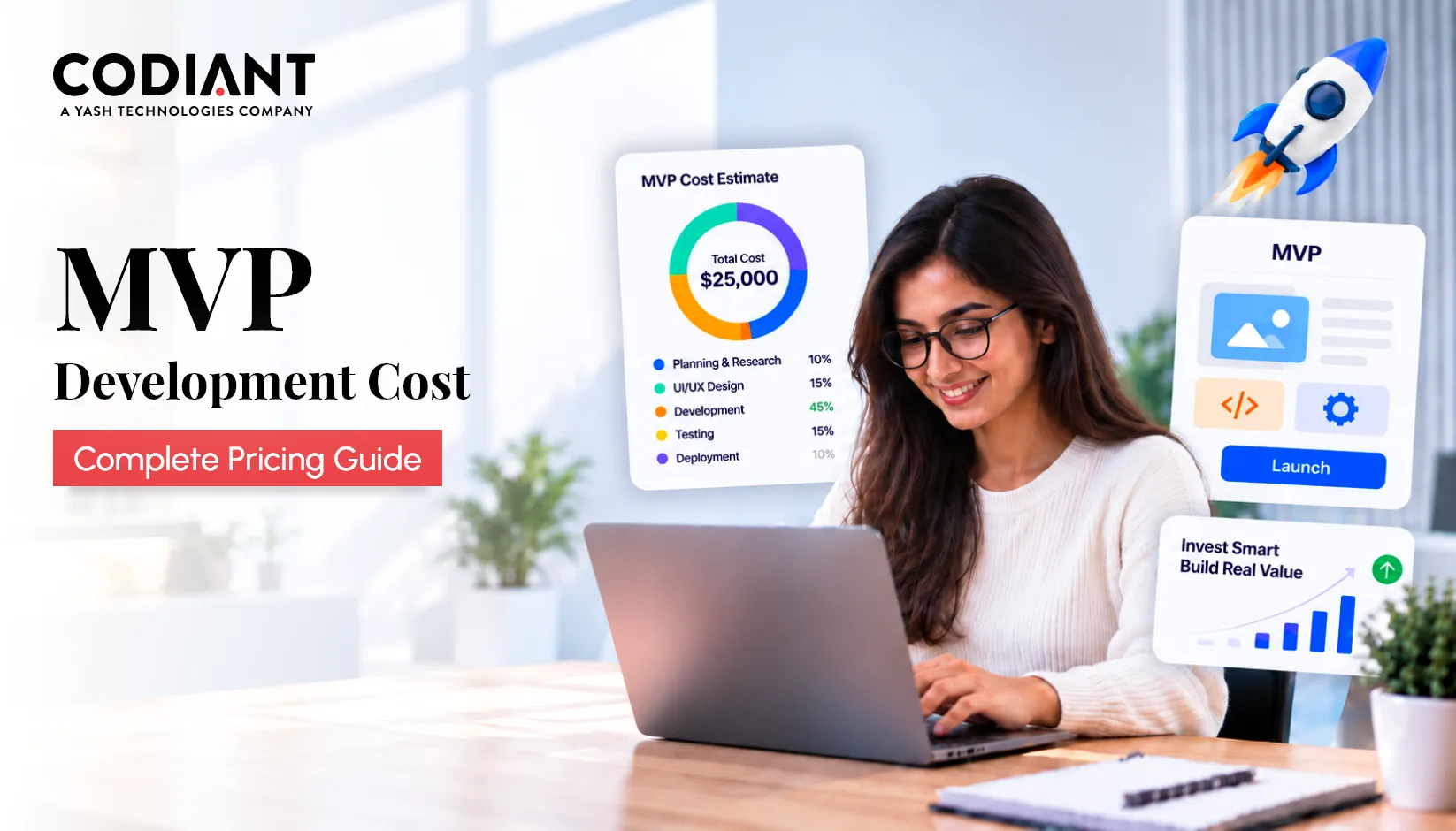
MVP development cost typically ranges from $5,000 for a basic web-based product to $150,000 or more for a complex, cross-platform solution. A custom MVP with user accounts, a backend, essential integrations and a polished interface often requires a planning budget of $25,000 to $90,000 and approximately three to five months.
These figures are estimates, not universal prices. The final minimum viable product cost depends on the product type, feature scope, platforms, integrations, security requirements, development location and delivery model.
A credible estimate should clearly state its assumptions, inclusions and exclusions. Without a defined product scope, we cannot confirm an accurate MVP development price. Based on Codiant’s experience delivering more than 100+ MVP projects, clear feature prioritisation and early scope validation are two of the most important factors in controlling cost and launch time.
Key Takeaways
- A basic web MVP may cost $5,000 to $20,000, while a custom app MVP commonly requires $25,000 to $90,000.
- Features, platforms, integrations, security and team location have the greatest effect on pricing.
- A focused MVP can take one to three months, while a mid-complexity product may require three to six months.
- Adding features before validating the core idea increases both cost and launch risk.
- Codiant provides full-cycle MVP development services covering product planning, design, engineering and launch support.
What Is an MVP?
A Minimum Viable Product (MVP) is the first working version of a product that includes only the essential features needed to solve a specific customer problem and validate a business idea. Instead of building a complete product from the start, businesses launch an MVP to test the concept, collect real user feedback, and reduce development costs and risks.
For example, if you want to build a food delivery app, an MVP might include user registration, restaurant listings, food ordering, online payments, and order tracking, while leaving advanced features for later versions.
The goal of an MVP is simple: build the core product, launch it quickly, learn from real users, and improve it based on feedback.
This approach helps startups and businesses determine whether their idea has market demand before investing heavily in full-scale product development.
How Much Does It Cost to Build an MVP?
MVP development can cost between $5,000 and $150,000 or more, depending on what is being built. A basic web MVP sits near the lower end, while a custom mobile or software product with several integrations, user roles and compliance controls sits near the higher end.
An MVP is not simply an unfinished application. AWS defines it as a basic product version that demonstrates the idea’s core benefit and allows a business to gather feedback quickly.
The following ranges can support early budgeting:
| MVP type | Illustrative development cost | Typical scope |
| Prototype or no-code pilot | $5,000–$15,000 | Clickable screens, limited automation or no-code workflows |
| Basic web MVP | $5,000–$20,000 | Login, forms, basic content and one core workflow |
| Simple custom app MVP | $25,000–$50,000 | Custom interface, backend, database and basic integrations |
| Mid-complexity MVP | $50,000–$90,000 | Dashboards, payments, APIs, notifications and multiple roles |
| Complex or regulated MVP | $80,000–$150,000+ | Multiple platforms, advanced integrations, security or compliance |
These ranges may exclude:
- Cloud hosting and usage charges
- Third-party software licences
- Paid APIs
- App Store and Play Store fees
- Content creation or data migration
- Post-launch marketing
- Long-term support and optimization
Therefore, an estimate should not be evaluated by its total price alone. Buyers should compare the deliverables, assumptions, quality controls and support included in each proposal.
What Factors Affect MVP Development Pricing?
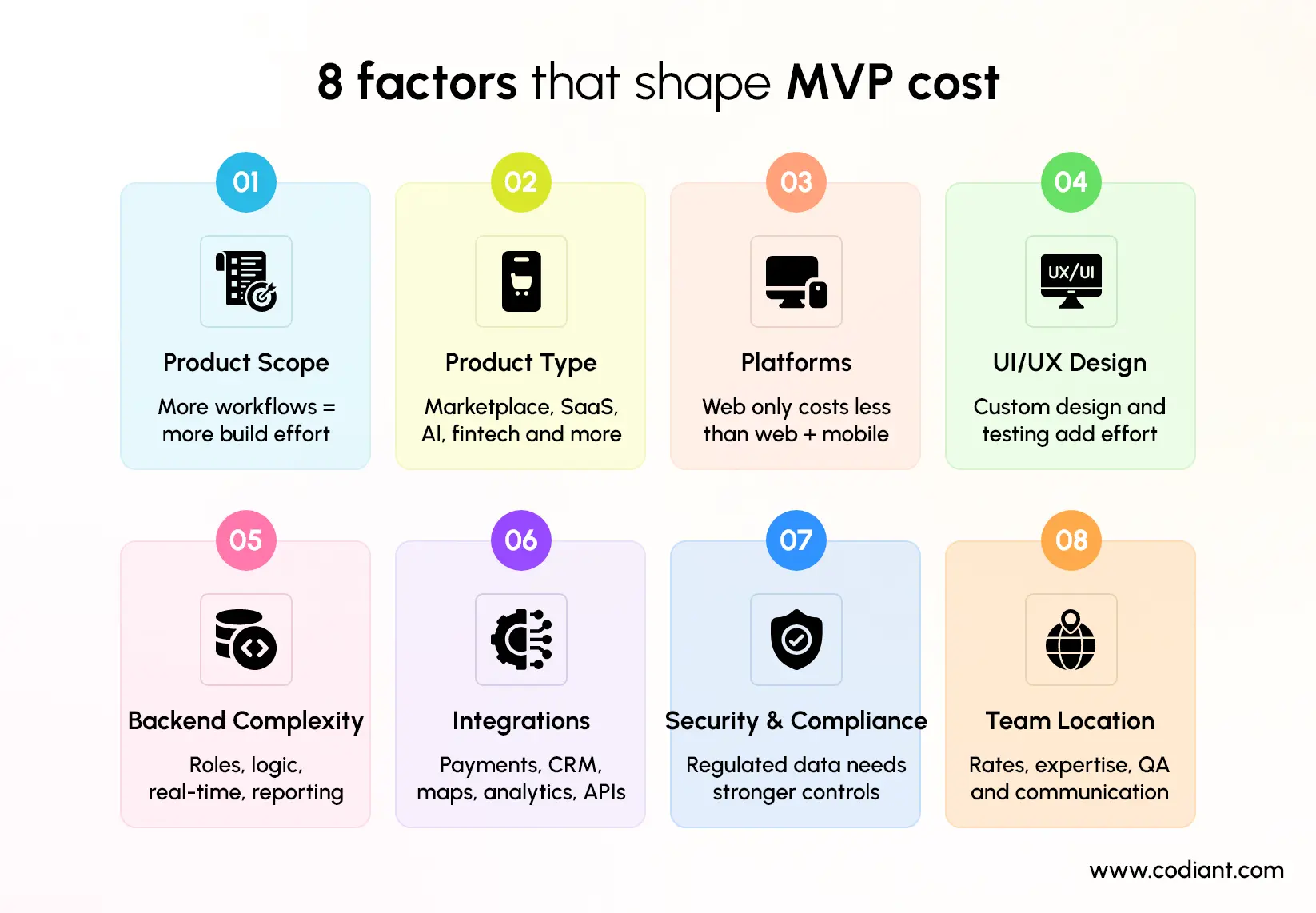
MVP development pricing is mainly determined by scope, complexity, platform choice, integrations, security and team structure. Two products described as “simple MVPs” may have very different costs because their technical requirements are not the same.
1. Product scope
The number of user journeys usually has a greater cost impact than the total number of screens.
For example, a booking application may require:
- Customer registration
- Service search
- Availability management
- Booking
- Payment
- Cancellation
- Notifications
- Provider administration
Each workflow introduces interface, backend, database and testing requirements. Removing non-essential workflows can reduce the product MVP cost without weakening the core value proposition.
2. Product type
MVP software development pricing differs by product category.
A content platform may require limited backend logic. A marketplace needs buyer and seller workflows. A financial application may require identity verification, audit trails and stricter data protection. An AI-enabled MVP may also involve model APIs, data preparation, retrieval systems, evaluation and usage controls. These additional AI development requirements can increase the technical scope and ongoing operating cost.
Did You Know?
Global startup ecosystem value fell by 31% in Startup Genome’s 2025 report.
This makes it even more important for startups to test ideas with a focused MVP before making a larger investment. The report analysed more than five million companies across over 350 startup ecosystems.
Source: Startupgenome
3. Platforms
Building only a responsive web application is normally less expensive than launching separate web, iOS and Android products.
A startup may reduce its initial MVP app development cost by selecting:
- One priority platform
- A responsive web application
- A cross-platform mobile framework
- A progressive web application where appropriate
The decision should reflect where early users are most likely to access the product.
4. UI and UX requirements
An interface built from a reusable design system generally requires less effort than a highly customised product with complex interactions, animations and accessibility requirements.
Design costs may include:
- User-flow planning
- Wireframes
- Interactive prototypes
- Visual design
- Design-system creation
- Usability testing
- Developer handoff
Good design should not be removed from an MVP. However, visual experimentation that does not support validation can usually be postponed.
5. Backend complexity
The backend controls data, business rules, user permissions and integrations. Costs increase when the MVP requires:
- Several user roles
- Real-time updates
- Complex search
- Location tracking
- Subscription billing
- Large file processing
- Recommendation systems
- Detailed reporting
A simple interface can still hide a technically complex backend.
6. Third-party integrations
Using existing services can shorten development, but every integration still requires configuration, error handling, testing and maintenance.
Common integrations include:
- Payment gateways
- Maps
- Email and SMS services
- Customer relationship management systems
- Accounting software
- Identity verification
- Analytics platforms
- AI model APIs
Licensing and usage charges should be listed separately from the custom MVP development fee.
7. Security and compliance
Healthcare, financial, insurance and enterprise products may require stronger identity controls, encryption, audit logs, consent management and compliance documentation.
Security should not be postponed simply because a product is called an MVP. The appropriate level depends on the data collected, the markets served and the potential consequences of unauthorised access.
8. Development-team location
Development costs vary by country, team experience, delivery model and access to specialised skills. Teams in regions with higher operating costs generally charge more, while offshore or nearshore teams may offer lower rates.
However, the lowest hourly rate does not always result in the lowest total cost. Poor planning, communication gaps, rework and limited quality assurance can extend the project and increase overall spending.
How Long Does It Take to Build an MVP?
A focused MVP usually takes one to three months, while a mid-complexity product may require three to six months. Products involving multiple platforms, regulated data, advanced integrations or untested technology can take longer.
A typical schedule may include:
| Stage | Illustrative duration |
| Discovery and requirements | 1–2 weeks |
| UX planning and wireframes | 1–3 weeks |
| UI design | 1–3 weeks |
| Development | 6–12 weeks |
| Testing and launch preparation | 2–4 weeks |
These stages form part of the broader steps to build an MVP, from defining the problem and researching users to prioritising features, developing the product and testing it with early adopters.
A realistic timeline should also state:
- How many team members are assigned
- Which platforms are included
- Whether design and discovery are complete
- How many integrations are required
- Who provides content and approvals
- Whether app-store review time is included
Promises such as “launch in four weeks” are not meaningful unless the included scope is clearly defined.
What Features Should Be Included in an MVP?
An MVP should include only the features required to deliver one core outcome, test the main assumption and collect usable feedback. Features that do not support those goals should usually move to a later release.
Before development begins, teams can use an MVP development checklist to confirm the target problem, core features, user journeys, technical requirements, success measures and launch priorities.
AWS describes an MVP as the smallest functional version that can be tested and improved using feedback.
Most MVPs need five feature groups.
1. Core user journey
The product must allow the target user to complete the main task.
Examples include:
- Booking a service
- Ordering a product
- Creating and sharing a document
- Tracking a delivery
- Receiving an AI-generated answer
- Connecting with a provider
2. Basic account management
Only include registration when the product needs saved data, personalisation or controlled access.
Possible features include:
- Sign-up and login
- Password reset
- Basic profile
- Role-based access
- Account deletion
3. Essential administration
An administrator usually needs a basic way to manage users, content, orders, listings or transactions.
The first version does not always need a fully customised administration portal. A simple internal dashboard may be sufficient.
4. Feedback and analytics
The product should measure whether users are receiving value.
Useful MVP metrics may include:
- Activation rate
- Task-completion rate
- Conversion rate
- Retention
- Feature usage
- Failed transactions
- User feedback
5. Minimum required security
Security requirements should reflect the data and workflows involved. Authentication, access controls, secure data transfer, backups and error monitoring may be necessary even in an early release.
Features such as advanced reporting, extensive personalisation, several payment options, multiple languages and complex automation can often wait unless they are central to the product hypothesis.
Why Should Startups Build an MVP First?
Startups should build an MVP first to test whether users need the product before committing to full-scale development. It converts an idea into a functional product that can generate evidence through actual user behaviour.
An MVP can help a startup:
- Validate the problem: User interviews show what people say. A functional product shows whether they will actually use the proposed solution.
- Test the value proposition: A startup can determine whether the central benefit is strong enough to attract registrations, repeated use, purchases or referrals.
- Prioritise future investment: Behavioural data can show which features need improvement and which requested features have limited value.
- Demonstrate progress: A working product can make investor, partner and stakeholder discussions more concrete. However, an MVP does not guarantee funding or commercial success.
- Reduce avoidable development: Building every planned feature before receiving feedback can produce a large product based on untested assumptions.
How Is MVP Development Cost Calculated?
MVP development cost is usually calculated using a fixed-price, time-and-materials, or dedicated-team model. The right option depends on how clearly the scope is defined, how likely the requirements are to change, and how much ongoing development support the product needs.
| Pricing model | How it works | Best suited for | Main consideration |
| Fixed price | The provider delivers an agreed scope for a set cost | MVPs with documented requirements, stable user journeys, known integrations, and clear acceptance criteria | Changes outside the agreed scope may increase the cost |
| Time and materials | The client pays for the hours or days worked by the team | Products with evolving requirements, technical uncertainty, or frequent user-feedback cycles | The estimate should show expected hours, team roles, and billing rates |
| Dedicated team | A defined team works on the product for a monthly fee | Longer product roadmaps requiring continuous design, development, testing, and optimization | Monthly cost depends on team size, seniority, and engagement duration |
1. Fixed-Price Model
Under a fixed-price model, the development company agrees to deliver a defined set of features for an agreed cost.
This model works best when:
- Requirements are documented
- User journeys are stable
- Integrations are known
- Acceptance criteria are measurable
Any feature or workflow added outside the approved scope may require a separate estimate or change request.
2. Time-and-Materials Model
Under a time-and-materials model, the client pays for the actual time spent by the delivery team.
This model works best when:
- Requirements may evolve
- User testing will influence priorities
- Technical uncertainty exists
- Iterative releases are planned
The estimate should clearly list the expected hours, assigned roles, billing rates, and review process.
3. Dedicated-Team Model
Under a dedicated-team model, a startup or business hires a defined team for a monthly period.
This model is suitable for longer product roadmaps that require ongoing:
- Product planning
- UX and interface design
- Frontend development
- Backend development
- Integrations
- Testing
- Deployment
- Project management
- Post-launch support
A transparent MVP proposal should separate the cost of each delivery stage and explain how scope changes, additional resources, and extended timelines will affect the final price.
How Can Businesses Control MVP Development Cost?
Businesses can control MVP development cost by narrowing the first release, selecting one validation goal and avoiding premature technical complexity.
Practical cost controls include:
- Define one primary user: Trying to serve customers, vendors, administrators, partners and internal teams in the first release can multiply workflows.
- Prioritise one core problem: The MVP should prove a specific assumption, not represent the complete long-term vision.
- Use existing services: Authentication, payments, messaging, maps and analytics do not always need to be built from the beginning.
- Choose one initial platform: Launching on one platform can generate enough evidence to decide whether expansion is justified.
- Document acceptance criteria: Clear acceptance criteria reduce disagreement, rework and uncontrolled scope growth.
- Plan for change without overengineering: The architecture should support likely next steps, but it does not need to solve every hypothetical future requirement.
- Reserve a contingency budget: A contingency amount can cover minor scope clarification, integration issues or launch changes. The appropriate percentage depends on how uncertain the requirements are; we cannot confirm one universal contingency percentage.
How Should You Evaluate an MVP Development Company?
Choose an MVP development company based on product thinking, technical suitability, estimation transparency and its ability to challenge unnecessary scope. Businesses that need support across planning, prototyping, design, development, testing and launch can consider full-cycle custom MVP development services.
Before selecting a provider, ask:
- What assumptions support the estimate?
- Which features and platforms are included?
- Which costs are excluded?
- Who owns the code and intellectual property?
- How will changes affect price and timeline?
- What testing is included?
- Who manages deployment?
- What happens after launch?
- How is security handled?
- Which team members will work on the product?
Review comparable work, but do not judge a provider only by the number of projects displayed. Ask what problem the team solved, what role it performed and what measurable outcome was achieved.
How Does Codiant Help Reduce MVP Development Cost and Risk?
Codiant supports MVP development by helping businesses define the core product idea, prioritise essential features and build a testable first version. The process focuses on reducing unnecessary scope while keeping the product stable enough for real-user validation.
The engagement may include:
- Product discovery and requirement clarification
- User-flow planning and feature prioritisation
- UI and UX design for the core journey
- Web, mobile or cross-platform development
- Backend, database and API development
- Third-party integrations
- Quality assurance and security testing
- Cloud deployment and launch support
The development approach can be adapted to startups, established businesses and teams validating a new digital product. Depending on the requirements, the MVP may be delivered through a fixed-price, time-and-materials or dedicated-team model.
Codiant also helps businesses plan beyond the first release by identifying which features should remain in the MVP and which can move to later phases. This makes the initial investment easier to control and creates a clearer roadmap for product expansion.
However, the final cost and timeline still depend on scope, platforms, integrations, security requirements and team structure. Without reviewing these details, an accurate MVP estimate cannot be confirmed.
Final Cost Estimate
For initial planning, businesses can use the following broad ranges:
- Basic web MVP: $5,000–$20,000
- Simple custom app MVP: $25,000–$50,000
- Mid-complexity MVP: $50,000–$90,000
- Complex or regulated MVP: $80,000–$150,000+
These ranges are based on publicly available Codiant and Clutch pricing examples and should not be treated as a quotation for a specific product.
Build Your MVP Without Overspending
Turn your idea into a market-ready MVP with the right features, technology, and development roadmap.
The Author

Frequently Asked Questions
MVP development cost is determined by product scope, user roles, platforms, interface complexity, backend logic, integrations, security requirements and team rates. A reliable estimate should also identify assumptions and exclusions. Without documented requirements and user journeys, we cannot confirm an accurate development cost.
Startups can reduce costs by focusing on one user problem, launching on one platform and postponing non-essential features. Existing services can also be used for payments, authentication, messaging and analytics. Cost reduction should not remove essential testing, data protection or the core experience being validated.
Common technologies include React or Angular for web interfaces, Node.js, Python, .NET or Laravel for backend development, and Flutter or React Native for cross-platform mobile apps. The correct stack depends on product requirements, team capability, integrations, performance needs and the expected development roadmap.
A basic MVP can take approximately one to three months, while a mid-complexity product may require three to six months. The timeline increases with additional platforms, integrations, security requirements and approval delays.
A business should expand after evidence shows that the MVP solves a meaningful problem and users repeatedly engage with it. Useful signals include retention, successful task completion, paid demand and consistent feedback. A full-scale build should respond to validated needs rather than an untested feature list.
Featured Blogs
Read our thoughts and insights on the latest tech and business trends

How Much Does It Cost to Hire a Dedicated AI/LLM Developer in 2026?
- September 8, 2026
- Artificial Intelligence Staff Augmentation
Hiring a dedicated AI or large language model (LLM) developer typically costs $35–$60 per hour for general AI engineering and $50–$200 per hour for specialised machine learning work, with enterprise pricing rising for advanced RAG,... Read more

HIPAA-Compliant App Development in 2026: How to Build Securely and Avoid Preventable Fines
- September 4, 2026
- Mobile App Development
HIPAA-compliant app development in 2026 requires six foundations: complete ePHI mapping, documented risk analysis, role-based access, encryption, signed business associate agreements, and continuous security monitoring. This matters most to healthcare CTOs, product leaders, and compliance... Read more

AI Developer Engagement Models Explained: How to Choose the Right AI Team
- August 27, 2026
- Artificial Intelligence
AI developer engagement model means deciding how external AI specialists will be assigned, managed, paid and held accountable. The main options are dedicated AI developers, AI team augmentation, time-and-material delivery, fixed-price projects and end-to-end AI... Read more