How to Hire a Dedicated Node.js Developer in 2026: Complete Guide
Table of Contents
Subscribe To Our Newsletter
Summarize with AI
Not enough time? get the key points instantly.
To hire a dedicated Node.js developer in 2026, evaluate candidates against five criteria: production Node.js experience, API architecture, database proficiency, cloud deployment skills, and communication within your delivery model.
This matters for CTOs at US mid-market companies and startup founders evaluating outsourcing because the developer may need to own backend services, integrations, performance, and release coordination rather than complete isolated coding tasks. The right hire should fit the existing stack, security requirements, sprint cadence, time-zone overlap, and expected level of technical ownership.
The Stack Overflow Developer Survey 2025 reports that 49.1% of professional developers had done extensive development work with Node.js during the previous year. The survey ranks Node.js first among the web frameworks and technologies reported by professional developers, ahead of React at 46.9%, indicating a large but competitive talent pool.
At Codiant, internal delivery data supplied for this brief record 40+ Node.js projects completed through dedicated developer and staff augmentation engagements. This complete hiring guide covers role scoping, required skills, interview questions, engagement models, costs, onboarding, and risk checks, with Codiant’s experience in building dedicated Node.js teams for distributed product delivery.
Key Takeaways
- A dedicated Node.js developer works exclusively with one client team; assess candidates across 5 criteria: Node.js, APIs, databases, cloud, and communication.
- Prioritize production ownership covering event-loop performance, API security, database design, testing, observability, and incident debugging.
- Allow 7–14 days for technical screening, architecture discussions, reference checks, and structured onboarding.
- Avoid hiring based only on years of experience without reviewing production code, system-design decisions, and debugging examples.
- Codiant has delivered 40+ Node.js projects and offers a 7-day free trial, helping clients assess technical, communication, and project fit before committing.
What is a Dedicated Node.js Developer?
A dedicated Node.js developer is a software engineer assigned primarily or exclusively to one client, product or development team for an agreed period. Unlike a freelancer completing a narrowly defined task, a dedicated developer generally works continuously across development, testing, deployment, maintenance and technical improvements.
The developer may be hired directly, supplied through a staff augmentation provider or engaged through a Node.js development company. In each case, the defining feature is sustained involvement in the product rather than one-time delivery.
Dedicated Node.js developers commonly handle:
- Backend application development
- REST and GraphQL API development
- Database design and optimization
- Authentication and authorization
- Third-party service integrations
- Real-time application features
- Microservices and serverless functions
- Performance testing and optimization
- Cloud deployment and monitoring
- Legacy Node.js modernization
- Production maintenance and incident resolution
The exact responsibilities should be written into the engagement scope. A title alone does not confirm whether the developer will own architecture, implementation, DevOps, testing or production support.
Build a Reliable Node.js Team Without Lengthy Hiring Delays Today
Access skilled developers matched to your backend goals, timeline, workflow, and requirements.
How to Hire Dedicated Node.js Developers?
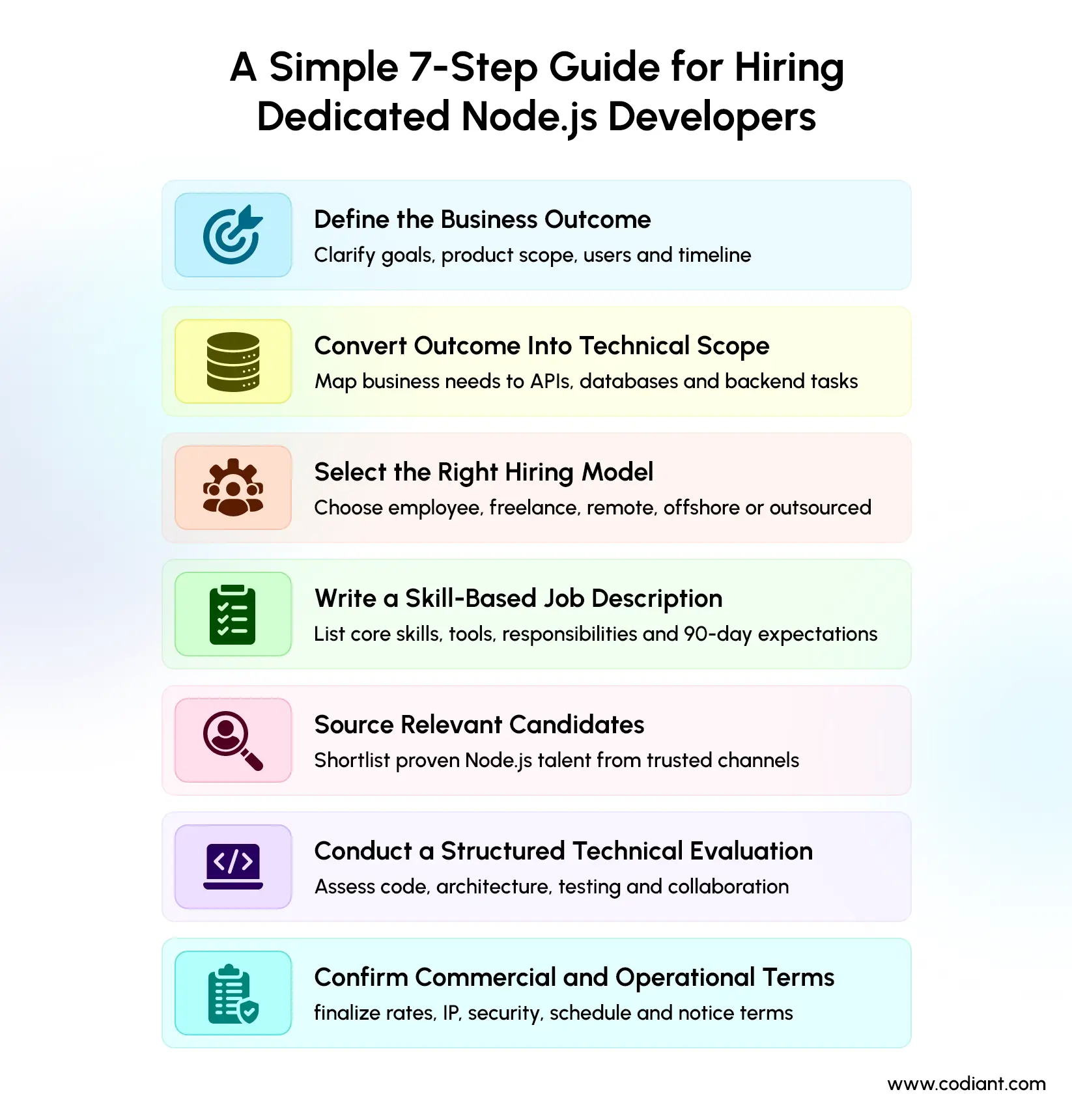
To hire dedicated Node.js developers successfully, first define the work, select an engagement model, create a skill-based role description, evaluate practical experience and complete technical due diligence before signing a long-term agreement.
The following process helps make each decision measurable.
1. Define the Business Outcome
Begin with the problem the developer must solve. Avoid starting with a generic requirement such as “need a senior Node.js developer.”
Write down:
- The product or system being developed
- Current development stage
- Expected backend responsibilities
- Required integrations
- Data and security requirements
- Expected users or transaction patterns
- Existing architecture and technical debt
- Planned deployment environment
- Project timeline
- Required working-hour overlap
- Expected engagement duration
For example, developing an internal administration API requires a different skill set from building a high-volume messaging platform or modernizing a monolithic application.
For mobile products, the backend should not be selected in isolation. Authentication, APIs, databases, frontend technology, integrations and deployment requirements must work as one system. Reviewing the factors involved in selecting the right mobile app tech stack can help teams align Node.js with the application’s wider architecture before hiring begins.
2. Convert the Outcome into Technical Scope
Translate business requirements into engineering responsibilities.
A clear scope could include:
- Design REST APIs using Node.js and TypeScript
- Build services with Express, NestJS or Fastify
- Work with PostgreSQL and Redis
- Integrate payment and identity providers
- Write unit and integration tests
- Configure Docker-based deployments
- Add tracing, metrics and error reporting
- Participate in code reviews
- Maintain technical documentation
- Support production releases
The scope should also clarify whether the role is limited to backend engineering or extends to frontend development. If one developer must own features across the interface, API and database layers, it may be useful to compare a Node.js backend specialist with the broader responsibilities involved in hiring full-stack developers for complex projects.
3. Select the Right Hiring Model
Choose whether the developer should be:
- A permanent employee
- An independent freelancer
- A dedicated remote developer
- Part of an offshore development team
- Supplied through staff augmentation
- Part of a complete outsourced project team
The right option depends on product duration, internal management capacity, confidentiality requirements and the number of supporting roles needed.
Did You Know?
Newer Node.js versions can run many TypeScript files directly, making development simpler and faster.
4. Write a Skill-Based Job Description
A useful job description separates essential capabilities from optional preferences.
Include:
- Required Node.js experience
- JavaScript and TypeScript expectations
- Framework experience
- API and database responsibilities
- Testing requirements
- Cloud and DevOps exposure
- Security responsibilities
- Collaboration expectations
- Time-zone overlap
- Contract duration
- Interview stages
- Expected outputs during the first 90 days
Avoid rejecting capable candidates simply because they have not used the exact library in your current stack. Evaluate whether they understand the underlying engineering problem.
5. Source Relevant Candidates
Businesses can find Node.js developers for hire through professional networks, technical communities, recruitment platforms, freelance marketplaces and companies offering Node.js outsourcing services. When comparing providers, review their Node.js development services and hiring models against the responsibilities defined in your scope, including APIs, databases, microservices, real-time functionality, cloud deployment and ongoing support.
Shortlist candidates according to evidence, not profile keywords. Relevant indicators include:
- Comparable production applications
- Backend ownership
- Scale or reliability challenges solved
- Code quality practices
- Long-term maintenance experience
- Clear explanation of technical decisions
- Experience working with distributed teams
6. Conduct a Structured Technical Evaluation
Use the same scoring criteria for every shortlisted candidate. Evaluate code quality, architecture, security, testing, communication and practical decision-making separately.
The evaluation should include:
- Resume and portfolio review
- Technical discussion
- Practical coding or review task
- Architecture interview
- Team collaboration interview
- Reference or employment verification
- Paid pilot, where appropriate
A structured process reduces the risk of selecting someone who communicates confidently but lacks production depth.
7. Confirm Commercial and Operational Terms
Before onboarding, document:
- Monthly or hourly rate
- Minimum engagement period
- Working schedule
- Notice period
- Leave and replacement policy
- Intellectual property ownership
- Confidentiality obligations
- Source-code access
- Security requirements
- Performance review process
- Invoicing and payment terms
A developer should not begin production work until repository permissions, data access and ownership terms are clear.
What Skills Should a Node.js Developer Have?
A capable Node.js developer should understand JavaScript or TypeScript, asynchronous execution, API design, databases, application security, automated testing, cloud deployment and production monitoring.
Node.js is an asynchronous, event-driven JavaScript runtime designed for network applications. Its event loop enables non-blocking input and output, but developers must understand how blocking work can reduce throughput or create denial-of-service risks.
Core Skills to Evaluate
| Skill area | What the developer should understand |
| JavaScript | Closures, modules, objects, promises, errors and modern ECMAScript |
| TypeScript | Types, generics, interfaces, configuration and safe refactoring |
| Asynchronous programming | Event loop, promises, async/await, streams and concurrency |
| Node.js internals | Process lifecycle, memory, worker threads and error handling |
| Backend frameworks | Express, NestJS, Fastify or comparable frameworks |
| API development | REST, GraphQL, validation, pagination, versioning and documentation |
| Databases | SQL, NoSQL, indexing, transactions, schema design and migrations |
| Authentication | Sessions, tokens, OAuth, authorization and access control |
| Testing | Unit, integration, contract and end-to-end testing |
| Security | Input validation, dependency management, secrets and secure APIs |
| Cloud deployment | Containers, CI/CD, cloud services and environment configuration |
| Observability | Logs, traces, metrics, alerts and production diagnostics |
| Collaboration | Git, reviews, documentation and stakeholder communication |
Framework experience should be evaluated according to the project architecture rather than the popularity of a particular tool. Teams still deciding between Node.js, Express and other options can review this comparison of web application development frameworks before making one framework mandatory in the job description.
1. JavaScript and TypeScript
The developer should be comfortable with modern JavaScript and understand the runtime behavior behind asynchronous operations.
TypeScript should be evaluated for projects with long-term maintenance requirements or multiple engineers. TypeScript adds a type system on top of JavaScript and can identify certain errors during development, although it does not replace runtime validation or testing.
Ask candidates to explain:
- How they model API request and response types
- How they handle unknown external data
- When they use generics
- How strict TypeScript settings affect reliability
- How they migrate JavaScript applications to TypeScript
2. Asynchronous Programming and Performance
The developer should explain the event loop without relying only on memorized definitions.
A strong candidate should understand:
- Non-blocking network operations
- Promise execution
- Error handling in asynchronous code
- Streams and backpressure
- CPU-intensive work
- Worker threads or separate services
- Connection pooling
- Caching
- Rate limiting
- Memory leak diagnosis
Node.js can process network workloads efficiently, but heavy synchronous or CPU-intensive operations may block request handling. The official Node.js guidance recommends keeping work on the event loop and worker pool bounded.
3. API and Integration Skills
Node.js backend developers frequently work with APIs and external services. Evaluate whether the candidate can design stable contracts rather than only create endpoints.
Look for experience with:
- Request validation
- Authentication and authorization
- Pagination and filtering
- Idempotency
- Webhooks
- API versioning
- Retry handling
- Timeout management
- Error structures
- OpenAPI documentation
- Third-party API failures
Give greater weight to candidates who can explain how they handle partial failures, duplicate requests and changing external APIs.
4. Database Knowledge
The developer should understand both application code and data behavior.
Evaluate knowledge of:
- Relational and document databases
- Indexes
- Query performance
- Transactions
- Schema migrations
- Data consistency
- Connection management
- Object-relational mapping
- Backup and recovery considerations
- Caching with Redis or comparable systems
Framework knowledge cannot compensate for weak database fundamentals.
5. Testing Ability
A developer should be able to select tests according to risk. Node.js provides a built-in test runner, while projects may also use Jest, Vitest, Mocha or other testing tools. The official Node.js test runner supports JavaScript testing without requiring an additional test-runner dependency.
Ask the candidate to distinguish among:
- Unit tests for isolated logic
- Integration tests for databases and services
- Contract tests for APIs
- End-to-end tests for complete workflows
- Performance tests for load-sensitive systems
The candidate should also explain what should not be mocked and how tests are executed in CI/CD.
6. Security Knowledge
Security should be evaluated as a core backend skill, not an optional specialization.
OWASP’s Node.js guidance identifies practices related to input validation, access control, error handling, request limits, application monitoring and dependency security. OWASP also maintains separate guidance for npm and REST API security.
Evaluate whether the developer understands:
- Input and schema validation
- Broken access control
- Injection risks
- Secure password storage
- Token handling
- Cross-origin resource sharing
- Rate limiting
- Secure headers
- Secret management
- Dependency vulnerabilities
- Logging without exposing sensitive information
A senior candidate should be able to identify security risks during design, not only after code is written.
7. Cloud and Observability Skills
Production experience should include deployment and monitoring.
A developer does not need to be a full-time DevOps engineer, but should understand:
- Docker
- Environment variables
- CI/CD pipelines
- Horizontal scaling
- Health checks
- Graceful shutdowns
- Cloud logging
- Error tracking
- Traces and metrics
- Rollback procedures
OpenTelemetry provides vendor-neutral APIs and tools for collecting traces, metrics and logs. Its JavaScript documentation includes Node.js instrumentation for monitoring application behavior.
What Should Businesses Check When Hiring Node.js Developers in 2026?
Businesses hiring in 2026 should specifically evaluate supported Node.js versions, TypeScript maturity, software supply-chain security, observability and responsible use of AI-assisted development tools.
1. Supported Node.js Versions
As of July 2026, Node.js 24 and Node.js 22 are LTS release lines, while Node.js 26 is the Current version. Node.js 26 is scheduled to enter LTS in October 2026. The Node.js project recommends using Active LTS or Maintenance LTS releases for production applications.
Ask candidates:
- Which Node.js versions they currently support
- How they plan major-version upgrades
- How they test dependency compatibility
- How they remove deprecated APIs
- How they respond when a version reaches end of life
Experience maintaining old versions without an upgrade plan should not be treated as a positive signal.
2. TypeScript Depth
Many candidates list TypeScript but use it only for basic annotations. Ask them to review code containing unsafe casts, poorly defined external data and broad any usage.
The objective is not to test obscure syntax. It is to determine whether TypeScript is being used to improve maintainability and interface clarity.
3. Dependency and Supply-Chain Management
Node.js projects often rely on third-party packages. Candidates should explain how they:
- Review new dependencies
- Lock dependency versions
- Monitor vulnerabilities
- Remove abandoned packages
- Limit package permissions
- Protect CI/CD credentials
- Verify production builds
A high package count is not automatically a problem, but every dependency introduces maintenance and security responsibilities.
4. AI-Assisted Coding
AI coding tools can support documentation, testing, refactoring and code generation, but generated code still requires technical review.
Ask candidates to explain:
- When they use AI tools
- How they verify generated code
- Whether confidential code is submitted to external services
- How they check licenses and dependencies
- How they prevent unreviewed code from reaching production
Do not evaluate a developer according to whether they use AI. Evaluate whether their process protects code quality, security and confidential information.
Why Should Businesses Choose Node.js for Backend Development?
Businesses often choose Node.js for applications that require network communication, API development, real-time updates or a shared JavaScript ecosystem across frontend and backend teams.
The runtime uses an event-driven architecture and supports non-blocking input and output, making it suitable for many connection-heavy applications. It is not automatically the best option for every workload, particularly when substantial CPU-intensive processing remains inside the main request path.
Node.js may be suitable for:
- SaaS platforms
- Web and mobile application backends
- Real-time dashboards
- Messaging and collaboration systems
- API gateways
- E-commerce platforms
- Streaming applications
- Serverless functions
- Microservices
- IoT data services
- Payment and booking systems
- Backend-for-frontend services
The suitability of Node.js also depends on the requirements of each industry. Healthcare platforms, for example, may use it for appointment systems, real-time communication, patient-facing applications and API integrations. This overview of Node.js for healthcare application development explains how the technology can support common healthcare and mHealth use cases.
The 2025 Stack Overflow Developer Survey found that 49.1% of professional developers answering its web-frameworks question reported working extensively with Node.js. JavaScript was reported by 68.8% of professional developers and TypeScript by 48.8% in the language section. These results indicate broad ecosystem familiarity, but they do not prove Node.js is the right architecture for every project.
Did You Know?
In its internal test, PayPal found that its Node.js application handled more requests and responded faster than a similar Java application.
Scale Backend Development Faster with Dedicated Node.js Engineering Expertise Today
Extend your team with experienced developers ready for complex product requirements today.
When Might Node.js Not Be the Best Choice?
Node.js may not be the best default choice when the application’s primary workload involves sustained CPU-intensive computation, specialized scientific computing or an existing ecosystem built around another language.
This does not mean Node.js cannot participate in such systems. Teams may separate computational work into worker threads, queues or services written in another language. The architecture should be selected according to workload characteristics rather than technology popularity.
Before choosing Node.js development services, ask:
- Is the workload primarily network-based or computation-heavy?
- Does the team already have JavaScript and TypeScript expertise?
- Are essential libraries actively maintained?
- What latency and throughput targets must be met?
- What systems must be integrated?
- Which compliance requirements apply?
- Who will maintain the system for the next three years?
How Can Businesses Assess a Node.js Developer’s Experience?
Businesses should assess Node.js experience through production examples, source code, architecture decisions, testing practices and problem-solving evidence.
Years of experience alone do not confirm capability. Two developers with five years of experience may have handled very different levels of responsibility.
1. Review Production Evidence
Ask the candidate to describe one system in detail:
- What problem did it solve?
- What did the candidate personally own?
- How was the backend structured?
- What database was used and why?
- What failed in production?
- How was the problem diagnosed?
- What would the candidate change now?
- How was performance measured?
- How was the system deployed?
- How were security risks handled?
Look for specific explanations rather than broad statements such as “improved performance” or “worked on microservices.”
2. Use a Practical Assignment
A practical task should resemble the role without requiring unpaid project work.
Suitable assignments include:
- Review a small API and identify problems
- Add one endpoint with validation and tests
- Diagnose an event-loop blocking issue
- Design a service for a stated workload
- Improve error handling and logging
- Explain a database query problem
Evaluate the reasoning, code structure, tests, documentation and trade-offs.
3. Run an Architecture Discussion
Give the candidate a realistic scenario rather than asking for a perfect system design.
For example:
Design the backend for a booking platform that must prevent duplicate reservations, process payments and notify users when booking status changes.
A strong answer should discuss data consistency, idempotency, failures, queues, database constraints, security and observability.
Beyond Resumes: How HireGroww Supports Skill-Based Node.js Hiring
HireGroww is Codiant’s AI-powered recruitment and skill-assessment platform that helps businesses evaluate candidates through structured screening, assessments and interviews. For Node.js hiring, this approach allows recruiters to compare practical capabilities instead of relying only on resumes and years of experience.
The platform brings together:
- Automated resume parsing and role matching
- Role-based technical assessments
- AI-generated interview questions
- Video interviews and candidate scoring
- Recruitment dashboards and ATS integrations
Codiant’s published case study reports that HireGroww achieved 70% faster shortlisting during its pilot rollout. It also reports up to a 65% reduction in hiring time, a 40% increase in recruiter productivity and a 35% improvement in candidate-role matching accuracy. These are Codiant-reported project outcomes and should not be treated as universal hiring benchmarks.
What Does This Mean for Node.js Hiring?
Businesses can apply the same skill-first approach when hiring dedicated Node.js developers. Assessments can evaluate API development, TypeScript, asynchronous programming, database knowledge, security, testing and production troubleshooting before a long-term hiring decision is made.
Which Node.js Interview Questions Should You Ask?
Interview questions should test how the developer applies knowledge in real systems.
Consider asking:
- How does the Node.js event loop work?: Look for an explanation of asynchronous I/O, callbacks and blocking work.
- What types of operations can block a Node.js application?: The candidate should discuss synchronous work, large computations and inefficient callbacks.
- How would you process a CPU-intensive task?: Listen for worker threads, queues, separate services or asynchronous processing.
- How do you prevent duplicate payment or booking requests?: Look for idempotency keys, database constraints and transactional handling.
- How do you validate data from an external API?: TypeScript types alone are not runtime validation.
- When would you choose SQL over a document database?: The answer should consider relationships, transactions, query patterns and consistency.
- How do you structure errors in a public API?: Look for stable error codes, appropriate status codes and safe messages.
- How do you test a service that uses a database and third-party API?: The candidate should distinguish unit, integration and contract testing.
- How do you secure secrets in local, CI and production environments?: Credentials should not be committed to source control.
- How do you diagnose increasing memory usage?: Look for profiling, heap analysis, metrics and controlled reproduction.
- How would you upgrade an older Node.js application?: The candidate should discuss version support, dependencies, tests and staged rollout.
- Tell us about a production incident you handled: A useful answer explains diagnosis, communication, recovery and prevention.
How Much Does It Cost to Hire Node.js Developers?
The cost to hire Node.js developers depends on experience, location, engagement model, project complexity, working-hour overlap and the supporting services included in the contract.
Businesses that need a more detailed comparison of experience-based and location-based pricing can review this breakdown of the cost to hire a Node.js developer. Published rate ranges should be treated as reference points rather than guaranteed quotations because actual pricing depends on the defined role and commercial terms.
Upwork’s public Node.js rate page currently shows a typical median hourly range of $18 to $38. It also lists indicative experience-based rates of $20 to $30+ for beginners, $30 to $60+ for intermediate developers and $60 to $90+ for experts. These are marketplace benchmarks, not guaranteed rates for every dedicated engagement.
Illustrative Monthly Cost Calculation
The following calculation assumes 160 billable hours per month:
| Public hourly benchmark | Monthly calculation | Illustrative monthly amount |
| $18 to $38 | Rate × 160 hours | $2,880 to $6,080 |
| $20 to $30 | Rate × 160 hours | $3,200 to $4,800 |
| $30 to $60 | Rate × 160 hours | $4,800 to $9,600 |
| $60 to $90 | Rate × 160 hours | $9,600 to $14,400 |
These figures are calculations based on Upwork’s published rates. They do not automatically include recruitment, benefits, taxes, project management, QA, DevOps, replacement coverage, equipment or agency fees.
What Affects Node.js Hiring Costs?
The main variables are:
- Developer seniority
- Country and location
- Framework specialization
- Architecture responsibilities
- Database complexity
- Security and compliance requirements
- Cloud and DevOps responsibilities
- Working-hour overlap
- Contract duration
- Urgency
- Required support hours
- Inclusion of QA or project management
A credible estimate should explain what is included, what is excluded and which assumptions were used. Without a role description and engagement scope, we cannot confirm an accurate hiring cost.
Which Engagement Model Is Best for Hiring Dedicated Node.js Developers?
The best engagement model depends on work duration, internal management capacity, required flexibility and ownership expectations.
| Engagement model | Best suited for | Main consideration |
| Permanent employee | Long-term internal engineering capability | Recruitment, benefits and retention |
| Freelancer | Limited tasks or short assignments | Availability and continuity |
| Dedicated developer | Ongoing product development | Requires clear management and goals |
| Offshore developer | Cost-sensitive long-term scaling | Time zones, communication and governance |
| Staff augmentation | Adding skills to an existing team | Client usually manages daily work |
| Project outsourcing | Defined deliverables requiring a complete team | Less direct control over individual resources |
Businesses with an established technical lead may benefit from remote Node.js developers or staff augmentation. Businesses without internal product and engineering management may need a complete team rather than one developer.
What Are the Advantages of Hiring Dedicated Node.js Developers?
Hiring dedicated Node.js developers can provide continuity, deeper product knowledge, direct collaboration and predictable development capacity.
The primary advantages are:
1. Consistent Product Context
A dedicated developer learns the product, architecture, users and operating constraints over time. This reduces repeated onboarding between tasks.
2. Direct Team Collaboration
The developer can participate in planning, stand-ups, code reviews and technical discussions alongside internal employees.
3. Flexible Team Scaling
Businesses can add or reduce development capacity according to the engagement contract without establishing a new legal entity in every hiring location.
4. Better Ownership
Long-term involvement can create clearer responsibility for code quality, documentation, testing and production stability.
5. Access to Specialized Skills
Businesses can hire for specific experience such as NestJS, real-time communication, payment systems, AWS, PostgreSQL or microservices.
These benefits depend on the actual contract and management process. A “dedicated” label does not by itself guarantee exclusivity, seniority, availability or performance.
How Should You Evaluate Offshore Node.js Developers?
Evaluate offshore Node.js developers using the same technical standards as local candidates, while adding checks for communication, time-zone overlap, data access, contractual protection and delivery governance.
Before selecting offshore Node.js developers, confirm:
- Developer identity and employment status
- Actual working hours
- Expected overlap with your team
- Communication proficiency
- Equipment and network security
- Access-control process
- Intellectual property terms
- Data location restrictions
- Backup or replacement arrangements
- Holiday and leave calendars
- Performance reporting
- Escalation contacts
Do not choose Node.js outsourcing services based only on the lowest hourly rate. Compare the complete delivery cost, including management time, rework, security, QA and continuity.
What Red Flags Should Businesses Avoid?
Red flags during Node.js hiring include weak JavaScript fundamentals, inability to explain production decisions, missing tests, careless dependency usage and vague claims about performance.
Watch for candidates who:
- Cannot explain asynchronous execution clearly
- Treat TypeScript as a substitute for validation
- Select databases without discussing query patterns
- Have no testing strategy
- Cannot describe a production failure
- Ignore supported Node.js versions
- Place secrets inside source code
- Install packages for trivial functions without review
- Claim expertise in every cloud and framework
- Cannot separate personal contributions from team achievements
- Avoid documenting decisions
- Submit generated code they cannot explain
One weak answer should not automatically disqualify a candidate. Evaluate the complete evidence and the requirements of the role.
How Should a Dedicated Node.js Developer Be Onboarded?
Onboarding should provide the developer with product context, architecture documentation, secure access and measurable first-month goals.
A practical onboarding plan includes:
Week 1: Access and Understanding
- Product walkthrough
- Repository setup
- Architecture overview
- Security and access training
- Local development environment
- Coding standards
- Release process
- Initial low-risk task
Week 2: Guided Contribution
- Complete a small feature or bug fix
- Add or update tests
- Participate in code review
- Review monitoring dashboards
- Document questions and assumptions
Weeks 3 and 4: Independent Ownership
- Take responsibility for a defined module
- Estimate and deliver planned work
- Participate in deployment
- Review technical debt
- Agree on 60-day priorities
Do not measure onboarding only by the number of tickets closed. Assess code quality, communication, understanding and ability to work safely within the existing system.
How Codiant Can Support Node.JS Development Needs?
Codiant can help businesses hire dedicated Node.js developers who match specific product, architecture and delivery requirements. The engagement can support new application development, backend modernization, API engineering, cloud deployment or long-term product maintenance without forcing companies into a fixed hiring model.
Support may include:
- Pre-vetted Node.js developers with relevant backend experience
- Flexible hourly, monthly or dedicated engagement options
- Expertise in TypeScript, Express, NestJS, databases and cloud platforms
- Integration with existing product, QA and DevOps teams
- Clear communication, progress tracking and code-review practices
- Scalable team extension as project requirements change
The selection process should still be based on technical fit, project scope, security needs and measurable responsibilities rather than availability alone.
Final Checklist for Hiring Node.js Developers in 2026
Before making an offer, verify:
1. Role and Scope
- Is the business outcome clearly defined?
- Are responsibilities and exclusions documented?
- Is the required seniority justified?
- Is production support included?
2. Technical Capability
- Can the developer explain the event loop?
- Is JavaScript and TypeScript knowledge sufficient?
- Can the developer design secure APIs?
- Are database fundamentals strong?
- Can the developer write and maintain tests?
- Is cloud and monitoring experience relevant?
3. Evidence
- Has production experience been verified?
- Did the candidate explain personal contributions?
- Was practical work assessed?
- Were architecture decisions discussed?
- Were references checked where appropriate?
4. Engagement Terms
- Are rates and billable hours defined?
- Is intellectual property ownership clear?
- Are confidentiality and data requirements documented?
- Are working hours and overlap agreed?
- Is a replacement or notice policy included?
5. Long-Term Fit
- Can the developer maintain the system after launch?
- Can they work with the existing team?
- Do they document decisions?
- Can they support upgrades and modernization?
- Are performance expectations measurable?
Turn Your Node.js Roadmap into Secure, Scalable Product Delivery Faster
Get dependable backend expertise for architecture, integrations, deployment, and ongoing optimization support.
The Author

Frequently Asked Questions
Businesses should evaluate JavaScript, TypeScript, asynchronous programming, Node.js internals, API development, databases, testing, security, cloud deployment and observability. The exact weighting should reflect the application’s architecture and the responsibilities assigned to the developer.
Hiring dedicated Node.js developers provides focused expertise, faster development cycles, improved code quality, scalable application architecture, seamless API integration, and long-term technical support. It also enables businesses to scale development teams efficiently while reducing recruitment and operational overhead.
A dedicated or staff augmentation model is often suitable when a business needs ongoing development capacity and already has internal technical leadership. A complete outsourced team may be more appropriate when product management, QA, DevOps and architecture support are also required.
The hiring timeline depends on whether you recruit independently or partner with a pre-vetted development company. With the right hiring partner, you can significantly reduce onboarding time. At Codiant, you can hire a dedicated Node.js developer within 24 hours and get started with a 7-day free trial, allowing you to evaluate technical expertise and team fit before making a long-term commitment.
Node.js is used across SaaS, financial technology, retail, healthcare, logistics, media, education, travel, property technology and communication platforms. Suitability depends on the application workload, integrations, security requirements and existing engineering ecosystem rather than the industry name alone.
Featured Blogs
Read our thoughts and insights on the latest tech and business trends

How Much Does It Cost to Build an MVP in 2026? A Complete Pricing Guide
- September 10, 2026
- Digital Transformation
MVP development cost typically ranges from $5,000 for a basic web-based product to $150,000 or more for a complex, cross-platform solution. A custom MVP with user accounts, a backend, essential integrations and a polished interface... Read more

How Much Does It Cost to Hire a Dedicated AI/LLM Developer in 2026?
- September 8, 2026
- Artificial Intelligence Staff Augmentation
Hiring a dedicated AI or large language model (LLM) developer typically costs $35–$60 per hour for general AI engineering and $50–$200 per hour for specialised machine learning work, with enterprise pricing rising for advanced RAG,... Read more

HIPAA-Compliant App Development in 2026: How to Build Securely and Avoid Preventable Fines
- September 4, 2026
- Mobile App Development
HIPAA-compliant app development in 2026 requires six foundations: complete ePHI mapping, documented risk analysis, role-based access, encryption, signed business associate agreements, and continuous security monitoring. This matters most to healthcare CTOs, product leaders, and compliance... Read more