Shopify Development Cost Breakdown 2026: What Business Owners Must Know
Table of Contents
Subscribe To Our Newsletter

Summarize with AI
Not enough time? get the key points instantly.
In a Nutshell
- Shopify plans in 2026 range from $5 to $2,300 monthly.
- Real monthly costs are $150–$300, not just the plan fee.
- Apps, fees, and maintenance are the biggest hidden costs.
- Building a store costs $500 DIY to $80,000+ custom agency.
- In India, development costs range from ₹15K to ₹5L+.
- Shopify Payments is unavailable in India; transaction fees apply.
- Freelancers charge $25–$100/hr., agencies charge $75–$200/hr.
- Shopify is more cost-effective than custom development for most businesses.
- Premium themes save more money than fully custom builds early on.
- Planning before building is the most powerful cost-control strategy.
So, you’re thinking about launching an online store on Shopify in 2026. Smart choice. But before you dive in, there’s one question every business owner asks and very few get a straight answer to, how much does it actually cost to build and run a Shopify store?
The confusion is understandable. Go to Shopify’s website and you’ll see plans starting at $39 per month.
That sounds affordable, right?
But the real number once you add themes, apps, transaction fees, developer charges and ongoing maintenance is very different. Some stores run efficiently on $150 a month. Others quietly balloon to $5,000+ per month without the owner quite knowing how it happened.
This guide breaks down every cost layer clearly and honestly from the Shopify subscription fee all the way to custom development, India-specific pricing and the hidden expenses that catch most first-time store owners off guard.
Whether you’re a small business owner in US testing a product idea, or a growing D2C brand in India ready to scale, this is the cost guide you need to read before spending a single dollar.
💡DID YOU KNOW?
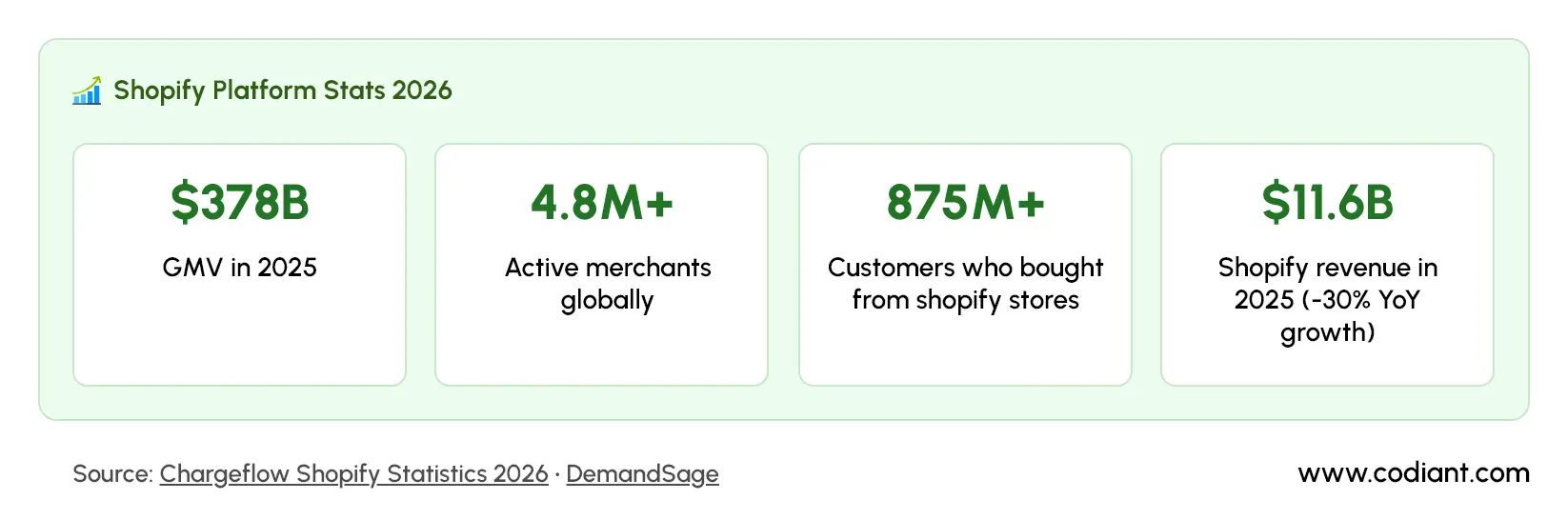
Shopify processed $378 billion in Gross Merchandise Volume (GMV) in 2025 a number that grew 30% year-over-year. Today, there are over 4.8 million active Shopify merchants in 175+ countries & Shopify holds approximately 29% of the global ecommerce platform market.
It is no longer just an option for online selling for millions of businesses, it is the backbone of their entire revenue engine.
Shopify Pricing Plans in 2026: What You Actually Pay Each Month
Shopify’s pricing structure in 2026 is built around five main tiers, each suited to a different stage of business growth. The first thing to understand is that all plan prices come with a 25% discount if you pay annually which can save you a meaningful amount over the year. Here’s how the plans stack up:
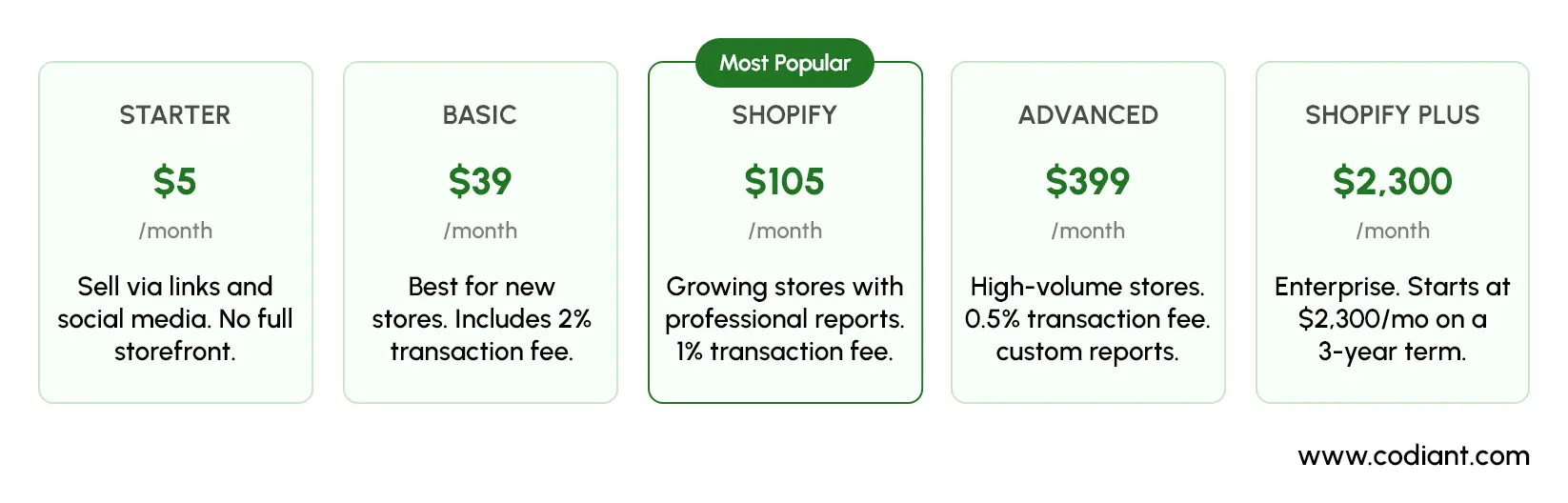
For Indian merchants, the monthly costs translate roughly as follows, Basic at approximately ₹1,994/month, the standard Shopify plan at ₹5,411/month & Advanced at ₹21,651/month billed annually. Shopify Plus starts at approximately ₹1,65,000 per month for enterprise-level brands.
One important thing to understand about Indian stores specifically, Shopify Payments is not available in India. This means that every transaction you process through Razorpay, PayU, or another third-party gateway will attract an additional transaction fee on top of the gateway’s own charges.
For the Basic plan, that’s 2% on every order. At scale, this becomes a significant number reason enough to consider upgrading your plan earlier than you might think.
Build a Shopify Store That Sells, Scales and Stays Cost-Smart
Get expert Shopify development support planned around your budget, goals and growth roadmap.
The Hidden Costs in Shopify Development That Nobody Warns You About
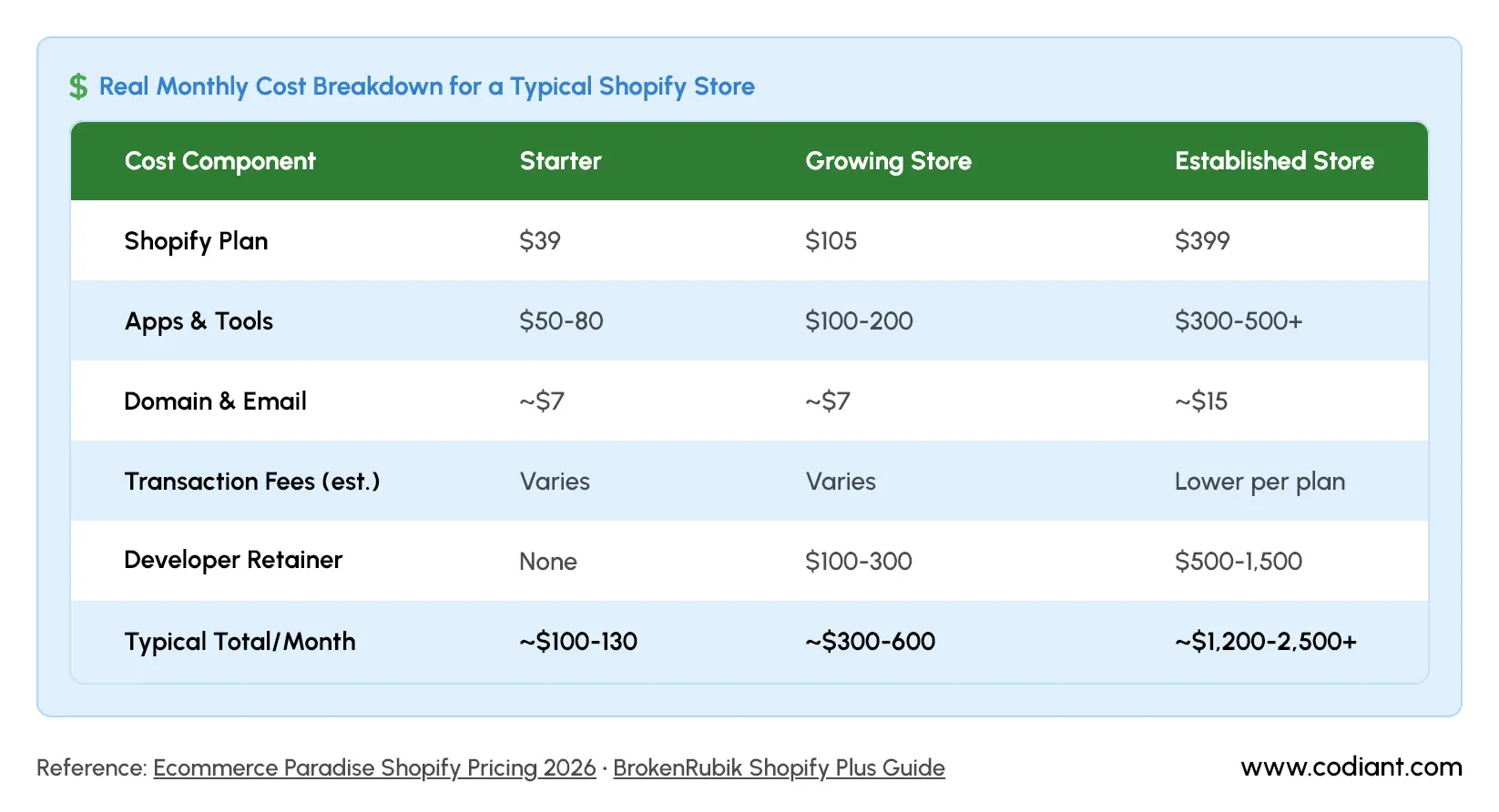
This is where a lot of first-time store owners get caught off guard. Of course, the Shopify subscription fee is just a small fraction of the bigger picture. After calculating all costs involved, the actual monthly running cost of a Shopify store development generally comes in closer to $150 -$300 per month for an average small-to-medium store setup.
Let’s look at what that “everything” includes.
1. Apps and Integrations
Shopify’s default features are robust for the basics, but almost every store requires paid apps in addition such as email marketing, reviews, loyalty programs, upsells, search engine optimization (SEO), inventory management & more.
A lean starter app stack might cost $50 to $80 per month, but an established store with a proper toolkit can easily spend $150 to $300 per month on apps alone. High-growth stores using enterprise-grade tools can push well past $500 per month.
2. Transaction Fees
As mentioned, Indian merchants using third-party gateways will pay an additional Shopify transaction fee 2% on Basic, 1% on the standard Shopify plan & 0.5% on Advanced. On ₹10 lakh in monthly GMV, a 2% fee means ₹20,000 per month going directly to Shopify on top of Razorpay’s own 2% charge. That’s ₹40,000 per month in payment costs on ₹10 lakh in sales, a number that adds up fast.
3. Theme Customisation Costs Over Time
You might launch with a free or premium theme and think you’re done. But as your store grows, you’ll want design tweaks, new landing pages, seasonal banners & feature additions. Each of these requires a developer’s time. Stores that skip planning for ongoing design work often find themselves paying for rushed fixes later at higher rates.
4. Domain and Email
A custom domain from Shopify or a provider like GoDaddy costs $10 to $15 per year. Professional email through Google Workspace adds around $6 per user per month. Small costs, but ones that add up when budgeting carefully.
5. SEO, Content and Marketing
Building a Shopify store is only half the job. Getting customers to find it is the other half and often the more expensive one. SEO and content marketing services can cost anywhere from ₹8,000 to ₹25,000 per month if outsourced. Paid advertising on Google and Meta is an additional variable cost that most growing D2C brands budget as 10 to 15% of their target monthly revenue.
What Does It Actually Cost to Build a Shopify Store?
This is the question most business owners want answered immediately, especially when planning their online store. The Shopify store development cost depends on one key decision: are you building it yourself, working with a freelancer, or hiring an agency?
1. DIY Setup (You Do It Yourself)
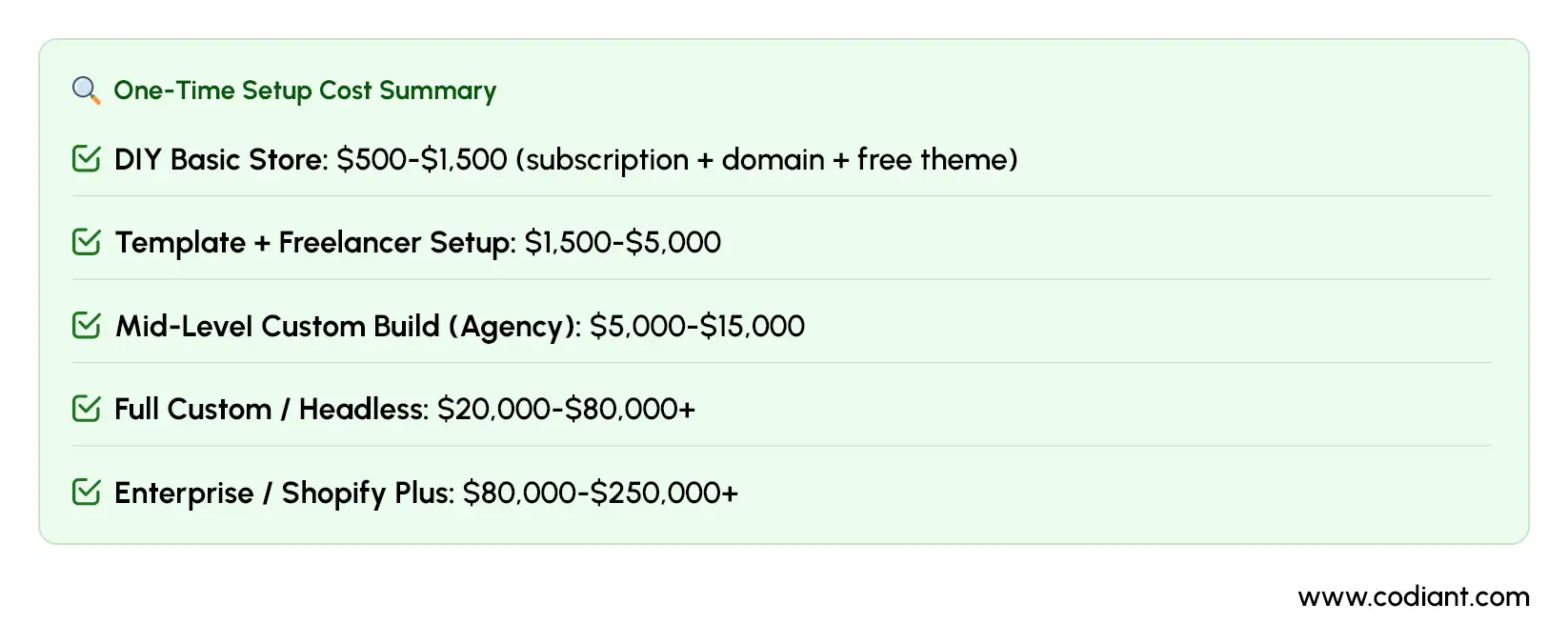
If you choose a free Shopify theme, set up your store using Shopify’s built-in editor & handle product uploads and configuration yourself, you can have a functioning store live for as little as a few hundred dollars in the first month primarily just your subscription fee and domain cost. This approach works well for businesses with small product catalogs testing a market quickly. The trade-off is time and the lack of design differentiation.
2. Template-Based Store with Professional Setup
The most common path for small-to-mid-sized businesses in 2026 is buying a premium theme ($150 to $400 one-time) and hiring a freelancer or agency to set it up professionally. This includes theme customization, product upload, payment and shipping configuration, basic SEO services & app setup. A startup launching this kind of store should expect to spend $1,500 to $3,500 in the first three months.
3. Mid-Level Custom Store
A mid-market brand with custom design requirements, third-party integrations & a proper app stack will typically invest between $5,000 and $15,000 in one-time development costs, along with $500 to $1,500 per month in ongoing operational expenses.
4. Fully Custom Shopify Store
Businesses that need complete design control, custom checkout logic, complex integrations (ERP, PIM, OMS), or headless architecture built on Shopify’s Hydrogen framework should budget significantly more. This level of development with an established agency typically runs from $15,000 to $80,000+ depending on scope, with enterprise builds occasionally exceeding $250,000. This tier is rarely necessary for businesses under significant GMV thresholds and is best evaluated after you have solid sales traction.
From Our Desk at Codiant
A skincare brand from Austin reached out to us last year with a familiar problem. They had already spent $12,000 with a freelancer over six months and still had no live store.
The design was half-done, payments weren’t configured correctly, and their product catalog was a mess. They were frustrated, out of budget, and close to giving up entirely.
We started with a full audit before writing a single line of code. Here’s exactly what we fixed:
- Rebuilt the theme from scratch using a conversion-optimised premium Shopify theme clean, fast, and mobile-first.
- Restructured the product catalog 200+ SKUs were reorganised into logical collections with proper tags, filters, and SEO-friendly URLs.
- Configured Shopify Payments correctly resolving the checkout errors that had been silently killing every potential transaction.
- Integrated Klaviyo for email marketing and Judge.me for product reviews both set up with automated flows from day one.
- Set up abandoned cart recovery and upsell sequences that started working the moment the store went live.
Six weeks later, the store launched on time and within the agreed budget. Within 90 days, they were doing $40,000 in monthly revenue.
The lesson wasn’t that the previous freelancer was incompetent. It was that unclear scope, no milestone planning, and zero accountability had quietly burned $12,000 before a single product was ever sold. The right partner makes all the difference.
Shopify Development Cost in India (2026)
India’s ecommerce market crossed $70 billion in gross merchandise value in 2025 and continues to grow at double-digit rates. D2C brands that once sold exclusively through Amazon and Flipkart are increasingly building their own Shopify stores to gain greater control over customer data and reduce the 15% to 25% marketplace commission on every order. As brands plan their transition, understanding the Shopify development cost can help them budget effectively while choosing the right features, integrations, and customization level for long-term growth.
For Indian business owners, understanding Shopify pricing in India 2026 is essential when planning a Shopify store. The overall Shopify website development cost typically falls into two distinct buckets: ongoing platform and app subscription costs, and the one-time development investment. Here’s a realistic breakdown of both to help businesses plan their budgets effectively.
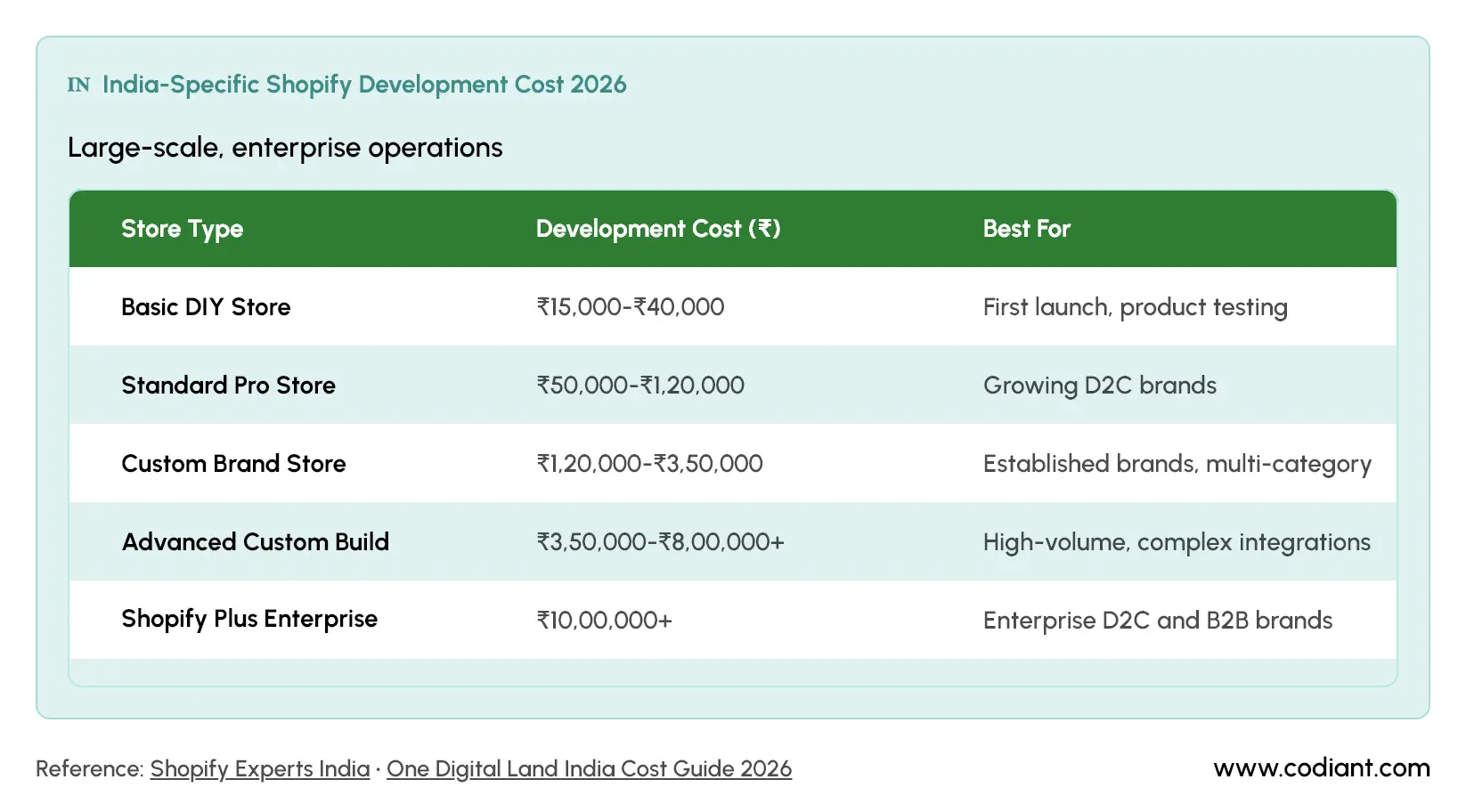
There are also India-specific cost components that most generic Shopify guides completely ignore. Setting up GST-compliant invoicing with correct HSN codes typically costs between ₹5,000 and ₹20,000 in developer time. Integrating with Indian shipping aggregators like Shiprocket or Delhivery adds another ₹8,000 to ₹25,000. And setting up WhatsApp commerce flows through tools like Wati or Interakt a critical sales channel in India adds its own development cost and monthly subscription.
On the monthly recurring side, an Indian D2C store doing ₹5 lakh per month in sales typically spends ₹24,000 to ₹28,000 per month on Shopify subscription, Razorpay transaction fees & a basic app stack. That works out to roughly 5 to 6% of GMV a standard and acceptable platform cost ratio for ecommerce at that revenue level.
Know Your Shopify Cost Before You Start Building Anything
Talk to Codiant experts and plan your store without hidden development surprises.
How Much Do Shopify Developers Charge in 2026?
One of the most frequently searched questions around Shopify development is simple: what does it actually cost to hire someone to build your store? The answer varies significantly based on geography, experience level, and engagement type.
1. Freelance Shopify Developers
Freelancers globally charge between $25 and $100 per hour, depending on location and experience. Indian freelancers with solid Shopify portfolios typically charge between ₹800 and ₹3,000 per hour. For a complete store setup project, a skilled Indian freelancer might quote ₹25,000 to ₹80,000, depending on scope.
The advantage with freelancers is cost. The trade-off is coordination overhead you’re managing the project timeline, the quality of deliverables & any gaps in expertise yourself. A $15/hour developer who takes three times as long and delivers inconsistent work often ends up costing more than a $60/hour developer who delivers clean work on schedule.
2. Shopify Development Agencies
A mid-tier agency internationally charges $75 to $200 per hour. An established Shopify agency in India typically charges ₹2,000 to ₹8,000 per hour, with full-project quotes for a professionally built store ranging from ₹1,20,000 to ₹4,00,000. Agencies deliver end-to-end project management, multi-disciplinary expertise (design, development, SEO, testing) & generally faster timelines with less risk of rework.
3. Shopify Experts via Shopify’s Partner Directory
Shopify maintains a verified partner directory of vetted Shopify experts and agencies. Vetted experts through this directory typically charge between $75 and $150 per hour internationally. Always check Shopify Partner credentials, review portfolios on real live stores & ask for references before committing to any engagement.
Shopify vs Custom Ecommerce Development: Which Is Actually Cheaper?
A question that comes up often, especially from business owners who feel constrained by Shopify’s structure or have had custom development quoted to them, is Shopify really more economical than building a custom ecommerce site development from scratch?
For the vast majority of businesses especially those under ₹1 crore in monthly GMV Shopify is significantly more cost-effective. Here’s why-
A custom ecommerce platform built in Node.js, Django, Laravel, or a comparable stack requires you to fund development of every feature that Shopify provides out of the box- hosting infrastructure, payment gateway integrations, inventory management, tax handling, mobile responsiveness, CDN, SSL & ongoing security patches.
The upfront development cost for a competent custom build is rarely under ₹5,00,000 & often exceeds ₹15,00,000. Then comes the ongoing cost of maintaining it, keeping dependencies updated & fixing bugs all without the support of a platform ecosystem behind you.
WooCommerce or WordPress has lower upfront costs since the plugin itself is free, but when you factor in reliable ecommerce hosting ($10 to $100 per month), security plugins, backup solutions, and developer time for updates, the total cost of ownership narrows considerably.
WooCommerce makes most sense for businesses that already have significant content assets on WordPress or need unusually specific product configuration logic.
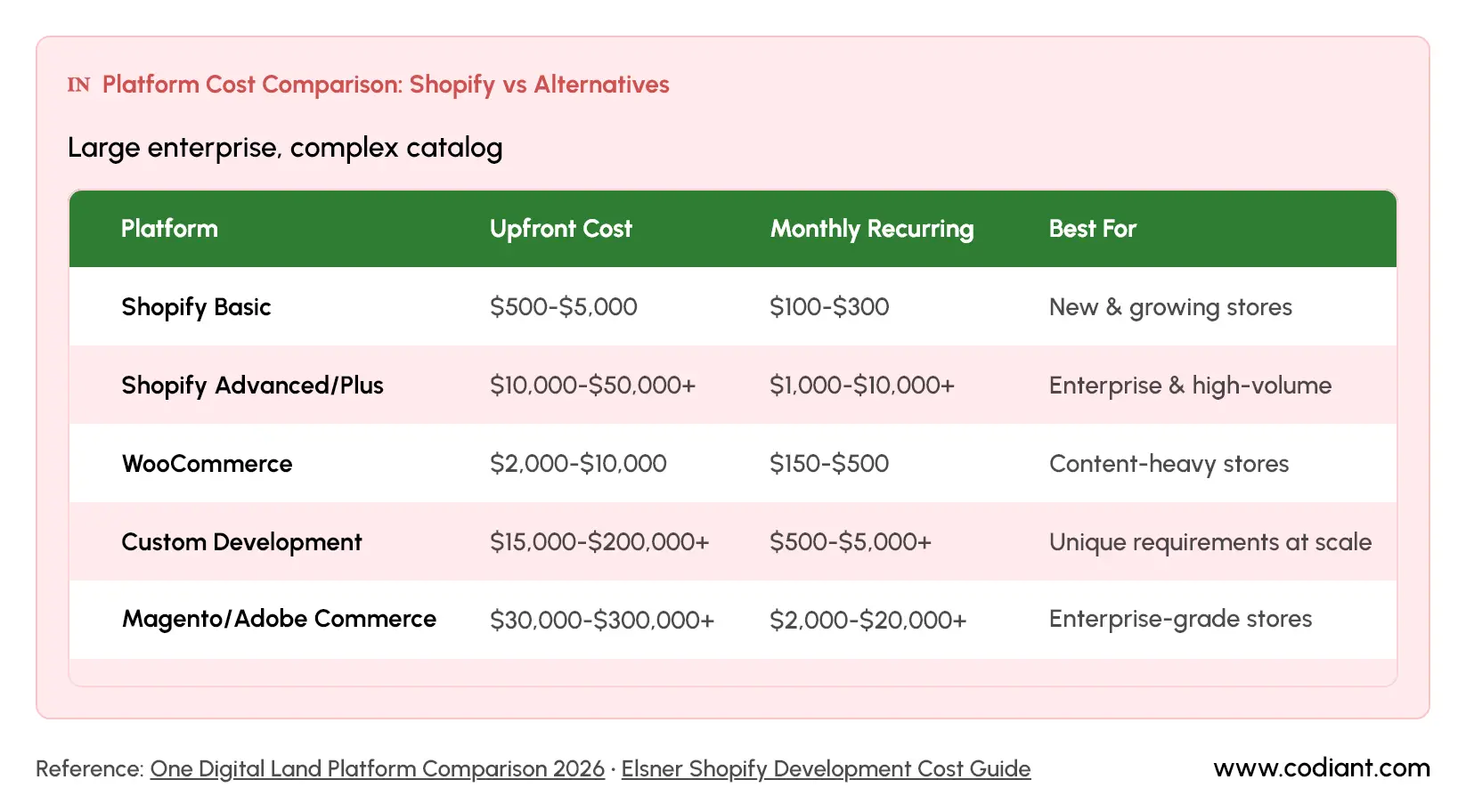
The bottom line: Shopify wins on speed to market, lower upfront investment, platform reliability & ecosystem support for most businesses.
Custom development is justified only when you have unique transactional requirements that no existing platform can accommodate efficiently, or when you’re operating at a scale where even Shopify’s transaction fees (0.5% on Advanced) represent a meaningful cost compared to building and maintaining your own infrastructure team.
How to Reduce Your Shopify Development Cost Without Cutting Corners?
Smart budgeting on Shopify is less about finding the cheapest option and more about avoiding the decisions that quietly multiply costs over time. Here are the most effective ways to keep your investment lean while still building a store that actually works.
1. Start with a Premium Theme, Not a Custom Build
For most businesses, a quality premium theme from the Shopify Theme Store ($180 to $400 one-time) is the right starting point. Premium themes include built-in sections, better performance & conversion-focused layouts. A full custom theme is only worth considering once you have consistent sales data showing exactly where customers are dropping off and what specific design changes would move the needle.
2. Use Shopify’s Native Features First
Shopify has added significant native functionality in 2025 and 2026, including subscription tools, improved discount logic & better analytics. Many tasks that once required third-party paid apps can now be handled natively at no extra cost. Before installing any paid app, verify whether Shopify’s built-in features already cover the need.
3. Keep Your App Stack Lean at Launch
New store owners commonly install 8 to 10 apps when they actually use 3. Every app adds monthly cost and, importantly, load time to your store. Launch with only what you genuinely need & add apps incrementally based on demonstrated need not anticipation.
4. Choose Your Developer Wisely
Review portfolios, check Shopify Partner credentials & ask for references before hiring. The cheapest quote rarely delivers the best value. A developer who delivers clean, well-structured code on time will cost you less over the life of the store than someone who hands over a fragile build that requires constant maintenance.
5. Use Shopify Payments Where Available
For stores outside India, using Shopify Payments eliminates additional transaction fees entirely you only pay the credit card processing rate. For Indian merchants, this option is not yet available, but it’s worth monitoring as Shopify continues expanding payment coverage globally.
6. Plan Before You Build
Most cost overruns aren’t technical they’re decision-related. Scope creep, changing requirements mid-project & rebuilding sections because they weren’t thought through upfront are the biggest cost drivers in Shopify development projects. A well-planned store doesn’t need everything on day one. It needs to work, load fast, and sell. Everything else can wait.
“We had spent a lot of money with some developers in San Francisco to build that for us and we didn’t like any of it. We just scrapped the tens of thousands of dollars that we really didn’t have to spend and then just built it ourselves with Shopify.”
– Colby Barr, CEO and co-founder of Verve Coffee, via Shopify Masters
How Codiant Can Help You Build the Right Shopify Store?
Figuring out costs is one thing getting the build right is another. At Codiant, we’ve helped startups, D2C brands, and established businesses launch and scale high-performing Shopify stores across the globe.
We don’t just build stores; we build ecommerce systems designed to convert, grow, and operate efficiently from day one.
Here’s what working with Codiant looks like in practice:
- Free cost consultation: We map your requirements to the right Shopify plan and build tier, so you never overpay or underbuild.
- End-to-end Shopify development: From theme setup and payment gateway configuration to custom integrations and Shopify Plus builds.
- Global expertise, local precision: Whether you’re selling to customers in the US, UK, Europe, or Asia, we build stores optimised for your target market, compliance requirements, and customer experience expectations.
- Ongoing growth support: Post-launch maintenance retainers, performance optimisation, app management, and conversion rate improvements.
Whether you’re launching your first Shopify store on a lean budget or migrating an enterprise business to a fully custom build, Codiant delivers quality, transparency, and measurable results without the cost surprises.
Conclusion
Shopify store development cost in 2026 is not a single number it’s a reflection of your business needs, ambitions, and how smartly you plan. From a $500 DIY launch to a $25,000+ custom build, every budget has a path forward on Shopify.
The key is understanding all the cost layers plan fees, apps, transaction charges, developer time before you commit. Avoid rushing into decisions, keep your app stack lean at launch, and invest in quality where it drives real sales. Build smart, launch fast, and scale with confidence.
Launch Your Shopify Store with the Right Budget Strategy
From setup to integrations, Codiant helps you build smarter and spend wisely.
The Author

Frequently Asked Questions
For a small business launching a professional store with a premium theme and professional setup, the average first-year investment typically lands between $2,000 and $5,000 in development costs, plus $100 to $300 per month in ongoing operational expenses.
In India, a comparable store costs between ₹50,000 and ₹1,50,000 in development, with ₹10,000 to ₹25,000 per month in recurring costs depending on app usage and GMV. These ranges assume a theme-based build rather than fully custom development.
Yes & this is one of the most important things to budget for. Ongoing costs include your monthly Shopify subscription, app subscriptions (email marketing, reviews, analytics, etc.), payment gateway transaction fees, domain renewal & ideally a developer retainer for ongoing updates and improvements.
Many store owners focus entirely on the upfront build cost and are surprised by the cumulative monthly expenses that follow. A realistic monthly budget for an operational store ranges from $100 to $1,500+ depending on scale.
Yes, absolutely. Shopify is one of the most small-business-friendly ecommerce platforms precisely because you can start lean and scale gradually.
With a free theme, the Basic plan & a handful of free or low-cost apps, a small business can launch a functional, professional-looking store for well under ₹5,000 per month total.
As revenue grows, you can invest in premium themes, additional apps & custom development incrementally rather than making large upfront bets before you have sales traction.
Not necessarily for a basic launch. Shopify’s built-in theme editor and free apps allow non-technical business owners to set up and manage a store without writing any code.
Many successful Shopify stores were built entirely by their founders using Shopify’s drag-and-drop tools.
However, if you want custom design, specific app integrations, GST configuration, shipping automation, or conversion-optimized layouts, hiring an experienced Shopify developer or agency will deliver significantly better results and save time in the long run.
The most effective strategies are- starting with a premium theme instead of a fully custom build, using Shopify’s native features before installing paid apps, keeping your initial app stack minimal, planning your store structure thoroughly before development begins to avoid costly rework & choosing a developer based on portfolio quality rather than the lowest price.
Perfectionism before launch is expensive a store that works and sells is always more valuable than a perfect store that’s still being built.
Featured Blogs
Read our thoughts and insights on the latest tech and business trends
How Much Does It Cost to Build an MVP in 2026? A Complete Pricing Guide
- September 10, 2026
- Digital Transformation
MVP development cost typically ranges from $5,000 for a basic web-based product to $150,000 or more for a complex, cross-platform solution. A custom MVP with user accounts, a backend, essential integrations and a polished interface... Read more

How Much Does It Cost to Hire a Dedicated AI/LLM Developer in 2026?
- September 8, 2026
- Artificial Intelligence Staff Augmentation
Hiring a dedicated AI or large language model (LLM) developer typically costs $35–$60 per hour for general AI engineering and $50–$200 per hour for specialised machine learning work, with enterprise pricing rising for advanced RAG,... Read more

HIPAA-Compliant App Development in 2026: How to Build Securely and Avoid Preventable Fines
- September 4, 2026
- Mobile App Development
HIPAA-compliant app development in 2026 requires six foundations: complete ePHI mapping, documented risk analysis, role-based access, encryption, signed business associate agreements, and continuous security monitoring. This matters most to healthcare CTOs, product leaders, and compliance... Read more