
Hire LLM Developers
Hire LLM developers to build secure, context-aware, and production-ready AI applications. Add pre-vetted LLM engineers to your team for RAG systems, model fine-tuning, AI assistants, intelligent search, model integration, evaluation, and enterprise LLM deployment. Review matched profiles, conduct direct interviews, and begin onboarding within 24 hours.
Hire LLM Developers NowLLM Development Services We Provide
Our LLM developers work closely with your team to understand your business goals, data environment, user needs, and technical challenges. From selecting the right language model to building, integrating, and maintaining production-ready applications, we provide end-to-end LLM engineering support tailored to your requirements.
LLM Consulting and Architecture
Our LLM consultants assess your use case, available data, infrastructure, security expectations, and desired outcomes to define a practical development roadmap. We help you select suitable models, RAG approaches, integration patterns, evaluation methods, and deployment environments, ensuring the proposed architecture aligns with your operational and technical requirements.
Custom LLM Application Development
Hire LLM developers to build intelligent applications tailored to your workflows, users, domain terminology, and business rules. Whether you need an AI assistant, enterprise search platform, document-analysis tool, knowledge system, or content application, our developers create solutions that connect language-model capabilities with real business processes.
Retrieval-Augmented Generation Development
Our LLM engineers develop RAG systems that connect language models with your approved documents, databases, and knowledge repositories. We implement data ingestion, document chunking, embeddings, vector search, metadata filtering, reranking, and context assembly to help applications generate responses grounded in relevant enterprise information.
LLM Fine-Tuning
We adapt suitable language models using your domain-specific terminology, instructions, examples, and preferred output formats. Depending on the model and use case, our engineers apply supervised fine-tuning, LoRA, or QLoRA techniques to improve response relevance, consistency, and task performance while considering training costs and infrastructure requirements.
LLM Integration
Our developers integrate LLM capabilities into your existing websites, mobile apps, SaaS platforms, CRMs, ERPs, help desks, and internal systems. Through secure APIs and system connectors, we enable language models to retrieve approved information, generate structured responses, support users, and participate in defined business workflows.
LLM Evaluation and Testing
We evaluate LLM applications against criteria that reflect their intended business use. Our testing process can assess response relevance, factual consistency, retrieval quality, instruction adherence, output structure, safety, latency, and cost. Automated evaluation is combined with structured human review when contextual or business judgment is required.
LLM Guardrails and Security
Our LLM developers implement safeguards designed to support controlled and responsible model use. These can include input filtering, output validation, user permissions, prompt-injection defenses, content policies, audit logs, and restricted knowledge access, helping the application operate within defined business, data, and security boundaries.
Private LLM Deployment
Deploy suitable language models within your preferred cloud, private-cloud, on-premises, or hybrid environment. Our LLM engineers configure model serving, access controls, monitoring, scaling, and data-handling workflows to support organizations that require greater control over infrastructure, sensitive information, and model operations.
LLM Performance Optimization
Our engineers optimize LLM applications for response speed, throughput, output quality, reliability, and inference cost. We improve prompts, context usage, caching, batching, model routing, retrieval settings, quantization, and deployment configurations, then benchmark the application against defined production and business requirements.
Discover Our AI Success Story
Explore how we build AI applications that turn repetitive, content-heavy processes into manageable digital workflows.
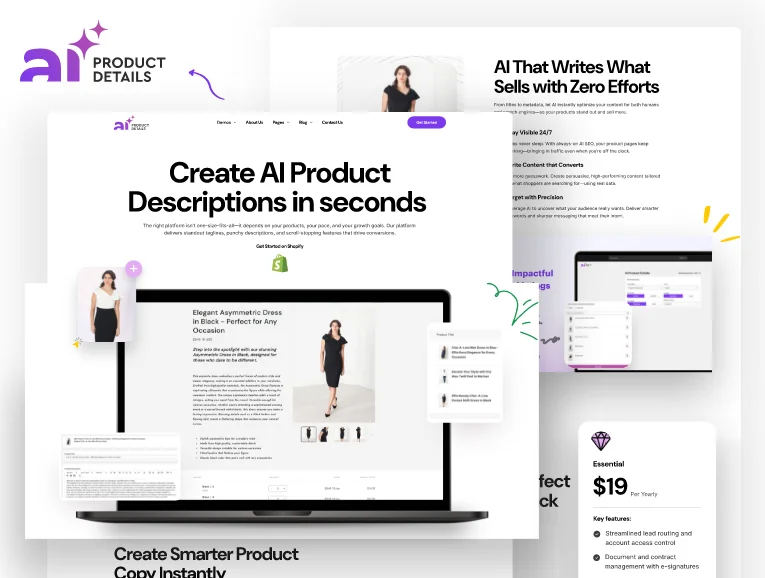
AI Product Details – An AI-Powered Shopify SEO Automation App
AI Product Details is a Shopify app that helps merchants automate SEO-optimized product titles, descriptions, tags, and meta fields using advanced AI models. Designed for stores with large inventories, it enables fast, scalable, and customizable content creation.- Automatically generate SEO-friendly content in bulk with webhook support.
- Customize tone, language, and formality to match your brand voice.
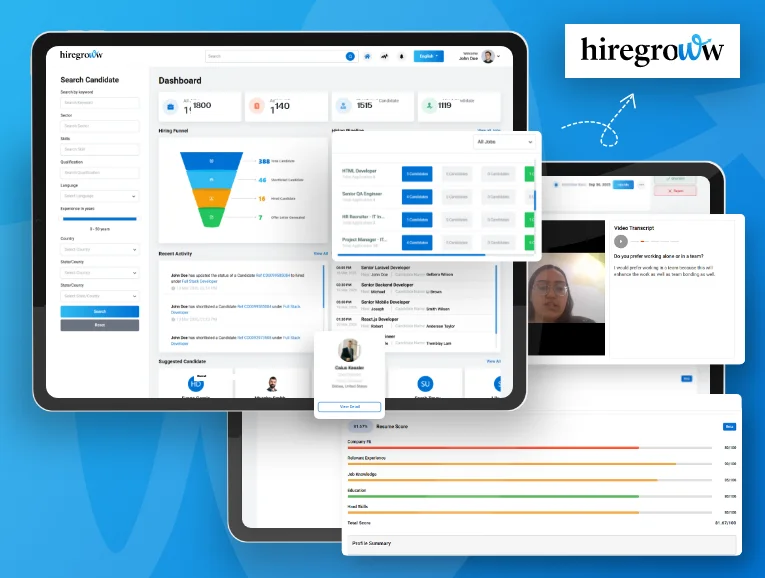
Hiregroww: An AI-Powered Skill-Based Hiring Platform
HireGroww is an intelligent recruitment and pre-employment assessment platform that helps companies streamline hiring through AI-powered screening, testing, and candidate evaluation. The platform simplifies talent acquisition with automated assessments, resume parsing, skill analytics, and bias-reduction workflows.- Screen resumes, conduct AI-driven assessments, and shortlist qualified candidates faster with intelligent evaluation workflows.
- Track hiring pipelines, monitor candidate performance, and improve recruitment decisions with real-time analytics and automation.

HireBeep - An AI-Driven Talent Acquisition Platform
HireBeep is an online recruitment software that helps businesses streamline hiring by automating candidate screening, job posting, and applicant tracking. The platform uses AI to identify top talent quickly and reduces time-to-hire.- Post jobs across multiple sites and manage applicants in one place.
- Track progress, collaborate with your team, and make data-driven hiring decisions.
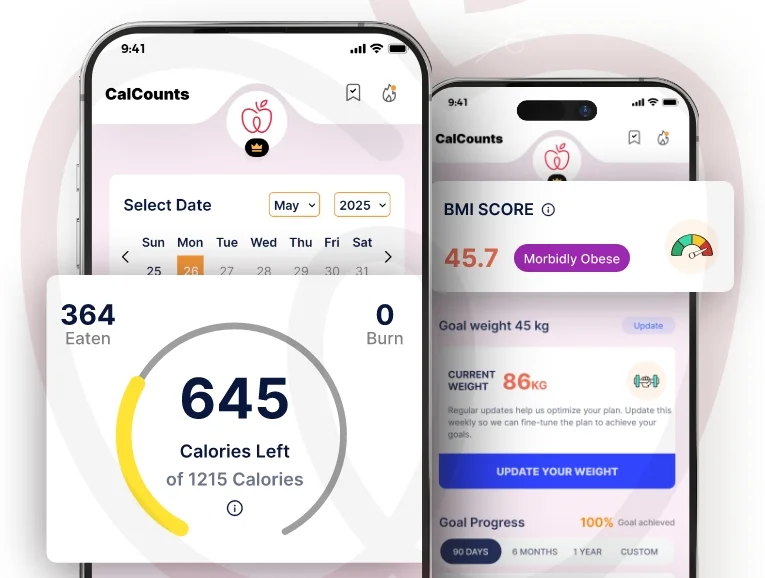
CalCounts – An AI-Powered Calorie Tracking App
CalCounts is a smart nutrition and fitness app that helps users achieve health goals by tracking meals, macros, and calories using AI. The app simplifies healthy eating with barcode scanning, food photo analysis, and goal-based meal planning.- Scan food, barcodes or upload meal photos to get instant calorie and macro breakdowns.
- Track progress, plan meals, and stay on top of your fitness goals with AI-powered insights.

Summrised - AI-Powered Book Summary and Podcast App
Summrised is an AI-driven content platform that transforms books into engaging summaries and podcasts using GPT-4 and text-to-speech technology. It helps creators and readers consume knowledge faster through automated insights and audio storytelling.- Extract key themes and generate structured summaries.
- Convert books into full podcast episodes with TTS.
Technology Stack of Our LLM Developers
Hire LLM engineers experienced in commercial and open-source models, orchestration frameworks, vector databases, cloud platforms, and deployment technologies required for scalable LLM applications.
Programming Languages
-
 Python
 -
 JavaScript
 -
 TypeScript
 -
 Java
Java -
 SQLite
Commercial Language Models
-
 GPT-4
GPT-4 -
 Anthropic/Claude
 -
 Gemini
 -
 Cohere
Open-Source Language Models
-
 Llama
Llama -
 Mistral
 -
 Gemma
Gemma -
 Qwen
Qwen -
 DeepSeek
LLM Frameworks
-
 LangChain
 -
 LlamaIndex
 -
 LangGraph
 -
 Semantic Kernel
 -
 Hugging Face Transformers
Vector Databases
-
 Pinecone
 -
 Weaviate
 -
 Milvus
 -
 Chroma
 -
 FAISS
FAISS -
 pgvector
Model Training and Optimization
-
 PyTorch
 -
 TensorFlow
 -
 ONNX
ONNX -
 LoRA
LoRA
Backend and APIs
-
 Fast API
 -
 Flask
Flask -
 NodeJS
 -
 RESTful APIs
 -
 GraphQL
Cloud AI Platforms
-
 Azure AI Foundry
 -
 Amazon SageMaker
 -
 Google Vertex AI
 -
 AWS Bedrock
Deployment and Monitoring
-
 Docker
 -
 Kubernetes
 -
 MLflow
 -
 Github
 -
 Jenkins
 -
 vLLM
vLLM
Data and Storage
-
 PostgreSQL
 -
 MongoDB
 -
 Redis
Redis -
 ElasticSearch
 -
 Amazon S3
Flexible Hiring Models for LLM Developers
Choose a hiring model based on your LLM project scope, model requirements, data environment, integration needs, delivery timeline, and requirement for ongoing optimization.
Dedicated Developers
For long-term projects, hire dedicated developers who work as an extension of your team. This model gives you full control, scalability, and consistent delivery aligned with your business goals.
- Transparent monthly pricing
- Full-time or part-time engagement
- Direct communication & control
- Quick onboarding in 24 hours
Time & Material
Perfect for evolving projects where requirements change frequently. Pay only for the time and resources utilized, ensuring flexibility and cost efficiency.
- Pay-as-you-go model
- Flexible scope & iterations
- Transparent hourly billing
- Ideal for MVPs & experimentation
Fixed Cost (Project-Based)
Best suited for clearly defined projects with fixed scope, timeline, and budget. Get predictable outcomes with structured planning and milestone-based execution.
- Fixed budget & timeline
- Clearly defined deliverables
- Milestone-based payments
- Low risk with predictable outcomes
Process to Hire LLM Developers in 24 Hours
Share your LLM use case, required models, data sources, integrations, infrastructure, security expectations, and delivery timeline. We shortlist profiles matched to your requirements, arrange direct technical interviews, and help you onboard the selected LLM developer within 24 hours.

Share Your LLM Requirements
Tell us what you want to build, which data sources and business systems are involved, your preferred models, deployment environment, security requirements, and expected timeline.
Review Matched Profiles
We shortlist pre-vetted LLM developers whose model experience, engineering skills, availability, domain exposure, and working hours align with your project.
Interview LLM Engineers
Assess shortlisted engineers through technical interviews, coding tests, architecture discussions, or practical questions covering RAG, fine-tuning, evaluation, security, integration, and deployment.
Select Your LLM Developer
Choose an individual engineer or dedicated LLM development team that best matches your technical requirements, engagement model, communication needs, and budget.
Complete Onboarding Within 24 Hours
Finalize the engagement, NDA, IP terms, repository access, development environments, communication tools, and project documentation. Your selected LLM developer can be onboarded within 24 hours.
Why Choose Codiant’s LLM Developers?
Build your LLM application with an experienced technology team, flexible hiring models, and complete support across architecture, development, integration, deployment, and maintenance.
1500+
Project launched450+
Inhouse Engineers19+
Years of Experience70%
Repeat Clients & Referrals


Top Mobile App Development Company in USA, UK, Australia (Good Firms)
Best User Experience Company 2023 (Software Suggest)
Best Website Development Company for Online Success 2023 (CyberNews)
Why Hire LLM Developers from Codiant?
Building a reliable LLM application requires more than connecting a model API to a user interface. When you hire LLM developers from Codiant, you get pre-vetted engineers who understand retrieval, model behaviour, software architecture, data access, evaluation, security, deployment, and the operational demands of production AI.
Our developers bring practical experience across commercial and open-source language models, RAG pipelines, embeddings, vector databases, fine-tuning, prompt engineering, model evaluation, guardrails, and deployment. Hire LLM engineers whose technical skills align with your data environment, infrastructure, and intended application.
Get support across use-case assessment, architecture planning, data preparation, model selection, retrieval development, fine-tuning, evaluation, integration, deployment, and monitoring. Our developers connect each technical decision with defined business, security, quality, latency, and cost requirements.
Hire one remote LLM developer to strengthen your existing engineering team or assemble a dedicated LLM development team for complete project delivery. Adjust the team’s size and specialist capabilities as your project moves from discovery and prototyping to production and ongoing optimization.
Our LLM engineers build applications that fit within existing enterprise technology and governance environments. They can implement controlled data access, user permissions, source-based retrieval, structured outputs, validation workflows, audit logs, monitoring, and integration with enterprise systems and approved knowledge repositories.
Work directly with dedicated or offshore LLM developers through your preferred communication, development, and project-management tools. We align working hours, sprint schedules, reporting practices, and technical discussions with your internal team to support coordinated delivery across locations.
Our support can continue after your LLM application enters production. We monitor output quality, retrieval performance, latency, token consumption, infrastructure health, and integration reliability while supporting prompt updates, model migrations, knowledge-based refreshes, regression testing, and deployment optimization.
Frequently Asked Questions
Our LLM developers work with commercial models such as GPT, Claude, Gemini, and Cohere Command, plus open-source models including Llama, Mistral, Gemma, Qwen, and DeepSeek. Their framework expertise includes LangChain, LlamaIndex, LangGraph, Semantic Kernel, Hugging Face Transformers, PyTorch, and TensorFlow.
Yes. Our developers can customize suitable LLMs using prompt engineering, retrieval-augmented generation, supervised fine-tuning, LoRA, or QLoRA. The chosen approach is based on your use case, available data, model licensing, expected output quality, infrastructure, security requirements, and budget.
Yes. You can hire LLM developers to integrate AI capabilities into an existing web application, mobile app, SaaS platform, CRM, ERP, help desk, or internal system. Integration may include secure APIs, RAG pipelines, model routing, structured outputs, user permissions, and connections with approved business data.
LLM developers can implement encryption, role-based access, restricted data retrieval, secure APIs, audit logs, data minimization, and input-output filtering. Deployment can use public cloud, private cloud, on-premises, or hybrid infrastructure. The final controls should reflect your data sensitivity, chosen model provider, and applicable regulatory requirements.
The cost is based on developer experience, required LLM expertise, model and infrastructure choices, integrations, project duration, and team size. Codiant offers dedicated monthly, time-and-material, and fixed-cost engagement models. A detailed estimate can be prepared after reviewing your use case, data, architecture, and delivery requirements.