
Computer Vision Development Services
Codiant is one of the leading Computer Vision Development Services providers, turn images, video, and visual data into actionable intelligence with our custom computer vision solutions. We build AI-powered vision systems for visual inspection, object detection, image recognition, video analysis, OCR, and workflow automation.
Discuss Your Computer Vision ProjectBuild Computer Vision Solutions That See, Analyze, and Act
Computer vision enables software to interpret and analyze information from images, videos, and other visual inputs. Common applications include object detection, image classification, OCR, tracking, and visual analysis. As a computer vision development company, Codiant builds custom solutions around specific business environments, visual data, workflows, and deployment requirements.
Computer Vision Consulting
Identify where computer vision can create measurable business value. Our consultants assess use cases, data availability, technical feasibility, model requirements, infrastructure, and integration needs to define a practical development roadmap.
Custom Computer Vision Development
Build vision applications around your unique operational needs. Our computer vision developers design, train, integrate, and deploy custom models and software for image, video, document, and real-time visual data processing.
Image Recognition & Classification
Automatically identify, categorize, and organize visual content using machine learning and deep learning models. We develop image recognition solutions for product identification, asset classification, content analysis, and other domain-specific applications. Image classification is an established computer vision objective supported by modern vision platforms.
Object Detection & Tracking
Detect specific objects within images or video and track their movement across frames. Our solutions support applications such as inventory monitoring, traffic analysis, safety monitoring, retail analytics, and operational surveillance.
Image Segmentation Solutions
Separate images into meaningful regions or individual objects for more detailed visual analysis. We develop semantic and instance segmentation solutions for healthcare imaging, industrial inspection, autonomous systems, and other specialized workflows.
OCR & Intelligent Text Extraction
Extract printed, handwritten, or embedded text from images and documents and convert it into machine-readable information. Our OCR solutions can support document processing, data capture, form workflows, invoice processing, and records digitization.
Video Analytics Solutions
Convert live or recorded video into structured insights by detecting objects, tracking movement, recognizing activities, or identifying events relevant to your workflows. Video intelligence systems can support object tracking, scene understanding, activity recognition, and text detection.
Face Detection & Recognition
Develop vision systems for face detection, matching, and recognition based on the requirements and safeguards of the intended application. Solutions can be integrated into identity, access, attendance, and other authorized workflows. Face detection and recognition are established computer vision capabilities.
Human Pose & Movement Analysis
Analyze body key points, posture, and movement patterns from images or video. We build pose estimation solutions for fitness applications, workplace workflows, sports analysis, interactive experiences, and other movement-based use cases.
Automated Visual Inspection
Use computer vision to inspect products, components, surfaces, or assets against defined visual criteria. We develop inspection workflows that help identify anomalies, classify defects, document findings, and route exceptions for further review.
Edge Computer Vision Solutions
Process visual data closer to cameras, devices, or other edge hardware when the use case calls for local inference. Our team designs computer vision software for edge and cross-platform environments based on latency, connectivity, privacy, and infrastructure requirements. OpenCV, for example, supports desktop and mobile environments and is designed for cross-platform computer vision development.
Computer Vision Integration Services
Connect computer vision capabilities with existing applications, cameras, APIs, cloud platforms, databases, ERP systems, or operational software. We build integrations that move detected visual information into the workflows where teams can actually use it.
End-to-End Computer Vision Development Capabilities
From visual intelligence to application-level automation, we develop the core components needed to turn images and video into functional computer vision software. Our capabilities span model engineering, intelligent processing, and production-ready integration.
Vision Model Engineering
Build and customize models for object detection, image classification, segmentation, OCR, tracking, pose estimation, and other visual tasks. We align model architecture and training approaches with your data, accuracy requirements, and operating conditions.
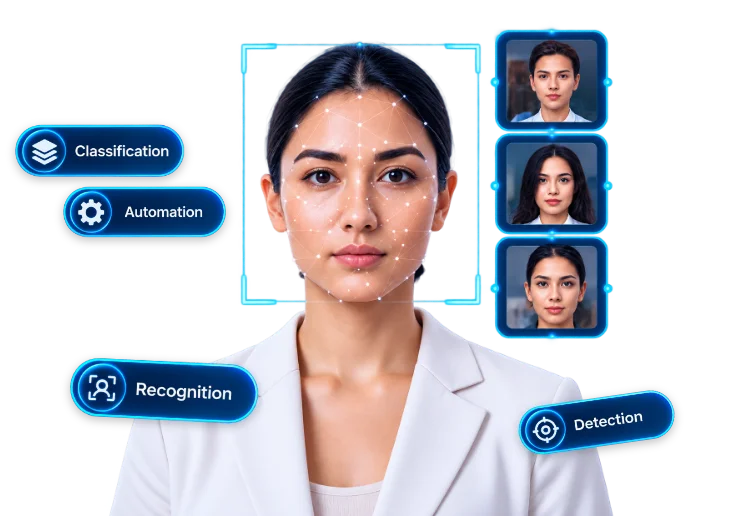
Visual Intelligence & Processing
Convert images, video streams, documents, and camera feeds into structured information your applications can use. Our solutions can identify objects, extract text, analyze movement, detect visual patterns, and surface relevant events based on the use case.
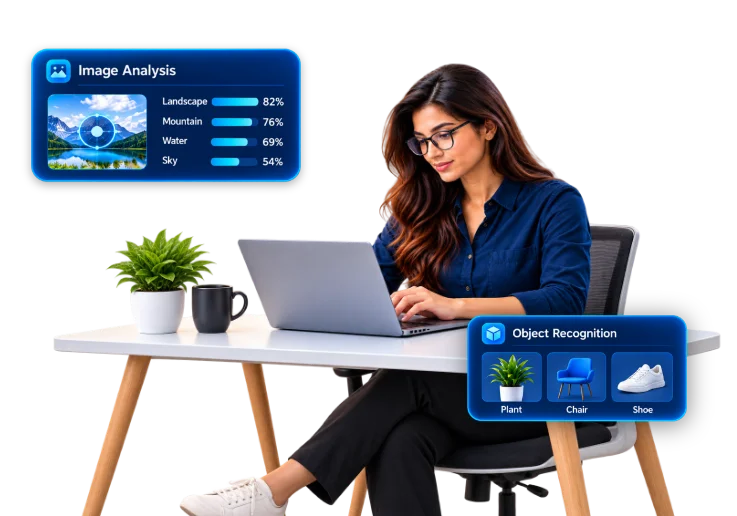
Vision Application Engineering
Turn computer vision models into usable software by connecting them with web and mobile applications, cameras, APIs, cloud platforms, edge devices, and enterprise systems. We build the application logic required to move visual insights into real business workflows.
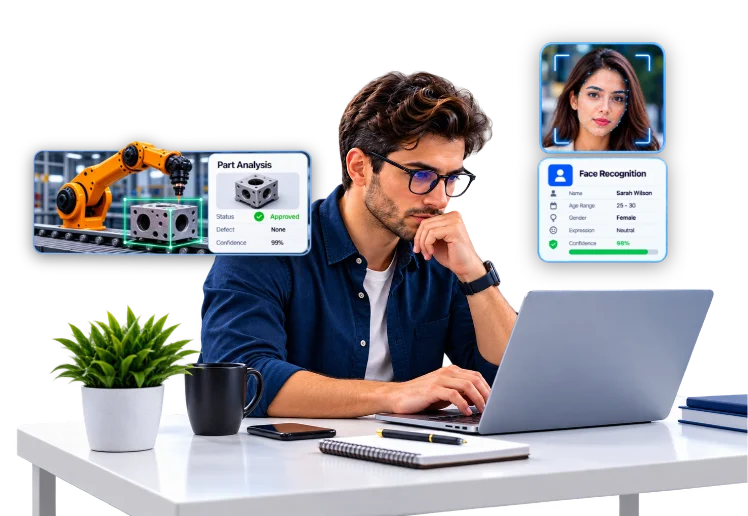
Our Computer Vision Development Process
Our computer vision development process covers everything from understanding your visual data requirements to model engineering, integration, and deployment. Each stage focuses on building a solution that performs reliably in its intended business environment.
We identify the visual tasks your business needs to automate, assess available image and video sources, and define expected outcomes. This helps establish technical feasibility, performance requirements, and clear project objectives.
We gather, organize, and prepare relevant visual datasets for model development. This includes image preprocessing, data annotation, augmentation, and quality checks to ensure the training data represents the intended operating conditions.
Our computer vision developers select, train, or fine-tune suitable models for object detection, image classification, segmentation, OCR, tracking, or other visual tasks based on your specific application requirements.
We connect trained models with your existing applications, camera systems, APIs, databases, and enterprise software. The integration ensures visual outputs can support automated workflows, alerts, reporting, and operational decisions.
We evaluate model performance using defined metrics and representative test data. Testing considers accuracy, processing speed, visual variations, and application-specific conditions before the solution moves into production.
We deploy computer vision solutions across suitable cloud, on-premises, mobile, or edge environments. Ongoing monitoring, model updates, and performance optimization help maintain effectiveness as data and operational requirements evolve.
Why Choose Codiant for Computer Vision Development?
Codiant combines computer vision expertise with end-to-end software engineering to build solutions that fit real business environments. From visual data preparation and model development to application integration and deployment, we focus on building scalable computer vision systems aligned with your workflows, infrastructure, and operational goals.
Computer Vision Expertise
Our computer vision developers work across image recognition, object detection, segmentation, OCR, video analytics, and other vision applications. We select development approaches based on your visual data, use case, and deployment environment.
Business-Focused Development
We start with the problem your vision system needs to solve. Each solution is planned around defined workflows, users, data sources, and expected outputs, helping connect computer vision development with practical business requirements.
Custom & Scalable Solutions
Instead of forcing predefined models into every use case, we build and adapt computer vision solutions around your requirements. Architectures can be designed for cloud, on-premises, mobile, or edge deployment as your application evolves.
Continuous Optimization & Support
Our involvement can continue after deployment with model monitoring, performance evaluation, updates, integration support, and ongoing optimization as data patterns, operating conditions, and business requirements change.
Our Process to Develop Computer Vision Solutions
Building reliable computer vision software starts with understanding what needs to be detected, analyzed, or automated. Our development process connects business requirements, visual data, model engineering, software integration, and deployment to create computer vision solutions designed for real-world use.
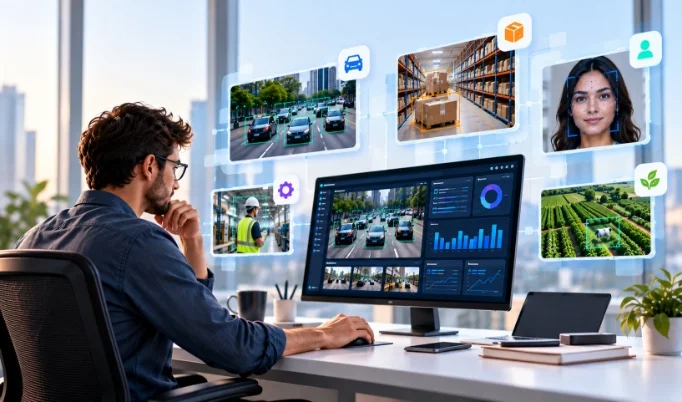
We begin by defining the business problem, visual inputs, expected outputs, operating conditions, and success criteria. Our team evaluates technical feasibility and identifies the right computer vision approach for the use case.
We assess available image and video data, organize datasets, define annotation requirements, and prepare visual inputs for model development. Data quality and relevance are evaluated against the intended application.
Based on the task, our computer vision developers select, train, fine-tune, or customize suitable models for image classification, object detection, segmentation, OCR, tracking, or other vision capabilities.
We evaluate the model against defined metrics and representative data, identify performance gaps, and optimize it for the target environment. Testing also considers factors such as image quality, lighting, camera angles, and processing requirements where relevant.
Once validated, the computer vision solution is integrated with the required applications, APIs, cameras, databases, or enterprise systems and deployed to the appropriate cloud, on-premises, mobile, or edge environment.
After deployment, we can monitor model performance, evaluate new data patterns, address model drift, and refine the solution as operating conditions and business requirements evolve.
Ready to Put Your Visual Data to Work?
Turn images, video, and camera feeds into actionable business intelligence with custom computer vision solutions. Our computer vision developers help you move from use-case validation to model development, integration, and deployment, building vision systems around your data, workflows, and operational requirements.
Book a Free call with Computer Vision Expert
Technology Stack We Use for Computer Vision Development
Our technology stack supports the complete computer vision development lifecycle, from image processing and model training to inference, optimization, and deployment. We select frameworks, models, libraries, and deployment technologies according to the visual task, data requirements, performance needs, and target environment. OpenCV, for example, provides a large computer vision and machine learning library, while current YOLO models support tasks including detection, segmentation, classification, pose estimation, depth estimation, and tracking.
AI & Deep Learning Frameworks
-
 TensorFlow
-
 PyTorch
-
 Keras
-
 Ajax
-
 ONNX
-
 Scikit-learn
Computer Vision Models
-
 Yolo
-
 SAML Authentication
-
 Resnet
-
 Efficient-net
Computer Vision Libraries & Toolkits
-
 OpenCV
-
 Torch
-
 Albumentations
-
 Detectron2
-
 Mmdetection
-
 Mediapipe
-
 Tesseract-ocr
-
 Ultralytics
Cloud & Vision AI Platforms
-
 AWS
-
 Microsoft Azure
-
 Google Cloud
-
 nVIDIA
Edge AI & Model Optimization
-
 Core ML
-
 Tensorrt
-
 Openvino
-
ONNX
-
 Nvidia-jetson
-
 Tensorflow-lite
Data Annotation & MLOps
-
 MLflow
-
 Docker
-
 Kubernetes
-
 Cvat
-
 Label-studio
-
 Dvc
-
 weights-biases
Frequently Asked Questions
Computer vision development services focus on building software that can analyze and interpret images, videos, documents, and camera feeds. These services can include image classification, object detection, segmentation, OCR, tracking, pose estimation, video analytics, model development, system integration, and deployment.
Computer vision can support industries where visual information plays an important role in operations or decision-making. Common applications span healthcare, manufacturing, retail and eCommerce, automotive, logistics, construction, agriculture, security, sports, and media, with use cases ranging from visual inspection and inventory monitoring to medical image analysis and video analytics.
Codiant can develop custom computer vision solutions for image recognition, object detection and tracking, image segmentation, OCR and document processing, video analytics, pose estimation, visual inspection, and other business-specific vision applications. Solutions can also be integrated with web, mobile, cloud, enterprise, camera, and edge systems.
There is no fixed cost for custom computer vision development. The budget depends on factors such as solution complexity, data availability and annotation requirements, model development needs, integrations, infrastructure, deployment environment, and ongoing support. A project assessment is required to provide a reliable estimate.
Development timelines vary based on the use case, dataset readiness, model complexity, required integrations, testing scope, and deployment environment. A focused proof of concept may require considerably less time than a production-scale computer vision platform. The timeline can be estimated more accurately after the requirements and available visual data have been assessed.