Top .NET Development Companies in the USA for Your Business in 2026
Table of Contents
Subscribe To Our Newsletter
Summarize with AI
Not enough time? get the key points instantly.
Building a business application means planning for how people will use it today and how it will evolve as your operations grow. Microsoft’s .NET platform supports web applications, cloud services, and connected business systems, making it an option for organizations building or modernizing their software.
Choosing the right .NET development company starts with finding a team that understands your business. Your partner should be able to translate complex workflows into practical features, connect the application with existing systems, and plan for maintenance beyond launch. Relevant experience, clear communication, and sound engineering should guide that decision.
This guide brings together 10 .NET development companies, with Codiant leading the list. Explore their core capabilities to identify potential partners for your next application, integration, or modernization project.
Quick Snapshot
- Best fit: A partner with proven enterprise .NET delivery, not the lowest quote.
- Typical cost: $20,000 to $100,000 for mid-size custom projects. Large platforms run higher.
- Core stack: ASP.NET Core, C#, Blazor, Entity Framework, Azure, SQL Server.
- Best use cases: Enterprise portals, ERP and CRM systems, fintech platforms, healthcare software, legacy modernization.
- Biggest risk: Hiring on rate alone. Rework and attrition inflate the real cost.
Which .NET Development Companies Should You Consider in the USA
| No. | Company | Core .NET Development Services |
| 1 | Codiant | Custom ASP.NET applications, enterprise software, system integration, legacy migration, and cloud integration. |
| 2 | Cyber Infrastructure | ASP.NET Core and Blazor development, enterprise ERP and CRM solutions, desktop applications, and Azure modernization. |
| 3 | Skynet Technologies | Custom ASP.NET web applications, content management systems, e-commerce solutions, and desktop application development. |
| 4 | Digisoft Solution | ASP.NET Core applications, APIs, Blazor interfaces, .NET MAUI development, and cloud-native modernization. |
| 5 | Zobiweb Solutions | ASP.NET development, dedicated ASP.NET Core and Blazor developers, enterprise software, and Azure development. |
| 6 | Innowise | Custom .NET web, mobile, and desktop applications, supported by dedicated development teams. |
| 7 | ELEKS | .NET software engineering and web application development across logistics, healthcare, insurance, and other industries. |
| 8 | Fingent | ASP.NET Core and Blazor development, Azure deployment, and dedicated .NET engineering teams. |
| 9 | Algoworks | .NET product development, web and desktop applications, web services, and functional and load testing. |
| 10 | DICEUS | .NET consulting, custom application development, system integration, and application support. |
1. Codiant
Codiant offers .NET development services in the USA for businesses looking to build new applications, integrate existing platforms, or modernize legacy systems. Its services cover every stage of the development process, including application planning, interface design, development, deployment, and ongoing support.
- Custom ASP.NET Application Development: Build web applications around specific business workflows, user roles, and operational requirements.
- Enterprise Application Development: Develop business applications that support internal processes and connect teams through shared systems.
- Third-Party Integration: Connect applications with external services, databases, and business platforms to support information exchange.
- Legacy Migration and Upgrades: Update existing ASP.NET applications and migrate functionality to an architecture suited to current requirements.
- Cloud Integration: Integrate applications with Microsoft Azure, AWS, or Google Cloud.
- Consulting and Support: Assess application requirements, recommend an architecture, and provide monitoring, updates, and issue resolution after deployment.
What Sets Codiant Apart
- 18 Years of Software Development Experience: Experience supporting businesses through application development, integration, and modernization projects.
- 1,500+ Projects Shipped: A delivery portfolio spanning software products, web applications, and mobile solutions.
- 550+ In-House Engineers: Access to expertise across development, UI/UX design, cloud engineering, and quality assurance.
- Complete Development Support: A structured process covering discovery, architecture, design, development, testing, deployment, and ongoing improvement.
- Microsoft Stack Expertise: Development capabilities across ASP.NET Core, C#, MVC, Web API, Entity Framework, SQL Server, and Azure.
- Flexible Engagement Models: Dedicated developers, team extensions, time-and-materials engagements, and fixed-cost projects aligned with business requirements.
- Connected Business Applications: Integration with CRMs, ERPs, payment gateways, third-party APIs, and internal systems.
- Support Beyond Launch: Bug fixes, security patches, framework upgrades, performance tuning, and planned feature enhancements.
2. Cyber Infrastructure
Cyber Infrastructure, also known as CIS, provides .NET engineering across web, desktop, and enterprise applications. Its services combine custom software development with modernization, cloud integration, and flexible development team arrangements.
- Custom Web Application Development: Create portals and SaaS applications using C#, ASP.NET Core, and Blazor.
- Enterprise Software Development: Build ERP and CRM systems around business processes and integrate them with existing applications.
- Desktop Application Development: Develop internal tools and business applications using Windows Presentation Foundation and Windows Forms.
- Legacy Application Modernization: Upgrade older .NET applications and transition suitable workloads toward modern .NET and Azure.
- AI and Cloud Integration: Incorporate Azure services and ML.NET capabilities into applications.
- Dedicated Development Teams: Engage engineering teams through staff augmentation, fixed-price projects, or time-and-materials arrangements.
3. Skynet Technologies
Skynet Technologies develops ASP.NET and C# applications for web, desktop, and business environments. Its services extend from custom application development to migration, integration, and ongoing maintenance.
- ASP.NET Web Application Development: Build custom web applications for industry-specific processes and customer-facing services.
- Content Management Systems: Develop applications that help businesses organize, update, and manage website content.
- E-Commerce Development: Create shopping cart functionality and applications that support online business operations.
- C# Desktop and Client-Server Applications: Develop software for desktop users and applications that communicate with centralized systems.
- Application Migration and Integration: Migrate existing applications and connect software with third-party services.
- Support and Maintenance: Maintain applications, resolve technical issues, and implement changes as business requirements evolve.
4. Digisoft Solution
Digisoft Solution offers .NET services across application development, platform engineering, and modernization. Its technology stack includes ASP.NET Core, Blazor, .NET MAUI, Azure, and tools for distributed application development.
- Enterprise Application Development: Build business platforms using modular architecture and defined engineering practices.
- Web Applications and APIs: Develop ASP.NET Core applications and APIs that connect interfaces, business logic, and external systems.
- Blazor Development: Create interactive web interfaces using the .NET ecosystem.
- Cross-Platform Application Development: Use .NET MAUI to develop applications with shared functionality across supported platforms.
- Cloud-Native Development and Modernization: Build or rework applications using microservices, containers, and serverless backends.
- DevOps and Security Engineering: Implement CI/CD pipelines, infrastructure as code, identity controls, and secure development practices.
- AI Integration: Connect applications with Azure OpenAI, Semantic Kernel, and supporting data services.
5. Zobiweb Solutions
Zobi Web Solutions provides Microsoft-focused application development alongside enterprise software, cloud engineering, and dedicated development teams. Its services cover both new software products and changes to existing business systems.
- ASP.NET Application Development: Build custom web applications using ASP.NET and ASP.NET Core.
- Blazor Development: Develop interactive application interfaces and provide dedicated Blazor developers.
- Enterprise Software Development: Create ERP, CRM, and workflow automation solutions around business requirements.
- SaaS and Product Development: Develop software products, SaaS platforms, and minimum viable products.
- Legacy Modernization: Update existing systems, including PowerBuilder-to-ASP.NET development.
- Azure and DevOps Services: Support cloud development, migration, and software delivery processes.
- Dedicated Teams and Quality Assurance: Extend engineering capacity with developers and testing support.
6. Innowise
Innowise offers .NET development for web, mobile, desktop, and embedded software. Businesses can engage its engineers for application development or add dedicated specialists to an existing team.
- Web Application Development: Build applications and backend services using C#, ASP.NET Core, and ASP.NET Web API.
- Desktop Software Development: Develop desktop applications using technologies such as WPF and Windows Forms.
- Mobile Application Development: Create cross-platform mobile solutions within the .NET ecosystem.
- Database and System Integration: Connect applications with databases and existing services.
- Business Logic and Automation: Develop application modules that implement business rules and automate operational processes.
- Azure Architecture: Support cloud application design, including SaaS architecture and Microsoft Entra integration.
- Dedicated .NET Teams: Provide developers and technical leads to supplement internal engineering capacity.
7. ELEKS
ELEKS combines .NET development with software engineering, consulting, and application optimization. Its services address the wider delivery process, including product planning, development, testing, and integration.
- Custom .NET Development: Engineer web applications for sectors including logistics, healthcare, and insurance.
- Enterprise Application Development: Build software that supports business operations and connects application functionality.
- Application Modernization: Rework existing software into updated platforms and reusable components.
- API and Third-Party Integration: Develop and integrate REST APIs and connect applications with external services.
- Product Design and Consulting: Define application requirements and user experiences before implementation.
- Quality Assurance: Provide testing services as part of software delivery.
- Cloud and DevOps: Support application infrastructure and development operations through cloud and DevOps expertise.
8. Fingent
Fingent provides .NET developers for application engineering within the Microsoft ecosystem. Its capabilities include ASP.NET Core, Blazor, Azure services, and deployment pipelines for cloud applications.
- ASP.NET Core Development: Develop application functionality and backend services using C# and ASP.NET Core.
- Blazor Development: Build interactive web interfaces with .NET technologies.
- Azure Application Deployment: Deploy applications through Azure App Service and related cloud services.
- Azure Functions Development: Implement serverless application functionality using Azure Functions.
- Containerized Deployment: Work with Docker and Kubernetes to package and deploy applications.
- Development Pipelines: Use Azure DevOps pipelines to support software delivery.
- Dedicated Engineering Support: Add .NET developers to existing teams, with capabilities spanning automated testing and code review.
9. Algoworks
Algoworks offers .NET product and application development across web and desktop environments. Its services also cover custom components, web services, and application testing.
- End-to-End Product Development: Develop software products using the .NET platform.
- Web Application Development: Build ASP.NET applications for business and customer-facing requirements.
- Desktop Application Development: Create desktop software within the Microsoft development ecosystem.
- Custom Component Development: Develop custom controls and application components for specific functionality.
- Web Services Development: Build .NET applications that communicate through web services.
- Functional and Load Testing: Test application behavior and evaluate performance under load.
- Technology Consulting: Provide guidance around software architecture, cloud enablement, and related technology choices.
10. DICEUS
DICEUS provides .NET consulting and development alongside software architecture, integration, and modernization services. Its offering supports businesses creating new applications or extending existing software.
- .NET Consulting: Assess requirements and define the technical approach for application development.
- Custom Application Development: Build tailored software using C#, ASP.NET, and ASP.NET Core.
- Software Architecture: Design application structures around functional and technical requirements.
- System Integration: Connect applications with databases, third-party software, and other business systems.
- Legacy Modernization and Data Migration: Update existing software and move data between systems.
- Cloud Development: Work with cloud platforms, including Microsoft Azure.
- Testing and Maintenance: Provide quality assurance, deployment, maintenance, and application support.
Turn Your .NET Project Into a Clear Development Plan
Book a consultation with Codiant to discuss your application requirements, integration needs, and development scope.
How Much Does .NET Development Cost in the USA?
.NET development in the USA costs $20,000 to $100,000 for most mid-size custom projects. Large enterprise platforms and legacy migrations cost more. Final pricing depends on scope, integrations, compliance, and team location.
Hourly rates by engagement model
Second Talent’s September 2026 benchmarks show how the model changes the rate for US-based .NET talent.
| Model | Mid-level (3-6 years) | Senior (7-10 years) |
| Freelance or contract | $85 to $135 per hour | $110 to $171 per hour |
| In-house employee | $95 to $150 per hour | $120 to $190 per hour |
| Agency or dev shop | $165 to $275 per hour | $210 to $350 per hour |
Agency rates carry project management, QA, and bench support. Freelance rates do not. Compare the full deliverable, not the line rate.
Hiring in-house adds salary, benefits, and overhead. Industry estimates put a fully loaded senior .NET developer in the US at $130,000 to $200,000 or more per year. Offshore alternatives commonly quote far lower, with hourly ranges from roughly $15 to $60 depending on region and seniority.
Indicative project ranges
These planning ranges help with budgeting. Treat them as estimates, not quotes.
| Project type | Typical scope | Indicative budget |
| Internal tool or MVP | Single module, basic integrations, 8 to 12 weeks | $20,000 to $40,000 |
| Mid-size business application | Multiple modules, role-based access, API integrations | $40,000 to $100,000 |
| Enterprise platform | Microservices, complex integrations, compliance, high availability | $100,000 to $500,000 or more |
| Legacy modernization | .NET Framework to modern .NET, cloud migration, phased rollout | Varies by codebase size and risk |
What drives the price
- Scope and complexity: Each integration, report, and workflow adds effort.
- Architecture: Microservices and event-driven designs cost more upfront and scale better.
- Compliance: HIPAA, PCI DSS, and SOC 2 add design, testing, and audit work.
- Team seniority: Senior architects raise the rate and lower the rework.
- Timeline: Compressed schedules require larger parallel teams.
- Post-launch support: Maintenance, monitoring, and upgrades run at 15% to 20% of build cost per year as a common planning figure.
Hidden costs to price in
The advertised rate is rarely the true rate. Agency margin, onboarding time, attrition, and rework add up. One industry analysis puts the true cost of an offshore engagement at 1.8 to 2.5 times the advertised hourly rate once these factors are modeled. Ask every vendor for a fixed-scope estimate with assumptions listed, plus a change request process in writing.
Understand Your .NET Development Costs Before You Commit
Share your requirements with Codiant to discuss development effort, key dependencies, and support needs.
What Does a .NET Development Company Do?
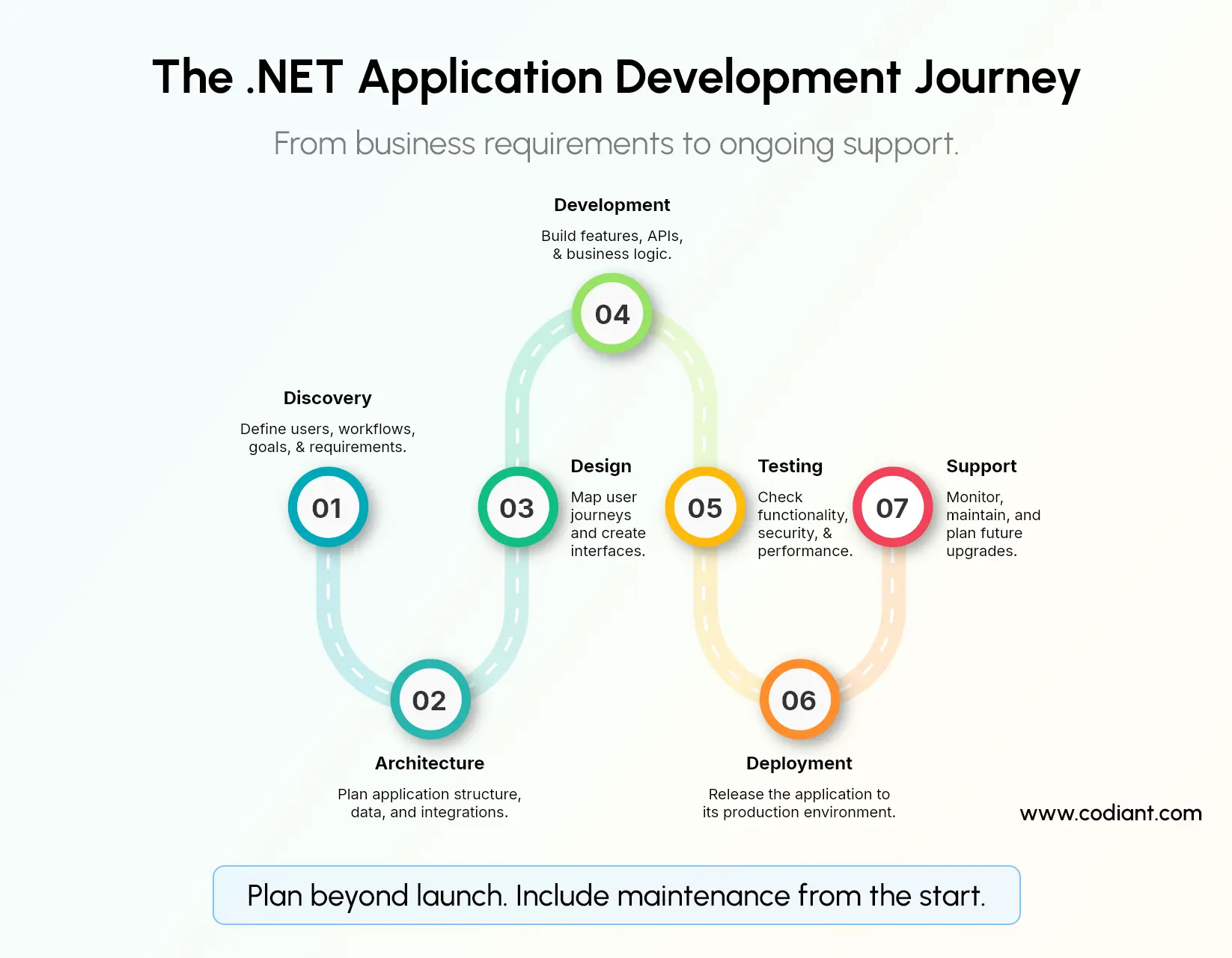
A .NET development company designs, builds, integrates, and maintains software on Microsoft’s .NET platform. It covers the full lifecycle: discovery, architecture, development, testing, deployment, and support. Clients range from startups to regulated enterprises.
Core .NET development services include the following:
- Custom .NET application development: A custom .NET development company USA businesses rely on builds software around your workflows instead of forcing workflows into off-the-shelf tools. Typical outputs include customer portals, internal operations systems, booking engines, and reporting platforms.
- ASP.NET web and API development: ASP.NET development companies USA buyers shortlist deliver web applications and REST or gRPC APIs on ASP.NET Core. This work powers SaaS products, partner integrations, and mobile backends. ASP.NET Core ranks among the faster mainstream web frameworks in independent benchmarks.
- Enterprise software development: Enterprise .NET development companies build ERP, CRM, supply chain, and HR systems. They handle single sign-on through Microsoft Entra ID, audit logging, role-based access, and high-volume data processing.
- Cloud and Azure services: Most .NET application development companies USA clients hire also run cloud work. This includes Azure architecture, containerization with Docker and Kubernetes, CI/CD pipelines, serverless functions, and cost optimization.
- Legacy modernization and migration: Many US enterprises still run .NET Framework applications. Modernization moves them to current .NET, replaces fragile components, and shifts hosting to the cloud. Phased migration keeps the business running during the change.
- Cross-platform and mobile development: Teams use .NET MAUI and Xamarin successors to build iOS and Android apps from a shared C# codebase. Blazor extends the same skills to interactive web interfaces.
- Integration and API services: Integration connects .NET systems to payment gateways, CRMs, ERPs, identity providers, and third-party data feeds. Strong integration work prevents data silos.
- Testing, security, and DevOps: QA engineers write automated unit, integration, and load tests. Security reviews cover OWASP risks, dependency scanning, and secrets management. DevOps teams build pipelines that ship safely and often.
- Support and maintenance: After launch, a .NET development services USA partner monitors performance, patches vulnerabilities, and upgrades runtimes. This matters now. Microsoft’s .NET 8 support window closes in November 2026, and .NET 10 is the current long-term support release, supported through November 2028. Teams on older runtimes need an upgrade plan.
How Do I Choose a .NET Development Company?
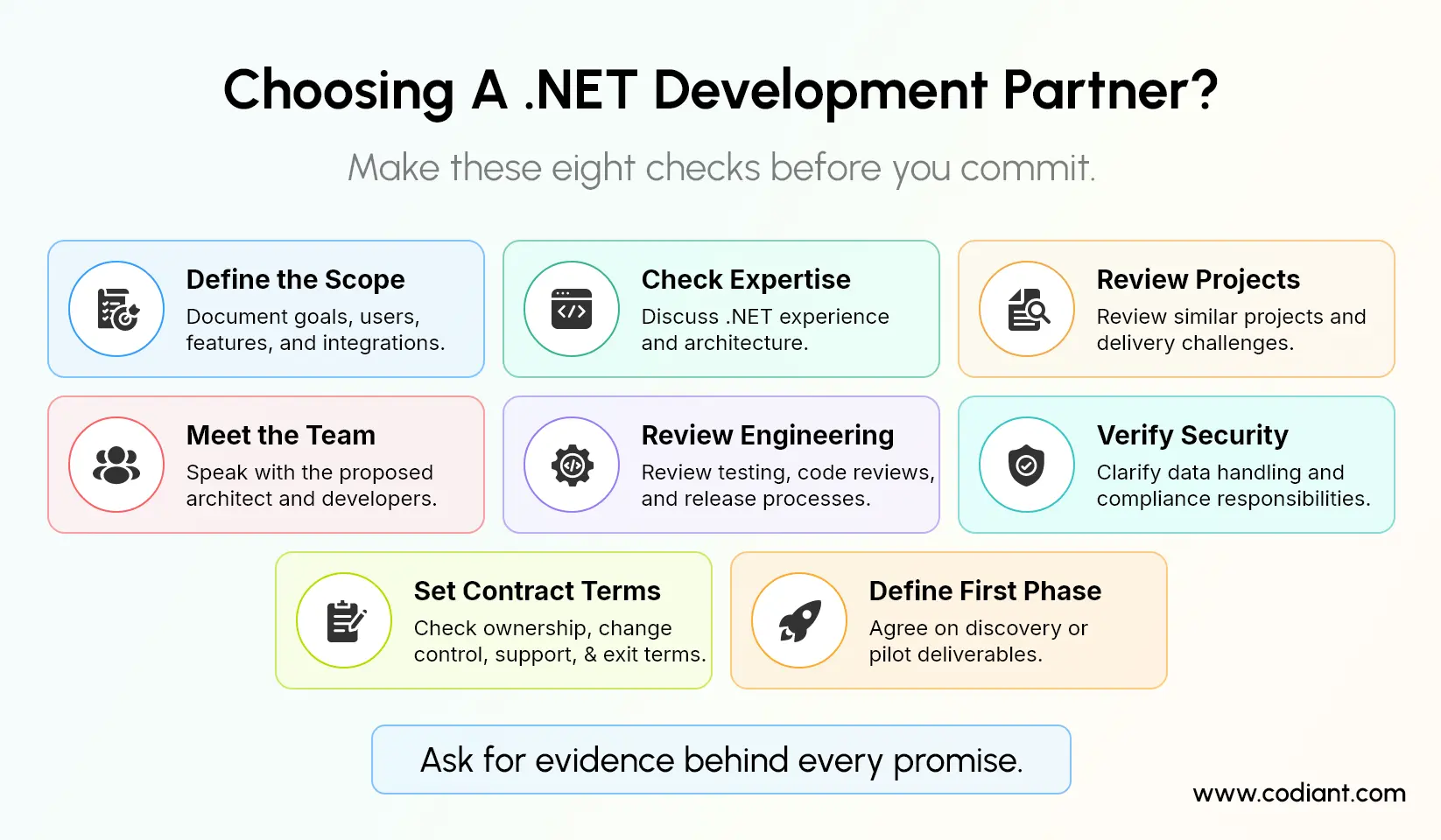
Choose a .NET development company by verifying technical depth, reviewing comparable case studies, testing communication, and confirming security and commercial terms before signing. Run this process in eight steps.
- Define the scope first. Write down goals, users, integrations, compliance needs, budget range, and launch date. Vendors quote better against a clear brief.
- Check .NET specialization. Ask which .NET versions the team ships in production today. A partner still building on legacy frameworks signals technical debt risk.
- Review case studies in your industry. Look for similar scale, similar regulation, and measurable outcomes. Ask for client references and call them.
- Interview the actual team. The sales lead is not the delivery team. Meet the architect and the lead developer who will work on your project.
- Test the engineering process. Ask about code review rules, test coverage targets, branching strategy, and release cadence. Request a sample sprint report.
- Confirm security and compliance. Ask for certifications, penetration testing practices, and data handling policies. Regulated sectors need written evidence.
- Scrutinize the contract. Confirm IP ownership, source code access, warranty period, exit terms, and the change request process.
- Start small. A paid discovery phase or a two-to-four-week pilot reveals working style at low risk.
Red flags
- A quote far below every other bid, with no assumptions listed
- No named team members or rotating staff
- Unwillingness to share references
- Vague answers on testing and security
- Pressure to sign before discovery is complete
- No post-launch support plan
Questions to ask on every call
- Which .NET version will you build on, and why
- Who owns the source code and infrastructure accounts
- What is your senior engineer retention rate
- How do you handle scope changes mid-sprint
- What happens in the first 30 days after launch
Get Technical Clarity for Your Next .NET Build
Discuss architecture, team requirements, testing, and delivery milestones with Codiant’s technical team.
Is .NET Good for Enterprise Application Development?
Yes. .NET is a strong choice for enterprise application development. It offers mature tooling, long-term support releases, strong security defaults, and deep Microsoft ecosystem integration. Large organizations in finance, healthcare, government, and logistics run mission-critical systems on it.
Why enterprises pick .NET
- Performance:NET Core handles high request volumes with low latency. Ahead-of-time compilation and improved garbage collection cut startup time and memory use.
- Security: Built-in authentication, authorization, data protection APIs, and regular security patches reduce exposure.
- Scalability: Microservices, containers, and Azure autoscaling support growth without rewrites.
- Ecosystem fit: Native integration with Azure, SQL Server, Active Directory, Power BI, and Microsoft 365 shortens delivery time.
- Long-term support: LTS releases give three years of patches, which suits enterprise change control.
- Talent pool: C# is widely taught, and the US market has a deep bench of experienced .NET engineers.
- Cross-platform: Modern .NET runs on Windows, Linux, and macOS. Teams can deploy to containers and Linux hosts and cut licensing cost.
- Tooling: Visual Studio, Visual Studio Code, and GitHub Copilot support fast, consistent development.
Where .NET is less suitable
No platform fits everything. Data science and machine learning pipelines lean toward Python. Teams with deep JavaScript skills and no Microsoft footprint may move faster on Node.js. Hybrid architectures are common, with .NET services handling core business logic and other stacks handling specialized workloads.
Industries that rely on .NET
- Healthcare: Patient portals, EHR integrations, claims systems, HIPAA-aligned data handling.
- Banking and fintech: Payment platforms, lending systems, fraud monitoring, regulatory reporting.
- Insurance: Policy administration, claims workflows, underwriting engines.
- Retail and e-commerce: Order management, inventory, loyalty platforms.
- Logistics and supply chain: Fleet tracking, warehouse systems, route optimization.
- Manufacturing: MES integration, quality control, IoT dashboards.
- Government and public sector: Citizen services, case management, secure records.
- Education and SaaS: Learning platforms, multi-tenant products, subscription billing.
Why Businesses Work with Codiant for .NET Development
Codiant delivers custom .NET development for US businesses, backed by 18 years of software development experience, 1,500+ projects shipped, and a company-wide team of 550+ in-house engineers. Its services cover application development, system integration, legacy modernization, and ongoing support.
What clients get:
- Dedicated .NET teams with architects, senior developers, QA, and DevOps under one engagement.
- Modern .NET delivery on current LTS releases, with clean architecture and automated testing.
- Azure-first cloud engineering for hosting, security, and cost control.
- Legacy modernization with phased migration and zero-downtime cutovers where possible.
- Transparent commercials with fixed-scope estimates, clear change control, and full IP transfer.
- Flexible models including dedicated teams, fixed-price projects, and time and material.
Conclusion
Choosing the top .NET development company in the USA for your business starts with understanding what your application needs to achieve. Whether you are developing a new platform, connecting business systems, or modernizing legacy software, evaluate each partner against your technical requirements, budget, and long-term plans.
Look beyond the initial proposal. Review comparable projects, speak with client references, and meet the engineers who will handle your application. Ask how they approach architecture, testing, security, and maintenance. A discovery phase or a small pilot can help you assess the working relationship before committing to a larger engagement.
Compare costs against clearly defined deliverables and responsibilities. Establish who owns the code, how scope changes will be managed, and what support is included after launch. These discussions give you a stronger basis for choosing a team and setting expectations.
To explore your next step, share your project requirements with Codiant’s .NET team. Discuss your existing systems, required features, and delivery priorities to request a scoped estimate.
Give Your .NET Project a Clear Starting Point
Planning a .NET project? Book a consultation with Codiant to discuss your requirements, development scope, and next steps.
The Author

Frequently Asked Questions
.NET development companies provide custom application development, ASP.NET web and API development, enterprise software, Azure cloud services, legacy modernization, cross-platform and mobile apps, system integration, QA and security testing, DevOps, and ongoing support. Full-service firms combine these under one team, which reduces handoff risk.
US-based freelance .NET developers charge roughly $85 to $135 per hour at mid-level and $110 to $171 at senior level. Agencies charge $165 to $350 per hour depending on seniority. A fully loaded in-house senior hire runs $130,000 to $200,000 or more per year. Offshore and nearshore teams cost less per hour, and many US companies mix models to balance cost and control.
Look for current .NET production experience, case studies in your industry, named delivery team members, documented engineering process, security credentials, transparent pricing, clear IP terms, and a post-launch support plan. Verify claims through reference calls and a paid pilot before committing to a large contract.
Businesses choose .NET for performance, built-in security, Azure integration, long-term support releases, cross-platform deployment, and a large talent pool. It reduces integration friction for organizations already on Microsoft infrastructure and supports microservices and cloud-native designs as systems grow.
Healthcare, banking and fintech, insurance, retail, logistics, manufacturing, government, education, and SaaS commonly use .NET. These sectors value security, compliance support, and stable long-term platforms.
Featured Blogs
Read our thoughts and insights on the latest tech and business trends

Migrate to Shopify from Magento/WooCommerce/BigCommerce: Complete Guide
- November 2, 2026
- Shopify
To migrate to Shopify, audit your existing store, map and transfer its data, rebuild the storefront and integrations, test the shopping experience, and switch your domain after a final data update. Shopify supports migration through... Read more
Legacy Application Modernization Services: Approach, Cost and Timeline
- October 29, 2026
- Digital Transformation
Legacy application modernization services typically take 3 to 24 months and cost between $50,000 and $1.5 million or more, depending on the approach, application size and integration complexity. Six approaches exist, from rehosting to full... Read more

AI App Maintenance and MLOps: Post-Launch Monitoring, Retraining and Cost
- October 26, 2026
- Artificial Intelligence
AI application maintenance means keeping the software, data pipelines, models and integrations working after launch. It includes monitoring service health, checking output quality, investigating drift, managing updates and controlling running costs. MLOps provides repeatable processes... Read more