Mobile Banking Application Development: A Complete Guide
Table of Contents
Subscribe To Our Newsletter

Summarize with AI
Not enough time? get the key points instantly.
Mobile banking app development requires five coordinated workstreams: product design, mobile and backend engineering, core banking integration, security and compliance, and post-launch operations.
The process affects banks, credit unions, fintech startups, and financial institutions that need customers to open accounts, transfer funds, manage cards, and access support without visiting a branch.
Unlike a standard consumer app, a digital banking app must maintain transaction accuracy, identity verification, auditability, fraud controls, system availability, and data protection across every customer journey.
Across a portfolio of 100+ fintech projects, Codiant has seen one common challenge: making onboarding, payments, transaction tracking, access controls, and data security work smoothly as one connected system.
A reliable mobile banking app must therefore be planned as a complete banking system, not as a collection of separate features.
In a Nutshell
- Mobile banking app development combines five areas: customer experience, mobile and backend engineering, financial-system integration, security and compliance, and continuous operations.
- The most important evaluation criterion is integration readiness. Confirm core banking APIs, transaction rules, data ownership, reconciliation processes, and failure handling before estimating the project.
- Clutch’s 2026 data places the average mobile app project at $90,780 and approximately 11 months, although banking requirements can increase both cost and delivery time.
- The biggest mistake is treating security as a final testing phase. Authentication, authorization, encryption, fraud controls, audit logs, and incident response must begin during discovery.
- Codiant delivered Monay: digital wallet, in six months, including bank linking, transfers, bill payments, balances, and transaction history.
What is Mobile Banking App Development?
Mobile banking app development is the process of building a secure digital channel through which bank customers can view accounts, transfer funds, manage cards, pay bills, apply for services, receive alerts, and contact support.
Unlike a general consumer application, a digital banking app must communicate with high-value financial systems and process sensitive customer information. Development therefore requires more than mobile interface design. It also involves identity management, fraud controls, transaction authorization, auditability, resilience, data protection, and integration with existing banking infrastructure.
A typical mobile banking solution contains five connected layers:
- Mobile application: The customer-facing iOS or Android experience.
- API and integration layer: Services that connect the application with banking systems.
- Banking backend: Business logic for customers, accounts, payments, cards, and transactions.
- Security and compliance layer: Identity, authentication, encryption, fraud controls, logging, and monitoring.
- Operations platform: Administrative dashboards, support tools, analytics, and incident management.
For neobanks and payment providers, the mobile application may be one part of a wider fintech software development program that also includes payment processing, financial analytics, compliance workflows, system integrations, and legacy platform modernization.
Turn Your Banking Scope into a Build Plan
Define features, integrations, security needs, timelines, and costs before development work begins.
How is a Mobile Banking Application Developed?
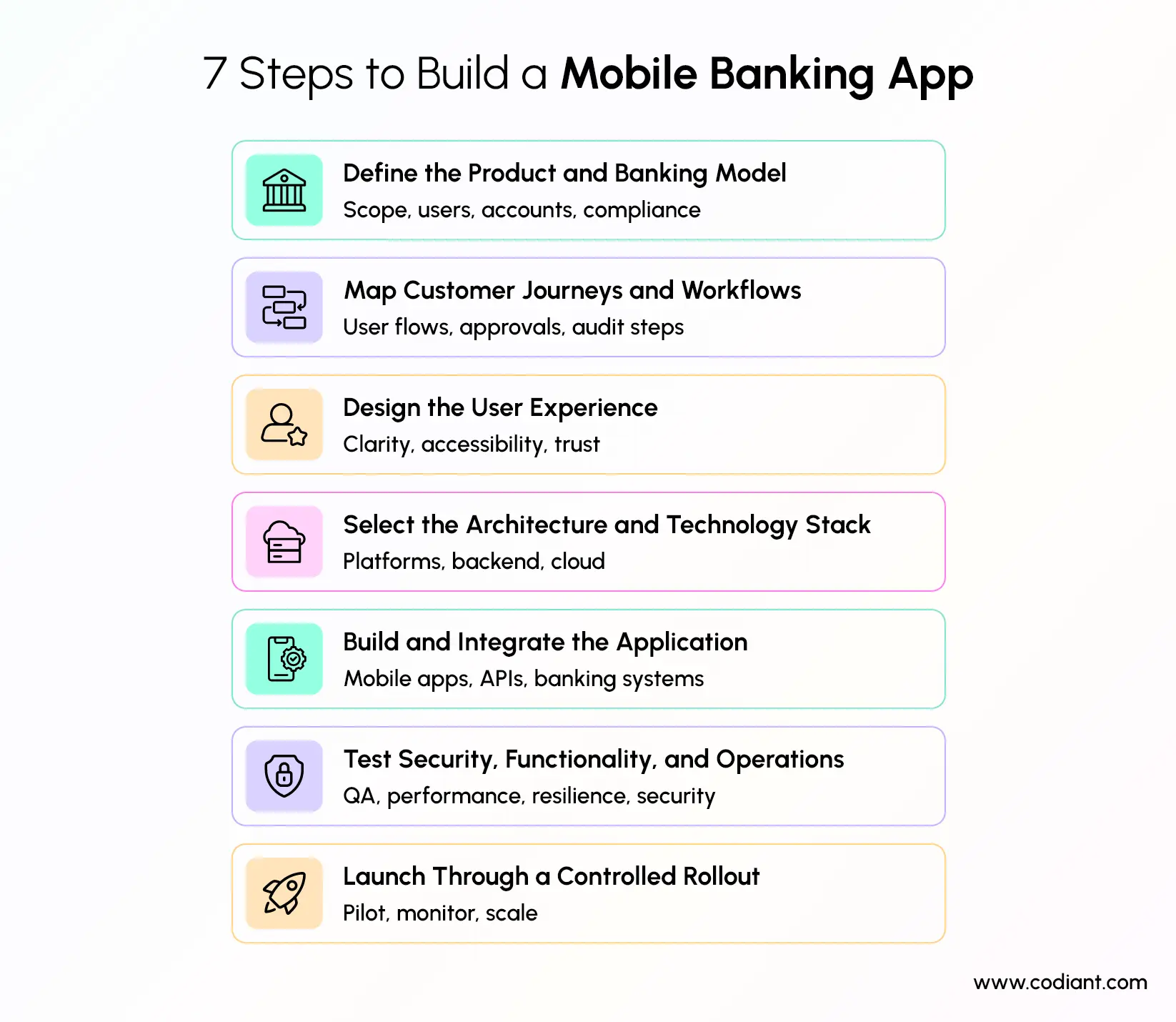
Mobile banking application development normally follows discovery, compliance planning, UX design, architecture, application engineering, integration, testing, controlled release, and continuous monitoring.
These stages follow the broader mobile app development lifecycle, but banking products require additional controls for financial transactions, identity verification, auditability, system integrations, and regulatory review.
Security and compliance should begin during discovery rather than being added after development.
1. Define the Product and Banking Model
The first step is to clarify what the application will provide and who is legally responsible for each financial service.
The discovery team should document:
- Target customer groups
- Countries and regulatory jurisdictions
- Account and transaction types
- Funding and payment methods
- Banking or licensed financial partners
- Core banking environment
- Identity verification requirements
- Fraud and risk policies
- Service-level and availability expectations
- Data residency requirements
- Accessibility requirements
- Initial and future product scope
A neobank working through a banking-as-a-service provider requires a different architecture from an established bank connecting a mobile channel to an existing core banking platform.
2. Map Customer Journeys and Operational Workflows
The product team should map both customer-facing journeys and internal workflows.
Customer journeys may include registration, identity verification, account activation, beneficiary creation, money transfer, card freezing, dispute submission, and password recovery. Internal workflows may cover KYC reviews, payment exceptions, fraud investigations, account restrictions, customer complaints, and compliance reporting.
Each flow should define:
- Required customer information
- Validation rules
- Approval conditions
- Failure states
- Security checks
- Notifications
- Audit events
- Manual review steps
This prevents the team from designing an attractive interface that cannot support actual banking operations.
3. Design the User Experience
Banking interfaces must make complex financial actions understandable without hiding important conditions.
Designers should prioritize:
- Clear account and balance information
- Visible transaction status
- Confirmation before sensitive actions
- Understandable fees and exchange rates
- Simple error recovery
- Accessible text and controls
- Consistent navigation
- Clear fraud and security warnings
Did You Know?
Global Account Ownership Reached 79%
The World Bank’s Global Findex 2025 reports that 79% of adults worldwide now have a financial account. The research also shows that mobile-enabled accounts are helping expand access to digital payments, savings, and other financial services.
Source: Worldbank
4. Select the Architecture and Technology Stack
The architecture must support secure transactions, system integration, controlled scaling, observability, and future product changes.
Banks may choose:
- Native iOS and Android applications
- Cross-platform mobile development
- Modular monolith or microservices backends
- Public, private, or hybrid cloud deployment
- API gateways and integration middleware
- Event-driven transaction processing
- Centralized or domain-specific data services
The right choice depends on the existing infrastructure, internal engineering capability, product roadmap, availability target, and compliance position.
5. Build and Integrate the Application
Development usually covers:
- iOS and Android applications
- Customer identity and access management
- Backend services
- Payment and transfer workflows
- Core banking integration
- Card processor integration
- KYC and AML provider integration
- Notification services
- Fraud and risk systems
- Customer support tools
- Administrative dashboards
- Analytics and reporting
Development should be incremental. Teams can release tested modules into controlled environments rather than waiting until every feature is complete.
6. Test Security, Functionality, and Operations
Testing must cover more than whether a button works.
A banking application should undergo:
- Functional testing
- API testing
- Integration testing
- Mobile device testing
- Accessibility testing
- Performance and load testing
- Penetration testing
- Secure code review
- Dependency scanning
- Resilience and recovery testing
- Fraud-scenario testing
- User acceptance testing
OWASP’s Mobile Application Security Testing Guide provides techniques for verifying controls defined by the Mobile Application Security Verification Standard.
7. Launch Through a Controlled Rollout
A phased launch reduces operational risk.
A bank may begin with employees, selected customers, one region, or a restricted feature set. The team can then measure authentication failures, transaction errors, crash rates, customer-support demand, fraud signals, and system performance before expanding access.
How Much Does It Cost to Develop a Mobile Banking Application?
A mobile banking application may require approximately $100,000 to more than $600,000, depending on its scope. This is an illustrative planning range, not a confirmed quotation. Without defined features, integrations, security requirements, jurisdiction, and delivery responsibilities, we cannot confirm an accurate project cost.
Clutch reported in July 2026 that the average mobile app development project in its dataset cost approximately $90,780 and usually lasted about 11 months. Most reviewed projects were priced between $10,000 and $49,999.
Banking projects may exceed general application averages because they can require financial-system integrations, stronger authentication, penetration testing, audit logging, regulatory review, fraud controls, and high-availability infrastructure. This is a scope-based inference supported by the additional security controls expected for financial applications.
Illustrative Mobile Banking App Budget
The following model uses an assumed blended development rate of $40 per hour, rounded from the $25 to $49 hourly range reported by Clutch. The estimated hours are planning assumptions and must be replaced with a project-specific work breakdown.
| Project type | Illustrative effort | Calculation | Planning estimate |
| Restricted banking MVP | 2,500–4,000 hours | Hours × $40 | $100,000–$160,000 |
| Full retail banking app | 4,000–8,000 hours | Hours × $40 | $160,000–$320,000 |
| Enterprise banking platform | 8,000–15,000+ hours | Hours × $40 | $320,000–$600,000+ |
A credible estimate should explain exactly what the price includes.
What Should the Estimate Include?
A complete banking app development estimate may cover:
- Product discovery
- Regulatory requirement mapping
- UX research and interface design
- Mobile application engineering
- Backend and API development
- Core banking integration
- KYC and identity integration
- Payment or card integration
- Cloud and DevOps setup
- Security engineering
- Quality assurance
- Penetration testing
- App store release support
- Documentation and knowledge transfer
What Features Should a Mobile Banking App Include?
A modern mobile banking application should include secure onboarding, account visibility, transactions, card management, alerts, support, and user-controlled security settings. The final feature set should reflect the bank’s products, customer needs, operational capability, and regulatory obligations.
Essential Customer Features
| Feature | Purpose |
| Digital onboarding | Registers users and collects required identity information |
| KYC verification | Confirms customer identity through approved processes |
| Secure login | Supports passwords, biometrics, passkeys, or multi-factor authentication |
| Account dashboard | Displays balances, accounts, and recent activity |
| Transaction history | Provides searchable and filterable transaction records |
| Fund transfers | Supports internal, domestic, or international payments |
| Beneficiary management | Lets users add and manage payment recipients |
| Bill payments | Enables one-time and recurring payments |
| Card controls | Supports card activation, freezing, limits, and PIN-related services |
| Real-time alerts | Notifies customers about transactions and account events |
| Statements and documents | Provides access to statements, tax documents, and notices |
| Profile management | Lets users update permitted personal and communication details |
| Support and disputes | Connects customers with service and transaction-dispute workflows |
Advanced Mobile Banking Application Features
Advanced digital banking solutions may also provide:
- Personal finance dashboards
- Spending categorization
- Budgeting and savings goals
- Subscription tracking
- Credit-score access
- Loan applications
- Investment account views
- Foreign exchange services
- Multi-currency accounts
- Virtual cards
- QR payments
- Location-aware fraud alerts
- AI-supported customer service
- Personalized financial education
When wallet capabilities are included, payment methods, transaction limits, account funding, user controls, and security rules should be defined before engineering begins. These strategies for building a digital wallet app help separate essential payment workflows from optional customer-engagement features.
AI features should not make unrestricted financial decisions or produce customer-facing advice without governance, validation, human oversight, and compliance review.
Voice support can help customers complete routine requests such as balance enquiries, transaction summaries, card-related actions, and support escalation. Banks considering this channel should assess how voice bots are used in banking alongside authentication, privacy, accessibility, and human hand-off requirements.
How Secure Are Mobile Banking Applications?
Mobile banking applications can provide strong protection when security is implemented across the mobile client, APIs, backend, identity systems, cloud infrastructure, and operational processes. No application is completely risk-free, and biometric login alone does not make a banking platform secure.
OWASP MASVS organizes mobile security requirements into secure storage, cryptography, authentication, network communication, platform interaction, code quality, resilience, and privacy. These control groups provide a practical baseline for secure banking app development.
Core Security Controls
1. Multi-Factor and Risk-Based Authentication
Authentication should reflect the sensitivity of the action.
Viewing an account balance, changing contact details, adding a beneficiary, and transferring a large amount should not automatically receive identical treatment. Banks can apply step-up authentication when risk increases.
FFIEC guidance recommends risk assessment and appropriate authentication practices for customers, employees, third parties, applications, service accounts, and devices accessing financial systems.
NIST SP 800-63B-4 defines requirements for remote authentication at three authenticator assurance levels. It is written for US government digital services, not as a universal banking regulation, but it can inform authentication design and assurance decisions.
2. Secure Credential and Key Storage
Sensitive keys and tokens should not be stored as plain application data.
Android provides the Keystore system for restricting how cryptographic keys are used. Apple provides Keychain and Secure Enclave-supported mechanisms for protecting keys and controlling access through local authentication.
Biometric authentication should be implemented through supported platform interfaces such as Android BiometricPrompt and Apple LocalAuthentication rather than custom biometric processing.
3. API and Session Security
Backend APIs should enforce authorization independently of the mobile interface. A hidden button or disabled screen is not an access control.
For high-value API scenarios, FAPI 2.0 provides a security profile based on OAuth 2.0. Its referenced specifications include PKCE, mutual TLS, pushed authorization requests, proof-of-possession mechanisms, and OAuth security best practices.
4. Data Protection
Sensitive data should be minimized, encrypted where appropriate, and retained only as long as required. Logs, analytics platforms, support tools, test environments, and backups must receive the same data-governance attention as the production database.
For cardholder data, PCI DSS 4.0.1 is the active PCI DSS version. It provides technical and operational requirements for protecting payment account data. Applicability depends on how the solution stores, processes, or transmits that data.
5. Fraud Detection and Transaction Controls
Security prevents unauthorized technical access. Fraud controls evaluate whether an apparently authorized action is suspicious.
Controls may include:
- Device and session risk
- Transaction velocity checks
- Beneficiary cooling periods
- Behavioral anomaly detection
- Transfer limits
- Step-up verification
- Sanctions and AML screening
- Manual investigation queues
- Customer confirmation alerts
Fraud rules should be measurable, reviewed regularly, and connected to operational response workflows.
Which Standards May Apply?
The applicable standards depend on the institution, products, countries, payment methods, and data handled.
| Standard or regulation | Relevant area |
| OWASP MASVS | Mobile application security |
| OWASP ASVS | Backend and web application controls |
| PCI DSS 4.0.1 | Payment card account data |
| NIST SP 800-63B-4 | Digital authentication guidance |
| FAPI 2.0 | High-security financial APIs |
| ISO 20022 | Financial messaging |
| WCAG 2.2 | Digital accessibility |
| GLBA and Safeguards Rule | Certain US financial institutions |
| PSD2 and SCA requirements | Applicable European payment services |
| Local banking regulations | Jurisdiction-specific obligations |
The FTC Safeguards Rule requires covered financial institutions under its jurisdiction to maintain measures for protecting customer information and to address service-provider safeguards. It does not apply universally to every bank or fintech company.
In Europe, applicable payment service providers may need to use Strong Customer Authentication for online account access and electronic payment initiation, subject to the governing rules and permitted exemptions.
A qualified legal and compliance team should determine the exact obligations before architecture and development decisions are finalized.
Build a Banking App Ready to Scale
Connect customer journeys, banking systems, payments, and operations through one architecture securely.
How Long Does It Take to Develop a Banking App?
A restricted mobile banking MVP may take four to six months. A full-featured application commonly requires six to twelve months, while an enterprise banking transformation can take twelve months or longer.
These are planning ranges rather than guaranteed delivery periods. Clutch’s broader mobile application dataset reports an average development timeline of about 11 months.
Codiant’s Monay digital-wallet project took six months, although a wallet project should not be treated as equivalent to a complete banking platform.
Illustrative Development Timeline
| Stage | Estimated duration |
| Discovery and compliance mapping | 3–6 weeks |
| UX research and product design | 4–8 weeks |
| Architecture and technical planning | 3–6 weeks |
| Mobile and backend development | 12–28 weeks |
| Integration and system testing | 6–12 weeks |
| Security assessment and remediation | 4–8 weeks |
| Pilot release and stabilization | 4–8 weeks |
Delivery teams can reduce avoidable delays by fixing the MVP scope, validating third-party dependencies early, and testing integrations in parallel. These ways to reduce fintech app development time can limit rework without compressing security, testing, or compliance reviews.
Which Technologies Are Used in Mobile Banking App Development?
Mobile banking applications use native or cross-platform mobile frameworks, secure backend technologies, API standards, financial messaging formats, databases, cloud platforms, and monitoring systems.
There is no single technology stack that is best for every bank.
Mobile Application Technologies
Native development
- Swift and SwiftUI for iOS
- Kotlin and Jetpack Compose for Android
Native development provides direct access to platform security features and device APIs. It may require separate iOS and Android engineering streams.
Cross-platform development
- Flutter
- React Native
- .NET MAUI
Cross-platform frameworks can share parts of the codebase, but security-sensitive integrations and device-specific behavior still require native expertise.
Backend Technologies
Common backend options include:
- Java with Spring Boot
- .NET
- Node.js with TypeScript
- Go
- Python for selected analytics or automation services
The decision should consider transaction volume, team expertise, existing bank systems, operational tooling, security controls, and long-term support.
Data and Event Technologies
Banks may use:
- PostgreSQL
- Oracle Database
- Microsoft SQL Server
- Redis
- Apache Kafka
- Managed queues and streaming services
Financial records require carefully designed consistency, reconciliation, retention, and audit processes. A high-throughput database does not automatically provide correct financial accounting.
API and Financial Messaging Technologies
REST APIs are widely used for mobile and partner integrations. Event-based integrations may support transaction updates, fraud events, notifications, and reconciliation.
ISO 2002 provides a common platform for developing financial messages and a shared structure for exchanging financial information. It should be adopted where it matches the payment rail, institution, or integration requirement rather than being treated as a universal mobile app format.
Cloud and Infrastructure Technologies
Mobile banking infrastructure may use:
- Amazon Web Services
- Microsoft Azure
- Google Cloud
- Private cloud
- Hybrid infrastructure
- Kubernetes and containers
- Infrastructure as code
- API gateways
- Hardware security modules
- Centralized monitoring platforms
Cloud selection should follow the institution’s resilience, regulatory, data-location, vendor-risk, and operational requirements.
How Can Mobile Banking Apps Integrate With Core Banking Systems?
Mobile banking apps usually integrate with core banking systems through controlled APIs, middleware, integration platforms, or service layers. The mobile application should not connect directly to the core database.
A controlled integration layer can:
- Authenticate and authorize requests
- Normalize legacy data formats
- Apply transaction rules
- Enforce rate limits
- Log auditable events
- Manage retries and timeouts
- Prevent duplicate transactions
- Translate modern API requests into core banking messages
- Isolate the mobile channel from internal systems
Older core banking environments may rely on files, message queues, stored procedures, proprietary protocols, or batch processing. In such cases, an anti-corruption or adapter layer can expose stable services without forcing immediate replacement of the core platform.
Every integration should define the source of truth, timeout behavior, reconciliation process, idempotency rules, and response when one system succeeds but another fails.
How Can Banks Improve Customer Engagement Through Mobile Applications?
Banks can improve engagement by helping customers complete important tasks faster, understand their finances, and control their accounts without creating unnecessary notifications or promotional pressure.
Effective engagement features include:
- Fast digital onboarding
- Real-time transaction alerts
- Personalized dashboards
- Savings goals
- Spending summaries
- Card and limit controls
- Proactive service updates
- In-app support
- Relevant financial education
- Secure self-service requests
- Consistent experiences across mobile, web, and support channels
Personalization should be based on permissioned, accurate, and relevant data. Customers should be able to understand and control communication preferences.
Engagement should not be measured only through login frequency. Banks should also track task completion, failed transactions, support demand, digital adoption, complaint rates, and customer retention.
Common Challenges in Banking App Development
Legacy infrastructure, security-usability trade-offs, third-party dependencies, regulatory changes, and production monitoring are recurring mobile banking app development challenges. Each issue can affect architecture decisions, development costs, testing requirements, and release planning.
1. Legacy System Limitations
Core systems may not provide real-time APIs or clear documentation. Discovery should include interface testing and data-flow validation before the delivery timeline is finalized.
2. Security Versus Convenience
Adding repeated authentication to every action can frustrate users, while weak authentication exposes the institution to risk. A risk-based model can apply stronger controls when the action, customer behavior, or device context warrants them.
3. Third-Party Dependency
KYC providers, card processors, banking partners, notification systems, and fraud services can affect availability. Contracts, fallback behavior, monitoring, and incident responsibilities should be reviewed during architecture planning.
4. Incomplete Regulatory Scope
A product may be developed for one market and later expanded into another. Identity, privacy, payment, data residency, accessibility, and consumer-protection requirements must be reassessed before expansion.
5. Production Monitoring
Passing pre-launch testing does not prove that the application will remain secure and reliable. Teams must monitor crashes, API errors, suspicious sessions, failed authentication, payment exceptions, vendor outages, and security events after release.
How Should You Choose a Banking App Development Company?
Choose a banking app development company that can demonstrate relevant fintech work, secure engineering practices, integration experience, transparent estimation, and long-term operational support.
Evaluate potential partners against these questions:
- Have they built banking, payment, lending, wallet, or regulated financial products?
- Can they explain how security is included in each development stage?
- Have they worked with core banking systems and third-party financial APIs?
- Do they provide assumptions, exclusions, and dependencies with estimates?
- Can they support mobile, backend, cloud, QA, and DevSecOps work?
- How do they conduct code reviews and penetration testing?
- Who owns the source code and documentation?
- How are production incidents and security updates handled?
- Can the team work with the bank’s legal, risk, compliance, and operations teams?
- What evidence supports their delivery claims?
A low initial quote may exclude integration, compliance assessment, security testing, cloud infrastructure, or post-launch support. Estimates should therefore be compared by scope rather than total price alone.
What Fintech Experience Does Codiant Bring to Banking App Development?
Codiant’s work across banking, finance, and insurance software includes fintech applications, payment systems, digital wallets, lending workflows, financial analytics, compliance tools, and third-party financial integrations.
A recurring delivery requirement is to connect customer journeys, transaction logic, account data, security controls, and operational workflows as one system. Treating these areas as separate modules can create gaps during integration, testing, and production monitoring.
However, the scope of every banking application is different. The required architecture, security controls, compliance obligations, integrations, cost, and delivery timeline must be assessed according to the institution’s products, target markets, existing systems, and operational requirements.
Build a Secure Digital Banking Experience
Define your banking workflows, integrations, security controls, and delivery roadmap with Codiant.
The Author

Frequently Asked Questions
A modern banking app should include secure onboarding, identity verification, account dashboards, transaction history, transfers, bill payments, card controls, alerts, statements, profile management, and customer support. Additional features should be selected according to the bank’s products, customer needs, operational capacity, and regulatory requirements.
Banking apps should consider OWASP MASVS for mobile security, OWASP ASVS for backend controls, PCI DSS 4.0.1 where cardholder data is in scope, and applicable authentication, privacy, banking, accessibility, and payment regulations. The exact compliance set depends on the institution, jurisdiction, and services offered.
A mobile banking app can connect through secured APIs, middleware, message queues, integration platforms, or adapter services. The integration layer should manage authorization, validation, data translation, retries, reconciliation, idempotency, audit logs, and errors instead of exposing the core banking database directly to the mobile channel.
Cost depends on features, platforms, UX complexity, core banking integration, payment rails, identity verification, fraud controls, security testing, regulatory requirements, cloud architecture, data migration, third-party services, and support. An accurate estimate cannot be confirmed until assumptions, inclusions, exclusions, responsibilities, and technical dependencies are documented.
Banks can improve engagement through faster onboarding, self-service account controls, real-time alerts, personalized dashboards, spending insights, savings tools, relevant education, and responsive in-app support. Engagement should be measured through successful task completion, digital adoption, reduced service friction, retention, and customer satisfaction rather than logins alone.
Featured Blogs
Read our thoughts and insights on the latest tech and business trends

Node.js Backend Development: A Complete Guide for 2026
- October 5, 2026
- Software Development
Node.js backend development involves building server-side applications using JavaScript to manage business logic, APIs, databases, authentication, and communication between systems. It helps businesses develop web and mobile applications that handle multiple simultaneous requests without creating... Read more

How Much Does It Cost to Hire a Dedicated Flutter Developer in 2026?
- September 24, 2026
- Staff Augmentation
Hiring a dedicated Flutter developer in 2026 typically costs $15–$30 per hour for junior talent, $30–$60 for mid-level developers and $60–$100+ for senior specialists. For a 160-hour working month, that equals approximately $2,400–$4,800, $4,800–$9,600 and... Read more

Healthcare Workflow Automation with AI: Benefits, Challenges & ROI
- September 21, 2026
- Artificial Intelligence Healthcare
Healthcare organizations do not lack technology. The challenge is turning disconnected systems, repetitive administrative tasks, and growing volumes of data into workflows that actually reduce the burden on staff. Healthcare workflow automation addresses that gap.... Read more